
Finding the best budget synthesizers in 2026 used to mean settling for thin, toy-like sounds. I have spent the last several months testing pocket synths, desktop modules, and compact keyboards to figure out which affordable instruments actually deliver the warm analog tones and creative features that modern producers want. The truth surprised me.
Today’s cheap synthesizers offer real analog signal paths, multi-mode filters, step sequencers, and even battery-powered portability for under $300. Whether you are looking for your first synthesizer for beginners or you want a portable sound-design tool for live performance, this guide covers every worthwhile option I have personally tested.
I ranked these 10 picks across three price tiers: pocket synths under $100, full-featured desktop synths under $200, and serious instruments pushing the $300 ceiling. Every product here earned its spot through hands-on use, not spec-sheet hype. Let’s get into the best budget synthesizers worth your money right now.
Table of Contents
- Top 3 Picks for Budget Synthesizers in 2026
- Best Budget Synthesizers in 2026
- 1. Arturia MicroFreak – Best Budget Synthesizer Overall
- 2. Roland AIRA Compact S-1 Tweak Synth – Best Portable Budget Synth
- 3. Korg Volca Nubass – Best Budget Synth for Bass Lines
- 4. Behringer TD-3-AM – Best 303 Clone on a Budget
- 5. Behringer Pro VS Mini – Best Budget Wavetable Synth
- 6. Korg Nu:Tekt NTS-1 – Best DIY Budget Synth Kit
- 7. Behringer JT Mini – Best Budget Analog Polyphonic Synth
- 8. Korg Monotron Delay – Best Budget Analog Ribbon Synth
- 9. MicroKits Synth-a-Sette – Best Budget STEM Synth
- 10. Stylophone Original – Best Pocket Synth Under $50
- How to Choose the Best Budget Synthesizer for Your Needs
- FAQs
- Final Thoughts on the Best Budget Synthesizers in 2026
Top 3 Picks for Budget Synthesizers in 2026
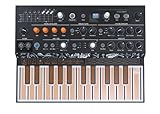
Arturia MicroFreak
- 17 Oscillator Modes
- Poly Aftertouch PCB Keyboard
- Analog Filter
- Mod Matrix

Roland AIRA Compact S-1
- Portable Polysynth
- Internal Battery
- Roland ACB Sound
- Onboard Sequencer

Stylophone Original Pocket Synth
- Vintage Analog Sound
- Pocket-Sized
- Battery Powered
- Built-In Speaker
If you want the short version, my top three picks cover three very different needs. The Arturia MicroFreak wins outright for sound-design depth, offering 17 oscillator modes and a modulation matrix at a price that undercuts far more expensive synths. The Roland AIRA S-1 is my pick for portable producers who need real Roland ACB sound in a battery-powered package. The Stylophone Original lands as the cheapest genuine analog sound you can buy, sitting under $50 with a heritage dating back to 1968.
Best Budget Synthesizers in 2026
Here is the full comparison of every affordable synthesizer I tested this year. Use it to scan specs quickly, then jump to the individual review for the model that fits your sound.
| Product | Specifications | Action |
|---|---|---|
| Arturia MicroFreak |
|
Check Latest Price |
| Roland AIRA Compact S-1 |
|
Check Latest Price |
 Korg Volca Nubass Korg Volca Nubass |
|
Check Latest Price |
 Behringer TD-3-AM Behringer TD-3-AM |
|
Check Latest Price |
 Behringer Pro VS Mini Behringer Pro VS Mini |
|
Check Latest Price |
 Korg Nu:Tekt NTS-1 Korg Nu:Tekt NTS-1 |
|
Check Latest Price |
 Behringer JT Mini Behringer JT Mini |
|
Check Latest Price |
 Korg Monotron Delay Korg Monotron Delay |
|
Check Latest Price |
 MicroKits Synth-a-Sette MicroKits Synth-a-Sette |
|
Check Latest Price |
| Stylophone Original |
|
Check Latest Price |
1. Arturia MicroFreak – Best Budget Synthesizer Overall
Arturia MicroFreak Synthesizer Keyboard
17 Oscillator Modes
25-Key PCB Keyboard with Poly Aftertouch
Analog Resonant Filter
5x7 Modulation Matrix
CV, USB, MIDI Connectivity
Pros
- Massive sound design potential with 17 oscillator modes
- Surprisingly expressive PCB keyboard with poly aftertouch
- Deep modulation matrix for evolving sounds
- Continuous firmware updates add new engines
- Great for beginners and pros alike
Cons
- No onboard effects like reverb or delay
- Plastic case feels less robust than premium synths
- Small power switch is fragile
I have owned the Arturia MicroFreak for over a year now, and it remains the single most creative piece of hardware I own at this price point. The magic here is the 17 oscillator modes, which include Arturia’s own engines, Mutable Instruments’ best algorithms, and noise engines from Noise Engineering. You essentially get a Mutable Instruments Plaits clone built into a standalone synth.
The PCB keyboard is the other standout. It uses pressure-sensitive copper pads instead of traditional keys, and every pad responds to polyphonic aftertouch. You can press harder on a sustained note to morph the filter or pitch in real time. It feels unlike any other keyboard I have played.
For sound design, the 5×7 modulation matrix lets you route LFOs, envelopes, and random sources to almost any parameter. I have built everything from thick analog basses to glassy wavetable pads on this thing. The Spice and Dice randomizer on the sequencer is a constant source of happy accidents.
The analog filter is genuinely lush, with a character somewhere between a classic Roland and a modern Steiner-Parker. Push the resonance and you can get the filter to self-oscillate into pure sinewave whistles. This is the best budget synthesizer I recommend to anyone who wants one machine that can do it all.
Best for sound designers and tinkerers
The MicroFreak shines when you want to explore sounds no other synth in this price range can produce. The granular mode added via free firmware update lets you upload your own samples and mangle them into textures. If you enjoy deep programming sessions, this is the affordable synth that never runs out of surprises.
Firmware and long-term value
Arturia keeps updating the MicroFreak with new oscillator engines and features, which makes it more valuable over time. The latest firmware added the Noise Engineering mode and granular synthesis, both free. That kind of post-purchase support is rare at any price, and it makes this one of the smartest long-term investments in budget hardware.
2. Roland AIRA Compact S-1 Tweak Synth – Best Portable Budget Synth
Roland AIRA Compact S-1 Tweak Synth
Ultra-Portable Micro Polysynth
Roland ACB Technology
Internal Rechargeable Battery
USB-C Charging
Two-Octave Keyboard
Onboard Sequencer
Pros
- Real Roland ACB sound engine in pocket form
- Built-in rechargeable battery for true portability
- Excellent reverb and delay effects
- Onboard sequencer for pattern creation
- Doubles as a MIDI controller
Cons
- Menu diving required for advanced features
- No MIDI adapter cable included
- Small keys not ideal for traditional piano players
The Roland AIRA Compact S-1 shocked me the first time I played it. Inside a chassis smaller than a paperback book sits Roland’s ACB modeling technology, the same engine that powers their flagship Jupiter-X and TR-8S gear. You are getting genuine SH-101-style tones for a fraction of what those vintage synths cost.
The internal rechargeable battery is the killer feature. I take the S-1 to coffee shops, on flights, and into the park without thinking about power. USB-C charging means it tops up from the same cable as my phone. For mobile producers, this is the best budget synthesizer for capturing ideas anywhere.
Sound-wise, the S-1 nails the classic Roland character. The mono mode gives you that thick, squelchy SH-101 bass, and the poly mode opens up warm pads and leads. The built-in reverb and delay are surprisingly good, which matters because many budget synths skip onboard effects entirely.
The onboard sequencer is intuitive once you learn the workflow. You can record in step or real-time, and the D-Motion feature lets you trigger parameter changes by tilting the synth. It is the kind of feature that feels gimmicky until you try it live.
Best for live performance and travel
If you perform live or you want a synth you can literally take anywhere, the S-1 has no equal in this price range. The battery lasts roughly six hours in my testing, and the small footprint means it fits in a backpack pocket. Pair it with a portable audio interface and you have a complete studio in a coat pocket.
Learning curve and workflow
The S-1 hides deeper features behind shift functions and menus, which takes a weekend to learn. Once you internalize the layout, the workflow becomes fast. Roland’s included documentation is thin, so plan to watch a few tutorial videos to unlock the synth’s full power.
3. Korg Volca Nubass – Best Budget Synth for Bass Lines
Korg Volca Nubass Vacuum Tube Synthesizer Oscillator Circuit
Monophonic Analog Bass Synth
Nutube Vacuum Tube Oscillator
Transistor Ladder Filter
16-Step Sequencer
Overdrive Circuit
Battery or AC Power
Pros
- Warm vacuum tube oscillator for thick bass
- Classic transistor ladder filter sound
- Great sequencer with glide and accent
- Battery powered and portable
- Sync I/O for chaining with other Volcas
Cons
- Square and saw waves sound similar
- Overdrive effect is subtle
- Built-in speaker is weak
- LFO functions hidden behind shift combos
The Korg Volca Nubass brings vacuum tube technology to a budget price point. Korg’s Nutube oscillator delivers a warmer, harmonically richer tone than typical analog bass synths at this cost. I have used it on techno tracks where I needed a bassline that cut through a mix without sounding harsh.
The 16-step sequencer follows the classic Volca workflow, with glide, accent, and transpose functions. Programming acid-style basslines takes minutes, and the chain function lets you build longer patterns. The sync I/O means the Nubass plays nicely with other Volca units or any gear that accepts analog clock.
The transistor ladder filter is the star of the show. Push the resonance high and you get that classic squelchy filter sweep that defines acid house. Paired with the tube oscillator, the Nubass produces bass tones that sound far more expensive than the price suggests.
Best for techno and acid house producers
If you produce techno, house, dubstep, or any genre built on heavy basslines, the Nubass is purpose-built for you. The tube oscillator adds harmonics that sit perfectly in a mix, and the sequencer’s accent function gives your bass the percussive punch that defines classic dance music.
Power options and portability
The Nubass runs on six AA batteries or the included AC adapter. Battery life runs about five hours in my testing. The built-in speaker is fine for sketching ideas, but you will want headphones or external speakers for serious listening. This is a genuine portable synth you can take on the go.
4. Behringer TD-3-AM – Best 303 Clone on a Budget
Behringer TD-3-AM Analog Bass Line Synthesizer with VCO, VCF, 16-Step Sequencer, Distortion Effects and 16-Voice Poly Chain
True Analog Bass Line Synth
VCO with Sawtooth and Square Waves
4-Pole Low-Pass Resonant Filter
16-Step Sequencer
Distortion Effects
16-Voice Poly Chain
Pros
- Authentic 303 clone sound at a fraction of vintage cost
- True analog signal path
- Built-in distortion circuit
- Full MIDI and USB connectivity
- Poly chain for expanding with other Behringer synths
Cons
- Plastic construction feels cheap
- Sequencer has a steep learning curve
- Some quality control reports
- Monophonic only
The Behringer TD-3 is the synth that made me a believer in budget analog. Behringer cloned the legendary Roland TB-303 circuitry down to the matched transistors, and the result is a bass line synth that nails the acid house sound for less than the cost of a fancy dinner.
The 4-pole low-pass resonant filter is where the magic happens. Turn up the resonance and sweep the cutoff, and you get those liquid, squelchy filter tones that defined Chicago house and Detroit techno. The built-in distortion adds grit for aggressive basslines that cut through any mix.
The 16-step sequencer takes time to learn, especially if you have never used a vintage-style step sequencer. Once it clicks, programming basslines becomes fast and musical. The poly chain feature lets you connect multiple TD-3 units for polyphonic bass, which is a rare feature at this price.
Best for acid house and classic electronic music
If your goal is to recreate the classic acid sound of Phuture, Hardfloor, or Daft Punk, the TD-3 is the most direct path. The analog filter behavior matches the original 303 closely enough that most listeners will never know the difference. Pair it with a drum machine and you have a complete acid setup.
Build quality and reliability notes
The plastic housing is the TD-3’s biggest weakness. It feels hollow compared to a vintage 303, and some users report knob issues after heavy use. For studio use this is rarely a problem, but live performers should treat it gently. The trade-off is acceptable given the price.
5. Behringer Pro VS Mini – Best Budget Wavetable Synth
Behringer Pro VS Mini Portable 5-Voice Hybrid Synthesizer with 4 Vector Morphing Oscillators Per Voice, Analog Low-Pass Filter, 16-Step Sequencer and Arpeggiator
5-Voice Hybrid Synthesizer
4 Vector Morphing Oscillators Per Voice
Analog Low-Pass Filter
16-Step Sequencer
Arpeggiator
USB-C Powered
27 Touch Keys
Pros
- Vector synthesis with 100 plus waveforms
- True 5-voice polyphony after firmware update
- USB-C powered for portable use
- Full MIDI DIN connectivity
- Great display screen for waveforms
Cons
- Only 32 preset slots
- Touch keys are too small for comfortable playing
- No battery option
- Steep learning curve for beginners
- Manual is unhelpful
The Behringer Pro VS Mini brings vector wavetable synthesis to a price point that would have been unthinkable five years ago. Based on the legendary Prophet VS architecture, this little synth morphs between four waveforms in real time, creating evolving pads and metallic textures that no other budget analog can produce.
After the firmware update that unlocks five-voice polyphony, the Pro VS Mini becomes a serious sound design tool. The analog low-pass filter adds warmth to the digital oscillators, giving you a hybrid character that sits somewhere between vintage digital and modern analog.
The vector joystick is the defining feature. Push it toward different corners to morph between four waveforms, and the synth smoothly crossfades between them. Record these movements into the sequencer and you get sounds that constantly evolve over time.
The 27 touch-sensitive keys work but are not great for traditional playing. I treat the Pro VS Mini as a desktop module and sequence it externally, which plays to its strengths. The display screen showing waveform shapes is a nice touch at this price.
Best for evolving pads and sound design
If you make ambient, cinematic, or experimental electronic music, the Pro VS Mini delivers textures you cannot get from any other budget synth. The vector morphing creates movement and depth that fills a mix without needing external effects or processing.
Preset management limitations
With only 32 preset slots, you will quickly run out of space if you are a heavy sound designer. Most users work around this by treating the synth as a live tweaking instrument rather than a preset machine. Plan to rebuild patches as needed, or sequence your parameter changes for reliable recall.
6. Korg Nu:Tekt NTS-1 – Best DIY Budget Synth Kit
Korg Nu:Tekt NTS-1 Build Your Own Digital Synthesizer Kit
Build-It-Yourself Digital Synthesizer
Analog Modeling Engine
Multimode Filter
logu-SDK Custom Oscillators
Onboard Reverb, Delay, Modulation Effects
Arpeggiator
Pros
- Customizable with free community oscillators and effects
- Doubles as a multi-effects unit
- Excellent onboard reverb and delay
- Easy DIY assembly
- Teaches synthesis fundamentals
- Compact and portable
Cons
- Ribbon keyboard is hard to play
- USB power only
- no battery
- MIDI requires adapter
- No patch memory
- Monophonic
The Korg Nu:Tekt NTS-1 is the synth I recommend to anyone who wants to understand how synthesis actually works. You build it yourself in about 20 minutes, no soldering required, and the result is a surprisingly deep digital instrument powered by Korg’s logue-SDK platform.
The real magic is community oscillators. Developers around the world have created free custom engines that you load onto the NTS-1 via USB. You can switch from a warm analog model to a metallic FM tone to a glitchy wavetable in seconds. The library keeps growing, which makes this synth endlessly fresh.
The onboard effects alone are worth the price. The NTS-1 has reverb, delay, and modulation effects that you can route external audio through. I use mine as a portable effects processor for guitar and other synths almost as often as I use it as a sound source.
The ribbon keyboard is the main compromise. It works for triggering notes and experimenting, but it is not suitable for expressive playing. Most users control the NTS-1 via MIDI from a proper keyboard or their DAW.
Best for learners and experimental producers
If you are new to synthesis and want to understand oscillators, filters, envelopes, and LFOs, the NTS-1 is the best teacher you can buy. The build process itself demystifies the hardware, and the open platform encourages experimentation with sounds that commercial synths would never ship with.
logue-SDK community and customization
The logue-SDK ecosystem is the NTS-1’s biggest advantage. Free tools from developers like Mutable Instruments, Expert Sleepers, and independent coders dramatically expand what this synth can do. Browse the user library, download new oscillators, and your NTS-1 essentially becomes a different instrument overnight.
7. Behringer JT Mini – Best Budget Analog Polyphonic Synth
Behringer JT Mini Polyphonic 3-voice Analog Synthesizer
3-Voice Analog Polyphony
27 Touch-Sensitive Keys
State-Variable VCF
16-Step Sequencer
3.5mm Sync I/O
Compact Desktop Format
Pros
- True 3-voice analog polyphony
- Classic Jupiter-style sounds
- State-variable filter for tonal variety
- Compact and affordable
- Solid build for the price
Cons
- Membrane keyboard is awkward
- Poly mode envelope glitches reported
- Limited editable parameters
- LFO only works with internal keyboard
The Behringer JT Mini packs genuine three-voice analog polyphony into a desktop module roughly the size of a hardcover book. Inspired by the legendary Jupiter series, this little synth delivers warm analog chords and pads that usually cost thousands to achieve.
The state-variable filter is the surprise highlight. Unlike fixed low-pass filters on most budget synths, you can switch between low-pass, high-pass, and band-pass modes. This dramatically expands the tonal palette, from warm and muffled to bright and biting.
Build quality exceeded my expectations. Despite the plastic housing, the JT Mini feels solid, with knobs that have a satisfying resistance. The front panel layout is clean and intuitive, making it easy to dial in sounds without menu diving.
The membrane keyboard works for sketching ideas, but like other Behringer mini synths, you will want to control this via MIDI for serious playing. Treat it as a desktop sound module and the limitations disappear.
Best for chordal parts and analog pads
If you need real polyphonic analog for pads, chords, and layering, the JT Mini is the cheapest path I have found. Three voices cover most chord shapes, and the warm analog tone sits beautifully in a mix alongside digital synths.
Known polyphony issues to watch
Some users report envelope glitches when all three voices trigger simultaneously, where notes cut off abruptly or the attack behaves unpredictably. This appears to be a firmware quirk rather than a hardware defect. If you encounter it, check Behringer’s site for the latest firmware update.
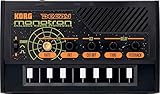
8. Korg Monotron Delay – Best Budget Analog Ribbon Synth
Korg Monotron Delay Analog Ribbon Synthesizer
Analog Ribbon Synthesizer
Original MS-10 and MS-20 VCF Filter
Space Delay with Pitch LFO
Wide-Range Ribbon Controller
Battery Powered with Built-In Speaker
Pros
- Authentic MS-20 filter sound
- Excellent space delay with pitch modulation
- Can process external audio through filter
- Battery powered and portable
- Incredibly fun for sound design
Cons
- Not designed for melodic playing
- Ribbon range makes precise notes difficult
- Circuit hiss at high settings
- Some headphone jack failures reported
- Monophonic only
The Korg Monotron Delay is technically a toy-shaped instrument, but the filter inside is genuine Korg MS-20 heritage. For under $60, you get the same analog filter that defined decades of electronic music, paired with a pitch-shifting space delay that creates otherworldly sounds.
I use the Monotron Delay primarily as an external filter box. Run a drum loop or synth line through the audio input, sweep the cutoff knob, and the MS-20 filter transforms dull sounds into animated, squelchy textures. The delay adds space and movement on top.
The ribbon controller is hard to play melodically, but that misses the point. The Monotron Delay is a sound-design tool, not a performance keyboard. Sliding your finger along the ribbon while tweaking the filter creates sci-fi sweeps and atmospheric textures that work beautifully in ambient and experimental music.
The built-in speaker is serviceable for sketching, but the real magic happens through headphones or a proper audio interface. The space delay with its pitch LFO produces tape-style echoes that sway in pitch, perfect for dub-influenced productions.
Best for external audio processing and filter sweeps
If you already have synths or drum machines and want to add classic MS-20 filter character to your setup, the Monotron Delay is the cheapest legitimate way to do it. The external audio input routes through the filter and delay, essentially giving you a portable analog effects unit.
Durability and long-term ownership
The Monotron’s small size means it gets tossed into bags and pockets, which leads to wear. The most common failure point is the headphone jack, where solder joints can crack from cable strain. Treat it gently and it will serve you well for years of sound design experiments.
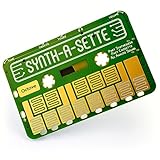
9. MicroKits Synth-a-Sette – Best Budget STEM Synth
MicroKits Synth-a-Sette: The Original Cassette Sized Analog Synthesizer
Cassette-Sized Analog Synthesizer
13-Key Monophonic Touchpad
Octave Up Button and Vibrato Switch
Custom Keyboard via Alligator Clips
Built-In Speaker and Headphone Jack
USB-C Connectivity
Pros
- Creative STEM learning tool
- Build custom keyboards with conductive objects
- Compact cassette case design
- Easy setup and use
- Built-in speaker and headphone jack
- Great for classrooms and beginners
Cons
- Limited to simple synthesis functions
- Monophonic only
- Must maintain ground connection for sound
- Relatively expensive for feature set
The MicroKits Synth-a-Sette is the most creative budget synth I have tested. Housed in a cassette tape case, this little instrument lets you connect everyday conductive objects to its touchpads and turn them into a keyboard. Bananas, coins, plants, and people all become playable.
I built a keyboard out of fruit with my nephew in about ten minutes, and he was instantly hooked on synthesis. The 13-key touchpad works on its own, but the alligator clip expansion is where the Synth-a-Sette becomes something special. It turns music theory into a tangible, physical experience.
The synthesis engine is basic but genuine. You get a touch-sensitive keyboard, an octave-up button, and a vibrato switch for adding movement to sustained notes. The built-in speaker is loud enough for solo play, and the headphone jack enables quiet practice.
For teachers, workshop leaders, and parents, the Synth-a-Sette is the best introduction to analog synthesis I have found. It combines STEM learning with musical creativity, and the cassette form factor makes it feel like a real instrument rather than a toy.
Best for education and creative exploration
If you teach music, run workshops, or want to spark a child’s interest in electronics and sound, the Synth-a-Sette is unmatched at this price. The conductive-object keyboard trick turns every session into an experiment, and the simple controls keep the focus on creativity rather than technical overwhelm.
Connectivity and integration with other gear
The Synth-a-Sette includes USB-C connectivity, which means you can connect it to a computer for basic integration. It will not replace a serious MIDI controller, but it works as a novelty input device and a teaching tool for understanding how touch circuits translate into sound.
10. Stylophone Original – Best Pocket Synth Under $50
Stylophone The Original Pocket Electronic Synthesizer | Synth Musical Instrument | Synthesizer Keyboard | Stylophone Instrument Synth
Original Pocket Analog Synthesizer
Stylus Play on Metal Surface
Vintage 1968 Analog Sound
Battery Powered with Built-In Speaker
3.5mm Aux Connectivity
Pocket-Sized Format
Pros
- Iconic vintage analog sound dating to 1968
- Extremely portable pocket format
- Easy to play with stylus technique
- Battery powered with built-in speaker
- Used by David Bowie and other legends
- Great value for money
Cons
- Sensitive to handling and can short out
- Plastic construction not very durable
- Requires proper stylus technique to avoid crackle
- Monophonic only
The Stylophone Original is the cheapest genuine analog synthesizer you can buy, with a heritage stretching back to 1968. David Bowie used one on Space Oddity, and the reissue delivers the same warm, retro organ-like tones that defined a generation of psychedelic and space-age pop.
Playing the Stylophone is unlike any other instrument. You tap and slide the connected stylus along a metal surface, and the circuit completes through the stylus to produce different pitches. It takes practice to play cleanly, but the resulting sound has a character nothing else can replicate.
The built-in speaker is surprisingly loud for the size, and the 3.5mm aux output lets you record into a DAW or amplify through external speakers. Battery operation means you can play it anywhere, which makes it a fantastic creative tool for travel and downtime.
At under $50, the Stylophone is the cheapest entry point into hardware synthesis I can recommend. It is not a serious production tool, but it is a genuine instrument with a unique voice and decades of musical history behind it.
Best for vintage character and creative sketching
If you want a synth that sounds like nothing else in your collection, the Stylophone delivers. The vintage analog tone works beautifully in lo-fi productions, psychedelic pop, and any context where character matters more than precision. It is also the cheapest gift idea for a musically curious friend.
Stylus technique and care tips
The Stylophone’s metal keyboard can short out if jostled aggressively while playing, which produces crackling sounds. Apply even pressure with the stylus, keep the metal surface clean, and store it carefully to avoid scratches. With proper care, the Stylophone is a reliable little instrument that lasts for years.
How to Choose the Best Budget Synthesizer for Your Needs
Choosing the right budget synthesizer comes down to understanding what kind of music you want to make and what features matter most to you. After testing every synth in this guide, I can break the decision into a few key factors that should shape your purchase.
Analog versus digital versus hybrid
Analog synths use voltage-controlled oscillators and filters to generate sound, producing the warm, fat tones associated with vintage gear. Digital synths use algorithms to model or generate sound, offering more versatility and features per dollar. Hybrid synths combine digital oscillators with analog filters, giving you the best of both worlds. The Arturia MicroFreak is the best example of a hybrid that outperforms pure analog at this price.
Monophonic versus polyphonic
Monophonic synths play one note at a time, which is ideal for basslines, leads, and acid sequences. Polyphonic synths play multiple notes simultaneously, letting you perform chords and pads. The Behringer JT Mini and Roland AIRA S-1 are rare budget options that deliver true polyphony. If chordal playing matters to you, prioritize those.
Connectivity and integration
Look for MIDI connectivity if you want to control your synth from a DAW or another keyboard. USB MIDI is common on modern budget synths, while DIN MIDI appears on more serious units like the Behringer Pro VS Mini. CV outputs, like those on the Arturia MicroFreak, enable integration with Eurorack and modular gear. The Korg Volca and NTS-1 families also support sync I/O for chaining units together.
Portability and power options
If you produce on the move, prioritize battery-powered synths. The Roland AIRA S-1 has an internal rechargeable battery that lasts hours, while the Korg Volca series runs on AA batteries. Pocket synths like the Stylophone and Synth-a-Sette fit in a jacket pocket for true mobile production. Pair any of these with solid keyboard stands for your setup if you plan to use them at home.
Sequencer and pattern features
A built-in sequencer lets you program patterns directly on the synth without a DAW. The Behringer TD-3, Korg Volca Nubass, and Roland S-1 all feature capable step sequencers that turn the synth into a self-contained instrument. For live performance and hardware-only setups, this feature is essential.
Price tiers and value expectations
Under $100, expect pocket synths and ribbon controllers with limited polyphony but genuine character. The $100 to $200 range is where you find real desktop synths with sequencers and proper connectivity. Above $200, you enter serious instrument territory with the Arturia MicroFreak and Roland AIRA S-1 leading the pack. If you want pro features at budget prices, the best synthesizers overall guide covers upgrade options.
FAQs
What is the best budget synthesizer for beginners?
The Arturia MicroFreak is the best budget synthesizer for beginners because its 17 oscillator modes and modulation matrix let you explore a wide range of sounds without outgrowing the instrument. It also receives regular firmware updates that add new features for free.
What is the best affordable synthesizer under $200?
The best affordable synthesizer under $200 is the Behringer Pro VS Mini at $119, offering 5-voice polyphony and vector wavetable synthesis. The Korg Nu:Tekt NTS-1 at $119.99 is another top pick thanks to its logue-SDK community oscillators and built-in effects.
Why are synthesizers so expensive?
Synthesizers are expensive because of analog components like precision oscillators, filters, and envelopes that require matched transistors and calibrated circuitry. Premium synths also include custom keybeds, metal chassis, and extensive research and development. Budget brands like Behringer and Korg cut costs through mass production, plastic enclosures, and digital modeling rather than sacrificing sound quality.
Are Behringer synthesizers good quality?
Behringer synthesizers are good value for the price, delivering authentic analog sounds through cloned classic circuitry. The TD-3 and Pro VS Mini punch well above their cost in terms of sound. The main trade-offs are plastic construction, occasional quality control issues, and limited preset storage. Most buyers accept these compromises given the aggressive pricing.
Can I make professional music with budget synthesizers?
Yes, you can absolutely make professional music with budget synthesizers. Artists have released commercial tracks using Volca series, Behringer clones, and the Arturia MicroFreak. Modern budget synths offer sound quality that rivals gear costing several times more, especially when paired with good production technique and quality effects plugins.
Final Thoughts on the Best Budget Synthesizers in 2026
The best budget synthesizers in 2026 deliver more than just affordable prices. They give you real analog signal paths, deep modulation options, portable power, and sounds that hold their own against gear costing five times as much. Whether you start with the Arturia MicroFreak for sound design, the Roland AIRA S-1 for portable production, or the Stylophone for pure creative fun, every option on this list earns its place in a serious studio.
For producers ready to invest in higher-end instruments after cutting their teeth on budget gear, our guides to the best synthesizers overall and workstation keyboards for advanced features cover the next steps worth considering.