
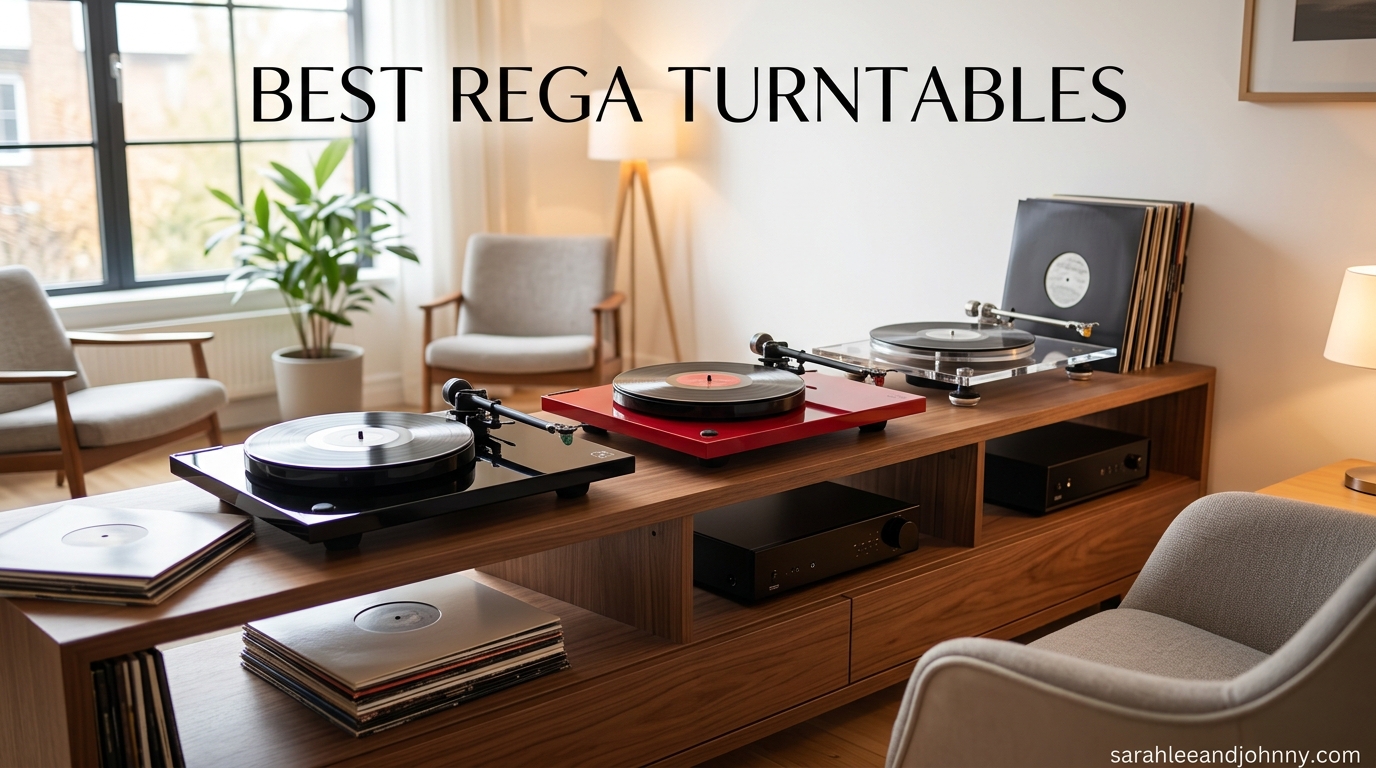
If you are shopping for one of the best Rega turntables in 2026, you are already on the right track. Rega Research has been hand-building turntables in the United Kingdom since 1973, and their Planar series is widely regarded as one of the strongest value propositions in hi-fi. The challenge is not whether to buy a Rega, but which one fits your budget and listening goals.
The best Rega turntable depends on what you want to spend and how serious you are about vinyl. For first-time buyers, the Planar 1 is unbeatable for plug-and-play simplicity. The Planar 3 remains the legendary sweet spot that most enthusiasts eventually land on. From there, the Planar 6, Planar 8, and Planar 10 climb into serious audiophile territory, with the Naia and RP40 Limited Anniversary sitting at the very top of the range.
This guide covers every current Rega turntable model, explains the design philosophy that makes them special, and helps you choose the right one for your system. Whether you are upgrading from a basic smart turntable or building a dedicated listening room from scratch, you will find clear, opinionated recommendations below. We have also pulled real owner experiences from communities like r/turntables and StereoNet to back up our picks.
Table of Contents
- Quick Picks: Best Rega Turntables by Budget
- Why Rega Turntables Sound Different: The Mass-Is-Energy Philosophy
- Rega Planar 1: The Best Rega Turntable for Beginners
- Rega Planar 1 Plus: Plug-and-Play With a Built-In Phono Stage
- Rega Planar 2: The Step-Up From Entry-Level
- Rega Planar 3: The Sweet Spot and Best Rega Turntable Overall
- Rega Planar 3 RS: Upgraded With Neo Power Supply
- Rega Planar 6: Upper-Mid-Range Excellence
- Rega Planar 8: Near-Reference Performance
- Rega Planar 10: The Reference Flagship
- Rega Naia: The Ultra Flagship
- Rega RP8 and RP10: The Previous Generation
- Rega RP40 Limited Anniversary Edition
- Rega Planar Series Comparison Table
- Buying Guide: How to Choose the Best Rega Turntable
- FAQs
- Final Recommendations: Best Rega Turntables for 2026
Quick Picks: Best Rega Turntables by Budget
Not everyone wants to read 5,000 words before buying. Here is the short version of the best Rega turntables for 2026, broken down by who they suit best.
Best for beginners: Rega Planar 1. It costs around $600, ships with a pre-mounted Carbon cartridge, and takes about five minutes to set up. Reddit owners describe it as a table that “requires basically no maintenance, provides excellent sound and has decent resale value.”
Best overall value: Rega Planar 3. Sitting around $1,280 to $1,595 depending on cartridge, it has been called “the most famous turntable in hi-fi history.” The hand-assembled RB330 tonearm, 12mm float glass platter, and double-brace technology make it a genuine sweet spot.
Best for serious listeners: Rega Planar 6. Around $1,925 to $3,025, it adds the Neo TT-PSU power supply and the advanced RB330 tonearm in a lighter foam-core plinth. Long-term owners describe it as “highly engaging, musical and toe-tapping.”
Best for audiophiles: Rega Planar 8. Around $3,395, with the option to add the Apheta moving coil cartridge and Neo PSU. It is built around a Tancast 8 foam core plinth and delivers near-reference performance.
Best flagship: Rega Planar 10. Starting around $6,450 and climbing past $14,000 fully loaded, the Planar 10 uses a ceramic oxide platter, RB3000 tonearm, and reference-grade power supply.
Why Rega Turntables Sound Different: The Mass-Is-Energy Philosophy
Before diving into specific models, it helps to understand why Rega turntables sound the way they do. Most turntable makers chase mass, building heavy platters and dense plinths to fight vibration. Rega goes the opposite direction.
Rega’s founding principle is “mass-is-energy.” The idea is that any mass added to a turntable stores and releases energy back into the record as resonance. By keeping the plinth light and rigid, Rega lets unwanted energy dissipate quickly instead of coloring the sound. This is why even the flagship Planar 10 weighs less than many mid-tier turntables from other brands.
Modern Rega plinths use a Tancast 8 polyurethane foam core sandwiched between thin, rigid skins, reinforced with ceramic braces. The foam is exceptionally light and stiff for its weight, and it damps resonance without adding mass. This construction first appeared on the Planar 8 and Planar 10, and it is a big reason those models punch above their price class.
Rega also favors belt drive with low-mass sub-platters, precision bearing housings, and hand-assembled tonearms. The RB series tonearms, from the RB220 on the Planar 2 up to the RB3000 on the Planar 10, are engineered in-house and have a reputation for outperforming third-party arms costing several times more.
Rega Planar 1: The Best Rega Turntable for Beginners
The Planar 1 is Rega’s entry-level turntable and the starting point for most owners. At roughly $600, it is one of the best-built new turntables you can buy for the money. The plinth is lightweight and rigid, the platter is phenolic resin, and the pre-installed Rega Carbon moving magnet cartridge gets you spinning records within minutes of unboxing.
Setup is genuinely plug-and-play. The cartridge is mounted and aligned at the factory, the bias and tracking force are pre-set, and the belt is pre-fitted. All you do is balance the tonearm, drop the stylus guard, and start playing. There is no anti-skate dialing-in, no cartridge alignment protractor, no phono stage calibration. For a first turntable, that simplicity is huge.
The Planar 1 uses the RB110 tonearm, a more basic arm than the RB330 on the Planar 3, but still engineered to Rega standards. The platter is a single-piece phenolic design rather than the glass platter found higher up the range. Speed switching is manual, requiring you to physically move the belt between 33 and 45 RPM pulleys.
Sonically, the Planar 1 punches well above its price. Owners on r/turntables consistently call it a “significant step up” from plastic-bodied suitcase players and entry-level Pro-Ject models. The Carbon cartridge is warm and forgiving, which suits rock, jazz, and vocals nicely. What you give up versus the Planar 3 is detail retrieval, bass weight, and speed stability.
Key specs: RB110 tonearm, phenolic resin platter, Rega Carbon MM cartridge, manual belt change for 33/45 RPM, no built-in phono stage.
Pros: Genuinely plug-and-play, excellent build quality for the price, strong resale value, easy to upgrade cartridge later, hand-built in the UK.
Cons: Manual speed change, no phono stage, RB110 tonearm limits ultimate cartridge upgrades, platter material is not as inert as glass.
Best for: First-time vinyl buyers, casual listeners upgrading from a suitcase player, anyone who wants a low-maintenance table that holds its value.
Rega Planar 1 Plus: Plug-and-Play With a Built-In Phono Stage
If you love the Planar 1 but your amplifier lacks a phono input, the Planar 1 Plus is the answer. It is mechanically identical to the standard Planar 1 but adds a high-quality built-in phono stage inside the plinth. That means you can plug it directly into any line-level input on a receiver, integrated amp, or powered speakers.
The internal phono stage is a moving magnet design tailored for the Rega Carbon cartridge. It is a real, purpose-built phono preamp, not a cheap afterthought. For buyers who do not want to buy a separate phono stage or who want a cleaner desktop setup, this solves a real problem.
Otherwise, the Planar 1 Plus shares the same RB110 tonearm, phenolic platter, and minimalist plinth as the standard Planar 1. You still get manual speed changes and the same cartridge. The only meaningful trade-off versus the standard Planar 1 is slightly higher cost and the fact that the internal phono stage cannot be bypassed, which matters if you later want to upgrade to a standalone phono preamp.
Key specs: Built-in MM phono stage, RB110 tonearm, phenolic platter, Rega Carbon cartridge, manual 33/45 switching.
Pros: No separate phono stage needed, otherwise identical to the excellent Planar 1, perfect for simple systems, easy setup.
Cons: Internal phono stage cannot be bypassed, slight premium over the standard Planar 1, limited cartridge upgrade path with RB110 arm.
Best for: Listeners with modern amps that lack a phono input, anyone who wants the absolute minimum component count, desktop and powered-speaker setups.
Rega Planar 2: The Step-Up From Entry-Level
The Planar 2 sits between the Planar 1 and the Planar 3 and targets buyers who want more performance than entry-level without jumping to the Planar 3’s price tag. At roughly $900 to $1,000, it upgrades the tonearm to the RB220, adds a float glass platter, and ships with the Rega Carbon cartridge like the Planar 1.
The bigger story is the glass platter. Float glass is denser and more inert than phenolic resin, and it contributes to better speed stability and lower wow and flutter. The RB220 tonearm is a noticeable step up from the RB110, with better bearings and a more rigid construction. The result is a turntable that sounds cleaner, faster, and more detailed than the Planar 1.
The Planar 2 still uses a foam-core plinth, but it is not the same Tancast 8 foam found on the Planar 8 and 10. It is a simpler laminate construction. Speed switching is still manual via belt change.
Where the Planar 2 gets interesting is the upgrade discussion. Many forum members on r/turntables argue that the Planar 2 is the weakest value in the Rega range, because the jump from Planar 2 to Planar 3 is dramatic while the price gap is relatively modest. If you are already spending Planar 2 money, the consensus is usually to stretch to the Planar 3.
Key specs: RB220 tonearm, float glass platter, foam-core laminate plinth, Rega Carbon MM cartridge, manual 33/45 switching.
Pros: Glass platter improves speed stability, better tonearm than Planar 1, strong mid-tier option if Planar 3 is out of budget.
Cons: Modest performance gain over Planar 1 for the price, manual speed change, most owners eventually wish they had bought the Planar 3.
Best for: Buyers who want glass-platter performance but cannot stretch to the Planar 3, casual listeners who want a step up from entry-level.
Rega Planar 3: The Sweet Spot and Best Rega Turntable Overall
The Planar 3 is the model most people should buy. It has earned a reputation as the best value audiophile turntable on the market, and the title is deserved. At roughly $1,280 with the Elys 2 cartridge or up to $1,595 with upgraded cartridges, it is the model that Future Audiophile, Sound Organisation, and Audio Advice all single out as the sweet spot of the entire Rega range.
What makes the Planar 3 special is the hand-assembled RB330 tonearm. The RB330 is built on a dedicated production line, hand-tuned by Rega technicians, and uses a precision bearing housing that tracks records with remarkable accuracy. It is the same arm philosophy used on more expensive Rega models, just scaled down for this price tier.
The Planar 3 also introduces double-brace technology. Two ceramic braces connect the tonearm mounting to the bearing housing and main platter bearing, creating a rigid path for energy to dissipate. Combined with the 12mm float glass platter and upgraded bearing, the Planar 3 extracts noticeably more detail, lower distortion, and tighter bass than the Planar 2.
Cartridge options on the Planar 3 are where things get flexible. The standard option is the Rega Elys 2 moving magnet cartridge. From there, you can step up to the Exact 2, Nd3, or Nd5. The Nd cartridges are Rega’s newer neodymium magnet designs and offer significantly better tracking and detail. Long-term Planar 3 owners on forums describe the table as “legendary” and “a true sweet spot.”
Key specs: RB330 tonearm, 12mm float glass platter, double-brace plinth with ceramic braces, Rega Elys 2 MM cartridge standard, optional Nd3, Nd5, Exact 2 upgrades.
Pros: Hand-assembled RB330 tonearm, double-brace technology, excellent cartridge upgrade path, legendary value, strong resale, can be upgraded toward Planar 6 performance with aftermarket tweaks.
Cons: Manual speed change on the standard model, no built-in phono stage, can be slightly intimidating to set up for absolute beginners versus the Planar 1.
Best for: Anyone serious about vinyl who wants the best performance per dollar in the Rega range. This is the table most owners should land on.
Rega Planar 3 RS: Upgraded With Neo Power Supply
Worth a separate mention is the Planar 3 RS, a version of the Planar 3 that adds the Neo TT-PSU external power supply. The Neo provides electronic speed switching (no more belt changes for 45 RPM), tighter speed stability, and lower noise floor. RS-spec Planar 3 owners on forums describe it as “better than a P8 and possibly better than the P10” and “a truly exceptional performer.”
The Neo PSU is the same power supply used on the Planar 6, and adding it to the Planar 3 closes much of the performance gap to the more expensive model. If you are torn between a Planar 3 and a Planar 6, the Planar 3 RS is often the smarter buy.
Best for: Listeners who want Planar 6-level performance without the full Planar 6 price, those who value electronic speed switching.
Rega Planar 6: Upper-Mid-Range Excellence
The Planar 6 is the model that makes the jump into serious audiophile territory. Priced around $1,925 to $3,025 depending on cartridge, it adds the Neo TT-PSU power supply as standard, a lighter foam-core plinth, and ships with either the Exact 2 or Ania Pro cartridge depending on configuration.
The biggest change versus the Planar 3 is the plinth. The Planar 6 uses a lighter, more advanced foam-core construction that reduces stored energy even further. Combined with the Neo PSU’s tighter speed control, the Planar 6 delivers deeper bass, wider soundstage, and better instrument separation than the Planar 3.
The Ania Pro moving coil cartridge option is where the Planar 6 really shines. Moving coil cartridges track more accurately and retrieve more low-level detail than moving magnet designs. Forum owners describe the Planar 6 RS pairing with Ania as “highly engaging, musical and toe-tapping. Gets the best out of high-end cartridges.”
One nuance worth knowing: the Planar 6 is sold in different configurations. The standard Planar 6 typically ships with the Exact 2 moving magnet cartridge. The Planar 6 RS version, with the Ania Pro moving coil cartridge, is the more desirable configuration for serious listeners.
Key specs: RB330 tonearm, foam-core lightweight plinth, Neo TT-PSU power supply with electronic speed switching, available with Exact 2 MM or Ania Pro MC cartridge.
Pros: Neo PSU included, lighter and more advanced plinth, available with moving coil cartridge, electronic speed switching, deeper bass and better separation than Planar 3.
Cons: Significant price jump from Planar 3, foam-core plinth requires careful handling, RB330 tonearm (same as Planar 3) feels modest at this price.
Best for: Listeners ready for moving coil cartridge performance, anyone who wants Neo PSU benefits, those who prioritize bass depth and soundstage width.
Rega Planar 8: Near-Reference Performance
The Planar 8 is where Rega’s flagship engineering starts to show up in force. At around $3,395, it introduces the Tancast 8 polyurethane foam core plinth (the same material used on the Planar 10), a ceramic oxide platter option, and the option of the Apheta 3 moving coil cartridge.
The Tancast 8 foam core is the same aerospace-grade material used in the Planar 10. It is exceptionally light and rigid, and it is a big reason the Planar 8 weighs so little while sounding so substantial. The platter on the Planar 8 is a float glass design, with an optional ceramic oxide upgrade that further reduces stored energy.
Sonically, the Planar 8 is a significant jump from the Planar 6. The sound is faster, more transparent, and more detailed, with a noticeably blacker background between notes. The Apheta 3 moving coil cartridge pairs beautifully with the Planar 8 and is the configuration most owners recommend.
The Planar 8 also benefits from the Neo TT-PSU as standard, with electronic speed switching and tighter speed stability than the lower models. The RB330 tonearm is carried over, but it is hand-tuned to a higher standard on the Planar 8 production line.
Key specs: Tancast 8 foam core plinth, RB330 tonearm (hand-tuned), float glass platter (ceramic oxide optional), Neo TT-PSU standard, available with Apheta 3 MC cartridge.
Pros: Tancast 8 plinth is genuinely flagship-level, excellent detail retrieval, near-reference transparency, optional ceramic oxide platter takes performance further.
Cons: RB330 tonearm is the same arm family as much cheaper models, full upgrade path (ceramic platter, Apheta) pushes price close to Planar 10 territory.
Best for: Audiophiles who want Planar 10-class construction without the Planar 10 price, those building a reference system on a (relatively) sensible budget.
Rega Planar 10: The Reference Flagship
The Planar 10 is Rega’s flagship production turntable. Starting around $6,450 and climbing well past $10,000 with cartridge and power supply upgrades, it represents the culmination of Rega’s mass-is-energy philosophy.
The Planar 10 uses the Tancast 8 foam core plinth, but with a thicker, more complex construction than the Planar 8. The platter is a ceramic oxide design, diamond-cut for maximum precision and minimum mass. The tonearm is the RB3000, Rega’s flagship hand-built arm with the tightest tolerances in the range.
The Planar 10 ships with the Apheta 3 moving coil cartridge standard, and can be upgraded to the Aphelion reference cartridge. The power supply is a dedicated reference-grade unit that further refines speed stability and noise floor.
Sonically, the Planar 10 is a different class of turntable. The sound is exceptionally transparent, with a noise floor that essentially disappears. Detail retrieval is reference-level, and the tonal balance is neutral without being analytical. This is a turntable for listeners who want to hear exactly what is on the record.
Key specs: Tancast 8 foam core plinth (upgraded), RB3000 hand-built tonearm, ceramic oxide diamond-cut platter, reference power supply, Apheta 3 MC cartridge standard.
Pros: Genuine reference-level performance, RB3000 is one of the best tonearms in production, ceramic oxide platter is state of the art, Apheta 3 included.
Cons: Significant investment, RB3000 tonearm limits cartridge options to Rega’s range, total cost with upgrades approaches Naia territory.
Best for: Reference system builders, listeners who want the best Rega turntable short of the ultra-limited editions, those with high-end amplification and speakers that can resolve the difference.
Rega Naia: The Ultra Flagship
For buyers who want the absolute pinnacle of Rega engineering, the Naia is the answer. At roughly $14,995, it is Rega’s most advanced production turntable, incorporating lessons learned from the Naiad prototype. The Naia uses a reference-grade platter, advanced bearing housing, and the RB3000 tonearm in a no-compromise package.
The Naia represents Rega’s purest expression of the mass-is-energy philosophy. Every component is optimized for minimum mass and maximum rigidity. The result is a turntable that sounds almost impossibly transparent, with dynamics, detail retrieval, and low-level resolution that few turntables at any price can match.
The Naia is rare and production is limited. Buyers typically work directly with Rega or an authorized dealer to configure one. If you are shopping at this level, the Naia competes with turntables from Clearaudio, VPI, and SME.
Best for: Collectors and reference system builders who want the most advanced Rega turntable available. This is the table for someone who already owns a Planar 10 and wants more.
Rega RP8 and RP10: The Previous Generation
Before the current Planar 8 and Planar 10 naming, Rega used the RP8 and RP10 names for the same tier of turntables. The RP8 (now Planar 8) and RP10 (now Planar 10) share much of the same engineering philosophy, and the older RP-series turntables are still sought after on the used market.
If you find a used RP8 or RP10 in good condition, it can be an excellent value. The RP10 with the RP10-specific power supply and Apheta cartridge is still a genuinely reference-level turntable. Used RP8 models typically sell for significantly less than a new Planar 8, making them one of the best values in high-end vinyl playback.
Best for: Buyers open to the used market who want Planar 8 or 10 performance at a discount.
Rega RP40 Limited Anniversary Edition
The RP40 Limited Anniversary Edition is a special run celebrating 40 years of Rega turntable production. It is based on the RP1 platform but features unique cosmetic upgrades, special finish, and anniversary badging. Production is limited, and availability is through authorized Rega dealers.
For collectors and Rega enthusiasts, the RP40 is a desirable limited edition. For buyers focused purely on performance, the standard Planar 1 offers the same sonic performance at a lower price. The RP40’s value is in its collectibility and aesthetic appeal rather than performance upgrades.
Best for: Rega collectors and enthusiasts who want a limited-edition piece with anniversary provenance.
Rega Planar Series Comparison Table
The table below summarizes the key specifications across the current Rega Planar range. Use it to compare tonearms, platters, plinths, and cartridge options side by side.
- Planar 1: RB110 tonearm, phenolic platter, foam-core plinth, Rega Carbon MM cartridge, manual speed change
- Planar 1 Plus: Same as Planar 1 with built-in MM phono stage
- Planar 2: RB220 tonearm, float glass platter, foam-core laminate plinth, Rega Carbon MM cartridge, manual speed change
- Planar 3: RB330 tonearm, 12mm float glass platter, double-brace ceramic plinth, Rega Elys 2 MM (Exact 2, Nd3, Nd5 upgrades), manual speed change
- Planar 3 RS: Same as Planar 3 with Neo TT-PSU power supply and electronic speed switching
- Planar 6: RB330 tonearm, lightweight foam-core plinth, Neo TT-PSU standard, Exact 2 MM or Ania Pro MC cartridge
- Planar 8: RB330 (hand-tuned), Tancast 8 foam core plinth, float glass platter (ceramic oxide optional), Neo TT-PSU standard, Apheta 3 MC optional
- Planar 10: RB3000 tonearm, upgraded Tancast 8 plinth, ceramic oxide diamond-cut platter, reference PSU, Apheta 3 MC standard
- Naia: RB3000 tonearm, reference construction throughout, limited production
Buying Guide: How to Choose the Best Rega Turntable
Choosing the best Rega turntable comes down to three questions: what is your budget, what amplifier and speakers are you pairing it with, and how important is upgrade flexibility?
Choose by Budget Tier
Under $700, the Planar 1 is the obvious choice. Between $700 and $1,200, decide between the Planar 1 Plus (if you need a built-in phono stage) or the Planar 2 (for glass platter performance). Between $1,200 and $1,800, the Planar 3 is the clear winner. From $1,800 to $3,200, look at the Planar 6 and Planar 3 RS. Above $3,000, the Planar 8 and Planar 10 take over.
The single most important piece of advice from long-term Rega owners is to buy the Planar 3 if your budget allows. Forum consensus on r/turntables and StereoNet is overwhelming: the Planar 3 is the model that delivers the most musical satisfaction per dollar in the entire Rega range.
Cartridge Upgrade Paths
Rega offers a clean cartridge upgrade path that scales with your turntable. The Carbon moving magnet ships on the Planar 1 and Planar 2. The Elys 2 is the standard on the Planar 3. From there, the Exact 2 is a step-up moving magnet, and the Nd3 and Nd5 are Rega’s newer neodymium magnet moving magnet designs.
For moving coil performance, the Ania and Ania Pro are the entry points on the Planar 6. The Apheta 3 is the moving coil of choice for the Planar 8 and Planar 10. The Aphelion is Rega’s reference cartridge for the Naia and fully-loaded Planar 10.
If you plan to upgrade cartridges later, this matters. The RB110 tonearm on the Planar 1 limits you to lighter cartridges. The RB330 on the Planar 3 and Planar 6 handles a wide range of moving magnet and lighter moving coil cartridges. The RB3000 on the Planar 10 is optimized for Rega’s own cartridge range.
For specific stylus and cartridge upgrade recommendations, see our replacement stylus guide and our broader record player upgrades resource.
Phono Stage Pairing
Rega turntables (except the Planar 1 Plus) do not include a built-in phono stage. You will need either a phono input on your amplifier or a standalone phono preamp. Rega makes several phono stages, including the Fono Mini A2D, Fono MM, Fono MC, and the Aria.
For the Planar 1 through Planar 3 with moving magnet cartridges, the Fono MM is a well-matched companion. For the Planar 6 with Ania and above, the Fono MC or Aria will get the best from moving coil cartridges. If your amplifier already has a phono input, try it first before adding a separate phono stage.
B-Stock and Certified Refurbished Rega Turntables
Rega authorized dealers occasionally offer B-stock and certified refurbished turntables at a discount. These are typically display models, customer returns, or units with minor cosmetic imperfections. They carry full warranty and are functionally identical to new stock.
B-stock can be an excellent value, particularly on higher-end models like the Planar 6 and Planar 8. Expect discounts of 10 to 20 percent off new pricing. Availability is irregular, so it is worth asking your local Rega dealer what they have in stock.
The used market is also strong for Rega. Because the brand holds resale value so well, used Planar 3 and Planar 6 models in good condition typically sell for 60 to 75 percent of new pricing. Used RP8 and RP10 models from the previous generation can be particularly good value.
Setup and Maintenance
Rega turntables are low-maintenance by design. The Planar 1 is essentially set-and-forget. The Planar 3 and above benefit from occasional cartridge alignment checks and belt replacement every few years. Rega belts are inexpensive and easy to fit.
One thing to watch: Rega’s lightweight plinth philosophy means the turntables are sensitive to vibration. A wall-mounted shelf or a heavy, isolated equipment stand is recommended for the Planar 6 and above. A good turntable mat can also help with resonance control and static.
Resale Value and Long-Term Ownership
Rega turntables hold resale value better than almost any other brand in hi-fi. Ten-year and twenty-year ownership stories are common on forums, and the Planar 3 specifically is described as “the turntable you buy once and keep.” If you decide to upgrade within the Rega range later, the resale value of your current table will help fund the move.
For long-term ownership, Rega’s parts availability is excellent. Belts, bearings, and tonearm parts are all available through authorized dealers, and Rega continues to service older models. This is a brand you can buy into with confidence that support will be there for decades.
Building a Complete Vinyl System
A Rega turntable is only one part of a vinyl system. Pairing it with the right amplifier, speakers, and accessories matters as much as the turntable choice itself. Our complete vinyl listening station setup guide walks through the full system building process.
If you are also planning record storage and a listening room, see our record storage solutions for furniture that pairs well with a Rega-based system.
FAQs
Which Rega turntable is best?
The best Rega turntable depends on your budget. For beginners, the Planar 1 (~$600) is unbeatable for plug-and-play simplicity. For most listeners, the Planar 3 (~$1,280-$1,595) is the legendary sweet spot with its RB330 tonearm and double-brace plinth. For audiophiles, the Planar 8 and Planar 10 deliver reference-level performance.
Are Rega turntables good quality?
Yes, Rega turntables are excellent quality. Hand-built in the UK since 1973, Rega uses a mass-is-energy design philosophy with lightweight rigid plinths, precision tonearms, and high-quality bearings. The Planar 3 is often called the most famous turntable in hi-fi history, and Rega consistently ranks among the best turntable brands for value and longevity.
Which is the best Rega planar?
The Rega Planar 3 is widely considered the best Rega Planar for most listeners. It features the hand-assembled RB330 tonearm, 12mm float glass platter, and double-brace ceramic plinth construction. For the money, it delivers the best balance of detail retrieval, bass weight, and upgrade flexibility in the Rega range. The Planar 6 RS is the next step up for listeners wanting moving coil performance.
Is Rega Planar 3 better than 2?
Yes, the Rega Planar 3 is significantly better than the Planar 2. The Planar 3 features a 12mm float glass platter, the superior hand-assembled RB330 tonearm (versus RB220 on the Planar 2), double-brace technology with ceramic braces, and a more advanced bearing housing. Most forum consensus recommends stretching to the Planar 3 if budget allows.
Do Rega turntables need a phono stage?
Most Rega turntables require a separate phono stage or an amplifier with a built-in phono input. The exception is the Planar 1 Plus, which includes a built-in moving magnet phono stage. For all other models, Rega offers the Fono MM, Fono MC, and Aria phono stages, or you can use any quality external phono preamp.
Are Rega turntables still made in the UK?
Yes, Rega turntables are still designed and hand-assembled in the United Kingdom. Rega Research operates from their facility in Essex, England, where they build turntables, tonearms, cartridges, amplifiers, and phono stages. The RB series tonearms and higher-end plinths are assembled and tuned by hand at the UK factory.
How long do Rega turntables last?
Rega turntables are built for long-term ownership and regularly last 20 years or more with basic maintenance. Belts need replacing every few years, and cartridge styli wear out with use, but the core turntable components (plinth, platter, tonearm, bearing) are engineered for decades of service. Parts and service remain available for older models through authorized Rega dealers.
Final Recommendations: Best Rega Turntables for 2026
The best Rega turntables are not just well-engineered record players; they are an investment in a long-term listening relationship. The brand’s mass-is-energy philosophy, hand-built UK construction, and clean upgrade path mean that whichever Planar model you choose, you are buying into one of the most respected names in vinyl playback.
For most readers, the Rega Planar 3 is the recommendation. It is the model that earned Rega its reputation, it offers the best value in the range, and it has the cartridge flexibility to grow with your system. The Planar 1 is the right choice for first-time buyers who want simplicity, and the Planar 6, Planar 8, and Planar 10 climb into genuine audiophile territory for listeners with the amplification and speakers to match.
Whatever you choose, buy from an authorized Rega dealer. The brand does not sell direct or through Amazon, and authorized dealers provide setup support, warranty service, and access to B-stock and trade-in options. Once your turntable is set up, consider adding a vinyl now playing display to round out your listening room.
The best Rega turntable is the one that fits your budget and system today, with room to grow tomorrow. Choose well, and it will be spinning records for decades.