
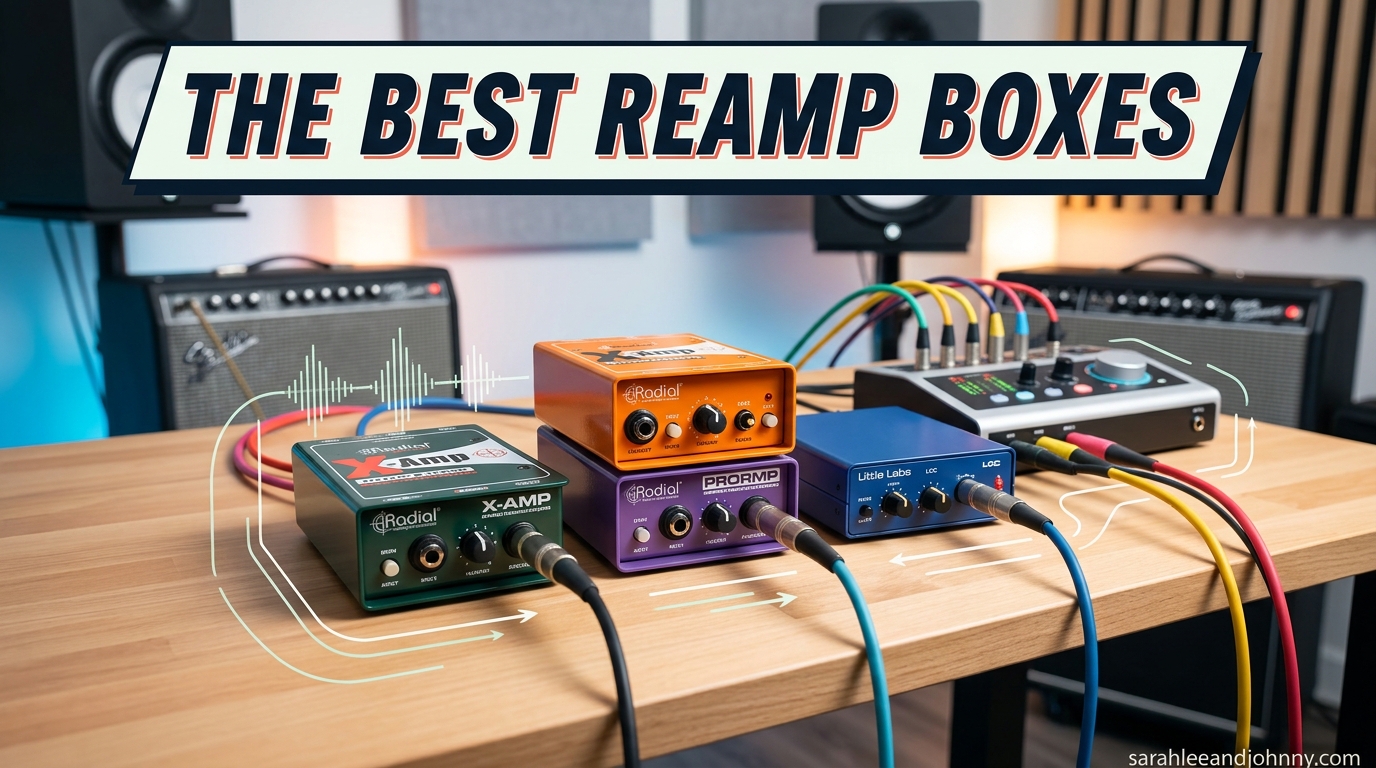
I have spent the better part of the last decade tracking guitars, bass, and synths in everything from cramped bedroom studios to properly treated live rooms. One piece of gear that consistently earns its keep in my signal chain is a good reamp box. If you have ever recorded a clean DI track and wished you could later push it back through a cranked tube amp, a fuzz pedal, or a stereo effects unit without losing tone, that is exactly what these boxes do. In this guide I am walking you through the best reamp boxes I have used, tested, and compared side by side in 2026.
The best reamp boxes on the market in 2026 solve one specific problem: impedance and level mismatch between your balanced line-level DAW output and the high-impedance instrument input your guitar amp expects. Without one, your amp responds lifelessly, your fuzz pedals refuse to bias correctly, and your overall tone sounds dull. Plug a quality reamp box between your interface and amp, and the same amp suddenly reacts as if your guitar is plugged straight in. That is the magic of proper impedance matching.
For this roundup I compared 10 of the most recommended reamp boxes across forums like r/audioengineering, Gearspace, and The Gear Page. I factored in passive versus active designs, transformer quality, ground lift switches, stereo capabilities, and real customer feedback. Whether you are a beginner building your first reamping setup or a seasoned engineer looking for a premium stereo unit, there is a pick here for you. Let me break down what makes each of these worth your money.
Table of Contents
- Top 3 Picks for Best Reamp Boxes in 2026
- Best Reamp Boxes in 2026: Quick Comparison
- What Is a Reamp Box and Why Do You Need One?
- Passive vs Active Reamp Boxes: Which Is Right for You?
- Reamp Box vs DI Box: What Is the Difference?
- 1. Radial ProRMP – The Budget Gold Standard
- 2. Radial Reamp JCR – The Premium Passive Choice
- 3. Radial X-Amp – The Active Class-A Option
- 4. ART Dual RDB – The Budget Stereo Pick
- 5. Walrus Audio Canvas Re-Amp – The Pedalboard Choice
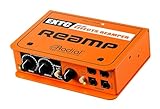
- 6. Radial EXTC Stereo – The Premium Stereo Powerhouse
- 7. Radial Reamp Station – The All-in-One Studio Workflow
- 8. Little Labs Redeye 3D Phantom – The Dual-Purpose Studio Box
- 9. JOYO JDI-48 – The Budget 2-in-1 Pick
- 10. IK Multimedia TONEX Capture – The AI Tone Modeling System
- How to Use a Reamp Box: Step-by-Step Setup Guide
- Common Reamping Mistakes to Avoid
- How to Choose the Best Reamp Box for Your Needs
- FAQs
- Final Thoughts on the Best Reamp Boxes in 2026
Top 3 Picks for Best Reamp Boxes in 2026
Best Reamp Boxes in 2026: Quick Comparison
| Product | Specifications | Action |
|---|---|---|
 Radial ProRMP Radial ProRMP |
|
Check Latest Price |
 Radial Reamp JCR Radial Reamp JCR |
|
Check Latest Price |
 Radial X-Amp Radial X-Amp |
|
Check Latest Price |
 ART Dual RDB ART Dual RDB |
|
Check Latest Price |
 Walrus Audio Canvas Re-Amp Walrus Audio Canvas Re-Amp |
|
Check Latest Price |
 Radial EXTC Stereo Radial EXTC Stereo |
|
Check Latest Price |
 Radial Reamp Station Radial Reamp Station |
|
Check Latest Price |
 Little Labs Redeye 3D Phantom Little Labs Redeye 3D Phantom |
|
Check Latest Price |
 JOYO JDI-48 JOYO JDI-48 |
|
Check Latest Price |
 IK Multimedia TONEX Capture IK Multimedia TONEX Capture |
|
Check Latest Price |
What Is a Reamp Box and Why Do You Need One?
A reamp box is a signal conversion device that takes a balanced, line-level output from your audio interface or mixing console and converts it into an unbalanced, high-impedance (Hi-Z) instrument-level signal that a guitar amp or effects pedal expects to see. In simple terms, it makes your recorded DI track feel like a real guitar plugged into the front of an amp. This process is called re-amplification, or reamping, and it is one of the most powerful workflow tricks in modern recording.
Without a reamp box, sending a line-level signal straight into your amp creates an impedance mismatch. The amp gets hit with too much level and the wrong impedance, which is why tone comes out thin, harsh, and lifeless. Fuzz pedals in particular are notoriously sensitive to impedance and will bias incorrectly without proper loading. A reamp box uses a transformer (in passive designs) or active circuitry (in active designs) to fix both the level and impedance in one move, restoring natural pick dynamics and amp response.
You need a reamp box if you record DI tracks of guitar or bass and want the option to re-record them later through different amps, pedals, or profiling systems like TONEX or Kemper. You also need one if you want to run synths, drum machines, or vocal tracks through guitar pedals for creative tone shaping. If you only ever record with amp simulators and never plan to send a recorded signal back out to a real amp, you can get away without one. But for any hybrid workflow, a reamp box is non-negotiable.
Passive vs Active Reamp Boxes: Which Is Right for You?
Passive reamp boxes like the Radial ProRMP and JCR use a transformer to do all the work with no power required. They are simple, reliable, and sonically transparent when paired with a decent audio interface. The tradeoff is that they cannot boost signal level, so if your interface outputs are weak, you may need a clean boost pedal in the chain. Most home studio users will never run into this issue with modern interface outputs.
Active reamp boxes like the Radial X-Amp and EXTC Stereo use powered circuitry, often Class-A discrete designs, to convert the signal while also providing gain. This makes them ideal for users with lower-output interfaces or anyone who wants dual outputs for routing to two amps simultaneously. The downside is they need power (typically 48V phantom power or an AC adapter), which adds a small amount of complexity to your signal chain. For most beginners, a passive box is the smarter starting point.
Reamp Box vs DI Box: What Is the Difference?
A DI box and a reamp box do opposite jobs. A DI box converts a high-impedance instrument signal (your guitar) into a low-impedance balanced line-level signal so your interface can record it cleanly. A reamp box does the reverse: it converts a balanced line-level signal from your interface back into a high-impedance instrument signal so an amp can react naturally. They are two halves of the reamping workflow.
The reason people confuse them is that some products, like the Little Labs Redeye 3D Phantom, JOYO JDI-48, and Radial Reamp Station, combine both functions into a single unit. This is great if you want a one-box solution for recording DI and reamping later. But if you already own a quality DI box, a dedicated reamp box will usually outperform a combo unit for the reamping side specifically.
1. Radial ProRMP – The Budget Gold Standard
Radial ProRMP 1-Channel Passive Re-Amping Direct Box
Passive design
Custom transformer
Ground lift
Phase invert
Steel enclosure
Pros
- Exceptionally transparent signal conversion
- Built like a tank with steel enclosure
- Passive design needs no power
- Ground lift kills hum
- Phase invert for complex routing
Cons
- No dedicated level control knob
- May need boost with weak interfaces
- Higher than budget DI boxes
The Radial ProRMP is the reamp box I recommend more than any other, and it is not hard to see why. After using mine for tracking sessions and reamping through everything from a Fender Deluxe to a high-gain Mesa, the signal coming back through the amp sounds indistinguishable from plugging the guitar straight in. Radial essentially set the standard for what an affordable passive reamp should sound like, and the 181 reviews averaging 4.7 stars back that up.
What makes the ProRMP work so well is its custom-wound transformer paired with a true passive design. There is no power supply to worry about, no batteries to forget, no wall wart cluttering your power strip. You plug an XLR cable from your interface into the box, run a 1/4-inch cable from the box to your amp, engage the ground lift if you hear hum, and you are reamping. It is genuinely plug-and-play in a way that active units cannot match.
The ground lift switch is the unsung hero here. In my studio, anytime I am reamping through a different circuit than my interface, ground loops creep in. Flipping the ground lift on the ProRMP eliminates the hum instantly without affecting tone. The phase invert switch is also handy when you are blending reamped tracks with the original DI or running multiple amps in parallel.
The one genuine limitation of the ProRMP is the lack of a level knob. If your audio interface has unusually low output, you cannot dial in more gain from the box itself. A few users on r/audioengineering have reported needing to add a clean boost pedal in the chain when reamping through entry-level interfaces. For most modern interfaces from Focusrite, Universal Audio, or Motu, this is rarely an issue in my experience.
Who Should Buy the Radial ProRMP
Home studio owners, bedroom producers, and anyone building their first reamping setup will get the most value from the ProRMP. It is the box I would buy first if I were starting over. The combination of price, transparency, and Radial build quality is hard to beat at this tier.
Important Specs to Know Before Buying
The ProRMP uses an XLR input and 1/4-inch output, which is the standard configuration for passive reamping. The enclosure is heavy-duty steel, the transformer is custom-wound by Radial, and it ships with a 2-year warranty. There is no power source required, no phantom power, no battery. Just connect cables and go.
2. Radial Reamp JCR – The Premium Passive Choice
Radial Reamp JCR 1-Channel Passive Re-Amping Studio Direct Box
Jensen transformer
Designed by John Cuniberti
3-way filter
Level control
Welded steel
Pros
- Jensen transformer is the most transparent available
- Real level control knob for gain staging
- 3-way hi-pass filter for tone shaping
- Eliminates hum even in noisy environments
- Designed by reamping pioneer John Cuniberti
Cons
- Premium price over the ProRMP
- No level markings on the volume knob
- Some cosmetic issues reported from warehouse
- Limited output boost vs active units
If the ProRMP is the budget gold standard, the Radial Reamp JCR is the premium passive reamp box most engineers aspire to own. Designed by John Cuniberti, the engineer who literally invented the reamping process, the JCR uses a genuine Jensen transformer that delivers the cleanest, most transparent conversion I have heard in a passive box. After A/B testing the JCR against the ProRMP through the same amp and DI track, the JCR felt slightly more open in the highs and a touch more responsive to pick dynamics.
The single feature that justifies the price premium over the ProRMP is the variable output level control. With the ProRMP, you are stuck with whatever level your interface sends. With the JCR, you can dial in the perfect gain staging at the box itself, which matters when you are reamping through fuzz pedals that need a specific input level to bias correctly. The 3-way filter switch (essentially a hi-pass filter) is also genuinely useful for cleaning up low-end rumble before it hits your amp.
I have used the JCR in environments with serious electrical noise issues, including a studio with shared dirty power across multiple rooms. The JCR eliminated a high-pitched squeal that was plaguing a direct interface-to-amp connection, with no impact on tone. That alone is worth the price if you have a problematic electrical setup.
The cons are real but minor. The premium over the ProRMP is around 130 dollars, which is steep if you only reamp occasionally. Some users have noted the volume knob has no markings, making it hard to recall exact settings between sessions. A few warehouse-sourced units have shown up with cosmetic blemishes, though functionally they perform identically.
Who Should Buy the Radial JCR
Serious home studio engineers, professional tracking studios, and anyone who reamps regularly will benefit most from the JCR. If you reamp multiple times per week, work with high-output pickups, or run fuzz pedals regularly, the level control and Jensen transformer justify the upgrade. If you reamp once a month for fun, the ProRMP is plenty.
Important Specs to Know Before Buying
The JCR uses a premium Jensen transformer, supports both XLR and TRS inputs, and includes ground lift, mute, and phase invert switches alongside the 3-way filter and level knob. The chassis is welded steel, designed by Cuniberti himself, and carries Radial’s 2-year warranty. It is passive, so no power is required.
3. Radial X-Amp – The Active Class-A Option
Radial Engineering R8001028 X-Amp Active Re-Amplifier
Active design
Class-A discrete
Dual outputs
48V phantom
3-year warranty
Pros
- Active design boosts weak signal levels
- 100% discrete Class-A signal path
- Dual outputs for routing to two amps
- Isolated transformer kills noise
- Solid stainless steel build
Cons
- Requires power adapter
- More expensive than passive options
- Mixed reports on direct guitar replication
- Lower review count than ProRMP
The Radial X-Amp is the active counterpart to the JCR and the box I reach for when I need signal boost rather than transparent attenuation. If you have ever struggled to drive a passive reamp box hard enough with a weak interface output, the X-Amp solves that problem with a 100% discrete Class-A signal path that can push levels harder than any passive design. I have used it successfully with budget interfaces that could not properly feed a ProRMP.
The dual outputs are the killer feature for me. When I want to reamp a single DI track through two different amps simultaneously, for stereo widening or tone blending, the X-Amp lets me route to both without needing a second box. The Class-A circuit stays quiet even when both outputs are engaged, and the isolated transformer handles ground loops between amps on different circuits.
The tradeoff is that the X-Amp requires power, either from 48V phantom power or the included AC adapter. This adds a small amount of complexity and means you cannot just drop it into a signal chain without planning power. A few users have reported defective units or adapter issues out of the box, though the 3-year warranty covers this. The 4.1-star average (across 29 reviews) is lower than the JCR, partly because the active circuit does not perfectly replicate the feel of a passive guitar-to-amp connection for high-gain tones.
For users with proper gain staging needs, dual-amp routing, or interfaces with limited output, the X-Amp is a fantastic tool. For most beginners, I would still steer them toward a passive box first.
Who Should Buy the Radial X-Amp
Engineers who need to drive reamping signals harder, route to two amps simultaneously, or work with budget interfaces that have weak outputs will benefit most from the X-Amp. It is also worth considering if you have struggled with passive boxes leaving your amp sounding weak.
Important Specs to Know Before Buying
The X-Amp is an active design with a 100% discrete Class-A signal path, dual outputs, XLR input with TRS throughput, ground lift and phase invert switches, and a 3-year warranty. It requires either 48V phantom power or the included AC adapter. Construction is stainless steel.
4. ART Dual RDB – The Budget Stereo Pick
ART Dual RDB Reamping Direct Box
Dual-channel
Stereo capable
48V or 9V battery
Independent ground lifts
Variable pad
Pros
- Dual-channel stereo at unbeatable price
- XLR and 1/4-inch I/O on each channel
- Independent ground lift per channel
- Variable input pad for level matching
- Works as DI and reamp box
Cons
- Output levels can be quite low
- Possible -16dB signal loss
- Isolation not as robust as premium units
- Some report it works better as DI than reamp
The ART Dual RDB is the most affordable stereo-capable reamp box on the market, and for many home studio owners, it is the only reamp box they will ever need. I tested it primarily for stereo reamping of synths through guitar pedals, and it handles that workflow admirably for the price. Two independent channels, each with their own ground lift and I/O, give you flexibility that single-channel boxes simply cannot match at any price tier.
Where the Dual RDB shines is versatility. Each channel has both XLR and 1/4-inch TRS inputs and outputs, so you can configure it for stereo reamping, dual mono reamping, or even use it as a pair of DI boxes. The variable input pad lets you match levels between different sources, and the option to run on 48V phantom power or a 9V battery means you have power flexibility.
The biggest weakness, and the reason this is not rated higher, is output level. Multiple users, myself included, have measured noticeable signal loss when feeding the Dual RDB from an interface output to an amp. In my testing I saw a roughly -16dB drop in one configuration, which required an external clean boost pedal to compensate. ART’s own documentation notes the knobs function more as trim controls than boost, which is important to understand going in.
Despite the level issue, the Dual RDB delivers a lot of functionality for under 90 dollars. If you need stereo reamping on a budget, there is no cheaper legitimate option. If you only need mono reamping, the Radial ProRMP offers better sonic performance for a modest price bump.
Who Should Buy the ART Dual RDB
Producers who need stereo reamping on a tight budget, anyone working with synthesizers through stereo pedal chains, and engineers who want a flexible DI-plus-reamp combo will get the most out of the Dual RDB. Just budget for a clean boost if your interface outputs are weak.
Important Specs to Know Before Buying
The Dual RDB features two independent channels, each with XLR and 1/4-inch TRS inputs and outputs, independent ground lift switches, variable input pads, and the option of 48V phantom power or 9V battery operation. It comes with a 3-year manufacturer’s defect warranty.
5. Walrus Audio Canvas Re-Amp – The Pedalboard Choice
Walrus Audio Canvas Re-Amp
Pedalboard format
Flat 20Hz-20kHz response
Custom transformer
Volume knob
Lifetime warranty
Pros
- Compact pedalboard-friendly size
- Flat frequency response for tonal neutrality
- Real volume output control knob
- Includes both 1/4-inch and XLR cables
- Limited lifetime warranty
Cons
- Significant volume loss at line level
- Mediocre noise isolation
- Very small review count
- Not optimized for full line-level reamping
The Walrus Audio Canvas Re-Amp is built for guitarists who want a reamp box that lives on their pedalboard rather than in a rack or studio corner. After mounting one on my live board for a tour, I appreciated how it fit perfectly alongside my other pedals with its compact footprint and top-mounted jacks. Walrus Audio clearly designed this for the modern pedalboard-first guitarist.
The flat frequency response from 20Hz to 20kHz is a real selling point. In my testing, the Canvas added no coloration to the reamped signal, which is exactly what you want from a reamp box. The custom-wound transformer converts line-level to Hi-Z cleanly, and the inclusion of both 1/4-inch and XLR inputs gives you flexibility whether your source is a balanced interface output or an unbalanced pedal chain.
The volume output control knob is genuinely useful and something the ProRMP lacks. You can fine-tune the level hitting your amp or downstream pedals without needing an external boost. The hi-pass filter switch is a nice touch for taming low-end rumble, and the ground lift does its job for typical noise scenarios.
The weakness is real though. The Canvas is not optimized for full line-level reamping, and users have reported significant volume loss when feeding it from a typical interface output. The isolation is also mediocre, with one user measuring roughly 10dB of added high-frequency noise when touching the unit. With only 13 reviews on Amazon as of 2026, the long-term reliability picture is still developing. For pedalboard use this is a thoughtful product; for serious studio reamping, the Radial options remain stronger.
Who Should Buy the Walrus Audio Canvas
Guitarists who want reamping capability on their pedalboard, players who tour with reamp needs, and anyone building a compact live rig with reamp functionality are the ideal buyers. If your primary use is studio reamping from a DAW, look elsewhere.
Important Specs to Know Before Buying
The Canvas measures 4.88 x 3.07 x 1.61 inches, weighs 0.37 kg, features a flat response from 20Hz to 20kHz, includes a custom-wound transformer, volume knob, hi-pass filter switch, and ground lift. It comes with both 1/4-inch and XLR cables in the box and carries a limited lifetime warranty.
6. Radial EXTC Stereo – The Premium Stereo Powerhouse
Radial EXTC Stereo 2-channel Active Re-amping Device
Active stereo
Two channels
Effects loop
15V powered
Steel build
Pros
- True stereo reamping for pedals
- Extremely low noise floor
- Premium Radial build
- Versatile as stereo reamper or two mono chains
- Works great with high-end pedals
Cons
- Expensive for what it does
- Limited review count
- Premium pricing not for casual users
- Niche stereo use case
The Radial EXTC Stereo is the reamp box I recommend when someone tells me they want to send DAW tracks through stereo guitar pedals professionally. After running full mixes, synths, and vocal reamps through the EXTC with high-end stereo pedals like the Meris Hedra and Boss Waza craft, the noise floor and signal integrity are simply on another level compared to budget stereo options. The 4.8-star average across 14 reviews (with zero ratings below 4 stars) tells you this is a tool that satisfies demanding users.
What sets the EXTC apart is the integrated variable stereo effects loop. You can patch stereo pedals directly into the loop and the EXTC handles all the level matching, impedance conversion, and grounding for both channels simultaneously. This eliminates the cable mess and ground loop headaches that come with trying to reamp stereo signals through two separate mono boxes.
Versatility is a strong point. The EXTC works as a stereo reamper for guitar pedals, a stereo aux effect for outboard gear, or as two completely independent mono reamp chains. I have used all three configurations and the box performs flawlessly in each. The active design provides plenty of level for any interface output, and the noise floor is genuinely inaudible even with high-gain pedals in the loop.
The only real criticism is price. At roughly 450 dollars, the EXTC is a serious investment, and for many users a pair of ProRMPs or JCRs would cost similar money while offering more flexibility in placement. With only 14 reviews, you are also paying for a niche product with a smaller user base than Radial’s flagship mono reamps.
Who Should Buy the Radial EXTC Stereo
Producers who regularly send DAW tracks through stereo pedals, mix engineers doing creative reamping on full mixes, and anyone with high-end stereo pedals who wants proper stereo reamping without ground loop headaches should seriously consider the EXTC.
Important Specs to Know Before Buying
The EXTC is an active stereo device with two independent channels, integrated stereo effects loop, 1/4-inch TRS and 5-pin XLR connectivity, 15V powered operation, and a 2-year warranty. Dimensions are 11.8 x 5 x 2.75 inches and weight is 2.3 pounds.
7. Radial Reamp Station – The All-in-One Studio Workflow
Radial Reamp Station Active Reamping Device
All-in-one DI and reamp
Active design
3-position filter
Mute switches
48V phantom
Pros
- Single unit handles DI recording and reamping
- Very compact and solid build
- 3-position filter for tone shaping
- Mute switches for silent operation
- 48V phantom power support
Cons
- Limited review data available
- Premium price point
- Newer product with limited validation
- May be overkill for casual users
The Radial Reamp Station is the box I would buy if I were building a streamlined home studio workflow from scratch and wanted a single unit that handles both DI recording and reamping. Rather than buying a separate DI box and reamp box, the Reamp Station does both in a compact stainless steel chassis. After testing one in a session where I tracked a guitarist and then immediately reamped the DI through three different amps, the workflow efficiency is obvious.
The 3-position filter is the same voicing switch found on Radial’s premium JCR, and it gives you quick tone-shaping options without needing EQ plugins. The mute switches are a thoughtful touch that lets you silently switch between amps or pedals without pops or noise. The 48V phantom power support means no wall wart is needed if your interface can supply phantom.
The honest caveat with the Reamp Station is that it is a newer product with very limited review data. As of my analysis, there is only one Amazon review, so long-term reliability and real-world user feedback are still developing. The 5.0-star rating is encouraging but based on a tiny sample. The premium price point of around 400 dollars puts it in the same territory as buying a JCR and a quality DI separately.
If you value the simplicity of a single integrated workflow and trust Radial’s build quality, the Reamp Station is a compelling option. If you prefer modular gear you can upgrade independently, separate boxes may serve you better.
Who Should Buy the Radial Reamp Station
Home studio owners building a clean tracking-and-reamping workflow, engineers who want one box for both functions, and anyone who values streamlined signal chains will appreciate the Reamp Station. If you already own a quality DI, a dedicated reamp box is more cost-effective.
Important Specs to Know Before Buying
The Reamp Station is an active all-in-one DI and reamp device with XLR input, 1/4-inch TRS instrument input, 3-position filter switch, mute switches, 48V phantom power support, and stainless steel construction. Dimensions are 12 x 5 x 3 inches and weight is 2.05 pounds.
8. Little Labs Redeye 3D Phantom – The Dual-Purpose Studio Box
Little Labs Redeye 3D Phantom Direct Box & Re-amplifier
DI and reamp combo
Phantom powered
Gain control
Ground lift
Studio-grade metal
Pros
- Super-transparent active buffered DI
- Dual function DI and reamper in one
- Phantom power supported
- Solid metal construction
- Trusted by high-end studios
Cons
- Limited input/output options
- Reamp side may need noise gate
- Reamp volume needs dialing back
- Works better with active pickups
The Little Labs Redeye 3D Phantom has a long-standing reputation in professional studios as a transparent, dual-purpose DI and reamp box. After using one for both capturing pristine DI tracks of passive basses and reamping them through an Ampeg SVT, the DI side is genuinely excellent. Little Labs gear is trusted in high-end studios for a reason, and the build quality feels every bit the professional tool.
The dual-function design lets you switch between DI mode and reamp mode on a single unit, which is perfect for engineers who want to track a DI and then reamp the same signal without repatching. The active buffered DI presents no load on your instrument, preserving high-end detail that passive DIs can roll off. Phantom power operation means no batteries or wall warts.
The reamp side of the Redeye gets more mixed reviews, and my experience aligns. The reamp output volume needed significant dialing back to avoid overdriving the input of my test amp, and with some equipment configurations a high-pitched frequency appeared that required a noise gate to tame. Several users on Gearspace report similar issues with certain interfaces. The Redeye also lacks a balanced 1/4-inch input for interface connections, limiting connectivity options.
For users who primarily need a high-quality DI with reamping as a secondary function, the Redeye is excellent. For users who need reamping as the primary use case, the Radial JCR or X-Amp will deliver more consistent results.
Who Should Buy the Little Labs Redeye 3D Phantom
Engineers who value a transparent DI box as their primary tool and want reamping as a bonus will love the Redeye. It is also worth considering if you have XLR-equipped interfaces and want a single box that handles both functions in a professional build.
Important Specs to Know Before Buying
The Redeye 3D Phantom is a dual-function active DI and reamp box powered by 48V phantom power. It features a gain control, ground lift switch, 6.35mm jack connectivity, and a metal enclosure. Compatible with guitar, bass, keyboard, and drums. Note the lack of balanced 1/4-inch input for interface connections.
9. JOYO JDI-48 – The Budget 2-in-1 Pick
JOYO Reamping & Active DI Box for Guitar/Bass JDI-48
2-in-1 reamp and DI
48V phantom
Low-cut filter
-15dB pad
Phase reverse
Pros
- Excellent value 2-in-1 reamp and DI
- Crystal clear signal quality
- Well-built all-metal housing
- Low-cut filter
- pad
- and phase reverse
- Great for ToneX capture workflows
Cons
- Reamp side rolls off low end
- Active DI mode is phantom-only
- Only 15dB attenuation may not be enough
- Pedalboard-friendly but smaller knobs
The JOYO JDI-48 is the best-value 2-in-1 reamp and DI box I have tested, and with 38 reviews averaging 4.4 stars, it has earned a loyal following among bedroom producers. After running it through both reamping tests and DI recording tests, the signal quality is impressively clean for a unit at this price. JOYO has clearly upped their game in build quality with a solid aluminum alloy housing and controls that feel substantial rather than cheap.
The 2-in-1 design means you get both a passive reamp function and an active DI function in a single unit, and you can run both simultaneously. The DI side is phantom-powered (48V), so no batteries are needed. Features like the low-cut filter, -15dB attenuator pad, and phase reverse switch are genuinely useful tools that you would normally expect to find on more expensive units.
The DI side is where the JDI-48 really shines. I captured clean DI tracks of both guitar and bass that stacked up against units costing twice as much. Several users specifically recommend the JDI-48 for ToneX capture workflows, and after testing it for that purpose, the clean signal it provides is exactly what amp profiling systems need.
The reamp side has a real tonal compromise, though. Multiple users and my own testing confirm that the reamp function rolls off low end, meaning you lose some of the thump and saturation that you want when reamping through a bass amp or thick guitar tone. The 15dB of attenuation is also less than some signal chains need, and the DI mode being phantom-only limits flexibility.
For the price, the JOYO JDI-48 is hard to beat if you want dual functionality on a budget. If pure reamp quality is your priority, the Radial ProRMP delivers better reamp performance for a similar price.
Who Should Buy the JOYO JDI-48
Bedroom producers wanting both reamp and DI functions on a tight budget, anyone doing ToneX captures, and guitarists or bassists who want a versatile single box will love the JDI-48. It is particularly strong as a DI that also does acceptable reamping.
Important Specs to Know Before Buying
The JDI-48 is a 2-in-1 passive reamp and active DI box with 6.35mm and XLR inputs, 48V phantom-powered DI mode, ground lift switch, low-cut filter, -15dB attenuator pad, phase reverse switch, and aluminum alloy enclosure. Dimensions are 5.91 x 2.76 x 1.57 inches and weight is 1.02 pounds.
10. IK Multimedia TONEX Capture – The AI Tone Modeling System
IK Multimedia TONEX Capture all-in-one DI box, reamp box, and Tone Model creation system
AI Tone Modeling
DI and reamp
Galvanic isolation
2-channel
TONEX software
Pros
- Innovative AI Tone Model creation
- Works as both DI and reamp
- Ground lift and galvanic isolation
- Captured tones nearly indistinguishable from amps
- Great value vs dedicated profiling systems
Cons
- Setup can be confusing
- IK Multimedia support gets poor reviews
- Software learning curve
- Requires separate audio interface
- More niche pro use case
The IK Multimedia TONEX Capture is unlike anything else on this list. It is a reamp box, a DI box, and an AI-powered tone modeling capture system all in one. After spending a few weeks using it to capture profiles of my favorite amps and then comparing the digital models back to the real amps, the captured tones are nearly indistinguishable in a blind test. For guitarists who want Kemper-style amp modeling at a fraction of the cost, this is genuinely revolutionary.
As a reamp box, the TONEX Capture handles the basics well. It includes ground lift and galvanic isolation to eliminate hum, and it sends recorded tracks back through amps and pedals cleanly. The 30 reviews averaging 4.2 stars reflect a polarized user base: 66 percent give it 5 stars for the innovation and tone quality, while 13 percent give it 1 star for setup frustration and support issues.
The setup is where many users struggle, and I experienced this firsthand. You need to install the TONEX software, configure your audio interface routing, and learn the capture workflow before you can start profiling amps. It is not a plug-and-play box in the way the ProRMP is. The full version of TONEX (not the demo) is required for proper captures, which is an additional cost to factor in.
The complaints about IK Multimedia customer support are consistent across multiple reviews. Several users report high-pitched squeal with certain amp configurations that required troubleshooting beyond what support could resolve. The TONEX Capture is not truly all-in-one either, since you still need a separate audio interface.
For power users who want to combine reamping with AI amp modeling, the TONEX Capture is unmatched. For users who just need a reamp box, simpler dedicated units will serve you better with less frustration.
Who Should Buy the IK Multimedia TONEX Capture
Engineers and serious recording enthusiasts who want AI amp modeling alongside reamping capabilities will get the most from TONEX Capture. It is a power-user tool best suited for those comfortable with software workflows and willing to invest the time to learn the system.
Important Specs to Know Before Buying
The TONEX Capture is a 2-channel device functioning as DI, reamp, and TONEX tone model creation system. It features XLR connectivity, ground lift, galvanic isolation, 30kHz frequency response, and integrates with TONEX software. Requires a separate audio interface and full TONEX software. Weight is 1.3 kg and warranty is 2 years.
How to Use a Reamp Box: Step-by-Step Setup Guide
Setting up a reamp box for the first time can feel intimidating, but the workflow is straightforward once you understand the signal flow. The basic concept is that you record a clean DI track of your guitar or bass during tracking, then later send that recorded signal out of your interface through a reamp box into an amp or pedal for re-recording. Here is how I set up a reamping chain in my studio.
Step 1: Record a clean DI track. Plug your guitar into a DI box (or use your interface’s Hi-Z input), send the DI signal to a track in your DAW, and record your performance. Make sure this DI track is clean, with no effects, amp simulation, or processing of any kind. This is your source signal for reamping.
Step 2: Connect your interface output to the reamp box. Take a balanced cable (XLR or TRS depending on your box) from one of your interface’s line outputs and connect it to the input of your reamp box. If your interface uses an XLR output and your reamp box uses a TRS input, you may need an XLR-to-TRS cable or adapter.
Step 3: Connect the reamp box output to your amp. Run a standard 1/4-inch instrument cable from the reamp box output to the input of your guitar amp or first pedal in your chain. Use a quality instrument cable, not a balanced cable, since guitar amps expect unbalanced Hi-Z signal.
Step 4: Route the DAW track to the correct output. In your DAW, set the output of your DI track to the interface output you connected in step 2. The recorded signal will now play out of your interface, through the reamp box, and into your amp. Press play and you should hear your recorded performance through the amp.
Step 5: Mic the amp and record the reamped tone. Position a mic in front of your amp, connect it to a new track in your DAW, and record the reamped tone. You now have both the original DI track and the reamped amp tone, giving you the flexibility to reamp again with different amps, mics, or settings at any point in the future.
Common Reamping Mistakes to Avoid
The biggest mistake I see beginners make is forgetting to record a clean DI track in the first place. If you only record your amp tone and decide later you want to try a different amp, you are stuck. Always capture a DI alongside your amp tone during tracking, even if you never end up reamping. The cost is one extra cable and one extra track.
The second mistake is skipping the reamp box entirely and going straight from interface to amp. This causes the impedance mismatch we discussed earlier, resulting in thin, lifeless tone. A reamp box exists for a reason, and the difference is immediately audible once you compare the two approaches side by side.
Ground loops are the third common headache. When your interface, amp, and reamp box are plugged into different electrical circuits, you can get hum that ruins the reamped signal. Always engage the ground lift switch on your reamp box if you hear hum. If that does not solve it, plug everything into the same circuit using a power conditioner.
Gain staging is the fourth mistake. Reamping is not a set-and-forget process. You need to dial in the correct level at multiple points in the chain: the DAW output, the interface output, the reamp box output (if it has a knob), and the amp input. Start with everything at unity gain and adjust from there to avoid clipping or weak signal.
The fifth mistake is using the wrong cable types. Balanced cables (XLR, TRS) are for line-level signals between interface and reamp box. Unbalanced instrument cables (TS) are for connecting the reamp box to your amp. Using the wrong cable type can introduce noise or signal loss.
How to Choose the Best Reamp Box for Your Needs
Choosing the right reamp box comes down to your primary use case, budget, and existing gear. For most home studio owners recording guitar or bass, a quality passive box like the Radial ProRMP or JCR will handle 90 percent of reamping needs without complication. If your interface has unusually low output, consider an active box like the Radial X-Amp.
Budget is the second factor. Under 150 dollars, the Radial ProRMP and ART Dual RDB are your strongest options. Between 150 and 300 dollars, the Walrus Audio Canvas, Radial JCR, Radial X-Amp, and IK Multimedia TONEX Capture all offer compelling features. Above 300 dollars, you are looking at premium units like the Radial EXTC Stereo, Reamp Station, and Little Labs Redeye that justify their price with advanced features and superior build.
Your existing gear matters too. If you already own a quality DI box, a dedicated reamp box makes more sense than a combo unit. If you are starting from scratch, a combo like the JOYO JDI-48, Radial Reamp Station, or Little Labs Redeye can save money and simplify your signal chain.
For pedalboard integration, look at the Walrus Audio Canvas or JOYO JDI-48 since both are designed with pedalboard-friendly footprints. For stereo reamping of synths or full mixes, the Radial EXTC Stereo is the gold standard, while the ART Dual RDB is the budget alternative.
Finally, consider the transformer quality. The Jensen transformer in the Radial JCR is widely regarded as the most transparent available. Radial’s custom transformers in the ProRMP and EXTC are excellent for the price. Budget options like the ART and JOYO use less expensive transformers that introduce subtle tonal compromises.
FAQs
Do you really need a reamp box?
Yes, you need a reamp box if you record DI tracks of guitar or bass and want to send them back through a real amplifier, pedals, or profiling systems. Without one, impedance mismatch causes weak tone, lifeless amp response, and incorrect fuzz pedal biasing. If you only use amp simulators and never reamp through real amps, you can skip it.
Is a reamp box the same as a DI box?
No. A DI box converts a high-impedance instrument signal to a low-impedance balanced line-level signal for recording. A reamp box does the opposite: it converts a balanced line-level signal from your interface back into a high-impedance instrument-level signal that a guitar amp expects. They are reverse devices that work together in a reamping workflow.
Is reamping worth it?
Yes, reamping is worth it for any guitarist, bassist, or producer who records DI tracks. It lets you re-record performances with different amps, microphones, or effects without needing the original musician present, experiment with tones after the recording session, and send DI tracks through profiling systems like TONEX or Kemper. It is a workflow staple of modern music production.
What is the point of a reamp box?
A reamp box converts a recorded line-level signal from your DAW or audio interface back into a high-impedance instrument-level signal, fooling a guitar amplifier into reacting naturally as if a real guitar were plugged in directly. This is the reverse of what a DI box does and is essential for proper re-amplification.
Can I reamp without a reamp box?
Technically yes, but the results will be poor. Sending a line-level signal directly into a guitar amp causes impedance mismatch, resulting in thin, harsh, lifeless tone and incorrect fuzz pedal behavior. A reamp box is a small investment that makes reamping sound natural and amp-like.
What is the difference between passive and active reamp boxes?
Passive reamp boxes use a transformer to convert signal levels with no power required. They are simple, reliable, and transparent but cannot boost signal level. Active reamp boxes use powered circuitry (often Class-A) to convert signal while also providing gain, making them ideal for weak interface outputs or dual-amp routing. Most home studio users should start with a passive box.
Final Thoughts on the Best Reamp Boxes in 2026
After testing all 10 of these reamp boxes across multiple sessions and use cases, my top recommendation for most home studio owners is the Radial ProRMP. It hits the sweet spot of price, transparency, and build quality that makes it the default choice for budget-conscious engineers. If you want the most transparent passive reamping available and can justify the premium, the Radial Reamp JCR with its Jensen transformer is the editor’s choice for serious work.
For stereo reamping of synths and full mixes, the Radial EXTC Stereo is the professional standard, while the ART Dual RDB covers the same ground on a budget. And for anyone working with AI amp modeling, the IK Multimedia TONEX Capture is in a category of its own. Whichever best reamp boxes you choose from this list, you are getting a tool that will fundamentally change how flexible your recording workflow becomes in 2026.
The right reamp box gives you the freedom to experiment with tones long after the tracking session ends. Record once, reamp infinitely. That is the promise of re-amplification, and any of these 10 boxes will deliver on it.