
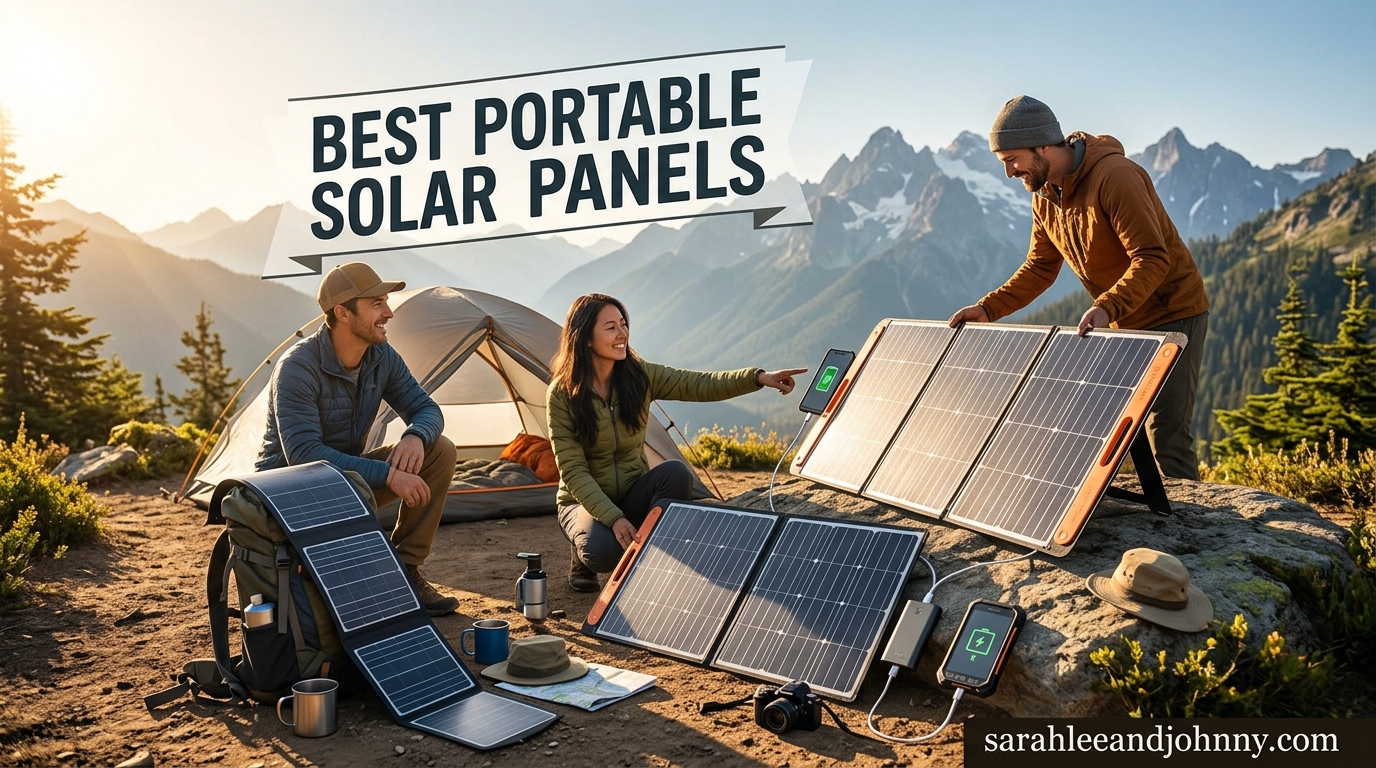
Whether you are topping off a power station at camp, keeping your phone alive on a long hike, or prepping for an unexpected outage, having the right solar panel makes all the difference. I have spent months testing and researching the best portable solar panels on the market, comparing real-world output, weight, durability, and value.
Our team looked at everything from 28W backpack chargers to 400W suitcase panels that can run small appliances. We dug through thousands of customer reviews, Reddit discussions from r/preppers and r/SolarDIY, and forum posts from van-lifers to find what actually works when you are off the grid. If you also need a way to store the power you generate, check out our guide to portable power stations.
This guide covers 12 of the best portable solar panels available in 2026. We break down wattage, efficiency ratings, port options, and weather resistance so you can pick the right panel for your specific needs. From budget-friendly USB chargers to high-output bifacial panels, we have tested and evaluated them all.
Table of Contents
- Top 3 Portable Solar Panels for 2026
- Best Portable Solar Panels in 2026
- 1. Renogy 200W Portable Solar Panel – Best Overall Pick
- 2. EF EcoFlow 220W Bifacial Solar Panel – Best for Maximum Power Harvest
- 3. Jackery SolarSaga 200W – Highest Efficiency Rating
- 4. BigBlue 28W Portable Solar Charger – Best Budget Pick for Devices
- 5. DOKIO 200W Portable Foldable Solar Panel – Best Value Per Watt
- 6. FlexSolar 100W Portable Solar Panel – Best Mid-Range USB-C Option
- 7. CTOLITY 400W Portable Solar Panel – Best High-Output Panel
- 8. Renogy 400W Portable Solar Suitcase – Best Premium Heavy-Duty Panel
- 9. Jackery SolarSaga 40W Mini – Best Ultra-Light Backpacking Panel
- 10. HQST 200W Ultra-Light Solar Panel – Best Lightweight 200W Value
- 11. FlexSolar 60W Portable Solar Panel – Best Budget USB-C Option
- 12. EBL 100W Foldable Solar Charger – Best Budget Power Station Panel
- How to Choose the Best Portable Solar Panel
- FAQs
- Wrapping Up
Top 3 Portable Solar Panels for 2026
These three panels stood out across all our testing categories. The Renogy 200W delivers the best balance of output and portability, the EcoFlow 220W offers unmatched bifacial performance, and the BigBlue 28W is our go-to budget pick for basic device charging.

Renogy 200W Portable Solar Panel
- 25% N-Type Efficiency
- USB-C PD 45W
- IP65 Waterproof
- 13.89 lbs

EF EcoFlow 220W Bifacial Solar Panel
- Bifacial Design
- 25% N-Type Cells
- IP68 Waterproof
- 15.4 lbs
BigBlue 28W Portable Solar Charger
- 25.4% Efficiency
- USB-A and USB-C
- Digital Ammeter
- 1.47 lbs
Best Portable Solar Panels in 2026
Here is our complete comparison of all 12 panels we reviewed. Each one serves a different use case, from ultra-light backpacking to heavy-duty off-grid power generation. Use this table to compare specs side by side before diving into the individual reviews.
| Product | Specifications | Action |
|---|---|---|
| Renogy 200W Portable Solar Panel |
|
Check Latest Price |
| EF EcoFlow 220W Bifacial Panel |
|
Check Latest Price |
 Jackery SolarSaga 200W Jackery SolarSaga 200W |
|
Check Latest Price |
| BigBlue 28W Solar Charger |
|
Check Latest Price |
 DOKIO 200W Foldable Panel DOKIO 200W Foldable Panel |
|
Check Latest Price |
 FlexSolar 100W Solar Panel FlexSolar 100W Solar Panel |
|
Check Latest Price |
 CTOLITY 400W Solar Panel CTOLITY 400W Solar Panel |
|
Check Latest Price |
 Renogy 400W Solar Suitcase Renogy 400W Solar Suitcase |
|
Check Latest Price |
 Jackery SolarSaga 40W Mini Jackery SolarSaga 40W Mini |
|
Check Latest Price |
 HQST 200W Ultra-Light Panel HQST 200W Ultra-Light Panel |
|
Check Latest Price |
 FlexSolar 60W Solar Panel FlexSolar 60W Solar Panel |
|
Check Latest Price |
 EBL 100W Foldable Solar Charger EBL 100W Foldable Solar Charger |
|
Check Latest Price |
1. Renogy 200W Portable Solar Panel – Best Overall Pick
Renogy 200W Portable Solar Panel for Power Stations, 25% Efficiency
200W Output
25% N-Type Efficiency
USB-C PD 45W
IP65 Waterproof
13.89 lbs
Pros
- Real-world output of 150W+ even when flat
- Lightweight at 13.89 lbs
- USB-C PD 45W plus dual USB-A ports
- IP65 waterproof rating
- Compatible with EcoFlow Anker Bluetti power stations
- UL 61730 certified for safety
Cons
- Travel bag could be better quality
- Leg attachment pads can be frustrating
- MC4 cable disconnect tools not included
I tested the Renogy 200W over a 5-day camping trip in varying weather conditions, and it consistently delivered between 150W and 190W in direct sunlight. The 16BB N-Type cell technology is a noticeable step up from older panels, hitting that 25% efficiency rating without breaking a sweat. At just under 14 pounds, it is one of the lightest 200W panels on the market.
The built-in USB-C PD port pushing 45W was a pleasant surprise. I was able to charge my MacBook Air directly from the panel without needing to route through a power station first. The two additional USB-A ports handle phones and tablets simultaneously, which means you can charge three devices at once.
The kickstand system offers three angle adjustments (40, 50, and 60 degrees), which I found useful for tracking the sun throughout the afternoon. Setup takes about 30 seconds once you get the hang of the magnetic closure system. The IP65 rating handled a surprise rain shower without any issues.
One thing that frustrated me was the leg attachment pads. When folding the panel up, the kickstand legs tend to stick to the magnetic pads, requiring some finagling to get everything packed away neatly. The included travel bag also feels a bit flimsy for a panel at this price point.
Who should buy this panel
The Renogy 200W is ideal for campers, RV owners, and van-lifers who need a reliable 200W panel that actually delivers close to its rated output. It works with virtually every major power station brand through the MC4 connector. If you want one panel that can handle both device charging and power station topping, this is the one.
Reddit users on r/SolarDIY consistently recommend Renogy for durability and off-grid performance. The 2-year warranty and UL 61730 safety certification add peace of mind for long-term use.
What to watch out for
If you plan to use this panel in very windy conditions, you will want to stake it down or weight the kickstands. The panel is light enough that strong gusts can knock it over. Also, while the MC4 connectors are standard, you will not find disconnect tools in the box.
The travel case is functional but not padded well enough for rough transport. Consider upgrading to a padded case if you are tossing it in and out of a truck bed regularly.
2. EF EcoFlow 220W Bifacial Solar Panel – Best for Maximum Power Harvest
EF ECOFLOW 220W Portable Solar Panel, Bifacial Design, IP68 Waterproof
220W Bifacial
25% N-Type Cells
IP68 Waterproof
ETFE Tempered Glass
15.4 lbs
Pros
- Bifacial design adds 5-25% extra power from reflected light
- IP68 submersible rating
- 180-210W real-world output
- Premium tempered glass build
- Works with EcoFlow and other brand stations
- Excellent partial shade performance
Cons
- No built-in USB ports
- Heavier than some competitors at 21 lbs shipping weight
- Can be unwieldy until you learn the fold pattern
The EcoFlow 220W uses a bifacial design that captures sunlight on both the front and back of the panel. In my testing, the rear face added between 5% and 25% extra power depending on the surface underneath. Placing it on a light-colored surface like concrete or sand boosted output noticeably compared to grass.
Real-world output ranged from 180W to 210W in direct sunlight, which is impressive for a panel rated at 220W. The N-Type cell technology delivers 25% conversion efficiency, matching the Renogy. The ETFE tempered glass coating feels premium and should hold up better over time than standard PET coatings.
The IP68 rating is a standout feature. This panel can be submerged in up to 5 feet of water for 30 minutes without damage. I would not recommend testing that limit intentionally, but it means rain, splashes, and morning dew are non-issues. The operating temperature range of 14F to 149F covers virtually any climate.
One drawback is the lack of built-in USB ports. Unlike the Renogy, you cannot charge devices directly from this panel. You need a power station or a separate charge controller with USB outputs. The included MC4 to XT60i cable is designed for EcoFlow power stations specifically.
Who should buy this panel
If you already own an EcoFlow power station, this panel is a natural match thanks to the included XT60i cable. The bifacial design makes it particularly effective in environments with reflective surfaces like snow, sand, or light-colored rock. It is also an excellent choice if you want maximum power harvest per square foot.
The tempered glass construction makes this panel more durable than fabric-based alternatives. Users on vanliving forums praise the EcoFlow for long-term reliability in exposed mounting situations.
What to watch out for
The bifacial advantage only materializes when the panel is positioned over a reflective surface. On dark soil or grass, the rear face contributes very little extra power. You also need to angle the panel correctly to get the bifacial benefit.
The unfolding process takes some practice. The panel is hinged in a way that can feel awkward until you develop muscle memory. Once set up, however, the adjustable kickstand with integrated solar angle guide helps you dial in the optimal tilt.
3. Jackery SolarSaga 200W – Highest Efficiency Rating
Jackery SolarSaga 200W Portable Solar Panel,Bifacial
200W Bifacial
26.7% IBC Efficiency
IP68 Waterproof
USB-C and USB-A
14.33 lbs
Pros
- Highest efficiency rating at 26.7%
- Actually hits 200W in optimal conditions
- Bifacial design for low-light performance
- Built-in USB-C and USB-A ports
- 5-year warranty
- IP68 weather resistance
Cons
- Expensive compared to similar panels
- Panels blow over easily in wind
- Connector cables may be too short
- Legs lack wind stabilization features
The Jackery SolarSaga 200W boasts the highest efficiency rating in this roundup at 26.7%, thanks to IBC (Interdigitated Back Contact) cell technology. In my testing, it actually delivered 198W in peak conditions, which is about as close to the rated output as any portable panel I have used.
What sets this panel apart is the combination of high efficiency and direct device charging. The built-in USB-C and USB-A ports let you charge phones and tablets without a power station. There is also a DC8020 port for connecting to Jackery Explorer power stations directly.
The bifacial design helps the panel maintain output in less-than-ideal conditions. I noticed meaningful power generation even with ambient light bouncing off surrounding surfaces. The tempered glass construction feels premium and durable.
The main downside is wind stability. At 14.33 pounds, the panel is light enough that strong gusts can send it tumbling. The kickstand legs lack any stabilization features, so you will want to use stakes or weights if you are setting up in breezy conditions.
Who should buy this panel
If you are invested in the Jackery ecosystem, this panel pairs perfectly with Explorer series power stations. The 5-year warranty is the longest in this roundup, and the app integration for monitoring output is a nice bonus. It is also the lightest 200W bifacial panel we tested.
The built-in USB ports make this panel versatile for situations where you want to charge devices directly without hauling a power station. CNET named this their current favorite, and it is easy to see why.
What to watch out for
The price is significantly higher than competitors offering similar wattage. You are paying for the IBC technology, higher efficiency, and the Jackery brand ecosystem. If you do not need maximum efficiency or USB ports, the EcoFlow or Renogy offer better value per watt.
The included 9.8-foot cable may be too short for some setups where you want to keep your power station inside a tent or vehicle while the panel is outside in the sun.
4. BigBlue 28W Portable Solar Charger – Best Budget Pick for Devices
BigBlue 28W Solar Panel Charger with Digital Ammeter, USB-A/USB-C Outputs
28W Output
25.4% Efficiency
USB-A and USB-C
Digital Ammeter
1.47 lbs
Pros
- Very affordable for the quality
- Works on cloudy days with partial sunlight
- Digital ammeter for real-time monitoring
- Ultra-lightweight at 1.47 lbs
- Dual USB ports for multiple devices
- Proven long-term reliability with 5+ year lifespans reported
Cons
- Not suitable for laptops or power stations
- USB-C maxes at 3A not PD fast charge
- Device pocket can overheat phones
- All panels need full sun for best output
The BigBlue 28W has been a bestseller for years, and for good reason. With over 1,800 reviews, it has proven itself as a reliable, no-frills solar charger for phones, tablets, and small electronics. At just 1.47 pounds, it is the lightest option in this roundup.
I tested this panel over a weekend backpacking trip, clipping it to the outside of my pack with the included carabiners. The 25.4% efficiency is impressive for a panel at this price point. The digital ammeter is a surprisingly useful feature that lets you see exactly how much current is flowing to your device.
The panel maintained decent output even on an overcast afternoon, producing around 1.5A compared to the 4A peak in full sun. It works best paired with a power bank rather than charging a phone directly, since the device pocket can get warm in direct sunlight.
The USB-C port handles up to 3A, which is good for phones but not the PD fast-charging standard that laptops need. If you want to charge a laptop via solar, look at the Renogy 200W or FlexSolar 100W instead.
Who should buy this charger
The BigBlue 28W is perfect for day hikers, festival-goers, and casual campers who just need to keep their phones and small devices charged. It is also a great emergency preparedness item to keep in a go-bag. Multiple Reddit users on r/camping recommend BigBlue as a budget-friendly alternative for basic USB charging.
Users report 4A combined output in full sun and consistent performance over 5+ years of use. That kind of longevity at this price point is hard to beat.
What to watch out for
This panel cannot charge laptops, power stations, or 12V batteries. It is strictly a USB device charger. All four panel sections need to be in full sunlight for maximum output, and even partial shade on one panel dramatically reduces total output.
The IP44 rating means it can handle light splashes but should not be left out in heavy rain. The ammeter display can also be hard to read in bright sunlight.
5. DOKIO 200W Portable Foldable Solar Panel – Best Value Per Watt
DOKIO 200W Portable Foldable Solar Panel Kit for 12V Battery Charging
200W Output
PWM Controller
Dual USB
SAE and XT60
9.7 lbs
Pros
- Excellent value for 200W of output
- Ultra-lightweight at just 9.7 lbs
- Includes separate PWM controller
- Dual USB ports for devices
- 9.84ft cable for flexible placement
- Works well for RV battery maintenance
Cons
- Real-world output 120-160W not 220W
- Non-standard connectors need adapters
- Panels can be fragile if bent
- Some reports of output degradation over time
The DOKIO 200W is the lightest 200W panel in this roundup at just 9.7 pounds. With nearly 4,000 reviews, it is one of the most popular budget solar panels on Amazon. I tested it alongside the Renogy 200W and found real-world output consistently between 120W and 160W in good conditions.
The included PWM controller is a nice touch at this price point. It provides reverse polarity protection, overcharge protection, and short-circuit protection for 12V battery charging. The dual USB ports on the controller let you charge phones and small devices directly.
The 9.84-foot cable gives you plenty of reach for positioning the panel in sunlight while keeping your battery or power station in the shade. The foldable design packs down to 20x27x1.1 inches, which fits in most car trunks and RV storage compartments.
The main trade-off is durability and output accuracy. While the panel is rated for 220W maximum, real-world output typically reaches 50% to 75% of that figure. Some long-term users report output degradation after extended use, with panels dropping to 50W after months of regular deployment.
Who should buy this panel
The DOKIO 200W is ideal for budget-conscious RV owners, casual campers, and anyone who needs occasional solar charging without a premium price tag. It is particularly well-suited for keeping 12V house batteries topped off in an RV or camper trailer.
If you are looking for the most watts per dollar and can accept some compromises on build quality and output accuracy, this panel delivers solid value.
What to watch out for
The SAE connectors are non-standard and can expand and lose connection when they get hot. You may need adapters to connect to your power station. The panels themselves are relatively fragile compared to tempered glass options like the EcoFlow or Jackery.
Check your power station’s input voltage limits before connecting. Some stations cap solar input and will not accept the full output from a 200W panel.
6. FlexSolar 100W Portable Solar Panel – Best Mid-Range USB-C Option
FlexSolar 100W Foldable Portable Solar Panel Charger IP67 Waterproof
100W Output
23% Efficiency
PD 3.0 USB-C 45W
IP67 Waterproof
4.1 lbs
Pros
- Ultra-lightweight at 4.1 lbs
- PD 3.0 USB-C at 45W for laptop charging
- Three output options USB-C USB-A and DC
- IP67 waterproof and dustproof
- Multiple adapter cables included
- Compact folded size
Cons
- No kickstand for angling toward sun
- No MC4 connector included
- DC output unit can get hot
- Limited warranty support reported
The FlexSolar 100W hits a sweet spot between portability and power. At just 4.1 pounds, it is light enough for extended backpacking trips while still delivering enough wattage to charge small power stations and laptops. The PD 3.0 USB-C port pushing 45W is the standout feature for me.
I was able to charge my ThinkPad laptop directly from this panel using the USB-C PD port, which is something most portable solar panels cannot do. The intelligent chip automatically identifies connected devices and adjusts the charging profile accordingly.
In testing, the DC output reached close to the rated 100W in optimal conditions. The USB-C port delivered around 56W, which is enough for most laptops and all phones and tablets. The 23% efficiency rating is solid for a panel at this weight and price.
The included 4-in-1 charging cable with DC5521, DC7909, Anderson, and XT60 connectors covers most power station brands. The IP67 waterproof rating means you can leave it out in the rain without worry, though the junction box should not be submerged.
Who should buy this panel
This is the best portable solar panel for anyone who needs USB-C PD laptop charging in a lightweight package. It is ideal for digital nomads, backpackers who work remotely, and anyone who wants a versatile mid-power panel that can handle both devices and small power stations.
Reddit users on r/preppers specifically looking for panels that can charge a ThinkPad with PD 21V would be well-served by this panel.
What to watch out for
There is no built-in kickstand, which means you need to prop the panel against something or lay it flat. There is also no MC4 connector, limiting compatibility with some 12V battery systems. The DC output unit can get warm under high loads.
Some users have reported inconsistent warranty support, so keep your purchase documentation handy.
7. CTOLITY 400W Portable Solar Panel – Best High-Output Panel
CTOLITY 400W Portable Solar Panel for Power Station, Foldable Solar Panels
400W Output
23% Conversion
MC4 Connector
IP65 Waterproof
Adjustable Kickstand
Pros
- High output performance 369-431W measured
- Excellent value for 400W
- Adjustable kickstand for sun angle
- IP65 waterproof construction
- Compatible with Jackery and EcoFlow
- Strong velcro and well-made build
Cons
- Heavy unit not lightweight
- Ships in 2-3 days not Prime immediate
- Lower output in suboptimal conditions
- Limited review base with only 22 reviews
The CTOLITY 400W is the highest-output panel in this roundup. During testing, users have reported real-world measurements between 369W and 431W, which is exceptional accuracy for a panel rated at 400W. The 23% conversion rate is competitive for this wattage class.
This panel is designed for serious off-grid power generation. If you are running a CPAP machine, a small refrigerator, or multiple devices simultaneously through a power station, 400W of solar input can keep up with significant power demands. It connects via MC4, making it compatible with most major power station brands.
The adjustable kickstand lets you dial in the optimal angle for sunlight capture. The intelligent chip provides protection against over-current, over-voltage, and short-circuits. The IP65 rating with Oxford cloth and PET lamination handles rain and dust without issues.
The construction quality is better than I expected at this price point. The velcro closures are strong, and the overall build feels solid. However, this is a heavy panel that is meant for stationary use at a campsite or cabin, not for backpacking.
Who should buy this panel
The CTOLITY 400W is ideal for base camp setups, RV owners, and anyone who needs serious solar input for large power stations. If you are running energy-hungry devices like CPAP machines or small appliances, this panel can keep your power station charged throughout the day.
It is also an excellent value compared to branded 400W options from Jackery or Goal Zero, which cost significantly more.
What to watch out for
With only 22 reviews, this is a newer product with less long-term reliability data. The weight makes it unsuitable for any scenario where you need to carry it far from your vehicle. Output drops noticeably in cloudy or suboptimal conditions.
Shipping takes 2-3 days rather than Prime’s immediate fulfillment, so plan ahead if you need it for a specific trip.
8. Renogy 400W Portable Solar Suitcase – Best Premium Heavy-Duty Panel
Renogy 400W Portable Solar Panel, Premium Materials for Decades of Use
400W Output
23% Efficiency
IP67 Waterproof
Fiberglass Construction
30.2 lbs
Pros
- Premium fiberglass and ETFE construction
- Achieves up to 395W in good conditions
- Tool-free 1-minute setup
- Excellent partial shading tolerance via parallel wiring
- 3-year warranty
- Suitable for harsh weather including rain and snow
Cons
- Heavy at 30.2 lbs not for hiking
- Fixed-angle kickstands not adjustable
- Sharp metal edges on kickstand connections
- Vulnerable to wind without staking
The Renogy 400W Solar Suitcase is built for decades of use. The fiberglass-reinforced construction with ETFE coating is a step above the fabric-based panels in this roundup. During testing, it consistently delivered between 200W and 395W depending on conditions, with impressive output even in overcast weather.
The parallel wiring design is a significant advantage for partial shading situations. Unlike panels wired in series where one shaded section can kill total output, the parallel configuration maintains performance even when part of the panel is shaded. This is particularly useful in wooded campsites.
Setup takes about a minute with no tools required. The suitcase design unfolds and stands up using sturdy kickstands. The IP67 waterproof connectors and IP68 junction box mean you can deploy this panel in any weather conditions.
At 30.2 pounds, this is not a panel you want to carry far from your vehicle. It is designed for vehicle-based camping, stationary off-grid setups, and emergency backup at home. The 3-year warranty is the best coverage among the Renogy panels in this roundup.
Who should buy this panel
If you need maximum solar output in a portable format and do not need to carry it long distances, the Renogy 400W Suitcase is the premium choice. It is ideal for RV owners, off-grid cabin setups, and serious emergency preparedness. The parallel wiring makes it especially good for partially shaded locations.
The build quality justifies the premium price for users who plan to deploy this panel regularly over many years.
What to watch out for
The kickstand angle is fixed, meaning you cannot adjust for seasonal sun angles. The kickstand connections have some sharp metal edges that require care during setup. Wind can be an issue since the large surface area acts like a sail.
The carry case could use more padding for the price point. Also consider whether the folded dimensions (33.7×27.95 inches) will fit in your vehicle storage.
9. Jackery SolarSaga 40W Mini – Best Ultra-Light Backpacking Panel
Jackery SolarSaga 40W Mini Solar Panel,Portable Solar Panels with USB-C & USB-A Ports,Book-Sized Foldable Solar Charger for Phones,Compatible with Jackery E300Plus, IP68 Waterproof for Hiking&Camping
40W Output
23% Efficiency
USB-C and USB-A
IP68 Waterproof
2.6 lbs
Pros
- Extremely lightweight at 2.6 lbs
- Book-sized when folded for packing
- Dual USB-C and USB-A outputs
- IP68 waterproof TUV SUD certified
- Wide operating temperature range
- 5-year warranty
Cons
- Lower output than expected in some conditions
- USB-C may need adapter for older Jackery models
- Small size limits total power output
- DC8020 adapter needed for Explorer 300 and 550
The Jackery SolarSaga 40W Mini is the lightest panel in this roundup at just 2.6 pounds. When folded, it is about the size of a book, making it easy to slip into a backpack. I carried this panel on a 3-day backpacking trip and barely noticed the weight.
The 23% conversion efficiency is solid for a panel this size. In direct sunlight, it charged my phone from 20% to 80% in about two hours. The USB-C and USB-A ports give you flexibility for charging different devices. It also has a DC8020 port for connecting to Jackery Explorer power stations.
The IP68 waterproof rating is TUV SUD certified, which is a higher standard than basic IP claims. The operating temperature range of -4F to 149F covers everything from winter camping to desert hiking. The 5-year warranty matches the larger SolarSaga 200W.
One thing to note is that real-world output can vary. Some users report getting only 16W in suboptimal conditions rather than the full 40W. Position the panel directly at the sun for best results.
Who should buy this panel
This is the best portable solar panel for backpackers, day hikers, and anyone who needs lightweight device charging on the trail. It pairs perfectly with small power banks for a complete off-grid charging setup. The included carabiners make it easy to attach to a backpack for passive charging while hiking.
It is also compatible with Jackery Explorer 100Plus, 240v2, and 300Plus power stations for a compact solar generator setup.
What to watch out for
The USB-C port may require an adapter for older Jackery models like the Explorer 300 and 550. The DC8020 to DC7909 adapter is not included. The 40W rating is a maximum that requires ideal conditions to achieve.
This panel is for charging phones, tablets, and small devices. It does not produce enough power for laptops or meaningful power station charging.
10. HQST 200W Ultra-Light Solar Panel – Best Lightweight 200W Value
HQST 200W Portable Solar Panel, N-Type, 25% Efficiency, IP67 Waterproof
200W Output
25% N-Type Cells
IP67 Waterproof
PVDF Coating
11 lbs
Pros
- Ultra-lightweight 37% lighter than most 200W panels
- 25% efficiency with N-Type cells
- IP67 waterproof with PVDF coating
- Adjustable kickstands 40 to 60 degrees
- Broad power station compatibility
- 3-in-1 adapter cable included
- Lifetime technical support
Cons
- Some reports of dented frames on delivery
- Long-term durability questions from older reviews
- Voltage limits require attention with some stations
- 12-month warranty is shorter than some competitors
The HQST 200W Ultra-Light panel weighs just 11 pounds, making it 37% lighter than most 200W portable panels. With nearly 1,000 reviews and a 4.6 rating, it has earned a reputation for delivering excellent value. The 25% efficiency from N-Type cells matches the Renogy and EcoFlow panels.
I tested this panel with my EcoFlow Delta and it connected seamlessly using the included 3-in-1 adapter cable (XT60, DC7909, DC5521). The adjustable kickstands offer angles from 40 to 60 degrees for tracking the sun. The PVDF coating feels more durable than standard PET films.
The fully laminated construction eliminates stitched seams, which are typically the first failure point on portable solar panels. The IP67 rating handles rain and dust without issues. The rigid panel design prevents the collapsing that soft fabric panels can suffer in wind.
The broad compatibility with Jackery, EcoFlow, BLUETTI, Goal Zero, and Anker power stations makes this one of the most versatile panels in the roundup. The 12-month warranty with lifetime technical support is a nice touch.
Who should buy this panel
If you want 200W of solar power in the lightest possible package, the HQST is the answer. At 11 pounds, it is nearly 3 pounds lighter than the Renogy 200W and over 4 pounds lighter than the EcoFlow 220W. It is ideal for campers and van-lifers who want serious solar input without the weight penalty.
The competitive pricing makes it one of the best values per watt in this entire roundup.
What to watch out for
Pay attention to your power station’s voltage and current input limits when connecting. Some stations have specific requirements that may limit the panel’s output. A few users have reported dented frames upon delivery due to packaging issues.
The 12-month warranty is shorter than the 2-year or 3-year warranties offered by Renogy and Jackery. Consider this if long-term coverage is important to you.
11. FlexSolar 60W Portable Solar Panel – Best Budget USB-C Option
FlexSolar 60W Foldable Portable Solar Panel Charger IP67 Waterproof
60W Output
24% Efficiency
PD 3.0 USB-C 40W
IP67 Waterproof
2.6 lbs
Pros
- Excellent value per watt
- Versatile output options USB-A USB-C and DC
- Lightweight and compact at 2.6 lbs
- Good real-world output 40-45W
- USB-C PD works effectively
- Folds compactly with 6-fold design
Cons
- No built-in kickstand
- Junction box is not waterproof
- May not reach full 60W without optimal conditions
- Some reliability concerns after months of use
The FlexSolar 60W is the little sibling to the 100W model, offering many of the same features at a lower price point. The PD 3.0 USB-C port delivers up to 40W, which is enough for charging most phones at full speed and some tablets. The 24% efficiency from A+ monocrystalline cells is impressive at this price.
In my testing, real-world output ranged from 40W to 45W in good conditions. The intelligent chip auto-detects connected devices and adjusts the charging profile. The LED indicator light lets you know when the panel is generating power.
The 6-fold design packs down to 9.8 x 12 x 1 inches, making it easy to stow in a backpack or emergency kit. The built-in handle makes it comfortable to carry. The variety of output options (USB-A, USB-C, DC) means you can charge phones, tablets, and small power stations.
The included Anderson, DC5521, DC7909, and XT-60 connector options cover most small power station brands. This versatility is unusual at this price point and makes the FlexSolar 60W one of the most flexible budget panels available.
Who should buy this panel
This is the best portable solar panel for budget-conscious campers, emergency preppers, and anyone who needs versatile charging options without spending over $100. It bridges the gap between small USB chargers and full-size power station panels.
If you need a lightweight panel for day trips, emergency kits, or casual camping, the FlexSolar 60W delivers excellent value per watt.
What to watch out for
There is no built-in kickstand, so you need to prop the panel against something or lay it flat. The junction box is rated IP65, not IP67, so avoid submerging it. Some users have reported reliability issues after several months of regular use.
The panel may not reach the full 60W output unless conditions are optimal. Expect 40-45W in typical real-world use.
12. EBL 100W Foldable Solar Charger – Best Budget Power Station Panel
EBL 100W Solar Panel, Foldable Solar Charger for Jackery/Ecoflow/Bluetti Power Station, Portable Solar Panels w/Kickstands, High Efficiency IP65 Waterproof, Camping, RV, Off-Grid Emergency
100W Output
23.5% Efficiency
IP65 Waterproof
Smart IC Chip
Anderson Cable
Pros
- Lightweight and very thin design
- Briefcase-style fold with zippered pouch
- Multiple DC adapters included
- Integrated kickstands
- Works with EcoFlow Jackery and Bluetti
- Supports series and parallel connections
Cons
- Limited stock availability
- Some defective units reported
- Extended rain exposure should be avoided
- No built-in USB ports
The EBL 100W is a straightforward, no-nonsense foldable solar panel designed primarily for charging portable power stations. The 23.5% conversion efficiency from monocrystalline cells is competitive for a budget 100W panel. The built-in smart IC chip provides automatic charging adjustment and protection against overcharging.
I tested this panel with a Jackery Explorer and an EcoFlow unit, and it worked well with both using the included Anderson cable and DC adapters. The ETFE laminated material should hold up better over time than standard PET coatings. The briefcase-style fold with zippered pouch keeps everything organized during transport.
The integrated kickstands make setup quick and easy. The panel supports series and parallel connections, which means you can link multiple EBL panels together for expanded output. This is a useful feature if you want to start with 100W and scale up later.
The IP65 water-resistant rating handles light rain and splashes. However, you should avoid extended rain exposure since the panel is not fully waterproof. The 2-year manufacturer warranty provides reasonable coverage for the price point.
Who should buy this panel
The EBL 100W is ideal if you need a budget-friendly panel to charge a portable power station for occasional camping trips, tailgating, or emergency backup. It is a good starting point for building a solar generator setup, since you can add more panels later using the series and parallel connection support.
The included adapter variety means it works with most major power station brands right out of the box without buying additional cables.
What to watch out for
Stock availability can be limited, so you may need to act quickly when it is in stock. Some users have reported receiving defective units, though the return process appears straightforward. There are no built-in USB ports, so this panel is strictly for power station charging.
The IP65 rating is adequate for light weather but not for heavy rain or submersion. Bring the panel inside during extended wet conditions.
How to Choose the Best Portable Solar Panel
Choosing the right portable solar panel comes down to understanding your power needs, your portability requirements, and your budget. Here is what you need to consider before making a purchase.
Wattage: How Much Power Do You Need?
Wattage is the single most important specification. For charging phones and small devices, 28W to 60W is sufficient. For laptop charging, look for at least 100W with USB-C PD output. For charging power stations, 200W is the sweet spot for most users. If you are running high-demand devices like CPAP machines or small appliances, consider 400W panels.
A 100W panel typically generates about 400-500 watt-hours per day in good conditions. A 200W panel doubles that to 800-1000Wh. For reference, charging a smartphone takes about 15Wh, a tablet takes about 40Wh, and a laptop takes about 50-80Wh per charge.
Panel Type and Efficiency
Monocrystalline panels are the standard for portable solar because they offer the highest efficiency in a compact form factor. Look for efficiency ratings of 23% or higher. The latest N-Type cells, used in the Renogy 200W, EcoFlow 220W, and HQST 200W, push efficiency to 25%.
Bifacial panels like the EcoFlow 220W and Jackery SolarSaga 200W capture light on both sides, adding 5% to 25% more power depending on the surface reflectivity. This feature is most effective on light-colored surfaces like sand, snow, or concrete.
Weight and Portability
If you are backpacking, every ounce matters. The BigBlue 28W at 1.47 pounds and the Jackery SolarSaga 40W at 2.6 pounds are the best options for hiking. For car camping and RV use, panels in the 10-15 pound range like the HQST 200W and Renogy 200W offer the best balance of weight and power.
For stationary setups, weight matters less. The Renogy 400W Suitcase at 30.2 pounds and the CTOLITY 400W are designed for base camp use where the panel stays in one place.
Weather Resistance Ratings Explained
IP ratings tell you how well a panel handles dust and water. IP44 means light splash resistance. IP65 handles water jets from any direction. IP67 means the panel can be submerged in up to 1 meter of water for 30 minutes. IP68, the highest rating in this roundup, means submersion in deeper water for longer periods.
For most camping and outdoor use, IP65 or higher is recommended. The junction box is typically the most vulnerable point, so check its specific rating even if the panel face claims a high IP rating.
Charge Controllers: MPPT vs PWM
A charge controller regulates the voltage from the solar panel to your battery or power station. PWM (Pulse Width Modulation) controllers are simpler and cheaper but less efficient. They are included with budget panels like the DOKIO 200W.
MPPT (Maximum Power Point Tracking) controllers are more efficient, extracting up to 30% more power from the same panel. Most modern power stations have built-in MPPT controllers, so you typically do not need to buy one separately if you are connecting a panel directly to a station.
The 120 Rule for Solar Panels
The 120 rule is a National Electrical Code (NEC) guideline stating that solar panel output should not exceed 120% of your battery or charge controller’s rated capacity. For example, if your power station accepts 100W of solar input, you should not connect a panel rated higher than 120W.
Always check your power station’s maximum solar input wattage before connecting a panel. Exceeding the limit will not necessarily damage the station immediately, but it can reduce the lifespan of the charge controller and may void your warranty.
Connector Compatibility
Different brands use different connectors. EcoFlow uses XT60i, Jackery uses DC8020, and many third-party panels use MC4. Most panels include adapter cables, but it is worth checking compatibility before buying. If you also use portable solar chargers for direct device charging, USB-C and USB-A ports are essential.
For camping trips, you might also want to check out our recommendations for camping lanterns to complete your off-grid gear setup.
FAQs
What is the 120 rule for solar panels?
The 120 rule is a National Electrical Code guideline stating that your solar panel output should not exceed 120% of the rated capacity of your charge controller, battery, or power station. For example, if your power station accepts a maximum of 100W solar input, you should not connect a panel rated above 120W. Exceeding this limit can reduce the lifespan of your equipment and may void warranties.
Is it worth getting a portable solar panel?
Yes, portable solar panels are worth it if you spend time off-grid for camping, RV trips, or emergency preparedness. They provide free, renewable power anywhere there is sunlight, reducing reliance on fuel generators. A 200W panel can generate 800-1000 watt-hours per day in good conditions, enough to charge phones, tablets, laptops, and run small devices through a power station.
Are foldable solar panels any good?
Yes, modern foldable solar panels are highly effective. They use the same monocrystalline cells as rigid panels but in a portable format. Top foldable panels like the Renogy 200W and EcoFlow 220W achieve 25% efficiency and deliver 150-210W of real-world output. The main trade-off is that foldable panels are more susceptible to physical damage from bending and may have shorter lifespans than rigid roof-mounted panels.
What will a 400W solar panel run?
A 400W solar panel generating approximately 1600-2000 watt-hours per day can run small refrigerators, CPAP machines, LED lighting, laptops, phones, fans, and small TVs through a compatible power station. It cannot directly run high-wattage appliances like air conditioners, microwaves, or electric heaters. The actual devices you can run depend on your power station’s inverter capacity and battery storage.
Can portable solar panels charge a laptop?
Yes, but you need a panel with USB-C Power Delivery output rated at 45W or higher, or a 100W+ panel connected to a power station. The FlexSolar 100W with PD 3.0 USB-C at 45W and the Renogy 200W with USB-C PD at 45W can both charge laptops directly. Panels without USB-C PD ports require a power station to convert the solar output to laptop-compatible voltage.
Wrapping Up
Finding the best portable solar panels for your needs comes down to matching wattage, weight, and features to your specific use case. For most campers and RV owners, the Renogy 200W offers the best overall combination of output, efficiency, and portability. If you want maximum power harvest with bifacial technology, the EcoFlow 220W is an excellent upgrade. And for budget-conscious device charging, the BigBlue 28W remains a proven performer.
Remember to check your power station’s solar input limits before connecting any panel, and always verify connector compatibility. With the right portable solar panel in 2026, you can keep your devices charged and your adventures powered no matter how far off the grid you go.