
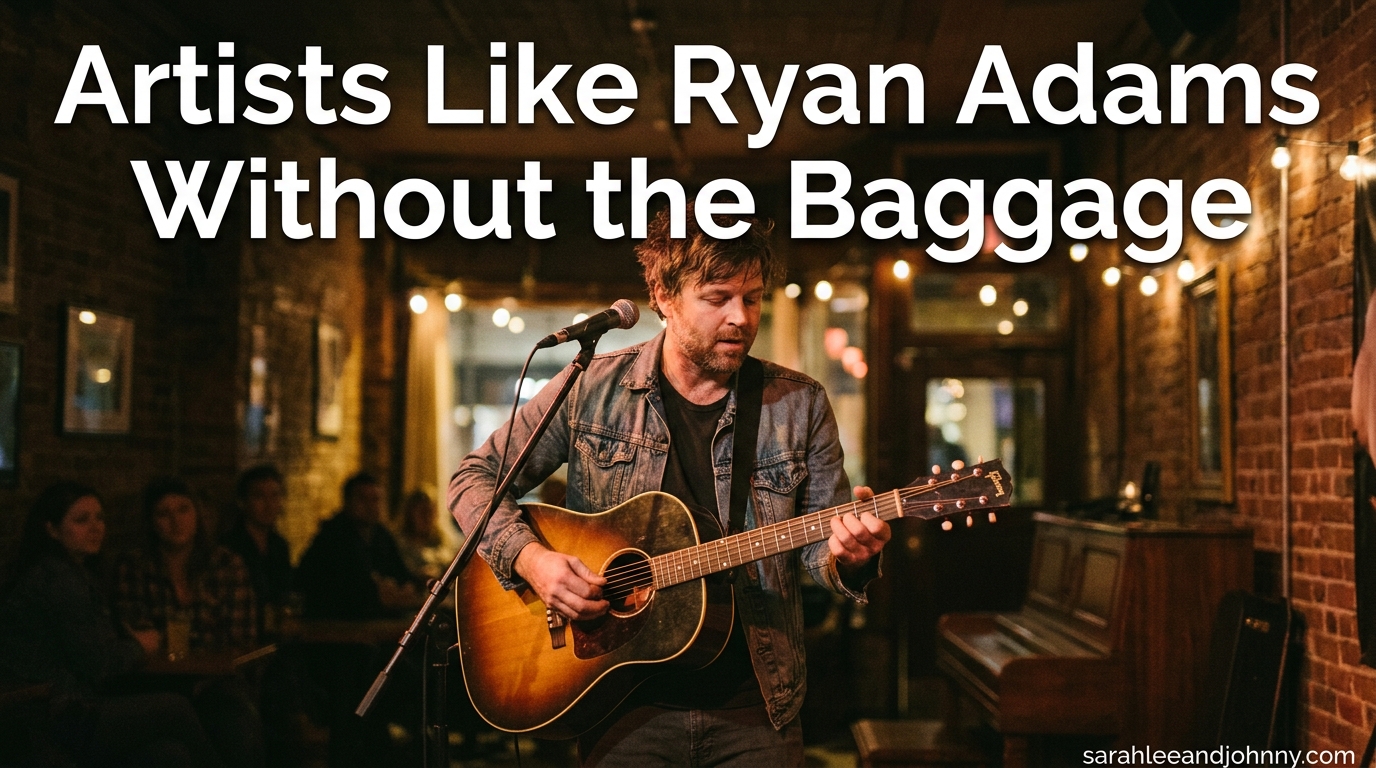
Ryan Adams built a career on songs that feel like reading someone’s diary. His blend of Americana, alt-country, and raw confessional songwriting produced some of the most emotionally devastating music of the 2000s. Albums like Heartbreaker, Gold, and Love Is Hell defined a sound that millions of fans fell in love with.
But in 2026, many of those same fans find themselves in an uncomfortable spot. The 2019 New York Times investigation detailed allegations of manipulative behavior and exploitation of younger artists, particularly women. For listeners who connected deeply with Adams’ music, the question became real and immediate: where do you find that same musical experience without the ethical weight?
The good news is that Adams did not invent confessional Americana. He popularized a specific strain of it, but the well runs deep. There are singer-songwriters working right now who deliver the same heartbreak, the same intimate vocals, the same acoustic grit — and they bring none of the offstage drama. Our team has spent years listening through the entire Americana and indie-folk landscape to find artists who hit those same emotional receptors.
This guide covers 12 artists like Ryan Adams without the baggage. Whether you miss the stripped-back acoustic moments, the full-band rockers, or the late-night sad songs, there is someone on this list for you. Each recommendation comes with specific albums and tracks to start with, so you can jump right in.
Table of Contents
- 12 Artists Like Ryan Adams (Without the Baggage): Quick List
- Jason Isbell: The Closest You Will Get
- Wilco: Experimental Americana With Emotional Depth
- Iron & Wine: The Quiet Alternative
- The Confessional Songwriters
- Phoebe Bridgers: Devastation With Indie Sensibility
- Ray LaMontagne: Raspy Warmth and Raw Vulnerability
- The Americana Traditionalists
- Hayes Carll: Texas Wit Meets Heartbreak
- Josh Rouse: Warm Nashville Indie-Folk
- Drive-By Truckers: Southern Storytelling at Its Finest
- Modern Americana Voices
- Lambchop: Atmospheric Nashville Oddballs
- Hiss Golden Messenger: Spiritual Americana for the Modern Era
- Nathaniel Rateliff: Gravel-Voiced Heartland Rock
- Dawes: Laurel Canyon Craft
- What Makes These Artists Sound Like Ryan Adams
- Frequently Asked Questions About Artists Like Ryan Adams
- Final Thoughts: Your New Playlist Awaits
12 Artists Like Ryan Adams (Without the Baggage): Quick List
Before we get into the details, here is the full list of recommended artists with a similarity score so you can see who matches your taste closest. These are all musicians who share Ryan Adams’ songwriting DNA — confessional lyrics, Americana arrangements, and emotional honesty — without any of the personal controversy.
- Jason Isbell (95% match) — The closest living alternative; former Drive-By Trucker turned solo Americana powerhouse with devastating lyrics about addiction, love, and redemption.
- Wilco (88% match) — Jeff Tweedy’s band blends experimental production with deeply personal songwriting that mirrors Adams’ genre-hopping instincts.
- Iron & Wine (85% match) — Sam Beam’s whispery, literary folk delivers the same late-night intimacy that made Adams’ acoustic work so powerful.
- Phoebe Bridgers (82% match) — A younger generation’s answer to confessional songwriting, with devastating emotional precision and indie-Americana arrangements.
- Ray LaMontagne (80% match) — Raspy-voiced folk-rock with raw vulnerability that hits the same nerve Adams does on his quieter albums.
- Hayes Carll (78% match) — Texas songwriter tradition blending wit and heartbreak in equal measure, very much in the Adams lyrical mold.
- Lambchop (77% match) — Nashville-based but gloriously weird; atmospheric alt-country that rewards deep listening.
- Josh Rouse (76% match) — Warm, polished indie-folk with Nashville tones and a consistent quality that rivals Adams’ best work.
- Hiss Golden Messenger (75% match) — Modern Americana with spiritual undertones and the kind of genre-blending Adams built his name on.
- Drive-By Truckers (74% match) — Southern rock storytelling at its finest, with multiple songwriters who each bring confessional depth.
- Nathaniel Rateliff (73% match) — Gravel-voiced heartland rock that channels the same working-class emotion Adams captured on his rock-oriented records.
- Dawes (72% match) — Laurel Canyon folk-rock with classic songwriter craft and the kind of earnest lyrical approach Adams fans love.
Jason Isbell: The Closest You Will Get
If there is one artist on this list who can genuinely replace Ryan Adams in your listening rotation, it is Jason Isbell. The similarity is almost uncanny — both are Southern-born songwriters who got their start in raucous bands (Isbell in Drive-By Truckers, Adams in Whiskeytown) before going solo and revealing themselves as two of the finest lyricists of their generation.
Isbell’s 2013 album Southeastern is the closest equivalent to Adams’ Heartbreaker — a record written in the aftermath of getting sober that lays bare every wound with unflinching honesty. Songs like “Cover Me Up,” “Elephant,” and “Traveling Alone” deliver the same gut-punch emotional impact that made Adams’ best work so compelling. The arrangements are sparse where they need to be, full-bodied when the song calls for it, and always serve the lyrics.
What separates Isbell from Adams — beyond the obvious lack of controversy — is an evolving maturity in his writing. His later albums, Something More Than Free (2015), The Nashville Sound (2017), and Reunions (2020), show a songwriter growing into his own skin, tackling fatherhood, marriage, politics, and the slow work of becoming a better person. His wife, Amanda Shires, is an accomplished artist in her own right, and their creative partnership adds another dimension to his work.
Where to start with Jason Isbell:
- Album: Southeastern (2013) — Start here, no question
- Track one: “Cover Me Up” — A love song so raw it feels invasive to listen to
- Track two: “Elephant” — Perhaps the finest song about dying written in the 21st century
- Track three: “If We Were Vampires” — From The Nashville Sound, a devastating meditation on mortality and love
The Reddit community consistently votes Isbell as the number one Ryan Adams alternative, and for good reason. One user on r/Music put it simply: “Jason Isbell — you’ll love him.” That recommendation has been echoed thousands of times across forums, and it holds up. Isbell is the answer to this question.
Wilco: Experimental Americana With Emotional Depth
Wilco occupies a unique position in the Ryan Adams conversation because Jeff Tweedy and Adams were friends and occasional collaborators for years. Tweedy produced albums, they shared stages, and their musical sensibilities overlap significantly. But where Adams tends to channel his emotions directly through conventional song structures, Tweedy pushes his into stranger, more experimental territory.
That experimentation is what makes Wilco such a rewarding alternative. Albums like Yankee Hotel Foxtrot (2001) and A Ghost Is Born (2004) blend Americana with avant-garde production, noise experiments, and ambient textures. The emotional core is identical to what Adams does — Tweedy writes about loneliness, doubt, love, and American life with the same confessional intensity — but the sonic wrapper is more adventurous.
For Adams fans who loved the fuller-band moments — think “New York, New York” or the Cardinals-era rockers — Wilco’s live performances are essential viewing. Tweedy’s band can swing from whisper-quiet ballads to full-throttle guitar workouts within the same set, much like Adams at his peak.
Where to start with Wilco:
- Album: Yankee Hotel Foxtrot (2001) — The masterpiece
- Track one: “Jesus, Etc.” — Heartbreak wrapped in beautiful pedal steel and strings
- Track two: “Misunderstood” — From Being There, a slow-burn anthem of frustration
- Track three: “How to Fight Loneliness” — From Summerteeth, the kind of sad, pretty song Adams wishes he wrote
Iron & Wine: The Quiet Alternative
When you think about Ryan Adams’ acoustic side — the fingerpicked ballads, the hushed vocals, the feeling of being alone in a room with someone pouring their heart out — Iron & Wine is the artist who fills that space most naturally. Sam Beam records under this name, and his early work is about as intimate as recorded music gets.
The debut album, The Creek Drank the Cradle (2002), was recorded on a four-track in Beam’s bedroom, and it sounds like it. Every creak of the guitar, every breath between lines, every imperfection is right there in the room with you. It is the same aesthetic Adams captured on Heartbreaker — songs that feel too personal to be playing through your speakers.
Beam has expanded his sound over the years, adding full-band arrangements, African-inspired rhythms, and studio polish. But even at his most produced, the core remains: a songwriter with literary instincts and a voice that makes you lean in closer.
Where to start with Iron & Wine:
- Album: Our Endless Numbered Days (2004) — The perfect balance of intimacy and production
- Track one: “Naked as We Came” — Two minutes of devastating simplicity
- Track two: “Flightless Bird, American Mouth” — Dreamy and melancholy in equal measure
- Track three: “The Trapeze Swinger” — A nine-minute epic that earns every second
The Confessional Songwriters
Phoebe Bridgers: Devastation With Indie Sensibility
Phoebe Bridgers represents the next generation of confessional songwriting, and she has been mentioned in Ryan Adams discussions for years — though not always for comfortable reasons. Setting that history aside, her music stands entirely on its own merits and delivers the same emotional devastation that Adams’ best work achieves.
Her debut, Stranger in the Alps (2017), introduced a songwriter with an almost surgical ability to find the exact detail that breaks your heart. “Motion Sickness,” “Funeral,” and “Scott Street” are songs about loss, displacement, and self-destruction that rank alongside anything in the confessional songwriting canon. Her follow-up, Punisher (2020), refined the formula with richer arrangements and even sharper lyrics.
Bridgers works in a more indie-rock space than Adams’ Americana, but the emotional register is identical. Both write songs that make you feel like you are reading someone else’s private correspondence. If the “baggage” aspect of Adams bothers you but you still want that raw honesty, Bridgers delivers it without compromise.
Where to start: Stranger in the Alps (2017). First track: “Smoke Signals.” It builds from a whisper to something enormous.
Ray LaMontagne: Raspy Warmth and Raw Vulnerability
Ray LaMontagne’s voice is the first thing that hits you — a raspy, lived-in instrument that sounds like it has been through things. It is the same quality that made Adams’ vocals so compelling, that sense that the singer has earned every crack and imperfection through actual experience.
LaMontagne broke through with “Trouble” in 2004, and his early albums share the same stripped-back, emotion-first approach that defined Adams’ solo debut. His songwriting tends toward the soulful end of folk-rock, with gospel and blues influences woven into the Americana framework. The result is music that feels warm and worn-in, like a jacket you have had for years.
Where Adams can sometimes veer into self-indulgence, LaMontagne maintains a dignified restraint. His songs are personal without being exhibitionist, sad without being performative. For Adams fans who loved the quieter moments — “Amy,” “Come Pick Me Up,” “Oh My Sweet Carolina” — LaMontagne is a natural landing spot.
Where to start: Trouble (2004). First track: the title track “Trouble.” Then try “Let It Be Me” from the same album.
The Americana Traditionalists
Hayes Carll: Texas Wit Meets Heartbreak
Hayes Carll is a Texas songwriter in the truest sense — he can make you laugh and cry in the same verse. That quality, the ability to balance humor and heartbreak, is something Ryan Adams has always done well, and Carll does it just as effectively if not better.
Albums like KMAG YOYO (2011) and Lovers and Leavers (2016) showcase a writer who can spin a drinking song into a meditation on lost love without missing a beat. His lyrics are conversational and direct, never hiding behind poetic abstraction, which gives them the same everyman quality that made Adams’ best writing so relatable.
Carll is less prolific than Adams, but what he lacks in quantity he makes up for in consistency. There is very little filler in his catalog, and his live performances are legendary in the Texas circuit. For fans who loved Adams’ storytelling side — the narrative songs that unfold like short stories — Carll is essential listening.
Where to start: Lovers and Leavers (2016). First track: “The Love That We Need.” Then try “Chances Are” from the same album.
Josh Rouse: Warm Nashville Indie-Folk
Josh Rouse has been making consistently excellent indie-folk records for over two decades, and he gets frequently compared to Ryan Adams without getting nearly the same recognition. That relative obscurity is actually a selling point — you can dive into his catalog without any of the cultural noise.
His album 1972 (2003) is a perfect entry point: warm, melodic, beautifully produced songs that split the difference between classic singer-songwriter fare and modern indie production. Nashville (2005) leans harder into the country-inflected sound that Adams fans will recognize immediately. Rouse’s voice is smoother than Adams’, less prone to breaking, but the emotional content is equally sincere.
What makes Rouse such a satisfying alternative is his reliability. He releases albums regularly, they are almost always good, and he has never been associated with any controversy. For listeners who just want to find a songwriter they can trust and explore deeply, Rouse is an ideal candidate.
Where to start: 1972 (2003). First track: “Slaveship.” Then try “Come Back (Light Therapy)” from Nashville.
Drive-By Truckers: Southern Storytelling at Its Finest
Drive-By Truckers are a band, not a solo artist, but they belong on this list because their approach to songwriting — long, narrative, deeply personal songs about Southern life — is cut from the same cloth as Adams’ best storytelling work. Patterson Hood and Mike Cooley trade songwriting duties, and both bring a confessional intensity that Adams fans will recognize immediately.
The Truckers’ catalog is massive, but The Dirty South (2004) and American Band (2016) are the essential starting points. The former is Southern gothic storytelling at its finest; the latter is politically charged rock that proves this band can evolve without losing their core identity. Jason Isbell was a member of this band before going solo, which tells you everything about the musical DNA at work here.
What the Truckers offer that Adams does not is multiplicity. With three songwriters contributing, you get different perspectives and voices within the same album. It is like getting several artists for the price of one, all working within the same Americana tradition.
Where to start: The Dirty South (2004). First track: “Where the Devil Don’t Stay.” Then try “Outfit” from the same album — it is an Isbell-written masterpiece.
Modern Americana Voices
Lambchop: Atmospheric Nashville Oddballs
Lambchop is the wild card on this list. Based in Nashville but operating in their own musical universe, this band led by Kurt Wagner makes slow, atmospheric, quietly devastating music that rewards the same kind of deep, late-night listening that Adams’ most introspective work demands.
Albums like Nixon (2000), Is a Woman (2002), and FLOTUS (2016) sound like nothing else in the Americana landscape. Wagner’s lyrics are oblique and literary, his delivery is whispered and understated, and the arrangements drift between country, soul, ambient, and electronic music without ever losing their emotional center.
Lambchop is not an obvious recommendation for Adams fans, and that is exactly why they are valuable. If you have exhausted the more direct comparisons and want something that captures the same late-night, alone-with-your-thoughts feeling but from a completely different angle, Lambchop is the band to explore. They are often overlooked in these discussions, which is a genuine shame.
Where to start: Is a Woman (2002). First track: “The Daily Growl.” Then try “The Old Gold Shoe” from Nixon.
Hiss Golden Messenger: Spiritual Americana for the Modern Era
M.C. Taylor records as Hiss Golden Messenger, and his music occupies a space that feels remarkably close to where Ryan Adams was heading before his career derailed. Taylor blends Americana, folk, gospel, and subtle electronic elements into songs that grapple with faith, family, doubt, and the daily work of being a person in the world.
Albums like Heart Like a Levee (2016) and Quietly Blowing It (2021) are full of warm, organically produced songs that sound both timeless and contemporary. Taylor’s voice has a lived-in quality that recalls Adams at his most relaxed, and his lyrics have the same conversational directness that made Adams such an effective communicator of complex emotions.
Hiss Golden Messenger is one of the most exciting acts in modern Americana, and the fact that he is not yet a household name means there is a rich catalog waiting for you to discover. He represents the genre-blending, forward-looking side of what Adams did so well — mixing traditions to create something that feels new.
Where to start: Heart Like a Levee (2016). First track: “Biloxi.” Then try “Hardlytown” from Quietly Blowing It.
Nathaniel Rateliff: Gravel-Voiced Heartland Rock
Nathaniel Rateliff’s voice is a force of nature — a booming, gravelly instrument that can fill a room or break your heart, sometimes simultaneously. He brings a soul and R&B influence to his folk-rock foundation that sets him apart from most Americana artists, but the emotional register is perfectly aligned with what Adams does at his most passionate.
Before his breakout hit “S.O.B.” made him famous, Rateliff spent years making quieter, more introspective folk records. Falling Faster Than You Can Run (2013) and And It’s Still Alright (2020) are the albums that Adams fans should seek out. They contain the same blend of vulnerability and resilience that characterized Adams’ best solo work, delivered with a voice that is arguably more powerful.
For fans who loved the rock-oriented Ryan Adams — the Cardinals era, the louder moments on Rock n Roll — Rateliff and his band the Night Sweats deliver that energy in spades, with the added benefit of a frontman whose live performances are legendary.
Where to start: And It’s Still Alright (2020). First track: “What Stopped Me.” Then try “Time Stand Still” from the same album.
Dawes: Laurel Canyon Craft
Dawes makes the kind of meticulously crafted folk-rock that would have fit perfectly on FM radio in 1974. Led by songwriter Taylor Goldsmith, the band channels the Laurel Canyon singer-songwriter tradition with a modern sensibility that should appeal strongly to anyone who loves Adams’ classicist approach to songwriting.
Albums like North Hills (2009) and All Your Favorite Bands (2015) are full of songs built on strong melodies, honest lyrics, and arrangements that serve the material without getting in the way. Goldsmith writes about relationships, uncertainty, and the passage of time with a directness that recalls Adams’ most accessible work.
There is a warmth to Dawes’ music that is genuinely comforting. Where Adams can sometimes leave you feeling like you have been through an emotional wringer, Dawes offers a gentler version of the same experience — the same confessional honesty, delivered with a little more daylight. It is a great option for when you want the Adams vibe without the full emotional wallop.
Where to start: All Your Favorite Bands (2015). First track: “Things Happen.” Then try “Now That It’s Too Late, Maria” from the same album.
What Makes These Artists Sound Like Ryan Adams
After going through all twelve recommendations, it helps to understand what connects them. Ryan Adams developed a specific sound built on several core elements, and each artist on this list shares at least three of these five qualities.
Confessional lyrics. Adams writes songs that feel like private thoughts made public. Every artist listed here does the same thing — they write from personal experience with an honesty that borders on uncomfortable. That is what makes the music so powerful.
Americana instrumentation. Acoustic guitars, pedal steel, Hammond organs, close harmonies — the sonic vocabulary of Americana runs through Adams’ catalog like a backbone. These artists share that foundation, even when they stretch into other genres.
Heartbreak as a core theme. Adams has built an entire career on love gone wrong, and these artists are no different. Whether it is Isbell writing about addiction destroying a relationship or Bridgers cataloging every way a person can let you down, the emotional subject matter is identical.
Intimate vocal delivery. Adams sings like he is talking directly to you, and so do the artists on this list. The best confessional songwriters share this quality — a vocal approach that makes the listener feel like they are in the room.
Prolific output and genre range. Adams has released albums spanning folk, rock, country, metal, and pop. Several artists on this list — particularly Wilco, Lambchop, and Hiss Golden Messenger — share that restlessness, refusing to stay in one sonic lane for too long.
Frequently Asked Questions About Artists Like Ryan Adams
What is Ryan Adams music style?
Ryan Adams is an American singer-songwriter whose music blends Americana, alternative country, heartland rock, and confessional folk. His style is characterized by intimate vocals, emotionally raw lyrics about heartbreak and loss, and prolific output spanning multiple genres. He is known for both stripped-back acoustic ballads and full-band rock arrangements, often within the same album.
What happened between Jason Isbell and Ryan Adams?
Jason Isbell and Ryan Adams were friends and mutual admirers in the Americana scene for years. After the 2019 New York Times investigation into Adams’ behavior, Isbell publicly distanced himself and became one of the most prominent voices in country and Americana music speaking about accountability in the industry. There was no direct personal conflict between the two — the separation was about the broader cultural reckoning.
What medical condition does Ryan Adams have?
Ryan Adams has been open about his struggles with Meniere’s disease, an inner ear condition that causes vertigo, tinnitus, and hearing loss. He also has spoken publicly about his experiences with addiction and mental health challenges, including anxiety and depression, which have influenced both his music and his personal life.
Who sounds like Bryan Adams?
Note: Bryan Adams and Ryan Adams are different artists. Bryan Adams is a Canadian rock singer known for ‘Summer of ’69’ and ‘Everything I Do.’ Artists who sound like Bryan Adams include John Mellencamp, Bruce Springsteen (radio-friendly era), and Richard Marx. If you are looking for artists who sound like Ryan Adams, see the full list above — Jason Isbell, Wilco, and Iron & Wine are the closest matches.
Why do people look for alternatives to Ryan Adams?
In 2019, the New York Times published an investigation detailing multiple allegations against Ryan Adams involving manipulative behavior and exploitation of younger female artists. Many fans who loved his music felt uncomfortable continuing to support him. The phrase ‘without the baggage’ refers to finding similar music from artists without these controversies attached.
Which artist is most similar to Ryan Adams?
Jason Isbell is widely considered the closest musical alternative to Ryan Adams. Both are Southern-born songwriters who started in bands (Isbell in Drive-By Truckers, Adams in Whiskeytown) before launching acclaimed solo careers built on confessional lyrics and Americana arrangements. Isbell’s album Southeastern is the closest equivalent to Adams’ Heartbreaker.
Final Thoughts: Your New Playlist Awaits
Finding artists like Ryan Adams without the baggage is not just possible — it is genuinely rewarding. The twelve musicians on this list represent the rich, deep tradition of confessional Americana songwriting that extends far beyond any single artist. From Jason Isbell’s devastating lyrical precision to Iron & Wine’s whispered intimacy, from Phoebe Bridgers’ generational voice to Lambchop’s atmospheric oddity, there is an entire world of music waiting for you.
Start with Jason Isbell’s Southeastern if you want the closest match. Branch out from there based on what drew you to Ryan Adams in the first place — the quiet acoustic moments, the full-band rockers, or the late-night sadness. Every artist here delivers that same emotional honesty, and none of them come with the weight. Your ears and your conscience will thank you.