
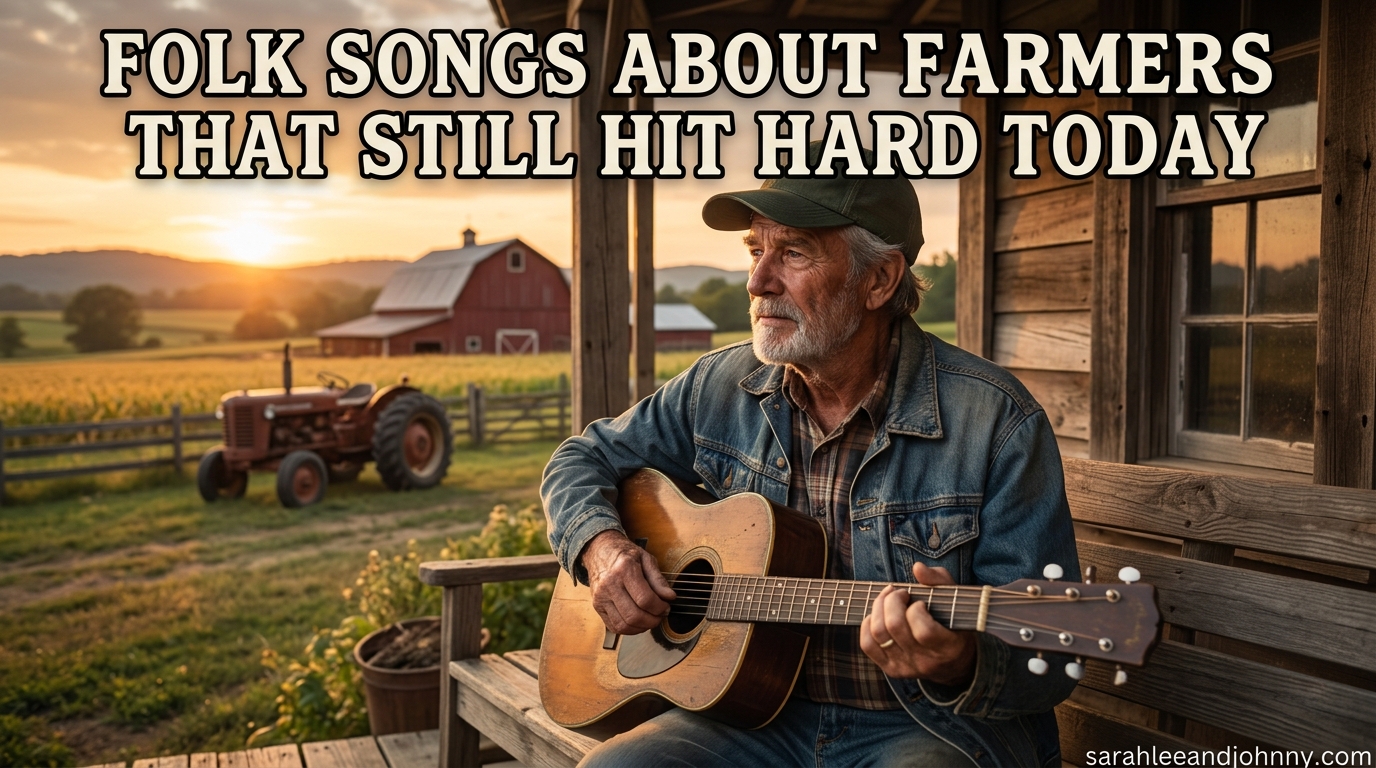
There is something about a song sung by someone who has actually worked the land that cuts right through you. The calloused hands, the pre-dawn mornings, the weight of depending on weather and soil — when a folk singer channels that reality into music, the result hits different. Folk songs about farmers have carried the stories of rural America for over a century, and honestly, the best ones still hit just as hard today as the day they were written.
I have spent years collecting and studying American folk music, and the farming songs always stand out. They are not background music. They are not decoration for a themed playlist. These songs are documents of real lives, real struggles, and a relationship with the land that most of us have lost touch with. In this guide, I want to walk you through the folk songs about farmers that carry the most emotional weight and explain exactly why they still resonate so deeply in 2026.
Whether you grew up on a farm, have farming in your family history, or simply appreciate honest storytelling set to acoustic guitar, these songs deserve a place in your listening rotation. We will cover the classics, the deep cuts, the Appalachian traditions, and the modern artists keeping farming music alive.
Table of Contents
Why Folk Songs About Farmers Still Hit Hard Today
The reason folk songs about farmers still land with such force comes down to one thing: authenticity. These songs were not written by songwriters sitting in air-conditioned studios imagining what farm life might be like. They were written by people who lived it, or by artists who spent enough time in rural communities to understand the weight of that life.
Consider what farming actually involves. You pour months of labor into a crop, and a single storm can wipe it out. You work from before sunrise until after sunset, and the financial return might not cover your costs. Your identity is tied to land that can be taken from you through economics you cannot control. That is the raw material of great songwriting — real stakes, real vulnerability, real consequence.
When Woody Guthrie sang about migrant farmworkers or when Johnny Cash sang about cotton picking, listeners heard truth. Not performative truth. Not dramatic truth. The quiet, exhausting, dignified truth of manual labor. That kind of honesty in music is rare, and when people hear it, they recognize it instinctively.
There is also the generational factor. Farming songs connect us to our grandparents and great-grandparents in a way that almost nothing else in modern culture does. When you hear a traditional harvest song, you are hearing a melody that might have been sung in the same fields a hundred years ago. That continuity is powerful.
In 2026, as small farms continue to disappear and agriculture becomes increasingly industrialized, these songs carry an additional layer of grief and preservation. They remind us of what we are losing. That emotional weight — the combination of historical respect and present-day loss — is why folk songs about farmers hit so hard right now.
Classic Folk Songs About Farmers That Defined a Genre
The foundation of farming music in America was built by a handful of artists who understood rural life from the inside. These songs shaped not just the folk genre but American music as a whole. Here are the tracks that matter most and why they still command attention.
Woody Guthrie: The Voice of the Farmworker
Woody Guthrie wrote about farmers because he traveled with them, ate with them, and slept in the same migrant camps. He was not a tourist in their world. His song “Pastures of Plenty” remains one of the most powerful agricultural ballads ever written. Written in 1941, it describes the lives of migrant workers moving through California’s fields, and every line carries the weight of lived experience.
The opening lines — “Come you ladies and you gentlemen, a-listen to my song / Sing it to you right, you might not think it’s wrong” — set a tone of direct, unflinching storytelling. Guthrie does not romanticize farm labor. He describes it plainly, and that plainness is what makes it devastating. The song moves through picking hops, cutting cotton, and working orchards, following the seasonal path that migrant farmworkers walked every year.
His lesser-known “Farmer Labor Train” takes a more overtly political approach, championing the rights of agricultural workers against exploitation. What makes Guthrie’s farming songs endure is his refusal to pity his subjects. He presents farmworkers as dignified, capable, and worthy of respect — a portrayal that was radical for its time and remains relevant in 2026.
Bob Dylan’s Maggie’s Farm: Protest Meets Agriculture
When Bob Dylan walked onstage at the Newport Folk Festival in 1965 and played “Maggie’s Farm” with an electric band, it was one of the most controversial moments in music history. But beyond the electric guitar controversy, “Maggie’s Farm” is a song about agricultural labor that doubles as a protest anthem.
The genius of “Maggie’s Farm” is that Dylan uses the metaphor of farm work — the endless, grinding, thankless labor of serving someone else’s land — to talk about artistic independence and personal freedom. “I ain’t gonna work on Maggie’s Farm no more” is a rejection of exploitation, whether that exploitation happens in a cotton field or a recording studio.
What makes this song still resonate with farmers and rural listeners is the specificity of the farming references. Dylan sings about the National Guard, about standing in lines, about people who “say one thing and then they do another.” The feeling of being trapped in a system you did not choose, working for people who do not have your best interests at heart — that is a feeling farmers know intimately.
Dylan grew up in Hibbing, Minnesota, surrounded by mining and farming communities. He understood the rural working class from direct experience, and that understanding surfaces in “Maggie’s Farm” with an energy that still electrifies listeners.
Johnny Cash and the Working Farm
Johnny Cash grew up on a cotton farm in Dyess, Arkansas, during the Great Depression. He picked cotton as a child. He watched his family struggle to keep their land. That biography runs through nearly every song he ever recorded, but a few tracks stand out for their direct connection to farming life.
“Pickin’ Time” is a straightforward celebration of cotton harvest season, but Cash delivers it with such conviction that it transcends its simple subject matter. You can feel the urgency of getting the crop in before the weather turns. “Five Feet High and Rising” tells the story of a flood threatening the family farm — based on a real event from Cash’s childhood — and it captures the helplessness of watching water consume everything you have built.
Cash’s farming songs work because he never condescended to the material. He treated farm life with the same gravity he brought to prison ballads and love songs. For Cash, a song about a flooded cotton field was every bit as important as a song about heartbreak, and his audience understood that.
Traditional and Appalachian Folk Songs About Farming
Before commercial recordings existed, farming communities in Appalachia and across rural America maintained rich musical traditions that served both practical and social purposes. These traditional folk songs about farmers represent the deepest roots of American agricultural music.
Appalachian folk music grew directly from the farming experience. Families would gather on porches after a day in the fields and play music together. The songs they sang were about the work they had just finished, the seasons they were navigating, and the communities they depended on. This was not performance art. This was how farming people processed their lives.
The Appalachian harvest tradition produced dozens of songs that followed the agricultural calendar. “Cluck Old Hen” is a playful tune about a chicken that lays eggs — simple on the surface, but it reflects the daily rhythm of farm life where every animal had a job and every product mattered. Songs like “Cripple Creek” and “Shady Grove” are often played at bluegrass festivals now without people realizing they originated as farming community songs.
The ballad tradition in Appalachia also produced darker farming songs. “The Farmer’s Curst Wife” and similar songs dealt with the difficulties of rural marriage, the isolation of farm life, and the harsh realities that came with depending on the land. These were not sanitized folk tales. They were honest reflections of lives shaped by geography and labor.
Bluegrass farming songs deserve special attention because the genre itself was born in agricultural communities. Bill Monroe, the father of bluegrass, grew up on a farm in Rosine, Kentucky, and his music carries the cadence of rural work. The fast-picking style of bluegrass mirrors the pace of harvest season — urgent, precise, and relentless.
What makes traditional farming folk songs remarkable is their specificity. They name crops, tools, seasons, and weather patterns. They mention specific rivers, specific counties, and specific varieties of corn or tobacco. That specificity is what forum users and folk music enthusiasts consistently say they value most — real farming references, not generic rural imagery.
Modern Folk and Country Songs About Farming Life
The tradition of writing honestly about farm life did not end with Guthrie and Cash. A new generation of artists is keeping agricultural themes alive in folk and country music, often with a sharper awareness of the challenges modern farmers face.
Chris Stapleton has become one of the most important voices in contemporary country music partly because his songwriting feels rooted in real places and real work. His music carries the same unvarnished quality that made Johnny Cash’s farming songs so powerful. Stapleton does not write jingles about tractors and sunsets. He writes about people struggling, working, and holding on to what matters.
Old Crow Medicine Show has done more than almost any other band to keep traditional farming music relevant for younger audiences. Their song “Humdinger” celebrates rural community gatherings with the kind of specificity that forum users consistently praise — mentioning particular foods, particular activities, and the genuine warmth of agricultural community life. Their cover of traditional folk songs brings Appalachian farming music to listeners who might never encounter it otherwise.
Jason Isbell writes about the rural South with a novelist’s precision. While his songs are not exclusively about farming, tracks like “Something More Than Free” capture the experience of manual labor and working-class life with an honesty that resonates deeply with farming communities. Isbell understands that agricultural life is not a costume or a marketing image — it is a daily reality with profound emotional consequences.
On the more traditional side, artists like Sam Unruh have released songs like “Life of a Farmer” that directly address contemporary agricultural challenges. Jeff Corle’s “Empty Barn” tackles the grief of losing a family farm — a reality that thousands of American farming families have faced over the past several decades. These newer songs prove that the tradition of honest farming music is alive and well.
The connection between these modern songs and their classic predecessors is striking. The same themes appear generation after generation: the dignity of hard work, the pain of loss, the beauty of the land, and the resilience required to keep going. What changes is the context. Modern farming songs often carry an undercurrent of mourning for a way of life that is disappearing, which gives them an emotional weight that earlier songs did not always carry.
The Emotional Power of Farm Songs: Why They Matter
I want to spend a moment on something that most articles about farming songs ignore — the specific emotional mechanisms that make these songs so powerful. Understanding why these songs affect us the way they do makes listening to them an even richer experience.
First, there is the power of specific detail. The best farming songs do not talk about “the countryside” in abstract terms. They name things. A red barn, a John Deere tractor, a flooded creek, a field of soybeans at harvest. This specificity activates our imagination in a way that generic language never can. When a songwriter mentions the exact variety of corn they are picking or the exact tool in their hands, the song becomes real to us.
Second, farming songs deal with emotions that most popular music avoids. Grief over losing land that has been in a family for generations. The anxiety of a drought that could destroy a year of work. The quiet pride of seeing a field you planted with your own hands grow tall. These are not the dramatic emotions that dominate pop music — betrayal, heartbreak, celebrity — but they are the emotions that define most human lives.
Third, farm songs create community. In the forum discussions I reviewed while researching this article, people consistently talked about sharing farming songs with family members, playing them during harvest, or using them to connect with their agricultural heritage. These songs are not consumed passively. They are shared, discussed, and treasured as connection points between generations.
Finally, farming songs matter because they preserve a perspective that is rapidly disappearing from American culture. As of 2026, less than two percent of the American population works in agriculture. The lived experience of farming — the physical sensation of it, the daily rhythm, the relationship with weather and soil — is becoming alien to most Americans. Folk songs about farmers are one of the few cultural forms keeping that experience alive in the collective memory.
FAQs
What is a good farming song?
Some of the best farming songs include Woody Guthrie’s “Pastures of Plenty,” Johnny Cash’s “Pickin’ Time,” and John Denver’s “Thank God I’m a Country Boy.” For a modern option, try Sam Unruh’s “Life of a Farmer” or Old Crow Medicine Show’s “Humdinger.” The best farming songs are ones that include specific, authentic references to agricultural work rather than generic rural imagery.
What Bob Dylan song is about a farm?
Bob Dylan’s most famous farm-related song is “Maggie’s Farm,” released in 1965 on the album Bringing It All Back Home. The song uses farm labor as a metaphor for exploitation and the desire for independence. Dylan famously performed it with an electric band at the Newport Folk Festival, marking a turning point in his career and in folk music history.
What is the traditional harvest song?
Traditional harvest songs include English folk songs like “Harvest Home” and “John Barleycorn,” as well as American Appalachian songs tied to the agricultural calendar. In the United States, many harvest songs were regional and passed down orally within farming communities rather than recorded commercially. “Bringing in the Sheaves” is one of the most widely known American harvest-time songs with roots in the 19th century.
What’s the saddest country song ever written?
This is subjective, but songs frequently cited as the saddest country songs include “He Stopped Loving Her Today” by George Jones, “Whiskey Lullaby” by Brad Paisley and Alison Krauss, and “Hurt” as covered by Johnny Cash. In the farming context, songs about losing the family farm carry a particular sadness because they combine personal loss with the loss of a way of life and a multi-generational legacy.
What is the country song about living on a farm?
There are many country songs about living on a farm. Some of the most well-known include John Denver’s “Thank God I’m a Country Boy,” Luke Bryan’s “Rain Is a Good Thing,” and Kenny Chesney’s “She Thinks My Tractor’s Sexy.” For more authentic and emotionally resonant songs about farm living, look to Johnny Cash’s “Five Feet High and Rising” or Merle Haggard’s working-class anthems like “Big City.”
What is the famous tractor song?
The most famous tractor song in country music is likely Kenny Chesney’s “She Thinks My Tractor’s Sexy,” but in the folk tradition, songs referencing tractors and farm equipment include Craig Morgan’s “International Harvester” and older folk songs about farm machinery that were part of the agricultural music tradition. In working-class folk music, tractors often symbolize both the pride and the financial burden of modern farming.
Conclusion: Carrying the Songs Forward
Folk songs about farmers that still hit hard today do so because they deal with emotions and experiences that never become obsolete. Hard work. Loss. Community. The relationship between people and the land that sustains them. These are not period-piece themes. They are permanent human concerns, and the best farming songs address them with an honesty that transcends any particular era.
From Woody Guthrie’s migrant worker ballads to Old Crow Medicine Show’s string-band celebrations of rural community, the tradition of folk songs about farmers represents some of the finest songwriting in American history. What makes these songs endure is not nostalgia. It is truth. The specific, grounded, unpretentious truth of people who work with their hands and write about what they know.
I encourage you to seek out the songs mentioned in this article and listen to them with full attention, not as background music but as the stories they are. Start with Guthrie’s “Pastures of Plenty,” then move to Cash’s “Five Feet High and Rising,” and work your way through to modern artists like Jason Isbell and Old Crow Medicine Show. Each song opens a window into a world that is worth understanding.
If you have farming in your family history, these songs might help you connect with that heritage in a way that nothing else can. And if farming is part of your daily life right now, these songs are a reminder that your experience has been heard, valued, and transformed into art by some of the greatest musicians America has ever produced. That is why folk songs about farmers that still hit hard today will continue to hit hard for generations to come.