

If you are searching for the best powered speakers for turntables under 400, you are solving one specific problem: your turntable has no speakers of its own, and you do not want to buy a separate amplifier to fix that. Powered speakers, also called active speakers, have the amplifier built into one or both cabinets, so a pair of RCA cables is the entire hookup.
There is one rule that decides whether a turntable will work with any of the ten pairs below. The cartridge on a turntable produces a tiny phono-level signal that is far too quiet to drive a speaker directly. A phono preamp raises that signal to line level. If your turntable has a switchable preamp, set it to LINE and plug straight into the speakers. If it does not, you need either a speaker with a built-in phono stage or a small external preamp first.
We spent weeks with these cabinets on a shelf, on a desk, and against a wall, comparing how each one handles a moving-magnet cartridge, how much bass knob range they actually give you, and whether they can fill a room rather than just a desktop. We also read a lot of owner threads, because the forum consensus on this topic is sharper than anything on a spec sheet.
If you are still choosing the turntable side of the system, start with our guide to turntables that pair with powered speakers, and our earlier roundup of powered speakers tested for turntables covers the higher and lower price bands.
Table of Contents
- Top 3 Picks for Best Powered Speakers for Turntables Under $400 (October 2026)
- Best Powered Speakers for Turntables Under $400 in 2026
- Powered vs Passive Speakers: Do You Need an Amplifier?
- How to Connect a Turntable to Powered Speakers
- 1. Edifier R1280T – Best Overall Pick for Vinyl
- 2. Edifier R1700BT – Best Value With the Widest Input Board
- 3. Edifier R1280DB – Best for TV Use and a Future Subwoofer
- 4. Audio-Technica AT-SP3XWH – Best for Tiny Rooms and Desks
- 5. Kanto YU4GB – Best Turntable Hub With a Built-In Phono Stage
- 6. Klipsch The One II – Single-Cabinet System With a Switchable Preamp
- 7. Fluance Ai41 – Best 5-Inch Driver Pair for Medium Rooms
- 8. PreSonus Eris 3.5 – Best Flat Desktop Monitors With a Headphone Jack
- 9. Klipsch R-40PM – Best for Turntables That Lack a Phono Preamp
- 10. Fluance Ai61 – Best Room-Filling Pair With 6.5-Inch Drivers
- What to Look For in Powered Speakers for Vinyl
- Frequently Asked Questions
- Are powered speakers good for turntables?
- Do I need powered or passive speakers for my turntable?
- What are the downsides of using passive speakers?
- What is the best active speaker for a turntable?
- What are the best active speakers with a phono preamp?
- Do powered speakers sound better than passive speakers?
- Can I connect a turntable to Bluetooth speakers?
- Final Verdict: Which Powered Speaker Pair Should You Buy?
Top 3 Picks for Best Powered Speakers for Turntables Under $400 (October 2026)
Our top pick, the best value pick, and the small-room pick cover most first vinyl systems. All three have a built-in amplifier and accept RCA input from a turntable.


Audio-Technica AT-SP3X
- 30W per speaker
- 3 inch woofer
- Multipoint Bluetooth
- 14mm silk tweeter
- 1.45 kg each
Best Powered Speakers for Turntables Under $400 in 2026
Every pair below sits under the 400 ceiling and drives a turntable through RCA input. The shortlist spans roughly 100 to 385 dollars, so you can match the spend to your room rather than to a brand.
| Product | Specifications | Action |
|---|---|---|
| Edifier R1280T |
|
Check Latest Price |
| Edifier R1700BT |
|
Check Latest Price |
 Edifier R1280DB Edifier R1280DB |
|
Check Latest Price |
| Audio-Technica AT-SP3X |
|
Check Latest Price |
 Kanto YU4GB Kanto YU4GB |
|
Check Latest Price |
 Klipsch The One II Klipsch The One II |
|
Check Latest Price |
 Fluance Ai41 Fluance Ai41 |
|
Check Latest Price |
 PreSonus Eris 3.5 PreSonus Eris 3.5 |
|
Check Latest Price |
 Klipsch R-40PM Klipsch R-40PM |
|
Check Latest Price |
| Fluance Ai61 |
|
Check Latest Price |
Two things jump out of that table. Only the Kanto YU4GB, the Klipsch The One II, and the Klipsch R-40PM have a phono stage inside the speaker, so they can rescue a turntable with no preamp. And only the Fluance pair, the Edifier R1280DB, and the Klipsch R-40PM give you a subwoofer output for later.
Powered vs Passive Speakers: Do You Need an Amplifier?
No. A powered speaker pair has the amplifier inside, which is the entire reason these ten are the right answer for a first turntable system.
A passive bookshelf speaker is just a driver in a box. It needs a separate amplifier or AV receiver to push current through it. Powered and active are the same thing: one cabinet holds the amp, the other receives signal over a short interconnect cable, and both take line-level input on the back.
The practical downsides of going passive are budget and cable clutter. You need the amplifier in the same purchase, which pushes a 400 dollar speaker budget well past 400 dollars, and you have to find a used amp that works. This trap shows up constantly on forums, where buyers describe picking up a passive Klipsch or Edifier model because the listing looked similar, then discovering they had no way to power it.
One trap worth naming: several Klipsch Reference models, including the R-41M, are sold in both powered and passive form at similar prices. Check that the listing says powered or active before you order, and check that the back panel has RCA inputs and a mains lead.
The second trap is signal level. A phono-level signal into a line-level input sounds thin and quiet, not dangerous. Leaving the preamp engaged on a turntable that also has a built-in phono stage is the bigger problem, because you boost an already-boosted signal and get a distorted, honking record. The rule is simple: exactly one preamp in the chain, and never two.
How to Connect a Turntable to Powered Speakers
The whole job takes about five minutes, and most setup failures come from one of the steps below.
1. Check the phono switch on the back of the turntable. If it has a PHONO and LINE position, set it to LINE. If it has no switch and no built-in preamp, you will need a preamp or a speaker with a phono stage.
2. Look at the back of the right-hand speaker. Find the RCA pair labelled AUX, Line In, or CD, and connect the red plug to red and the white plug to white. On most powered speakers the RCA input is line level by default.
3. If your turntable has a grounding post, run a thin wire from it to the small ground screw on the speaker. This single wire removes most hum. A loop of bare copper twisted a few times works fine.
4. Power the speakers, turn the volume to about a third, lower the needle, and raise the volume gradually. A turntable should be silent at rest; if it hums, the ground wire is loose or the preamp is engaged twice.
5. If the record sounds muffled and lacks treble, the preamp is engaged twice. If it sounds thin and quiet, the preamp is missing entirely. Those two symptoms point in opposite directions, and swapping between them takes ten seconds.
Keep vinyl wired. Several of these pairs support Bluetooth, and the listed latency on the models we measured runs from roughly 150 to 200 milliseconds, which is fine for streaming from a phone between records and wrong for anything you watch on screen.
1. Edifier R1280T – Best Overall Pick for Vinyl
Edifier R1280T Powered Bookshelf Speakers -2.0 Near Field Studio Monitor
42W output
4 inch woofer,13mm silk dome tweeter
85 dB signal to noise,4 ohm
2 year warranty
Pros
- Largest owner review base in this group
- Over 19k reviews averaging 4.6 stars
- Twin AUX inputs let a turntable and a phone share the pair
- Remote handles volume bass and treble
- MDF wood cabinet in three finishes
Cons
- No Bluetooth at all
- Only one physical input type for analogue sources
- Bass runs out in a larger room
The Edifier R1280T is the best powered speaker pair for vinyl under 400 because it has been sold, reviewed, and re-bought more than anything else in this price band, and the reviews keep pointing at the same thing: the sound is neutral enough to listen to for hours without fatigue.
On the back you get two AUX input pairs, so a turntable and a phone or a CD player can stay connected at the same time without swapping cables. Each channel has its own volume, bass, and treble knob on the side panel, which is faster than reaching for a menu. The included remote handles the same three functions.
Underneath is a 4 inch full-range driver with a 13 mm silk dome tweeter, a nominal 4 ohm load, and a listed 80 Hz low end. Signal to noise is quoted at 85 dB, which is high enough that you will not hear hiss between tracks on a quiet pressing. The MDF cabinet is wrapped in a wood-effect vinyl and comes in black, walnut, and white.
Two real limitations. There is no Bluetooth, so streaming between records means a 3.5 mm cable to the AUX input, and there is no subwoofer output, so if you outgrow the bass you are replacing the whole pair. Owners also note that 42 watts is not much once you move past a bedroom.
Why it works as a turntable pairing
A moving-magnet cartridge outputs a fairly warm, mid-focused signal, and the R1280T does nothing to make that harsher. The 4 inch driver keeps the midrange clear enough for vocals and acoustic instruments without pushing treble forward.
Because the bass and treble are on physical knobs rather than a fixed DSP curve, you can dial the low end back the moment a heavily mastered record sounds boomy. That single control is the reason this pair has survived years of owner feedback.
Where it falls short
In a room much larger than a bedroom, the low end stops filling the space before the volume knob runs out of travel. If you are furnishing a living room and plan to move to a larger place, the Fluance Ai61 in this list handles that case with 6.5 inch drivers and a 120W amplifier.
The other trade-off is silence about wireless. If your setup depends on phone streaming rather than cable work, add that cost to the purchase or choose the R1280DB instead, which adds Bluetooth and digital inputs at the same tier.
2. Edifier R1700BT – Best Value With the Widest Input Board
Edifier R1700BT Bluetooth Bookshelf Speaker – Active Near-Field Studio Monitors – Powered Speaker 2.0 Setup Wooden Enclosure – 66w RMS
33 watts x 2 built-in amplifier
66W RMS,4 inch woofer,19mm tweeter
55 Hz to 20 kHz,6 ohm
Bluetooth 4.0,10 degree tilt
Pros
- Built-in phono preamp switch
- Four input types including optical coaxial and XLR
- 10 degree cabinet tilt aims the drivers at seated listeners
- Bluetooth for streaming between records
Cons
- Bluetooth 4.0 is dated
- Remote feels thin in the hand
- Weak bass for hip-hop and EDM
The Edifier R1700BT is the pair we recommend when a turntable has no phono stage, because the amplifier section has a phono preamp switch built into it. That single feature is worth more to a first-time buyer than a longer feature list anywhere else in this roundup.
The input board is unusually generous. You get RCA, optical, coaxial, and XLR, which means a turntable, a TV, and a game console can live on the same system. Four onboard EQ settings cover flat, pop, classical, and rock, and the cabinet sits on a 10 degree incline so the drivers face a seated listener rather than the ceiling.
Output is 33 watts per channel for a stated 66W RMS, driving a 4 inch woofer and a larger 19 mm tweeter than the R1280T. Frequency response is listed from 55 Hz to 20 kHz, which extends meaningfully lower than the 80 Hz figure on the cheaper model, and the 6 ohm impedance gives the amplifier a little more headroom.
Owners are consistent about the trade-offs. The remote is thin and feels cheap, Bluetooth 4.0 is two generations behind current hardware, and the auto-wake feature does not engage over Bluetooth, so you press a button when you come back to it. For bass-heavy material, owners consistently recommend adding a subwoofer rather than pushing these further.
What the phono switch actually saves you
If your turntable has no built-in preamp, this pair saves you a separate box and an extra cable run. The switch sits on the rear panel, and you move the turntable from PHONO to LINE depending on the source.
If your turntable does have a switchable preamp, leave the speaker switch on LINE and set the turntable to LINE. Two preamps in series is the most common source of that thin, honky sound new owners describe, and it costs one click to rule out.
Where it falls short
The 4 inch woofer bottoms out well before the kind of low end modern pressed vinyl expects. Play a heavily mastered electronic album and you will reach for a subwoofer, which this pair does not offer an output for.
Bluetooth 4.0 also means you are giving up range and the newer audio codecs. It is perfectly usable for a phone at the other end of a room, but if you walk to the kitchen, expect the connection to drop.
3. Edifier R1280DB – Best for TV Use and a Future Subwoofer
Edifier R1280DB Powered Bluetooth Bookshelf Speakers – Optical Input – Wireless Studio Monitors – 4 Inch Near Field Speaker – 42W RMS – Wood Grain (Black)
42W RMS per pair
4 inch woofer,13mm silk dome tweeter
Bluetooth with optical and coaxial inputs
Subwoofer out port
Pros
- Subwoofer output lets you add bass later without replacing the pair
- Optical and coaxial digital inputs for a TV
- Remote switches inputs from the sofa
- Wooden enclosure reduces cabinet resonance
Cons
- Bluetooth codec version is not specified
- Remote uses a CR2 battery
- Only 42W RMS for larger rooms
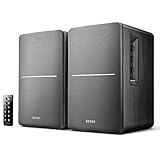
The Edifier R1280DB is the version of the entry pair to buy if your system is going to do more than spin records. It keeps the same 4 inch driver and 13 mm silk dome tweeter as the R1280T, then adds Bluetooth, optical, coaxial, and a real subwoofer output.
That port is the reason it earns a place in this list. The other Edifiers here have no way to add bass later, so when you want deeper low end you buy a different pair of speakers. With the R1280DB you plug a subwoofer into the Sub-Out and the amplifier handles the low-pass filtering so the mains stay clean.
The optical and coaxial inputs are genuinely useful with a turntable setup because most televisions now output digital audio and most cheap amplifiers have no optical jack. Connect the TV digitally, connect the turntable by RCA, and both live on the same pair of speakers.
Enclosure work is better than the price suggests. The wooden box is described as isolating acoustic resonance, and the front-facing bass reflex port means you are not tied to a wall clearance to get any low end at all, which matters on a shallow shelf.
The cons are modest. The Bluetooth codec version is not published, so you are buying on faith. The remote takes a CR2 battery, which is less common than the AA cells in most remotes. And at 42W RMS it remains a small-room speaker no matter how many inputs it has.
Is the sub-out worth choosing this model over the R1280T
If you think you will ever want more bass, yes. The port means the upgrade path is one extra box rather than a whole new speaker pair, and the crossover is handled inside the amplifier.
If you are buying for a bedroom and will never add a subwoofer, the R1280T gives you a better remote and a lower cost for the same driver. Choose the R1280DB when the speakers are part of a living room system.
Where it falls short
Forty-two watts per pair is the number to keep in mind. In a mid-sized room with the speakers more than a few feet from your chair, you will push the volume near the top of its travel before a large room feels filled.
The other limitation is the digital side. There is no HDMI ARC, so if your television only outputs over HDMI you need an optical converter before these speakers can carry the picture’s audio. Check what your set supports before buying on the strength of the digital inputs.
4. Audio-Technica AT-SP3XWH – Best for Tiny Rooms and Desks
Audio-Technica AT-SP3XWH Powered Bookshelf Speaker
30 watts per speaker
3 inch woofer,1.1 inch silk dome tweeter
70 dB signal to noise
Bluetooth multipoint plus dual RCA
Pros
- Highest rating in this group at 4.8 stars
- Smallest footprint and lightest weight here
- Multipoint Bluetooth holds two devices at once
- Volume dial and power button right on the cabinet
Cons
- No remote control
- No subwoofer output
- Fixed primary speaker cannot swap channels
The Audio-Technica AT-SP3XWH is the best choice when your listening position is a desk or a very small bedroom, because at 1.45 kg and under 8 inches tall it is the least intrusive pair in this roundup and it costs almost nothing in shelf space.
Each cabinet holds a 3 inch woofer and a 1.1 inch silk dome tweeter with 30 watts of amplification. That is not a lot of paper cone, and reviewers say so, but in a room under about 100 square feet it is more than enough to play records properly.
Connections are dual RCA jacks on one cabinet plus Bluetooth on both, and the multipoint pairing function holds two devices at the same time. That means your turntable stays plugged in on RCA while your phone stays paired, which is exactly the arrangement most first vinyl systems end up with.
Operation is entirely physical: a power button with an LED indicator and a volume dial. There is no remote, so you walk over to the speaker to change the level. Signal to noise is listed at 70 dB, lower than the Edifier pairs, and on very quiet passages that difference is audible on close listening.
Two design limits are worth knowing. The primary speaker cannot be swapped from left to right, so you must decide at placement time which cabinet lives where. And Bluetooth here is limited to the SBC codec, with measured latency around 160 milliseconds, which is fine for background listening and useless for anything with a moving image.
Does the 3 inch driver hurt a turntable setup
In a small room, no. The smaller driver responds quickly and keeps the midrange uncluttered, and a moving-magnet cartridge does not need deep extension to sound good on a jazz or vocal record.
In a larger space, yes. The honest limit is room size, not amplifier power, and if you are furnishing a living room, the Fluance Ai41 or Ai61 give you a 5 or 6.5 inch cone for that reason.
Where it falls short
There is no subwoofer output, so the upgrade path here is a new pair of speakers rather than an added sub. And the 2 meter inter-speaker cable is short, which limits how far apart you can place the two cabinets in a wider room.
For owners who want a remote and a wider input board, the Edifier R1280T costs less and covers more. Buy this one for footprint and rating, not for features.
5. Kanto YU4GB – Best Turntable Hub With a Built-In Phono Stage
Kanto YU4GB Powered Speakers with Bluetooth and Built-in Phono Preamp | Auto Standby and Startup | Remote Included | 140W Peak Power | Pair | Gloss Black
4 inch Kevlar woofer,1 inch silk dome tweeter
140W peak power,4 ohm
Built-in phono preamp switch
Sub out,dual optical,RCA,aux,Bluetooth
Pros
- Phono preamp built into the amplifier
- Two optical inputs plus RCA
- aux
- Bluetooth and a sub out
- Remote covers bass
- treble
- balance and input
Cons
- Bluetooth 4.0 is outdated
- USB port charges devices but carries no audio
- Mid-bass can sound boomy without a subwoofer
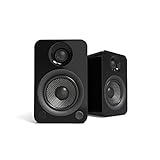
The Kanto YU4GB is the most complete single box for a turntable system, because it puts a switchable phono preamp, a subwoofer output, and two optical inputs behind the same 4 inch pair of drivers.
That input selection is unusual at this level. You get RCA with the phono switch, two optical inputs, an auxiliary input, Bluetooth, and a Sub-Out port. In practice it means a turntable, a television over optical, and a phone over Bluetooth can share the speakers without any switching box.
The drivers are a 4 inch Kevlar woofer and a 1 inch silk dome tweeter, rated at 140 watts peak and 4 ohm. The cabinet is MDF with a wood finish, and there is a range of colour options and a larger 5.25 inch version within the same family if you want more cone later.
Owners single out the imaging and clarity, and also recommend pairing it with a subwoofer for the best low end. The auto standby and auto startup functions mean the pair wakes when you begin playback and sleeps when you stop, which saves power without any menu diving.
The disappointments are specific. The USB port is for charging only and accepts no audio, so it is not a digital input. Bluetooth is version 4.0 with aptX, which is dated. And the bright LED indicators are a genuine annoyance in a dark listening room.
Is a speaker phono stage better than a turntable one
Both do the same job, and either is fine. The advantage of the speaker stage is that it costs nothing extra, since the amplifier is already there, and the switch is on the back of a cabinet you can reach in five seconds.
The turntable’s own preamp is usually slightly better placed electrically, but at this budget the difference is small enough that convenience wins. The rule still applies: use one or the other, never both.
Where it falls short
At 6 kg for the pair this is the second-heaviest bookshelf option here, so a light shelf or a small cabinet is worth checking before you commit. The remote’s infrared sensor also has a narrow angle, so aim it at the speaker rather than waving it around.
If you only need a phono stage and a phone connection, the Edifier R1700BT does the same job for roughly half the money. You pay here for the optical inputs, the sub out, and the finish.
6. Klipsch The One II – Single-Cabinet System With a Switchable Preamp
Klipsch The One II Phono Wireless Tabletop Shelf Stereo in Walnut
Single cabinet tabletop stereo
200 watts peak output
Built-in switchable phono preamp
Dual RCA and Bluetooth,20m range
Pros
- One cabinet instead of two
- Built-in phono preamp and dual RCA
- Real wood veneer and tactile switches
- 200W peak for a single unit
Cons
- Single unit rather than a true stereo pair of separated cabinets
- Partly plastic enclosure
- Bluetooth 4.2 rather than current
The Klipsch The One II solves a problem none of the other nine solve: how do you play records in a room where two separate cabinets will not fit. It is one 15.8 inch wide tabletop unit with a phono preamp, a pair of RCA inputs, and Bluetooth.
Because both drivers live in one enclosure, the low end sums acoustically and the quoted 200 watts peak translates into more output than that number suggests on a separated pair. In a mid-sized room it plays louder than anything else at this price except the Fluance Ai61.
The built-in preamp is switchable, so it handles a turntable with or without an internal stage. The cabinet is a mix of plastic and real wood veneer, and the switches and knobs are tactile rather than capacitive, which is a real difference when you are changing input mid-album.
Bluetooth range is listed at 20 meters, better than most of the Edifiers here. The walnut finish suits mid-century furniture better than any black plastic box on this list, and that matters more than spec sheets admit in a living room.
The trade-off is the single cabinet. There is no true stereo separation at the listening position unless you sit almost exactly on the centre line, and the enclosure is partly plastic. If you listen from an off-centre seat on a sofa, the imaging is the first thing you will notice.
Who should choose a one-box system
Buy this if your turntable lives on a sideboard in a small room, or if you want the furniture to look considered. The single object is much easier to place well than two boxes with a cable between them.
Owners also like that there is nothing to reposition. There is no inter-speaker cable to trip over, no left and right to assign, and no stereo balance to argue about when one person sits at the desk.
Where it falls short
Stereo imaging is the honest limit. On a wide soundstage recording, an orchestral or jazz record, the separation is not what a separated pair at the same spend delivers, and the Fluance Ai41 gives you that for less.
There is also no subwoofer output on this model, so adding low end later means a different system entirely. For anyone who plans to grow the setup, the Fluance or Klipsch R-40PM are better foundations.
7. Fluance Ai41 – Best 5-Inch Driver Pair for Medium Rooms
Fluance Ai41 Powered 2-Way 2.0 Stereo Bookshelf Speakers with 5″ Drivers, 90W Amplifier for Turntable, TV, PC and Bluetooth 5 Wireless Music Streaming with RCA, Optical, Subwoofer Out (Natural Walnut)
90 watt integrated amplifier
5 inch woven glass fiber woofer
Bluetooth 5.0,15m range,Optical,RCA,sub out
16 pounds for the pair
Pros
- 5 inch drivers give real midrange clarity and bass reach
- Bluetooth 5.0 with optical input and sub out
- MDF cabinets with neodymium tweeters
- Remote and two year manufacturer warranty included
Cons
- Rear bass port needs clearance from the wall
- Bluetooth stability issues reported by some owners
- Deep bass still wants a subwoofer
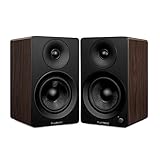
The Fluance Ai41 is the most-forgotten recommendation in the 250 to 300 dollar band, and forum threads about this price range name it repeatedly as the step up from the Edifiers.
The reason is driver size. A 5 inch woven glass fiber woofer moves noticeably more air than a 4 inch one, and the 90 watt integrated amplifier has the headroom to control it. Vocals sit clearly in front of the mix rather than being buried, which is the first thing you notice when you move from an entry pair.
Connectivity is modern. Bluetooth 5.0 with a listed 15 meter range, optical digital input, RCA analogue, and a subwoofer output mean this pair can grow into a 2.1 system without being replaced. The MDF cabinets are finished in natural walnut and there are multiple finish options, some sold with stands.
In the box you get a remote, batteries, a power cable, and 18 gauge speaker wire, plus a two year manufacturer warranty. At 16 pounds for the pair, these are real shelf speakers rather than desk accessories.
Owners report some Bluetooth connectivity issues, and the subwoofer out is described as wireless in the listing, which is worth verifying in the manual before you plan around it. The rear bass port also needs some clearance from a wall, so measure your shelf rather than assuming it will fit.
Is 5 inches worth the step up from a 4 inch pair
In a room between about 100 and 200 square feet, yes. The larger cone means you can sit back from the speakers without turning the volume up to a level where the midrange starts to compress.
Owners characterise the midrange as detailed and the soundstage as wide, which is exactly what an Edifier’s fixed tuning tends to lack. If you listen to a lot of acoustic and vocal records, the difference is obvious.
Where it falls short
The rear port rules out pushing these flat against a wall, and the cabinets are 13 inches wide, so they need a real shelf. Deep bass extension is still limited, and owners looking for the bottom end generally add a subwoofer through the Sub-Out.
Some buyers also note that the control app covers functions a physical remote would handle better. If you like physical buttons for input selection, the Kanto YU4GB in this list is the better buy at a similar spend.
8. PreSonus Eris 3.5 – Best Flat Desktop Monitors With a Headphone Jack
PreSonus Eris 3.5 Powered Studio Monitors, Pair — 3.5” Active Near
50 watts per speaker
3.5 inch woven composite woofer,1 inch silk dome tweeter
Adjustable high and low frequency controls
Front aux,TRS,RCA,headphone jack
Pros
- Lowest cost in this roundup
- Front headphone jack for late-night listening
- Acoustic tuning controls let you correct a room
- TRS input for a clean studio connection
Cons
- Only one cabinet contains the amplifier
- No Bluetooth on this base model
- 3.5mm aux input can be noisy
- Limited bass from 3.5 inch drivers
The PreSonus Eris 3.5 is the cheapest way into this roundup and the flattest-sounding pair on it, which is a deliberate design choice inherited from studio monitoring rather than a compromise.
Flat means voices and instruments sit where the record puts them, with no bass boost to flatter the low end. On a well-mastered record that is a genuine advantage. On a heavily bass-boosted modern pressing, it makes the imbalance more obvious rather than less.
Each cabinet has 50 watts of amplification driving a 3.5 inch woven composite woofer and a 1 inch silk dome tweeter. The rear panel carries high and low frequency trim controls, so you can dial out a boomy shelf or a bright wall. Inputs cover TRS, RCA, and a front 3.5 mm aux.
The front headphone output is the feature that separates it from every other desktop pair here. You can drop a turntable into the RCA inputs during the day and plug headphones into the front jack at night without touching anything else.
Be clear about one thing that trips people up: this is not a fully active pair. One cabinet holds the amplifier and the other is driven by a short interconnect cable. Functionally you still get a turntable and speakers in two boxes, but you cannot swap which cabinet is primary.
Are flat monitors right for a first vinyl system
They are right if you want to hear what the record actually sounds like rather than what a consumer speaker wants you to hear. Many owners use them for mixing, and the habit of accurate monitoring carries straight over to listening.
They are wrong if you bought a record expecting the warm, boosted low end that entry speakers are tuned for. The 3.5 inch drivers also stop early on bass, so a subwoofer is the only real fix and this model has no sub-out.
Where it falls short
There is no Bluetooth on the base model, so streaming between records means the 3.5 mm aux, and owners report that input can be noisy compared with the RCA or TRS. Use RCA for the cleanest signal.
There is also a caution about leaving the pair powered continuously. Some owners have reported capacitor failure on units that stayed on for long periods, and while that is not a widespread pattern, switching them off when you leave the room is a free habit that removes the risk.
9. Klipsch R-40PM – Best for Turntables That Lack a Phono Preamp
Klipsch Reference R-40PM Powered Bookshelf Speakers – 90-Degree x 90-Degree Tractrix Horn – Linear Travel Suspension – Sleek, Modern Appearance
4 inch copper-spun TCP woofers
1 inch LTS aluminium tweeter in a 90 degree horn
240 watt maximum output
Phono input with ground screw,sub out
Pros
- Phono input with a ground screw built into the speaker
- Subwoofer output for a 2.1 setup
- Bluetooth with aptX HD
- Remote included
- Three year warranty
Cons
- Horn tweeters can sound forward and bright
- Factory volume setting is very low
- Bluetooth pairing gives no confirmation tone
The Klipsch R-40PM is the other pair in this list that can rescue a turntable with no phono stage, and it does it differently from the Kanto: the phono input has its own ground screw, which is the correct connection for a moving-magnet cartridge.
That ground post matters. Without it, a phono-level signal into a line-level input often carries a low hum that no amount of gain correction removes. Owners who connect correctly report a silent system, and the difference is audible immediately.
Output is quoted at 240 watts maximum per pair, driving 4 inch copper-spun TCP woofers and 1 inch aluminium LTS tweeters inside a 90 by 90 degree Tractrix horn. The horn controls directivity, so the treble stays focused on the listening position rather than spreading across the room.
There is a subwoofer output for a 2.1 system, Bluetooth with aptX HD, and a remote in the box, backed by a three year warranty. That warranty is the longest on this list, which matters for powered electronics.
The consistent complaint is tonal. Klipsch horn-loaded tweeters are famously detailed and dynamic, and listeners who prefer a warm or neutral presentation find the top end forward. Owners also note that the factory volume is set very low, so you turn it up further than you expect to at first.
Should you be wary of the horn tweeter
Only if you are sensitive to high frequencies. The Tractrix horn improves clarity and reduces distortion at the crossover, and many listeners prefer it for vocals and acoustic material because the midrange is left alone.
But it is a real tonal difference rather than a subtle one. If you know you pull treble down on every other system you own, the Fluance Ai41 or the flat Eris pair is a safer place to start.
Where it falls short
There are some quality control reports worth noting, including a power LED that blinks and Bluetooth pairing that completes silently with no confirmation sound. Neither is serious, but the second is genuinely confusing the first time it happens.
It is also the lightest on internal review volume here at 225 reviews, so you are buying on a thinner owner history than the Edifiers. For the phono stage and the ground screw it is still a compelling package.
10. Fluance Ai61 – Best Room-Filling Pair With 6.5-Inch Drivers
Fluance Ai61 Powered 2-Way 2.0 Stereo Bookshelf Speakers with 6.5″ Drivers, 120W Amplifier for Turntable, TV, PC and Bluetooth 5 Wireless Music Streaming – RCA, Optical, USB & Sub Out (Natural Walnut)
120 watt integrated amplifier
6.5 inch woven glass fiber woofers
1 inch neodymium tweeters
Bluetooth 5.0,USB-C,optical,RCA,sub out
Pros
- Largest drivers in this roundup for real low-end reach
- 120W amplifier fills a large room
- USB-C digital input plus optical and RCA
- Sub out for later expansion
Cons
- Very large and very heavy at over 27 pounds for the pair
- App-dependent control
- 200ms Bluetooth latency breaks video sync
The Fluance Ai61 is the pair to buy if your listening room is large or you are buying once for a space you will not move out of. Nothing else under 400 puts this much cone area in front of you.
Six and a half inch woven glass fiber woofers with 120 watts of amplification give real output headroom. The bass reaches lower than the Ai41 and stays controlled at volume, which is the difference that matters when you are playing an orchestral record at normal levels rather than background levels.
The input board is the widest in this roundup. Bluetooth 5.0, USB-C for digital audio, optical, RCA for the turntable, and a subwoofer output all live on the back, with a two year manufacturer warranty and lifetime customer support included.
You have to accept the size to get the output. At 15.6 inches wide and over 27 pounds for the pair, these are stand or large-shelf speakers, and the cabinet plus stand space is the first thing to measure. The MDF construction is solid and finished in natural walnut.
Two honest drawbacks. Control leans on the app rather than physical buttons on the cabinet, and the listed Bluetooth latency of 200 milliseconds is high enough that video falls out of sync, so keep the television on optical or RCA.
When does 6.5 inches actually matter
In a room over roughly 200 square feet, or on a pair of stands rather than a shelf. A 4 inch driver at those distances runs out of bass well before the volume knob runs out, and that is the single most common reason people feel their first speaker pair was a mistake.
Owners consistently report the Ai61 as the pair that fixed a system which had outgrown smaller speakers. If you are in a flat and will stay there, the Ai41 gives you most of the benefit at a lower weight and a lower cost.
Where it falls short
Weight and footprint are the real limits, not sound. If your furniture is light or your shelf is short, this pair does not fit and no amount of output compensates for that.
The other caveat is price for the feature set. At the top of this budget you are buying amplifier power and driver area rather than inputs or preamp flexibility, and if you need a phono stage as well, the Klipsch R-40PM or Kanto YU4GB give you that for less.
What to Look For in Powered Speakers for Vinyl
The shortlist above is sorted by what actually changes how records sound, not by brand or specification count. Here is how to apply the same logic to a pair we have not covered.
1. Phono preamp compatibility comes first. Check whether your turntable has a switchable preamp. If it does, any powered pair with RCA input works. If it does not, you need a built-in phono stage in the speaker, an external preamp, or a turntable upgrade. This single question eliminates half the catalogue.
2. Match the driver to the room, not the wattage. Under 100 square feet, a 3 inch driver at 30 watts is plenty. Between 100 and 200 square feet, look for 4 or 5 inch drivers. Over 200 square feet, you want 5.25 or 6.5 inch drivers on stands, because that is where the extra cone area starts to pay.
3. Read RMS watts, not peak watts. The Klipsch The One II is quoted at 200 watts peak and the Kanto YU4GB at 140 watts peak, while the R1700BT is quoted at 66 watts RMS, and the lower number is not the weaker speaker. Peak figures double transient peaks for marketing; RMS is a continuous measure you can compare across brands.
4. Treat a subwoofer output as future-proofing. If you think you will want more bass, buy a pair with a Sub-Out port now. The Edifier R1280DB, the Fluance Ai41 and Ai61, the Kanto YU4GB, and the Klipsch R-40PM all have one. The amplifier handles the low-pass filtering so the mains do not have to be replaced later.
5. Keep the turntable wired and use Bluetooth for everything else. Latency on the models here runs from roughly 150 to 200 milliseconds, which is invisible for background music and obvious on anything with a moving image. Wired RCA from the cartridge is also the shortest signal path, and on this budget the difference is real.
6. Buy the input board you will actually use. Optical and coaxial digital inputs matter if a television is part of the system. A front headphone jack matters if you listen at odd hours. Two RCA inputs matter if you want a turntable and a phone plugged in simultaneously. Paying for a feature you never touch is the most common budget mistake after buying a passive speaker by mistake.
7. Tame the bass. The single most repeated owner comment across forum threads is that Edifier pairs arrive with the bass boosted to the point where it drowns the midrange, and owners recommend turning the bass knob almost all the way down. The R1280T, the R1700BT, and the R1280DB all put a physical bass control on the cabinet, so this takes five seconds. If your pair has no adjustable low end, choose a different pair.
8. Place them properly. Put both cabinets on stands or on the same surface at the same height, roughly 6 to 8 feet apart, and angle them toward your chair. Speakers with a rear bass port, including both Fluance models, need a few inches of clearance from a wall. Speakers with a front port, like the R1280DB, are far more forgiving. The R1700BT helps you here with a 10 degree cabinet tilt that aims the drivers at a seated listener.
9. Budget for the whole system, not the speakers. Speakers are usually the better place to spend than a second turntable, but a starter setup still needs a turntable and an RCA cable. Many first systems are a beginner turntable plus one of the pairs here, and spending the entire budget on speakers while assuming a turntable is included is a common and expensive misunderstanding.
Our wider guides cover powered bookshelf speakers across every price band and turntables in this same budget range if you are building the two halves at once.
Frequently Asked Questions
Are powered speakers good for turntables?
Yes. Powered speakers have an amplifier built in, so they connect straight to a turntable’s RCA output with no separate receiver. They are the standard first upgrade for a starter vinyl system because entry-level turntables ship with weak built-in drivers while the speakers decide how the record actually sounds. The only requirement is that the signal reaching them is at line level.
Do I need powered or passive speakers for my turntable?
Powered. A passive bookshelf speaker has no amplifier inside it, so you would need to buy a separate amplifier or receiver to drive it, which adds cost, cable clutter, and a second failure point. Most buyers who pick passive models by mistake end up buying an amp they had not budgeted for. Check that a listing says powered or active and shows RCA inputs plus a mains lead before ordering.
What are the downsides of using passive speakers?
Three main ones. You have to buy an amplifier separately, which pushes a speaker budget well past its stated limit. Passive models often look and sound more refined for the same spend, so you may be comparing a bare driver to a complete system. And they offer no built-in phono stage, so a turntable without a preamp still needs a separate preamp box on top of the amplifier.
What is the best active speaker for a turntable?
The Edifier R1280T is the best overall pick under 400, with the largest owner review base in the group and neutral sound that suits long listening sessions. If your turntable has no phono preamp, the Edifier R1700BT or the Klipsch R-40PM add a built-in phono stage. In a large room, the Fluance Ai61 has the driver area to fill the space.
What are the best active speakers with a phono preamp?
Three pairs in this roundup have a phono stage inside the amplifier. The Edifier R1700BT and the Klipsch R-40PM are the strongest options under 300, and the Klipsch R-40PM adds a proper ground screw for a moving-magnet cartridge. If your turntable already has a switchable preamp, set it to LINE and leave the speaker’s phono switch unused.
Do powered speakers sound better than passive speakers?
Neither is inherently better. A well-matched passive pair with a good amplifier sounds more refined than a cheap powered pair, and a good powered pair sounds more refined than a passive pair with a budget amplifier. Within this budget the honest answer is that buying a complete powered system gets you more sound for the same money than buying bare drivers and an entry amplifier.
Can I connect a turntable to Bluetooth speakers?
Not usefully for listening to records. Bluetooth adds codec compression and, on the models measured here, latency of roughly 150 to 200 milliseconds. Keep the turntable wired over RCA and use Bluetooth for streaming from a phone between albums. A few turntables do offer Bluetooth output, but the same latency and compression limits still apply.
Final Verdict: Which Powered Speaker Pair Should You Buy?
For most people, the Edifier R1280T is the answer to the best powered speakers for turntables under 400 question in 2026. It has the biggest owner history in the group, adjustable bass and treble on the cabinet, twin RCA inputs so a phone and a turntable can stay connected, and a sound signature that stays out of the way of the record.
Buy the Edifier R1700BT instead if your turntable has no phono stage or if a television is part of the plan. Buy the Edifier R1280DB if you want a subwoofer output now. Move up to the Fluance Ai61 if the room is large, and pick the Klipsch R-40PM if you want a phono input with a proper ground screw.
Whichever you choose, set the phono switch in exactly one place, run the ground wire, and turn the bass back a few notches. That is where most of the sound improvement hides.