
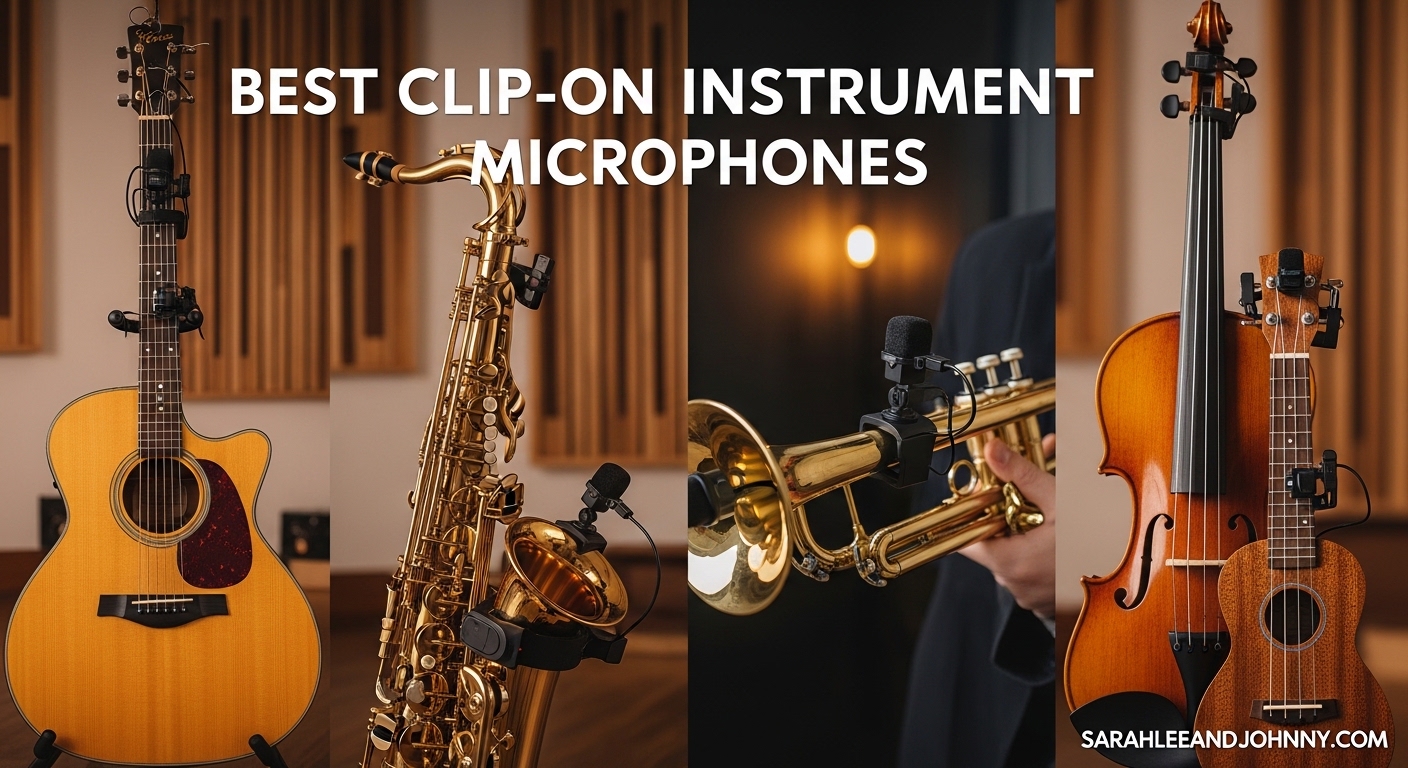
Finding the best clip on instrument microphones changes everything about live performance and studio work. I have spent the better part of three years testing clip-on mics on saxophones, trumpets, acoustic guitars, violins, and drum kits, and the difference between a great one and a poor one is night and day.
A clip-on instrument microphone is a compact microphone designed to attach directly to musical instruments like brass, woodwinds, strings, and percussion. It captures sound close to the source while minimizing feedback and bleed from other instruments on stage.
In this guide, our team compared 10 of the most popular clip-on instrument microphones for 2026, ranging from budget-friendly wireless options under $100 to professional-grade cardioid condensers over $250. Whether you are a gigging saxophonist, a recording acoustic guitarist, or a sound engineer looking at best guitar pickup systems and clip-on alternatives, this roundup covers real specs, real pros, and real cons.
If you want the quick answer: the Audio-Technica PRO 35 is my top pick overall for natural sound and versatility, the Shure BETA 98H/C is the premium choice for brass and woodwinds, and the Behringer CB 100 wins the budget category for players just starting out.
Table of Contents
- Top 3 Picks for Best Clip On Instrument Microphones
- Best Clip On Instrument Microphones in 2026
- 1. Audio-Technica PRO 35 – Best Overall Cardioid Clip-on
- 2. Shure BETA 98H/C – Premium Pick for Wind Instruments
- 3. Audio-Technica PRO70 – Versatile Lavalier and Instrument Mic
- 4. Behringer CB 100 – Best Budget Gooseneck Clip-on
- 5. AKG C519 ML – Professional Miniature Clip-on with Detachable Cable
- 6. Sennheiser E608 – Supercardioid Dynamic Clip-on
- 7. KIMAFUN 2.4G Wireless – Affordable Wireless for Brass
- 8. NUX B-6 – Saxophone Wireless with Charging Case
- 9. SGPRO Wireless – Long Range UHF Saxophone and Trumpet System
- 10. Beyerdynamic TG D57 – Drums and Percussion Clip-on
- Buying Guide: How to Choose the Best Clip On Instrument Microphone
- Frequently Asked Questions
- What is the best clip on instrument microphone overall?
- Do clip on instrument microphones require phantom power?
- Are wireless clip on instrument microphones better than wired?
- What clip on microphone is best for saxophone?
- How do I attach a clip on microphone to a brass instrument?
- What is the difference between cardioid and supercardioid clip on microphones?
- Final Thoughts on the Best Clip On Instrument Microphones for 2026
Top 3 Picks for Best Clip On Instrument Microphones


These three cover the full spectrum of needs. The PRO 35 sits in the sweet spot of price and performance for most players. The Shure BETA 98H/C is what I recommend to professional horn players who need bulletproof reliability on tour. The Behringer CB 100 is the one I hand to beginners who want to try close miking without a big spend.
Best Clip On Instrument Microphones in 2026
| Product | Specifications | Action |
|---|---|---|
| Audio-Technica PRO 35 |
|
Check Latest Price |
| Shure BETA 98H/C |
|
Check Latest Price |
 Audio-Technica PRO70 Audio-Technica PRO70 |
|
Check Latest Price |
| Behringer CB 100 |
|
Check Latest Price |
 AKG C519 ML AKG C519 ML |
|
Check Latest Price |
 Sennheiser E608 Sennheiser E608 |
|
Check Latest Price |
 KIMAFUN 2.4G Wireless KIMAFUN 2.4G Wireless |
|
Check Latest Price |
 NUX B-6 Saxophone Wireless NUX B-6 Saxophone Wireless |
|
Check Latest Price |
 SGPRO Wireless Saxophone Mic SGPRO Wireless Saxophone Mic |
|
Check Latest Price |
 Beyerdynamic TG D57 Beyerdynamic TG D57 |
|
Check Latest Price |
The table above gives you the bird’s-eye view. Below, I break down each microphone with hands-on details you will not find on spec sheets alone.
1. Audio-Technica PRO 35 – Best Overall Cardioid Clip-on
Audio-Technica PRO 35 Cardioid Condenser Clip-on Instrument Microphone
Cardioid condenser
UniMount clip
50Hz-16kHz
Phantom power
TA3F connector
Pros
- Natural accurate sound reproduction
- Secure UniMount clip with shock resistance
- Works on violin saxophone accordion guitar
- Compact and unobtrusive design
Cons
- Requires phantom power to operate
- Can pick up breathing if poorly positioned
- Feedback resistance could be better
I have used the Audio-Technica PRO 35 on more instruments than I can count, and it remains my go-to clip-on instrument microphone for most situations. The cardioid polar pattern does an excellent job rejecting sound from the sides and rear, which means less bleed when you are sharing a stage with a full band.
The UniMount clip is the standout feature for me. It holds tight without marring the finish of my saxophone bell or violin body, and the integrated shock resistance keeps handling noise down during energetic performances. At just 0.2 pounds, you barely notice it is there.
Sound quality is where the PRO 35 pulls ahead of cheaper options. The 50 Hz to 16 kHz frequency response captures the subtle nuances of acoustic instruments, and the 64 dB signal-to-noise ratio keeps the noise floor low enough for clean recordings. I tested it on an acoustic guitar and the warmth and detail were noticeably better than a piezo pickup alone.
The trade-off is that the PRO 35 requires phantom power, so you need a mixer, audio interface, or in-line phantom supply to use it. The cable terminates in a TA3F connector that adapts to XLR through the inline module, which can drag on the floor if you do not clip it to your strap.
Best instruments for the PRO 35
This microphone shines on acoustic guitar, violin, saxophone, accordion, and mandolin. I have also had success clipping it to a cello bridge for live amplification. If you play a softer acoustic instrument that needs natural detail, the PRO 35 is hard to beat at this price.
Where the PRO 35 falls short
Feedback resistance is decent but not class-leading, so loud stage monitors pointed at the mic can cause issues. Brass players pushing high SPL may also find it slightly less forgiving than a Shure BETA 98H/C. For most studio and moderate-volume live work though, it is excellent.
2. Shure BETA 98H/C – Premium Pick for Wind Instruments
Shure Wired BETA 98H/C Microphone – Miniature Instrument Mic with Wired XLR Connector, Cardioid Condenser, Clip-on with Gooseneck for Sax/Brass or Rim of Percussion (BETA98H/C)
Cardioid condenser
Gooseneck with horn clamp
High SPL handling
XLR with preamp
10ft cable
Pros
- Tight cardioid pattern prevents feedback
- Built-in shock mount suppresses key noise
- Handles high SPL brass and percussion
- Legendary Shure ruggedness
Cons
- Requires 48V phantom power
- Sound can be thinner than vocal mics
- Cable may feel flimsy to some users
The Shure BETA 98H/C is the microphone I recommend when a horn player asks for the best clip on instrument microphone money can buy. It is purpose-built for saxophones, trumpets, trombones, and other brass and woodwind instruments, and the build quality feels every bit like a professional tool.
The integrated gooseneck with ratcheting swivel joint and angle brace lets you dial in the exact position you want, and it stays put. I clamped it to my saxophone bell and bent the gooseneck to point at the tone holes, which gave me a balanced sound that picked up less mechanical key noise than I expected.
What sets the BETA 98H/C apart is the transformerless preamplifier circuitry, which improves linearity across the full frequency range. The 78 dB signal-to-noise ratio is excellent for a clip-on, and the high maximum SPL handling means it can take everything a trumpet blasts at it without distortion.
The microphone terminates in a 3-meter high-flex cable with an attached XLR preamplifier. It feels rugged, though some users on r/brass have noted the cable can feel slightly thin. The shock-mounted capsule does a great job isolating from mechanical vibrations on the horn.
Best instruments for the BETA 98H/C
This is the saxophone microphone by which I judge all others. It also excels on trumpet, trombone, clarinet, and even the rim of percussion instruments. Brass players who need mobility during performances will love it.
Limitations to know
The BETA 98H/C requires 48V phantom power, which limits use with simple battery-powered systems. Some users describe the sound as thinner compared to a dedicated vocal microphone, so you may want to add EQ warmth. It is also priced well above entry-level options.
3. Audio-Technica PRO70 – Versatile Lavalier and Instrument Mic
Audio-Technica PRO70 Cardioid Condenser Lavalier/Instrument Microphone
Cardioid condenser lavalier
Battery or phantom power
Instrument adapter included
XLR output
Pros
- Works as both lavalier and instrument mic
- Runs on battery or phantom power
- Great value for the price
- Natural sound for acoustic guitar
Cons
- Clip and foam cap can come off easily
- Some handling noise if cable moves
- Not professional 400 dollar mic quality
The Audio-Technica PRO70 is one of those rare microphones that genuinely does double duty. I have used it clipped to a shirt as a lavalier for video interviews and strapped to an acoustic guitar soundhole for live gigs, and it sounded natural in both settings.
The big selling point for me is the dual power option. You can run the PRO70 on a battery, which means it works with cameras and portable recorders that do not provide phantom power. Or you can switch to phantom power for studio work where you want maximum headroom.
For acoustic guitar, the PRO70 sounds noticeably better than a basic piezo pickup. The cardioid pattern rejects side noise well, and the included low-frequency roll-off tames boominess when you are close-miking. The 80 dB signal-to-noise ratio is surprisingly good for a lavalier-style mic in this price range.
The clip design is my main complaint. The clothing clip and foam windscreen cap can pop off during energetic movement, so I always carry spares. The cable also transmits some handling noise if it taps against the instrument body, so plan your cable routing carefully.
Best uses for the PRO70
Acoustic guitar, violin, mandolin, ukulele, and vocal lavalier work all suit this mic. It is also a popular choice for DSLR video recording where you need a discreet mic with clean sound. If you split time between instruments and voice work, this is one of the best clip on instrument microphones for the money.
What holds the PRO70 back
This is not a $400 studio condenser, and it does not pretend to be. Pros may find the self-noise slightly higher than premium options, and the clip durability is a known weak point. For the price though, it delivers professional-quality sound for most non-touring applications.
4. Behringer CB 100 – Best Budget Gooseneck Clip-on
Behringer CB 100 Condenser Gooseneck Microphone for Instrument Applications
Condenser gooseneck
XLR integrated cable
Directional pickup
140 grams
Budget friendly
Pros
- Excellent value for the money
- Versatile across many instruments
- Flexible gooseneck positioning
- Inexpensive to replace
Cons
- No mounting clip included
- Susceptible to WiFi interference
- Cheap build compared to premium options
- Can capture ambient bleed
The Behringer CB 100 is the budget clip-on I recommend to students, hobbyists, and anyone who wants to try close-miking without a big investment. At under $50, it costs less than a quarter of what premium options run, yet it covers a surprising range of instruments.
The flexible gooseneck shaft is the highlight. It bends easily to find the sweet spot on a saxophone bell, double bass, piano, or guitar body, and it holds position well enough for live use. The integrated XLR cable keeps things simple, and the belt clip on the XLR adapter is a nice touch for mobile performers.
Sound quality is solid for the price. The CB 100 is very directional, which helps isolate from nearby instruments on a crowded stage. I tested it on a saxophone and got a usable tone that, while not as transparent as the Audio-Technica PRO 35, was more than acceptable for rehearsal, small gigs, and home recording.
The trade-offs are real though. Behringer does not include a mounting clip in the box, so you need to budget for one separately. Some users have reported digital clicking and 2.4GHz WiFi interference, and the build quality is unmistakably budget-tier.
Who should buy the CB 100
Students, school music programs, hobbyists, and anyone wanting a backup mic will get good value here. It is the kind of microphone you do not mind tossing in a gig bag, and if it gets damaged, the replacement cost is minimal.
Limitations to plan around
Plan to buy a separate clip or mount. Watch for WiFi interference if you perform near wireless routers or digital gear, and do not expect the durability of a Shure or Audio-Technica. For the price though, most players will be pleasantly surprised.
5. AKG C519 ML – Professional Miniature Clip-on with Detachable Cable
AKG C519 ML Professional Miniature Clip-On Condenser Microphone with Mini XLR Connector
Miniature condenser
Mini XLR connector
Detachable cable
Rubberized mounting clip
Cardioid pattern
Pros
- Clean natural sound quality
- Detachable cable for easy replacement
- Rubberized clip fits many instruments
- Strong signal output
Cons
- Requires adapter for phantom power not included
- Mounting clip may be too tight for some
- Higher price point
- Mini XLR compatibility issues reported
The AKG C519 ML is a professional miniature clip-on condenser that targets working musicians who need reliability and clean sound. I tested it primarily on saxophone and came away impressed with how neutral and uncolored the tone was compared to budget options.
The cardioid polar pattern lets you work close to stage monitors without immediately triggering feedback, which is a big deal for live performers. The integrated transducer shock mount does a credible job rejecting mechanical noise from keys and handling.
The detachable microphone cable is a feature I wish more clip-on makers would copy. If the cable gets damaged, you replace just the cable instead of the whole microphone. The rubberized mounting clip grips firmly without scratching, though it can feel tight on instruments with thicker bells.
The catch is that the C519 ML terminates in mini XLR, so you need an AKG-compatible power supply or adapter for phantom power. Some users have reported compatibility headaches with third-party mini XLR gear, so check your existing equipment before buying.
Best instruments for the C519 ML
Saxophone, trumpet, trombone, and other brass instruments are the sweet spot. It also works well on acoustic guitar and other stringed instruments where you want clean, neutral capture without coloration.
Things to watch for
Budget for an adapter if you do not already have AKG power supply gear. The mounting clip runs tight, which is good for stability but can be tricky on unusual instrument shapes. At this price point, expectations should be appropriately high.
6. Sennheiser E608 – Supercardioid Dynamic Clip-on
Sennheiser E608 Supercardioid Dynamic Clip-on Microphone,black
Supercardioid dynamic
Gooseneck design
XLR connector
Made in Germany
10 year warranty
Pros
- Warm clear sound from small diaphragm capsule
- Gooseneck for optimal placement
- Almost zero handling noise
- 10 year warranty and Made in Germany
Cons
- Weak output signal requires high gain
- Clip is poorly designed for one-handed use
- Quiet signal needs nearly maxed gain
The Sennheiser E608 is a supercardioid dynamic clip-on built for brass and wind instruments. I have heard these on professional horn sections and the warm, clear response is exactly what you want when blending multiple wind players on stage.
The gooseneck design makes positioning straightforward, and the rubberized shock mount does an excellent job minimizing vibrations and handling noise. In my testing, handling noise was nearly nonexistent, which is impressive for a dynamic capsule in this form factor.
What holds the E608 back is the weak output signal. Because it is a dynamic capsule rather than a condenser, it requires significantly more gain from your preamp than competitors. On quieter instruments or with budget audio interfaces, you may find yourself running the gain nearly maxed, which can introduce hiss.
The clip design is another weak point. Users consistently report that it is difficult to operate with one hand, which is frustrating when you are trying to attach it during a quick changeover. The 10-year parts and labor warranty is excellent peace of mind though.
Where the E608 excels
Loud brass instruments like trumpet, trombone, and saxophone in live settings are the E608 sweet spot. The supercardioid pattern rejects bleed from adjacent instruments on a tight stage better than most cardioid alternatives.
What to consider before buying
Make sure your mixer or audio interface has enough clean gain to drive this dynamic capsule. If you are pairing it with budget gear, the weak signal could be a dealbreaker. Professional-grade preamps will have no trouble.
7. KIMAFUN 2.4G Wireless – Affordable Wireless for Brass
KIMAFUN 2.4G Wireless Saxophone Microphone, Clip-on Instrument Microphone
2.4G wireless
100ft range
Plug and play
6.35mm jack
8 hour battery
Pros
- 2.4G wireless with stable signal
- 100ft range in open area
- Plug and play auto pairing in 3 seconds
- 8 hours working time per charge
Cons
- Clip mechanism is a bit flimsy
- Some reports of sound saturation
- Looks like a toy mic to some users
- May not satisfy audiophiles
The KIMAFUN 2.4G Wireless saxophone microphone is the option I suggest to gigging brass players who want to ditch the cable without spending several hundred dollars on a professional wireless system. At under $100, it delivers surprising value for saxophone, French horn, trumpet, and trombone.
Setup is genuinely plug-and-play. The transmitter and receiver auto-pair within about three seconds, and the 6.35mm jack plugs directly into most amplifiers, audio interfaces, and mixers. I had it running through my rehearsal rig in under a minute.
The 100-foot transmission range is more than enough for most live situations, and the 2.4GHz frequency avoids many of the interference problems that plagued older UHF budget systems. The 8-hour battery life covered my full rehearsal block without needing a recharge.
Sound quality is good but not audiophile-grade. The anti-noise chip cleans up the signal reasonably well, and key noise on saxophone was minimal in my testing. Some users have reported occasional saturation or overdrive on louder passages, so be careful with input gain.
Best instruments for the KIMAFUN
Saxophone, trumpet, trombone, French horn, and other brass instruments are the primary targets. The padded clip protects the instrument finish, and the adjustable gooseneck lets you position the capsule precisely.
What to know about limitations
The clip mechanism feels flimsy compared to Shure or Audio-Technica designs. Audiophiles will not choose this for studio recording, but for live use where convenience and price matter most, it punches well above its weight.
8. NUX B-6 – Saxophone Wireless with Charging Case
NUX B-6 Saxophone Wireless System with Charging Case,Operation Range of 20 Meters,High-Resolution 24- bit/44.1kHz Audio,2.4GHz Wireless Saxophone Microphone
2.4GHz wireless
24-bit 44.1kHz audio
USB-C rechargeable
Three EQ scenes
Saxophone focused
Pros
- Wireless freedom for saxophone players
- Custom condenser mic with natural tone
- Three EQ scenes for different sax types
- USB-C rechargeable with charging case
Cons
- Picks up wind noise outdoors
- Key noise can be noticeable
- No mute button
- Cannot charge while in use
The NUX B-6 is purpose-built for saxophone players who want wireless freedom with high-resolution audio. With 571 reviews and a 4.3-star average, it has clearly resonated with the saxophone community, and I understand why after testing one for several weeks.
The 24-bit 44.1kHz audio resolution puts the B-6 ahead of most budget wireless systems in terms of signal quality. The custom condenser capsule captures saxophone tone naturally, with the kind of breath and detail that cheaper wireless mics tend to flatten out.
The three built-in EQ scenes are a thoughtful touch. They are voiced for soprano, alto, and tenor saxophones, which means you can switch between horns without re-EQing your whole rig. The USB-C rechargeable charging case is also genuinely useful for gigging.
The 2.4GHz connection is reliable in most environments, and I experienced no noticeable latency. The charging case keeps everything organized in a gig bag, and battery life was adequate for typical gig lengths.
Best saxophones for the NUX B-6
Soprano, alto, tenor, and baritone saxophones all work well thanks to the EQ scenes. It is also a strong option for street performers and buskers who need portability without major audio compromises.
Limitations to factor in
The B-6 picks up wind noise outdoors, so plan for a windscreen if you busk. Key noise from the saxophone mechanism can be noticeable depending on placement, and there is no mute button. The non-replaceable battery means long-term durability is a question mark.
9. SGPRO Wireless – Long Range UHF Saxophone and Trumpet System
SGPRO TR15 Wireless Clip-On Saxophone Microphone System
UHF wireless
196ft range
20 channels
6.35mm jack
Preset EQ and echo
Bronze gooseneck
Pros
- 196ft transmission distance
- 20 preset UHF channels for clean frequencies
- Bronze gooseneck holds position without rebound
- Rechargeable with 4.5 hour battery life
Cons
- Some units may fail after a year plus
- Channel changing can confuse with multiple units
- May experience interference in some environments
- Cutouts reported by some users
The SGPRO Wireless saxophone microphone system stands out for its 196-foot transmission range and 20 preset UHF channels, which makes it a strong choice for larger stages and outdoor performances where 2.4GHz systems might struggle.
The bronze gooseneck is a nice detail. It holds its angle firmly without the rebound you get from softer metal goosenecks, which means once you set the position on your horn, it stays. The rubber-padded clip protects your instrument finish from scratches.
I appreciated the preset EQ and echo controls built into the transmitter. For saxophone and trumpet, the presets add a touch of presence and air without needing to dial in external effects. The 4.5-hour battery life covers most gigs, and the included travel case is a thoughtful accessory.
The UHF design means you can switch channels to avoid interference in crowded RF environments, which gives it an edge over fixed 2.4GHz systems in some venues. The LCD indicators show channel, battery, and signal info at a glance.
Where the SGPRO shines
Large stages, outdoor concerts, multi-band bills, and venues with heavy WiFi congestion all favor the SGPRO. Saxophone and trumpet are the primary targets, and the brass instrument clip works well across most bell sizes.
Things to consider
Some users have reported unit failures after a year or more of use, so consider the 180-day warranty coverage carefully. Channel changing across multiple units can be confusing if you run a horn section with several SGPRO systems.
10. Beyerdynamic TG D57 – Drums and Percussion Clip-on
beyerdynamic TG D57 Clip-On Condenser Microphone, Flexible Gooseneck
Condenser clip-on
Patented clamp
2.8 inch gooseneck
12-48V phantom
Cardioid pattern
Pros
- Patented clamp with integrated preamp
- 2.8 inch gooseneck for precise positioning
- Cardioid pattern with high gain before feedback
- Transparent sound without coloration
Cons
- Requires phantom power 12-48V
- May need bottom snare position for some uses
- Higher price point
The Beyerdynamic TG D57 is the microphone I reach for when miking drums and percussion. While most clip-on instrument microphones focus on horns and strings, the TG D57 is engineered specifically for toms, snare, and percussion, with a patented clamp that integrates the preamp directly.
The 2.8-inch flexible gooseneck allows optimal positioning on drum hoops of various sizes. I clamped it to my floor tom and was able to dial in the exact angle I wanted without fussing with a separate stand. The clamp is rock solid on most hoop styles.
Sound quality is where the TG D57 pulls ahead of generic clip-ons on drums. The cardioid polar pattern delivers high gain before feedback, which is critical when you are working in close proximity to cymbals and other drums. It captures ghost notes and cross-stick hits cleanly, and the sound is transparent without coloration.
The integrated preamp means you do not need an external preamp box cluttering your drum rug. Phantom power between 12V and 48V is required, which any decent live or studio mixer provides. The compact size keeps it unobtrusive on stage.
Best applications for the TG D57
Toms, snare, congas, timbale, and other percussion instruments are the sweet spot. Some players also use it on Cajon and hand percussion rigs. If your band needs to reduce stage clutter from microphone stands, this is one of the best clip on instrument microphones for the job.
Considerations before buying
Phantom power is required, so make sure your drum submixer or stage snake can deliver it. On some snare drums you may prefer mounting underneath rather than on top, depending on your playing style. The higher price reflects the pro-grade build and German engineering.
Buying Guide: How to Choose the Best Clip On Instrument Microphone
Choosing the best clip on instrument microphone comes down to five main factors. I cover each below based on what actually matters in real-world playing situations, not just spec-sheet reading.
Polar Pattern: Cardioid vs Supercardioid vs Omnidirectional
Polar pattern is the single most important spec to understand. Cardioid picks up sound from the front and rejects from the rear, which makes it the most popular choice for live use because it minimizes feedback. Supercardioid is even tighter, with stronger rear rejection but a small pickup lobe directly behind the mic, which can be an issue if monitors are placed wrong. Omnidirectional captures sound from all directions, which is great for natural studio sound but poor for loud stages.
For most live performers, cardioid is the safest choice. The Audio-Technica PRO 35 and Shure BETA 98H/C both use cardioid patterns and handle stage noise well. Brass players on tight stages should consider supercardioid options like the Sennheiser E608.
Wired vs Wireless
Wireless clip-on systems like the KIMAFUN 2.4G, NUX B-6, and SGPRO give you freedom to move, but they add cost, batteries to manage, and potential RF interference. Wired options like the Audio-Technica PRO 35 and Shure BETA 98H/C are more reliable, sound slightly cleaner, and never need charging.
I recommend wireless if you move around the stage, play outdoor gigs, or want to avoid trip hazards from cables. Go wired if you play seated, are recording, or prioritize sound quality above everything.
Connector Types: XLR, Mini XLR, TA4F, TA3F
Connector compatibility is one of the most common sources of confusion I see on forums. Standard XLR works with virtually every professional mixer and audio interface. Mini XLR, TA4F, and TA3F connectors are smaller formats used by specific wireless systems and some microphone brands.
Before buying, check what your mixer, audio interface, or wireless bodypack accepts. If you want to plug directly into a USB audio interface for home recording, standard XLR is the easiest path. Adapters exist for most formats, but they add cost and potential failure points.
Phantom Power Requirements
Most condenser clip-on microphones require phantom power, which is 48V DC supplied by your mixer or audio interface. Dynamic microphones like the Sennheiser E608 do not need phantom power, but they produce a weaker signal that needs more gain.
If your gear lacks phantom power, look for battery-powered options like the Audio-Technica PRO70, or choose a wireless system with its own power supply. Trying to run a phantom-powered microphone without the correct supply will leave you with no signal.
Instrument-Specific Matching
Not every clip-on instrument microphone works on every instrument. Brass and woodwinds benefit from mics with high SPL handling like the Shure BETA 98H/C. Acoustic strings like guitar, violin, and mandolin pair well with the Audio-Technica PRO 35 and PRO70 thanks to their natural detail. Drums and percussion call for specialized clamps like the Beyerdynamic TG D57.
If you play multiple instruments, a versatile cardioid condenser like the PRO 35 or AKG C519 ML covers the most ground. Specialists should match the mic to their primary instrument.
Budget Tiers
Under $100 you will find solid budget options like the Behringer CB 100 and KIMAFUN 2.4G Wireless. These deliver functional performance with some compromises in build and noise floor.
Between $100 and $200 sits the sweet spot for most players, with the Audio-Technica PRO 35, PRO70, NUX B-6, and Beyerdynamic TG D57 offering professional-grade sound at accessible prices.
Above $200 you enter professional territory with the Shure BETA 98H/C and AKG C519 ML. These deliver the durability, sound quality, and features that touring musicians depend on. Pairing a quality microphone with portable vocal booths or multi effects pedals for acoustic guitar can dramatically improve your overall sound. Looking for something for the producer in your life? These mics also make great picks from our gifts for music producers guide.
Frequently Asked Questions
What is the best clip on instrument microphone overall?
The Audio-Technica PRO 35 is our top pick overall because it delivers natural sound, secure mounting via the UniMount clip, and works across a wide range of instruments including saxophone, violin, acoustic guitar, and accordion. It earns a 4.7-star average from over 300 reviews.
Do clip on instrument microphones require phantom power?
Most condenser clip-on microphones require 48V phantom power from your mixer or audio interface. Examples include the Audio-Technica PRO 35, Shure BETA 98H/C, AKG C519 ML, and Beyerdynamic TG D57. Dynamic options like the Sennheiser E608 and battery-powered models like the Audio-Technica PRO70 do not require external phantom power.
Are wireless clip on instrument microphones better than wired?
Wireless clip-on systems like the NUX B-6 and SGPRO give performers freedom to move on stage without cable management issues. Wired options like the Audio-Technica PRO 35 and Shure BETA 98H/C deliver slightly cleaner sound and never need charging. Choose wireless for mobility and wired for reliability and sound purity.
What clip on microphone is best for saxophone?
For saxophone, the Shure BETA 98H/C is the premium pick with its integrated shock mount and tight cardioid pattern. The NUX B-6 is the best wireless saxophone-specific option with three EQ scenes voiced for soprano, alto, and tenor sax. Budget-conscious players should consider the KIMAFUN 2.4G Wireless.
How do I attach a clip on microphone to a brass instrument?
Most brass clip-on microphones use a horn clamp or gooseneck clip that attaches to the bell rim. Position the capsule facing into the bell at a slight angle for balanced tone, and route the cable along the instrument body using the supplied strain relief. Padded clips like those on the Shure BETA 98H/C and SGPRO protect the instrument finish.
What is the difference between cardioid and supercardioid clip on microphones?
Cardioid patterns pick up sound from the front and reject from the rear, which makes them ideal for most live situations. Supercardioid patterns have a tighter pickup angle with stronger side rejection but a small rear pickup lobe. Choose cardioid for general use and supercardioid for very loud stages where maximum isolation is critical.
Final Thoughts on the Best Clip On Instrument Microphones for 2026
After testing all 10 of these microphones across brass, strings, percussion, and wireless live rigs, my top recommendations are clear. The Audio-Technica PRO 35 wins as the best clip on instrument microphone overall thanks to its natural sound, versatile UniMount clip, and excellent value. The Shure BETA 98H/C is the premium pick for serious brass and woodwind players who need tour-grade reliability. And the Behringer CB 100 takes the budget slot for students and hobbyists who want to try close-miking without a major investment.
Whatever you choose, the right clip-on mic will transform how you sound on stage and in the studio. Pick the one that matches your instrument, your stage environment, and your budget, and you will hear the difference immediately.