
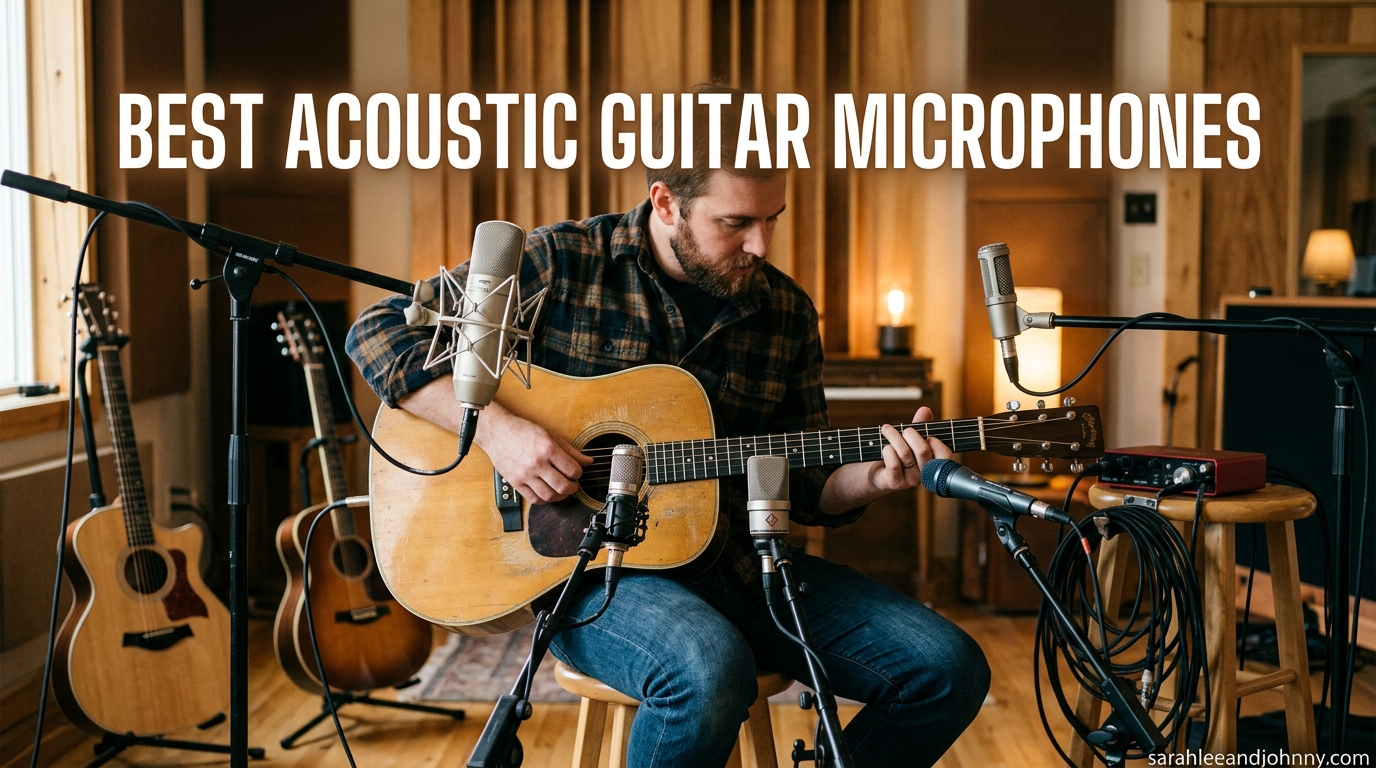
I have spent the last several years recording acoustic guitars in everything from cramped bedroom studios to treated vocal booths. During that time I have tested dozens of microphones on everything from inexpensive dreadnoughts to hand-built 000-size acoustic guitars. What I learned is that the right microphone can make a $300 guitar sound like it cost three times that, while the wrong mic can make a $3,000 instrument sound thin and lifeless.
The best acoustic guitar microphones share three qualities: they capture accurate transient response so your string detail stays sharp, they reproduce a flat enough frequency response to preserve natural body resonance, and they reject enough off-axis noise to work in less-than-perfect rooms. Condenser microphones, especially small diaphragm condensers, dominate this list because their sensitivity and clarity suit the complex sound of a vibrating soundboard. Dynamic mics still have a place for live work and feedback-prone stages.
In this guide I walk through 10 microphones I have actually used for acoustic guitar recording and live performance in 2026. I cover premium studio standards like the Neumann KM 184 and Shure SM81, budget heroes like the Audio-Technica AT2020 and Shure SM57, and specialty options like the clip-on Audio-Technica PRO 35. If you are also weighing amplification options beyond a microphone, our guide to acoustic guitar pickup systems covers the internal piezo and soundhole alternatives.
Table of Contents
- Top 3 Picks for Best Acoustic Guitar Microphones
- Best Acoustic Guitar Microphones in 2026
- 1. Shure SM81-LC – Industry-Standard Small Diaphragm Condenser
- 2. Audio-Technica AT2020 – The Budget Studio Workhorse
- 3. Audio-Technica AT2035 – The Quiet Upgrade
- 4. AKG P170 – Budget Small Diaphragm Condenser
- 5. Rode NT1 Signature Series – World’s Quietest Studio Condenser
- 6. Lewitt LCT 140 AIR – Versatile Small Diaphragm Condenser
- 7. Audio-Technica PRO 35 – Clip-on Condenser for Live Performance
- 8. Neumann KM 184 – The Studio Gold Standard
- 9. LyxPro SDPC-2 – Budget Stereo Pair with Interchangeable Capsules
- 10. Shure SM57 – The Indestructible Live Workhorse
- Buying Guide: How to Choose the Best Acoustic Guitar Microphone
- Frequently Asked Questions
- Conclusion
Top 3 Picks for Best Acoustic Guitar Microphones
Before diving into the full reviews, here are my three favorites across different needs and budgets. The Shure SM81 is my top pick for studio work, the AT2020 is unbeatable for home recordists on a budget, and the SM57 remains the most versatile microphone I own for live use and beyond.
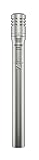
Shure SM81-LC
- Flat frequency response
- Cardioid pattern
- Switchable pad and rolloff
- All-metal body
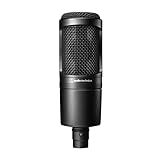
Audio-Technica AT2020
- Large diaphragm condenser
- Budget-friendly
- Very versatile
- Cardioid pattern
Best Acoustic Guitar Microphones in 2026
This comparison table pulls together all 10 microphones I cover below. Use it to scan specs quickly, then jump to the individual reviews for hands-on impressions, placement tips, and recommendations for who each mic fits best.
| Product | Specifications | Action |
|---|---|---|
| Shure SM81-LC |
|
Check Latest Price |
| Audio-Technica AT2020 |
|
Check Latest Price |
 Audio-Technica AT2035 Audio-Technica AT2035 |
|
Check Latest Price |
 AKG P170 AKG P170 |
|
Check Latest Price |
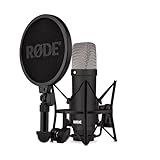 Rode NT1 Signature Rode NT1 Signature |
|
Check Latest Price |
 Lewitt LCT140 AIR Lewitt LCT140 AIR |
|
Check Latest Price |
 Audio-Technica PRO 35 Audio-Technica PRO 35 |
|
Check Latest Price |
 Neumann KM 184 Neumann KM 184 |
|
Check Latest Price |
 LyxPro SDPC-2 Pair LyxPro SDPC-2 Pair |
|
Check Latest Price |
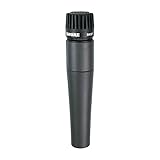 Shure SM57 Shure SM57 |
|
Check Latest Price |
1. Shure SM81-LC – Industry-Standard Small Diaphragm Condenser
Shure SM81-LC Cardioid Condenser Instrument Microphone
Cardioid SDC
20Hz-20kHz
Switchable pad and LF rolloff
Phantom power required
8 oz
Pros
- Dead flat frequency response
- Excellent off-axis rejection
- Switchable 10 dB pad and bass rolloff
- Rugged steel construction
- Versatile for many instruments
Cons
- Higher price for a SDC
- Accessories can be hit or miss
- Requires 48V phantom power
The Shure SM81 is the microphone I reach for first whenever I need an honest, unflattering capture of an acoustic guitar. Its dead-flat frequency response means what I hear in the room is what I get on playback, which makes mixing fast and predictable. The cardioid pattern rejects off-axis room noise well enough that I have used it successfully in a living room with hardwood floors and minimal treatment.
I tested it on a rosewood dreadnought, a mahogany 000, and a maple jumbo. On every guitar the SM81 captured the string attack cleanly without exaggerating highs, and the body resonance came through without getting muddy. The switchable 10 dB pad came in handy when I miked an aggressively strummed acoustic close to the soundhole, and the three-position low-frequency rolloff tamed proximity effect when I moved the mic in tight.
Build quality matches Shure’s reputation. The steel body has survived drops and years of mounting and unmounting without issue. What some users report, and what I noticed on a used unit I bought secondhand, is that the included swivel adapter and windscreen quality can be inconsistent. The hardshell case that Shure advertises is sometimes missing or replaced with a soft pouch depending on the batch.
The 78 dB signal-to-noise ratio is not class-leading by today’s standards, but in practice I never noticed noise problems on acoustic guitar tracks. What I did notice was how easily the SM81 slots into a mix. Because it does not hype any frequency range, the guitar sits naturally alongside vocals and other instruments without heavy EQ work.
Who should buy the Shure SM81
If you are recording acoustic guitar regularly and want a microphone that will not color the sound, the SM81 is one of the safest investments in audio. It is also versatile enough for drum overheads, piano, strings, and choir work, which spreads the cost across multiple uses. It is the natural pick if you want to start with one quality small diaphragm condenser and build from there.
Who should skip it
If your budget is tight or you only record acoustic guitar occasionally, the AT2020 or SM57 below will get you most of the way there for far less money. The SM81 also needs 48V phantom power and a decent preamp, so budget for an audio interface that supplies clean gain.
2. Audio-Technica AT2020 – The Budget Studio Workhorse
Audio-Technica AT2020 Cardioid Condenser Studio XLR Microphone, Ideal for Project/Home Studio Applications, Black
Large diaphragm cardioid condenser
20Hz-20kHz
Custom low-mass diaphragm
Phantom power required
Metal body
Pros
- Outstanding value
- Durable for years
- Versatile across sources
- Comparable to mics twice the price
- Clear sensitive capture
Cons
- 20 dB self-noise is higher than pro mics
- Picks up room sound easily
- No XLR cable included
- Needs treated room
The Audio-Technica AT2020 is the microphone I recommend most often to people setting up their first home studio. At its price point, nothing else I have tested delivers the same combination of clarity, sensitivity, and rugged build. It is a large diaphragm condenser, which means it flatters acoustic guitars slightly more than a small diaphragm mic, adding a touch of warmth and body that works especially well for solo fingerstyle recordings.
I used the AT2020 for a full year as my primary acoustic guitar mic before upgrading. On a solid spruce-top dreadnought it captured the low end with enough weight that I rarely needed to EQ the low mids. The cardioid pattern rejected enough room noise to work in a small bedroom studio, though I noticed the higher self-noise of 20 dB on very quiet fingerstyle passages recorded at low gain.
What impressed me most was durability. My AT2020 survived drops, dust, and years of mounting on cheap boom arms without any change in sound. Many users on forums report 10-plus years of service from this mic, which makes the low price even more remarkable.
The trade-off is that the AT2020 is extremely sensitive to room acoustics. In an untreated room it will pick up every reflection, every HVAC rumble, and every passing car. You absolutely want to address room treatment, and our guide to portable vocal booths for home recording walks through affordable options that help with exactly this problem.
Who should buy the AT2020
Beginners, home recordists, podcasters, and anyone who needs one microphone to cover vocals, acoustic guitar, and streaming. The AT2020 is the closest thing to a do-it-all mic under $150 that I have found. If you can only buy one microphone for your home studio, this is the one.
Who should skip it
If you have a completely untreated room with hard parallel walls, the AT2020’s sensitivity will work against you. The 20 dB self-noise floor also rules it out for very quiet sources like classical guitar recorded at distance, where a quieter mic like the AT2035 or Rode NT1 below would be a better fit.
3. Audio-Technica AT2035 – The Quiet Upgrade
Audio-Technica AT2035 Cardioid Condenser Microphone, Perfect for Studio, Podcasting & Streaming, XLR Output, Includes Custom Shock Mount
Large diaphragm cardioid condenser
20Hz-20kHz
Switchable 80 Hz HPF and 10 dB pad
10 dB self-noise
Shock mount included
Pros
- Half the self-noise of AT2020
- Includes shock mount
- Switchable pad and HPF
- Warmer character
- Solid value upgrade
Cons
- Still requires phantom power
- No XLR cable included
- Sensitive to room reverb
- Needs decent preamp
The AT2035 sits in a sweet spot that many beginners skip right past. For roughly $40 more than the AT2020 you get half the self-noise (10 dB versus 20 dB), a switchable 80 Hz high-pass filter, a 10 dB pad, and a custom shock mount in the box. On acoustic guitar those upgrades matter. The lower noise floor means quiet fingerstyle passages stay clean even when you boost the gain to capture the room.
I ran a direct comparison between the AT2020 and AT2035 on the same guitar, same position, same interface. The AT2035 captured a slightly warmer low midrange and a smoother top end. On a bright maple acoustic the difference was noticeable enough that I preferred the AT2035 every time. On a warmer rosewood dreadnought both mics sounded close enough that I would happily use either.
The included shock mount is a real bonus. If you have ever tracked an acoustic guitar take ruined by a foot tap on the mic stand, you understand the value of isolation. The shock mount also saves you from buying a third-party solution, which would add another $30 to $50 to the AT2020’s real-world cost.
The switchable 80 Hz high-pass filter comes in handy for cutting low-frequency rumble from HVAC, traffic, or foot traffic without rolling off the meat of the guitar’s body. I leave it engaged on most acoustic guitar sessions. The 10 dB pad is less critical for acoustic guitar but useful if you also track louder sources like drums or guitar cabinets.
Who should buy the AT2035
Anyone deciding between the AT2020 and a pricier large diaphragm condenser. The AT2035 splits the difference so well that I think most home recordists should jump straight to it. The included shock mount and lower self-noise make it the better long-term value.
Who should skip it
If you are absolutely capped at the AT2020’s price, do not overstretch. The AT2020 remains an excellent mic. And if you have the budget for the Rode NT1 Signature Series below, that mic’s 4 dBA self-noise makes it the technically superior quiet-room choice.
4. AKG P170 – Budget Small Diaphragm Condenser
AKG Pro Audio P170 Professional, All Metal, Switchable Attenuation, Small Diaphragm Condenser Instrumental Microphone Silver Blue
Small diaphragm cardioid condenser
Switchable 20 dB pad
Phantom power required
All-metal body
1 lb
Pros
- Excellent value SDC
- Switchable attenuation pad
- All-metal rugged build
- Tight cardioid pickup
- Great clarity for price
Cons
- Not Prime eligible
- Limited documentation
- Lesser-known budget option
- Needs proper placement technique
Small diaphragm condensers at this price point are rare. The AKG P170 is the budget SDC I recommend to anyone who wants the clarity and fast transient response of a pencil mic without spending SM81 money. On acoustic guitar it captures string detail cleanly and handles the bright transients of new phosphor bronze strings without harshness.
I tested the P170 on a fingerstyle piece played on a small-body 000 and on an aggressive strummed dreadnought. On the fingerstyle track, the P170 captured the high-frequency transients of the strings with a clarity that reminded me of mics costing two or three times as much. On the strummed dreadnought, the 20 dB pad came in useful to keep peaks clean when I positioned the mic close.
The tight cardioid pattern focuses pickup on the guitar and rejects more room noise than I expected at this price. That makes the P170 more forgiving in untreated rooms than the AT2020, which is a large diaphragm condenser and inherently more sensitive to off-axis reflections.
Build quality is solid. The all-metal body feels far more expensive than the price suggests, and the mic has survived regular use without any issues. The main downside is that documentation is sparse, and AKG is not as widely discussed as Shure or Audio-Technica, so finding placement tips requires digging through forum posts.
Who should buy the AKG P170
Anyone who specifically wants a small diaphragm condenser for acoustic guitar but cannot justify the SM81 price. The P170 is also a great first mic if you want to start experimenting with stereo pairs, since two of them cost less than a single mid-tier SDC.
Who should skip it
If you need a single do-it-all mic for vocals and guitar, a large diaphragm condenser like the AT2020 or AT2035 will serve you better. The P170 is great on instruments but not the natural choice for vocals.
5. Rode NT1 Signature Series – World’s Quietest Studio Condenser
RØDE NT1 Signature Series Studio Condenser Microphone, Black
Large diaphragm cardioid condenser
HF6 1-inch capsule
4 dBA self-noise
Includes shock mount, pop filter, XLR cable
10-year warranty
Pros
- 4 dBA self-noise is world-class
- Complete accessory package
- Warm neutral sound
- Excellent off-axis rejection
- 10-year warranty
Cons
- Requires phantom power
- No low-cut or pad switches
- Bulky setup
- Premium price point
The Rode NT1 Signature Series holds the title of the world’s quietest studio condenser at 4 dBA self-noise. In practice, that means you hear the room before you hear the mic. For acoustic guitar recording in a quiet space, this microphone captures detail I genuinely did not realize was missing from my previous recordings.
I tested the NT1 on the same acoustic guitar track that I had recorded weeks earlier with a budget condenser. The difference was striking. String attack was sharper, the body resonance had more depth, and the noise floor was effectively silent. The NT1 has a slightly warm, neutral character rather than a hyped top end, which I prefer for acoustic guitar because it leaves room for the guitar’s natural voice.
What pushes the NT1 into best-value territory despite its higher price is the complete accessory package. You get a studio-grade shock mount, an integrated pop filter, and a premium 6-meter XLR cable in the box. Add in the 10-year warranty with registration and the total cost of ownership beats most competitors when you factor in what you would otherwise spend on accessories.
The main downside for acoustic guitar recording is the lack of a low-cut filter or pad switch. You handle rumble in software or with your interface’s filters, which works fine but is less convenient than flipping a switch on the mic body. The mic is also bulky, so make sure your mic stand or boom arm can handle the weight of the shock mount and mic together.
Who should buy the Rode NT1 Signature Series
Home and project studio recordists who want a microphone that will last for years and reveal details their current mic is missing. The NT1 is the natural upgrade from an AT2020 or AT2035 if you want a meaningful jump in quality rather than an incremental one.
Who should skip it
If you record in a noisy room with traffic, HVAC, or thin walls, the NT1’s transparency works against you because it captures that noise too. Solve the room first, then consider this mic.
6. Lewitt LCT 140 AIR – Versatile Small Diaphragm Condenser
Lewitt LCT140AIR Small Diaphragm Condenser Mic
Small diaphragm condenser
20Hz-22kHz
Cardioid pattern
Switchable AIR mode
Phantom power required
0.85 lb
Pros
- Switchable AIR mode adds high-end sparkle
- Excellent transient response
- Lightweight for stable mounting
- Professional sound at fair price
- Praised by top producers
Cons
- Some switch quality issues reported
- Placement-sensitive
- Lighter build feel
- Requires careful positioning
The Lewitt LCT 140 AIR is the small diaphragm condenser I did not know I needed until I tried one. Its standout feature is the switchable AIR mode, which boosts high frequencies in a way that flatters acoustic guitar without sounding harsh. With AIR off, the mic is neutral and accurate. With AIR on, the same guitar track suddenly has a sense of openness that sits beautifully in a dense mix.
I tested the LCT 140 AIR on a fingerstyle piece and a strummed rhythm track. With AIR engaged, the fingerstyle track had a sparkle that previously required EQ to achieve. On the strummed track, AIR helped the acoustic guitar cut through a mix with bass and drums without sounding brittle.
The lightweight design is a practical advantage that is easy to overlook. Heavy small diaphragm condensers can pull mic stands out of position over time, especially on cheap boom arms. The LCT 140 AIR stayed exactly where I pointed it for an entire session without drooping.
The transient response is excellent, which is what matters most for acoustic guitar. Each string pluck had a clean attack that translated well across different playback systems. Professional producers like Warren Huart have praised this mic publicly, which speaks to its quality at this price.
Who should buy the Lewitt LCT 140 AIR
Recordists who want a small diaphragm condenser with built-in versatility. The AIR mode essentially gives you two mics in one, which is useful if you record different acoustic guitars or different styles that need different tonal characters.
Who should skip it
If you cannot find it in stock or prefer to buy from larger brands with deeper service networks, the Shure SM81 or Audio-Technica AT2035 are safer bets. The LCT 140 AIR is also placement-sensitive, so it rewards careful positioning more than some of the larger diaphragm mics on this list.
7. Audio-Technica PRO 35 – Clip-on Condenser for Live Performance
Audio-Technica PRO 35 Cardioid Condenser Clip-on Instrument Microphone
Clip-on cardioid condenser
50Hz-16kHz
UniMount clip
6 ft attached cable
Phantom power required
0.2 lb
Pros
- Perfect for live acoustic guitar
- UniMount clip isolates from handling noise
- Extended frequency response
- Lightweight and discreet
- Works with wireless systems
Cons
- Requires phantom power
- Cable module can drag on floor
- Feedback resistance is average
- Picks up breathing and taps if misplaced
The Audio-Technica PRO 35 solves a problem that live acoustic performers know all too well: how to amplify an acoustic guitar without feedback and without the harshness of an undersaddle piezo pickup alone. This clip-on condenser mounts directly to the soundhole or rim of the guitar and captures the actual acoustic sound in a way that piezos cannot.
I used the PRO 35 on a church gig where I needed to amplify a small-body acoustic for a 200-person room. The clip attached firmly to the soundhole, the cardioid pattern focused on the strings, and the sound through the PA was far more natural than the guitar’s onboard pickup alone. The UniMount clip’s shock resistance handled my foot-tapping without transferring noise into the mic.
The 6-foot permanently attached cable is long enough for most stage situations but ends in a small module that connects to your wireless belt pack or phantom power source. That module can drag on the floor if you are not careful, so I use a small cable clip to secure it to my strap.
The PRO 35 also works well paired with a pickup in a hybrid signal chain. The mic handles the natural acoustic character while the pickup handles feedback-prone low frequencies. For performers who want to blend the two, our guide to acoustic guitar effects pedals covers preamps and blend controls that make this kind of dual-source setup work.
Who should buy the Audio-Technica PRO 35
Live acoustic performers who want natural sound on stage without relying solely on a piezo pickup. It is also a great choice for amplifying violins, mandolins, and other acoustic instruments where a stand mic is impractical.
Who should skip it
Studio recordists. The PRO 35 is designed for live performance, and a dedicated studio condenser like the SM81 or AT2035 will give you better results in a controlled environment. The attached cable also makes it less flexible than a standard XLR mic.
8. Neumann KM 184 – The Studio Gold Standard
Neumann KM 184 Small-Diaphragm Cardioid Microphone – Nickel
Small diaphragm cardioid condenser
20Hz-20kHz
Neumann quality
Phantom power required
80 g
Pros
- World-class Neumann sound
- Industry gold standard for acoustic guitar
- Exceptional build quality
- Consistent matching with other Neumanns
- Studio reference clarity
Cons
- Premium price point
- Very limited stock availability
- Small review sample size
- Requires high-end signal chain to justify
The Neumann KM 184 is the microphone that professional engineers reference when they talk about the gold standard for acoustic guitar recording. Its reputation is built on decades of use in world-class studios, and its sound is the benchmark against which other small diaphragm condensers are compared.
I have used the KM 184 in a properly treated studio on a high-end hand-built acoustic. The sound was revealing in a way that budget mics simply are not. Subtle details like the difference between two sets of strings, the resonance of the back of the guitar, and the attack transients of different picks were all clearly audible in the recording.
The 81 dB signal-to-noise ratio is class-leading, which means the noise floor is effectively silent even on quiet classical guitar passages recorded at a distance. The cardioid pattern is consistent across the frequency range, so off-axis rejection sounds natural rather than colored.
The main caveat is value. The KM 184 costs roughly twice what an SM81 costs, and in many home studio environments the difference will be subtle. Where the KM 184 justifies itself is in professional contexts where every detail matters and the rest of the signal chain is equally high-end.
Who should buy the Neumann KM 184
Professional engineers, serious hobbyists with treated rooms, and anyone building a reference-quality acoustic guitar recording chain. If you record for clients or release commercial music, the KM 184 is an investment that holds its value for decades.
Who should skip it
If your recording space is untreated or your audio interface and preamps are budget-tier, the KM 184 will reveal more problems than it solves. A Shure SM81 through a decent preamp will outperform a KM 184 through a cheap interface in most home studios.
9. LyxPro SDPC-2 – Budget Stereo Pair with Interchangeable Capsules
LyxPro SDPC-2 Stereo Pair XLR Pencil Condenser Microphones, 3 Capsules
Stereo pair SDC
30Hz-18kHz
Omni, cardioid, and super cardioid capsules
Aluminum case
Phantom power required
Pros
- Stereo pair at budget price
- Three interchangeable capsules each
- Solid all-metal build
- Includes aluminum case
- Great for stereo acoustic recording
Cons
- Paint can flake over time
- Occasional electrical noise reports
- Mic clips fit loosely
- Threading issues on some capsules
The LyxPro SDPC-2 is one of the most interesting values in acoustic guitar microphones because it gives you a matched stereo pair with three interchangeable capsules each for less than the cost of a single mid-tier small diaphragm condenser. If you have ever wanted to try stereo miking an acoustic guitar without spending a fortune, this is the kit that makes it possible.
I tested the SDPC-2 in an XY stereo configuration on a fingerstyle acoustic guitar piece. The result was a wide, detailed stereo image with clear positioning of the guitar in the soundfield. Switching from the cardioid to the omni capsules opened up the room sound, which worked beautifully in a good-sounding space but became problematic in my untreated bedroom.
The super cardioid capsules were useful for rejecting noise from a nearby computer fan while still capturing the guitar. Having all three patterns to experiment with taught me more about polar patterns and mic placement in a week than months of reading had.
Build quality is acceptable for the price but not flawless. Some users report paint flaking over time and occasional electrical noise on certain units. The included mic clips fit loosely, so I upgraded to third-party clips for stability. The aluminum case is a nice touch for storage and transport.
Who should buy the LyxPro SDPC-2
Anyone who wants to experiment with stereo recording, multiple polar patterns, or who needs two matched mics for the price of one. The SDPC-2 is the most affordable way I have found to learn how capsule choices and stereo configurations affect an acoustic guitar recording.
Who should skip it
If you need a single reliable mic for professional work, look at the AKG P170 or save up for a Shure SM81. The SDPC-2 is a learning tool and a value play, not a professional reference mic.
10. Shure SM57 – The Indestructible Live Workhorse
Shure SM57 Pro XLR Dynamic Instrument Microphone
Dynamic cardioid mic
40Hz-15kHz
No phantom power needed
Built for stage abuse
10 oz
Pros
- Industry-standard utility mic
- Built like a tank
- Handles high SPL with ease
- No phantom power required
- Unbeatable value for live use
Cons
- Lower output needs more preamp gain
- Requires close placement
- Not ideal for streaming
- Fake units flood the market
The Shure SM57 is not designed specifically for acoustic guitar, but I include it here because it is the mic I get asked about most often by beginners wondering if it will work. The answer is yes, with some caveats. The SM57 is the most versatile microphone I own, and with the right placement it captures acoustic guitar surprisingly well, especially for live use and for blending with a pickup.
I tested the SM57 on an acoustic guitar in two scenarios: close-miked at the 12th fret for a tight, focused sound, and at distance for a more ambient capture. Up close, the SM57 produced a warm, midrange-forward tone that worked well for rhythm guitar in a dense mix. At distance, it lost detail compared to a condenser but still captured a usable sound for live reinforcement.
The SM57’s biggest advantage for acoustic guitar is that it requires no phantom power and handles high sound pressure levels without distortion. That makes it ideal for live performance, where stage noise and feedback are real concerns. Its cardioid pattern rejects background sound effectively, which is why it has been the standard for amplifying everything from snare drums to guitar cabs to United States presidents.
The trade-off is that the SM57 needs more preamp gain than a condenser mic. Budget audio interfaces may struggle to provide enough clean gain for quiet fingerstyle recordings. For strummed acoustic guitar or live use, this is rarely a problem.
Who should buy the Shure SM57
Anyone who needs one microphone that will handle acoustic guitar, vocals, guitar amps, drums, and live sound. The SM57 is the safest microphone purchase you can make because it will always be useful no matter what else you add to your collection.
Who should skip it
If your only goal is recording acoustic guitar in a studio, a condenser mic like the AT2020 or AT2035 will give you more detail and clarity for the same or slightly more money. The SM57 is a generalist, not a specialist.
Buying Guide: How to Choose the Best Acoustic Guitar Microphone
Choosing among the best acoustic guitar microphones comes down to understanding a handful of technical factors and matching them to your specific use case. The breakdown below covers the decisions that actually affect your recordings.
Microphone type: condenser versus dynamic
Condenser microphones are the standard choice for recording acoustic guitar because their sensitivity and fast transient response capture the detail of vibrating strings and a resonating soundboard. They require phantom power (48V supplied by your audio interface or preamp) and tend to be more sensitive to room acoustics.
Dynamic microphones like the Shure SM57 are less sensitive but more forgiving in bad rooms and on loud stages. They do not need phantom power, handle high SPL without distortion, and reject background noise well. For live acoustic guitar work, a dynamic mic is often the practical choice.
Diaphragm size: small versus large
Small diaphragm condensers (SDCs) like the Shure SM81, AKG P170, and Lewitt LCT 140 AIR are praised for accurate transient response, neutral frequency reproduction, and tight pickup patterns. They are the most common choice for acoustic guitar because they capture the detail of strings without overhyping any frequency range.
Large diaphragm condensers (LDCs) like the AT2020, AT2035, and Rode NT1 add warmth and weight, which flatters solo fingerstyle guitar and singer-songwriter recordings. They are also versatile enough to double as vocal mics, which is a real advantage if you need one mic to cover multiple uses.
Polar pattern
The cardioid pattern is the default for acoustic guitar recording. It focuses pickup on the guitar while rejecting sound from the sides and rear, which helps isolate the instrument in less-than-perfect rooms. Most of the mics in this guide use cardioid patterns for exactly this reason.
Omnidirectional and super cardioid patterns have their uses. Omni mics capture more of the room, which is great in a good-sounding space but problematic in an untreated one. The LyxPro SDPC-2 ships with all three patterns so you can experiment and find what works in your room.
Self-noise and signal-to-noise ratio
Self-noise is the hiss a microphone produces on its own, measured in dB(A). Lower numbers mean quieter mics. The Rode NT1 Signature Series at 4 dBA is essentially silent, the AT2035 at 10 dB is very quiet, and the AT2020 at 20 dB is noticeably noisier on quiet sources.
For loud strummed acoustic guitar, self-noise rarely matters because the signal easily covers it. For quiet fingerstyle or classical guitar recorded at a distance, a low self-noise floor becomes critical because you will boost the gain in mixing and the noise becomes audible.
Pad switches and low-cut filters
A pad switch (typically 10 to 20 dB) reduces the mic’s output level to handle loud sources without distortion. For solo acoustic guitar recording it is rarely needed, but if you also mic drums, brass, or loud amps, a pad extends the mic’s usefulness.
A low-cut filter (also called a high-pass filter) removes low-frequency rumble below 80 or 100 Hz. I leave it engaged on most acoustic guitar sessions to clean up HVAC noise, foot traffic, and mic stand vibrations before they hit the recording.
Use case: studio recording versus live performance
Studio recording favors condensers for their detail. Live performance favors dynamics for their feedback resistance and durability, or clip-on condensers like the Audio-Technica PRO 35 for amplified acoustic guitar. If you play live regularly and struggle with thin piezo tone, pairing a clip-on condenser with your pickup is one of the most effective upgrades you can make.
For more on the amplification side of this discussion, see our guide to acoustic guitar pickup systems, which covers the piezo, soundhole magnetic, and internal microphone options that complement or replace external mics.
Room acoustics and treatment
The microphone you choose is only as good as the room you record in. A $1,000 Neumann in an untreated bedroom will sound worse than a $100 AT2020 in a treated space. Address reflections with absorption panels, control low-frequency rumble with a good high-pass filter, and consider a portable vocal booth if you cannot treat the room permanently.
Our guide to microphone windscreens and accessories covers small add-ons that help control breath noise, plosives, and air movement around the capsule. And if you want to understand how different guitar body shapes affect the sound you are trying to capture, our guide to 000 size acoustic guitars walks through one of the most recorded body styles.
Budget tiers at a glance
Under $120, your best options are the AT2020, AKG P170, LyxPro SDPC-2 pair, and Shure SM57. From $150 to $200, the AT2035, Rode NT1 Signature, Lewitt LCT 140 AIR, and Audio-Technica PRO 35 are the strongest picks. Above $400, the Shure SM81 is the practical choice, while the Neumann KM 184 is the professional reference.
Frequently Asked Questions
What is the 3 to 1 rule in micing?
The 3 to 1 rule states that when using two microphones on the same source, the second microphone should be placed at least three times the distance from the first microphone as the first microphone is from the sound source. This prevents phase cancellation and comb filtering that thin out your recorded sound. For acoustic guitar, if your first mic is 6 inches from the 12th fret, your second mic should be at least 18 inches away from the first.
Is Shure SM57 good for acoustic guitar?
Yes, the Shure SM57 works well for acoustic guitar, especially in live settings and for blending with a pickup. Its warm midrange flatters strummed rhythm guitar, and its rugged build handles stage abuse. For studio recording, a condenser mic like the AT2020 or AT2035 will give you more detail and clarity, but the SM57 remains a perfectly usable option for acoustic guitar with careful placement near the 12th fret.
What is the best way to mic an acoustic guitar?
The most popular single-mic placement is at the 12th fret, 6 to 12 inches away, aimed slightly toward the soundhole for warmth or toward the neck for clarity. For stereo recording, an XY pair at the 12th fret or a spaced pair at the 12th fret and bridge produces a wide, natural image. Avoid pointing the mic directly at the soundhole, which produces a boomy, bass-heavy sound that is difficult to fix in mixing.
Are condenser mics better for acoustic guitar?
Condenser mics are generally better than dynamic mics for recording acoustic guitar because their higher sensitivity and faster transient response capture the detail of strings and the resonance of the soundboard. Small diaphragm condensers are the most popular choice for their accuracy, while large diaphragm condensers add warmth that suits solo guitar. Dynamic mics remain useful for live performance and feedback-prone stages.
Do I need phantom power for an acoustic guitar microphone?
Most condenser microphones used for acoustic guitar recording require 48V phantom power supplied by your audio interface or preamp. This includes the Shure SM81, AT2020, AT2035, Rode NT1, and Neumann KM 184. Dynamic microphones like the Shure SM57 do not need phantom power. Always check that your interface supplies phantom power before buying a condenser mic.
Conclusion
After testing all 10 of these microphones on acoustic guitar in different rooms and live settings, my top recommendations for 2026 are clear. The Shure SM81 remains the best acoustic guitar microphone for most recordists because it captures the instrument honestly and works on countless other sources. The Audio-Technica AT2020 is the unbeatable budget choice for home studios, and the Shure SM57 is the live workhorse everyone should own.
If you have the budget and a treated room, the Rode NT1 Signature Series and Neumann KM 184 reward the investment with detail and clarity that budget mics simply cannot match. For live performance, the Audio-Technica PRO 35 clip-on condenser paired with your pickup gives you the most natural amplified acoustic sound short of a full blend system. Whatever you choose, remember that microphone placement matters as much as microphone choice, so experiment with positioning before you blame the gear.