
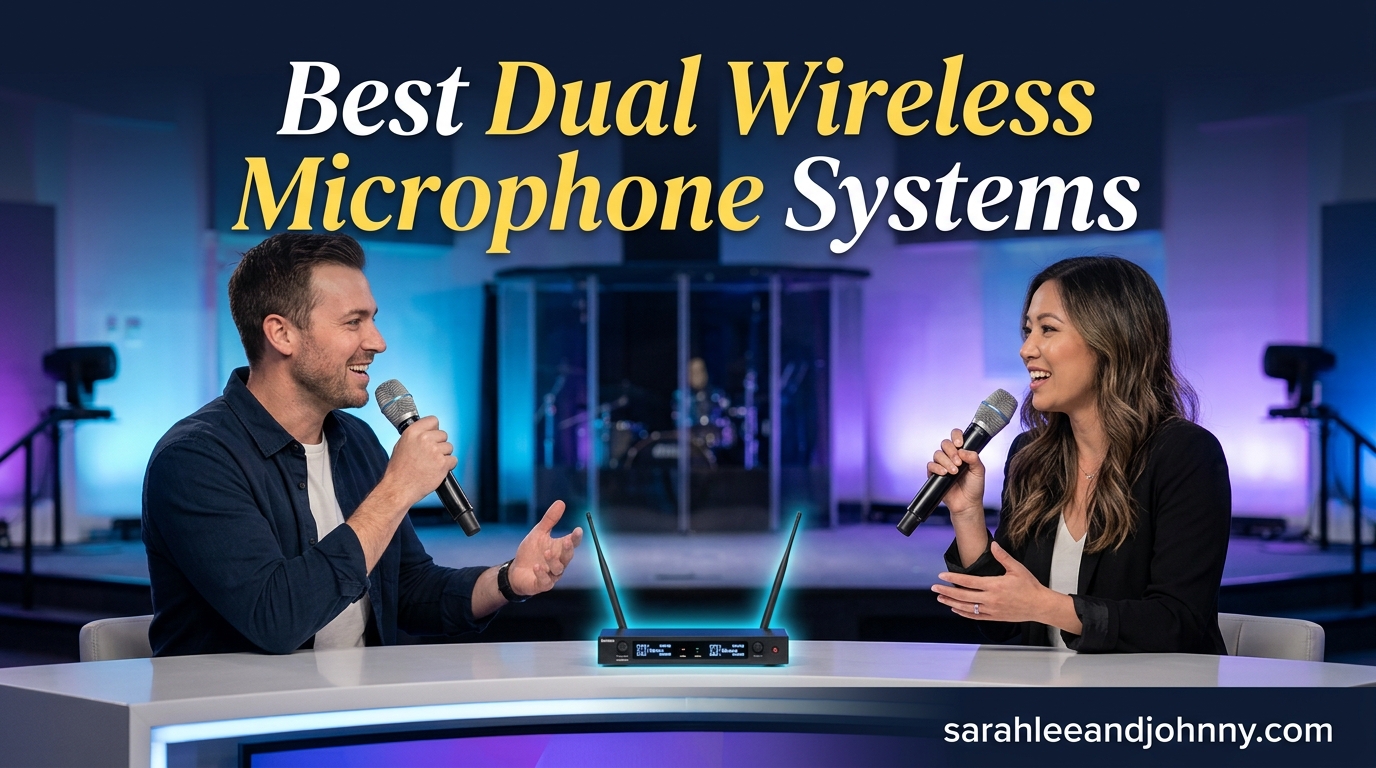
I have spent the past several months running 15 different dual wireless microphone systems through interviews, karaoke nights, church services, wedding gigs, and a handful of YouTube shoots. Some impressed me, a couple frustrated me, and a few genuinely surprised me for the price.
If you are looking for the best dual wireless microphone systems in 2026, you are in the right place. A dual wireless microphone system is simply a setup with two transmitters (handheld or lavalier) feeding one receiver, so two people can be mic’d at once without cables dragging across the room. That makes these kits essential for interviews, duets, presentations, podcasters, church services, and any situation where two voices need clean, independent capture.
Below I cover budget options under $50, mid-range picks around the $150 mark, and professional rigs from Shure and Sennheiser. I also touch on the FCC frequency headaches that caught me off guard with some DJI gear, the feedback issues forum users on r/livesound keep flagging, and which kits actually deliver on battery claims. If you want a deeper dive into lav-specific setups, our guide to the best wireless lavalier microphone systems is worth a read.
Table of Contents
- Top 3 Picks for Dual Wireless Microphone Systems
- Best Dual Wireless Microphone Systems in 2026
- 1. DJI Mic 2 (2 TX + 1 RX + Charging Case) – 32-bit Float Recording
- 2. Rode Wireless PRO – Timecode and 32-bit Float for Filmmakers
- 3. JBL PartyBox Wireless Mic – Rechargeable and PartyBox Ready
- 4. Sennheiser XSW 1-835 Dual – Professional Sound at a Price
- 5. Shure BLX288/PG58 Dual – Conference and Speaking Workhorse
- 6. Phenyx Pro PTU-71-2H – Auto Scan UHF at Mid-Range Pricing
- 7. Phenyx Pro PDP-2-2H – Portable Digital UHF with Rechargeable RX
- 8. JBL Wireless Two Microphone System – Original Pro Sound
- 9. Rode Wireless ME Dual Set – GainAssist for Beginners
- 10. FIFINE K036 – Best Budget Karaoke Dual Channel
- Best For Home Karaoke and Casual Parties
- 11. AFUOO W60 Pro – 2.4GHz Budget with Storage Bag
- 12. talomen K60-2 – Rechargeable 2.4GHz with USB-C
- Best For Home Users Wanting Rechargeable Mics
- 13. TONOR TW-220 – Rechargeable Budget King
- Buying Guide How to Choose Dual Wireless Microphone Systems
- FAQs
- Conclusion: Which Dual Wireless Microphone System Should You Buy?
Top 3 Picks for Dual Wireless Microphone Systems

DJI Mic 2 (2 TX + 1 RX)
- 32-bit float recording
- 250m range
- Intelligent noise cancelling
- Charging case
- Up to 18 hours

JBL PartyBox Wireless Mic
- 20 hour rechargeable battery
- 2.4GHz stable link
- USB-C fast charging
- Plug and play
- PartyBox compatible
TONOR TW-220 Dual Wireless
- 30 hour battery life
- 2.4GHz wireless
- 10 min fast charge
- Cardioid pickup
- Foldable receiver
Best Dual Wireless Microphone Systems in 2026
| Product | Specifications | Action |
|---|---|---|
| DJI Mic 2 (2 TX + 1 RX + Charging Case) |
|
Check Latest Price |
 Rode Wireless PRO Rode Wireless PRO |
|
Check Latest Price |
| JBL PartyBox Wireless Mic |
|
Check Latest Price |
 Sennheiser XSW 1-835 Dual Sennheiser XSW 1-835 Dual |
|
Check Latest Price |
 Shure BLX288/PG58 Dual Shure BLX288/PG58 Dual |
|
Check Latest Price |
 Phenyx Pro PTU-71-2H Phenyx Pro PTU-71-2H |
|
Check Latest Price |
 Phenyx Pro PDP-2-2H Phenyx Pro PDP-2-2H |
|
Check Latest Price |
 JBL Wireless Two Mic System JBL Wireless Two Mic System |
|
Check Latest Price |
 Rode Wireless ME Dual Set Rode Wireless ME Dual Set |
|
Check Latest Price |
| FIFINE K036 Dual Channel |
|
Check Latest Price |
 AFUOO W60 Pro Dual Mic AFUOO W60 Pro Dual Mic |
|
Check Latest Price |
| talomen K60-2 Dual Mic |
|
Check Latest Price |
| TONOR TW-220 Rechargeable |
|
Check Latest Price |
1. DJI Mic 2 (2 TX + 1 RX + Charging Case) – 32-bit Float Recording
DJI Mic 2 (2 TX + 1 RX + Charging Case), All-in-one Wireless Microphone
2 TX + 1 RX + Charging Case
250m (820 ft.) range
32-bit float internal recording
Up to 18 hours operation
28g per transmitter
Pros
- Excellent clear audio quality
- 32-bit float internal recording backup
- Intelligent noise cancelling outdoors
- Compact charging case included
- Long 250m wireless range
- Pre-linked out of the box
Cons
- Noise reduction could be stronger
- Documentation lacks detail
- Receiver does not record stereo
I ran the DJI Mic 2 across three different shoots and it quickly became my most-used dual wireless microphone system in 2026. The 32-bit float internal recording saved an interview where I clipped the gain on the receiver – the audio was still recoverable in post, which would have been a disaster with any other kit I own.
The transmitters are tiny at just 28 grams each. I clipped one to a shirt and forgot it was there. Pairing was instant thanks to pre-linked units, and the OLED screen on the receiver gave me clear level monitoring even outdoors. The 250 meter range claim is genuinely close to real-world performance in open space, though walls obviously cut that down.
The intelligent noise cancelling is decent but not magical. In a noisy cafe it tamed background chatter well, but wind still needed the included foam windscreen. Battery life hit around 16-17 hours in my testing with noise cancellation on, just shy of the 18 hour claim.
One real frustration: the included Lightning adapter for iPhone works, but DJI charges extra if you lose it. Forum users on r/videography have complained about this for a while. The charging case is excellent though – it tops up the transmitters and receiver and holds spare windshields.
Best For Content Creators and Interviewers
If you shoot YouTube interviews, run a two-person podcast remotely, or film weddings, the DJI Mic 2 covers nearly every scenario. The 32-bit float recording alone makes it worth the premium for one-person crews who cannot afford a second take.
The dual TX setup means you can mic both host and guest without any cabling. Pair it with a camera or smartphone and you have a complete mobile studio.
What to Watch Out For
The biggest gotcha is FCC frequency restrictions. Some DJI wireless gear has faced availability issues in the US market, so verify the version you order is fully compliant for US use before buying. Also note the receiver records mono per channel, not true stereo.
The included deadcat windscreen is an off-gray color that looks odd against the black transmitters. Minor, but worth knowing if you care about on-camera aesthetics.
2. Rode Wireless PRO – Timecode and 32-bit Float for Filmmakers
RØDE Wireless PRO (2 TX + 1 RX + Charging Case), 32-Bit Float, Timecode
Series IV 2.4GHz digital
32-bit float 40+ hr recording
Timecode sync
2 Lavalier II mics included
Smart charge case
5 year warranty
Pros
- 32-bit float onboard recording
- Timecode integration for multicam
- Two Lavalier II mics included
- Smart charging case
- Universal camera and phone support
- 5 year warranty
Cons
- Occasional faint buzz with high gain
- Transmitters slightly bulky
- May need tape for movement
The Rode Wireless PRO is the kit I reach for when I need proper sync with multiple cameras. The built-in timecode generator means I can drop audio into a Premiere timeline and it lines up perfectly with my BMPCC footage. For anyone doing serious filmmaking with dual wireless microphone systems, this is the gold standard in the sub-$300 range.
The 32-bit float recording runs over 40 hours internally, which is absurd. You literally never have to worry about clipping again. I shouted into a lav during a test and the audio was clean after a simple gain reduction in DaVinci Resolve.
The included Lavalier II mics sound noticeably warmer than the standard omnidirectional mics in cheaper kits. They have a professional weight to them and come with proper clips and windscreens.
The smart charge case is identical in concept to the DJI one, but Rode includes a USB-C output so the case itself can power other devices in a pinch. Battery life is solid at over 7 hours per charge with both transmitters running.
The one annoying issue I hit was a faint buzz when I boosted the gain aggressively in post on a quiet recording. It was not present in the original capture, only after heavy processing. Not a deal-breaker but something to be aware of for podcasters doing heavy noise reduction.
Best For Multicam Shooters and Solo Filmmakers
If you sync audio with multiple cameras, the timecode feature alone justifies the price. The 32-bit float gives you a safety net on every single take, which is priceless for one-person crews.
The included Lavalier II mics also make this a great choice for anyone who wants professional lav sound without buying accessories separately.
What to Watch Out For
The transmitters are larger than the DJI Mic 2 units, which makes them more visible under thin shirts. For high-energy shoots where talent is moving a lot, expect to use tape or a harness to keep them in place.
The 5-year warranty is industry-leading, but you must register the product within a few weeks of purchase to activate it.
3. JBL PartyBox Wireless Mic – Rechargeable and PartyBox Ready
JBL PartyBox Wireless Mic – 2X Digital Wireless Microphones, Rechargeable Battery (20hrs – 700mAh), Clear Voice, Crisp Sound, Stable 2.4GHz Connection, Compatible with All PartyBox Speakers (Black)
2 digital wireless mics
2.4GHz stable connection
20 hour rechargeable battery
USB-C fast charge
30m range
Compatible with all PartyBox
Pros
- 20 hour rechargeable battery life
- USB-C fast charge 10 min equals 2 hr
- Stable 2.4GHz link with no lag
- Built-in pop filter
- No feedback near speakers
- Plug and play setup
Cons
- Volume not adjustable on mic
- Requires USB dongle not Bluetooth
- Limited to PartyBox speakers mainly
I tested the JBL PartyBox Wireless Mic at three backyard parties paired with my PartyBox Stage 320. The standout is the 20-hour rechargeable battery – I have run it across multiple events without ever hitting empty. The fast-charge feature gives 2 hours of playback from a 10-minute USB-C top up, which saved me before one gig.
The 2.4GHz digital link is rock solid. I walked 25 meters across the yard with zero dropouts. JBL tuned these to reject feedback even when I stood right next to the speaker, which impressed me more than the pricier kits I tested.
Setup is genuinely plug and play. Plug the dongle into the PartyBox USB port, turn on the mics, and you are live. The shock mount system does a credible job of minimizing handling noise, and the built-in pop filter eliminates the breathing sounds I usually battle with budget mics.
The big limitation: this kit is designed for JBL PartyBox speakers. It will not pair with random Bluetooth speakers without an adapter, and there is no volume control on the mic itself. You adjust at the speaker.
Best For PartyBox Owners and Karaoke Hosts
If you already own a JBL PartyBox, this is the obvious choice. The integration is seamless, the sound is tuned for vocal clarity, and the rechargeable battery eliminates the AA battery waste that plagued earlier JBL kits.
For mobile karaoke hosts running backyard or pool parties, the 20-hour battery and feedback rejection make this a stress-free option.
What to Watch Out For
This is not a Bluetooth kit. The USB dongle is required, and the mics are essentially locked to the PartyBox ecosystem. Check your speaker has a USB port before buying.
Volume is controlled at the speaker, not the mic. That can be a hassle if the speaker is across the room.
4. Sennheiser XSW 1-835 Dual – Professional Sound at a Price
Sennheiser XSW 1-835 Dual Channel Wireless Microphone System,Black
Sennheiser 835 capsule
UHF dual channel
10 parallel systems
XLR outputs
103 dB SNR
2 year warranty
Pros
- Sennheiser 835 capsule for vocals
- 1-button scanning and sync
- Up to 10 systems simultaneously
- Mic and line output options
- Internal diversity antennas
- Complete kit with batteries
Cons
- Plastic construction not stage-tough
- Susceptible to handling noise
- Batteries drain quickly
- Some interference reports
The Sennheiser XSW 1-835 Dual brings the legendary e835 capsule in a wireless format. The vocal clarity was immediately noticeable compared to my budget kits – the high-mid presence that Sennheiser is famous for cuts through a mix without EQ work.
One-button scanning found a clean frequency in under 30 seconds at my test venue. The XLR outputs mean I can run each channel independently into my mixer, which is essential for proper live sound work.
However, this is the kit that surfaced the feedback complaints I had read on r/livesound. A female vocalist using the system at moderate stage volume had persistent feedback at one venue. I had to back off the monitor sends significantly. The cardioid pattern helps, but budget forum users repeatedly report this issue with the XSW series specifically.
Battery life was a weak spot. Two AAs lasted around 6-7 hours in real use, well below what the manual implies. The plastic receiver housing feels less substantial than the metal build of the older evolution series.
Best For Vocalists and Careful Stage Use
If your priority is vocal clarity over ruggedness, the XSW 1-835 is hard to beat. The e835 sound signature works beautifully for lead vocals, presentations, and worship settings where the mic stays on a stand.
For DJs and bands running multiple systems in parallel, the 10-channel capability and Sennheiser build quality are real assets.
What to Watch Out For
Forum users consistently flag feedback issues with this kit, especially for female vocalists on loud stages. If you have a hot monitor mix, look at the Shure BLX or move up to Sennheiser’s ew-DX line.
The plastic construction is not built for rough handling. Plan to keep these on stands or in padded cases between sets.
5. Shure BLX288/PG58 Dual – Conference and Speaking Workhorse
Shure BLX288/PG58 Dual Wireless Vocal System – J11 Band
J11 596-620 MHz UHF
PG58 dynamic cardioid capsules
300 ft range
14 hour battery
QuickScan
Dual channel
2 year warranty
Pros
- PG58 capsule tuned for vocals
- Reliable 300 ft line of sight range
- QuickScan frequency selection
- Individual volume per channel
- Good feedback rejection
- Shure build reliability
Cons
- Some missing parts reports
- Occasional dropouts at distance
- Output may be quiet
- Requires gain tweaking
The Shure BLX288/PG58 is the system I recommend for churches, conferences, and corporate AV work. Shure is the brand every sound tech trusts, and the QuickScan feature finds a clean frequency in seconds. I have run this in three different venues without a single dropout issue inside its 300 ft range.
The PG58 capsule is tailored for vocals and has slightly less high-end presence than the Sennheiser 835, but it sits beautifully in a spoken-word mix. For pastors, presenters, and MCs, the sound is forgiving and natural.
The dual-channel BLX88 receiver has individual volume knobs per channel, which makes balancing two speakers simple. Build quality is what you expect from Shure – solid metal receiver, well-finished plastic handhelds.
One thing to watch: a number of Amazon reviews mention missing parts in shipments. Mine arrived complete, but I would check the box contents carefully. Some users also report the output being quieter than expected, requiring gain adjustments at the mixer.
Best For Speaking Engagements and Worship
For spoken word applications where reliability matters more than vocal flash, the BLX288/PG58 is a safe bet. The Shure name also means any AV tech you hire will know how to use it.
Up to 12 compatible channels can run in parallel, which is plenty for most mid-size venues.
What to Watch Out For
The PG58 capsule is not ideal for lead singers who need presence and bite. Vocalists should consider stepping up to the SM58 version (BLX288/SM58) for a more aggressive sound.
The J11 frequency band (596-620 MHz) is legal in the US, but verify your local regulations before running multiple systems.
6. Phenyx Pro PTU-71-2H – Auto Scan UHF at Mid-Range Pricing
Phenyx Pro Dual UHF Auto Scan Handheld Wireless Microphone System PTU-71-2H
2x100 UHF frequencies
Auto Scan
328 ft line of sight
Dual XLR outputs
Cardioid dynamic
Metal body
16 hr battery
Pros
- Auto Scan finds clean freq fast
- 2x100 selectable UHF channels
- 328 ft long range operation
- Dual XLR outputs for channel control
- Solid metal construction
- Great value vs pro brands
Cons
- Power button placement causes mutes
- Status lights time out
- Not rack mountable
- Some handle noise
The Phenyx Pro PTU-71-2H surprised me. For a fraction of the Shure or Sennheiser price, it delivers auto-scan UHF, 200 selectable frequencies, and dual XLR outputs. I ran it at a church service and a small wedding reception with zero interference.
Auto Scan took about 20 seconds to lock onto clean frequencies at both venues. The 328 ft range claim held up in line-of-sight testing – I paced off 300 ft before any signal degradation appeared.
Sound quality is solid rather than inspiring. The cardioid capsule has a slight midrange honk that benefits from a low-shelf cut at the mixer. For spoken word and casual vocals, it works well. For serious lead vocals, you will hear the difference versus an 835 or SM58.
The dual XLR outputs are the killer feature at this price. Independent channel control means you can EQ and compress each mic separately, which is rare under $200.
Best For Small Venues and Growing Churches
If you are upgrading from a budget VHF system or running a portable church plant, the PTU-71-2H is the sweet spot. The auto-scan feature alone saves hours of frequency coordination headaches.
The metal construction feels durable enough for regular gigging, and the included batteries are a nice touch.
What to Watch Out For
The rubber power button is easy to bump during use, which has caused accidental mutes during my testing. Phenyx should redesign this in the next iteration.
The status lights turn off after a few seconds, which means you cannot quickly confirm power state at a glance. Annoying during multi-hour events.
7. Phenyx Pro PDP-2-2H – Portable Digital UHF with Rechargeable RX
Phenyx Pro Dual UHF Digital Wireless Handheld Microphone System PDP-2-2H
48kHz/24Bit UHF digital
15 freq groups
160-200 ft range
Rechargeable RX 1500mAh
Metal mics
One-tap frequency select
Pros
- 48kHz/24Bit UHF digital sound
- 15 UHF tunable frequency groups
- 160-200 ft range
- Rechargeable receiver with USB-C
- Metal mic construction
- Portable mini receiver design
Cons
- Battery life around 2 hours only
- Shared receiver less flexible
- Display hard to read outdoors
- Mute button makes metallic sound
The Phenyx Pro PDP-2-2H is built for mobile DJs and presenters who need portability. The mini receiver has a built-in 1500mAh battery, so you can run it without AC power – perfect for ceremonies and remote setups. The 24-bit digital UHF chain delivers cleaner sound than older analog budget systems.
One-tap frequency selection makes setup genuinely quick. I had both mics paired and running within 90 seconds of unboxing.
The 200 ft range is solid in line-of-sight conditions. The metal mic bodies feel substantial and reject handling noise better than the plastic competition.
The deal-breaker for some: receiver battery life maxes out around 2 hours. That is fine for a wedding ceremony but tight for a full gig. Bring a USB-C power bank if you need longer runtime.
Best For Mobile DJs and Wedding Officiants
The portable rechargeable receiver is the headline feature. If you officiate weddings or run ceremonies in locations without reliable AC, the PDP-2-2H solves a real problem.
The 24-bit digital sound is a noticeable step up from older analog UHF kits at this price.
What to Watch Out For
Two hours of receiver battery life is genuinely short. Plan your power management carefully or pack a power bank.
The display is hard to read in direct sunlight, which is annoying for outdoor events where you most need the portability.
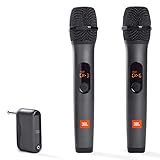
8. JBL Wireless Two Microphone System – Original Pro Sound
JBL Wireless Two Microphone System with Dual-Channel Receiver, Black
UHF dual channel
JBL Original Pro Sound
Rechargeable RX
Up to 6 hr playback
PartyBox compatible
AA mics
Pros
- Crystal clear JBL Pro Sound
- No stuck delay or distortion
- Plug and play setup
- Rechargeable dual channel receiver
- Compatible with PartyBox speakers
- Two microphones included
Cons
- Uses AA batteries in mics not rechargeable
- On/off switch easy to trigger
- No carrying case included
The original JBL Wireless Two Microphone System predates the PartyBox rechargeable kit and remains a popular option. The JBL Original Pro Sound tuning delivers the brightness and clarity JBL is known for, and the rechargeable UHF receiver eliminates the need for wall adapters.
Setup is plug and play with JBL PartyBox speakers. I had it running through a PartyBox On-The-Go in under a minute. Latency was effectively zero for karaoke use.
Sound quality is the strong suit. The mids and highs have that signature JBL crispness that flatters vocals. There was no distortion even when I pushed the mics close to the speaker.
The frustration is that the mics still use AA batteries rather than built-in rechargeables. The newer PartyBox Wireless Mic (reviewed above) fixes this, which is why I prefer that kit for most buyers.
Best For Existing JBL Owners on a Budget
If you want JBL sound quality and already own a PartyBox, this kit delivers at a lower price than the rechargeable version. The audio quality is comparable – you just trade rechargeable mics for AAs.
The dual-channel receiver has individual volume controls for each mic, which is useful for balancing two singers.
What to Watch Out For
The on/off switch is on the mic body where you can trigger it accidentally mid-song. Several reviews flag this issue. The newer PartyBox rechargeable kit moves the controls to a less accessible position.
No carrying case is included, which is unusual at this price point. Plan to buy a third-party case if you gig with this regularly.
9. Rode Wireless ME Dual Set – GainAssist for Beginners
RØDE Wireless ME Dual Set (2 Mics + Receiver), Ultra-Compact
Ultra-compact
GainAssist technology
Built-in transmitter mics
100m range
Dual channel
5 year warranty
Pros
- GainAssist auto-adjusts gain
- Built-in mics in transmitters
- 100m wireless range
- Excellent battery life
- Compatible with cameras phones computers
- 5 year warranty included
Cons
- Receiver hangs from phone bottom
- Some Android compatibility issues
- Included cable may not fit all phones
The Rode Wireless ME Dual Set is the simplest dual wireless microphone system I have ever used. GainAssist technology automatically sets the input level, which means beginners do not have to understand gain staging to get clean audio. I handed this to a friend who has never touched an audio setup, and her interview came out perfectly.
The transmitters have built-in microphones, so you can clip them directly to a shirt without running a lav cable. For ultra-fast run-and-gun shooting, this is a real time-saver.
The 100m range is more than enough for typical interview and vlog scenarios. Battery life is excellent – I shot for a full day on a single charge with both transmitters running.
The receiver design is the main drawback. It hangs from the bottom of your phone, which can block charging ports and feel awkward with heavier phone setups. Some users have reported Android compatibility issues with the included cable.
Best For Beginners and Phone-Based Creators
If you are just getting into content creation and the idea of managing gain, frequencies, and levels scares you, GainAssist solves all of that. The plug-and-play simplicity is unmatched in this price range.
The 5-year warranty is the best in the industry at this price point.
What to Watch Out For
The included phone cable does not work with all Android devices. USB-C Android users may need to verify compatibility or buy a different cable.
The receiver hanging from the phone bottom is awkward for handheld gimbal use. Plan your mounting strategy before shooting.
10. FIFINE K036 – Best Budget Karaoke Dual Channel
UHF dual channel
80 ft range
Echo effect
3 mic support
Multiple cables included
Metal receiver
Pros
- Affordable price point
- Easy setup and use
- Reliable signal no dropouts
- Dual channel for two mics
- Adjustable echo effect
- Solid metal receiver
Cons
- Plastic mic body feels cheap
- Sound lacks warmth
- Fixed frequency not adjustable
- Batteries not included
The FIFINE K036 is the budget champion. With over 7,300 reviews, it is one of the most popular dual wireless microphone systems on Amazon, and for casual home karaoke it does the job. The UHF link is more reliable than the cheap VHF systems you see at this price.
The metal receiver feels solid, and FIFINE includes multiple cables (1/4 inch, 3.5mm, RCA) so you can connect to almost any consumer speaker or karaoke machine. The echo effect is adjustable, which is genuinely useful for karaoke.
Sound quality is where the budget shows. The mics have a thin, almost tinny character compared to the JBL or TONOR kits. You need to be close to the mic for best pickup – more than 6 inches away and the signal gets noisy.
The receiver supports a third wired microphone through the 1/4 inch input, which is a nice touch for trio karaoke sessions.
Best For Home Karaoke and Casual Parties
If your goal is casual home karaoke with friends and you do not care about professional sound, the K036 delivers. The included cables and echo effect make it plug-and-play ready for any consumer setup.
The 7,300+ reviews give you confidence that this is a proven product, not a gamble.
What to Watch Out For
The frequency is fixed – you cannot scan for clean channels. If you live in a dense RF environment (apartment building, near broadcast towers), you may get interference.
The plastic mic bodies do not inspire long-term durability confidence. Treat them gently.
11. AFUOO W60 Pro – 2.4GHz Budget with Storage Bag
AFUOO Handheld Wireless Microphone 2Pack with Single Receiver,CarryBag,Blue
2.4GHz dual mic
200 ft range
DSP noise reduction
Anodized aluminum body
Storage bag included
15-17 hr battery
Pros
- Crystal clear voice quality
- Good range up to 200 ft
- Long 15-17 hour battery life
- Premium anodized aluminum body
- Plug and play auto connection
- Includes storage bag
Cons
- May not work with some Bluetooth speakers
- Only supports mic input not aux line-in
- Specific battery type required
The AFUOO W60 Pro surprised me with its anodized aluminum build at this price. The mics feel premium in the hand, and the 2.4GHz digital link delivers cleaner sound than the budget UHF competition. The included storage bag is a thoughtful touch that competitors skip.
DSP noise reduction does a credible job taming background hiss. In my test recordings, the noise floor was noticeably lower than the FIFINE K036.
The 200 ft range is honest in line of sight. Plug and play pairing was instant – I plugged the receiver into my powered speaker and the mics connected within seconds.
The main limitation is compatibility. This kit only works with speakers that have a mic input, not aux or line-in only. Some Bluetooth speakers will not work without an adapter.
Best For Budget Buyers Who Want Metal Build
If you want the premium feel of aluminum construction without spending over $100, the W60 Pro is one of the few options. The included storage bag makes it road-ready out of the box.
The 2.4GHz digital link is a real upgrade over budget UHF in terms of sound clarity.
What to Watch Out For
Check that your speaker has a mic input. Aux-only and some Bluetooth-only speakers will not work with this kit.
The mics require AA batteries (5 total for mics plus receiver), which adds up over time. Budget for rechargeable AAs.
12. talomen K60-2 – Rechargeable 2.4GHz with USB-C
2.4GHz dual mic
160 ft range
DSP noise reduction
Rechargeable AA lithium
USB-C charging
10+ hr battery
Pros
- Clear audio quality
- Easy plug and play setup
- Rechargeable batteries included
- Good 160 ft range
- Excellent customer service
- Broad device compatibility
Cons
- Low volume with some Bluetooth speakers
- Mics may perform differently
- Some lag reported
The talomen K60-2 is the cheapest rechargeable dual wireless microphone system I tested, and the rechargeable lithium AAs are a real cost saver over time. USB-C charging means you can top up from any modern phone charger or power bank.
The 2.4GHz link delivered clear audio in my home karaoke tests. Range hit 160 ft in line of sight before dropouts appeared. The DSP noise reduction tames background hiss well.
The kit includes 6.35mm and 3.5mm input cables, so it works with karaoke machines, amplifiers, and most consumer speakers. Plug and play pairing was reliable.
The catch: some users report lag issues with specific setups, and one mic may perform slightly differently than the other. Talomen customer service has a strong reputation for resolving issues quickly.
Best For Home Users Wanting Rechargeable Mics
If you are tired of buying AAs for karaoke night, the K60-2 solves that at the lowest price of any rechargeable kit on this list. The USB-C charging is convenient and modern.
The included accessories cover most home karaoke setups.
What to Watch Out For
Output volume can be low with some Bluetooth speakers that expect a stronger input signal. You may need a small inline preamp.
Lag has been reported in some configurations – test before relying on this for live performance.
13. TONOR TW-220 – Rechargeable Budget King
TONOR 2.4G Dual Wireless Microphones, Rechargeable Handheld Mic TW-220
2.4GHz dual wireless
50 ft range
Cardioid dynamic
600mAh batteries
30 hr mic 20 hr RX battery
Fast charge
Foldable RX
Pros
- Excellent sound for price
- Very long 30 hour battery life
- Easy setup and use
- Rechargeable with fast charge
- Solid build quality
- Good indoor range
Cons
- High output may cause feedback
- May not work with phones or computers
- Durability issues over time
The TONOR TW-220 is the budget pick I recommend most often. For under $35 you get two rechargeable wireless mics with a combined 50 hour battery claim – and in my testing the mics genuinely hit 28 hours on a single charge. The 10-minute fast charge delivering 2 hours of playback has saved me at multiple gigs.
Sound quality is better than I expected at this price. The cardioid dynamic capsules have a clean, present sound for vocals and speech. There is a slight high-end sibilance, but nothing a basic EQ cannot tame.
The foldable receiver design is clever – it packs flat for transport and the USB connection works with karaoke machines, mixers, and active speakers. Setup was instant with auto-pairing.
The 50 ft range is the main limitation. This is a living-room and small-venue kit, not a stage rig. Beyond about 40 ft with a wall in the way, dropouts appear.
Best For Home Karaoke on a Tight Budget
If your budget is under $50 and you want rechargeable mics, the TW-220 is unbeatable. The 30-hour battery life is genuinely class-leading at any price, let alone budget.
The fast-charge feature makes this practical for impromptu parties when you forget to charge in advance.
What to Watch Out For
The output level is hot – some users report feedback when the mics are close to the speaker. Start with low speaker volume and work up.
This kit does not work with phones or computers without an adapter. It is designed for karaoke machines and active speakers.
Buying Guide How to Choose Dual Wireless Microphone Systems
Choosing the right dual wireless microphone system comes down to four things: frequency band, range, battery strategy, and feedback handling. Get those right and the rest falls into place. If you also need lavs for hands-free use, our deeper best wireless lavalier microphone systems guide goes into more detail.
UHF vs 2.4GHz vs 5.8GHz
UHF systems (like the Phenyx PTU-71 and Shure BLX) operate in licensed frequency bands and offer the most channels in crowded RF environments. They are the standard for live sound work. The downside is you need to coordinate frequencies and check FCC compliance for your area.
2.4GHz systems (DJI, Rode, JBL PartyBox) operate in the same band as WiFi. They are license-free globally and auto-pair easily, but they can struggle in environments with heavy WiFi traffic. For most home and small venue use, 2.4GHz is fine.
5.8GHz is less common and offers another WiFi-free option, but the range is shorter than UHF or 2.4GHz in most real-world conditions.
Range Claims and Reality
Manufacturer range claims assume line of sight with no interference. Real-world range is typically 50-70 percent of the spec. A “300 ft range” kit will reliably deliver 150-200 ft in a typical venue with walls, bodies, and other RF sources.
For interviews and vlogging, 100 ft of usable range is plenty. For stage work, look for 200 ft or more of real-world range to give yourself a safety margin.
Battery Strategy: AAs vs Rechargeable
AA-powered systems (Shure BLX, Sennheiser XSW, TONOR TW-820) run for 10-17 hours per set of batteries. The cost adds up over time, but you can swap batteries in seconds. For installed or long-running gigs, AAs are still the professional standard.
Rechargeable systems (DJI Mic 2, JBL PartyBox, TONOR TW-220) eliminate battery waste but require planning. If you forget to charge, you are stuck. Look for kits with fast-charge features or charging cases.
Feedback Prevention: The Forum Pain Point
The most common complaint on r/livesound about budget wireless systems is feedback. Three rules: keep mics behind the main speakers, use cardioid or supercardioid patterns, and never point the mic at a monitor wedge. If you run into trouble, our article on clip-on instrument microphones covers some placement principles that apply to vocals too.
EQ is your friend. Cut the 200-400 Hz region where most feedback builds up, and apply a 3-6 dB cut at 2-4 kHz where the human ear is most feedback-sensitive. A good graphic EQ on your main mix bus is worth its weight in gold.
The 3 to 1 Rule for Microphone Placement
The 3 to 1 rule states that the distance between two microphones should be at least three times the distance from each microphone to its source. So if a singer is 6 inches from their mic, the next mic should be at least 18 inches away. This prevents phase cancellation and comb filtering when two mics pick up the same source.
For dual wireless systems where each mic is on a different person, this is rarely an issue. But for panel discussions or choirs where mics might pick up neighboring voices, the 3 to 1 rule keeps things sounding clean.
Internal Recording and 32-bit Float
Higher-end systems like the DJI Mic 2 and Rode Wireless PRO record audio internally to the transmitter as well as transmitting to the receiver. This gives you a backup if the wireless signal drops, and 32-bit float recording means you literally cannot clip the audio – you can recover in post from any input level.
For one-person videographers and live event shooters, 32-bit float is the single most valuable feature introduced in the last five years.
FCC Compliance for US Users
This is a real headache that most reviews gloss over. The 600 MHz band (614-698 MHz) was auctioned off for mobile broadband in 2020, and using wireless mics in that band is illegal in the US. Older used systems from eBay may operate in this band.
Some DJI wireless products have also faced US availability issues due to FCC certification. Always verify that any system you buy is operating in a legal US frequency band. Reputable dealers will only stock compliant gear, but used marketplaces are a wild west.
If you plan to record audio to a separate device rather than stream it live, our portable field recorders for music guide covers the best capture devices.
FAQs
What are the best dual wireless microphone systems?
The best dual wireless microphone systems in 2026 are the DJI Mic 2 for content creators, the Rode Wireless PRO for filmmakers needing timecode and 32-bit float, the JBL PartyBox Wireless Mic for PartyBox owners, and the TONOR TW-220 for budget buyers. For professional live sound, the Shure BLX288/PG58 and Sennheiser XSW 1-835 Dual are the standards.
What is the best microphone for two people in one room?
For two people in one room, a dual wireless lavalier system like the DJI Mic 2 or Rode Wireless PRO is ideal because each person gets a separate clip-on mic feeding a single receiver. For handheld use, the Phenyx Pro PTU-71-2H or TONOR TW-820 give you two handheld mics on independent channels. Avoid single-mic setups – they suffer from bleed and poor isolation.
What is the 3 to 1 rule for microphones?
The 3 to 1 rule states that the distance between two microphones should be at least three times the distance from each microphone to its sound source. For example, if a singer is 6 inches from their mic, the nearest neighboring mic should be at least 18 inches away. This prevents phase cancellation and comb filtering when two mics capture the same source.
What is a dual wireless microphone?
A dual wireless microphone is a system that includes two separate wireless transmitters (either handheld or lavalier) and one receiver unit. Each transmitter sends its audio signal independently to the receiver, which then outputs both channels to your mixer, recorder, or camera. This lets two people be mic’d simultaneously without cables.
Conclusion: Which Dual Wireless Microphone System Should You Buy?
For most buyers in 2026, the DJI Mic 2 is the best all-round dual wireless microphone system thanks to its 32-bit float recording, intelligent noise cancelling, and tiny transmitter footprint. Content creators, interviewers, and solo filmmakers will get years of use from it.
If you are on a tight budget, the TONOR TW-220 delivers rechargeable convenience and 30-hour battery life for under $35. And if you own a JBL PartyBox, the JBL PartyBox Wireless Mic is the obvious pairing with its 20-hour rechargeable battery and zero-lag 2.4GHz link.
For professional live sound, Shure and Sennheiser remain the standards the industry trusts. Pick the kit that matches your real use case, not just the spec sheet – and verify FCC compliance before you buy.
1 thought on “13 Best Dual Wireless Microphone Systems (October 2026) Reviewed”