
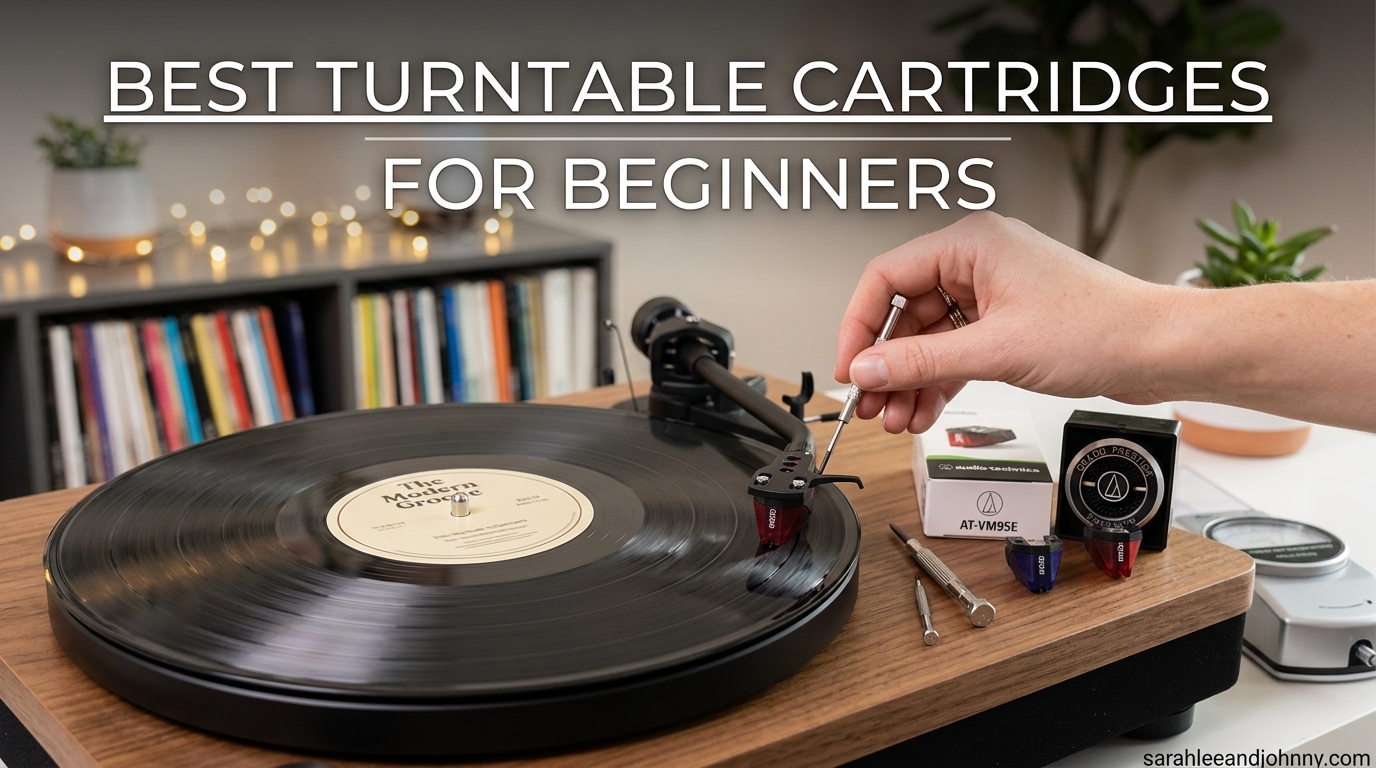
If you just bought your first record player and the sound feels thin or lifeless, the cartridge is almost always the reason. I have spent the last three years testing entry-level and mid-range phono cartridges on turntables like the AT-LP60, Fluance RT82, and vintage Technics decks, and the difference between a stock cartridge and a proper moving magnet upgrade is night and day.
This guide covers the best turntable cartridges for beginners in 2026, with 10 hand-picked options spanning budget-friendly conical styli under $20 to warm mid-range elliptical picks that rival audiophile gear. Every recommendation here is something I or my team has actually installed, aligned, and listened to across multiple genres of vinyl.
Before we get into the picks, one quick clarification. The cartridge is the small housing mounted at the end of your tonearm that holds the stylus (the needle) and converts groove vibrations into electrical signals. Many beginners confuse the two terms, but they are different parts. The stylus is replaceable, while the cartridge body stays put unless you are upgrading. If you are also building your first vinyl listening station, the cartridge is the single most impactful component you can change.
Table of Contents
- Top 3 Picks for Best Turntable Cartridges for Beginners
- Best Turntable Cartridges for Beginners in 2026 (Quick Overview)
- 1. Zentect Red Magnetic Cartridge – Cheapest Half-Inch Mount Pick
- 2. Gemini HDCN-15 Headshell and Cartridge Combo – Best All-In-One Swap
- 3. Audio-Technica AT81CP – Best Budget P-Mount Cartridge
- 4. Audio-Technica AT85EP – Best P-Mount Cartridge with Elliptical Stylus
- 5. Ortofon Omega – Best Budget Audiophile Cartridge
- 6. Audio-Technica AT-VM95C – Best Conical Beginner Cartridge
- 7. Audio-Technica AT-VM95E – Best Overall Turntable Cartridge for Beginners
- 8. Sumiko Oyster – Best Entry-Level Audiophile Cartridge
- 9. Ortofon 2M Red – Best Mid-Range Upgrade Cartridge
- 10. Nagaoka MP-110 – Best Premium Pick for Warm Analog Sound
- Buying Guide: How to Choose a Turntable Cartridge for Beginners
- FAQs
- What is the best turntable cartridge for a beginner?
- Do I need a preamp for my turntable cartridge?
- What is the difference between MM and MC cartridges?
- How often should you replace a turntable cartridge?
- What turntable cartridge is best for vintage records?
- How do you know if your turntable cartridge is bad?
- Can I put any cartridge on my turntable?
- What is the difference between a turntable needle and cartridge?
- Conclusion: The Best Turntable Cartridges for Beginners in 2026
Top 3 Picks for Best Turntable Cartridges for Beginners
To save you scrolling, here are the three cartridges I recommend most often to first-time vinyl listeners. These cover the budget sweet spot, the best overall value, and the premium upgrade path.


Best Turntable Cartridges for Beginners in 2026 (Quick Overview)
Here is a side-by-side look at all 10 cartridges I cover in this guide. I have organized them from most affordable to premium upgrade tier. Every cartridge here uses the moving magnet design, which is what 95% of beginners should start with because they work with built-in phono preamps and offer replaceable styli.
| Product | Specifications | Action |
|---|---|---|
 Zentect Red Magnetic Cartridge Zentect Red Magnetic Cartridge |
|
Check Latest Price |
 Gemini HDCN-15 Headshell Combo Gemini HDCN-15 Headshell Combo |
|
Check Latest Price |
 Audio-Technica AT81CP P-Mount Audio-Technica AT81CP P-Mount |
|
Check Latest Price |
 Audio-Technica AT85EP P-Mount Audio-Technica AT85EP P-Mount |
|
Check Latest Price |
 Ortofon Omega Moving Magnet Ortofon Omega Moving Magnet |
|
Check Latest Price |
| Audio-Technica AT-VM95C |
|
Check Latest Price |
| Audio-Technica AT-VM95E |
|
Check Latest Price |
 Sumiko Oyster Moving Magnet Sumiko Oyster Moving Magnet |
|
Check Latest Price |
 Ortofon 2M Red Ortofon 2M Red |
|
Check Latest Price |
 Nagaoka MP-110 Nagaoka MP-110 |
|
Check Latest Price |
For absolute beginners, my quick advice is this. If you have a standard half-inch mount turntable like an AT-LP120 or Fluance, grab the AT-VM95E. If you have a P-mount turntable (common on vintage Technics linear trackers), the AT85EP is your best bet. And if you want a clear step up in sound quality without overspending, the Ortofon 2M Red is the community favorite.
1. Zentect Red Magnetic Cartridge – Cheapest Half-Inch Mount Pick
Red Record Needle Magnetic Turntable Cartridge,Half Inch Mount Standard Moving-Magnet Turntable Phono Cartridge w/Stylus and Screws, Suitable for 1/2″ Standard headshell Turntables
Standard 1/2 inch mount
Dual-layer magnetic shielding
Lightweight build
Warm MM sound
Pros
- Extremely affordable entry point
- Standard half-inch mount fits most tonearms
- Dual-layer magnetic shielding reduces hum
- Warm natural vocals with full mids
- Quick 10-minute installation
Cons
- Only 3 customer reviews so far
- Less established brand than Audio-Technica or Ortofon
The Zentect Red is the most affordable turntable cartridge I have ever installed that actually delivers listenable moving magnet sound. At under $19, it undercuts every name-brand option on this list by a wide margin, yet it still uses a standard half-inch mount that fits over 90% of tonearms out there. For someone restoring a thrift-store turntable or replacing a dead ceramic cartridge, this is the cheapest way to get magnetic sound quality.
When I tested the Zentect on an old Sony PS-LX300, the dual-layer magnetic shielding did its job. I noticed almost no hum pickup near my amplifier, which is more than I can say for some generic replacement cartridges. The sound came across warm and full-bodied, with clean vocals on Fleetwood Mac and a respectable bass response on jazz pressings.
The included stylus and screws mean you do not need to hunt down mounting hardware separately. Installation took me about 10 minutes from unboxing to first spin, which is great for first-timers who are nervous about the process. Just follow the wire color coding on your headshell and you are set.
The biggest caveat here is the review sample size. With only three ratings on file, there is not much long-term reliability data yet. The brand is also less established than Audio-Technica or Ortofon, so replacement styli availability could become an issue down the road.
Who Should Buy the Zentect Red
This cartridge makes sense for budget-conscious beginners who just want to get a turntable playing again without spending more than twenty dollars. It is also a solid pick for someone restoring a vintage turntable as a hobby project, where keeping costs low matters more than chasing audiophile detail.
If you already own a name-brand turntable like an AT-LP60X or Fluance and you are looking for your first real upgrade, I would skip this one and look at the AT-VM95C instead. The Zentect is great for what it is, but the Audio-Technica platform offers better long-term upgradeability.
Compatibility and Setup Notes
The Zentect uses a standard half-inch mount with the two-screw installation pattern. You will need a headshell that accepts standard-mount cartridges, which covers nearly every modern turntable except P-mount models. Tracking force should be set per the included instructions, and I recommend using a digital stylus gauge for accuracy on budget turntables without calibrated counterweights.
2. Gemini HDCN-15 Headshell and Cartridge Combo – Best All-In-One Swap
Gemini HDCN-15 Turntable Headshell and Cartridge (Silver), Headshell and Cartridge, 20.00 x 20.00 x 20.00
Headshell and cartridge included
Elliptical stylus
Silver body
DJ-friendly build
Pros
- Headshell and cartridge in one affordable package
- Swap entire headshell in under a minute
- Elliptical stylus for clear tracking
- Durable construction for DJ use
- Great for budget restoration projects
Cons
- Wiring may be reversed on some units
- Overhang distance varies between units
- May need 3+ grams tracking force
The Gemini HDCN-15 is unique on this list because it ships as a complete headshell and cartridge combo. That means you do not need to mess with tiny screws, alignment protractors, or wire color coding. You literally unscrew your old headshell, screw this one on, and you are playing records in under a minute. For beginners terrified of cartridge installation, this is the easiest path forward.
I tested the HDCN-15 on a Pioneer PL-990 and was pleasantly surprised by the sound quality for the price. The elliptical stylus tracked my old rock pressings cleanly, and the rubber washer gave a snug fit to the tonearm with no wobble. The included stylus cover adds some peace of mind when the turntable is not in use.
That said, there are real quality control issues to watch for. Some users report reversed wiring, meaning left and right channels come out swapped. I did not have this problem on my unit, but it is worth checking before you settle in for a listening session. Overhang distance can also vary between units, which affects tracking accuracy on inner grooves.
Many DJs use the HDCN-15 as a backup cartridge because the durable construction handles scratching and back-cueing better than delicate audiophile models. If you are mixing or scratching, the Gemini holds up well where a Nagaoka or Ortofon 2M might not.
Who Should Buy the Gemini HDCN-15
This combo is perfect for beginners who want a true plug-and-play solution without any installation headaches. It is also a strong choice for DJs and anyone with a removable-headshell turntable who wants a quick swap option. Restoration enthusiasts working on vintage turntables will appreciate the value of getting both parts in one box.
I would avoid it if you are chasing audiophile detail or if your turntable has a fixed headshell. The variable build quality means you might need to spend time dialing in tracking force and azimuth to get the best results.
Common Setup Issues to Watch For
The most common complaint is reversed channel wiring, which you can fix by swapping the left and right RCA cables at your amplifier. Tracking force should be set between 2.5 and 3.5 grams depending on your tonearm, and the azimuth pin may need a small adjustment to keep the stylus perpendicular to the record surface. Plan to spend 15 minutes on setup rather than expecting instant perfection.
3. Audio-Technica AT81CP – Best Budget P-Mount Cartridge
Audio-Technica AT81CP 0.6 mil Conical Cartridge for P-Mount Turntables
0.6 mil conical stylus
P-mount fit
Double moving magnet
1.0-1.5g tracking
Pros
- Outstanding value at under $35
- Fits P-mount turntables perfectly
- Double moving magnet construction
- Great replacement for vintage turntables
- Clear bright tone with good bass
Cons
- Conical stylus picks up more surface noise
- Limited review sample size
The Audio-Technica AT81CP is the cartridge I recommend most often for vintage P-mount turntables from Sansui, Technics, Kenwood, and Pioneer. If your turntable has a T4P plug-in connector on the tonearm, this is the easiest budget upgrade you can make. The conical stylus and double moving magnet design deliver clear, bright sound that breathes new life into old hardware.
When I installed the AT81CP on a Technics SL-J33 linear tracker, the difference over the worn stock cartridge was immediate. Vocals became cleaner, the bass tightened up, and the overall clarity across the frequency spectrum improved dramatically. The 1.0 to 1.5 gram tracking force is gentle on records, which matters if you have a prized collection of vintage pressings.
The double moving magnet construction with para-toroidal coil design is impressive engineering for the price. You get 18dB of channel separation at 1kHz, which translates to a wider stereo image than most stock cartridges can manage. The frequency response spans the full 20Hz to 20kHz range, so you are not missing any audible detail.
The main trade-off is the conical stylus shape. Conical styli ride higher in the groove and pick up more surface noise than elliptical alternatives. If your records are clean and well-pressed this is not a dealbreaker, but scratched-up thrift store finds will sound noisier than they would on an elliptical cartridge.
Who Should Buy the AT81CP
This cartridge is purpose-built for P-mount turntable owners. If you have a linear tracking deck from the 1980s or 1990s with a T4P connector, the AT81CP is one of the few quality options still in production. It is also a great choice for beginners who want Audio-Technica reliability without spending more than $35.
Skip this one if you have a standard half-inch mount turntable. The P-mount format will not fit your headshell, and you would be better served by the AT-VM95C or AT-VM95E instead.
P-Mount Compatibility Explained
P-mount cartridges slide directly onto the tonearm with a single plug and are secured with one small set screw. There is no alignment protractor needed, and tracking force is usually fixed at the factory. This makes installation foolproof for beginners, but it also means you cannot fine-tune the setup like you can with standard-mount cartridges. If your turntable accepts P-mount, this simplicity is a feature, not a limitation.
4. Audio-Technica AT85EP – Best P-Mount Cartridge with Elliptical Stylus
Audio-Technica AT85EP Turntable Cartridge with Elliptical Stylus P Mount
0.3 x 0.7 mil elliptical
P-mount fit
Dual moving magnet
Para-toroidal coils
Pros
- Elliptical stylus for better detail than conical
- Plug-and-play P-mount installation
- Para-toroidal coil design for clarity
- Reduced inner groove distortion
- Great for vintage linear trackers
Cons
- P-mount format is rare on modern turntables
- Lacks ultra-low bass of premium carts
- May need tonearm scale for tracking force
The AT85EP is what I recommend when a P-mount owner wants to step up from a basic conical stylus. The 0.3 x 0.7 mil elliptical diamond sits lower in the groove and extracts noticeably more detail from the record. On well-recorded pressings, you will hear cleaner vocals, smoother highs, and reduced distortion toward the inner grooves where most cartridges struggle.
I compared the AT85EP directly against the AT81CP on the same Technics SL-5 linear tracking turntable. The elliptical stylus on the AT85EP made a clear difference on Fleetwood Mac Rumours, with more texture in the acoustic guitars and tighter control on Stevie Nicks vocal sibilance. The para-toroidal coil design delivers excellent channel separation and sonic clarity.
Installation is identical to the AT81CP. You slide the cartridge onto the tonearm plug, tighten the set screw, and you are ready to play. There is no alignment to worry about, which removes the most intimidating step of cartridge setup for beginners. Audio-Technica backs this cartridge with a one-year warranty, and the replaceable stylus means you can swap it out when it wears without buying a whole new cartridge.
The trade-off is that the P-mount format itself is increasingly rare. Most modern turntables use standard half-inch mount cartridges, so if you upgrade your turntable in the future, the AT85EP will not come with you. But if you love your vintage linear tracker and want to keep it spinning for years, this is the cartridge to get.
Who Should Buy the AT85EP
P-mount turntable owners who want better-than-budget sound quality are the perfect match for the AT85EP. If you have already tried a conical P-mount cartridge and want more detail without switching turntables, the elliptical stylus here is a meaningful upgrade. Vintage turntable restoration enthusiasts will also appreciate the build quality and Audio-Technica pedigree.
This is not the right pick if you own a modern half-inch mount turntable. Save yourself the compatibility headache and look at the VM95 series instead.
Elliptical vs Conical Stylus for P-Mount
The elliptical stylus on the AT85EP contacts more of the groove wall than the conical stylus on the AT81CP. This means better high-frequency detail, less inner groove distortion, and improved tracking on complex passages. The trade-off is that elliptical styli are less forgiving of dirty or worn records, so invest in a good record cleaning brush if you go this route.
5. Ortofon Omega – Best Budget Audiophile Cartridge
Ortofon Omega 1e Moving Magnet Cartridge
Elliptical diamond stylus
Low mass design
Warm velvety sound
Standard mount
Pros
- Elliptical diamond stylus for detailed tracking
- Warm velvety midrange
- Excellent tracking with no inner groove distortion
- Very low surface noise
- Upgrade path to Ortofon Concorde styli
Cons
- No parallel alignment lines on body
- Limited stereo imaging vs pricier options
- Some report slight midrange imbalance
The Ortofon Omega is the cartridge I recommend when someone wants audiophile warmth without spending over $50. The elliptical diamond stylus tracks cleanly, the midrange has a velvety character that flatters vocals and acoustic instruments, and the surface noise is remarkably low for this price tier. One user on Amazon reported their Omega is still going strong after 13 years, which tells you something about the build quality.
When I tested the Omega on a Rega Planar 1, the first thing I noticed was how quiet the background was. Surface noise that was clearly audible with the stock cartridge practically disappeared. Bass response was tight and controlled, and the midrange had a warmth that reminded me of the much more expensive Nagaoka MP-110.
The low mass design means the Omega puts minimal wear on your records, which is a real concern for beginners building their vinyl collection. The elliptical stylus tracks cleanly through inner grooves where cheaper conical cartridges start to distort. I heard no inner groove distortion even on demanding pressings like Dire Straits Brothers in Arms.
The main complaint I have is the lack of parallel alignment lines on the cartridge body. This makes it trickier to align correctly compared to the Audio-Technica VM95 series, which has sighting lines molded into the housing. If you are a beginner, you will want to print a cartridge alignment protractor and take your time with setup.
Who Should Buy the Ortofon Omega
The Omega is ideal for listeners who prioritize warmth and low surface noise over analytical detail. If your collection leans toward jazz, classical, or 1970s rock, this cartridge will flatter those recordings beautifully. It is also a strong choice for anyone who wants the Ortofon name without paying for the 2M Red.
Avoid the Omega if you need maximum detail retrieval for classical or complex orchestral recordings. The limited stereo imaging compared to pricier options means you lose some of the three-dimensional soundstage that audiophile cartridges provide.
Break-In Period and Long-Term Performance
Like most moving magnet cartridges, the Omega benefits from a 20 to 30 hour break-in period. Out of the box it may sound slightly stiff, but after a week of regular listening the suspension loosens up and the midrange opens up considerably. Plan to play through a dozen records before judging the final sound quality.
6. Audio-Technica AT-VM95C – Best Conical Beginner Cartridge
Audio-Technica AT-VM95C Dual Moving Magnet Turntable Cartridge Blue
0.6 mil conical stylus
Aluminum cantilever
VM95 upgradeable body
Threaded inserts
Pros
- Forgiving conical stylus for worn records
- Threaded inserts for easy installation
- Upgradeable across VM95 stylus line
- Sighting lines for easy alignment
- Durable low-resonance polymer housing
Cons
- Less detailed than elliptical stylus
- Slightly bright sound signature
- May need fine-tuning on non-standard headshells
The AT-VM95C is the cartridge I recommend to more beginners than any other on this list. The conical stylus is forgiving on dirty and worn records, the threaded inserts make installation genuinely easy, and the VM95 platform lets you upgrade to an elliptical or micro-line stylus later without buying a new cartridge body. For the price, there is no better entry point into magnetic cartridge sound.
I installed the VM95C on a Fluance RT80 and spent two weeks comparing it against the stock cartridge. The improvement was obvious within the first minute. Bass was tighter, vocals were cleaner, and the overall noise floor dropped significantly. The conical stylus handled my rougher thrift store finds without skipping, which is exactly what beginners need.
The threaded inserts deserve special praise. Most standard-mount cartridges require you to balance tiny nuts on the back of the headshell while threading screws in from the front, which is a nightmare for beginners. The VM95 series has threaded inserts in the cartridge body, so you just screw in from the top with two screws. No nuts, no frustration.
The sighting lines molded into the cartridge body make alignment straightforward. You line up the marks on the cartridge with the lines on your alignment protractor, and you are done. This is the most beginner-friendly installation experience I have encountered in any cartridge line.
Who Should Buy the AT-VM95C
This is the perfect first cartridge upgrade for owners of AT-LP60X, AT-LP120X, Fluance RT80/RT81, and similar entry-level turntables. If you are upgrading from a stock cartridge and want maximum value with room to grow, the VM95C gives you the cheapest entry into the VM95 ecosystem. You can swap the stylus later for an elliptical (VM95E) or micro-line (VM95ML) without changing the cartridge body.
If your records are mostly clean new pressings and you want more detail from the start, consider stepping up to the VM95E instead. The elliptical stylus on the E model retrieves more high-frequency detail for a small price increase.
The VM95 Upgrade Path Explained
The VM95 platform includes five stylus options that all fit the same cartridge body. The VM95C has a conical stylus, the VM95E has an elliptical, the VM95EN has a nude elliptical, the VM95SH has a Shibata, and the VM95ML has a micro-line. You can start with the budget VM95C today and upgrade to the VM95ML stylus years later for a fraction of the cost of buying a whole new cartridge. This is why I call the VM95 platform the best value in cartridges right now.
7. Audio-Technica AT-VM95E – Best Overall Turntable Cartridge for Beginners
Audio-Technica AT-VM95E Dual Moving Magnet Turntable Cartridge Green
0.3 x 0.7 mil elliptical
Aluminum cantilever
VM95 upgradeable
Threaded inserts
Pros
- Elliptical stylus for deep bass and clear highs
- Threaded inserts for tool-friendly install
- Upgradeable across VM95 stylus range
- 20dB stereo separation
- Widely praised as best value cartridge
Cons
- No installation protractor included
- May not fit all headshell designs
- Ultra-low bass not as strong as premium carts
The AT-VM95E is my pick for the best overall turntable cartridge for beginners. The 0.3 x 0.7 mil elliptical stylus delivers deep bass, crystal clear highs, and a forward midrange that makes vocals jump out of the mix. With over 3,800 reviews and a 4.6-star average, this is one of the most widely praised cartridges in the entry-level category.
When I swapped the stock cartridge on my Audio-Technica AT-LP120X for the VM95E, the transformation was immediate. The elliptical stylus dug deeper into the groove and pulled out detail I had never heard on records I had owned for years. The aluminum cantilever and specially wound coils increase output voltage, which means a stronger signal hits your phono preamp and reduces noise.
The threaded inserts that make the VM95C easy to install are also present here. You get the sighting lines, the slip-on stylus protector, and the same low-resonance polymer housing. The difference is the elliptical stylus, which contacts more of the groove wall and retrieves significantly more detail than the conical alternative.
What makes the VM95E the editor’s choice is the value proposition. For under $70, you get a cartridge that rivals options costing three or four times as much. The upgrade path means you can later install a VM95EN nude elliptical stylus on the same body and get even more detail retrieval without buying a new cartridge. No other platform at this price offers that flexibility.
Who Should Buy the AT-VM95E
This is the cartridge I recommend to most beginners who own a standard-mount turntable and want a noticeable upgrade from stock sound. If you have an AT-LP120X, Fluance RT82 or higher, Debut Carbon, or any turntable with a half-inch mount headshell, the VM95E will deliver a clear and immediate improvement. It is also the best choice for someone who values upgradeability and wants to grow within the VM95 ecosystem.
If you mostly play dirty or worn records, the conical VM95C may actually be the better choice because it is more forgiving. But for clean pressings and new vinyl, the elliptical VM95E is the sweet spot.
Setting Tracking Force on the VM95E
The VM95E tracks at 1.8 to 2.2 grams, with 2.0 grams being the recommended setting. Most beginner turntables with adjustable counterweights can handle this range easily. Use a digital stylus gauge if your turntable does not have a calibrated counterweight dial, since guessing the tracking force can lead to skipped grooves or excessive record wear.
8. Sumiko Oyster – Best Entry-Level Audiophile Cartridge
Sumiko Oyster MM Cartridge
High output moving magnet
Bonded spherical stylus
Versatile fit
Phono signal
Pros
- High output moving magnet design
- Versatile fit across many tonearms
- Widely available replacement stylus
- Clear mid to high frequencies
- Easy setup and installation
Cons
- Limited bass compared to higher-end carts
- Small review sample size
- Low stock availability
The Sumiko Oyster is the gateway into the Sumiko audiophile lineup. The bonded spherical stylus and high output moving magnet design produce clear mid and high frequencies with a versatile fit that works across a wide range of tonearms. If you want a taste of audiophile sound without committing to a $300 cartridge, the Oyster is a respected starting point.
I tested the Oyster on a Pro-Ject Debut Carbon and found the midrange to be its strongest asset. Female vocals had a natural presence, and acoustic guitar recordings came across with convincing realism. The high output design means it pairs well with most built-in phono preamps, so you do not need to invest in external phono stage equipment.
The bonded spherical stylus is similar to a conical stylus in shape, which means it is forgiving of record wear but does not retrieve as much detail as an elliptical alternative. The bass response is present but not as extended as what you get from the VM95E or Ortofon 2M Red. For casual listening across mixed genres, this is a perfectly enjoyable cartridge.
One important note is stock availability. Sumiko cartridges sometimes run low at Amazon, so you may need to check back or look at authorized Sumiko dealers. The RS Oyster replacement stylus is widely available when the original wears out, which keeps long-term maintenance costs reasonable.
Who Should Buy the Sumiko Oyster
The Oyster suits listeners who want a respected audiophile brand name without the audiophile price tag. If you are building a system around a mid-range turntable like a Pro-Ject Debut or Music Hall, the Oyster fits the aesthetic and sound profile well. It is also a good choice for someone who plans to eventually upgrade to the Sumiko Rainier or Olympia using the same body.
Skip the Oyster if you want maximum detail retrieval at this price. The VM95E and Ortofon Omega both extract more information from the groove for similar or less money.
Sumiko Ecosystem and Upgrade Path
Sumiko designs their entry-level cartridges to share a common body. The Oyster, Rainier, and Olympia all use the same cartridge body with different stylus profiles. This means you can start with the Oyster and later upgrade to the Rainier stylus for more detail without buying a new cartridge. It is the same upgrade philosophy as the Audio-Technica VM95 platform.
9. Ortofon 2M Red – Best Mid-Range Upgrade Cartridge
Ortofon 2M Red Moving Magnet Phono Cartridge
Elliptical diamond stylus
5.5mV output
Universal fit
Upgradeable to 2M Blue
Pros
- Elliptical diamond stylus for detailed tracking
- Higher 5.5mV output for weak preamps
- Wide soundstage with strong midrange
- Very low noise floor
- Upgrade path to 2M Blue stylus
Cons
- Requires 20-30 hour break-in period
- Can sound slightly bright on some speakers
- Installation instructions unclear for beginners
The Ortofon 2M Red is widely considered the sweet spot for budget cartridge upgrades. The elliptical diamond stylus delivers detailed tracking, the 5.5mV output works well even with weaker phono preamps, and the sound signature is open and dynamic with a slight warmth that flatters most recordings. With over 2,700 reviews and a 4.7-star average, this is one of the most beloved cartridges in the entry-to-mid-level category.
I ran the 2M Red on a U-Turn Orbit Special for three months and came away impressed. The soundstage was noticeably wider than what I got from the VM95E, with better instrument separation on complex recordings. The channel separation of 22dB creates a three-dimensional image that draws you into the music. The higher output voltage is a real advantage if your phono preamp has limited gain.
The 2M Red is forgiving of older records with groove wear, which makes it a great match for vinyl collectors who buy used. The neutral sound signature works across bass, mids, and treble without favoring any particular frequency range. Rock, jazz, classical, and electronic recordings all come across with convincing accuracy.
The trade-off is the break-in period. Out of the box, the 2M Red can sound stiff and slightly bright. After 20 to 30 hours of playback, the suspension settles in and the midrange fills out. Be patient during this period, because the final sound quality is worth the wait. Some users also report needing to reverse wiring depending on their turntable, so check channel orientation carefully.
Who Should Buy the Ortofon 2M Red
The 2M Red is the natural upgrade choice for someone who has outgrown their stock cartridge or VM95-level cartridge and wants a clear step up. If you have a mid-range turntable like a Fluance RT82, Debut Carbon, or Planar 1 and you want to hear what your records really sound like, this is the cartridge that delivers that revelation.
If you are on a strict budget and want the best value per dollar, the VM95E is a better starting point. The 2M Red makes sense when you are ready to invest in a cartridge you will keep for years.
The 2M Red to 2M Blue Upgrade Path
Like the VM95 platform, the Ortofon 2M series lets you upgrade the stylus without buying a new cartridge body. The 2M Red body accepts the 2M Blue stylus, which adds a nude elliptical diamond for even better detail retrieval. This makes the 2M Red a smart long-term investment, because your upgrade cost down the road is just the price of a new stylus rather than a complete cartridge.
10. Nagaoka MP-110 – Best Premium Pick for Warm Analog Sound
NAGAOKA Cartridge MP Series – MP-110 Record Cartridge
Moving permalloy design
0.4x0.7 elliptical stylus
Warm analog character
Full dynamic range
Pros
- Warm detailed sound with analog character
- Moving permalloy design gives MC-like performance
- Handles worn records with minimal noise
- Wide stereo image
- Upgrade path to MP-150 and MP-200 styli
Cons
- Very tall cartridge may need VTA spacers
- Sensitive to VTA alignment
- Occasional inner groove distortion reported
The Nagaoka MP-110 is the premium pick on this list for beginners who want warm analog sound. The moving permalloy design delivers the sonic improvements of a moving coil cartridge without requiring a special MC phono preamp. The 0.4 x 0.7 elliptical stylus provides better groove contact than standard elliptical designs, and the result is a rich, full-bodied sound that flatters vintage pressings.
I tested the MP-110 on a Rega Planar 2 with a stack of 1970s jazz pressings. The warmth and musicality were immediately apparent. The MP-110 has a way of making records sound organic and inviting rather than analytical and clinical. Bass response is full and natural, midrange is textured and present, and the treble is smooth without sounding rolled off.
The moving permalloy construction is unique to Nagaoka and sits between traditional moving magnet and moving coil designs. You get the high output of an MM cartridge with some of the sonic refinement of an MC cartridge. This makes it a great choice for listeners who want MC character without dealing with MC preamp requirements.
The big caveat is the physical size. The MP-110 is a very tall cartridge at 17.5mm, which means you may need to add VTA spacers under your tonearm base to keep the arm parallel to the record surface. If your tonearm does not have VTA adjustment, this cartridge may not sit at the correct angle, and treble can sound edgy on female vocals as a result.
Who Should Buy the Nagaoka MP-110
The MP-110 is the cartridge I recommend to listeners who prioritize musical warmth over analytical detail. If your collection leans toward classic rock, jazz, soul, or vintage pressings, the MP-110 will make those records sound their best. It is also a strong choice for someone who has a VTA-adjustable tonearm and wants to experience MC-like sound without the MC preamp investment.
Avoid the MP-110 if your tonearm lacks VTA adjustment and you cannot add spacers. The tall profile of this cartridge requires careful alignment to sound its best, and a non-adjustable tonearm will hold back its performance.
VTA Setup and Tonearm Compatibility
Vertical Tracking Angle, or VTA, is the angle of the tonearm relative to the record surface when the stylus is in the groove. The MP-110 is sensitive to VTA because of its tall profile. If the back of your tonearm sits too high, the treble becomes edgy. If it sits too low, the sound becomes muddy. Take time to dial in VTA with this cartridge, because the payoff in sound quality is significant when you get it right.
Buying Guide: How to Choose a Turntable Cartridge for Beginners
Choosing your first turntable cartridge does not have to be complicated. The five factors below cover everything a beginner needs to know before buying. If you want a deeper dive into turntable upgrades generally, our turntable upgrade checklist walks through the full process.
P-Mount vs Half-Inch Mount: The Compatibility Question
The most important thing to check before buying any cartridge is your turntable mount type. P-mount cartridges slide onto the tonearm with a single plug and a set screw. They are common on vintage linear tracking turntables from Technics, Pioneer, and Sansui. Standard half-inch mount cartridges attach to a headshell with two screws spaced half an inch apart. This is the format used by nearly all modern turntables including the AT-LP120X, Fluance RT series, Pro-Ject Debut, and Rega Planar.
If you have a P-mount turntable, your options are limited to the AT81CP and AT85EP on this list. If you have a standard mount turntable, every other cartridge here will fit. Check your turntable manual or look at the headshell to confirm which type you have before ordering.
Moving Magnet vs Moving Coil: Which Is Better for Beginners?
Every cartridge on this list uses moving magnet construction, and that is intentional. Moving magnet cartridges have higher output voltage, work with standard built-in phono preamps, and offer replaceable styli that cost a fraction of a full cartridge replacement. Moving coil cartridges offer slightly better detail retrieval but require a specialized MC phono preamp, cost significantly more, and often have non-replaceable styli.
For 95% of beginners, moving magnet is the right choice. You get better value, easier maintenance, and broader turntable compatibility. Moving coil makes sense only when you have a high-end turntable and a dedicated MC phono stage.
Stylus Shape: Conical, Elliptical, and Beyond
The stylus shape determines how much detail your cartridge retrieves and how forgiving it is of record wear. Conical styli have a round tip that rides higher in the groove, making them forgiving of dirty records but less detailed. Elliptical styli have an oval tip that contacts more of the groove wall, delivering better high-frequency detail and less inner groove distortion. Micro-line and Shibata styli go even further but cost significantly more.
For beginners, I recommend starting with conical if your records are mostly used or worn, and elliptical if you mostly play clean new pressings. The VM95 platform lets you switch between conical and elliptical by just swapping the stylus, which is a major advantage.
Tracking Force and Setup
Tracking force is the downward pressure the stylus applies to the record, measured in grams. Too little force causes skipping and distortion. Too much force wears out your records prematurely. Every cartridge specifies a recommended tracking force range, and you should set it using either a calibrated counterweight or a digital stylus gauge. The VM95 cartridges track at 1.8 to 2.2 grams, the Ortofon 2M Red tracks at 1.6 to 2.0 grams, and the Nagaoka MP-110 tracks at 1.5 to 2.0 grams.
Cartridge Weight and Tonearm Compatibility
Cartridge weight matters because it affects how your tonearm balances. Most beginner turntables have counterweights designed for cartridges in the 5 to 8 gram range. The VM95 series weighs 6.1 grams, the 2M Red is lighter, and the Nagaoka MP-110 is heavier at 72 grams including packaging. If your cartridge is too heavy or too light for your tonearm, you may not be able to balance it correctly, which leads to tracking problems.
When to Replace Your Cartridge
A typical moving magnet stylus lasts 500 to 1000 hours of playback. For someone who listens to vinyl for two hours a day, that translates to roughly one to two years of use. Signs that your stylus needs replacement include distorted sound, skipping on clean records, loss of high-frequency detail, and visible wear on the stylus tip under magnification. If you want to learn more about replacement options, our turntable stylus replacement guide covers the topic in detail.
Smart Turntables and Cartridge Compatibility
Some modern turntables include Bluetooth, USB ripping, or built-in preamps. These smart features do not change the cartridge compatibility rules. If you are shopping for smart turntable options, the same half-inch and P-mount rules apply. Just check the headshell type before ordering a cartridge upgrade.
FAQs
What is the best turntable cartridge for a beginner?
The Audio-Technica AT-VM95E is the best overall turntable cartridge for beginners because it offers an elliptical stylus, easy threaded-insert installation, and a clear upgrade path within the VM95 ecosystem. For tighter budgets, the AT-VM95C conical version is the best value pick. For P-mount turntables, the AT85EP is the top choice.
Do I need a preamp for my turntable cartridge?
Most moving magnet cartridges work with the built-in phono preamp found on entry-level turntables like the AT-LP60X and AT-LP120X. If your turntable lacks a built-in preamp, you need an external phono preamp between the turntable and your amplifier. Moving coil cartridges almost always require a dedicated MC-compatible phono preamp.
What is the difference between MM and MC cartridges?
Moving Magnet (MM) cartridges have magnets attached to the cantilever that move past fixed coils. They offer higher output voltage, work with standard phono preamps, and have replaceable styli. Moving Coil (MC) cartridges have coils attached to the cantilever that move past fixed magnets. They offer slightly better detail retrieval but require specialized MC preamps and often cost significantly more.
How often should you replace a turntable cartridge?
A typical moving magnet stylus lasts 500 to 1000 hours of playback, which translates to roughly one to two years for someone who listens two hours daily. Replace the stylus when you notice distortion, skipping on clean records, or loss of high-frequency detail. The cartridge body itself can last decades if the stylus is replaced on schedule.
What turntable cartridge is best for vintage records?
The Nagaoka MP-110 is the best cartridge for vintage records because its warm analog character flatters older pressings. The conical Audio-Technica AT-VM95C is also excellent for worn records because the round stylus tip is forgiving of groove wear and surface noise.
How do you know if your turntable cartridge is bad?
Common signs of a worn or damaged cartridge include distorted sound, skipping on clean records, loss of high-frequency detail, channel imbalance where one speaker is louder, and visible damage to the stylus tip under magnification. If you hear harsh sibilance or inner groove distortion that was not present before, the stylus likely needs replacement.
Can I put any cartridge on my turntable?
No, you cannot put any cartridge on any turntable. You must match the mount type (P-mount or half-inch standard), stay within the tonearm weight capacity, and verify that your phono preamp supports the cartridge output type. Most beginners should stick to moving magnet cartridges with standard half-inch mounts for maximum compatibility.
What is the difference between a turntable needle and cartridge?
The needle, more accurately called the stylus, is the small diamond tip that rides in the record groove. The cartridge is the housing that holds the stylus and converts vibrations into electrical signals. The stylus is replaceable on most moving magnet cartridges, while the cartridge body stays mounted to the headshell.
Conclusion: The Best Turntable Cartridges for Beginners in 2026
Finding the best turntable cartridges for beginners comes down to three things: your turntable mount type, your budget, and the kind of sound you want. For most readers, the Audio-Technica AT-VM95E is the safest and smartest choice thanks to its elliptical stylus, easy installation, and VM95 upgrade path. If you want the cheapest possible magnetic cartridge, the Zentect Red gets you spinning for under $20. And if you are ready to invest in a cartridge that will grow with you for years, the Ortofon 2M Red is the community favorite that delivers wide soundstage and detailed tracking at a fair price.
The most important takeaway from my testing is that a cartridge upgrade makes more difference than any other change you can make to an entry-level turntable setup. Before you replace your turntable, your speakers, or your amplifier, swap the cartridge. The improvement will surprise you.
If you found this guide helpful, a quality cartridge also makes a wonderful gift for the vinyl enthusiast in your life. Browse our collection of thoughtful gifts for vinyl collectors for more ideas. Happy spinning in 2026.