
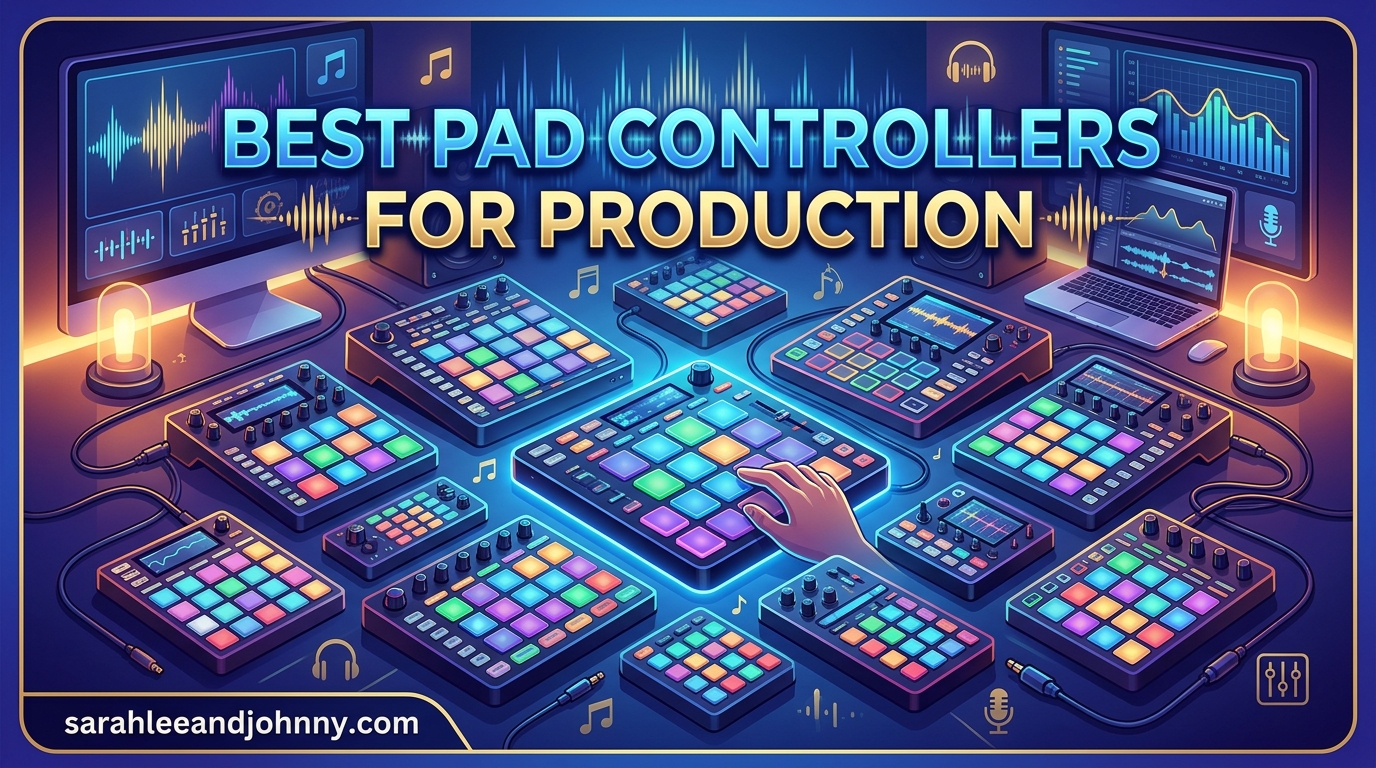
Finding the best pad controllers for production changed everything about how I make beats. I spent years clicking drum patterns into a piano roll with a mouse, and once I switched to tapping pads with my fingers, the creative difference was night and day. The right MIDI pad controller turns rhythm from a technical task into something physical and instinctive.
A pad controller is a grid-based MIDI device with velocity-sensitive buttons used for triggering drums, samples, loops, and controlling software instruments in a DAW. These controllers send MIDI data through USB to your computer, translating finger taps into notes that drive virtual instruments and clip-launching workflows. Whether you produce in Ableton Live, FL Studio, Logic Pro, or Studio One, a good pad controller adds tactile control that a keyboard alone cannot match.
Our team tested 12 controllers over several months across different production scenarios. We looked at finger drumming feel, DAW integration, pad sensitivity, build quality, and overall value. We also paired them with MIDI keyboards for music production and ran them through audio interfaces for studio connectivity to see how they fit into a real setup. Below you will find our complete rankings from budget-friendly starters to premium production workstations.
Table of Contents
- Top 3 Picks for Pad Controllers in 2026
- Best Pad Controllers for Production in 2026
- 1. Akai Professional APC Mini MK2 – Best Budget Grid Controller for Ableton
- 2. Akai Professional LPD8 Mk2 – Best Ultra-Portable Drum Pad Controller
- 3. Akai Professional MPD218 – Best Feature-Packed Pad Controller Under $150
- 4. Donner STARRYPAD – Best Budget Pad Controller for Beginners
- 5. HXW EMP16 – Best Wireless MIDI Pad Controller with Bluetooth
- 6. PreSonus ATOM – Best Pad Controller for Studio One Users
- 7. ESI Xjam – Best Pad Controller with Polyphonic Aftertouch Under $150
- 8. Novation Launchpad Mini MK3 – Best Portable Grid Controller for Ableton
- 9. Akai Professional MPC Studio – Best Portable MPC Workflow Controller
- 10. Akai Professional APC64 – Best Advanced Controller for Ableton with Step Sequencer
- 11. Native Instruments Maschine Mikro Mk3 – Best Pad Controller for Expressive Finger Drumming
- 12. Ableton Push 3 – Best Premium Pad Controller for Ableton Live
- Buying Guide: How to Choose the Best Pad Controller for Production
- FAQs
- Conclusion: Which Pad Controller Is Right for You
Top 3 Picks for Pad Controllers in 2026
Native Instruments Maschine Mikro Mk3
- 16 expressive pads
- 4 input modes
- built-in sequencer
- Maschine software

Best Pad Controllers for Production in 2026
| Product | Specifications | Action |
|---|---|---|
 Akai APC Mini MK2 Akai APC Mini MK2 |
|
Check Latest Price |
 Akai LPD8 Mk2 Akai LPD8 Mk2 |
|
Check Latest Price |
 Akai MPD218 Akai MPD218 |
|
Check Latest Price |
| Donner STARRYPAD |
|
Check Latest Price |
 HXW EMP16 HXW EMP16 |
|
Check Latest Price |
 PreSonus ATOM PreSonus ATOM |
|
Check Latest Price |
 ESI Xjam ESI Xjam |
|
Check Latest Price |
| Novation Launchpad Mini MK3 |
|
Check Latest Price |
 Akai MPC Studio Akai MPC Studio |
|
Check Latest Price |
 Akai APC64 Akai APC64 |
|
Check Latest Price |
| NI Maschine Mikro Mk3 |
|
Check Latest Price |
 Ableton Push 3 Ableton Push 3 |
|
Check Latest Price |
1. Akai Professional APC Mini MK2 – Best Budget Grid Controller for Ableton
Akai Professional APC Mini MK2 USB MIDI Pad Controller
64 RGB pads
9 assignable faders
USB bus-powered
Ableton Live Lite
Pros
- 64 RGB pads provide visual color feedback
- 9 assignable faders for hands-on mixer control
- Compact and portable design
- Includes Ableton Live Lite and virtual instrument pack
Cons
- Pads can be more sensitive than some prefer
- Documentation for customization is lacking
I plugged the APC Mini MK2 into my laptop and had it running clips in Ableton Live within minutes. The 64-pad grid mirrors your Ableton session view perfectly, which makes launching scenes and clips feel natural rather than fiddly. At under 2 pounds, this controller fits in a backpack and runs entirely on USB bus power with no wall adapter needed.
The 9 assignable faders caught me off guard in the best way. I mapped them to track volumes and sends, which gave me hands-on mixing control that I usually only get from larger desks. The Drum and Note modes with Smart Scale View let me play melodies without worrying about hitting wrong notes, which is handy for quick ideas.
For a budget MIDI pad controller, the build quality feels solid for the price. The plastic housing has some flex if you press hard, but nothing that affected my playing. The RGB pads light up in colors that match your Ableton session, so you always know what is loaded and playing.
The pads run a bit hot on velocity for my taste. I found myself triggering clips accidentally when my fingers brushed the grid during live sets. Some time in the settings dialed it back, but the included documentation does not explain customization well at all.
Best DAW Pairing and Workflow Fit
The APC Mini MK2 was designed for Ableton Live and that is where it shines brightest. The integration is near-seamless with Ableton Live Lite included in the box. You can also map it to other DAWs like FL Studio and Logic Pro, but you lose the deep session-view integration that makes this controller special.
I would recommend this for Ableton users who want clip-launching capability on a budget. If you primarily finger drum or produce in a linear DAW, a traditional 16-pad controller might serve you better.
Portability and Live Performance Readiness
Weighing just 810 grams and measuring roughly 9.5 inches wide, this controller is built for travel. I carried it to a live gig in a laptop bag with zero hassle. The USB 2.0 connection is reliable but the connector feels like a potential weak point over time if you pack and unpack frequently.
For live performance, the visual feedback from 64 RGB pads is genuinely useful. You can see your entire set laid out in front of you without staring at your laptop screen. That alone makes it worth considering for performers who want to step away from the computer.
2. Akai Professional LPD8 Mk2 – Best Ultra-Portable Drum Pad Controller
Akai Professional LPD8 USB MIDI Pad Controller
8 RGB MPC pads
8 assignable knobs
4 preset slots
Metal backplate
Pros
- Exceptional pad quality and responsiveness for the price
- Compact and highly portable
- Solid build quality with metal backplate
- 8 assignable knobs for parameter control
Cons
- Pads require firm hits to trigger
- Limited velocity curve options
The LPD8 Mk2 is the controller I toss in my bag when I want to make beats on the go. It weighs under a pound and the metal backplate gives it a premium feel that belies the low price. The 8 RGB MPC pads are genuinely good for finger drumming once you adjust to the sensitivity.
I mapped the 8 Q-Link knobs to filter cutoffs, reverb sends, and EQ parameters across different tracks. Having physical knobs for sound design beats dragging sliders with a mouse every time. The 4 programmable preset slots mean I can switch between drum mapping, synth control, and mixer modes with a button press.
These are real MPC pads, which means they have that thick, fat feel Akai is known for. The pads felt stiff out of the box but loosened up after a week of daily use. I appreciate that they do not double-trigger the way some cheaper pads do.
The main limitation is the pad count. With only 8 pads, you will be switching banks frequently if you want access to a full drum kit. There is also no Bluetooth MIDI, which would have been nice for wireless iPad use. But for what it is, the LPD8 delivers excellent value.
Who Benefits Most from 8 Pads
This controller is ideal for producers who already have a keyboard and just want a few pads for drum programming. It also works well as a secondary controller for triggering samples or controlling specific plugins. If you need a full 16-pad layout for complex finger drumming, look elsewhere.
I found the LPD8 especially useful for sketching ideas on an iPad using BeatMaker 3. The compact size and USB class-compliance mean it works with no drivers on Mac, Windows, and iOS.
Knob Quality and Assignment Flexibility
The 8 knobs have a smooth rotation with just enough resistance for precise adjustments. Each knob is fully assignable to any MIDI CC parameter, which gives you deep control over synths and effects. The 4 preset slots store your knob assignments independently, so switching contexts is instant.
One frustration is the limited velocity curve options. I could not find a curve that felt perfect for light finger drumming. Users who play with more force will not notice this as much.
3. Akai Professional MPD218 – Best Feature-Packed Pad Controller Under $150
Akai Professional MPD218 USB MIDI Pad Controller
16 MPC pads
3 pad banks
18 assignable knobs
Note Repeat and Full Level
Pros
- Fat MPC pads feel authentic and responsive
- Multiple pad banks expand functionality
- 18 assignable knobs for extensive control
- Note repeat feature excellent for rhythmic effects
Cons
- Pad sensitivity can cause double triggering
- Knobs are infinite rotation without detents
The MPD218 has been my go-to recommendation for beat makers who want the MPC experience without spending MPC money. With 16 thick MPC pads across 3 banks, you get 48 assignable pads total. That is enough room for a full drum kit, melodic samples, and one-shot effects all loaded at once.
The MPC Note Repeat function is genuinely useful for creating trap-style hi-hat rolls and rhythmic patterns. I mapped the timing division to a knob and could switch between 16th notes, 32nd triplets, and 64th notes on the fly. The Full Level button is handy when you want every hit at maximum velocity for punchy drums.
The 18 assignable knobs give you extensive control over your DAW and plugins. I used them for mixing tasks, synth parameter tweaking, and effect automation. They are 360-degree potentiometers with infinite rotation, which some users dislike because there are no detents to indicate position.
With over 5,800 reviews and a 4.4-star rating, this controller has proven itself to thousands of producers. The included software bundle with Ableton Live Lite, MPC Beats, and Drum Synth 500 adds serious value. It even connects to iOS devices via the Camera Connection Kit.
DAW Compatibility Beyond Ableton
The MPD218 works well with Ableton Live, FL Studio, Logic Pro, and most other major DAWs out of the box. The preset editor lets you customize pad assignments and knob mappings for each DAW. I ran it in FL Studio and had a custom template set up in about 20 minutes.
For Pro Tools users, the integration is decent but requires manual MIDI mapping. Studio One users will find it works as a generic MIDI controller without deep integration features.
Software Bundle and Long-Term Value
The included software alone is worth a significant portion of the purchase price. MPC Beats is a full beat-making DAW, Ableton Live Lite gets you started in Ableton, and Drum Synth 500 provides quality drum sounds. This bundle makes the MPD218 one of the best values among the best pad controllers for production.
I have owned mine for over a year with no hardware issues. The pads have held up to daily use, and the USB connection remains reliable. The plastic body shows some wear but nothing structural.
4. Donner STARRYPAD – Best Budget Pad Controller for Beginners
Donner MIDI Pad Beat Maker Machine Professional, Drum Machine with 16 Beat Pads, 2 Assignable Fader & Knobs and Music Production Software, USB MIDI Controller with 40 Courses, STARRYPAD
16 silicone pads
3 banks 48 assignable
2 faders 2 knobs
MIDI in/out
Pros
- More responsive pads than Akai controllers reduced double-trigger
- Soft silicone pads with good feel
- Easy to edit with Starrypad Editor software
- Great value compared to Akai MPD series
Cons
- USB-C port may break after extended use
- Requires DAW software to produce sound not standalone
The Donner STARRYPAD surprised me with how good the pads feel for the price. The soft silicone pads have a slight downward flex that feels natural for finger drumming. Compared to my Akai MPD218, I experienced noticeably fewer double-trigger events on the STARRYPAD.
The 16 pads spread across 3 banks give you 48 assignable pads total, which matches what pricier controllers offer. The 2 assignable faders and 2 knobs are basic but functional for controlling volume and filter cutoff. I especially liked the 7 customizable pad colors that help you visually organize sounds.
Donner includes Melodics courses and Cubase LE software, which is a strong bundle for beginners. The Melodics subscription alone is valuable for learning finger drumming technique. Tap Tempo syncs with your DAW BPM, and the Note Repeat function has ultra-low latency.
The build quality reflects the budget price. The USB-C port is my main concern for long-term durability. The body is mostly silicone and plastic, and while it feels fine on a desk, I would be cautious about heavy travel use.
Setup Experience and Editor Software
The Starrypad Editor software makes it easy to customize pad assignments, colors, and MIDI mappings. I had my entire template configured in about 15 minutes. The editor also lets you save 3 memory bank locations for different setups.
Some users report setup frustrations without proper guidance. The included instructions are minimal, so I recommend watching a quick tutorial video before diving in. Once configured, the controller works reliably across sessions.
FL Studio and Mobile Compatibility
The STARRYPAD works well with FL Studio, Ableton Live, Koala Sampler, and other popular production apps. The MIDI in/out ports let you connect external synthesizers and drum machines directly. I tested it with a hardware synth and it controlled notes and parameters without issue.
For mobile producers, the USB-C connection works with iPads that have USB-C ports. Some Android compatibility issues have been reported, so test your specific device before committing.
5. HXW EMP16 – Best Wireless MIDI Pad Controller with Bluetooth
HXW EMP16 MIDI Pad Controller Beat Maker Machine With Bluetooth
16 RGB pads 4 banks
Bluetooth 5.0
OLED display
MIDI in/out and USB
Pros
- Great value described as mini MPC at fraction of price
- Bluetooth connectivity works well with iPad and iPhone
- Sturdy pad construction
- OLED display for instant visual feedback
Cons
- Pressure sensitivity requires velocity curve adjustment
- Menu navigation can be clunky
The EMP16 stands out because of its Bluetooth 5.0 connectivity. I connected it wirelessly to my iPad running GarageBand and experienced no noticeable input lag during finger drumming sessions. That wireless freedom is something you do not find on most pad controllers at any price.
The 16 RGB pads across 4 banks give you 64 assignable pads, matching what premium grid controllers offer. The OLED display shows parameter values and settings in real time, which is a feature usually reserved for more expensive units. I found myself checking it frequently for velocity and note assignments.
Battery power via 2 AA batteries means you can use the EMP16 without being tethered to a USB port. I got roughly 15 hours of use before needing fresh batteries. The USB connection also works for wired use and charging-free operation.
The pad pressure sensitivity took some adjustment. Out of the box, the pads felt too firm and required a velocity curve change to register lighter hits consistently. Once I found the right curve in the 3 available options, the pads responded well with good crosstalk protection between adjacent pads.
Wireless Workflow with iOS and Mac
The Bluetooth connection to Mac, iPad, and iPhone is genuinely useful for mobile production. I set it up with Cubasis on an iPad and controlled drum patterns without any cables running across my workspace. The connection remained stable across a 10-foot range.
For desktop use, the USB MIDI connection provides lower latency than Bluetooth. I recommend USB for serious tracking sessions and Bluetooth for casual sketching and practice.
Value Compared to Name-Brand Alternatives
Multiple reviewers describe the EMP16 as a mini MPC at a fraction of the price. While it does not match the build quality or pad feel of an actual Akai MPC, it offers features like Bluetooth, OLED display, and MIDI in/out that you typically only find on controllers costing significantly more.
The included Cubase LE15 and Cubasis LE3 software add value, though some users wish more documentation was included. The 360-day warranty is slightly shorter than the 1-year standard from other brands.
6. PreSonus ATOM – Best Pad Controller for Studio One Users
PreSonus ATOM Production & Performance Midi Pad Controller with Studio One Artist and Ableton Live Lite Recording Software
16 velocity and pressure pads
20 assignable buttons
4 encoders
Studio One integration
Pros
- Excellent integration with Studio One software
- 16 full-size velocity-sensitive pads
- Versatile assignable controls
- Comes with over 1000 of software plugins
Cons
- Limited functionality beyond Studio One
- Cannot program MIDI note values for individual pads
The PreSonus ATOM is built for Studio One users, and that integration is where this controller truly shines. The 16 full-size velocity- and pressure-sensitive RGB pads feel great for finger drumming. PreSonus includes over $1,000 worth of software plugins, which makes the package value hard to beat.
I mapped the 20 assignable buttons to transport controls, track navigation, and session functions. The 4 endless rotary encoders handled plugin parameter tweaks smoothly. Everything works together so tightly that the ATOM feels like a hardware extension of Studio One rather than a separate MIDI controller.
The stainless steel build quality is noticeably better than plastic alternatives. At just 16 ounces, it is portable enough to move between studio and live setups. The selectable pad velocity curves let you dial in the perfect response for your playing style.
The ATOM also includes MIDI keyboard mode, Note Repeat mode, and Full Velocity mode. These production-focused features make it one of the best pad controllers for production if Studio One is your primary DAW. The MVP Loops content gives you sounds to start producing immediately.
Studio One Integration Depth
With Studio One, the ATOM controls navigation, transport, track selection, and plugin parameters with minimal setup. The pads automatically map to Impact XT and Sample One instruments. I navigated my entire session without touching the mouse after initial setup.
The integration extends to pattern editing and beat sequencing within Studio One. You can build drum patterns, audition samples, and adjust parameters all from the controller surface. This level of integration rivals what Ableton Push offers for Ableton users.
Using ATOM with Other DAWs
Outside of Studio One, the ATOM functions as a generic MIDI controller. It works with Ableton Live via Ableton Live Lite included in the bundle. However, you lose the deep integration features that make this controller special.
I tested it with Ableton and FL Studio, and while the pads trigger notes fine, the button and encoder mappings require manual setup. If your primary DAW is not Studio One, you may want to consider a controller designed for your specific software.
7. ESI Xjam – Best Pad Controller with Polyphonic Aftertouch Under $150
Xjam Mobile Studio MIDI Pad Controller – Apple-style ultra-thin aluminum frame, velocity-sensitive, polyphonic aftertouch, plug & play on iPad, iPhone, Mac, PC
16 aftertouch pads
Aluminum frame
18 assignable knobs
USB-C plug and play
Pros
- Very well built with aluminum frame
- Responsive and velocity-sensitive pads
- Polyphonic aftertouch support
- Compact and portable
Cons
- Proprietary driver required for Windows
- Knobs are jerky and sluggish for fine adjustment
The ESI Xjam caught my attention because it offers polyphonic aftertouch on 16 pads at a price point where most controllers do not include it at all. Aftertouch lets you press harder on a pad after the initial hit to add expression, which opens up creative possibilities for melodic playing and sound design.
The aluminum frame feels like an Apple product, slim and premium. At 14.4 ounces, it is one of the lightest pad controllers with full-size pads I have tested. The USB-C connection is plug-and-play on Mac with no drivers needed, and it works across iPad, iPhone, Android, and Linux.
The 48 user-programmable scene presets give you extensive control configurations. I set up scenes for different plugins and DAWs, then switched between them with button presses. The 18 assignable knobs provide parameter control comparable to much more expensive controllers.
The pad sensitivity is excellent for finger drumming. The pads are quiet with no hollow or boxy sound, which matters if you produce late at night. The tricolor LED indicators show velocity levels in red, green, and yellow rather than full RGB.
Encoder and Knob Limitations
The 18 knobs are the weak point of the Xjam. They feel jerky and sluggish, with rotational velocity that makes fine adjustments difficult. The encoders also do not remember their position when you switch scenes or banks, which can cause parameter jumps.
If you primarily need quality pads and can work around the knob limitations, the Xjam delivers outstanding value. Forum users on Reddit consistently recommend it as a budget alternative to the Maschine Mikro for finger drumming.
Software Bundle and Platform Support
The included Bitwig Studio 8-Track, Cubasis LE, and WaveLab LE provide solid production tools. Bitwig 8-Track is particularly capable for electronic music production. The broad platform support means you can use the Xjam across all your devices without compatibility concerns.
I tested it with Ableton, Logic Pro, GarageBand, and FL Studio with no issues on Mac. The Windows driver requirement adds a step to setup on PC, and some users report setup challenges with Cubase specifically.
8. Novation Launchpad Mini MK3 – Best Portable Grid Controller for Ableton
Novation Launchpad Mini MK3 MIDI USB Grid Controller
64 RGB pads
Ableton Live integration
Scale Mode
USB-C bus-powered
Pros
- Perfect Ableton Live session reflection with RGB pads
- Compact and lightweight for portability
- Scale Mode prevents wrong notes
- Custom Modes allow extensive customization
Cons
- Limited velocity sensitivity compared to Pro version
- Pads are small for some users
The Novation Launchpad Mini MK3 earned our Editor’s Choice because it nails the balance of portability, features, and price. With 4,269 Amazon reviews and a 4.6-star rating, this controller has proven itself to the production community. The 64 RGB pads reflect your Ableton Live session in real time, showing clip status in colors that match your screen.
Scale Mode is a feature I did not know I needed until I used it. The controller locks your pads to a selected scale, so every pad plays an in-key note. This makes it possible to jam melodic ideas without music theory knowledge. I sketched chord progressions in minutes that would have taken much longer on a piano roll.
The three Custom Modes let you map the 64 pads to control anything via MIDI. I set up one mode for drum rack triggering, one for clip launching, and one for mixer control. The Novation Components web app makes creating and editing custom mappings straightforward.
At just 0.88 pounds and 7.1 inches square, the Launchpad Mini is incredibly portable. It slips into a laptop sleeve and draws all its power from the USB-C connection. The Stop, Solo, and Mute controls give you session navigation without reaching for your mouse.
Ableton Integration and Beyond
The Launchpad Mini was designed for Ableton Live and the integration is flawless. Clip launching, scene triggering, and session navigation all work right out of the box. Ableton Live Lite is included to get you started.
The controller also works with Logic Pro, FL Studio, and other DAWs as a generic MIDI grid controller. You lose the deep session integration outside of Ableton, but the pads and custom modes remain fully functional. Many producers on Reddit praise the Launchpad Mini for its value-to-performance ratio.
Launchpad Mini vs Launchpad X vs Pro
The Mini is the most compact and affordable option in the Launchpad lineup. The Launchpad X adds velocity-sensitive pads and Note mode for a higher price. The Launchpad Pro Mk3 adds aftertouch, standalone sequencer capabilities, and CV outputs for the most demanding users.
For most producers, the Mini hits the sweet spot. You get the same 64-pad grid and Ableton integration as the pricier models, just without velocity sensitivity and aftertouch. If those features matter to you, consider upgrading to the X or Pro.
9. Akai Professional MPC Studio – Best Portable MPC Workflow Controller
Akai Professional MPC Studio USB MIDI Pad Controller
16 MPC pads with aftertouch
Ribbon touch strip
LCD display
MPC2 Software
Pros
- Solidly built with equipment-grade feel
- 16 RGB MPC velocity and pressure-sensitive pads with aftertouch
- MPC2 Software included with 8 instrument plugins
- MPC Stems feature for isolating drums bass music vocals
Cons
- Only works natively with MPC2 Software
- Steep learning curve not beginner friendly
The MPC Studio brings the legendary MPC workflow to a slim, portable format. The 16 RGB MPC pads are velocity- and pressure-sensitive with aftertouch, delivering the thick, expressive feel that made Akai’s MPC line the standard for beat making. The MPC2 Software included is a full production environment with 8 powerful instrument plugins.
I was impressed by the Ribbon touch strip, which provides real-time parameter control for filters, pitch, and effects. The LCD color display shows parameter values and settings without looking at your computer screen. Chords and Scale modes help you play musical ideas even if you are not a trained keyboardist.
The MPC Stems feature is a standout, letting you isolate drums, bass, music, and vocals from any audio file. I used it to sample and remix existing tracks with surprising quality. The Studio Mixing and Mastering FX included cover compression, EQ, reverb, and delay needs.
The main trade-off is that the MPC Studio is designed to work natively with MPC2 Software. Getting it running smoothly with Ableton, FL Studio, or other DAWs requires workarounds. The learning curve is steep, and beginners may find the MPC workflow confusing at first.
MPC2 Software Ecosystem
MPC2 Software is a comprehensive DAW built around the MPC workflow. It includes 128 mixer channels, pattern sequencing, sample editing, and plugin hosting. The 8 instrument plugins cover drums, synths, bass, and sampled instruments.
Vocal Tuning, Harmoniser, and Doubler effects round out the vocal production toolkit. The included 2 months of Splice Creator plan gives you access to millions of samples and loops. MPC Academy provides tutorials for learning the system.
Is the MPC Workflow Right for You
The MPC workflow is sample-centric and pattern-based, which suits hip-hop, electronic, and pop production. If you are coming from a linear DAW like Pro Tools or Cubase, the adjustment takes time. Producers committed to the MPC ecosystem will find the Studio an excellent entry point.
If you want a controller that works seamlessly across multiple DAWs, the MPC Studio is not the best choice. Look at the Novation Launchpad Mini or PreSonus ATOM for broader compatibility.
10. Akai Professional APC64 – Best Advanced Controller for Ableton with Step Sequencer
Akai Professional APC64 USB MIDI Pad Controller
64 velocity pads with aftertouch
8-track step sequencer
CV/Gate outputs
USB-C powered
Pros
- Solid build quality with responsive RGB pads
- Built-in step sequencer for live sets
- CV outputs allow connection to modular gear
- More affordable alternative to Ableton Push
Cons
- Touch faders can be difficult for precise control
- Display could be bigger for better feedback
The APC64 is Akai’s answer to the Ableton Push, offering 64 velocity-sensitive RGB pads with polyphonic aftertouch at roughly a quarter of the price. The built-in 8-track, 32-step sequencer lets you create patterns for external devices without touching your computer. I found this feature transformative for live performance and hardware synth control.
The 8 CV/Gate outputs in 1/8-inch format connect directly to modular and analog gear. I patched the APC64 into my Eurorack system and sequenced oscillators and envelopes from the controller pads. This kind of integration usually requires dedicated hardware sequencers costing far more.
The 8 assignable touch strips handle pitch bend, modulation, vibrato, and automation. They are capacitive and respond to finger position along the strip. I enjoyed using them for filter sweeps and expression, though precise parameter control can be tricky since the faders reset to random values when touched.
The color display provides real-time feedback on parameters and settings. It is functional but could be larger. The Probability, Velocity, and Mutate functions add generative possibilities to your MIDI patterns that keep compositions fresh and evolving.
Step Sequencer for DAW-Less Workflows
The built-in step sequencer is the APC64’s killer feature. You can program 8 tracks of 32-step sequences and send them to external MIDI or CV devices. This enables genuine DAW-less live performance where the APC64 acts as your sequencing brain.
I used it to drive a drum machine, two synths, and a modular rack simultaneously during a live set. The ability to mutate patterns and adjust probability in real time kept the performance dynamic and engaging.
Ableton Integration and Setup
The APC64 works right out of the box with Ableton Live 11 and later. The 64 pads mirror your session view, and clip launching is immediate. Ableton Live Lite is included for users who do not already own the full version.
Setup on Windows 10 or later and Mac is straightforward via USB-C bus power. The controller requires no external power adapter, which keeps your setup clean. Some users report needing more computer interaction than expected for certain functions, so budget time for learning the workflow.
11. Native Instruments Maschine Mikro Mk3 – Best Pad Controller for Expressive Finger Drumming
Native Instruments Maschine Mikro Mk3 Drum Controller, 25707
16 expressive pads
4 input modes
Maschine software
Standalone DAW or VST
Pros
- God-tier pad sensitivity most expressive drum controller available
- Versatile 4 modes drum keyboard chord and step sequencer
- Works as standalone DAW or VST in major DAWs
- 1.6 GB of included samples and presets
Cons
- Software installation can be buggy on some systems
- Initial setup can be confusing for beginners
The Maschine Mikro Mk3 has the best-feeling pads I have ever played on a pad controller. Native Instruments engineered these pads for maximum expressiveness, and the difference is immediately noticeable compared to budget controllers. The sensitivity and dynamic range let you play ghost notes, accents, and rolls with nuanced control.
The 4 input modes set this controller apart. Drum mode triggers samples and one-shots. Keyboard mode plays melodic instruments across a scale. Chord mode generates full chords from single pad presses. Step sequencer mode lets you program patterns grid-style. I switched between these modes constantly during production sessions.
The Maschine software included is a full production environment that works standalone or as a VST/AU/AAX plugin inside your DAW. The 1.6 GB factory selection provides drums, synths, bass, and effects sounds that cover most production styles. I found the included presets genuinely usable rather than filler content.
The build quality matches the premium feel of the pads. The stainless steel and metal construction feels rugged enough for years of use. At 1.12 kilograms, it has enough heft to stay planted on a desk during aggressive finger drumming without sliding around.
Maschine Software vs Hardware Integration
The Maschine software is tightly integrated with the hardware. Every button, pad, and encoder maps to a specific function in the software. The browser lets you audition sounds from the controller without looking at your screen.
You can open multiple instances of Maschine as a plugin in Ableton Live, Pro Tools, FL Studio, or any VST-compatible DAW. Each instance runs independently with its own sound set. This flexibility makes it one of the most versatile production tools available.
Who Should Choose Maschine Mikro
The Maschine Mikro Mk3 is ideal for producers who prioritize pad feel and expressive finger drumming. It suits hip-hop, electronic, and any genre where beat making is central. The learning curve is real, but the payoff in workflow speed and sound quality is significant.
If you primarily use Ableton Live for clip launching, the Novation Launchpad or APC series may serve you better. But for production-centric workflows centered on beat making and sampling, the Maschine ecosystem is hard to beat.
12. Ableton Push 3 – Best Premium Pad Controller for Ableton Live
Ableton Push 3 Desktop Controller Workstation w/Audio Interface
64 MPE pads
Built-in audio interface
CV/Gate outputs
Ableton Live integration
Pros
- Superb build quality and tactile feel
- Perfect pairing with Ableton Live workflow
- MPE pads allow expressive playing
- Built-in audio interface is a major plus
Cons
- Tethered to computer not standalone
- Price point may be high for casual users
The Ableton Push 3 is the ultimate controller for Ableton Live users. The 64 MPE-enabled pads with XY touch sensors represent the current state of the art in pad technology. MPE means each pad responds independently to pressure and lateral movement, enabling expressive techniques like vibrato, slides, and bowing that are impossible on standard pads.
I played fretless string sounds, chord pads, and melodic lines with a level of expression I had not experienced on any other controller. The pads respond to how you press, hold, and release, which transforms beat making and melodic playing into something far more musical. For finger drumming, the varied articulations possible are remarkable.
The built-in audio interface is a major advantage. With 2 inputs (line and instrument) and 2 balanced outputs, plus ADAT optical for 8 additional channels, the Push 3 can serve as your studio hub. I connected a microphone, guitar, and monitors directly to the controller, eliminating the need for a separate interface.
The CV/Gate outputs connect to modular and analog synthesizers, extending the Push 3’s control beyond the software domain. Two footswitch jacks and a MIDI input round out the connectivity. The 3-year warranty provides peace of mind for a premium investment.
MPE Pads and Expressive Playing
MPE (MIDI Polyphonic Expression) is the technology that makes the Push 3 pads special. Each pad communicates on its own MIDI channel, allowing per-note expression that standard MIDI cannot achieve. You can bend one note in a chord while holding others steady, or add vibrato to specific notes.
This expressiveness is not just a gimmick. It changes how you interact with virtual instruments. Pads feel more like real instruments than triggers, which makes the production process more engaging and musical. The XY touch sensors detect finger position across the pad surface for additional control dimensions.
Is the Push 3 Worth the Investment
For dedicated Ableton Live users, the Push 3 is the closest thing to a purpose-built instrument for the software. Every Ableton function is mapped and accessible from the controller surface. The workflow speed improvement over mouse-and-keyboard production is substantial.
The main limitation is that the Push 3 is tethered to a computer running Ableton Live. It is not a standalone instrument like the Push 3 Standalone version. Some users report stability issues and bugs on certain systems, and the sequencing capabilities are not as deep as dedicated hardware grooveboxes like Elektron or MPC. For Ableton-centric producers, though, these trade-offs are worth it.
Buying Guide: How to Choose the Best Pad Controller for Production
Choosing the right pad controller comes down to your DAW, production style, and budget. After testing 12 controllers across months of production work, here are the factors that matter most.
Pad Count and Layout
Pad count determines how much you can control simultaneously. Controllers with 8 pads like the Akai LPD8 are great for simple drum programming and portability. 16-pad controllers like the Maschine Mikro Mk3 and MPD218 offer enough pads for a full drum kit plus extras. 64-pad grid controllers like the Launchpad Mini and APC64 excel at clip launching and melodic playing but have smaller individual pads.
Think about how you produce. If you primarily finger drum, 16 large pads will serve you better than 64 small ones. If you perform live with Ableton Live, a 64-pad grid is essential for session control.
Pad Sensitivity and Aftertouch
Velocity sensitivity is what separates good pad controllers from bad ones. Quality pads detect the full range of strike force, from ghost notes to full-volume hits. The Maschine Mikro Mk3 and Ableton Push 3 have the best pad sensitivity I have tested. Budget controllers like the Donner STARRYPAD and HXW EMP16 offer decent sensitivity after velocity curve adjustment.
Aftertouch adds a dimension of expression by detecting pressure after the initial hit. Polyphonic aftertouch, found on the ESI Xjam, APC64, and Push 3, allows per-pad pressure control. This is valuable for melodic playing and sound design.
DAW Compatibility and Integration
The best pad controller for production depends heavily on your DAW. Ableton Live users should strongly consider the Novation Launchpad Mini, Akai APC series, or Ableton Push 3 for deep integration. Studio One users get the best experience with the PreSonus ATOM. FL Studio users have flexibility since most controllers work as generic MIDI devices.
MPC-centric producers benefit from the Akai MPC Studio or Maschine Mikro Mk3, which come with their own production software. If you switch between DAWs frequently, look for controllers with strong generic MIDI mode support like the Novation Launchpad series.
Connectivity: USB, MIDI, and CV
USB connectivity is standard on all modern pad controllers. Bus-powered controllers draw power from USB, eliminating the need for a wall adapter. The HXW EMP16 adds Bluetooth 5.0 for wireless use with iOS devices.
MIDI in/out ports let you connect hardware synths and drum machines directly. The Donner STARRYPAD, HXW EMP16, and ESI Xjam all include MIDI ports. CV/Gate outputs, found on the APC64 and Push 3, enable control of modular and analog gear. If you work with budget synthesizers to pair with your controller, MIDI and CV connectivity matters.
Build Quality and Portability
For studio use, build quality affects longevity and playing feel. Metal-framed controllers like the ESI Xjam and Maschine Mikro Mk3 feel more premium than plastic alternatives. Consider the weight if you plan to travel. The Launchpad Mini at 0.88 pounds and LPD8 at under a pound are ideal for mobile production.
If you are building a production space, check out our guide to studio desks for music production to find furniture that accommodates your controller setup. Also consider these controllers as gifts for music producers in your life.
Software Bundle Value
Included software can add significant value to your purchase. The PreSonus ATOM includes over $1,000 in plugins. The Maschine Mikro Mk3 ships with 1.6 GB of sounds and the full Maschine production environment. Ableton Live Lite is bundled with several controllers on this list, giving you a capable DAW to start with.
Factor the software value into your decision. A controller that costs slightly more but includes production software you would buy separately can represent better overall value.
FAQs
What is the best MIDI pad controller for beginners?
The Donner STARRYPAD is the best MIDI pad controller for beginners because it includes Melodics finger drumming courses, has soft pads that are easy to play, and costs under $100. The Novation Launchpad Mini MK3 is another excellent beginner choice thanks to its Scale Mode that prevents wrong notes and seamless Ableton Live integration.
What pad controller should I buy for Ableton Live?
For Ableton Live, the Novation Launchpad Mini MK3 and Akai APC series are purpose-built for session view integration. The Ableton Push 3 is the premium option with MPE pads and a built-in audio interface. The Akai APC64 adds a step sequencer and CV outputs for advanced Ableton workflows.
How much do MIDI pad controllers cost?
MIDI pad controllers range from $60 for basic 8-pad controllers like the Akai LPD8 to $999 for premium units like the Ableton Push 3. Most quality controllers fall between $70 and $300. Budget options under $100 include the Donner STARRYPAD and Akai APC Mini MK2, while mid-range options like the Maschine Mikro Mk3 offer professional features around $250.
What is the difference between Launchpad and Maschine?
The Novation Launchpad is a 64-pad grid controller designed for clip launching and melodic playing in Ableton Live, with smaller pads optimized for session control. The Native Instruments Maschine is a 16-pad production workstation focused on beat making and sampling, with larger pads optimized for finger drumming and its own production software that works standalone or as a VST plugin.
Can I use a pad controller with any DAW?
Yes, most pad controllers work with any DAW as generic MIDI devices via USB. However, the depth of integration varies. Controllers like the Ableton Push, Novation Launchpad, and PreSonus ATOM offer deep DAW-specific integration with their target software. Other controllers like the Akai MPD218 and ESI Xjam work well across multiple DAWs including FL Studio, Logic Pro, Ableton Live, and Cubase.
Conclusion: Which Pad Controller Is Right for You
After testing 12 controllers across months of production, the best pad controllers for production in 2026 come down to your needs. For Ableton Live users, the Novation Launchpad Mini MK3 delivers unmatched value with 64 RGB pads and deep integration. The Native Instruments Maschine Mikro Mk3 wins for finger drumming feel with the most expressive pads on the market. On a budget, the Donner STARRYPAD and Akai APC Mini MK2 get you producing without breaking the bank.
If you want the ultimate Ableton experience and have the budget, the Ableton Push 3 with MPE pads and a built-in audio interface is the premium choice. For Studio One users, the PreSonus ATOM offers integration that rivals dedicated controllers. Whatever your DAW and budget, there is a pad controller on this list that will transform your production workflow from clicking to playing.