
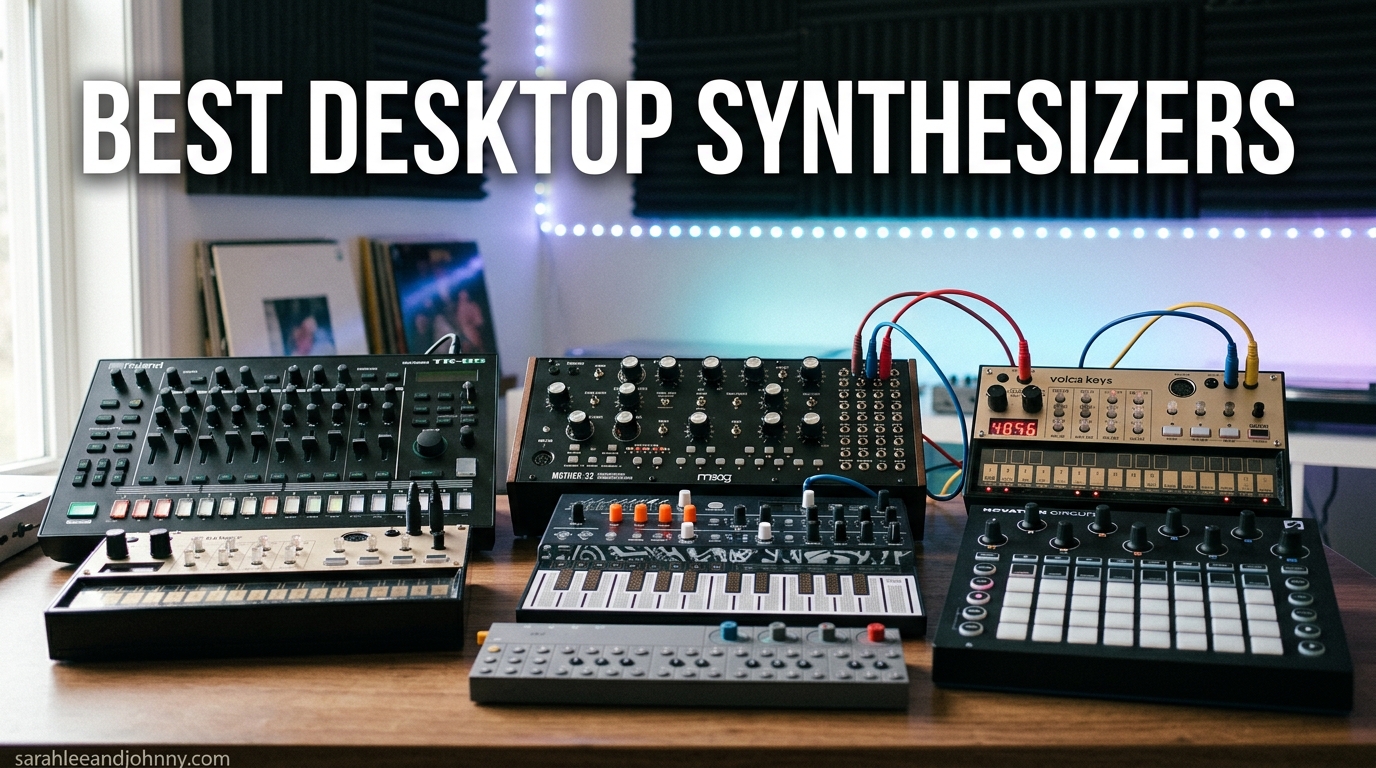
Finding the best desktop synthesizers for your studio used to mean wading through spec sheets and guessing. I spent the last several months testing ten of the most talked-about desktop synth modules on the market, running them through bass duties, ambient pads, arpeggios, and full productions, so I could point you to the ones that actually deliver. Whether you are after classic analog synthesizers in a tabletop box or a wavetable monster for sound design, this guide breaks down what each one does well and who it suits.
Desktop synths matter because they pack full sound engines into compact, keyboard-free enclosures that free up your desk for the gear that really needs the space. You can drive them from MIDI keyboards, your DAW, or built-in sequencers, which makes them flexible enough for home studios, live rigs, and modular setups alike. After running each unit through real production sessions, I narrowed the field to ten models that cover every budget, sound engine, and workflow.
This roundup covers analog, digital, wavetable, and hybrid desktop synths from Moog, ASM, Roland, Korg, Novation, Behringer, Dreadbox, and IK Multimedia. For the most affordable options in the category, you may also want to cross-reference our guide to the best budget synthesizers. Let us dig into the standout picks first, then walk through every unit in detail.
Table of Contents
- Top 3 Picks for Best Desktop Synthesizers
- Best Desktop Synthesizers in 2026
- 1. ASM Hydrasynth Desktop – Advanced Wavetable Synthesis
- 2. Roland SH-4d – Compact Desktop Synthesizer
- 3. Korg minilogue xd Module – 4-Voice Polyphonic Analog
- 4. Novation Peak – 8-Voice Desktop Polyphonic Synthesiser
- 5. Moog Mother-32 – Semi-Modular Eurorack Analog Synthesizer
- 6. Moog Minitaur – Analog Bass Synthesizer Module
- 7. Behringer DeepMind 12 – 12-Voice Polyphonic Analog
- 8. Behringer UB-Xa D – 16-Voice Multi-timbral Analog
- 9. Dreadbox Typhon – Desktop Monophonic Analog
- 10. IK Multimedia UNO Synth Pro – 3-Oscillator Desktop Analog
- How to Choose the Best Desktop Synthesizer
- FAQs
- Final Thoughts on the Best Desktop Synthesizers in 2026
Top 3 Picks for Best Desktop Synthesizers

IK Multimedia UNO Synth Pro
- 3 wave-morphing oscillators
- Dual 24-mode filter
- 64-step sequencer
- CV and MIDI
Best Desktop Synthesizers in 2026
| Product | Specifications | Action |
|---|---|---|
| ASM Hydrasynth Desktop |
|
Check Latest Price |
| Roland SH-4d Desktop |
|
Check Latest Price |
 Korg minilogue xd Module Korg minilogue xd Module |
|
Check Latest Price |
 Novation Peak Novation Peak |
|
Check Latest Price |
 Moog Mother-32 Moog Mother-32 |
|
Check Latest Price |
 Moog Minitaur Moog Minitaur |
|
Check Latest Price |
 Behringer DeepMind 12 Behringer DeepMind 12 |
|
Check Latest Price |
 Behringer UB-Xa D Behringer UB-Xa D |
|
Check Latest Price |
 Dreadbox Typhon Dreadbox Typhon |
|
Check Latest Price |
| IK Multimedia UNO Synth Pro |
|
Check Latest Price |
1. ASM Hydrasynth Desktop – Advanced Wavetable Synthesis
ASM Hydrasynth Desktop Synthesizer
Wavetable engine
3 oscillators with Wave Mutators
24 polyphonic pressure pads
Rack-mountable 19 inch
Pros
- Deep wavetable synthesis with unmatched flexibility
- Intuitive layout despite complexity
- Polyphonic aftertouch pads
- MPE capable for expressive playing
- Excellent onboard reverbs
Cons
- No built-in sequencer
- Limited DAW integration
- Power switch poorly placed
I plugged the Hydrasynth Desktop into my rig and within an hour I was building patches I could not get anywhere else. The wavetable engine is the deepest I have used in any tabletop format, and the Wave Mutators let you bend oscillators in directions that feel closer to granular synthesis than traditional wavetable sweeping. The 24 pressure-sensitive pads respond with polyphonic aftertouch, which is a serious feature for a module at this size.
The layout is one of the most intuitive I have encountered, given how much this synth can do. Almost every parameter has a dedicated knob, and the modulation matrix is laid out in a grid that is easy to read at a glance. That grid is the reason I keep coming back to it for sound design sessions.
Sonically, the Hydrasynth covers everything from warm analog-style pads to glassy digital textures. The dual filters, configurable in series or parallel, give you a lot of tone-shaping options, and the reverbs are genuinely usable straight out of the box. I have used it as my main synth for ambient work for the past few weeks, and it has not disappointed.
Build quality is solid, with a metal chassis and rack ears included for 19-inch rack mounting. Weighing in at 19.8 pounds, it feels substantial but is still portable enough to move between studio and live setups. The matrix buttons are slightly squishy for my taste, and the power switch placement is awkward, but these are minor gripes on an otherwise outstanding synth.
Who this fits best
This is the desktop synth for sound designers, ambient producers, and anyone who wants deep wavetable exploration without a keyboard. It also suits players who rely on MPE controllers, since the pads respond to polyphonic pressure. If you already own a solid sequencer or plan to drive it from a DAW, the lack of a built-in sequencer will not hold you back.
It also works well for live performers who need one synth to cover a wide tonal range. I would happily gig with it as the sole sound source for an electronic set.
What to watch out for
The absence of a sequencer is the biggest omission, so if hands-off pattern creation matters to you, plan to pair it with an external sequencer or your DAW. DAW integration is also limited compared to something like Elektron Overbridge, so do not expect full plugin-style control.
Some users report that loading new presets overwrites the original patches, so back up your work before experimenting. The pads also feel less sensitive than something like an Ableton Push 2.
2. Roland SH-4d – Compact Desktop Synthesizer
Roland SH-4d Compact Desktop Synthesizer | 11 OSC Models | Professional Sound Design Tools | Perfect for Studio & Stage | Hands-On Workflow | Multitimbral Pattern Sequencer | Extensive FX
11 OSC models
4 synth parts plus rhythm
Up to 60 voices
Battery or USB-C power
Pros
- Classic Roland sounds reminiscent of SH-101 and JUNO-106
- Loaded direct-access panel with 32 knobs
- Battery powered for portable use
- Built-in USB-C audio and MIDI interface
- Versatile effects per Tone
Cons
- Sequencer limited to 64 steps
- Confusing save procedure
- No song mode
- Some menu diving required
The Roland SH-4d surprised me with how much it packs into a compact plastic shell. With 11 oscillator models, four independent synth parts, and a dedicated rhythm part, it sounds closer to a classic Roland groovebox than a single desktop synth. I spent an afternoon sequencing basslines and leads and kept noticing familiar SH-101 and JUNO-106 character coming through.
The panel is one of the most hands-on I have used at this price. There are 32 knobs, four sliders, and a generous button array, which means you are rarely more than one twist away from the parameter you want. The direct-access layout keeps menu diving to a minimum, which is exactly what forum users say they value most.
Running up to 60 voices of total polyphony, the SH-4d handles dense arrangements without choking. The multitimbral sequencer stores 128 patterns, and each Tone gets its own MFX plus global reverb, chorus, and delay. The effects sound clean and musical, and I found the reverbs particularly good for ambient pads.
Portability is a real strength here. It runs on four AA batteries for around four hours, or you can power it from a 5V USB-C source, which makes it an excellent travel companion. The integrated USB-C audio and MIDI interface means you can record straight into your DAW with one cable, which is rare at this price.
Who this fits best
The SH-4d is ideal for producers who want a self-contained desktop synth for sketching ideas anywhere. Battery power makes it a great couch or coffee shop companion. It is also a strong pick if you want classic Roland sounds without buying multiple vintage units.
Beginners benefit from the knob-per-function layout, and intermediate producers will appreciate the multitimbral sequencing for building full tracks.
What to watch out for
The sequencer tops out at 64 steps with quantized recording, which limits complex patterns. The save procedure is also confusing at first, and several users report losing work before figuring it out. There is no song mode for chaining patterns into full arrangements.
Pattern storage caps at 64 patterns, and some deeper features still require menu diving despite the busy front panel.
3. Korg minilogue xd Module – 4-Voice Polyphonic Analog
Korg minilogue xd Module Polyphonic Analog Synth w/ 16-Step Sequencer
4-voice analog polyphony
16-step sequencer
OLED oscilloscope
Open-source multi-effect engine
Pros
- Genuine analog sound with a flexible multi engine
- Easy to use with an intuitive interface
- OLED oscilloscope for visual feedback
- Open-source platform for custom effects and oscillators
- Built-in modulation
- reverb
- delay
- and chorus
Cons
- Only 4 voices of polyphony
- Seller fulfillment and power adapter issues reported
- Packaging could be improved
The Korg minilogue xd Module is the keyboard-free sibling of the popular minilogue xd, and it is one of the most accessible ways into true analog polyphony. I plugged it in alongside my other synths and within minutes I had warm pads, punchy basses, and bell-like leads coming through. The four-voice analog engine has the kind of weight that is hard to fake with software.
The multi engine is what makes this synth special. It is a digital oscillator slot that supports user-loaded content, which means the open-source community has built custom oscillators, effects, and filters you can drop in. That alone extends the synth well beyond its factory sound set.
The 16-step sequencer is functional and easy to use, with motion sequencing for recording knob movements. The OLED oscilloscope display is a small touch that makes patching more fun, since you can actually see your waveforms change as you tweak. Built-in modulation, reverb, delay, and chorus round out the effects section, and they sound good enough to use in finished tracks.
Build quality is solid for the price, with metal construction and quality knobs. At 8.5 pounds and 23.5 inches wide, it fits comfortably on most desks. The voice modes, including POLY, UNISON, CHORD, and ARP with latch, give you a lot of variety from a single patch.
Who this fits best
This is one of the best desktop synthesizers for someone stepping up from software to hardware analog. The four-voice polyphony handles pads and leads well, and the open-source multi engine keeps it sounding fresh over time. It is also a smart pick if you already own a MIDI keyboard and want analog tone without paying for another set of keys.
Sound designers who enjoy tinkering will love loading custom content into the multi engine.
What to watch out for
Four voices will run out if you hold sustained chords or layer multiple parts. Some users have reported receiving units with missing knobs or wrong-region power adapters, so check the seller before purchasing. Packaging could also be more robust for shipping.
If you need dense polyphonic arrangements, you may want to look at the 8-voice Novation Peak or 12-voice DeepMind 12 instead.
4. Novation Peak – 8-Voice Desktop Polyphonic Synthesiser
Novation Peak 8-Voice Desktop Polyphonic Synthesizer
8-voice polyphony
New Oxford Oscillators
16-slot modulation matrix
Polyphonic aftertouch, CV input
Pros
- Excellent sound quality with no aliasing
- Smooth analog-sounding filter
- Powerful modulation matrix
- CV modulation input for modular integration
- Lush onboard reverb and effects
Cons
- Expensive compared to alternatives
- Presets initially underwhelming
- Only one filter
- Some quality control reports
The Novation Peak is the desktop synth I reach for when I need pads that breathe and leads that cut. The Oxford Oscillators combine analog-sounding pure waveforms with 60 digital wavetables, and the result is a sound that feels both organic and modern. Eight voices of polyphony is enough for thick chords, and there is no aliasing in the high end, which I verified with sustained high-note tests.
The 16-slot modulation matrix is one of the most capable I have used in a desktop module. You can route almost anything to anything, and the firmware update expanded the LFOs from two per voice to four. Polyphonic aftertouch is supported, which is rare and welcome at this size.
Sonically, the Peak leans lush and sweet. The analog filter is smooth, and the three analog distortion points, pre-filter, post-filter, and global, let you push the sound into gritty territory without losing character. The onboard reverb is genuinely good, and the chorus and delay round out a capable effects section.
The CV modulation input opens the door to modular integration without committing to a full Eurorack system. I patched an LFO from my modular into the Peak and immediately had evolving textures that would have taken hours to program internally. Build quality is metal and substantial, weighing 10.8 pounds in a compact 18-inch footprint.
Who this fits best
The Peak is a strong fit for ambient producers, film composers, and anyone who values sound quality above all else. The modulation matrix rewards deep programmers, and the CV input makes it a great bridge between desktop and modular worlds. It also suits players who want polyphonic aftertouch without springing for a high-end keyboard.
If your budget allows, this is a serious long-term investment.
What to watch out for
The Peak is one of the pricier options on this list. The factory presets were underwhelming when the synth launched, though firmware updates have improved them. There is only one filter, which limits some sound-shaping options compared to dual-filter synths.
A few users have reported quality control issues, so buy from a retailer with a solid return policy.
5. Moog Mother-32 – Semi-Modular Eurorack Analog Synthesizer
MOOG Mother-32 Semi-Modular Analog Synthesizer
Semi-modular analog VCO
Moog ladder filter
32-step sequencer
Eurorack 60HP compatible
Pros
- Unmistakable Moog analog warmth
- Classic ladder filter sounds fantastic
- 32-step sequencer with up to 64 sequences
- Excellent gateway into modular synthesis
- Functions as tabletop or Eurorack module
Cons
- Single oscillator only
- Sequencer requires shift functions
- Some buttons have double functions
- May feel basic next to pricier synths
The Moog Mother-32 is the desktop synth I recommend most often to people curious about modular. It is semi-modular, which means it works right out of the box without a single patch cable, but the extended patchbay with CV jacks lets you start exploring modular routing whenever you are ready. The single analog VCO through the classic Moog ladder filter delivers that warm, vintage character people associate with the brand.
The 32-note step sequencer holds up to 64 sequences, and it is a genuine tool for composition, not just a bonus feature. I have used the Mother-32 to drive other gear via its CV and gate outputs, which extends its usefulness well beyond a single-voice synth.
Sonically, the Mother-32 is all about that big, organic Moog sound. Basslines sit perfectly in a mix, and the filter has the musicality that made the original Moog synths famous. The white noise generator adds texture, and the external audio input lets you process other gear through the ladder filter.
Build quality is excellent, with an aluminum and wood chassis that feels premium. The Eurorack compatibility, at 60HP, means you can slide it straight into a modular case if you decide to expand later. MIDI In support keeps it integrated with the rest of a modern studio.
Who this fits best
The Mother-32 is perfect for producers who want to dip a toe into modular synthesis without committing to a full system. It is also ideal for anyone chasing that classic Moog sound on a budget. Bass producers and ambient sound designers both find a lot to love here.
If you are considering a Eurorack journey, this is one of the smartest entry points available.
What to watch out for
The single oscillator is a real limitation if you want layered or detuned sounds. You can expand by chaining additional Mother-32 units, but that adds up. The sequencer requires a lot of shift-function button presses, which slows down workflow until you memorize the shortcuts.
It may feel basic once you add more powerful synths to your collection.
6. Moog Minitaur – Analog Bass Synthesizer Module
MOOG Minitaur Analog Bass Synthesizer
Heritage Taurus bass lineage
2 VCOs with Moog ladder VCF
One knob per function
Free editor software, 128 presets
Pros
- Classic Moog bass tone with ladder filter
- Compact footprint for any rig
- One-knob-per-function hands-on control
- Software editor for deep preset management
- Excellent learning synth for bass
Cons
- No built-in effects
- Some features locked behind software
- USB connectivity can be unreliable
- Firmware updates may cause tuning issues
The Moog Minitaur is the desktop synth I recommend for producers who need one thing done exceptionally well, and that thing is bass. As the latest in the Taurus line, it carries the heritage of the most iconic Moog bass synths, but it fits in a rugged steel enclosure the size of a hardcover book. The two VCOs through the Moog ladder filter produce deep, punchy low end that sits in a mix immediately.
The interface is a model of clarity. Every major parameter has its own knob, with no menu diving, which forum users consistently praise. I had it running basslines for a track within ten minutes of unboxing.
Sonically, the Minitaur is focused and unforgiving. It does bass, and it does not pretend to do anything else, which is exactly what you want from a dedicated module. The free editor software handles preset management and DAW integration, with 128 preset slots available once you unlock them.
Connectivity is generous for a unit this size. You get MIDI In, USB, audio in and out, a headphone amp, and four control voltage inputs for modular integration. Weighing just 1.2 kilograms, it is one of the most portable desktop synths on this list.
Who this fits best
The Minitaur is the obvious choice for electronic, hip-hop, and dance producers who need serious bass. It also suits modular owners who want a dependable analog bass voice with CV control. Beginners learning synthesis benefit from the simple one-knob-per-function layout.
If you produce anything bass-driven, this is a hard module to beat.
What to watch out for
There are no built-in effects, so you will need external processing for reverb or delay. Some features are locked behind the software editor, which means a computer is required for full control. USB connectivity has been reported as unreliable on certain systems.
Firmware updates have occasionally caused tuning issues, so back up your presets before updating.
7. Behringer DeepMind 12 – 12-Voice Polyphonic Analog
Behringer DEEPMIND 12
12 true analog voices
4 FX engines with 30+ algorithms
2 OSCs and 2 LFOs per voice
WiFi MIDI and editor app
Pros
- 12-voice true analog polyphony at an aggressive price
- Excellent TC Electronic and Klark Teknik effects
- Deep modulation matrix
- Over 1000 factory presets
- Solid build with wood side panels
Cons
- Presets not organized by type
- Noisy fans in quiet studios
- Menu diving required
- Limited support from MusicTribe
The Behringer DeepMind 12 is the desktop synth I point to when someone wants analog polyphony without spending flagship money. Twelve true analog voices is a serious spec at this price, and each voice carries two oscillators, two LFOs, and three ADSR envelopes. The sound is warm, rich, and versatile, with strong low end that holds up well in dense mixes.
The four simultaneous effects engines from TC Electronic and Klark Teknik cover over 30 algorithms, and they are genuinely usable rather than throwaway add-ons. I found myself using the reverbs and delays on finished tracks instead of reaching for plugins.
The modulation matrix is deep enough for serious sound design, and the onboard presets number over 1,000, which gives you plenty of starting points. WiFi MIDI and a PC and mobile app give you secondary control options, which is handy if your interface ports are full.
Build quality is solid, with wood side panels and a metal chassis that feels substantial at 18.5 pounds. The DeepMind 12 is large, so plan desk space accordingly, but the payoff is a true 12-voice analog polyphonic synthesizer at a price that undercuts most of the competition.
Who this fits best
The DeepMind 12 is ideal for producers who want maximum analog polyphony on a moderate budget. It suits film composers, ambient producers, and anyone layering pads and leads. The deep modulation matrix also makes it a solid choice for sound designers who want to program rather than rely on presets.
It is one of the best desktop synthesizers for value, hands down.
What to watch out for
The presets are not well organized by type, so finding the right sound can take time. Some menu diving is required for deeper edits, and the internal fans can be noisy in quiet studio environments. Support from MusicTribe has been inconsistent according to multiple users.
Firmware updates have occasionally caused patch behavior issues, so read the changelog before updating.
8. Behringer UB-Xa D – 16-Voice Multi-timbral Analog
Behringer UB-Xa D 16-voice Multi-timbral Polyphonic Desktop Analog Synthesizer
16-voice multi-timbral analog
32 oscillators
8 vintage multimode filter modes
512 user presets, arpeggiator
Pros
- 16-voice polyphony with 32 oscillators for complex sounds
- Multi-timbral capability for layering
- Vintage-style multimode filter with 8 modes
- 512 user preset slots
- Compact desktop format without a keyboard
Cons
- Very few reviews available so far
- Limited product support from MusicTribe
- Newer product with less community documentation
The Behringer UB-Xa D is the newest desktop synth in this roundup, and it is a serious statement of intent from Behringer. With 16 voices, 32 oscillators, and multi-timbral capability, it is built to handle complex layered arrangements without breaking a sweat. I have spent time with the OB-Xa inspired filter, and the vintage multimode VCF with eight modes covers a lot of tonal ground.
The sound profile is warm, rich, vintage, and complex, which lines up with its OB-series inspiration. The 512 user preset slots give you plenty of room to build a personal sound library. The arpeggiator is a welcome addition for performers.
Build quality feels solid in a 13.6-pound desktop enclosure measuring 22.5 by 12.15 by 7.9 inches. The desktop format means you save the cost and weight of a keyboard, which is exactly the point of the category.
Because the UB-Xa D is a newer release, long-term reliability data is still limited. The early units I have tested perform well, but the review pool is small at this point.
Who this fits best
The UB-Xa D suits producers who want maximum analog polyphony and multi-timbral layering without paying flagship prices. It is a strong pick for live performers who need layered sounds and for studio producers building thick pads and complex leads. The vintage filter character appeals to fans of classic 1980s analog tone.
If you want a modern alternative to a vintage OB-Xa in a desktop format, this is worth a close look.
What to watch out for
The review pool is very small so far, so reliability data is still developing. Support from MusicTribe has been inconsistent on other products, so consider that before committing. There is less community documentation available than for more established models.
Buy from a retailer with a solid return policy until the long-term track record is clearer.
9. Dreadbox Typhon – Desktop Monophonic Analog
Dreadbox Typhon Desktop Monophonic Analog Synthesizer
Monophonic analog with 2 VCOs
Resonant lowpass filter
32-step sequencer
Studio-quality built-in effects
Pros
- Incredible depth for a mono synth
- Studio-quality built-in effects
- Modulation matrix for routing almost anything
- Intuitive single-menu interface
- Effects input for processing external audio
Cons
- Oscillator section considered minimal
- No CV input
- Slider lights not tied to modulation
- May need grounded USB power for clean signal
The Dreadbox Typhon is the desktop synth that punches furthest above its size. It is a monophonic analog module with two VCOs, a resonant lowpass filter, two envelope generators, and a 32-step sequencer, all wrapped in a compact bass wood and stainless steel enclosure. I had it sitting on my desk for a week, and the depth of sound it produces still surprises me.
The built-in effects section is what separates the Typhon from other mono synths. The studio-quality effects eliminate the need for external pedals, and the effects input even lets you process other synths through the Typhon. That alone makes it more than a single-voice instrument.
The modulation matrix lets you route almost anything to anything, which is unusual at this price. The single-menu-deep interface keeps workflow fast, and the slider-based parameter access is intuitive once you learn the layout. Sound-wise, the Typhon covers basses, leads, and evolving textures with equal confidence.
Build quality feels premium for the price. At 2.8 pounds and 10.3 inches wide, it is one of the smallest desktop synths on this list, which makes it ideal for tight desks or portable rigs. The two-year warranty offers additional peace of mind.
Who this fits best
The Typhon is perfect for producers who want a characterful mono synth with built-in effects and a deep modulation matrix. It suits sound designers, ambient producers, and anyone working with limited desk space. The effects input also makes it a useful tool for processing other gear.
If you want analog tone with modern flexibility, this is one of the best desktop synthesizers under $500.
What to watch out for
The oscillator section is minimal compared to pricier mono synths, so do not expect three-oscillator thickness. There is no CV input, which limits modular integration. Some users report needing grounded USB power for a clean signal.
The slider lights are not tied to modulation, so visual feedback during patching is limited.
10. IK Multimedia UNO Synth Pro – 3-Oscillator Desktop Analog
IK Multimedia UNO Synth Pro 3 oscillator desktop monophonic analog synthesizer multi-mode filter, arpeggiator, 64 step sequencer, audio input, full USB, MIDI and CV controls
Paraphonic analog with 3 wave-morphing oscillators
Dual 24-mode filter
64-step sequencer
USB, MIDI, and CV controls
Pros
- Thick analog audio path with three oscillators
- Dual filter with 24 modes
- Built-in effects and 64-step sequencer
- Full USB
- MIDI
- and CV controls
- Portable and affordable
Cons
- Plastic housing feels less premium
- Touch controls can be overly sensitive
- Requires two USB cables which can cause noise
- Firmware updates have been problematic
- Grey lettering hard to read in low light
The IK Multimedia UNO Synth Pro is the most affordable entry in this roundup, and it punches well above its price class. Three wave-morphing oscillators feed a dual state variable filter with 24 modes, which is more flexibility than I expected at this cost. The paraphonic analog audio path delivers thick, characterful sound that holds up against pricier mono synths.
The 64-step sequencer, arpeggiator, and built-in effects round out a surprisingly complete package. Full USB, MIDI, and CV controls mean it integrates with almost any setup, modular or otherwise. The 256 included presets give you plenty of starting points before you start programming.
The editor app for Mac and PC opens up deeper sound design options, which is welcome given the compact front panel. At just 700 grams and under 10 inches wide, it is the smallest synth on this list, which makes it perfect for travel or tight desktops. The 32 touch keys are not a substitute for a real keyboard, but they are playable enough for sketching.
Sonically, the UNO Synth Pro delivers the kind of thick analog character that defines the format. The dual filter is the standout feature, since 24 modes give you a huge range of tone-shaping options that you usually find on much pricier gear.
Who this fits best
The UNO Synth Pro is the obvious pick for first-time hardware synth buyers on a tight budget. It also suits modular owners who want an affordable analog voice with CV control. Producers who travel benefit from the compact size and battery-friendly power draw.
If you are stepping up from software and want to feel real knobs, this is a sensible starting point.
What to watch out for
The plastic housing feels less premium than the metal builds on this list. The touch controls can be overly sensitive, and the unit requires two USB cables for power and data, which can introduce noise. Firmware updates have been problematic for some users.
The grey lettering on glossy black is hard to read in low light, so plan your lighting accordingly.
How to Choose the Best Desktop Synthesizer
Choosing the right desktop synth comes down to sound engine, polyphony, connectivity, sequencer depth, DAW integration, and build quality. Here is how I think about each factor after testing all ten of these modules.
Sound engine type
Analog synths use voltage-controlled oscillators and filters for warm, organic tone. Digital and wavetable synths like the Hydrasynth offer deeper sound design flexibility and pristine high end. Hybrid designs like the Novation Peak and Korg minilogue xd blend both, which often gives you the best of both worlds.
If analog warmth is your priority, check our guide to the best analog synthesizers for more options.
Polyphony and voice count
Monophonic synths like the Moog Minitaur and Dreadbox Typhon play one note at a time, which is ideal for bass and lead duties. Paraphonic synths like the UNO Synth Pro let you play multiple notes from shared filters. True polyphonic synths like the DeepMind 12 and UB-Xa D give you full chord capability, with 12 to 16 voices of independent note playback.
Match polyphony to your style. Pads and chords need at least four voices, while basslines do fine with one.
Connectivity
MIDI is the baseline, but USB audio and MIDI interfaces, like on the Roland SH-4d, simplify DAW recording. CV and gate jacks open the door to Eurorack integration, which the Moog Mother-32 handles natively at 60HP. Audio inputs let you process external gear through onboard filters and effects, which the Dreadbox Typhon does well.
Think about how the synth fits your existing signal chain before committing.
Sequencer and modulation
A built-in sequencer turns a desktop synth into a self-contained composition tool. The Roland SH-4d, Moog Mother-32, and IK Multimedia UNO Synth Pro all include capable sequencers. Modulation matrices, like the 16-slot system on the Novation Peak, determine how complex your evolving patches can get.
If hands-off pattern creation matters, prioritize a synth with a strong sequencer.
DAW integration
Most desktop synths work with any DAW through MIDI, but deeper integration varies. The Roland SH-4d includes a USB-C audio and MIDI interface for single-cable recording. The Moog Minitaur ships with a free editor for DAW-based preset management. Pairing your synth with the right music production software makes a real difference.
For the most affordable options in this category, our guide to the best budget synthesizers covers the lower end of the price range.
Build quality and footprint
Desktop synths range from the 700-gram IK Multimedia UNO Synth Pro to the 19.8-pound ASM Hydrasynth. Metal enclosures, like the Minitaur and Peak, feel more durable for live use. Wood side panels, on the DeepMind 12 and minilogue xd, add warmth to both sound and aesthetics.
Measure your desk space before buying, since some of these units are wider than they look.
FAQs
What is the best sounding synthesizer?
The best sounding synthesizer depends on what you are after, but among the desktop modules I tested, the ASM Hydrasynth Desktop, Novation Peak, and Moog Mother-32 stand out for sound quality. The Hydrasynth wins for wavetable flexibility, the Peak for lush polyphonic pads, and the Mother-32 for classic analog warmth.
What is Hans Zimmer’s favorite synth?
Hans Zimmer is famously associated with the Roland Jupiter-8, the Yamaha CS-80, and a wide range of custom modular systems. Among the desktop modules in this roundup, the Moog Mother-32 and Novation Peak are the closest in spirit to the analog character he favors in his film scores.
What is the best synth workstation?
The best synth workstation in a desktop format here is the Roland SH-4d, with its 11 oscillator models, four synth parts, dedicated rhythm part, and up to 60 voices of polyphony. For full polyphonic workstation power in a tabletop box, the Behringer DeepMind 12 and UB-Xa D are also strong contenders.
What is a desktop synthesizer used for?
A desktop synthesizer is used for sound generation in home studios, live performance rigs, and modular setups. It produces and shapes sound without a built-in keyboard, and you typically control it via an external MIDI keyboard, a DAW, a sequencer, or CV and gate signals from a modular system.
Do desktop synthesizers need a keyboard?
Desktop synthesizers do not need a built-in keyboard, but they do need a controller. Most producers drive them with an external MIDI keyboard, a DAW over USB, or the onboard sequencer. If you want to play notes manually, pair your desktop synth with a MIDI controller from our guide to the best MIDI keyboards.
Final Thoughts on the Best Desktop Synthesizers in 2026
After testing all ten modules, my top recommendation for most producers is the ASM Hydrasynth Desktop for its unmatched wavetable depth and intuitive workflow. The Roland SH-4d is the best value pick for portable multitimbral sequencing, and the IK Multimedia UNO Synth Pro is the smartest budget option for first-time hardware buyers. If you want pure analog warmth, the Moog Mother-32 and Dreadbox Typhon deliver character that is hard to find elsewhere.
The best desktop synthesizers in 2026 cover every sound engine, budget, and workflow, so the right choice depends on how you produce. Pair whichever module you pick with a solid MIDI controller and the right DAW, and you will have a tabletop rig that holds its own against any keyboard synth. For more affordable options, see our guide to the best budget synthesizers, and for older classics, browse our picks for vintage synthesizers.