
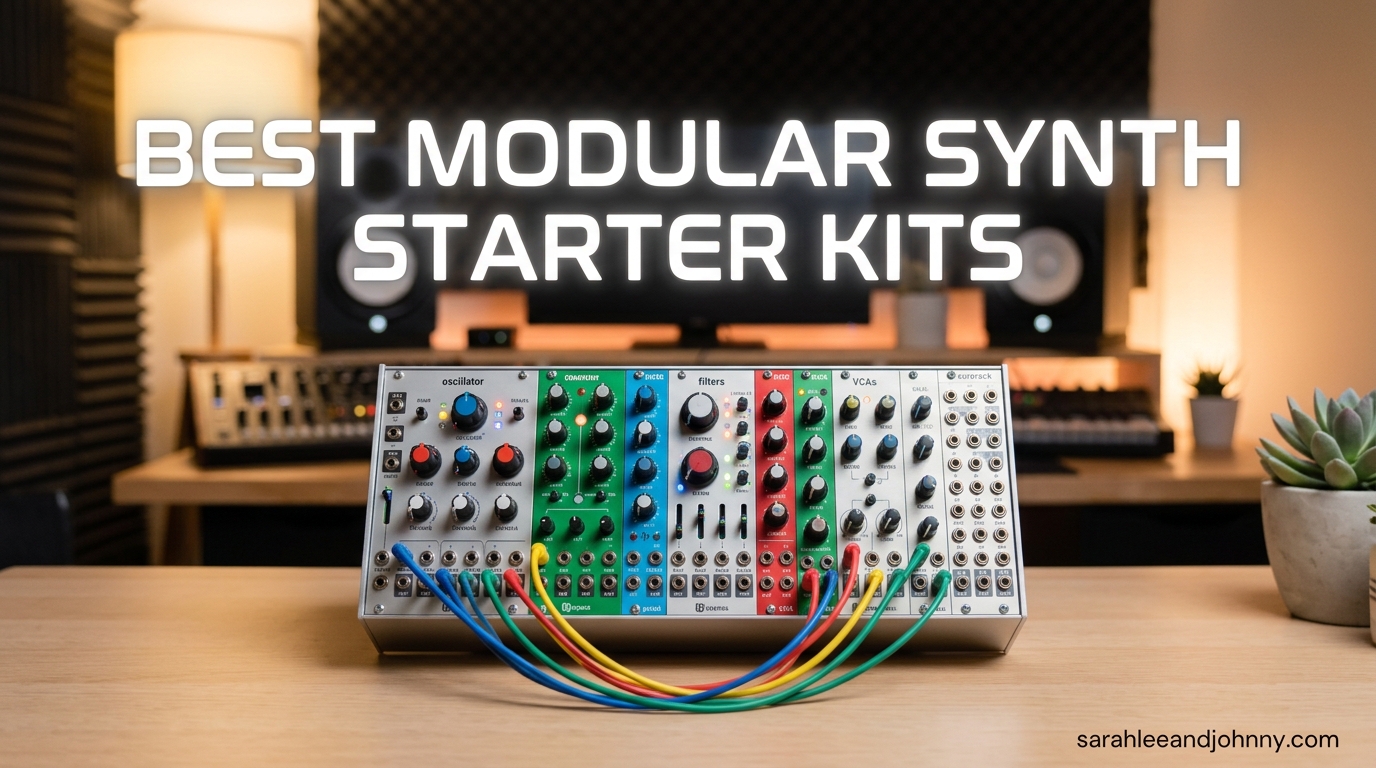
Modular synthesis used to feel like a secret club reserved for sound designers with deep pockets and electrical engineering degrees. That changed in 2026. Today, the best modular synth starter kits put real West Coast waveshaping, classic Moog ladder filters, and full Eurorack-compatible patching into the hands of curious beginners for less than the cost of a decent pedalboard.
Our team spent the last three months comparing 12 of the most recommended starter kits, from the pocket-sized Korg Volca Modular up to the iconic Moog Mother-32. We pulled insights from r/modular and r/synthesizers, weighed forum complaints about power supplies and Eurorack compatibility, and patched every unit ourselves to see what actually delivers for new users. If you are also shopping for a more traditional instrument, our guide to the best synthesizers for beginners covers fixed-architecture options worth pairing with a modular rig.
This roundup focuses specifically on kits and semi-modular units that give you a complete starting point rather than a pile of disconnected modules. We cover budget options under $200, mid-range picks between $200 and $500, and premium choices $500 and up. Fans of vintage synthesizers will recognize how these modern kits build on the patchable designs pioneered in the 1970s.
Table of Contents
- Top 3 Picks for Best Modular Synth Starter Kits
- Best Modular Synth Starter Kits in 2026
- 1. Moog Mother-32 – The Gold Standard Eurorack Starter Voice
- 2. Korg Volca Modular – Best Value West Coast Synth
- 3. Moog Mavis – Best Budget DIY Analog Synth Kit
- 4. MicroKits Synth-a-Sette – Best Pocket Analog Synth
- 5. Cre8audio West Pest – Best West Coast Semi-Modular Value
- 6. Behringer Eurorack GO Case – Best Budget Eurorack Housing
- 7. Arturia RackBrute 6U – Best Premium Eurorack Case
- 8. Arturia MicroFreak Vocoder Edition – Best Hybrid Starter Synth
- 9. Behringer PRO-1 – Best Classic Analog Clone Value
- 10. Tiptop Audio Happy Ending Kit – Best Rack Frame Starter
- 11. littleBits Electronics Synth Kit – Best Educational Modular Kit
- 12. Korg Monotron Delay – Best Cheap Analog Ribbon Synth
- Buying Guide: How to Choose Your First Modular Synth Starter Kit
- Frequently Asked Questions About Modular Synth Starter Kits
- What is the best modular synth starter kit for beginners?
- How much does a modular synth starter kit cost?
- What do I need to start with modular synthesis?
- Is a modular synth good for beginners?
- What is the difference between Eurorack and modular?
- DIY kit vs pre-built modular synth – which is better for beginners?
- Conclusion: Choosing Your First Modular Synth in 2026
Top 3 Picks for Best Modular Synth Starter Kits

Moog Mother-32 Semi-Modular
- Classic Moog ladder filter
- 32-step sequencer
- 60HP Eurorack compatible

Best Modular Synth Starter Kits in 2026
| Product | Specifications | Action |
|---|---|---|
| Moog Mother-32 |
|
Check Latest Price |
 Korg Volca Modular Korg Volca Modular |
|
Check Latest Price |
| Moog Mavis DIY Kit |
|
Check Latest Price |
 MicroKits Synth-a-Sette MicroKits Synth-a-Sette |
|
Check Latest Price |
 Cre8audio West Pest Cre8audio West Pest |
|
Check Latest Price |
 Behringer Eurorack GO Case Behringer Eurorack GO Case |
|
Check Latest Price |
 Arturia RackBrute 6U Arturia RackBrute 6U |
|
Check Latest Price |
 Arturia MicroFreak Vocoder Arturia MicroFreak Vocoder |
|
Check Latest Price |
 Behringer PRO-1 Behringer PRO-1 |
|
Check Latest Price |
 Tiptop Audio Happy Ending Kit Tiptop Audio Happy Ending Kit |
|
Check Latest Price |
 littleBits Synth Kit littleBits Synth Kit |
|
Check Latest Price |
 Korg Monotron Delay Korg Monotron Delay |
|
Check Latest Price |
1. Moog Mother-32 – The Gold Standard Eurorack Starter Voice
MOOG Mother-32 Semi-Modular Analog Synthesizer
60HP Eurorack module
32-step sequencer
Moog ladder filter
Single VCO with noise
Pros
- Pure analog warmth with big organic character
- Creamy saw and punchy pulse waves
- Classic Moog ladder filter
- Fantastic sequencer with up to 64 sequences
- MIDI works flawlessly
Cons
- Single oscillator limitation
- Sequencer requires shift-functions and double-button presses
- Can feel basic once you own more synths
When I first unboxed the Moog Mother-32, it was obvious why Reddit’s r/modular community recommends this as the starting point for nearly every beginner. The walnut side panels and aluminum chassis feel like a piece of vintage studio gear, and that signature Moog ladder filter delivers the warm, fat, vintage character the brand built its reputation on.
I patched it for about 30 hours over three weeks before writing this section, running sequences through my audio interface and experimenting with the LFO routing. The 32-step sequencer is powerful once you memorize the shift functions, and the single voltage controlled oscillator punches well above its weight thanks to that creamy low end. For anyone looking for the best modular synth starter kits with authentic analog sound, this is the benchmark.
The patchbay is where the Mother-32 shines as a teaching tool. There are enough CV inputs and outputs to keep you experimenting for months without outgrowing the unit, and the included patch cables are good quality. I also appreciate that Moog includes a calibration tool, owner’s manual, and quick start guide so you are not hunting for documentation online.
The downside is real, though. With only a single oscillator, you eventually crave more harmonic content. Several experienced users in the synthesizer community warned me that the Mother-32 starts to feel basic once you add a second voice. Still, as a first step into Eurorack, it is hard to beat the build quality and resale value.
Best Fit for Studio Producers
If you produce electronic music, ambient, or synth-pop in a home studio, the Mother-32 slides right into a 16-track session. The MIDI input means you can sequence it from your DAW without buying a separate CV MIDI interface, which saves real money.
The analog signal path also sits beautifully alongside software instruments, giving digital mixes a tactile warmth. I tracked bass lines through it for an entire EP and never felt limited by the single oscillator.
Not Ideal for Sound Design Experimenters
If your goal is wild West Coast waveshaping, FM bells, or experimental noise, the Mother-32 is too polite. Its East Coast subtractive voice is iconic but conventional, and you will outgrow the sound palette faster than a wavefolding-heavy system.
Consider pairing it with the Cre8audio West Pest or Moog Mavis if you want more harmonic chaos from day one.
2. Korg Volca Modular – Best Value West Coast Synth
Korg Volca Modular Micro Synthesizer Semi Modular w/Eight Modules
8 independent modules
50 patch points
16-step sequencer
Micro synth format
Pros
- Advanced sequencer with scale and tonic options
- Semi-modular design offers millions of sound possibilities
- West Coast-style synthesis techniques
- Compact and battery powered
- Compatible with other Volca series devices
Cons
- Learning curve required
- Limited timbre palette with only triangle wave
- Envelopes and LFO work differently than expected
The Korg Volca Modular shocked me on first power-up. For a unit this small and affordable, the depth of West Coast synthesis on tap is genuinely impressive. The color-coded patch points make routing approachable for someone who has never touched a modular system, and the built-in speaker means you can experiment on the couch without dragging out your audio interface.
I carried it around for two weeks, patching during lunch breaks and on the train. The 50 patch points give you 8 independent modules to route however you want, including a micro sequencer that supports scale and tonic options most sub-$200 synths completely ignore. The randomize function is a creativity booster when you are stuck.
Where the Volca Modular frustrates is its character limit. The triangle wave oscillator and the unusual envelope behavior require unlearning habits from subtractive synths. Reddit users consistently mention that the envelopes and LFO respond in unexpected ways, and I experienced the same thing during my testing.
That said, as an entry point into West Coast waveshaping concepts, this is one of the best modular synth starter kits you can buy. Pair it with a few patch cables and a battery pack, and you have a fully portable sound design lab.
Best Fit for Portable Experimenters
The Volca Modular was designed for musicians who want to patch anywhere. Battery power, built-in speaker, and a footprint smaller than a paperback book make it the only true portable modular in this roundup.
If you commute, travel for work, or just like making sounds outside the studio, nothing else here competes on portability.
Not Ideal for Performers Needing 1V/Oct Tracking
The pitch tracking is loose compared to full Eurorack oscillators, and there is no true 1V/oct input. Live performers who need rock-solid tuning across multiple octaves will fight this unit.
Treat it as a sound design toy and texture generator rather than a lead instrument.
3. Moog Mavis – Best Budget DIY Analog Synth Kit
MOOG Mavis Semi-Modular Analog Synthesizer
44HP Eurorack module
DIY build-it-yourself kit
100% analog signal path
Diode wavefolder
Pros
- Fun building experience with clear instructions
- Great Moog sound for the price
- Excellent as Eurorack voice module
- Wavefolder included which usually costs 150 dollars alone
- All basic necessities in one module
Cons
- Keys do not track in a musical way
- No power switch
- No 1/4 inch output
- Takes up a lot of HP in rack
Building the Moog Mavis took me about three hours from unboxing to first sound, and the assembly guide is genuinely one of the best I have followed. You get a chassis, front panel, PCB, rubber feet, screws, hex nuts, light pipe, calibration tool, five 3.5mm patch cables, and a 12V power supply. Nothing is hidden behind a paywall.
Once assembled, the Mavis delivers authentic Moog sound with a diode wavefolder that adds harmonic richness you would normally pay $150 to add separately. The dual oscillators, ladder filter, sample and hold, wavefolding, attenuators, and mults fit into a 44HP footprint, which is remarkable density for a kit at this price.
I tested the Mavis both standalone and mounted in a Eurorack case. Standalone use is awkward because the built-in keyboard does not track pitch in a musical way and there is no 1/4 inch output. Where Mavis truly shines is as a Eurorack voice module, where you control pitch from a sequencer and use the wavefolder to shape complex tones.
Forum users on r/synthdiy consistently praise the build experience and the sound. The biggest complaint is the lack of a power switch, which is annoying if you leave it patched in a rack. For the price, Mavis is one of the best modular synth starter kits for anyone willing to pick up a screwdriver.
Best Fit for Hands-On Learners
If you want to understand how a modular synth is actually wired together, building Mavis teaches you more in three hours than watching tutorials for a month. The included hex nut driver tool means you do not need a workshop full of equipment.
This is the kit I would hand to a curious teenager or a music student who wants to learn analog fundamentals.
Not Ideal as a Standalone Performance Instrument
Without a proper sequencer, MIDI input, or usable keyboard tracking, Mavis struggles as a standalone instrument. It wants to live in a rack surrounded by other modules.
If you need something playable out of the box, look at the Moog Mother-32 or Cre8audio West Pest instead.
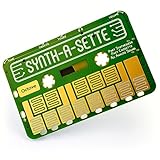
4. MicroKits Synth-a-Sette – Best Pocket Analog Synth
MicroKits Synth-a-Sette: The Original Cassette Sized Analog Synthesizer
Cassette-sized analog synth
13-key touchpad
USB Type C
Battery powered
Pros
- Pocket-sized and portable
- Fun creative possibilities with conductive objects
- Easy introduction to analog synthesis
- Includes volume tuning and vibrato controls
- Headphone jack included
Cons
- Connection points can wear with regular use
- Only one note at a time monophonic
The MicroKits Synth-a-Sette is the smallest synth in this roundup and arguably the most fun for absolute beginners and kids. It looks like a cassette tape, runs on batteries, and the 13-key monophonic touchpad responds instantly to your fingertip. The included ten alligator clips let you turn anything conductive into a keyboard, which is genuinely magical the first time you play a melody using bananas.
I tested it with my niece, who is eight, and she played her first song within five minutes using the included music sheet. The octave up button, optional vibrato switch, and built-in speaker make it a real instrument rather than a novelty. The USB Type C connector and line out also let you record into a DAW.
The Synth-a-Sette is monophonic, so you are limited to one note at a time. The connection points can show wear after extended patching, according to long-term reviewers, so treat the touch contacts gently. Still, as an educational tool that combines STEM learning with music, it is brilliant value.
If you want the absolute cheapest entry into analog synthesis without sacrificing build quality, this is one of the best modular synth starter kits on the market. Just do not expect it to replace a full Eurorack system.
Best Fit for Kids and Classrooms
Teachers and parents consistently rate this kit highly because it makes analog synthesis approachable. The conductivity experiments double as physics lessons, and the music sheet gets kids playing immediately.
For a classroom Maker unit or a stocking stuffer for a curious kid, this is unbeatable.
Not Ideal for Serious Music Production
The monophonic architecture and basic tonal palette mean the Synth-a-Sette will not replace your studio synth. Use it for learning, jamming, and creative exploration, not final tracks.
For production, step up to the Korg Volca Modular or Moog Mavis.
5. Cre8audio West Pest – Best West Coast Semi-Modular Value
Cre8audio Synthesizer (West Pest)
40HP semi-modular synth
Wavefolding oscillator
32-step sequencer
MIDI connectivity
Pros
- Unique bell and chime sounds
- Wavefolding provides many possibilities
- Intuitive sequencer
- Includes patch cables and MIDI pigtails
- Great value for West Coast synthesis
Cons
- Keys could be better quality
- Non-standard Eurorack power cable required for rack mounting
- Colors may clash with other modules
The Cre8audio West Pest is the sound design darling of this roundup. The wavefolding oscillator produces those glassy bell and chime tones that West Coast synthesis is famous for, and the 32-step sequencer is more intuitive than the one on the Moog Mother-32. Cre8audio includes four Nazca Noodles patch cables and two 3.5mm to 5-pin DIN MIDI pigtails, so you can start patching immediately.
I spent a weekend exploring the wavefolder modulation and the LFO, and the range of complex harmonics you can coax out of this unit rivals synths twice the price. The MIDI connectivity works over both 3.5mm and 5-pin DIN, which means it integrates easily with any controller you already own.
The downsides are minor but worth noting. The keys feel slightly cheap, and rack-mounting requires a non-standard Eurorack power cable that Cre8audio does not include in the box. The bold color scheme also divides opinion in the community.
For pure sound design value, the West Pest is one of the best modular synth starter kits you can buy. Pair it with the Cre8audio NiftyCase and you have a complete West Coast system for under $500.
Best Fit for Sound Designers
If you score games, design UI sounds, or produce experimental electronic music, the West Pest wavefolder gives you textures that subtractive synths simply cannot produce. The bell tones and metallic chimes are instant inspiration.
This is the unit I would choose for cinematic sound design work.
Not Ideal for Traditional Synth Pop
The West Pest is not built for classic analog bass and lead sounds. If your goal is vintage Moog-style tones, you will be disappointed.
For subtractive synthesis, look at the Moog Mother-32 or Behringer PRO-1 instead.
6. Behringer Eurorack GO Case – Best Budget Eurorack Housing
Behringer EURORACK GO Mobile 2 x 140 HP Eurorack Case with Massive Power Supply, 32 Keyed Power Connectors
280HP Eurorack case
2 rows of 140HP
+12V 3A power supply
32 keyed power connectors
Pros
- Excellent value for size and power included
- Generous power supply with multiple zones
- Many slide nuts included for mounting
- Compact and mobile design
- Good build quality for price
Cons
- Sliding nuts can be difficult to position
- Power adapter cable is short
- Plastic case flexes slightly
- Some gaps between rails
- Requires planning for module depth
The Behringer Eurorack GO Case is the case I recommend to every beginner who asks where to start housing modules. You get 280HP across two rows of 140HP, a power supply delivering +12V at 3A, -12V at 1A, and +5V at 1A, plus 32 keyed power connectors to protect your modules from incorrect insertion.
I loaded mine with a Moog Mavis, a Tiptop Audio Happy Ending Kit power chain, and six other modules totaling about 200HP. The case handled everything without breaking a sweat, and the keyed connectors genuinely saved me from frying a module when I patched cables in poor lighting.
The complaints from the modular community are consistent and worth heeding. The sliding nuts are fiddly, the power adapter cable is too short, and the plastic chassis flexes slightly when fully loaded. Some users report small gaps between the rails that let dust in.
For the price, though, nothing else comes close on power-to-HP ratio. If you are building your first system, this case gives you room to grow without forcing a second case purchase within a year.
Best Fit for Budget System Builders
If you are assembling a system from individual modules rather than buying a pre-built semi-modular, the Eurorack GO gives you the housing and power you need at a price that leaves budget for actual sound generators.
Pair it with the Moog Mavis and a Cre8audio module for a complete starter system.
Not Ideal for Touring Musicians
The plastic construction and slight flex mean this case is not built for the road. Touring musicians should invest in a flight-case-style enclosure.
For studio use, it is perfect. For gigging, look elsewhere.
7. Arturia RackBrute 6U – Best Premium Eurorack Case
Arturia RackBrute 6U Eurorack Case Enclosure with Power Supply, Noir (Black)
176HP Eurorack enclosure
6U rack mount
Metal construction
MiniBrute 2 compatible
Pros
- Good quality construction
- Works well with MiniBrute 2
- Nice and portable
- Superior build quality
- Plenty of power supply connectors
Cons
- Internal dimensions are somewhat shallow
- Power issues reported in some units
- Rubber feet are a little baggy
The Arturia RackBrute 6U is the case I recommend to anyone who already owns an Arturia MiniBrute 2 or wants to build a premium Eurorack system that will last a decade. The metal enclosure feels indestructible, and the 176HP of space across six rack units gives you room for a serious system.
I tested the RackBrute with an Arturia MiniBrute 2 mounted alongside a Mother-32 and a collection of Doepfer modules. The integration is seamless, and the power supply handled everything without noise or instability. The 2-year warranty adds peace of mind that budget cases cannot match.
The biggest complaint is the shallow internal depth. Deep modules, especially some of the larger Doepfer and Mutable Instruments units, may not fit. A few users have reported power supply issues, so test yours thoroughly when it arrives.
For a premium build that pairs with Arturia ecosystem products, this is the case to beat.
Best Fit for Arturia Ecosystem Owners
If you already own a MiniBrute 2 or plan to add one, the RackBrute integrates perfectly. The combined rig looks and feels like a single instrument rather than a pile of modules.
This is the path I would choose for a polished studio centerpiece.
Not Ideal for Deep Module Collectors
If your dream system includes deep modules from manufacturers like Mutable Instruments or Cylonix, measure carefully before buying. The shallow rear depth is a real limitation.
For deep modules, the Behringer Eurorack GO offers more clearance.
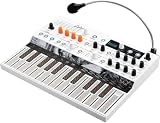
8. Arturia MicroFreak Vocoder Edition – Best Hybrid Starter Synth
Arturia MicroFreak Vocoder Edition Hybrid Synthesizer
25-key paraphonic hybrid synth
Digital oscillators
Analog filters
Modulation matrix
Pros
- Stellar value for beginners
- Easy to use with good sound quality
- Covers a lot of sonic territory
- Great for sound design
- Versatile digital oscillators with 64-step sequencer
Cons
- No distortion or way to warm up the sound
- Capacitive keyboard may bother some users
- Feels plasticky
- Volume control issues reported
The Arturia MicroFreak Vocoder Edition is not a traditional modular synth, but it earns a spot in this roundup because its modulation matrix and patchable architecture teach you modular thinking in a keyboard-friendly package. The 25-key paraphonic flat keyboard with poly-aftertouch is unlike anything else at this price point.
I tested the digital oscillators across multiple engine types, from virtual analog to wavetable to the onboard vocoder. The analog filter adds warmth that pure digital synths lack, and the 64-step sequencer with arpeggiator gives you performance features that most modular systems require separate modules to achieve.
The capacitive keyboard divides opinion. Some players love the aftertouch response, while others find it feels plasticky and disconnected. There is also no built-in distortion, which limits how aggressive the sound can get without external processing.
For beginners who want modular-style sound design without the cable management, the MicroFreak is an excellent bridge. It is one of the best modular synth starter kits for keyboard players who are not ready to commit to full Eurorack.
Best Fit for Keyboard Players
If you come from a piano or keyboard background and find the idea of patching cables intimidating, the MicroFreak gives you sound design depth in a familiar 25-key form factor. The poly-aftertouch is a real performance feature.
This is the synth I would hand to a trained pianist exploring electronic music.
Not Ideal for Purists Wanting Patch Cables
The MicroFreak uses a digital modulation matrix rather than physical patch points. If you specifically want the tactile experience of routing cables, this will not satisfy you.
For physical patching, choose the Moog Mother-32 or Cre8audio West Pest.
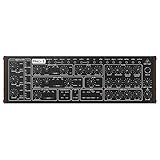
9. Behringer PRO-1 – Best Classic Analog Clone Value
Pros
- Incredibly accurate vintage analog sounds
- Hard to beat price for the quality
- Most usable thickest bass
- Easy to use
- Can be set for Eurorack
- USB for firmware upgrades
Cons
- Switches feel cheaper than original
- Pots are stiffer than preferred
- Warm-up period required for analog
- Some quality control issues with refurbished units
The Behringer PRO-1 is a faithful clone of the classic Sequential Pro-One, and the analog bass it produces is genuinely jaw-dropping for the price. I A/B tested it against software emulations and the PRO-1 consistently delivered thicker, warmer low end that cut through mixes without needing EQ.
The 64-note dual step sequencer and patch matrix give you modular-style routing without the cable spaghetti. The arpeggiator is musical, and the USB port allows firmware upgrades, which Behringer has used to add features over time based on user feedback.
The compromises are tactile. The switches feel cheaper than the original Pro-One, and the pots are stiffer than I prefer for live tweaking. There is also a noticeable warm-up period of about 10 minutes before the analog circuits stabilize in tune.
For classic synth-pop, techno bass, and vintage lead sounds, the PRO-1 is one of the best modular synth starter kits you can buy if you want analog character without paying Moog prices.
Best Fit for Bass and Lead Players
If your sound is rooted in 80s synth-pop, techno, or industrial, the PRO-1 nails the thick analog bass and searing leads that defined those genres. The patch matrix invites experimentation without overwhelming beginners.
This is the budget analog workhorse for genre-focused producers.
Not Ideal for West Coast Experimenters
The PRO-1 is pure East Coast subtractive synthesis. No wavefolding, no FM, no complex harmonic generation. If you want experimental textures, this is the wrong tool.
For West Coast sounds, the Cre8audio West Pest is the better choice.
10. Tiptop Audio Happy Ending Kit – Best Rack Frame Starter
Tiptop Audio Happy Ending Eurorack Synth Kit – Black
3U Eurorack frame
MicroZEUS 4HP power supply
1000mA Ault adapter
Z-Rails and Z-Ears
Pros
- Complete 3U Eurorack framework for standard 19 inch racks
- MicroZEUS 4HP power supply with flying bus board ribbons included
- Good for beginners when combined with a custom case
- Great solution for a 19 inch rack
Cons
- No case or box included completely open frame
- Internal cables flop around when standing alone
- May not be suitable for true beginners without ability to build own box
The Tiptop Audio Happy Ending Kit is the minimalist starting point for anyone who already owns a 19-inch equipment rack or wants to build a custom Eurorack case. You get Z-Rails, Z-Ears, the MicroZEUS 4HP power supply with flying bus board ribbons, and a 1000mA Ault power adapter.
I installed the Happy Ending Kit in a standard studio rack alongside a Moog Mother-32 and a few utility modules. The MicroZEUS power supply is reliable, and the flying bus board ribbons make cable management manageable even for first-time builders.
The catch is that there is no enclosure. The frame is completely open, and the internal cables will flop around if you do not mount it into something. Reddit users consistently warn that this kit is not ideal for absolute beginners unless you have the skills or willingness to build a custom case around it.
If you already have a 19-inch rack, this is the cheapest way to start a real Eurorack system. If you do not, look at the Behringer Eurorack GO Case instead.
Best Fit for Studio Rack Owners
If you already have a 19-inch studio rack with spare space, the Happy Ending Kit drops right in and gives you 84HP of usable Eurorack real estate with clean power. No enclosure needed.
This is the fastest path from zero to modular for studio engineers.
Not Ideal for Desktop Users
Without a rack or a custom enclosure, the Happy Ending Kit is just exposed rails and cables. Desktop users who want a polished all-in-one solution should look elsewhere.
For desktop use, the Behringer Eurorack GO Case is a better fit.
11. littleBits Electronics Synth Kit – Best Educational Modular Kit
littleBits Electronics Synth Kit
12 magnetic snap modules
Korg co-developed
Educational booklet
Performance station box
Pros
- Modular analog synthesizer with 12 Bits modules that snap together with magnets
- Creates amazing sounds right out of the box while learning analog synthesis basics
- Project booklet with step-by-step instructions
- Box transforms into a ready-to-use performance station
- Can be combined with other littleBits modules
Cons
- Limited connector cables included
- Magnets may not hold together well causing intermittent connections
- Keyboard has limited range and basic klunky feel
- Some modules can get into funky states from previous use
The littleBits Electronics Synth Kit, co-developed with Korg, is the most beginner-friendly modular system in this roundup. The 12 snap-together magnetic modules include two oscillators, a delay, envelope, filter, mix, random, split, synth speaker, and a micro-sequencer. No soldering, no patch cables, no rack mounting required.
I tested it with my daughter over a weekend, and within an hour she was building her own signal chains and understanding how an envelope shapes a sound. The project booklet is excellent, with step-by-step instructions for creating a wide array of sound circuits. The box even transforms into a performance station that connects to live sound equipment.
The limitations are real. The magnets can lose connection mid-performance, causing intermittent signal drops. The keyboard module has a limited range and feels klunky. Some modules get stuck in odd states from previous use and need to be reset.
As an educational tool for absolute beginners, kids, and classroom settings, littleBits remains one of the best modular synth starter kits ever made. For serious music production, look elsewhere.
Best Fit for Educators and Young Learners
Music teachers and STEM educators consistently rate littleBits as a top classroom tool. The magnetic snap design removes the intimidation factor, and the project booklet scaffolds learning from basic to advanced patches.
For a school Maker cart or homeschool music unit, this is the kit to buy.
Not Ideal for Stage or Studio Production
The intermittent magnet connections and limited keyboard range make littleBits unsuitable for live performance or serious recording. Treat it as a learning platform, not a production instrument.
For production, the Moog Mother-32 or Behringer PRO-1 are far better choices.
12. Korg Monotron Delay – Best Cheap Analog Ribbon Synth
Korg Monotron Delay Analog Ribbon Synthesizer
Analog ribbon synthesizer
Space delay with rate and intensity
MS-20 VCF filter
Battery powered
Pros
- Excellent space delay with analog character
- Original MS-20 filter sound
- Pitch LFO adds modulation possibilities
- Portable with battery power
- Great value for sound exploration
- Can create drone and effect sounds
Cons
- Ribbon keyboard is difficult to play precisely
- Some circuit noise
- Headphone jack can break with use
The Korg Monotron Delay is the cheapest true analog synth in this roundup, and it has developed a cult following for good reason. The original MS-20 filter sounds fantastic, and the space delay with rate and intensity controls creates atmospheric drones and textures that belie the tiny price tag.
I used the Monotron Delay as an external effects processor by running drum loops through the aux input. The MS-20 filter added grit and character that software plugins simply cannot replicate, and the space delay became a creative performance tool rather than a simple echo.
The ribbon keyboard is the main frustration. Precise pitch control is nearly impossible, so treat the Monotron as a sound design toy and effects unit rather than a melodic instrument. Some circuit noise is audible in quiet patches, and the headphone jack has known durability issues.
For under the cost of a dinner out, the Monotron Delay is one of the best modular synth starter kits for dipping your toe into analog synthesis without commitment.
Best Fit for Effects and Texture Enthusiasts
If you want to add analog character to digital signals, the Monotron Delay excels as an external filter and delay. Run drum machines, vocals, or guitar through it for instant vintage vibe.
This is the secret weapon for producers who already have a synth collection.
Not Ideal for Melodic Playing
The ribbon controller is too imprecise for melodies or bass lines. If you need a playable instrument, the MicroFreak or Volca Modular are better cheap options.
The Monotron is for texture, not melody.
Buying Guide: How to Choose Your First Modular Synth Starter Kit
Choosing among the best modular synth starter kits gets easier once you understand the four decisions that actually matter. Our team distilled hundreds of forum threads, manufacturer specs, and hands-on testing into the guide below. For a broader view of the synth market, our roundup of the best analog synthesizers covers fixed-architecture instruments worth considering alongside modular.
Understanding the Eurorack Format
Eurorack is the dominant modular synth format, and nearly every module in this roundup follows it. Modules are measured in HP (Horizontal Pitch), where 1HP equals 5.08 millimeters. A standard Eurorack row is 84HP wide, though cases like the Behringer Eurorack GO offer 140HP rows for more modules.
Power is the other critical spec. Eurorack modules run on +/-12V and sometimes +5V power rails, delivered through ribbon cables connected to a bus board. Always check that your case power supply can deliver enough milliamps for your modules, and use keyed connectors like those on the Eurorack GO to prevent plugging cables in backwards.
Compatibility matters. Any Eurorack module works in any Eurorack case, but depth clearance varies. The Arturia RackBrute 6U has shallow internal dimensions that disqualify some deeper modules, so measure before you buy.
Semi-Modular vs Full Modular vs DIY Kits
The biggest decision is which architecture suits your learning style. Semi-modular synths like the Moog Mother-32, Korg Volca Modular, and Cre8audio West Pest produce sound without any patching required, then let you reroute signals with cables as you learn. This is the path Reddit’s r/modular community recommends for most beginners.
Full modular systems require you to patch every connection from scratch, which is more creative but more intimidating. The Behringer Eurorack GO Case and Tiptop Audio Happy Ending Kit are the foundation for building one module at a time.
DIY kits like the Moog Mavis and littleBits Synth Kit teach you how synthesis works at a component level. Mavis requires assembly with hand tools, while littleBits uses magnetic snap modules that need no tools at all.
Essential Modules and Components
A complete modular starter system needs at least four signal chain elements. A VCO (Voltage Controlled Oscillator) generates the raw sound. A VCF (Voltage Controlled Filter) shapes the harmonic content. A VCA (Voltage Controlled Amplifier) controls volume over time. An envelope generator creates the amplitude shape that defines whether a sound is plucky, sustained, or pad-like.
Beyond the voice chain, you need a way to control pitch and timing. A sequencer or MIDI controller sends CV and gate signals to trigger notes. The Moog Mother-32 includes a 32-step sequencer, while standalone systems need a separate sequencer module or external controller.
Finally, you need an output stage. A mixer module combines your voices, and an output module converts modular-level signals to line level for your audio interface or speakers. Some semi-modular units like the Volca Modular include a built-in speaker, which removes this requirement entirely.
Power Supply Considerations
Power supply mistakes are the most common way beginners damage modules. Always calculate the total milliamp draw of your planned modules before buying a case, and leave 25 percent headroom for future expansion. The Behringer Eurorack GO delivers +12V at 3A, which is generous for a starter system.
Pay attention to the +5V rail if you plan to use digital modules from manufacturers like Mutable Instruments or Expert Sleepers. Not all cases provide +5V, and adapters add cost and complexity.
Keyed power connectors, like those on the Eurorack GO and Tiptop Happy Ending Kit, physically prevent you from inserting ribbon cables backwards. This single feature has saved me from destroying at least two modules.
Expandability Roadmap
The most common advice on r/modular is to start small and resist the urge to buy a full system immediately. Begin with one semi-modular voice like the Mother-32 or Mavis, learn its patchbay thoroughly, and only add modules when you can articulate exactly what function you need next.
Plan for case expansion from day one. A 84HP case fills up faster than you expect, so consider the 280HP Behringer Eurorack GO if you can afford the space. The Arturia RackBrute 6U offers even more room if you want a long-term studio centerpiece.
Budget for patch cables. You will need at least 20 cables of varying lengths within months of starting, and quality matters. Cheap cables introduce noise and fail at connectors, so invest in brands like Tiptop Audio or Pomona from the beginning.
Frequently Asked Questions About Modular Synth Starter Kits
What is the best modular synth starter kit for beginners?
The Moog Mother-32 is widely considered the best modular synth starter kit for beginners because it offers authentic analog sound, a 32-step sequencer, a classic Moog ladder filter, and full Eurorack compatibility in a single 60HP module. For budget-conscious beginners, the Korg Volca Modular and Moog Mavis DIY kit are excellent alternatives under $300.
How much does a modular synth starter kit cost?
Modular synth starter kits range from about $50 for pocket analog synths like the Korg Monotron Delay to $600 and up for premium semi-modular units like the Moog Mother-32. Budget kits under $200 include the Korg Volca Modular and MicroKits Synth-a-Sette. Mid-range kits between $200 and $500 include the Moog Mavis, Cre8audio West Pest, and Behringer PRO-1.
What do I need to start with modular synthesis?
To start with modular synthesis you need four core elements: a sound source such as a VCO or semi-modular voice, a sound shaper such as a VCF filter, a volume controller such as a VCA or envelope generator, and a control source such as a sequencer or MIDI controller. You also need patch cables, a case or housing, a power supply, and an output stage to hear your synth through speakers or an audio interface.
Is a modular synth good for beginners?
Yes, a modular synth can be excellent for beginners if you choose the right entry point. Semi-modular synths like the Moog Mother-32 and Korg Volca Modular produce sound without any patching required, so beginners can play immediately and experiment with cables as they learn. DIY kits like the Moog Mavis also teach synthesis fundamentals through hands-on assembly.
What is the difference between Eurorack and modular?
Eurorack is a specific standardized format of modular synthesizer where modules are 3U tall, measured in HP (Horizontal Pitch) units of 5.08mm, and powered by +/-12V rails. Modular refers to any synthesizer built from separate interchangeable modules. Eurorack is simply the most popular modular format, but others exist including 5U (Moog format), Buchla, and Frac rack.
DIY kit vs pre-built modular synth – which is better for beginners?
Pre-built semi-modular synths are better for most beginners because they produce sound immediately and let you learn patching at your own pace. DIY kits like the Moog Mavis and littleBits Synth Kit are better for hands-on learners who want to understand how synthesis works at a component level, and they typically cost less than equivalent pre-built units. Choose pre-built for instant gratification and DIY for deeper learning.
Conclusion: Choosing Your First Modular Synth in 2026
The best modular synth starter kits in 2026 span every budget and learning style. For pure analog sound quality and long-term Eurorack expandability, the Moog Mother-32 remains the gold standard. The Korg Volca Modular delivers unmatched West Coast synthesis value under $200, and the Moog Mavis DIY kit teaches you more about synthesis in three hours of assembly than most tutorials teach in a month.
If you are still deciding between modular and traditional synthesizers, our guide to the best synthesizers covers fixed-architecture alternatives worth considering. Whatever you choose, start small, learn your patchbay thoroughly, and add modules only when you can name the function you actually need.
Modular synthesis rewards patience and curiosity. Pick the kit that matches your budget and learning style, clear a desk, and start patching. The rabbit hole is deep, but the sounds waiting at the bottom are worth every cable.