
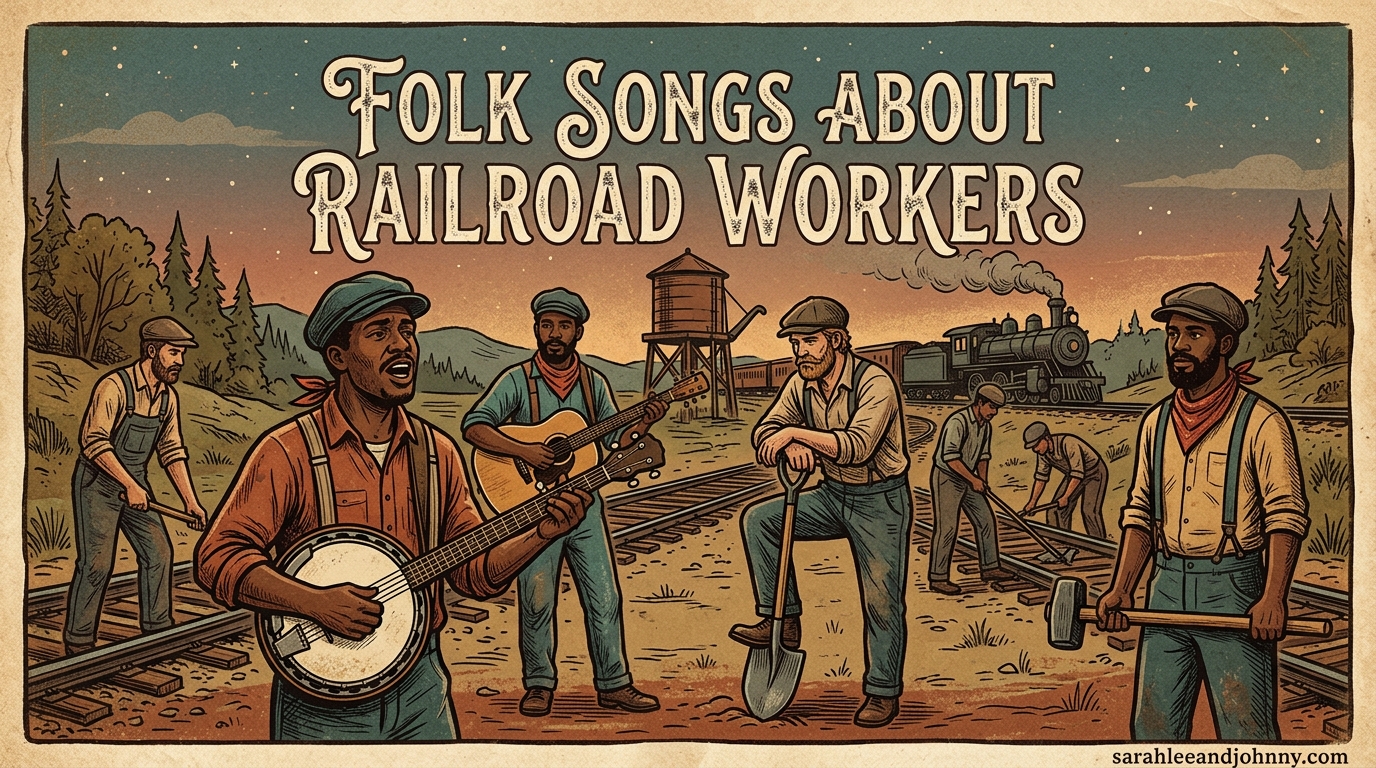
When I first heard Lead Belly growl his way through “Rock Island Line,” I understood something that books had never taught me about American history. Folk songs about railroad workers carry the weight of real lives, real dangers, and real dreams packed into verses that regular people sang to survive long days of grueling labor. These songs are not museum pieces locked behind glass. They are living stories about the people who laid the tracks across a continent and the culture that grew up around the rails.
Railroad folk songs form one of the richest veins in American traditional music. They stretch from work chants sung by track-laying crews in the 1830s to polished concert performances by folk revival artists in the 1960s and beyond. Along the way, they document train wrecks, celebrate legendary engineers, mourn lost companions, and give voice to the hobos who rode the freight cars looking for work and freedom.
In this guide, our team walks through the most important folk songs about railroad workers, the history behind them, and why they still matter. Whether you are a folk singer building your repertoire, a history buff, or someone who just heard “Casey Jones” for the first time and wants to know more, you will find everything you need right here.
Table of Contents
- What Are Folk Songs About Railroad Workers?
- The History of Railroad Songs in America
- Famous Folk Songs About Railroad Workers
- Regional Variations in Railroad Worker Songs
- African American Contributions to Railroad Folk Songs
- Hobo Songs and Freight Train Culture
- Modern Folk Songs About Railroad Workers
- How to Learn and Perform Railroad Folk Songs
- FAQs
- Conclusion
What Are Folk Songs About Railroad Workers?
Folk songs about railroad workers are traditional American ballads, work songs, spirituals, and blues pieces that document the experiences of the people who built, operated, and traveled on the railroads. They emerged from the real daily lives of engineers, firemen, brakemen, track layers, and the hobos and migrants who rode the freight trains crisscrossing the country.
These songs fall into several overlapping categories. Work songs were sung in rhythm by railroad construction crews to coordinate heavy labor like driving spikes and laying rails. Ballads told stories of specific events, especially train wrecks and heroic engineers. Spirituals and gospel songs used the train as a metaphor for salvation and freedom. Blues and hobo songs expressed the loneliness, danger, and wanderlust tied to railroad life.
What ties all these forms together is oral tradition. Most railroad folk songs were not written down when they were first sung. They traveled from worker to worker, town to town, shifting and evolving with each new singer. Folklorists like John Lomax and his son Alan began collecting these songs in the early 1900s, traveling with portable recording equipment to capture performances that might otherwise have vanished entirely.
The importance of these songs goes well beyond entertainment. For historians, they serve as primary source documents that reveal details about working conditions, wages, racial dynamics, and daily life on the railroads that official records often omit. For musicians, they represent some of the strongest melodic and lyrical material in the American folk tradition. For anyone who cares about the stories of working people, they are irreplaceable cultural artifacts.
The History of Railroad Songs in America
Railroads reshaped American life starting in the 1830s. The Baltimore and Ohio Railroad, chartered in 1827, kicked off an era of explosive expansion. By the 1880s, railroad companies had laid over 90,000 miles of track across the United States. This massive construction effort required tens of thousands of workers, and those workers brought their music with them.
Irish immigrants laid much of the early track in the Northeast and Midwest. They brought ballad traditions from their home country and adapted them to their new circumstances. African American workers, both enslaved and free, built huge portions of the southern rail lines. Their work song traditions, rooted in the same call-and-response patterns used in cotton fields and logging camps, shaped the rhythmic character of railroad folk music.
Chinese immigrants played a major role in building the Central Pacific portion of the Transcontinental Railroad, though their musical contributions were less documented in American folk song collections. Mexican and Mexican American workers in the Southwest developed their own railroad song traditions, blending corrido forms with themes of railroad labor. These diverse voices all contributed to the rich tapestry of railroad folk music.
The golden age of railroad folk songs ran roughly from the 1890s through the 1930s. During this period, railroads were the primary means of long-distance transportation, and nearly every American had some connection to the rails. Train wrecks were common and dramatic, making natural material for ballad writers. Legendary figures like Casey Jones became larger than life in song. The daily rhythm of train schedules, whistle signals, and station life became so deeply embedded in American culture that they generated an entire musical vocabulary.
By the mid-twentieth century, automobiles and airplanes began replacing trains as the dominant mode of travel. But the folk revival of the 1950s and 1960s brought new attention to railroad songs. Artists like Pete Seeger, Lead Belly, and later Bob Dylan and Johnny Cash recorded traditional railroad songs and wrote new ones, keeping the tradition alive for modern audiences. This revival period proved that railroad songs had staying power far beyond their original context.
Famous Folk Songs About Railroad Workers
The best way to understand railroad folk music is to look at the songs themselves. Each one opens a window into a specific moment, person, or way of life connected to the rails. Here are the most significant folk songs about railroad workers and the stories behind them.
Casey Jones – The Heroic Engineer
“Casey Jones” might be the most famous railroad ballad in American history. It tells the story of Jonathan Luther “Casey” Jones, a railroad engineer who died on April 30, 1900, when his Illinois Central passenger train collided with a stalled freight train near Vaughan, Mississippi. According to the song, Jones stayed at the throttle to slow the train as much as possible, saving his passengers at the cost of his own life.
Wallace Saunders, an African American engine wiper who worked with Jones, wrote the original version of the song shortly after the wreck. It spread through oral tradition among railroad workers before being published and popularized by vaudeville performers. The version most people know today, recorded by countless folk and country artists, comes from the adaptation by T. Lawrence Seibert and Eddie Newton in 1909.
The song paints Jones as the ultimate railroad man, skilled and brave. Lines about his faithful fireman Sim Webb and the engine’s whistle screaming add vivid detail that makes listeners feel like they are riding in the cab. It became a symbol of railroad heroism and remains a standard in folk music repertoires. The Grateful Dead later recorded a version with altered lyrics that turned Casey into a cautionary tale about speed, showing how the song continues to evolve.
John Henry – The Steel-Drivin’ Man
“John Henry” stands as one of the most powerful American folk songs ever created, and it is rooted deep in railroad history. The song tells the story of a steel driver, a man whose job was to hammer steel drill bits into rock to create blast holes for tunnel construction. John Henry races against a steam-powered drill to prove that human muscle can beat machine power. He wins the contest but dies from the effort, hammer in hand.
The historical John Henry likely worked on the Chesapeake and Ohio Railroad’s Big Bend Tunnel in West Virginia during the early 1870s. Researchers have found evidence supporting a real person matching the song’s description, though details remain debated. What is certain is that the song emerged from the African American work song tradition and spread widely through railroad and mining communities.
John Henry became a symbol of human dignity and resistance in the face of industrialization. The song has been recorded by hundreds of artists across genres, from Lead Belly and Woody Guthrie to Johnny Cash and Bruce Springsteen. Each version carries the same core message: a worker stood his ground against the machine, and even though it killed him, his spirit could not be replaced. The ballad of John Henry remains one of the most recorded folk songs in American history.
I’ve Been Working on the Railroad – The Classic Work Song
“I’ve Been Working on the Railroad” is one of the most widely known American folk songs, taught to children in schools across the country. Despite its familiar melody, the song has genuine roots in railroad labor culture. It likely originated in the 1890s as a minstrel song, with lyrics reflecting the long hours and repetitive tasks of railroad construction work.
The verses about “Dinah, won’t you blow your horn” and “someone’s in the kitchen with Dinah” may seem disconnected from railroad work, but they reflect the communal living conditions of railroad camps. Workers lived in temporary settlements where cooking, socializing, and music-making happened together after long days of labor. The song captures both the monotony of the work and the camaraderie that helped workers endure it.
Over the decades, the song transformed from a work song into a children’s standard. But its value as a historical document remains. It preserves a glimpse into the daily rhythm of railroad construction life, even if that glimpse has been softened by time and repeated sing-alongs. The melody itself has roots in earlier British folk tunes, showing how immigrant traditions blended with American experiences on the railroad.
The Wreck of the Old 97 – Tragedy in Song
“The Wreck of the Old 97” recounts the September 27, 1903, derailment of a fast mail train operated by the Southern Railway near Danville, Virginia. Engineer Joseph A. (“Steve”) Broady was running behind schedule and pushing his locomotive at dangerous speed when the train jumped the tracks on a curved trestle, killing eleven people.
The ballad follows the classic disaster narrative pattern found throughout folk music. It names specific people and places, describes the fatal decisions that led to the crash, and ends with the grim aftermath. This specificity is what makes railroad disaster ballads so compelling and so historically valuable. They serve as both entertainment and documentation of real events that shaped communities.
Multiple claims of authorship surround the song, with Fred Jackson Lewey and Charles E. Noell both credited in various sources. Vernon Dalhart’s 1924 recording became one of the first million-selling records in country music history, proving the enormous appetite for railroad disaster songs among American listeners. The song remains a staple of old-time and bluegrass repertoires, and its narrative structure has influenced countless disaster ballads that followed.
Wabash Cannonball – The Mythical Train
“Wabash Cannonball” is unusual among railroad folk songs because it is not about a real train, at least not originally. The song describes a legendary, almost magical train that traveled across the American landscape. Some versions suggest the train carried passengers to the afterlife, giving the song a spiritual dimension alongside its celebration of railroad grandeur.
The song first appeared in the 1880s as a sheet music number called “The Great Rock Island Route.” Over time, it evolved through oral tradition, changing its title and picking up the mythical elements that make it distinctive. By the time the Carter Family recorded their influential version in 1929, the Wabash Cannonball had become a folk standard. Roy Acuff’s later recording made it one of the most performed songs in country music history.
What makes this song remarkable is how it captures the wonder that railroads inspired in everyday Americans. At a time when trains were the fastest, most powerful machines most people would ever encounter, it made sense to mythologize them. The Wabash Cannonball was not just transportation. In the song, it represents the majesty and possibility of American rail travel, connecting cities and communities that had previously been isolated from one another.
Freight Train Blues – The Hobo and Blues Tradition
“Freight Train Blues” belongs to the tradition of blues and hobo songs that grew out of the experience of riding freight trains. Popularized by Woody Guthrie and later by Bob Dylan, the song expresses the restlessness and loneliness of life on the rails. The train whistle becomes a haunting sound that follows the singer across the country, a constant companion and a reminder of rootlessness.
The blues tradition intersected with railroad culture in countless songs. Train whistles, track rhythms, and the imagery of departure and arrival became standard elements of blues composition. Artists like Jimmie Rodgers, known as “The Singing Brakeman,” built entire careers on railroad-themed music, blending country and blues styles with authentic railroad experience. Rodgers actually worked as a railroad brakeman before becoming a recording star, and his yodeling style was influenced by the sounds of the rail yard.
The hobo songs of the Great Depression era deserve special mention here. During the 1930s, thousands of unemployed Americans rode freight trains looking for work. Their experiences generated songs that mixed hardship with dark humor and a strange kind of freedom. These songs documented a side of railroad life far removed from the heroism of Casey Jones, focusing instead on survival, displacement, and the search for a better life somewhere down the line.
Rock Island Line – Work Song to Folk Standard
“Rock Island Line” began as a work song sung by African American railroad workers and became one of the most popular folk songs of the twentieth century. The song tells the story of a train approaching a toll station. The engineer lies about his cargo to avoid paying a higher fee, claiming he carries livestock when he actually carries pig iron, then races through the gate.
Lead Belly recorded the song in the 1930s after learning it from prison work gangs, where it was used to set the pace for manual labor. His version, with its infectious rhythm and sly humor about outsmarting authority, became the template for later recordings. Lonnie Donegan’s 1956 skiffle version topped charts in the United Kingdom and helped launch the British skiffle movement that would eventually produce the Beatles.
The song’s journey from a railroad work chant to an international pop hit illustrates how folk songs about railroad workers traveled far beyond their original context. It also shows how these songs carried messages of resistance and cleverness, qualities that resonated with working people everywhere. Johnny Cash recorded a well-known version at Folsom Prison, connecting the railroad song tradition to the prison song tradition in a way that felt completely natural.
Regional Variations in Railroad Worker Songs
Railroad songs did not develop in one single place. They sprang up all across the country, shaped by local cultures, regional economies, and the specific challenges of building railroads in different landscapes. Understanding these regional variations adds depth to our appreciation of railroad folk music.
In the South, railroad songs were heavily influenced by African American musical traditions, including work songs, spirituals, and the blues. Songs from this region tend to feature call-and-response structures, syncopated rhythms, and themes tied to the hardships of manual labor. Many of the most famous railroad songs, including “John Henry” and “Rock Island Line,” have deep southern roots and reflect the experiences of Black railroad workers.
The Appalachian region produced its own distinctive railroad ballads, often performed on fiddle and banjo. These songs tended to focus on the social impact of the railroads on mountain communities, telling stories of separated lovers, economic displacement, and the arrival of outside industry. The Carter Family, who grew up in the Appalachian region of Virginia, recorded many railroad songs that reflected this mountain perspective and helped define the sound of early country music.
Midwestern railroad songs often celebrated the prairie landscapes the trains crossed. Freight train songs from the Midwest tended to emphasize distance and the vastness of the American interior. Hobo songs from this region, collected during the Great Depression, describe the experience of riding trains through endless fields and small towns across the heartland. Steve Goodman’s “City of New Orleans,” written in 1970 about the Illinois Central train running from Chicago to New Orleans, carries forward this midwestern railroad song tradition.
Western railroad songs incorporated themes of adventure and frontier expansion. Songs about building the Transcontinental Railroad and crossing the Sierra Nevada mountains carry a different tone than the labor songs of the South. They emphasize progress, conquest of nature, and the ambition of linking the coasts by rail. These western songs often feature broader, more sweeping melodies that match the grandeur of the landscapes they describe.
African American Contributions to Railroad Folk Songs
African American workers and musicians shaped railroad folk music more profoundly than any other single group. Their contributions span every category of railroad song, from work chants to spirituals, blues ballads, and protest songs. Any serious discussion of railroad folk music must center these contributions.
Railroad construction in the South relied heavily on Black labor, both before and after emancipation. These workers used songs to coordinate physical tasks and to express the pain, hope, and solidarity of their experience. The rhythmic patterns of railroad work songs, with their call-and-response structure, became a foundation for later American popular music, including rhythm and blues and rock and roll. When you hear a backbeat in modern music, you are hearing a distant echo of the railroad work song.
The train held powerful symbolic meaning in African American spirituals and gospel music. In songs like “The Gospel Train” and “This Train Is Bound for Glory,” the train represents salvation, deliverance, and the journey to freedom. This symbolism connects directly to the Underground Railroad, the network of safe routes used by enslaved people escaping to freedom, even though the actual Underground Railroad predated the widespread use of trains. The metaphor was so natural that the name transferred effortlessly from one form of liberation to another.
Key African American performers preserved and popularized railroad folk songs for wider audiences. Lead Belly recorded dozens of train songs during his career, drawing on his experiences in the South and his time in prison work gangs. Josh White brought railroad blues to concert stages and recordings. Elizabeth Cotten, a self-taught guitarist from North Carolina, wrote “Freight Train,” which became one of the most widely performed folk songs of the twentieth century. Her fingerpicking style, known as “Cotten picking,” influenced generations of guitarists and remains a foundational technique for folk guitar players.
These contributions remind us that railroad folk songs are not just about trains. They are about the people who did the hardest work and the music they created to sustain themselves through it. Ignoring the African American roots of railroad folk music would mean missing the very heart of the tradition.
Hobo Songs and Freight Train Culture
No discussion of folk songs about railroad workers is complete without acknowledging the hobo tradition. Hobos were itinerant workers who rode freight trains to travel between jobs, especially during the Great Depression when unemployment drove thousands onto the rails. Their songs form a distinct subgenre within railroad folk music, one that captures a very different side of railroad life.
Hobo songs differ from work songs and ballads in tone. They often mix hardship with humor, danger with a sense of adventure, and loneliness with a fierce attachment to freedom. The hobo code of ethics, which included rules about sharing food and respecting fellow travelers, shows up in the lyrics of these songs. They paint a picture of a shadow community that existed alongside mainstream America, connected by the rail lines they rode.
Harry “Mac” McClintock’s “Big Rock Candy Mountain,” first recorded in 1928, is one of the most famous hobo songs. It describes a hobo’s fantasy paradise filled with cigarette trees, lemonade springs, and lakes of stew. The sweetness of the vision makes more sense when you understand that it was born from the desperation of life on the road. The song became a children’s favorite, its darker origins largely forgotten by mainstream audiences.
Woody Guthrie drew heavily on hobo culture in his songwriting. His experiences riding freight trains during the Dust Bowl era informed songs that documented the struggles of displaced workers. Guthrie’s railroad songs are less about the machinery and more about the people whose lives were shaped by economic forces far beyond their control. His music became a bridge between traditional railroad folk songs and the protest folk tradition that followed, influencing artists like Bob Dylan and Bruce Springsteen.
Modern Folk Songs About Railroad Workers
One of the most overlooked aspects of railroad folk music is the fact that artists continue to write and record new songs about railroad workers. The tradition did not die with the steam locomotive. Contemporary folk artists keep the themes alive, addressing both historical railroad culture and the realities of modern rail work.
Songwriters in the folk and Americana traditions still draw on railroad imagery because it resonates with universal themes of travel, labor, loss, and longing. The rhythm of a train remains one of the most natural musical patterns in existence, and its pull on the imagination has not faded. Artists like Gillian Welch, The Wood Brothers, and numerous independent folk musicians have released railroad-themed songs in recent years, proving that the tradition still has creative energy left to give.
The revival of interest in traditional American music has also brought renewed attention to classic railroad songs. Younger artists learning old-time and bluegrass music frequently add railroad songs to their repertoires. Festivals dedicated to folk and traditional music regularly feature railroad song workshops and performances, ensuring that these songs continue to be sung by new generations of musicians and audiences.
Railroad workers themselves still make music. Contemporary rail workers, especially those involved in maintenance-of-way crews and yard operations, carry on musical traditions connected to their work. While these songs may not reach wide audiences, they represent the living continuation of a practice that stretches back nearly two hundred years. The tradition that began with track-laying crews singing to coordinate their labor is still alive on the rails today.
How to Learn and Perform Railroad Folk Songs
If you want to explore these songs yourself, whether as a listener or a performer, there are excellent resources available. Our team has spent years collecting and performing railroad folk songs, and these are the paths we recommend for getting started.
Start with the recordings. The Smithsonian Folkways collection includes hundreds of railroad songs in their catalog, featuring performances by Lead Belly, Pete Seeger, Cisco Houston, and many others. Their “Classic Railroad Songs” compilation is an ideal starting point because it covers the full range of the genre in two discs. The Library of Congress Archive of Folk Culture holds field recordings made by John and Alan Lomax during their collecting trips, capturing performances by railroad workers and folk singers in their original contexts. Hearing these raw, unpolished recordings connects you directly to the source of the tradition.
For guitar and banjo players, many railroad songs work well with basic fingerpicking and strumming patterns. “Freight Train” by Elizabeth Cotten is one of the best starting points for learning fingerstyle guitar because the alternating bass pattern she developed is both accessible and musically satisfying. “Rock Island Line” works well with a simple boom-chuck strumming pattern on guitar. “Casey Jones” and “Wreck of the Old 97” follow standard folk ballad chord progressions that intermediate players can handle without much difficulty.
If you want to dive deeper, look for songbooks published by Folkways Records and Oak Publications. These often include historical notes alongside lyrics and chords, giving you both the music and the context behind it. Online communities dedicated to old-time music and folk singing are also valuable resources, with members who freely share knowledge about tuning, technique, and the history behind specific songs.
Listening to multiple versions of the same song is one of the best ways to understand how folk music works. Compare Lead Belly’s “Rock Island Line” with Lonnie Donegan’s version and Johnny Cash’s recording. Notice how the melody, tempo, and even lyrics shift between performers. That variation is not a flaw. It is the essence of folk tradition. Each singer brings something new while honoring the core of the song, and understanding this flexibility is key to performing railroad folk songs with authenticity and feeling.
FAQs
What is the old folk song about a train?
The oldest and most widely recognized folk song about a train is “I’ve Been Working on the Railroad,” which dates to the 1890s and originated as a minstrel song reflecting railroad construction labor. Other extremely old railroad folk songs include “Casey Jones” (1900) and “John Henry” (1870s). The exact oldest song is debated, but railroad themes have appeared in American folk music since the 1830s when railroads first expanded across the country.
What are some folk train songs?
Essential folk train songs include “Casey Jones,” “John Henry,” “The Wreck of the Old 97,” “Wabash Cannonball,” “Rock Island Line,” “Freight Train” by Elizabeth Cotten, “City of New Orleans” by Steve Goodman, “This Train Is Bound for Glory,” “Orange Blossom Special,” and “Freight Train Blues.” These songs span work songs, ballads, spirituals, and blues traditions, and have been recorded by artists from Lead Belly and Woody Guthrie to Johnny Cash and Bob Dylan.
What are some famous songs about trains?
Famous songs about trains include “Casey Jones,” “John Henry,” “Wabash Cannonball,” “The Wreck of the Old 97,” “City of New Orleans” (Steve Goodman, popularized by Arlo Guthrie), “Orange Blossom Special,” “Chattanooga Choo Choo,” “Folsom Prison Blues” (Johnny Cash), “Mystery Train” (Elvis Presley), “Freight Train” (Elizabeth Cotten), and “King of the Road” (Roger Miller). These span folk, country, blues, and rock genres.
What songs about trains were in the 1950s?
Notable train songs from the 1950s include Johnny Cash’s “Folsom Prison Blues” (1955), Elvis Presley’s recording of “Mystery Train” (1955), Lonnie Donegan’s skiffle hit “Rock Island Line” (1956), Hank Snow’s “I’m Moving On” (1950), and various folk revival recordings by Pete Seeger and the Weavers. The 1950s folk revival brought renewed attention to older railroad songs, while country and rockabilly artists created new train-themed hits.
Conclusion
Folk songs about railroad workers are among the most enduring and meaningful contributions to American traditional music. From the heroic ballad of Casey Jones to the defiant spirit of John Henry, from the playful deception of “Rock Island Line” to the haunting whistle of “Freight Train Blues,” these songs tell the real story of the people who built and operated the railroads that connected a nation.
What makes these songs so lasting is their emotional truth. They were written by people who lived the experiences they describe, and that authenticity comes through in every verse. The engineer pushing his locomotive too hard, the steel driver racing against a machine, the hobo riding the blinds through the night, the worker singing to make the hours pass. These are not fictional characters. They are the voices of American labor, preserved in melody and verse.
Our team encourages you to go beyond reading about these songs and actually listen to them. Find the field recordings from the Library of Congress. Put on the Smithsonian Folkways collections. Pick up a guitar and learn “Freight Train” or “Rock Island Line.” These songs were meant to be heard and sung, not just studied. Every time someone performs a railroad folk song, that chain of oral tradition stretches a little further, carrying the stories of railroad workers forward into another generation.