
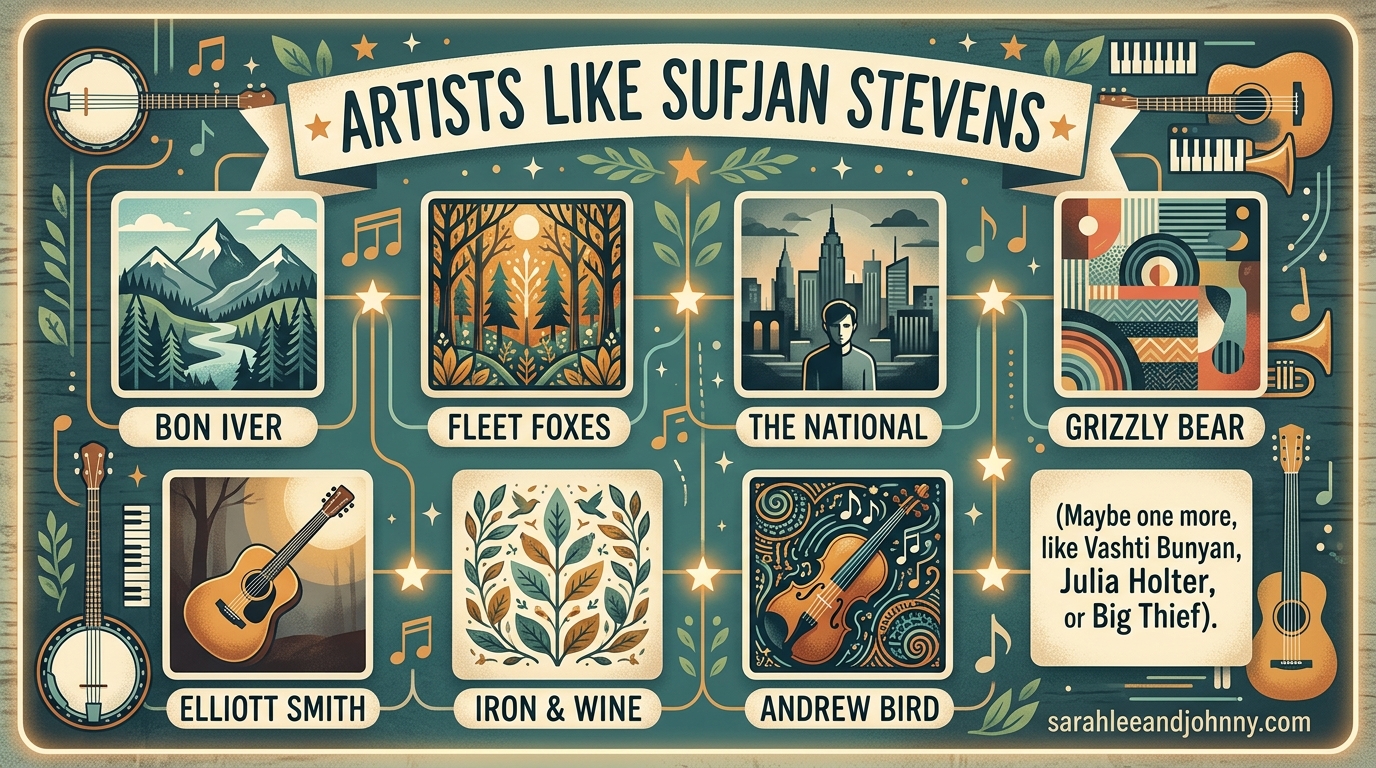
If you have spent any time lost in the layered harmonies and aching melodies of Sufjan Stevens, you already know the feeling. His music has a way of pulling you into quiet, reflective spaces that are hard to find elsewhere. The combination of intimate folk storytelling, baroque pop arrangements, and raw emotional honesty makes Sufjan one of a kind. But what happens when you need more music like that in your life?
Finding artists like Sufjan Stevens is not just about matching a genre tag. Sufjan’s catalog spans indie folk, orchestral pop, electronic experimentation, and ambient soundscapes. Some fans connect with the stripped-back grief of Carrie & Lowell, while others love the maximalist ambition of Illinois. This guide covers 14 artists organized into three categories so you can find exactly what draws you to Sufjan’s music and discover new favorites along the way.
Our team has spent years listening to these artists, comparing albums, and tracing the web of connections between them. Every recommendation below includes a specific album and song to start with, so you can jump right in rather than scrolling through discographies.
Table of Contents
Artists Like Sufjan Stevens: Intimate Folk Storytellers
These artists share Sufjan’s gift for turning deeply personal experiences into songs that feel universal. If the confessional, acoustic-driven side of Sufjan is what moves you, start here.
Elliott Smith
Elliott Smith is the closest thing indie folk has to a patron saint of emotional honesty. His whispered vocal delivery and intricate fingerpicked guitar create an intimacy that feels like reading someone’s private journal. Albums like Either/Or and XO layer beautiful melodies over lyrics that deal with addiction, loneliness, and self-doubt without ever sounding theatrical about it.
Start with: The album Either/Or (1997), specifically the song “Between the Bars.” It captures everything that makes Smith essential: a melody that haunts you for days and words that hit harder with each listen.
Why Sufjan fans connect: Smith’s confessional depth and meticulous acoustic guitar work mirror the stripped-back moments on Carrie & Lowell. Both artists understand that sometimes the quietest songs carry the heaviest weight.
Phoebe Bridgers
Phoebe Bridgers emerged in the late 2010s as one of the most important voices in indie folk, and for good reason. Her songwriting balances sardonic humor with genuine devastation, often in the same verse. Punisher is a masterclass in writing about grief, relationships, and self-awareness without wallowing.
Start with: The album Punisher (2020), specifically “Kyoto.” It is an upbeat-sounding song about emotional numbness, which is a very Sufjan trick.
Why Sufjan fans connect: Bridgers shares Sufjan’s willingness to let vulnerability drive the song rather than hiding behind irony. She also has orchestral ambitions that echo his larger arrangements.
Adrianne Lenker
As the frontwoman of Big Thief, Adrianne Lenker has become one of the most respected songwriters working today. Her solo recordings are even more hushed and intimate, often recorded with just an acoustic guitar and her voice in a room. The album songs feels like eavesdropping on someone singing to themselves in the woods.
Start with: The album songs (2020), specifically “anything.” The title alone tells you where Lenker’s head is at.
Why Sufjan fans connect: Lenker’s fragile vocal delivery and nature-infused lyricism recall Sufjan’s most tender moments. Both write about the natural world as a mirror for internal landscapes.
Laura Marling
Laura Marling started releasing albums as a teenager in the British folk scene and has evolved into one of the most consistently compelling songwriters of her generation. Her arrangements have grown from simple acoustic guitar to complex string sections and experimental production, all while her lyrics have gotten sharper and more literary.
Start with: The album Once I Was an Eagle (2013), specifically “Master Hunter.” It shows off her ability to build an entire world within a single song.
Why Sufjan fans connect: Marling’s restless musical evolution mirrors Sufjan’s own genre-hopping. She never makes the same album twice, and each shift rewards long-time listeners.
The Mountain Goats
John Darnielle has been writing songs as The Mountain Goats since the early 1990s, building one of the most devoted followings in indie music. His early work was famously recorded on a boombox, but even as the production values increased, the focus on literate, deeply personal narratives never wavered. Albums like The Sunset Tree confront difficult family history with a directness that stops you in your tracks.
Start with: The album The Sunset Tree (2005), specifically “This Year.” It is an anthem about surviving a difficult adolescence, and it hits with the force of a freight train.
Why Sufjan fans connect: Darnielle’s concept-album ambitions and willingness to write about faith, family, and personal history align closely with Sufjan’s project-based approach to album-making.
Orchestral and Genre-Bending Visionaries
Sufjan Stevens is not just a folk singer. His albums are carefully constructed worlds with elaborate arrangements that draw from classical, electronic, and pop traditions. These artists share that ambition for building something bigger than a simple singer-songwriter album.
Bright Eyes
Conor Oberst’s Bright Eyes was part of the same early-2000s indie folk explosion that shaped Sufjan’s career. The project mixes folk, country, electronic beats, and orchestral swells, sometimes within the same song. I’m Wide Awake, It’s Morning is widely considered one of the defining albums of that era, blending raw emotion with ambitious arrangements.
Start with: The album I’m Wide Awake, It’s Morning (2005), specifically “First Day of My Life.” It is a love song so direct and unguarded it might make you uncomfortable.
Why Sufjan fans connect: Bright Eyes and Sufjan emerged from the same musical moment, sharing a commitment to literary lyricism and genre-melding production that defined mid-2000s indie.
Andrew Bird
Andrew Bird is a classically trained violinist who has built an entire career around baroque indie pop. His songs feature virtuosic whistling, plucked violin, and lyrics stuffed with obscure vocabulary and literary references. The Mysterious Production of Eggs is a good entry point, balancing accessibility with the kind of musical sophistication that rewards repeated listens.
Start with: The album The Mysterious Production of Eggs (2005), specifically “A Nervous Tic Motion of the Head to the Left.” The title alone should tell you this is someone who takes craft seriously.
Why Sufjan fans connect: Bird’s baroque pop sensibilities and virtuosic musicianship parallel Sufjan’s own multi-instrumental talents. Both treat arrangement as a form of storytelling.
Joanna Newsom
Joanna Newsom plays the harp and writes songs that sound like they were discovered in an ancient manuscript. Her album Ys consists of just five tracks, each stretching past ten minutes, with orchestral arrangements by Van Dyke Parks. It is not background music. It demands your full attention and rewards it generously.
Start with: The album Ys (2006), specifically “Emily.” It is a fourteen-minute song about her sister, and it will change how you think about what a song can do.
Why Sufjan fans connect: Newsom’s uncompromising artistic vision and elaborate arrangements match Sufjan’s willingness to follow an idea wherever it leads, regardless of commercial expectations.
Iron & Wine
Sam Beam started Iron & Wine recording whisper-quiet folk songs in his bedroom. Over two decades, the project has evolved into something far more expansive, incorporating Afrobeat rhythms, jazz textures, and rich studio production. The Shepherd’s Dog marks the turning point where Beam’s arrangements became as important as his songs.
Start with: The album The Shepherd’s Dog (2007), specifically “Flightless Bird, American Mouth.” It begins as a gentle folk song and unfolds into something far more sweeping.
Why Sufjan fans connect: Iron & Wine’s career arc from stripped acoustic to ornate arrangements mirrors Sufjan’s own trajectory. Both prove that intimate songwriting and ambitious production are not mutually exclusive.
Perfume Genius
Mike Hadreas performs as Perfume Genius, and his music channels raw emotion through art-pop, glam rock, and tender balladry. No Shape is a wildly inventive album that careens from orchestral swells to distorted synth-pop, all held together by Hadreas’s fearless vocal performances. He writes about queer identity, trauma, and desire with a directness that is both uncomfortable and thrilling.
Start with: The album No Shape (2017), specifically “Slip Away.” It is a soaring love song that builds to a climax worthy of a classic Hollywood film.
Why Sufjan fans connect: Hadreas treats vulnerability as artistic strength rather than weakness, and his genre-defying evolution across albums echoes Sufjan’s own restlessness.
Atmospheric and Ambient Explorers
On albums like The Ascension and Convocations, Sufjan has shown that he is just as comfortable in electronic and ambient territory as he is with acoustic guitar. These artists share that atmospheric sensibility, building soundscapes that reward deep, patient listening.
Bon Iver
Justin Vernon created Bon Iver in a cabin in Wisconsin, and the myth of that origin story has sometimes overshadowed the music itself. But the songs on For Emma, Forever Ago earned every bit of their legendary status. Vernon’s falsetto, layered over fingerpicked guitar and homemade arrangements, created a template for intimate indie music that continues to influence artists today.
Start with: The album For Emma, Forever Ago (2007), specifically “Skinny Love.” Then listen to 22, A Million to hear how far Vernon has pushed into electronic abstraction.
Why Sufjan fans connect: Vernon shares Sufjan’s Midwestern roots, falsetto vocals, and willingness to evolve from folk into electronic territory. Their careers have run on parallel tracks for nearly two decades.
Fleet Foxes
Robin Pecknold leads Fleet Foxes with a voice that seems designed for soaring over lush, pastoral arrangements. The band’s vocal harmonies are their signature, stacked in layers that recall both Renaissance choral music and 1960s folk-rock. Helplessness Blues is the album where Pecknold’s songwriting caught up with his arranging ambitions.
Start with: The album Helplessness Blues (2011), specifically “White Winter Hymnal.” The vocal round that opens the song is one of the most recognizable moments in modern indie music.
Why Sufjan fans connect: Fleet Foxes share Sufjan’s love of lush vocal arrangements and sweeping folk orchestrations. Both build albums that feel like complete, immersive worlds.
Mitski
Mitski has never made the same album twice. She shifts from synth-pop to punk to orchestral balladry with a confidence that makes each transformation feel inevitable rather than calculated. Be the Cowboy is perhaps her most accessible entry point, pairing sharp pop instincts with lyrics about loneliness and desire that cut deep.
Start with: The album Be the Cowboy (2018), specifically “Nobody.” It is a disco-inflected song about isolation, and that contrast is exactly what makes Mitski so compelling.
Why Sufjan fans connect: Mitski matches Sufjan’s emotional intensity and shares his willingness to completely reinvent his sound from album to album.
Mount Eerie
Phil Elverum records as Mount Eerie (and previously as The Microphones), creating music that confronts the biggest questions directly. After the death of his wife, Elverum released A Crow Looked at Me, an album so raw and unflinching that it is difficult to listen to without being shaken. The songs were recorded in the room where she died, using her instruments, and the result is a document of grief unlike anything else in modern music.
Start with: The album A Crow Looked at Me (2017), specifically “Real Death.” Be prepared: this is not background listening.
Why Sufjan fans connect: Both Sufjan and Elverum have made albums that process grief directly and honestly. Carrie & Lowell and A Crow Looked at Me are companion pieces in how they face loss without turning away.
A Listening Path: Where to Start
If you want a guided path through these artists, here is the order our team recommends. Start with Bon Iver’s For Emma, Forever Ago since it is the most sonically accessible and shares that Midwestern indie folk DNA. Move to Iron & Wine’s The Shepherd’s Dog next to hear how folk arrangements can expand into something richer.
From there, branch into the confessional storytellers: Elliott Smith’s Either/Or, Phoebe Bridgers’ Punisher, and Adrianne Lenker’s songs. These albums reward quiet, focused listening and pair naturally with Carrie & Lowell.
Then tackle the ambitious orchestrators. Andrew Bird’s The Mysterious Production of Eggs and Joanna Newsom’s Ys demand more attention but give back exponentially. Finally, explore the atmospheric edges with Mitski’s Be the Cowboy and Perfume Genius’s No Shape to see how far this sensibility can stretch.
FAQs
Who sounds like Sufjan Stevens?
Artists who sound like Sufjan Stevens include Bon Iver, Iron & Wine, Elliott Smith, Phoebe Bridgers, Andrew Bird, Joanna Newsom, Fleet Foxes, Bright Eyes, Laura Marling, Adrianne Lenker, The Mountain Goats, Mitski, Perfume Genius, and Mount Eerie. The closest matches depend on which Sufjan era you prefer: Bon Iver and Iron & Wine for the indie folk side, Andrew Bird and Joanna Newsom for the orchestral arrangements, and Mount Eerie for the raw emotional depth.
What kind of genre is Sufjan Stevens?
Sufjan Stevens is primarily classified as indie folk and baroque pop, but his music spans a wide range including orchestral pop, electronic, ambient, and experimental. Albums like Illinois showcase his baroque pop side with elaborate arrangements, while Carrie & Lowell is stripped-back indie folk. His later work, including The Ascension and Convocations, moves into electronic and ambient territory. This genre range is part of what makes finding similar artists so interesting.
What is Sufjan Stevens’ most popular album?
Sufjan Stevens’ most popular album is generally considered to be Illinois (2005), which features the song Chicago and is widely regarded as a landmark indie album. However, Carrie & Lowell (2015) is his most critically acclaimed album in recent years and has become the entry point for many newer fans due to its emotional depth and confessional songwriting about the death of his mother.
Is Sufjan Stevens considered indie folk?
Yes, Sufjan Stevens is considered one of the defining artists of modern indie folk, though he resists being categorized into any single genre. His early albums like Michigan and Seven Swans are rooted in folk traditions, but his work consistently incorporates orchestral arrangements, electronic production, and experimental structures that go well beyond typical indie folk. Many fans and critics use the term baroque pop to describe his more elaborate work.
What artists influenced Sufjan Stevens?
Sufjan Stevens has cited influences ranging from classical composers like Steve Reich and John Adams to folk and indie artists like Elliott Smith and Nick Drake. He has also drawn inspiration from choral music, sacred harp singing, and electronic artists like Aphex Twin. This broad range of influences explains why his own music spans so many genres and why finding artists similar to him means looking across multiple musical traditions.
Final Thoughts
The beauty of searching for artists like Sufjan Stevens is that the search itself reveals something about what draws you to music in the first place. Maybe it is the confessional songwriting, the orchestral ambition, the electronic experimentation, or simply the feeling that someone is being honest with you through their art. Each of the 14 artists on this list shares at least one of those qualities with Sufjan, and many of them share several.
I have been listening to these artists for years, and what keeps me coming back is the same thing that keeps me returning to Sufjan’s catalog: the sense that the music was made by someone who cares about every single note. Start with the listening path above, follow your ears, and do not be afraid to branch off in whatever direction feels right. The best discoveries happen when you stop trying to recreate a specific sound and start following the feeling behind it.