
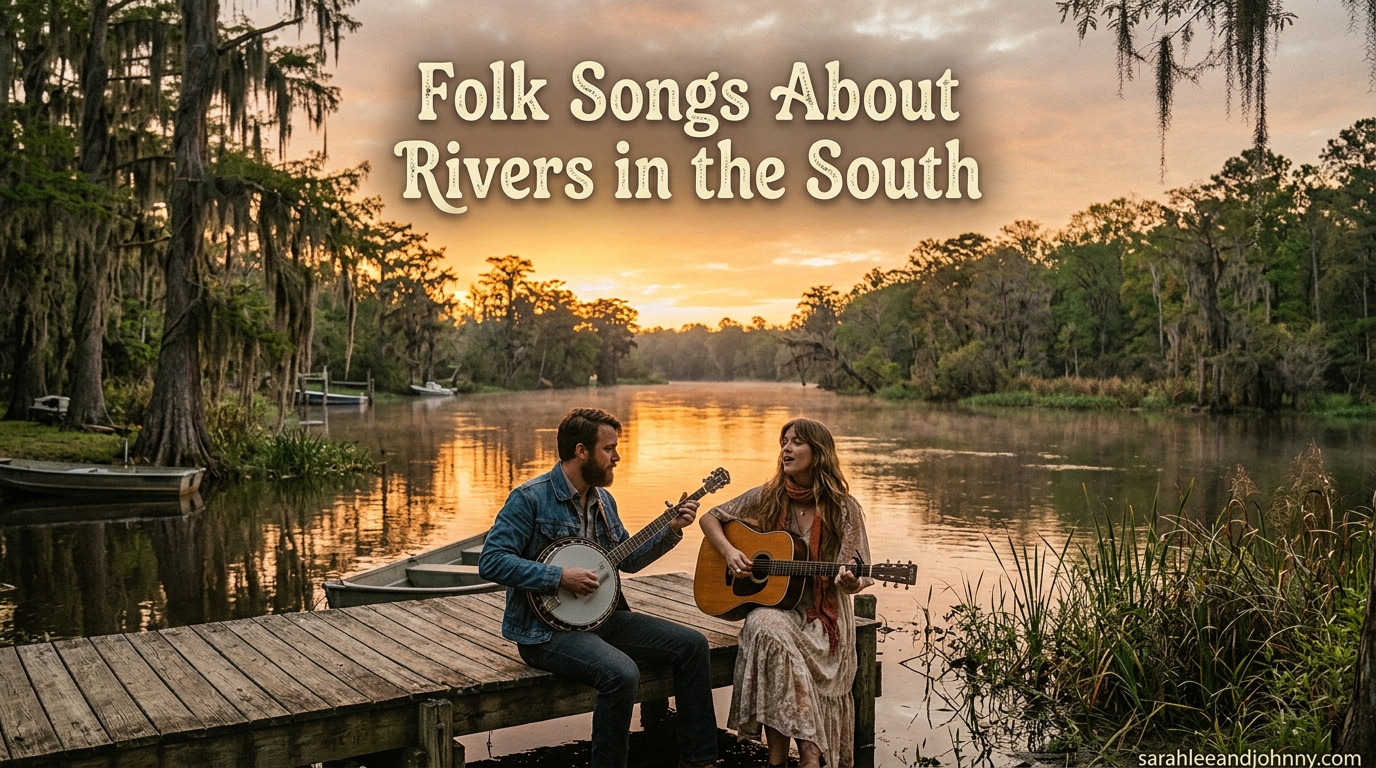
There is something about a southern river that has always pulled music out of people. Maybe it is the slow, patient way the water moves, or the way a current can sound like a rhythm section if you sit beside it long enough. For generations, musicians living along southern waterways have turned those rivers into songs, and those songs have become part of the fabric of American folk music. From the Mississippi Delta to the Appalachian hollows, folk songs about rivers in the South carry the weight of history, the ache of longing, and sometimes the quiet thrill of freedom just beyond the next bend.
I have spent years listening to these songs, tracing their origins, and trying to understand why rivers show up in southern folk music more than almost any other landscape feature. What I keep finding is that rivers were not just scenery for the people who wrote and sang these tunes. They were livelihoods, obstacles, borders, escape routes, and symbols all at once. A river could feed your family or carry you away from everything you knew. That kind of emotional weight naturally produces powerful songs.
This guide covers the most important folk songs about rivers in the South, including the stories behind them, the people who wrote or popularized them, and the cultural contexts that gave them life. Whether you are a musician looking to add traditional river songs to your repertoire, a teacher building a lesson on American folk music, or simply someone who loves a good song with history behind it, you will find what you need here.
Table of Contents
- Why Rivers Run Through Southern Folk Music
- Folk Songs About Rivers in the South: The Mississippi River Collection
- Old Folks at Home: The Suwannee River Song
- Oh Shenandoah: The River Ballad That Crossed America
- Red River Valley: A Song of Parting and Longing
- Appalachian River Songs and Mountain Streams
- Rivers and Freedom: Underground Railroad Songs
- Contemporary Southern Folk Artists and River Songs
- How to Explore Southern River Folk Songs
- FAQs
- Carrying the Song Forward
Why Rivers Run Through Southern Folk Music
Rivers shaped the American South in ways that go far beyond geography. Before highways and railroads, rivers were the highways. The Mississippi, the Ohio, the Tennessee, the Suwannee, the Red River, and dozens of smaller waterways served as the primary routes for moving goods, people, and ideas across the region. Towns grew up along riverbanks. Cultures mixed at river ports. And music traveled up and down those waterways, picking up influences from every community it passed through.
The steamboat era, which ran roughly from the 1810s through the late 1800s, turned rivers into floating entertainment venues. Musicians played on the decks of steamboats, blending folk traditions from different regions into new hybrid styles. Calliope organs blasted melodies that could be heard for miles. Deckhands sang work songs to coordinate their labor. Passengers brought songs from home and learned new ones on the journey. This constant musical exchange along southern rivers helped create the rich folk tradition we know today.
Rivers also carried a deeper symbolic meaning in southern folk songs. A river could represent the boundary between slavery and freedom, especially in spirituals sung by enslaved people. The Ohio River, in particular, marked the line between slave states and free states. Singing about crossing a river could mean dreaming of escape, mourning someone who left, or celebrating a journey completed. These layered meanings give southern river folk songs an emotional depth that keeps them relevant even now in 2026.
Folk Songs About Rivers in the South: The Mississippi River Collection
The Mississippi River may be the most musical river in the world. The National Park Service itself has said so, and when you look at the sheer number of folk songs, blues numbers, jazz standards, and country ballads inspired by the Mississippi, it is hard to argue. Folk songs about the Mississippi River stretch back to the early 1800s, and they cover every aspect of life along its banks.
One of the earliest and most enduring is “When It’s Moonlight on the Mississippi,” a song that captures the romantic ideal of the river that dominated 19th-century popular music. Composed during the tin pan alley era but rooted in folk tradition, this song painted the Mississippi as a place of beauty and nostalgia. People who had never seen the river sang about it because it had already become a mythic symbol of the American frontier.
Work songs from river laborers form another important strand of Mississippi River folk music. Men who loaded and unloaded barges, steered flatboats, and maintained levees sang to keep time and to make the brutal work bearable. These songs rarely had named composers. They belonged to the collective, shifting and evolving as they passed from one crew to the next. The call-and-response structure of many of these work songs directly influenced the development of the blues, which was born in the Mississippi Delta and spread up the river to Memphis, St. Louis, and Chicago.
The Mississippi River also features prominently in folk ballads about flooding. The Great Mississippi Flood of 1927 inspired numerous songs, both contemporary and retrospective, that treated the river as a powerful, destructive force beyond human control. These flood songs echoed older folk traditions in which rivers were characters in their own right, capable of both generosity and cruelty. Charley Patton’s “High Water Everywhere” stands as one of the most powerful folk responses to the 1927 flood, capturing the terror and displacement that the river brought to communities along its banks.
What makes Mississippi River folk songs distinctive is their range. The same river that inspired love songs and lullabies also inspired songs of loss, protest, and resilience. You can hear the full emotional spectrum of southern life in the folk songs written about the Mississippi, and that is why they remain central to any discussion of folk songs about rivers in the South.
Old Folks at Home: The Suwannee River Song
If there is one song that defines the connection between folk music and southern rivers, it is “Old Folks at Home,” also known as “Swanee River.” Written by Stephen Collins Foster in 1851, this song became one of the most famous American songs of the 19th century and remains one of the most recognizable folk songs about rivers in the South. Foster reportedly chose the Suwannee River because he liked the way the name sounded, having never actually visited the river in person. The Suwannee runs through Georgia and Florida, and at the time Foster wrote the song, it flowed through relatively remote, undeveloped territory.
The lyrics of “Old Folks at Home” tell the story of someone longing for their childhood home on the banks of the Suwannee. The narrator has wandered far from the river but dreams of returning to the place where they grew up. That theme of nostalgic longing for a specific place along a specific river struck a deep chord with American audiences, many of whom had themselves moved away from rural homes during the rapid urbanization of the 19th century.
In 1935, Florida adopted “Old Folks at Home” as its official state song, cementing the Suwannee River’s place in American cultural history. The song’s journey from a parlor composition to a state anthem reflects the way folk traditions absorb and repurpose material over time. Despite its composer’s urban, professional background, the song took on a life of its own in folk communities, who sang it around campfires, on porches, and at gatherings for decades.
It is impossible to discuss “Old Folks at Home” without acknowledging its origins in the minstrel show tradition. Foster wrote the song for a white performer in blackface, and the original lyrics contain dialect and racial language that are deeply offensive by today’s standards. In 2026, understanding this history is essential. The song carries both genuine musical beauty and a painful racial legacy. Some modern performances use revised lyrics that remove the offensive dialect while preserving the melody and the emotional core of the song. Florida considered replacing it as state song for this reason, eventually adopting a modified version alongside a new official song in 2008.
Despite its complicated history, “Old Folks at Home” remains one of the most important folk songs about rivers in the South because of the way it cemented the idea of a southern river as a symbol of home, memory, and belonging. Many later river songs echo its structure and sentiment, whether intentionally or not.
Oh Shenandoah: The River Ballad That Crossed America
“Oh Shenandoah” occupies a unique place among American folk songs about rivers. Its origins are uncertain, with scholars tracing it variously to fur traders in the early 1800s, Atlantic sea shanties, and Native American traditions. What is clear is that the song existed in oral tradition long before anyone wrote it down, and it evolved significantly as it passed from singer to singer across the country.
The Shenandoah River runs through Virginia and West Virginia, part of the Appalachian region that produced so much of America’s folk music heritage. The song’s lyrics describe a longing for the Shenandoah Valley and the Missouri River, blending two geographic references into a single expression of wanderlust and attachment. Some versions of the song tell the story of a trader who falls in love with the daughter of a Native American chief named Shenandoah. Others treat Shenandoah as purely a place, a rolling valley that the singer can never forget.
What makes “Oh Shenandoah” especially relevant to southern folk tradition is the way it captures the emotional pull of a specific landscape. Like “Old Folks at Home,” the song uses a river as a stand-in for home, for love, and for the parts of ourselves we leave behind when we move on. The melody has a gentle, flowing quality that mirrors the movement of water, which may be part of why it has endured for nearly two centuries.
The song has been recorded by countless artists across genres, from folk singers to classical orchestras to country performers. Each version emphasizes different aspects of the song’s character, but the river always remains at the center. In 2026, “Oh Shenandoah” is still taught in schools, performed at folk festivals, and sung around campfires, making it one of the most enduring folk songs about rivers in the American South and beyond.
Red River Valley: A Song of Parting and Longing
“Red River Valley” is one of those folk songs that feels like it has always existed. Its exact origins are debated, with some scholars tracing it to the Red River Valley along the Minnesota-North Dakota border and others linking it to the Red River that forms part of the border between Texas and Oklahoma. Regardless of which Red River inspired the song, it became deeply associated with southern and western folk tradition as it spread through oral tradition in the late 1800s.
The song tells the story of someone who is about to leave the Red River Valley, and the person they are leaving behind who begs them to stay. It is a parting song, a genre that runs through southern folk music like a thread. Rivers appear in parting songs because they represent both the distance that separates people and the connection that remains between them. Water flows onward, but the memory of the place lingers.
“Red River Valley” spread through the United States and Canada via cowboys, settlers, and soldiers who carried it from one community to the next. Each region adapted the lyrics to fit local geography, which is why you can find versions referencing valleys and rivers across the continent. The version most people know today was standardized in the early 20th century when sheet music publishers and early recording artists sought a definitive text. But in folk tradition, the song never had a single fixed form. That mutability is part of what makes it a genuine folk song rather than a composed popular song.
The melody is simple enough for anyone to sing, which is why “Red River Valley” has remained a staple of folk gatherings, school music programs, and campfire sing-alongs for well over a century. Its connection to southern river culture comes through its emotional honesty and the way it uses a river valley as shorthand for everything the singer is giving up by leaving.
Appalachian River Songs and Mountain Streams
The Appalachian region has its own rich tradition of river and stream songs that deserves attention alongside the better-known Mississippi and Suwannee material. While the big river songs tend to dominate discussions of folk songs about rivers in the South, the smaller mountain streams and rivers of Appalachia inspired a body of music that is equally powerful and, in some ways, more intimate.
Appalachian folk music developed in relative isolation compared to the commercially connected river highways of the Deep South. Mountain communities preserved older musical traditions, including English and Scots-Irish ballads that had been carried to America by early settlers. Many of these ballads featured rivers and streams as settings for stories of love, loss, and violence. Over generations, Appalachian musicians adapted these old-world songs to reflect the landscapes they actually lived in, replacing English rivers with Appalachian ones.
Songs like “The Cuckoo” and various fiddle tunes named after rivers and creeks reflect the mountain relationship with water. In Appalachia, rivers were not the vast commercial highways of the Mississippi Delta. They were obstacles to cross, sources of food, and boundaries between hollows and communities. The music reflects this different relationship. Appalachian river songs tend to be more personal and less grandiose than the big river ballads of the lowland South. They sing about creeks you can wade across and swimming holes where children play.
The distinction between Appalachian folk music and other forms of southern folk music matters here. Bluegrass, old-time, and Appalachian folk share roots but developed along different paths. Appalachian river songs often feature fiddle and banjo arrangements that give them a distinct sound compared to the guitar-based folk songs of the Mississippi Delta. Both traditions contribute to the larger body of folk songs about rivers in the South, and understanding their differences helps you appreciate the full range of this music.
Rivers and Freedom: Underground Railroad Songs
Some of the most powerful folk songs about rivers in the South are not celebrations of natural beauty at all. They are coded messages. Enslaved people in the American South used spirituals and folk songs to communicate plans for escape, and rivers appeared in these songs as both literal landmarks and symbols of the journey from bondage to freedom.
“Wade in the Water” is perhaps the most famous example. On the surface, the song draws from the biblical story of the Israelites crossing the Red Sea. But in the context of the Underground Railroad, the lyrics carried a practical double meaning. Escaping enslaved people were advised to wade in water to throw tracking dogs off their scent. The song spread through southern communities as both a worship song and a survival guide, its river imagery hiding a message of resistance and hope in plain sight.
The Ohio River plays a central role in many of these songs. It formed the border between slave states and free states, and for enslaved people in Kentucky, Virginia, and other border regions, reaching the Ohio River meant reaching the threshold of freedom. Songs that referenced crossing the river or reaching the other shore were understood by those in the know as references to this dangerous journey northward. Harriet Tubman herself reportedly used songs to signal when it was safe to move and which routes to take.
“Deep River” is another spiritual that uses river imagery to express the longing for freedom. The lyrics speak of crossing over into camp ground, which historians have interpreted as a reference to both the Promised Land and the Union Army camps that offered refuge to people escaping slavery. The river in this song is both a real geographic feature and a boundary between two entirely different lives.
Understanding these coded meanings transforms how we listen to southern river folk songs. What sounds like a simple spiritual about water may in fact be a carefully constructed map to freedom, preserved and passed down through song because it was too dangerous to write down in plain language. These songs represent some of the most courageous and creative uses of folk music in American history, and they remain an essential part of the story of folk songs about rivers in the South.
Contemporary Southern Folk Artists and River Songs
The tradition of writing and performing folk songs about rivers in the South did not end with the 19th century. Contemporary artists continue to draw on the imagery, themes, and musical traditions of southern river songs, keeping the genre alive while adding new perspectives and sounds. The folk revival movement of the 1960s brought renewed attention to traditional river songs, and modern artists have continued that momentum into 2026.
Artists like Rhiannon Giddens have reexamined traditional river songs with fresh ears, bringing attention to their African American roots and their connections to the experience of slavery and freedom. Her performances of songs like “Waterboy” and traditional spirituals highlight the deep well of meaning that river songs carry, connecting historical material to contemporary conversations about race, heritage, and American identity.
The environmental movement has also inspired a new wave of river songs in the southern folk tradition. As concerns about water quality, dam construction, and habitat loss have grown, folk musicians have responded with songs that treat southern rivers not just as romantic symbols but as threatened ecosystems that need protection. This environmental angle is relatively new in the tradition, and it adds a layer of urgency to a genre that has always been about the relationship between people and water.
Independent folk artists throughout the South continue to write songs about the rivers they grew up near, from the Tennessee River to the Black Warrior River in Alabama to the St. Johns River in Florida. These songs may not achieve the widespread fame of “Oh Shenandoah” or “Old Folks at Home,” but they carry the tradition forward in the same way those songs once did: by expressing real, lived experiences of life along southern waterways. If you explore contemporary folk playlists, you will find that the river is still very much present in southern songwriting.
How to Explore Southern River Folk Songs
If you want to dive deeper into folk songs about rivers in the South, there are several approaches that can enrich your experience. Listening to the songs is the obvious starting point, but knowing a bit about their history and context transforms a pleasant listening experience into something much more meaningful.
Start with the songs covered in this article. “Old Folks at Home,” “Oh Shenandoah,” “Red River Valley,” “Wade in the Water,” and “Deep River” form a solid foundation for understanding the range of southern river folk music. Seek out multiple versions of each song by different artists. You will be surprised how much the same song can change depending on who is performing it and what instruments they use. Folk music is a living tradition, and no single version of any song is the “correct” one.
For those interested in playing these songs yourself, many southern river folk songs use simple chord progressions that are accessible to beginner and intermediate musicians. “Red River Valley” can be played with three chords on guitar or banjo. “Oh Shenandoah” requires a bit more skill in terms of phrasing and dynamics but uses a straightforward harmonic structure. Sheet music and chord charts for most traditional southern river songs are widely available online, and learning to play them yourself connects you directly to the oral tradition that kept these songs alive for generations.
Consider exploring regional folk festivals in the South, where you can hear river songs performed in the landscapes that inspired them. The Suwannee River Jam in Florida, the Mississippi Delta Blues Festival, and various Appalachian folk festivals offer opportunities to experience this music in context. Hearing “Old Folks at Home” performed near the actual Suwannee River adds a layer of meaning that no recording can fully capture.
FAQs
What are some songs about rivers?
Some of the most well-known folk songs about rivers include “Oh Shenandoah,” “Old Folks at Home” (Swanee River), “Red River Valley,” “Shenandoah,” “Wade in the Water,” “Deep River,” “Moonlight on the Mississippi,” and “Roll On, Missouri.” These songs span multiple genres including folk, spirituals, and traditional ballads, and they represent rivers across the American South and beyond.
What is the song about the Suwannee River?
The most famous song about the Suwannee River is “Old Folks at Home,” also known as “Swanee River,” written by Stephen Foster in 1851. The song expresses longing for a childhood home on the banks of the Suwannee River in Florida. It became Florida’s official state song in 1935 and remains one of the most recognizable American folk songs. The song has a complicated history due to its origins in the minstrel show tradition.
What is the folk song about water?
One of the most famous folk songs about water is “Wade in the Water,” a traditional African American spiritual. While it draws on the biblical story of the Israelites crossing the Red Sea, it also served as a coded message for enslaved people escaping through the Underground Railroad. The water imagery in the song carried a practical instruction: wading in water helped escapees throw tracking dogs off their scent.
What is Mississippi’s state song?
Mississippi’s official state song is “Go, Mississippi,” adopted in 1962. However, when people ask about Mississippi’s musical heritage, they are often thinking of the many folk songs about the Mississippi River itself, including “Moonlight on the Mississippi” and various blues and work songs that originated along its banks. The Mississippi River has inspired more folk songs than perhaps any other American waterway.
What is the oldest folk song in the United States?
There is no single agreed-upon oldest folk song in the United States because folk songs existed in oral tradition long before anyone wrote them down. However, “Barbara Allen” is often cited as one of the oldest, with origins traced to England or Scotland in the 1600s and documented in America by the early 1700s. Among river-specific folk songs, “Oh Shenandoah” dates to at least the early 1800s and may be older, having circulated among fur traders and sailors before it was ever notated.
Carrying the Song Forward
Folk songs about rivers in the South are more than historical curiosities. They are living documents that record how generations of southerners understood their relationship with the land, with each other, and with the waterways that shaped their daily lives. From Stephen Foster’s polished “Old Folks at Home” to the anonymous spirituals of the Underground Railroad, these songs carry emotional truth that no amount of time can dilute.
What I find most remarkable about these songs is their persistence. People are still singing “Oh Shenandoah” and “Red River Valley” in 2026 for the same reasons they sang them in the 1800s: because the feelings they express are universal. We all know what it means to long for a place we cannot return to. We all understand the power of water to carry us somewhere new or to wash away what we thought we knew. Southern river folk songs give those feelings a voice, and that voice has never really gone quiet.
If you take one thing from this guide, let it be the encouragement to listen actively. Put on a recording of “Wade in the Water” and think about what it meant for someone to sing those words not as metaphor but as survival instructions. Play “Old Folks at Home” and consider the complicated history behind its beautiful melody. Sit with “Oh Shenandoah” and let yourself feel the pull of a place you may never have visited but somehow already know. The rivers are still there, and so are the songs. All you have to do is listen.