
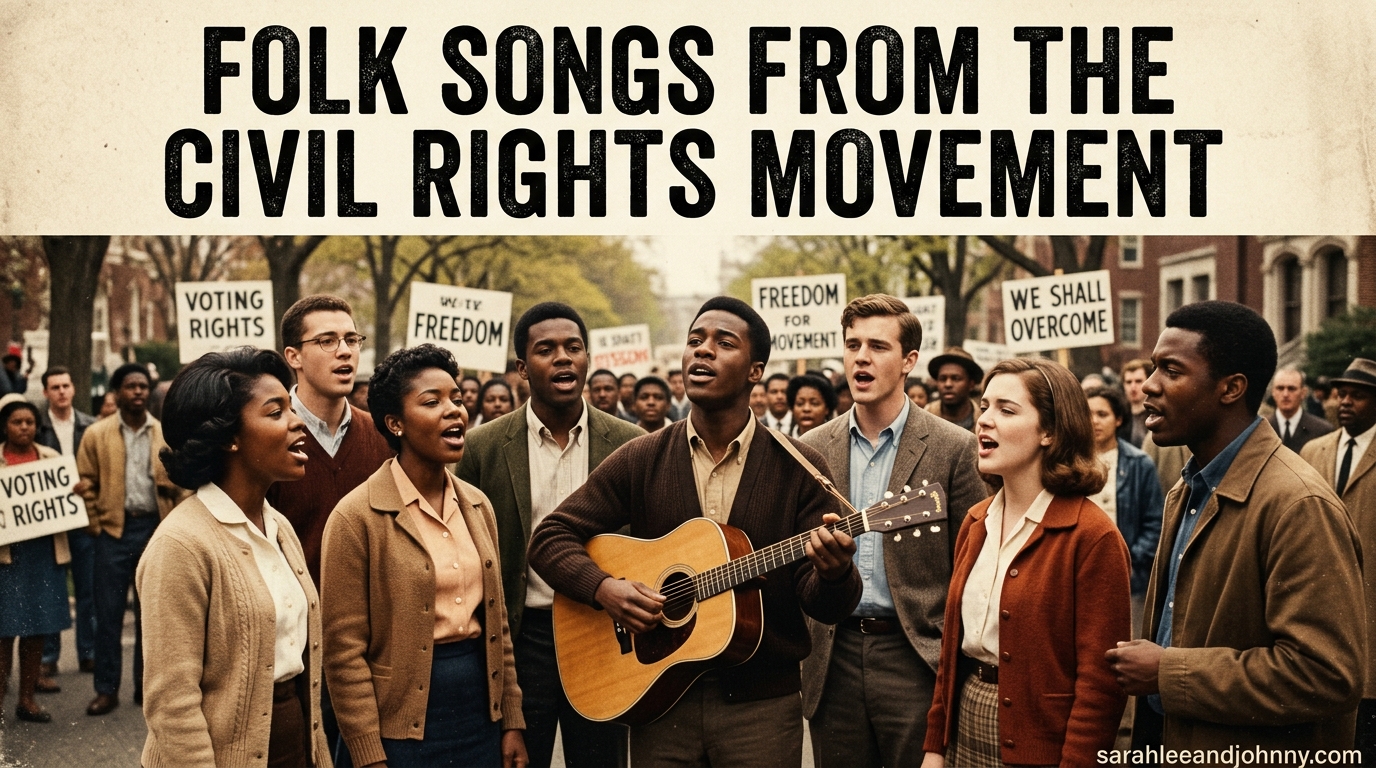
Music was the heartbeat of the American Civil Rights Movement, and folk songs from the civil rights movement gave activists something no speech could deliver on its own: a shared voice. When hundreds of marchers locked arms and sang “We Shall Overcome” as they crossed the Edmund Pettus Bridge in Selma, they were drawing on a tradition that stretched back through gospel hymns, labor union anthems, and centuries-old African American spirituals. These songs were not background music. They were tools of resistance, sources of courage, and the glue that held communities together during some of the hardest fights for justice in American history.
Our team has studied the recordings, historical accounts, and firsthand testimonies from movement participants to put together this guide. What we found goes far beyond a single anthem. The folk songs of this era ranged from reworked church hymns to original compositions by some of the most important musicians of the 20th century. Understanding these songs means understanding the movement itself.
In this article, we trace the origins of civil rights folk music, break down the essential songs every listener should know, spotlight the artists who carried this music into the streets, and explain how singing became one of the most effective forms of nonviolent protest in American history.
Table of Contents
The Roots of Civil Rights Folk Music
The folk songs from the civil rights movement did not appear out of thin air. They grew out of deep musical traditions that had sustained Black Americans through slavery, Reconstruction, and the long era of Jim Crow segregation. African American spirituals like “Oh Freedom” and “Wade in the Water” carried coded messages of liberation and hope long before the organized movement of the 1950s and 1960s. When civil rights activists needed songs, they reached into this well of shared musical memory and found material that was already meaningful to their communities.
Gospel music played an equally important role. The Black church was the central organizing institution of the Civil Rights Movement, and its musical traditions provided both the repertoire and the performance style that made civil rights songs so powerful. Call-and-response patterns, rhythmic hand-clapping, and the practice of group singing without instruments all carried directly from Sunday services into protest marches and jail cells. Dr. Martin Luther King Jr. himself recognized this connection, calling freedom songs “the soul of the movement” in a 1964 address to the Berlin Jazz Festival.
The Highlander Folk School in Monteagle, Tennessee became the critical bridge between these traditions and the organized movement. Founded in 1932 as a training center for labor organizers, Highlander began hosting civil rights workshops in the 1950s. Its cultural director, Zilphia Horton, collected folk songs and taught them to activists, adapting old hymns and labor songs to fit the specific struggles of the civil rights era. Horton is the person who first taught “We Shall Overcome” to Pete Seeger, who then carried it to audiences across the country. Without Highlander, many of the movement’s most important songs might never have reached the activists who needed them most.
The labor movement also contributed key songs and organizational practices. Songs like “We Shall Not Be Moved” and “Which Side Are You On?” had been sung in union halls and on picket lines for decades before civil rights activists adapted their lyrics and carried them into a new fight. This overlap made sense: many early civil rights leaders, including Bayard Rustin and James Lawson, had been trained in nonviolent resistance through labor and pacifist organizations. They understood from experience that singing together builds solidarity faster than almost anything else.
The Student Nonviolent Coordinating Committee, known as SNCC, took this musical strategy further than any other organization. SNCC members composed new freedom songs on the spot during sit-ins, freedom rides, and voter registration campaigns. They adapted familiar hymn tunes with new lyrics that addressed immediate situations, creating what scholar Bernice Johnson Reagon called a “singing movement.” Reagon, who joined SNCC as a college student, later became one of the foremost historians of this musical tradition, founding the a cappella ensemble Sweet Honey in the Rock to keep these songs alive.
We Shall Overcome: The Anthem of the Movement
“We Shall Overcome” is the single most important folk song from the civil rights movement, and its journey to that status spans more than half a century. The song traces its roots to a hymn called “I’ll Overcome Someday,” written by Philadelphia minister Charles Albert Tindley and published in 1901. Tindley’s hymn was a standard in Black churches for decades, but it was slow and hymn-like, very different from the stirring protest anthem it would become.
The transformation began in the 1940s, when Black tobacco workers at the American Tobacco Company in Charleston, South Carolina, adapted the hymn during a labor strike. They changed “I will overcome” to “We will overcome,” shifting the song from a personal declaration to a collective one. Zilphia Horton learned the song from these workers and brought it to the Highlander Folk School, where she taught it to visiting activists and modified the lyrics further.
Pete Seeger encountered the song at Highlander and made one crucial change: he replaced “We will” with “We shall,” which gave the line a more rhythmic, march-friendly cadence. Seeger began performing the song at concerts and rallies across the country, publishing it in his newsletter and teaching it to audiences everywhere he went. By the late 1950s, it had become a staple of civil rights gatherings.
The song reached its most iconic moment on August 28, 1963, at the March on Washington for Jobs and Freedom. As the crowd of over 200,000 people gathered at the Lincoln Memorial, Joan Baez led a performance of “We Shall Overcome” that was broadcast to millions of television viewers. Later that same year, folksinger Guy Carawan taught the song at a conference at Highlander, and from there it spread to virtually every civil rights organization in the country.
President Lyndon B. Johnson surprised the nation on March 15, 1965, when he concluded a televised address to Congress with the words “We shall overcome,” using the movement’s own anthem to argue for the Voting Rights Act. It was a remarkable moment: a sitting president had adopted the language of protest singers and march organizers to demand federal legislation. The Voting Rights Act became law later that year.
During the Selma to Montgomery marches in March 1965, marchers sang “We Shall Overcome” as they walked, as they faced state troopers, and as they rested at campsites along the route. The song had become more than music. It was a statement of identity, a declaration of resolve, and a source of comfort during the most dangerous moments of the movement.
Essential Folk Songs From the Civil Rights Movement
While “We Shall Overcome” stands as the movement’s defining anthem, dozens of other folk songs powered the civil rights struggle. Here are the essential songs that every listener, student, and musician should know.
Blowin’ in the Wind (Bob Dylan, 1962)
Bob Dylan wrote “Blowin’ in the Wind” in April 1962, and it quickly became one of the most sung songs of the movement despite its abstract lyrics. The song posed nine rhetorical questions about freedom, war, and equality, and its simple melody made it easy for crowds to sing together. Peter, Paul and Mary’s version became a top-10 hit, bringing civil rights themes to mainstream audiences who might never have attended a rally. Dylan performed the song at voter registration drives in Mississippi, and movement leaders embraced it as a powerful tool for reaching white allies who were not yet engaged with the cause.
A Change Is Gonna Come (Sam Cooke, 1964)
Sam Cooke wrote “A Change Is Gonna Come” after hearing Dylan’s “Blowin’ in the Wind” and feeling moved that a white songwriter could express the struggle for equality so effectively. Cooke’s response was deeply personal, drawing on his own experiences with racism, including being turned away from a whites-only motel in Louisiana. Released as a single in December 1964, just days after Cooke’s death, the song became an anthem of hope and resilience. Its sweeping orchestral arrangement and Cooke’s extraordinary vocal performance made it a centerpiece of the movement’s emotional life. The song captured the feeling that change was not just possible but inevitable, a message activists desperately needed during the most difficult campaigns.
Keep Your Eyes on the Prize
“Keep Your Eyes on the Prize” adapted the melody and structure of the old gospel song “Keep Your Hand on the Plow” and refitted it with lyrics about the civil rights struggle. The song became a favorite at mass meetings and training sessions because it was easy to learn, easy to sing in large groups, and carried a clear message about persistence in the face of oppression. Alice Wine, a South Carolina activist, is credited with adapting the lyrics, and the song spread rapidly through SNCC networks. Each verse addressed a different moment in the movement, from the Montgomery bus boycott to the freedom rides, making the song a living record of the struggle as it unfolded.
Oh Freedom
“Oh Freedom” has one of the deepest historical lineages of any civil rights song. It dates to the post-Civil War period, when newly emancipated Black Americans sang it as a declaration of liberation. The song’s stark opening line, “Oh freedom, oh freedom, oh freedom over me,” carried a weight that resonated across nearly a century of Jim Crow oppression. Civil rights activists revived the song during the 1950s and 1960s, and it became especially associated with the 1963 Birmingham Campaign, where children sang it as they marched into fire hoses and police dogs. Joan Baez performed “Oh Freedom” at the March on Washington, bringing the song to its largest audience ever.
This Little Light of Mine
“This Little Light of Mine” began as a children’s gospel song, written by Harry Dixon Loes in the 1920s. Civil rights activists transformed it into a protest anthem by adding verses about specific movement events and singing it during marches, sit-ins, and jail protests. The song’s simplicity was its strength: even the youngest participants could sing it, and its message of refusing to hide your conviction fit perfectly with the movement’s philosophy of visible, nonviolent resistance. Fannie Lou Hamer, the Mississippi voting rights activist, often led crowds in singing “This Little Light of Mine” during some of the movement’s most dangerous moments, including the 1964 Freedom Summer campaign.
We Shall Not Be Moved
“We Shall Not Be Moved” came directly from the labor movement, where it had been sung on picket lines since at least the 1930s. Civil rights activists adapted the lyrics to reflect their own struggles, changing verses to reference specific campaigns and organizations. The song was especially popular during sit-ins, where activists would sing it while seated at segregated lunch counters, physically refusing to move. Its steady, determined rhythm and repetitive structure made it ideal for these situations, where singing had to serve as both morale booster and statement of defiance. The Congress of Racial Equality used the song extensively during its early campaigns, and it became a standard at freedom rider gatherings.
Ain’t Gonna Let Nobody Turn Me Around
“Ain’t Gonna Let Nobody Turn Me Around” was a SNCC favorite that exemplified the movement’s tradition of adapting existing spirituals for new purposes. The melody came from an old spiritual, but SNCC members added verses naming specific obstacles: segregationists, police chiefs, jail cells, and even death threats. The song was designed to be modified on the spot, with singers calling out new verses in a call-and-response pattern that kept the song relevant to whatever situation they faced. This improvisational quality made it one of the most versatile songs in the movement’s repertoire. It was sung during the freedom rides, the Albany Movement, and in jail cells across the South where arrested activists waited for bail.
Key Artists Who Shaped the Movement’s Music
The folk songs from the civil rights movement were carried into history by a remarkable group of musicians. Some were professional performers who used their platforms to support the cause. Others were activists who sang as an organizing tool. Many were women whose contributions have been historically underrecognized.
Pete Seeger: The Bridge Between Movements
Pete Seeger was perhaps the single most important musical figure in the civil rights era, even though he was not a civil rights activist in the traditional sense. Seeger had been singing protest songs since the 1940s, first with the labor movement and then with the folk revival. His role in popularizing “We Shall Overcome” was critical: he performed it at concerts, published its lyrics and chords in his magazine Broadside, and taught it to other musicians who carried it further. Seeger also performed at benefit concerts for civil rights organizations and marched alongside activists in Selma. His ability to connect the folk music tradition to the civil rights struggle gave the movement access to a national audience of folk music fans who might otherwise have remained uninvolved.
Joan Baez: The Voice of Nonviolent Protest
Joan Baez was already a major recording artist when she committed herself fully to the civil rights movement. She performed at the March on Washington, singing “We Shall Overcome” to the crowd of 250,000, and later joined the march from Selma to Montgomery. Baez’s crystalline soprano voice and her commitment to nonviolent philosophy made her one of the movement’s most visible musical ambassadors. She refused to perform in segregated venues, a stance that cost her lucrative touring opportunities in the South. Baez also helped introduce Bob Dylan’s protest songs to her substantial audience, amplifying their reach during the critical early years of the movement.
Odetta: The Voice of the Civil Rights Movement
Time magazine once called Odetta “the queen of American folk music,” and Martin Luther King Jr. reportedly called her the queen of the civil rights movement. Odetta Holmes, known professionally by her first name, was a classically trained singer who channeled her extraordinary voice into folk music and spirituals. Her 1956 album Odetta Sings Ballads and Blues influenced an entire generation of folk singers, including Dylan and Baez. Odetta performed at the March on Washington and at countless rallies and fundraisers throughout the movement. Her renditions of songs like “Oh Freedom” and “Waterboy” brought the power of African American musical traditions to integrated audiences, making the cultural case for equality alongside the political one.
Nina Simone: Artistic Courage Under Fire
Nina Simone was not a folk singer in the traditional sense, but her contributions to the music of the civil rights era were profound. In 1963, after the bombing of the 16th Street Baptist Church in Birmingham, Alabama, which killed four Black girls, Simone wrote “Mississippi Goddam” in a burst of fury and grief. The song was a direct, unsparing condemnation of racial violence and the slow pace of change, and it was banned in several Southern states. Simone performed the song at concerts across the country and at the Selma to Montgomery marches, risking her career and her safety. Her willingness to put her anger into music inspired other artists to take stronger political stands.
Bernice Johnson Reagon: The Scholar-Activist
Bernice Johnson Reagon joined SNCC as a student at Albany State College in Georgia and became one of the movement’s most important musical figures. As a member of the SNCC Freedom Singers, she traveled the country performing freedom songs at concerts and rallies, raising money and awareness for the movement. Reagon later earned a doctorate and became a historian of African American music, founding the Grammy-winning ensemble Sweet Honey in the Rock in 1973. Her scholarly work documented how songs were created, adapted, and transmitted within the movement, preserving a musical tradition that might otherwise have been lost. Reagon’s dual role as performer and historian makes her the single most authoritative voice on the folk songs of the civil rights era.
Guy Carawan: The Song Teacher
Guy Carawan succeeded Zilphia Horton as cultural director of the Highlander Folk School after Horton’s death in 1956, and he played a crucial role in teaching freedom songs to a generation of activists. Carawan organized singing workshops at Highlander and at civil rights conferences across the South, teaching participants not just the melodies and lyrics but the practice of group singing as a tool of nonviolent resistance. He compiled and published songbooks that were distributed throughout the movement, creating a standardized repertoire that allowed activists from different cities and organizations to sing the same songs together when they met at national events. Without Carawan’s organizational work, the movement’s singing tradition would have been far more fragmented and far less effective.
How Music Powered the Civil Rights Movement
Understanding folk songs from the civil rights movement means understanding what the music actually did during protests, marches, and organizing campaigns. The songs served several practical functions that went far beyond entertainment.
Building Courage in Dangerous Moments
Singing gave activists psychological strength in situations where they faced physical danger. When Freedom Riders boarded buses heading into the Deep South in 1961, they sang to manage their fear. When marchers in Selma faced state troopers with billy clubs and tear gas at the Edmund Pettus Bridge on Bloody Sunday, they were singing. When children in Birmingham marched out of the 16th Street Baptist Church toward fire hoses and police dogs in 1963, they were singing. The act of making music together transformed individual terror into collective resolve. As Bernice Johnson Reagon explained, “When you sing, you are not alone. You are part of a community, and that community gives you strength.”
Creating Unity Among Strangers
Civil rights campaigns brought together people from different cities, backgrounds, and organizations. Mass meetings might include local church members alongside college students from the North, labor organizers from the Midwest, and religious leaders from across the country. Singing together was the fastest way to turn these diverse groups into a unified body. Songs functioned as a kind of social glue: once you had sung “We Shall Overcome” arm in arm with strangers, those strangers became comrades. This unity was essential for nonviolent discipline, because protesters who felt connected to each other were more likely to maintain their commitment to nonviolence under pressure.
Communicating the Message
Folk songs served as vehicles for the movement’s political message, reaching audiences who might not read pamphlets or attend speeches. A song like “Blowin’ in the Wind” could communicate the moral absurdity of segregation in three minutes more effectively than a lecture could in an hour. When the SNCC Freedom Singers performed at concerts across the country, they were raising money for the movement but also educating predominantly white audiences about conditions in the South. The music made the abstract concrete: hearing “Oh Freedom” performed by someone who had been jailed for trying to register to vote carried an emotional force that no amount of written reporting could match.
Sustaining Morale in Jail
One of the most remarkable aspects of the movement’s musical tradition was jail singing. When activists were arrested during protests, they continued singing from their cells, often through the night. This practice served multiple purposes: it communicated between cells, letting arrested activists know they were not alone; it annoyed jailers, asserting the prisoners’ humanity and refusal to be silenced; and it maintained morale during what could be days or weeks of incarceration. Accounts from the Hinds County jail in Mississippi describe activists singing freedom songs for hours, with the sound carrying through the cell blocks and into the street, where supporters gathered to listen. The Stanford-based Martin Luther King Jr. Institute has collected extensive oral histories documenting this practice.
Training and Preparation
Before any major action, activists gathered in mass meetings and training sessions where singing was a central activity. These sessions served a dual purpose: organizers taught practical skills like how to protect yourself during a beating, and they taught the songs that would be sung during the action. The singing served as rehearsal for the protest itself, but it also functioned as a bonding ritual that strengthened participants’ commitment. Martin Luther King Jr. often spoke about how the singing at mass meetings transformed uncertain volunteers into determined marchers. The music was, in his words, preparation of the spirit as well as the body.
The Lasting Legacy of Civil Rights Folk Songs
The folk songs from the civil rights movement did not fade into history when the major legislative victories of the 1960s were won. They became part of the permanent repertoire of American protest music, resurfacing in every major social movement that followed. The songs were sung during the anti-apartheid movement of the 1980s, at LGBTQ rights rallies, and during the Black Lives Matter protests of the 2010s and 2020s. “We Shall Overcome” has been translated into dozens of languages and sung at protests on every continent, making it arguably the most widely known protest song in the world.
Contemporary artists continue to draw on this tradition. Musicians working in gospel, folk, hip-hop, and soul have all cited the civil rights songbook as a major influence on their approach to socially conscious music. The practice of adapting old songs to new struggles continues as well: protest movements in 2026 still modify the lyrics and melodies of 1960s freedom songs to address current issues, proving that this musical tradition remains alive and adaptable.
For educators and community organizers, these songs remain practical tools. Group singing builds community in classrooms, churches, and organizing meetings in the same way it did during the movement. Teaching young people to sing “This Little Light of Mine” or “Keep Your Eyes on the Prize” connects them to a tradition of resistance and hope that stretches back generations. The folk songs from the civil rights movement are not museum pieces. They are living music that continues to serve the purpose for which they were adapted: giving people the courage to stand together and demand justice.
FAQs
What are the folk songs for civil rights?
The most important folk songs from the civil rights movement include We Shall Overcome, Blowin’ in the Wind, A Change Is Gonna Come, Keep Your Eyes on the Prize, Oh Freedom, This Little Light of Mine, We Shall Not Be Moved, and Ain’t Gonna Let Nobody Turn Me Around. These songs were adapted from African American spirituals, gospel hymns, and labor union anthems, and were sung at marches, sit-ins, jail protests, and mass meetings throughout the 1950s and 1960s.
What famous folk song became an anthem of the Civil Rights Movement?
We Shall Overcome became the defining anthem of the Civil Rights Movement. Originally based on Charles Albert Tindley’s 1901 hymn I’ll Overcome Someday, it was adapted by Black tobacco workers in the 1940s, popularized by Pete Seeger at the Highlander Folk School, and sung at virtually every major civil rights event, including the 1963 March on Washington and the 1965 Selma to Montgomery marches.
What was the most famous song of the Civil Rights Movement?
We Shall Overcome was the most famous song of the Civil Rights Movement, recognized universally as the movement’s unofficial anthem. It was sung at the March on Washington, during the Selma marches, and in jail cells across the South. President Lyndon B. Johnson even quoted its title during his 1965 address to Congress advocating for the Voting Rights Act.
How did folk music influence the Civil Rights Movement?
Folk music influenced the Civil Rights Movement in five key ways: it gave activists psychological courage during dangerous protests, created unity among diverse groups of marchers, communicated the movement’s message to wider audiences, sustained morale during jail incarcerations, and served as a training tool at mass meetings and organizing sessions. Dr. Martin Luther King Jr. called freedom songs the soul of the movement, recognizing that singing transformed individual fear into collective strength.
Who was the folk singer of the Civil Rights Movement?
There was no single folk singer of the Civil Rights Movement, but Pete Seeger is generally considered the most influential. Seeger popularized We Shall Overcome, performed at civil rights rallies and benefit concerts, and taught freedom songs to activists at the Highlander Folk School. Other essential musical figures included Joan Baez, Odetta, Nina Simone, Guy Carawan, and Bernice Johnson Reagon, each of whom contributed in distinct ways to the movement’s musical identity.
The folk songs from the civil rights movement represent one of the most powerful intersections of art and activism in American history. These songs took the deepest traditions of African American music and sharpened them into tools of resistance that helped dismantle legal segregation in the United States. From “We Shall Overcome” at the March on Washington to freedom songs echoing through southern jail cells, this music gave the movement its voice. I encourage you to seek out the original recordings by Odetta, Joan Baez, Pete Seeger, Bernice Johnson Reagon, and the SNCC Freedom Singers. Listening to these performances, recorded in the heat of the struggle, conveys an emotional truth that no written description can fully capture. These songs are not just history. They are a living tradition that continues to inspire movements for justice around the world, and understanding them is essential for anyone who cares about the power of music to change the world.