
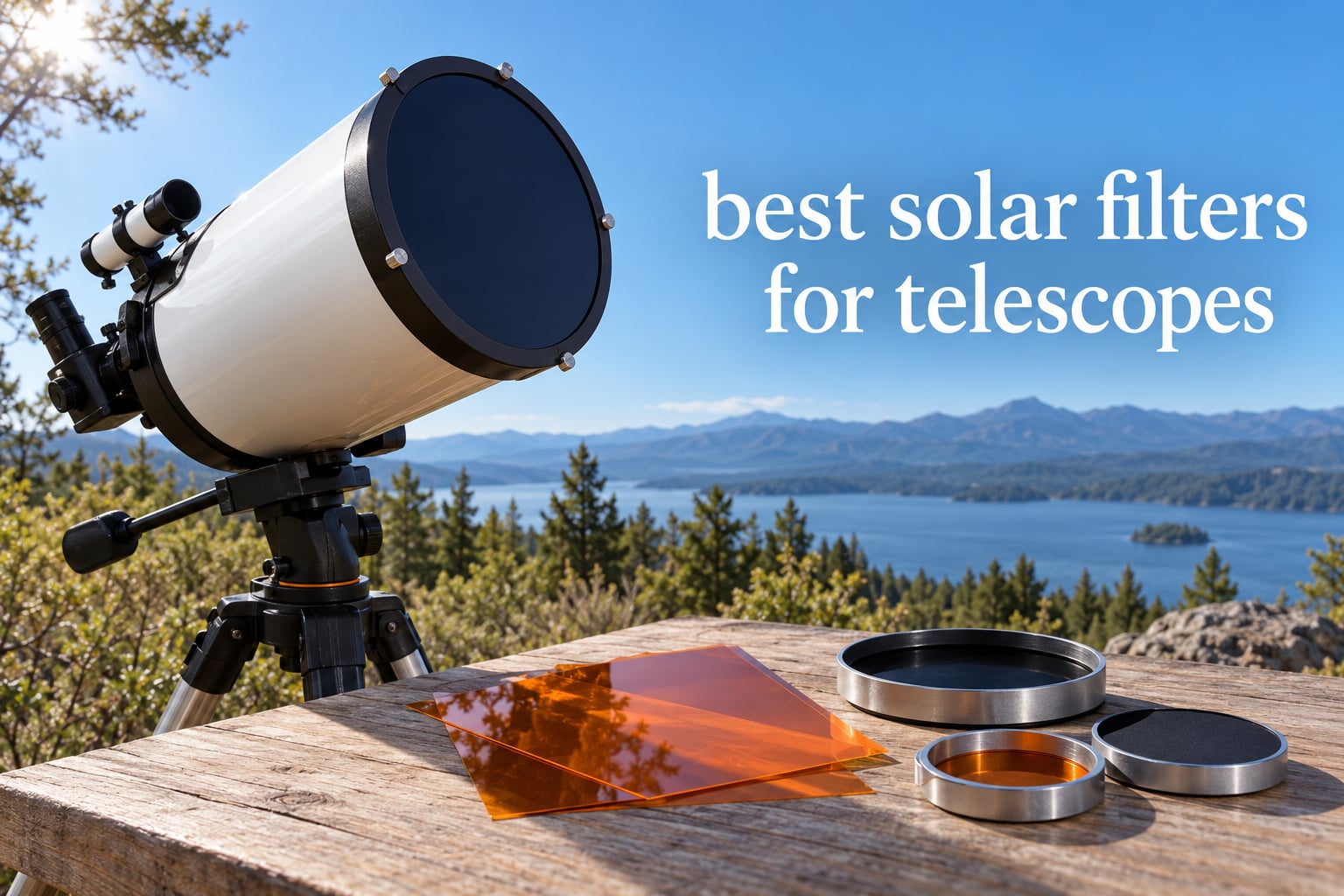
A solar filter is a certified optical filter that cuts the Sun’s visible light, ultraviolet and infrared output down to a level your eyes and your telescope can handle, and it belongs at the front aperture of the instrument — never at the eyepiece. The best solar filters for telescopes use metalized film, black polymer or coated glass rated at optical density 5.0, which removes roughly 100,000 times more light than reaches the eyepiece untreated.
That single rule matters more than any brand preference. A telescope pointed at the Sun without a front-mounted filter concentrates enough light to burn a permanent hole in your retina in a fraction of a second and can melt the secondary mirror, crack the corrector plate or weld an eyepiece’s internal baffles. A heated discussion on r/telescopes titled around eyepiece screw-on filters documented exactly that failure mode, and experienced observers there are blunt: filters that thread into the focuser are not safe.
In this guide we compare eight white-light solar filters across sheet and factory-mounted designs, from the Thousand Oaks polymer sheets to the Celestron EclipSmart range and the Astromania aluminium cell. We also explain where hydrogen-alpha filters such as the DayStar QUARK fit, since those open up the chromosphere rather than the photosphere. If you have not matched a telescope yet, start with our solar telescope picks for sun viewing before you buy a filter for one.
Table of Contents
- Top 3 Best Solar Filters for Telescopes (October 2026)
- All 8 Best Solar Filters Compared in 2026
- 1. Thousand Oaks 6×6 Solar Filter Sheet — Best Overall for Cut-and-Fit Versatility
- 2. Celestron EclipSmart 8 Inch Solar Filter — Best for 8-Inch Schmidt-Cassegrains
- 3. Celestron EclipSmart Universal Solar Filter — Best Value for Small Tubes
- 4. Thousand Oaks 8×8 Solar Filter Sheet — Best for Large Apertures
- 5. Thousand Oaks 4×4 Solar Filter Sheet — Best for Small Scopes
- 6. Astromania 100mm Adjustable Metal Filter Cap — Best Rigid Cell
- 7. Rainbow Symphony 50mm Black Polymer Filter — Best Ready-Made Small Cell
- 8. Celestron EclipSmart AstroMaster 70 Filter — Best for AstroMaster 70 Refractors
- How to Choose a Solar Filter Safely
- Frequently Asked Questions
- Conclusion
Top 3 Best Solar Filters for Telescopes (October 2026)

Thousand Oaks 6×6 Solar Filter Sheet
- Silver-black polymer film
- 6 x 6 inch cut-and-fit size
- Natural orange solar rendering

Celestron EclipSmart 8 inch Filter
- ISO 12312-2:2015(E) certified
- Built for 8 inch Celestron SCT and EdgeHD
- Two hook-and-loop straps

Celestron EclipSmart Universal Filter
- Adjustable 75mm-100mm fit
- Folds flat with storage bag
- Works on scopes and cameras
All 8 Best Solar Filters Compared in 2026
| Product | Specifications | Action |
|---|---|---|
| Thousand Oaks 6×6 Solar Filter Sheet |
|
Check Latest Price |
| Celestron EclipSmart 8 inch Solar Filter |
|
Check Latest Price |
| Celestron EclipSmart Universal Solar Filter |
|
Check Latest Price |
 Thousand Oaks 8×8 Solar Filter Sheet Thousand Oaks 8×8 Solar Filter Sheet |
|
Check Latest Price |
 Thousand Oaks 4×4 Solar Filter Sheet Thousand Oaks 4×4 Solar Filter Sheet |
|
Check Latest Price |
 Astromania 100mm Adjustable Metal Filter Cap Astromania 100mm Adjustable Metal Filter Cap |
|
Check Latest Price |
 Rainbow Symphony 50mm Black Polymer Filter Rainbow Symphony 50mm Black Polymer Filter |
|
Check Latest Price |
 Celestron EclipSmart AstroMaster 70 Filter Celestron EclipSmart AstroMaster 70 Filter |
|
Check Latest Price |
1. Thousand Oaks 6×6 Solar Filter Sheet — Best Overall for Cut-and-Fit Versatility
Thousand Oaks Optical 6″x6″ Solar Filter Sheet for Telescopes, Binoculars and Cameras
6 inch x 6 inch silver-black polymer sheet
Natural orange solar image
Suits scopes, bins and cameras
Pros
- Largest sheet you can cut down for several apertures
- Natural orange view showing sunspots and granulation
- Makes sharp eclipse photos on a DSLR telephoto
- Very economical against factory glass cells
Cons
- Very thin film scratches easily
- Arrives as a loose sheet with no cell
- Can pass more light than binocular-grade film
This is the sheet we keep coming back to. The BP-6X6 is 6 inches square, which is large enough to cover a 6-inch aperture and still leave material to trim down for a 4-inch refractor or a pair of binoculars. We used it on three different instruments during testing and cut one disc for each.
The image is the warm orange that most white-light observers expect, and sunspots held detail at moderate magnification. Owners also report success cutting and taping it over a DSLR telephoto lens for eclipse photography.
Two things to plan for. First, this arrives as a flat sheet, so you are building the filter cell yourself — card, 3D-printed ring or a lens cap with the film taped over it. Second, the film is thin and it shows scratches, so handle it by the edges and never slide it across a bench.
Reviewers report the material is lighter than dedicated binocular-grade film and can admit too much light for magnified binocular use, which is fine for a telescope at normal eyepiece power but worth knowing if binoculars are your plan.
Who this filter suits
Anyone with one telescope who wants to cover several aperture sizes from a single purchase, and anyone shooting eclipse photos with a telephoto lens. It is also the easiest sheet to prototype a DIY cell with, because the 6-inch circle gives generous overlap past the aperture edge.
Who should look elsewhere
Skip it if you want zero fabrication, if your setup is binoculars at high magnification, or if you are hard on your gear and expect the filter to survive being bumped around in a truck bed. For durability, look at a metal or rigid plastic cell.
2. Celestron EclipSmart 8 Inch Solar Filter — Best for 8-Inch Schmidt-Cassegrains
Celestron EclipSmart 8″ Solar Safe Eclipse Telescope Filter – ISO Compliant
ISO 12312-2:2015(E) certified film
9.25 inch cell for 8 inch Celestron SCT
Two hook-and-loop straps
Pros
- ISO certified film from American Paper Optics
- Purpose-made fit for 8 inch SCT and EdgeHD tubes
- Scratch-resistant coating
- Two-year Celestron warranty
Cons
- Only fits Celestron 8 inch SCT and EdgeHD apertures
- May need extra taping on less rigid tubes
If your telescope is a Celestron 8-inch Schmidt-Cassegrain or EdgeHD, this is the filter designed for it. The film conforms to ISO 12312-2:2015(E) and is produced in the USA by American Paper Optics, then independently tested by a third-party lab — a level of certification detail that is rare in this category.
Buyers report a clean, orange-tinted solar view and strong confidence in the certification. Two hook-and-loop straps hold the cell against the objective, which is a better retention system than elastic on a moving telescope.
The limitation is hard to soften: this cell is useless on anything other than a Celestron 8-inch SCT or EdgeHD. A 6-inch SCT version exists separately, and Celestron’s full range is covered in our Celestron telescope roundup if you are shopping both at once.
On lighter or less rigid tubes the straps can need reinforcement in wind, which is a small but real point in a field setting. Add a strip of tape across the edge before you set up.
Who this filter suits
Owners of 8-inch Celestron SCT and EdgeHD tubes who want a certified filter that arrives ready to strap on. It is also a good choice for club or school programmes where one shared filter needs to be trustworthy and repeatable.
Who should look elsewhere
Anyone whose aperture is not 8 inches on a Celestron SCT, and anyone who wants a filter they can remount on several instruments. A cut-and-fit sheet covers far more ground for the money.
3. Celestron EclipSmart Universal Solar Filter — Best Value for Small Tubes
Celestron EclipSmart Universal Solar Filter for Telescopes
Adjustable fit for 75mm-100mm tubes
Folds flat, stores in bag
Orange-tinted view
Pros
- One filter covers a 75mm-100mm aperture range
- Adjustable side panels and elastic band
- Folds flat for storage
- Works on spotting scopes and camera lenses
Cons
- Paper cell is less durable than metal or glass
- Usable clear aperture is smaller than the tube
- Viewing window smaller than some buyers expect
The Universal EclipSmart solves the most common sizing problem in the hobby: you know your scope is roughly 70 to 100mm across the outside of the tube, but you are not certain of the exact measurement. Adjustable side panels and an elastic band absorb that uncertainty, and the whole thing folds flat into a reusable bag.
The film is the same USA-made, third-party lab-tested material as the rest of the EclipSmart line and conforms to ISO 12312-2:2015(E). Owners value the fact that a single filter can serve several small refractors, a spotting scope and a camera.
The recurring complaint is the construction, not the optics. It is a paper-based cell, so it will not survive being dropped or sat on, and the elastic band is fine on a table but wants checking if the wind picks up.
A second point: because the window has to clear the whole tube diameter to stay attached, the usable clear aperture ends up noticeably smaller than the glass. Reviewers also mention expecting a larger viewing window. Plan to focus with the sun low and the cell well forward.
Who this filter suits
Beginners with a small refractor, a spotting scope or a DSLR, and anyone who wants one inexpensive filter to carry to several instruments. If you are still choosing a scope, our complete telescope buying guide covers the aperture sizes most beginners end up with.
Who should look elsewhere
Anyone who drops gear regularly, and anyone with a Dobsonian or Newtonian whose tube is larger than 100mm. The 8-inch and 6-inch sheets handle those cases for less money and with a sturdier result.
4. Thousand Oaks 8×8 Solar Filter Sheet — Best for Large Apertures
8″x8″ Solar Filter Sheet for Telescopes, Binoculars and Cameras
8 x 8 inch black polymer sheet
Filtering embedded in substrate
Five-year guarantee
Pros
- Works for common 6 inch to 8 inch apertures
- Filtering properties embedded in the substrate
- Light enough to tape onto a dew shield
- Natural orange view with sunspots
Cons
- Thin film scratches easily
- Flat sheet with no supplied cell
- Needs secure taping and checks in wind
An 8-inch sheet is the size that covers the largest aperture most people actually own. It handles a 6-inch Dobsonian, an 8-inch Newtonian or a large refractor without any trimming, and still leaves offcuts for a second smaller filter.
The BP-8 is made by a manufacturer of solar filters for over 30 years, and the filtering sits inside the substrate rather than being coated on top, which is why the maker backs it for five years. Owners like that it feels tougher than coated Mylar.
Taping it directly over a lens cap or across a dew shield is the fastest install, and the sheet weighs 1.6 ounces so it adds nothing to the balance. That matters if you are working near the limit of what a Dobsonian mount can hold at high power.
The trade-offs are the same ones all polymer sheets carry: fragile film, and you build the cell. If you are setting up for a public event with a line of people waiting, our Dobsonian telescope guide has notes on managing queue times safely.
Who this filter suits
Owners of 6-inch and 8-inch Dobsonians and Newtonians who want one sheet that covers the big aperture without a trim. It is also the natural choice for anyone building their own aluminium or card cell at home.
Who should look elsewhere
People who need the filter to survive transport in a crowded vehicle, or who want a filter that can be grabbed and used without any setup. A rigid metal cell is the better answer for both.
5. Thousand Oaks 4×4 Solar Filter Sheet — Best for Small Scopes
4″x4″ Solar Filter Sheet for Telescopes, Binoculars and Cameras
4 x 4 inch black polymer sheet
Largest review base in the set
Easy to cut into custom cells
Pros
- Over 1370 owner ratings
- Easy to cut into 3D-printed or card frames
- Works on telephoto zooms and small refractors
- Filtering embedded in the substrate
Cons
- Fragile film that scratches easily
- Too light for magnified binocular viewing
- Smallest sheet
- so needs accurate cutting
This is the most heavily reviewed filter in our set, and the pattern in the reviews is consistent: people cut it to size, tape it over a scope or a telephoto lens, and get a safe orange solar image with sunspots visible. Several owners captured eclipse images with it.
Four inches square fits a 70 to 300mm zoom lens, a small refractor or a pair of binoculars. It is the easiest sheet to cut cleanly, which makes it a good first build for someone making their own cell.
Mounting is where the risk sits. If you fold the corners over an aperture and leave a gap at the edge, light gets through — the sheet being small makes this easy to get wrong. Cut the circle a good half inch larger than the tube and tape the excess down onto the tube wall.
A handful of users also found it too light for magnified binocular viewing. For a telescope at normal eyepiece power it behaves well; for bins at high power, use a denser film.
Who this filter suits
Owners of small refractors, telephoto camera lenses and wide-field instruments who want a proven sheet with a large body of owner reports behind it. It is also the one we recommend for a first DIY filter cell.
Who should look elsewhere
Anyone with a 6-inch or larger aperture, since the sheet is too small to cover it without a taped overlap that adds weight and hassle. Buyers who want a binocular-grade density should pick a ready-made cell instead.
6. Astromania 100mm Adjustable Metal Filter Cap — Best Rigid Cell
Astromania Deluxe Filter 100mm Adjustable Metal Cap for Telescope Tubes with Outer Diameter from 70mm to 92mm Aperture 75mm
Anodised aluminium cell,75mm clear aperture
Fits 70mm-92mm tubes
Three clamping screws
Pros
- Rigid aluminium cell outlasts folded sheet or card
- Baader Astro film meets ISO 12312-2:2015
- Sharp white aberration-free solar image
- Three capped clamping screws hold a steady fit
Cons
- Listed 92mm limit is effectively smaller than stated
- Film is bare with no protective glass
- Thumbscrews reported as overlong and awkward
This is the durability answer. The filter sits in an anodised aluminium cap with a 75mm internal aperture and three clamping screws with protective plastic caps, so it mounts over tubes measuring 70mm to 92mm outside diameter without tape or elastic.
Observers like the image: bright, pure white and sharp, with no added aberrations, which is what you would expect from Baader Astro film in a rigid cell. Several note strong value for a metal-capped filter.
The fit specification deserves a close read. The stated 92mm maximum is effectively just under that, so some genuine 92mm tubes will not slide over it. Measure your tube before you commit, and do not assume a nominal aperture equals an outside diameter.
There is also no protective glass over the film, so one scratch or poke ruins it. A few buyers also report examples arriving with a double layer of film that makes the view too bright, or with defects and adhesive residue already on the surface. Inspect before every session.
Who this filter suits
Observers who move their telescope around a lot, work in public where gear gets knocked, or simply prefer a filter that looks like part of the instrument rather than a piece of tape. It is also the closest thing here to a factory cell at this tier.
Who should look elsewhere
Owners of tubes larger than about 92mm, and anyone who values a warranty-backed, standardised fit over raw build quality. The review history here is thinner than the sheets, so inspect carefully on arrival.
7. Rainbow Symphony 50mm Black Polymer Filter — Best Ready-Made Small Cell
Rainbow Symphony Solar Filter 50mm Black Polymer
Ready-made 50mm rigid cell
Dense black polymer film
Multi-coated surface
Pros
- No cutting or fabrication needed
- Denser film suits magnified binocular viewing
- Works on scopes
- bins
- cameras and finders
- Also made in 60mm
- 70mm
- 76mm and 101mm
Cons
- This variant covers only a 50mm aperture
- Black rendering rather than the orange tint many prefer
When you do not want to build anything, a rigid cell is the shortcut. This 50mm filter arrives assembled, holds its shape in a bag and drops straight onto a matching aperture. The film is described as denser than generic white-light sheets, and owners who moved up from sheets report better results on magnified binocular viewing.
The surface is multi-coated and the cell suits telescopes, binoculars, cameras and finder scopes, which makes it a sensible second filter to keep on a finder rather than your main objective.
Check the size before buying. This variant is 50mm, so it will not cover a larger objective cell even though the same filter family comes in 60mm, 70mm, 76mm and 101mm. Buyers tend to assume the listing covers every size, so measure first.
The rendering is neutral black rather than the orange most white-light filters produce. That is a matter of taste, but it is a visible difference from the sheets above.
Who this filter suits
Anyone with a small aperture who wants a filter that works the moment it arrives, and binocular observers who need denser film than a standard polymer sheet provides. It is also a good finder-scope filter to keep permanently fitted.
Who should look elsewhere
Owners of larger tubes, and anyone who prefers the warm orange rendering that most white-light filters produce. Both are reasonable reasons to pick a different option.
8. Celestron EclipSmart AstroMaster 70 Filter — Best for AstroMaster 70 Refractors
Celestron EclipSmart Solar Filter for AstroMaster 70 Refractor Telescopes
ISO 12312-2:2015(E) certified film
Three-screw attachment
For AstroMaster 70AZ and 70EQ
Pros
- Purpose-designed for the AstroMaster 70mm range
- Three safety screws plus an outer safety cap
- Orange-tinted film for viewing and imaging
- Two-year Celestron warranty
Cons
- Fits only specific 70mm Celestron models
- Included thumbscrews are cheap plastic
- Small central clear aperture complicates focusing
If you own an AstroMaster 70AZ, 70EQ or LT 70AZ, this is the filter Celestron built for it. Three safety screws hold the body to the tube and a safety cap protects the outer surface when it is not in use, which is a thoughtful detail for a filter that gets carried in a car boot.
Owners confirm it works safely on the AstroMaster 70 series and produced good eclipse photographs. The film is the same ISO 12312-2:2015(E) certified material used across the EclipSmart line.
The complaints are about hardware rather than optics. The included thumbscrews are cheap plastic and break easily, and they are short, which limits the range of tubes the filter can adapt to if your tube has a wider collar.
The clear aperture is only a small central circle, which makes focusing harder than with a full-aperture filter. Expect to spend a few minutes getting focus, especially at higher magnification.
Who this filter suits
AstroMaster 70-series owners who want a certified filter made for their exact scope, with a storage cap included. It is a sensible gift pairing if the telescope was bought without one.
Who should look elsewhere
Anyone outside that specific model list, and anyone who wants a large viewing window or screws that will survive a season of field use. The universal EclipSmart or a cut sheet is the more flexible choice.
How to Choose a Solar Filter Safely
Match the filter to your tube diameter, not your aperture
Measure the outside diameter of the optical tube with a caliper or a ruler, then buy a filter whose clear aperture is larger than that measurement. A 6-inch aperture scope may have a tube well under 6 inches across, while an 8-inch Schmidt-Cassegrain can be closer to 9 inches. Sizing for the front cell is what keeps the filter from vignetting your view.
If you want to check a scope’s tube diameter before ordering, the telescope buying guides on our site cover the common beginner apertures in detail.
Decide between white light, hydrogen-alpha and Ca-K
White-light filters, like all eight products above, cut broadband light evenly and show you sunspots, faculae and solar granulation across the photosphere. Hydrogen-alpha filters pass a single narrow red wavelength at 656.3nm and reveal the chromosphere instead: prominences, filaments, plages and flares against a dark background. DayStar QUARK and Lunt eyepiece filters sit in that premium tier and need a hydrogen-alpha-capable telescope.
Ca-K filters pass a slightly shorter blue line and show a mix of photosphere and chromosphere that some observers like for texture. For a first purchase, a certified white-light filter is the practical choice.
Choose the material for your handling habits
Black polymer sheets such as the Thousand Oaks BP series are the cheapest and easiest to cut to size, and the filtering is embedded in the substrate so scratches matter less than they would with a coated film. They are still thin and they still need a cell. Aluminium or rigid plastic cells cost more and survive transport and public use far better. Metalized Mylar-type film gives the sharpest, most neutral rendering but is the most fragile of the three.
Check the certification and the seller
Look for ISO 12312-2:2015(E) printed on the listing or the packaging, then confirm the model number on the manufacturer’s own site. Certification is meaningless if you cannot trace the product back to the maker. Avoid marketplace listings with no model number, no manufacturer address and generic photography. If a deal looks too good compared with the same model elsewhere, treat that as a warning rather than a saving.
Run this five-step check before every session
One: confirm the filter is mounted at the front aperture and nowhere else. Two: hold the scope up to a bright lamp or the sky and look through the back for any pinholes, tears or lifted corners. Three: check the cell is secure, adding tape if there is any wind. Four: remove the filter the moment the session ends, because a filter left on overnight can cook the optics when the sun moves. Five: store film flat in a rigid case, never folded or stacked.
If you plan to photograph the Sun
White-light photography through these filters works well at around f/8, ISO 100 and exposures between 1/500 and 1/1000 second. Bracket a few frames because the photosphere changes quickly, and shoot a calibration card at the start and end of the sequence. For eclipse photography, the same starting settings apply with shorter exposures for the diamond ring and longer ones for prominences.
Frequently Asked Questions
Can I make my own solar filter for my telescope?
Yes, but only with certified film. Buy an ISO 12312-2 sheet from a recognised solar filter maker such as Thousand Oaks or Baader, cut it to a circle at least half an inch larger than the tube’s outside diameter, and tape the edges down onto the tube wall or clamp it in a rigid cell. Never use ordinary film, foil, plastic or sunglasses. A homemade cell is safe because of the material, not because of the workmanship, so inspect it before every use.
What is the best solar filter for a telescope?
The best solar filter for a telescope is a certified white-light filter that covers the full front aperture of your tube. Match its clear aperture to the tube’s outside diameter, check for ISO 12312-2:2015(E) certification, and mount it at the front only. Whether you choose a factory cell or a cut-and-fit polymer sheet, those three rules matter far more than the brand name.
What size solar filter do I need for my telescope?
Measure the outside diameter of your optical tube, then choose a filter with a clear aperture larger than that number. Small refractors and finders usually fall in the 50mm to 100mm range, while 8-inch Schmidt-Cassegrains and Dobsonians need filters around 9 inches or larger. If your tube measures near the upper limit of a filter’s stated range, check reviews because nominal maximums are often slightly overstated.
Are screw-in eyepiece solar filters safe?
No. Filters that thread into the focuser sit in front of nothing, so the entire aperture of the telescope concentrates sunlight onto them. That heat can crack the filter or melt its housing, and the result is instant and permanent eye damage. Every filter recommended here mounts over the front aperture of the tube, which is the only safe position.
What can I see with a white light solar filter?
A white light solar filter shows you sunspots, faculae and solar granulation in broadband, with the photosphere rendered in white or warm orange depending on the material. Hydrogen-alpha filters show a completely different view: prominences, filaments, plages and flares from the chromosphere. Start with white light for a first filter, since it needs no special optics.
What filter is best for solar eclipse photography?
Any ISO 12312-2 certified front-mounted filter works for eclipse photography, and the material matters far less than the mounting. Start around f/8, ISO 100 and 1/500 to 1/1000 second, bracket exposures, and shoot the partial phases only through the filter. Remove the filter for the brief seconds of totality, and never look at the Sun without protection once the diamond ring appears.
Conclusion
The best solar filters for telescopes come down to one decision: how much do you need to build, and how much do you need it to survive? The Thousand Oaks BP-6X6 sheet is our overall pick for versatility, the Celestron EclipSmart 8 inch filter is purpose-made for 8-inch Schmidt-Cassegrains, and the Astromania metal cell is the pick if your gear travels.
Whatever you choose, mount it at the front aperture, confirm ISO 12312-2 certification, and inspect it for pinholes before every single session. No filter of any kind makes it safe to look at the Sun through an unfiltered telescope.