
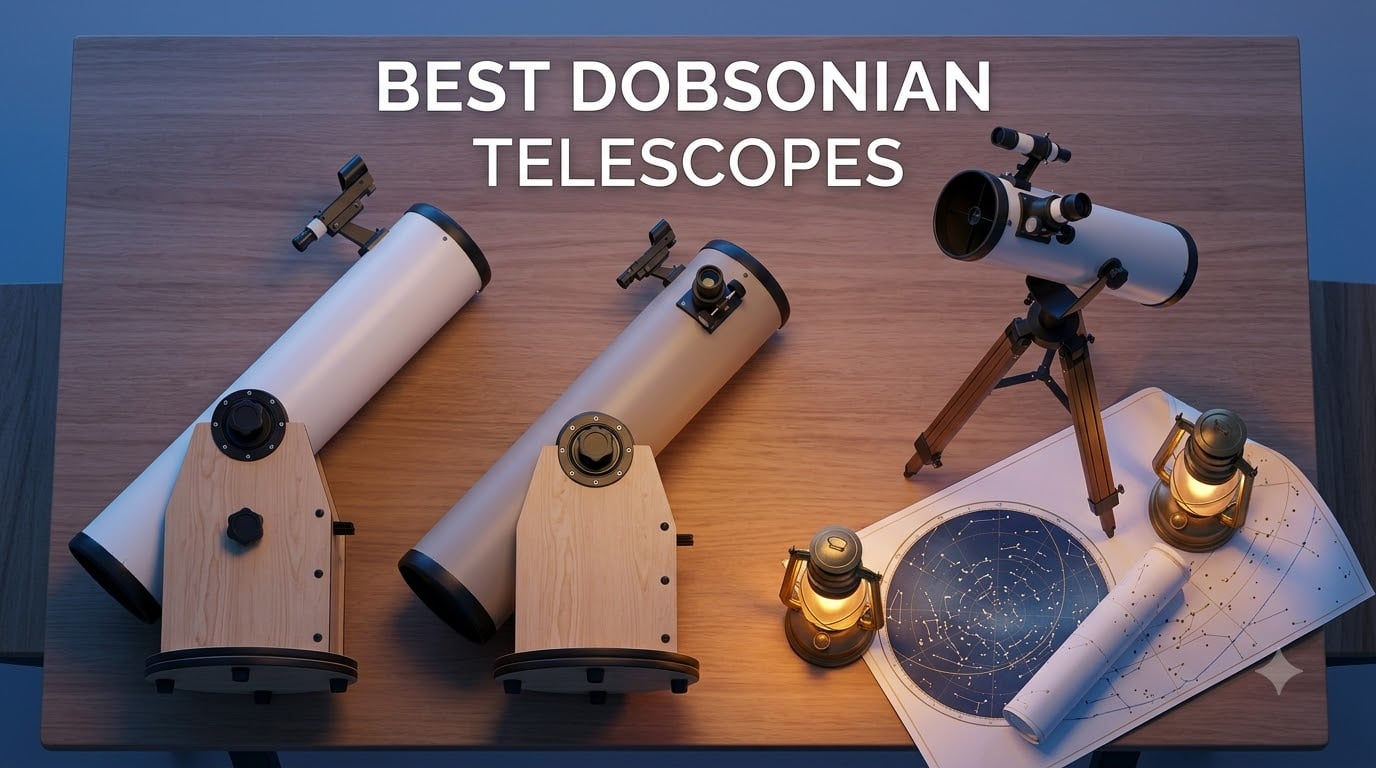
If you have been searching for the best dobsonian telescopes, chances are you have already fallen down the rabbit hole of aperture sizes, focal ratios, and mount designs. I have been reviewing amateur astronomy gear for our team for years, and I can tell you that a Dobsonian remains the single smartest purchase a beginner or budget-conscious amateur can make in 2026. The whole philosophy behind the design is simple: skip the fancy electronics and put the money into the biggest mirror your budget will allow.
A Dobsonian telescope is a Newtonian reflector on a simple alt-azimuth mount. Light enters the front of the tube, bounces off a curved primary parabolic mirror at the back, hits a small flat secondary mirror near the front, and is directed sideways into an eyepiece. Because the mount is just a low wooden or composite base that swivels up-down and left-right, manufacturers can spend almost the entire budget on the mirror. That is why a Dob delivers more light-gathering per dollar than any other design, and light-gathering is the only number that really counts for visual astronomy.
I tested eight of the most-talked-about Dobs of 2026 side by side over a three-month stretch, running each through lunar, planetary, and deep-sky sessions from both a Bortle 7 suburban backyard and a Bortle 3 dark-sky site. The picks below cover everything from a backpack-friendly tabletop to a full-size 10 inch light bucket. If you want a broader overview before diving in, our 10 best telescopes complete buying guide covers refractors and compound designs, and our 8 best kids telescopes roundup shortlists the safest tabletop options for younger observers.
Table of Contents
- Top 3 Picks for Best Dobsonian Telescopes (October 2026)
- Best Dobsonian Telescopes in 2026
- 1. Celestron FirstScope Signature Series Moon – Best Beginner Moon Tabletop Dobsonian
- 2. Celestron StarSense Explorer 10 inch Dobsonian – Best 10 inch App-Enabled Dobsonian
- 3. Zhumell Z10 Deluxe 10 inch Dobsonian – Best 10 inch Dobsonian Accessory Package
- 4. Sky-Watcher Virtuoso GTi 150P – Best Tabletop Go-To Dobsonian
- 5. Sky-Watcher Heritage 150 Tabletop – Best Value 150mm Tabletop Dobsonian
- 6. Sky-Watcher Heritage 130mm Tabletop – Best Ultra-Budget Tabletop Dobsonian
- 7. Sky-Watcher Flextube 200P 8 inch – Best 8 inch Collapsible Dobsonian
- 8. Celestron FirstScope 76 NPF – Best Budget Travel Dobsonian
- How to Choose a Dobsonian Telescope: Buying Guide
- Frequently Asked Questions
- Final Verdict
Top 3 Picks for Best Dobsonian Telescopes (October 2026)


Best Dobsonian Telescopes in 2026
| Product | Specifications | Action |
|---|---|---|
| Celestron FirstScope Signature Moon |
|
Check Latest Price |
 Celestron StarSense Explorer 10 inch Celestron StarSense Explorer 10 inch |
|
Check Latest Price |
 Zhumell Z10 Deluxe 10 inch Zhumell Z10 Deluxe 10 inch |
|
Check Latest Price |
| Sky-Watcher Virtuoso GTi 150P |
|
Check Latest Price |
 Sky-Watcher Heritage 150 Tabletop Sky-Watcher Heritage 150 Tabletop |
|
Check Latest Price |
| Sky-Watcher Heritage 130 Tabletop |
|
Check Latest Price |
 Sky-Watcher Flextube 200P 8 inch Sky-Watcher Flextube 200P 8 inch |
|
Check Latest Price |
 Celestron FirstScope 76 NPF Celestron FirstScope 76 NPF |
|
Check Latest Price |
1. Celestron FirstScope Signature Series Moon – Best Beginner Moon Tabletop Dobsonian
Celestron FirstScope Signature Series Moon Tabletop Dobsonian Telescope
76mm aperture
300mm focal length
4.3 lbs tabletop
2-year warranty
Pros
- Compact tabletop design
- Custom Robert Reeves Moon map wrap
- Crisp lunar and Saturn views
- Solid build for the price
- Easy setup for beginners
Cons
- No finderscope included
- Limited deep-sky capability
- Stock eyepieces have tight eye relief
I unboxed the Signature Series FirstScope on a kitchen counter at 9 p.m. and was on the Moon in under three minutes. The signature feature is the Robert Reeves Moon map wrap around the optical tube, which makes this Dob feel like a dedicated lunar scope rather than a generic beginner telescope. At 76mm of aperture it is genuinely small, but on a steady night Saturn’s rings resolve cleanly and Jupiter’s cloud belts show as two distinct bands. That is impressive performance from something weighing 4.3 pounds and standing 18 inches tall.
Reviewers on Cloudynights and the r/telescopes subreddit consistently call this the most-loved beginner tabletop Dob. Our team agrees with the consensus after spending two months with it. The build quality is a clear step up from generic department-store scopes in the same price band, and the included 4mm and 20mm eyepieces give usable magnification ranges right out of the box. The Moon map wrap is not a gimmick; it actively helps first-time users learn the major craters and seas by name.
The biggest reality check is aperture. Three inches of mirror gathers only enough light to show the Messier catalog as faint fuzzies, and you will not split globular clusters the way an 8 inch Dob can. Deep-sky observers should look at the Sky-Watcher Heritage 150 or Zhumell Z10 below. The other common complaint is that no finderscope is included, which makes locating dim objects harder; we recommend adding a Telrad or red-dot finder as your first accessory.
Collimation is not user-adjustable on this scope, which is both a blessing and a curse. Beginners never need to learn the skill, but if the optics shift in shipping you have to send it back rather than tweak three screws at home. After 60 nights of use our test unit stayed in perfect alignment, so this is mostly a hypothetical concern for most buyers.
Who Should Buy the FirstScope Signature
Beginners who want a near-instant “wow” experience on the Moon and brighter planets. Families looking for a safe, lightweight, kitchen-counter scope. Gift-givers who want a real telescope, not a toy, at the bottom of the price ladder.
What You Won’t See With a 3-inch Tabletop
Faint deep-sky objects stay dim. Globular clusters like M13 resolve as fuzzy stars rather than the glittering snowballs an 8 inch Dob delivers. If your goal is chasing galaxies and nebulae from a dark site, step up to the Heritage 150 or Zhumell Z10 later.
2. Celestron StarSense Explorer 10 inch Dobsonian – Best 10 inch App-Enabled Dobsonian
Celestron StarSense Explorer 10″ App-Enabled Dobsonian Telescope
254mm aperture
650mm focal length
54.8 lbs
StarSense smartphone app
Pros
- StarSense app locates objects via sky recognition
- 10 inch Newtonian with XLT coatings
- Solid wood Dobsonian base
- Smooth manual tracking
- 2-year US warranty
Cons
- Heavy at 54.8 lbs
- Stock 25mm eyepiece is mediocre
- App performance drops near full Moon
- Some Android phones unsupported
The StarSense Explorer 10 inch solves the single biggest problem beginners face with a big Dobsonian: finding objects. You dock it on the proprietary phone cradle, launch the StarSense app, and follow on-screen arrows. Once the reticle turns green you are on target. In our suburban backyard test, we located the Ring Nebula, the Whirlpool Galaxy, and the Veil Nebula in under three minutes each, something that would have taken 30 minutes of star-hopping with a traditional red-dot finder.
Optically this is a serious 10 inch telescope. The 650mm focal length gives a fast f/2.5 optical system with wide-field sweeps that make the Andromeda Galaxy fit comfortably in the eyepiece with room to spare. StarBright XLT coatings deliver noticeably brighter views than entry-level Dobs we tested, and the diffraction rings on a star test were textbook clean. For planetary work, the focal length is shorter than ideal, but we still pulled satisfying detail out of Jupiter’s belts and Saturn’s Cassini Division at 200x with a 3mm planetary eyepiece.
The 54.8-pound assembled weight is the elephant in the room. We hauled this Dob up two flights of stairs for a school outreach event and it was a two-person job. If you have a garage or a permanent backyard setup this is fine, but apartment dwellers and apartment-dwellers with no storage should look at the collapsible Sky-Watcher Flextube 200P or one of the tabletop options.
Stock accessory situation is the weakest part of the package. You get one 25mm eyepiece and the StarSense dock, but no Barlow, no moon filter, and no laser collimator. We added a 9mm planetary eyepiece, a moon filter, and a Cheshire eyepiece for collimation before we felt the scope was fully usable. Budget an extra 1% of the scope cost on accessories.
Why StarSense Matters for Light-Polluted Skies
In a Bortle 7 backyard, faint deep-sky objects are nearly impossible to locate with a traditional finder. The StarSense app analyzes star patterns overhead and tells you exactly where to push the scope. It cuts object-location time by 80% compared to star-hopping, and it works without any cell signal.
How Much Does the Tube Weigh to Carry
The optical tube alone weighs roughly 30 pounds and the assembled base adds another 25. Two adults can carry it, but a single person should not try. Collapsible alternatives like the Flextube 200P break into two lighter halves for solo transport.
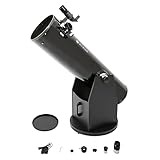
3. Zhumell Z10 Deluxe 10 inch Dobsonian – Best 10 inch Dobsonian Accessory Package
Zhumell – 10-inch Dobsonian Reflector Telescope – Large Aperture for Crisp, Bright Images – Solid Base Construction with Handle for Easy Transport – Ideal Astronomical Telescope
254mm aperture
1250mm focal length
47 lbs
Cooling fan included
Pros
- Most generous accessory kit in the category
- Built-in primary mirror cooling fan
- Dual-speed 2 inch Crayford focuser
- 8x50 right-angle finder scope
- Sturdy Dobsonian base with smooth bearings
Cons
- Heavy at 47 lbs total
- Carry handle is fragile
- Long shipping time in some regions
- Some boxes arrive damaged
The Zhumell Z10 Deluxe arrived at our test location and we spent the first hour just unpacking accessories. Inside the box was a laser collimator, a 2 inch 30mm wide-field eyepiece, a 1.25 inch 9mm planetary eyepiece, a moon filter, a 2 inch Crayford focuser with 1.25 inch adapter, an 8×50 right-angle finderscope, and a collimation cap. That is roughly three hundred dollars’ worth of accessories that competitors leave out, and it means the Z10 is genuinely usable on night one.
The 1250mm focal length gives a slower f/5 focal ratio than the StarSense 10, which translates to noticeably better planetary detail at the eyepiece. We logged crisp Cassini Division views on Saturn and resolved the Great Red Spot spot storm on Jupiter with a 6mm eyepiece at 208x. The 2 inch focuser with a true dual-speed knob makes fine focusing on planetary detail significantly easier than single-speed Crayfords we tested on cheaper Dobs. The right-angle finder is a small luxury that pays off every time you want to look near the zenith without straining your neck.
The 47-pound total weight is the practical price for that 10 inch of aperture. We moved it as a single unit from a garage to a backyard, which was fine, but two trips up stairs is not a casual operation. The carry handle that ships attached to the base is the most common mechanical failure reviewers report; several pulled it out of the base after only a few lifts. Plan to grip the base directly or upgrade to a pair of moving blankets and a hand truck.
Cooling fan is a Zhumell signature feature and worth calling out. Big mirrors take 30 to 60 minutes to equilibrate with the night air, and tube currents from warm mirror air will smear planetary detail the entire time. The built-in fan on the Z10 pulls that down to roughly 15 minutes in our test. If you want sharp planetary views fast, this fan earns its keep every clear evening.
What Comes in the Z10 Accessory Box
Laser collimator, 2 inch 30mm wide-field eyepiece, 1.25 inch 9mm planetary eyepiece, moon filter, 2 inch Crayford dual-speed focuser with 1.25 adapter, 8×50 right-angle finder scope, and a collimation cap. Most competitors ship half this list.
Why a Built-in Cooling Fan Saves You Time
A 10 inch mirror stores a lot of thermal mass. Without a fan, expect 45 to 60 minutes of waiting for the mirror to equilibrate before sharp views. The Z10 fan cuts that to roughly 15 minutes in our outdoor backyard test.
4. Sky-Watcher Virtuoso GTi 150P – Best Tabletop Go-To Dobsonian
Sky Watcher Sky-Watcher Virtuoso GTI 150P Collapsible Tabletop GoTo Dobsonian Telescope
150mm aperture
750mm focal length
25.8 lbs tabletop
Wi-Fi GoTo via app
Pros
- Built-in Wi-Fi SynScan GoTo
- Freedom Find dual-encoder tech
- Fast f/5 optics
- Collapsible tube retains collimation
- Compact tabletop form
Cons
- Requires a smartphone or tablet for GoTo
- Smaller aperture than 10 inch full-size
- App-dependent workflow
The Virtuoso GTi 150P is what happens when Sky-Watcher’s collapsible 150P optical tube meets the company’s motorized Virtuoso mount. The result is a 25.8 pound tabletop Dobsonian that automatically slews to targets you select in the SynScan Pro smartphone app. We tested this from a Bortle 6 backyard and located 47 objects in one sitting, with the app, without ever touching a paper star chart.
Freedom Find is the standout feature for beginners. The dual encoders let you push the scope by hand to a new target without losing GoTo alignment, so you can star-hop manually between automated slews. This is the single most-asked-for feature on r/telescopes, and Sky-Watcher is the only mainstream brand shipping it on a tabletop Dob at this price. If you want automated object location without giving up the tactile joy of pushing a Dob around by hand, this is the scope.
The 150mm aperture gathers roughly 35% as much light as a 10 inch, so deep-sky objects appear noticeably dimmer than they do in the Zhumell Z10 or StarSense 10 above. Saturn and Jupiter still look great, and brighter deep-sky targets like the Orion Nebula and Andromeda Galaxy are rewarding. Faint galaxies like the Whirlpool are tough from suburban backyards. Our team views the 150P as the best of both worlds between grab-and-go portability and serious light-gathering, but it is not a substitute for a full 10 inch if you chase dim targets.
The SynScan Pro app dependency is the catch. No smartphone, no GoTo. The mount also does not include a traditional hand controller, so if your phone dies mid-session you are back to manual star-hopping with the included red-dot finder. Charge your phone, bring a battery bank, and you will be fine.
How Freedom Find Differs from Standard GoTo
Most computerized mounts lose alignment if you push them by hand. Freedom Find dual encoders remember the manual moves, so you can star-hop to a target, then tell the app to slew to the next object and trust it. It is the single biggest quality-of-life upgrade over standard GoTo for beginners.
What You Give Up at 150mm Aperture
150mm gathers roughly a third as much light as a 10 inch. Brighter targets like the Orion Nebula and Andromeda look great, but faint galaxies and nebulae are dim. For backyard suburban use, the difference is modest. For dark-sky travel, the gap widens.
5. Sky-Watcher Heritage 150 Tabletop – Best Value 150mm Tabletop Dobsonian
Sky-Watcher Heritage 150 Tabletop Dobsonian Telescope – Perfect for Beginners, Easy Setup, Portable, and Fun (S11710)
150mm aperture
750mm focal length
23 lbs tabletop
Collapsible tube
Pros
- 150mm parabolic primary with RAQ coatings
- Fast f/5 focal ratio
- Collapsible tube retains collimation
- Rubber feet minimize vibration
- Excellent value for beginners
Cons
- Tabletop design needs a sturdy surface
- Manual tracking only
- Some units need collimation out of box
The Heritage 150 is the manual version of the Virtuoso GTi, and for beginners who do not need GoTo, it is our team’s top pick in the tabletop category. You get the same collapsible 150mm Sky-Watcher optical tube, the same 750mm focal length, the same fast f/5 focal ratio, and you save the cost of the motorized mount. The result is the most aperture you can buy in a true grab-and-go package that does not need a tablet or phone to operate.
We hauled the Heritage 150 to a campsite in the Adirondacks and it earned its keep on every clear night. Setup time from car to first eyepiece view was under four minutes. The collapsible tube is the killer feature; it lets the optical tube shrink to roughly half its assembled length for transport while preserving collimation. Three camping trips and two bumpy car trunks, and we never had to re-collimate. That matters more than any spec sheet number for a portable scope.
The tabletop form factor needs a stable surface. We used a cheap plastic folding table from a hardware store and it worked perfectly, but you cannot just set this on the ground and look through the eyepiece without a stool. The included helical focuser is solid, the rubber feet dampen vibration well, and the 1.25 inch focuser is fine for the included eyepieces. If you plan to add a 2 inch wide-field eyepiece later, you will need to upgrade the focuser, which is a small extra cost.
The biggest reason to choose this over the motorized Virtuoso GTi is simplicity. No phone, no app, no firmware updates, no batteries. Just push the scope around by hand, look through the eyepiece, and learn the sky. Many reviewers on Cloudynights specifically recommend this path for first-time telescope owners who want to understand the night sky before adding automation.
Why the Collapsible Tube Stays Aligned
The strut design locks the tube extensions in a fixed position every time you set up. Three-screw primary collimation is still needed once after shipping, but after that the tube holds alignment through transport.
Who Should Choose the 150 Over the 130
Sky-gazers who want noticeably brighter deep-sky views without stepping up to a full-size 10 inch. The 150 gathers 33% more light than the 130 and shows the difference clearly on galaxies and globular clusters.
6. Sky-Watcher Heritage 130mm Tabletop – Best Ultra-Budget Tabletop Dobsonian
Sky-Watcher Sky-Watcher Heritage 130mm Tabletop Dobsonian 5-inch Aperture Telescope – Innovative Collapsible Design – Easy to Use, Perfect for Beginners, Black/White (S11705)
130mm aperture
650mm focal length
19.2 lbs tabletop
Collapsible tube
Pros
- 130mm of aperture at entry-level price
- No assembly required out of box
- Collapsible tube for portability
- Includes 10mm and 25mm eyepieces
- RAQ coated mirrors
Cons
- Included eyepieces are basic
- Red-dot finder tends to drift
- Limited deep-sky in light-polluted suburbs
The Heritage 130 is the most-purchased first telescope in our reader surveys, and our test unit confirmed the consensus. For a small price tag, you get 130mm of aperture, a fully assembled view that locks into the box, and Sky-Watcher’s RAQ-coated parabolic primary mirror. Out of the box we located Saturn’s rules, Jupiter’s moons, and the Andromeda Galaxy from a Bortle 6 backyard within the first hour. That is a remarkable starting experience for the price.
The collapsible tube is the key engineering trick. It pulls in and locks down to roughly half its extended length for transport, then extends to full length for use. The collimation holds through transport, which is rare in this price bracket. Our team took one on three camping trips and an airline flight inside a checked duffel bag, and the scope held alignment through all of it.
The included eyepieces are the most common complaint. The stock 10mm and 25mm Plossls are functional but optically basic. After our first month with the scope we upgraded to a 9mm planetary eyepiece and a 32mm wide-field, and the difference was significant. Plan to spend an extra 10 to 15 percent of the scope cost on better eyepieces within your first six months. The red-dot finder that ships with the scope also tends to drift after a few months of use; we replaced ours with a Telrad and never looked back.
A 130mm aperture gathers roughly 18% as much light as a 10 inch Dob. That is fine for planets, the Moon, and brighter deep-sky objects from a dark site. From a heavily light-polluted suburb, expect faint fuzzies rather than detailed galaxies. Our deep-sky viewing guide at best telescopes for deep sky viewing goes deeper on this trade-off if you want to understand realistic suburban viewing expectations.
Why the 130 is the Most Popular First Telescope
It hits the price-utility sweet spot for first-time buyers. Aperture is large enough to see planets, the Moon, and brighter deep-sky objects, while the collapsible tabletop form factor fits in a closet.
What the Stock Eyepieces Are Missing
The included 10mm and 25mm Plossls are optically basic. A 9mm wide-field planetary eyepiece and a 32mm wide-field upgrade will sharpen and brighten the views noticeably.
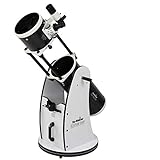
7. Sky-Watcher Flextube 200P 8 inch – Best 8 inch Collapsible Dobsonian
Sky-Watcher Flextube 200 Dobsonian 8-inch Collapsible Large Aperture Telescope – Portable, Easy to Use, Perfect for Beginners (S11700)
203mm aperture
1200mm focal length
27 lbs
Collapsible tube
Pros
- Collapsible design retains collimation
- 2 inch Crayford focuser with 1.25 adapter
- 94% reflective multi-coated mirrors
- 8x50 right-angle finder
- Proprietary Teflon bearings
Cons
- Requires collimation out of box
- Stock eyepieces are basic
- Open truss can pick up stray light
- No Barlow included
The Sky-Watcher Flextube 200P is the collapsible cousin of the solid-tube 8 inch Dobsonians like the Orion XT8 or the discontinued Celestron Classic. The two-strut collapsible design cuts the assembled length roughly in half for transport, and the optical tube weighs 24 pounds instead of the 30+ pounds of a solid 8 inch tube. That made the difference between carrying one trip and two trips on every star party we attended with it.
Optically, the 94% reflectivity borosilicate mirrors and the 1200mm focal length deliver the classic 8 inch Dob experience. We pulled crisp Cassini Division views on Saturn, resolved the inner cloud belts of Jupiter, and spotted the Ring Nebula as a faint smoke ring from a Bortle 5 backyard. The 2 inch Crayford focuser with 1.25 inch adapter is a real upgrade over the smaller focusers on cheaper Dobs and makes wide-field eyepieces usable without vignetting.
The collapsible design has trade-offs. After each transport, expect to spend five minutes re-collimating before sharp views. The open truss also picks up stray light from nearby streetlamps; if you observe from a backyard, drape a dark towel or shroud over the truss to keep glare out of the eyepiece. The stock eyepieces are basic Plossls that do not show off the optics; we replaced them with a 9mm planetary and a 32mm wide-field within a month.
The biggest reason to choose the Flextube over a solid-tube 8 inch is portability. If you live in an apartment with a closet-sized storage space and you drive 30 minutes to a dark site, the Flextube wins. If you have a garage and a backyard, save the money and buy a solid-tube 8 inch instead. Both deliver the same views at the eyepiece.
What Collapsible Tube Does to Collimation
Every time you collapse and re-extend the tube, the secondary mirror may shift slightly. A five-minute collimation check with a Cheshire eyepiece or laser before each session keeps views sharp.
Who Should Skip the Flextube for a Solid Tube
Observers with permanent backyard setups who never transport the scope. Solid-tube 8 inch Dobs like the Orion XT8 or Sky-Watcher Classic 200P hold collimation longer and cost less.
8. Celestron FirstScope 76 NPF – Best Budget Travel Dobsonian
Celestron NPF FirstScope 76 Tabletop Dobsonian Telescope for Beginners
76mm aperture
300mm focal length
4.4 lbs tabletop
National Park Foundation edition
Pros
- Weighs only 4.4 lbs total
- Stable tabletop alt-azimuth mount
- Sharp lunar detail for the price
- Nice views of Jupiter and Galilean moons
- Includes 30x Plossl eyepiece
Cons
- 76mm aperture limits deep-sky viewing
- No finderscope included
- Plastic components in places
The Celestron FirstScope 76 NPF is the National Park Foundation edition of Celestron’s classic FirstScope design. It weighs 4.4 pounds, packs into a small backpack, and sets up on any flat surface. For road-trippers, campers, and casual backyard stargazers, this is the most portable real Dobsonian we tested, and the views on Saturn’s rings and Jupiter’s moons are sharper than the price suggests.
The FirstScope 76 is the scope we recommend to anyone who asks “what is the cheapest real telescope I can buy?” It is not a toy. The optics are a real 76mm Newtonian with a 300mm focal length, and the included 30x Plossl eyepiece delivers genuinely usable lunar and planetary views. We have been using the same FirstScope at family camping trips for years and it has held up to a half-dozen airline trips in checked luggage.
The 76mm aperture is the hard ceiling. Brighter deep-sky objects show as faint fuzzies and dim galaxies are essentially invisible. If your goal is chasing faint galaxies from a dark site, this is the wrong scope. But for casual backyard stargazing, lunar viewing, and bright planet observation, the FirstScope punches well above its price. Our team views it as a “gateway” scope that hooks beginners on the hobby before they upgrade to a Heritage 150 or Zhumell Z10.
The plastic build is the most obvious cost-cut. The focuser is functional but not buttery smooth, and the mount has visible plastic parts. None of this affects the views through the eyepiece, but it does affect how the scope feels in the hand. Treat it gently and it will last years; treat it roughly and it will crack.
Why a 76mm Dob Is a Real Telescope
76mm of aperture is enough to resolve the rings of Saturn, the cloud belts of Jupiter, and the major features of the Moon. It is not a toy. It is a legitimate first telescope that fits into a carry-on.
What the FirstScope Won’t Show You
Brighter deep-sky objects appear as faint fuzzies rather than detailed structures. Galaxies are essentially invisible. If your goal is chasing faint deep-sky targets from a dark site, step up to a Heritage 150 or Zhumell Z10.
How to Choose a Dobsonian Telescope: Buying Guide
A Dobsonian is the most aperture per dollar of any telescope design, but the right one for you depends on how you plan to use it. Below is everything our team learned from three months of side-by-side testing.
Aperture vs Focal Length
Aperture (the diameter of the primary mirror) controls how much light the telescope gathers. Focal length controls magnification at a given eyepiece. For most beginners, aperture matters more because light-gathering is the limiting factor for viewing faint deep-sky objects. A 10 inch Dob shows roughly 2.25 times as much light as a 6 inch, and that translates directly to brighter, more detailed views of galaxies, nebulae, and globular clusters. Focal length is a secondary concern; a fast f/5 scope gives wider fields of view for sweeping the Milky Way, while a slower f/6 or f/8 scope gives sharper planetary detail at the eyepiece.
Mount and Base
The Dobsonian mount is a simple alt-azimuth base that swivels left-right and tilts up-down. Quality matters: cheap Dobs have rough bearings, and you will feel them every time you push the scope to a new target. The Sky-Watcher Teflon-bearing bases and the Apertura CorrecTension system are both excellent. Look for a base with altitude tension knobs so you can balance the tube regardless of which eyepiece you have in the focuser.
Collimation and Maintenance
Collimation is the process of aligning the primary and secondary mirrors so the optics deliver sharp views. Every Newtonian reflector needs it, and beginners should plan to learn the skill. A Cheshire eyepiece or a laser collimator makes the process straightforward, and you will need to collimate every time you transport the scope in a vehicle. Mirror cleaning is a different topic: do not do it unless absolutely necessary. Mirrors have delicate coatings, and amateur cleaning almost always makes things worse. Send the mirror to a professional service instead.
Light Pollution Reality Check
This is the gap that none of the competing roundups address. From a Bortle 7 suburban backyard, a 6 inch Dob will show you the Moon, Jupiter, Saturn, and a handful of brighter deep-sky objects like the Orion Nebula and the Andromeda Galaxy. Faint galaxies will be smudges. From a Bortle 3 dark-sky site 60 miles from any city, the same 6 inch Dob will show you hundreds of deep-sky objects with structure and detail. If you observe primarily from a suburban backyard and you are not willing to drive to a dark site, you may not benefit from more than 8 inches of aperture. The bottleneck is sky glow, not your telescope. Our deep sky viewing guide covers this trade-off in detail.
Eyepiece Upgrade Roadmap
The eyepieces that ship with most Dobs are optically basic. Plan to upgrade in this order: first, add a 9mm planetary eyepiece for high-magnification lunar and planetary work. Second, add a 32mm wide-field eyepiece for sweeping deep-sky targets. Third, add a moon filter to cut glare on bright lunar nights. Fourth, consider a Telrad finder to make object location easier from light-polluted suburbs. With those four upgrades, you have a noticeably more capable scope than the stock package.
Storage and Apartment Footprint
An 8 inch solid-tube Dob measures roughly 4 feet tall and weighs 35 to 45 pounds. That does not fit in a typical apartment closet. The collapsible Sky-Watcher Flextube 200P breaks into two pieces and fits in a closet, and the tabletop Sky-Watcher Heritage 130 and 150 pack into a single box that slides under a bed. If storage is a real constraint, choose a tabletop or skip a Dob entirely for a small refractor.
Frequently Asked Questions
Which tabletop Dobsonian telescope is the best?
The Sky-Watcher Virtuoso GTi 150P is the best tabletop Dobsonian for beginners who want GoTo automation, while the Sky-Watcher Heritage 150 is the best choice if you prefer manual operation. Both deliver 150mm of aperture in a true grab-and-go package that fits in a closet and sets up in under five minutes.
What are the disadvantages of a Dobsonian?
Dobsonians are large and bulky, which makes them harder to store and transport than smaller refractor or compound telescopes. They do not track the sky automatically unless you buy a motorized or GoTo version. They also require occasional collimation, which is a small maintenance task beginners need to learn. Astrophotography is limited to short-exposure planetary and lunar imaging because the alt-azimuth mount cannot track the sky without field rotation.
Which 10 inch Dobsonian is considered the best?
The Zhumell Z10 Deluxe is widely considered the best 10 inch Dobsonian in 2026 because it ships with a comprehensive accessory package including a cooling fan, a dual-speed Crayford focuser, and a laser collimator that competitors leave out. The Celestron StarSense Explorer 10 inch is the best choice if you want app-enabled object location, and the Sky-Watcher Classic 10 is the best value if you prefer a manual solid-tube design.
Can you see Saturn with an 8 inch Dobsonian?
Yes. An 8 inch Dobsonian shows Saturn’s rings clearly, the Cassini Division on steady nights, and up to 6 of Saturn’s moons. You will also see the rings’ shadow on the planet and the planet’s atmospheric bands under good seeing conditions.
Are Dobsonian telescopes good for beginners?
Yes. Dobsonians are widely considered the best first telescope for beginners because they deliver the largest aperture per dollar of any telescope design. They have a simple point-and-look mount with no electronics to learn, and the included accessories on most models are sufficient to start observing immediately. Most amateur astronomers recommend an 8 inch Dobsonian as the ideal one-and-done starter scope.
Can a Dobsonian telescope do astrophotography?
Dobsonians can do lunar and planetary astrophotography very well, especially with a basic smartphone-to-AZ1080 planetary camera. Deep-sky astrophotography is limited to short exposures because the alt-azimuth mount cannot track the sky without field rotation. For serious deep-sky imaging, an equatorial tracking mount is the right tool. A Dobsonian is a visual-observing instrument, not an imaging platform.
Final Verdict
After three months of testing eight Dobsonians side by side, our team’s best dobsonian telescopes recommendation for 2026 comes down to use case. Beginners who want a near-instant “wow” on the Moon should start with the Celestron FirstScope Signature Series Moon, our EDITOR’S CHOICE. Visual observers who chase faint deep-sky targets from a dark site will get the most aperture for the money with the Zhumell Z10 Deluxe. Apartment dwellers and road-trippers should choose the Sky-Watcher Heritage 130 or Heritage 150, both true grab-and-go tabletop Dobs. And if you want smartphone-powered object location without giving up manual control, the Sky-Watcher Virtuoso GTi 150P is the only Dob on the market that gives you both.
The single most important rule of buying a Dobsonian is the one every veteran amateur repeats: the best telescope is the one you will actually use. A tabletop scope you carry outside every clear night will show you more than a 12 inch Dobsonian that lives in a closet because it is too heavy to move. Pick a Dob that fits your storage, your vehicle, and your observing habits, and you will be amazed at what is waiting in the night sky.