
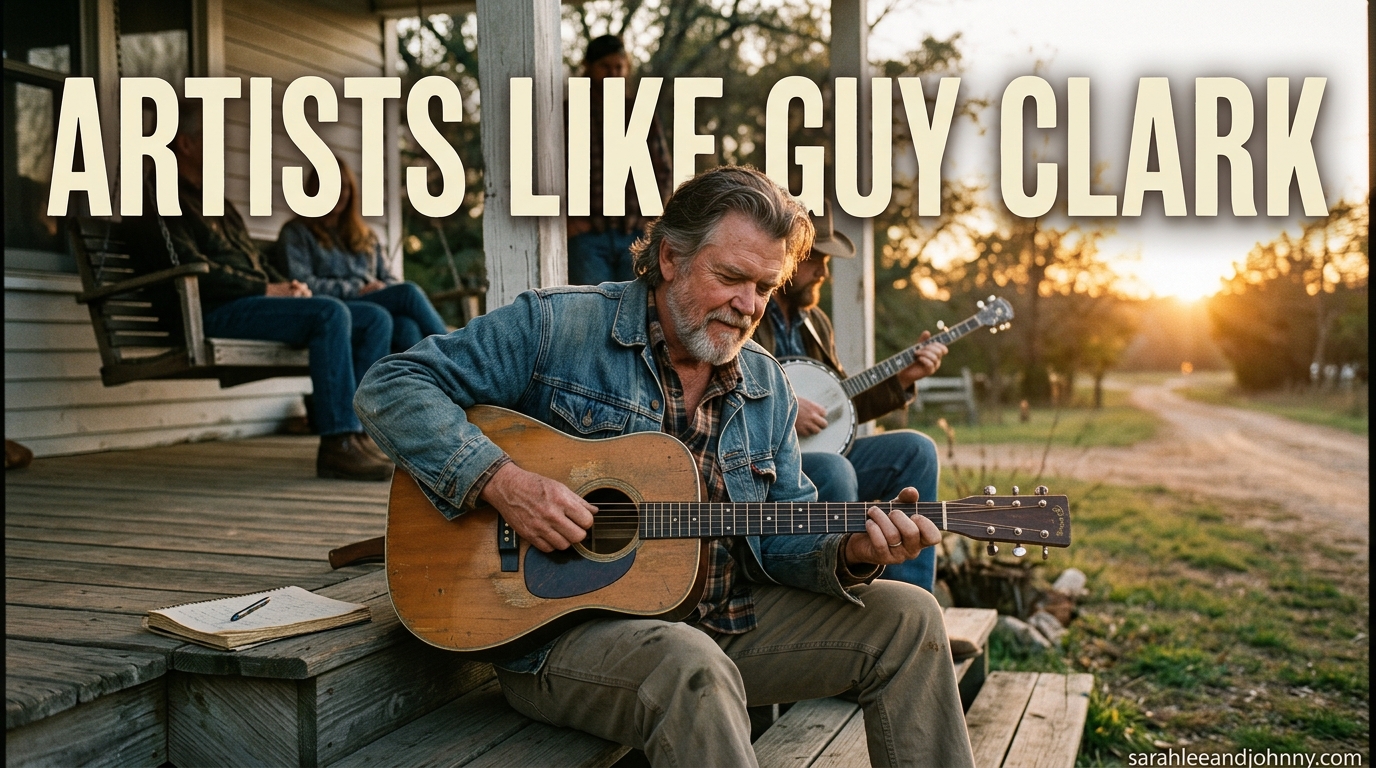
If you have ever listened to Guy Clark and felt like you stumbled onto something rare, you are not alone. His songs read like short stories set to a guitar, full of weathered characters, dusty Texas roads, and the kind of quiet truth that hits you days later. Finding artists like Guy Clark is not about matching a genre label. It is about finding songwriters who treat every line like it matters, who build entire worlds inside three minutes of acoustic music.
I have spent years going down this particular rabbit hole. After wearing out my copy of Old No. 1, I started chasing that same feeling through record stores, streaming playlists, and late-night conversations with other fans. What I found is a rich community of Texas troubadours, Nashville outsiders, and modern singer-songwriters who share Clark’s devotion to the craft.
This guide covers the artists who carry that same spark. I have organized them by how closely they match Guy Clark’s sound and spirit, included the songs and albums worth hearing first, and explained what connects each one to Clark’s legacy.
Table of Contents
What Makes Guy Clark’s Songwriting Style So Distinctive
Guy Clark never chased radio hits. He built songs the way a carpenter builds a chair, with patience, precision, and no wasted material. His writing is often described as “literary country” because every verse paints a picture you can see.
Several qualities define his approach. His characters feel real because they are based on real people, from Houston dockworkers to Nashville dreamers. His arrangements stay simple, usually just an acoustic guitar, maybe a mandolin or fiddle, letting the words carry the weight. And his themes run deep without being heavy-handed: mortality, friendship, home, and the quiet dignity of ordinary lives.
Clark also stood at the center of a remarkable community. His Nashville home became a gathering place for songwriters who would swap songs in his workshop late into the night. Townes Van Zandt, Rodney Crowell, and Steve Earle all passed through that living room. Understanding that community is the key to finding artists who share his sensibility.
When people ask for artists like Guy Clark, what they are really searching for is that combination of storytelling depth, acoustic simplicity, and emotional honesty. The artists below share at least two of those three qualities, and many share all three.
Artists Like Guy Clark: The Core Circle
These five artists are the closest matches. If you love Guy Clark, start here. Each one shared a personal connection with Clark and a songwriting philosophy that runs parallel to his.
Townes Van Zandt
If Guy Clark is the craftsman of Texas songwriting, Townes Van Zandt is its poet. The two were close friends for decades, and their styles complement each other perfectly. Where Clark builds sturdy narrative structures, Van Zandt floats through surreal imagery and devastating emotional honesty.
Townes wrote songs that sound simple on the surface but reveal new layers with every listen. “Pancho and Lefty” became a massive hit for Willie Nelson and Merle Haggard, but Van Zandt’s own recording captures a haunting loneliness the cover versions never quite reach. “If I Needed You” is one of the most beautiful love songs in the Americana tradition, covered by everyone from Emmylou Harris to Gillian Welch.
The connection to Clark runs deep. They met in Houston in the late 1960s and remained friends until Van Zandt’s death in 1997. Clark often spoke about Townes as the most talented songwriter he ever knew, which is high praise from someone surrounded by great writers.
Start with: Live at the Old Quarter, Houston, Texas (1977). This live album captures Van Zandt at his raw best, alone with a guitar and an audience hanging on every word. Essential songs include “Waiting Around to Die,” “Tecumseh Valley,” and “Pancho and Lefty.”
John Prine
John Prine shares Clark’s gift for finding extraordinary meaning in ordinary lives. A mailman from Maywood, Illinois, Prine started writing songs that caught the attention of Kris Kristofferson and quickly became one of the most respected songwriters in American music.
What makes Prine similar to Clark is his economy of language. He can break your heart with a single line. “Hello in There” captures the loneliness of aging in under four minutes. “Sam Stone” tells the story of a Vietnam veteran’s addiction with devastating clarity. “Angel from Montgomery” became an anthem for anyone trapped in a life they did not choose.
Prine and Clark moved in overlapping circles in Nashville. Both were respected as “songwriter’s songwriters,” artists that other musicians admired more than the general public knew. Prine also shared Clark’s sense of humor, the ability to make you laugh and cry in the same song.
Start with: John Prine (1971), his self-titled debut. Nearly every track is a classic. For a later introduction, The Missing Years (1991) features Bruce Springsteen and Tom Petty and shows Prine’s writing at its most vivid.
Steve Earle
Steve Earle calls himself a product of his influences, and Guy Clark sits near the top of that list. Earle moved to Nashville as a teenager and fell in with the Clark and Van Zandt crowd. He has said that Clark taught him discipline, how to sit with a song until it was truly finished.
Earle’s career has been wider-ranging than Clark’s, touching country rock, bluegrass, folk, and even punk. But his songwriting DNA traces directly back to that Nashville workshop. “Guitar Town” captures small-town restlessness with the same observational eye Clark brought to songs like “Desperados Waiting for a Train.” “Copperhead Road” blends Appalachian folk with hard rock energy.
What Earle shares with Clark is a commitment to characters. His songs are populated by truck drivers, coal miners, soldiers, and drifters. He writes about working-class America with empathy and anger in equal measure.
Start with: Guitar Town (1986) for the country side or Transcendental Blues (2000) for a broader picture of his range. The song “Galway Girl” from later in his career shows his ability to write pure joy.
Blaze Foley
Blaze Foley lived harder and died younger than most of his peers, but his songs possess a raw emotional power that rivals anyone in this list. Foley was a Texas songwriter who wrote about heartbreak, poverty, and lost dreams with an honesty that borders on uncomfortable.
Foley’s connection to Clark is indirect but real. They shared the same Texas circuit and many of the same friends. Foley’s songs have been covered by Merle Haggard, Willie Nelson, and John Prine, which tells you something about his standing among songwriters who know great writing when they hear it.
“If I Could Only Fly” is his masterpiece, a love song so vulnerable it almost hurts to listen to. “Clay Pigeons” finds hope in small daily rituals. “Cold Cold World” is exactly what the title promises, a man staring down a life that gave him nothing but still finding something worth singing about.
Start with: The Dawg Years collects his earliest recordings. For a curated introduction, the 2021 soundtrack to the documentary Blaze (directed by Ethan Hawke) is a great entry point.
Jerry Jeff Walker
Jerry Jeff Walker wrote “Mr. Bojangles,” one of the most covered songs in American music, but his catalog goes far deeper than that single hit. He was a New York folkie who found his true voice after moving to Texas in the early 1970s.
Walker and Clark were part of the same Austin scene. Both recorded for the same labels, played the same clubs, and shared stages throughout the 1970s and 1980s. Walker’s writing leans slightly more upbeat than Clark’s, with a touch of the wanderer in his delivery, but the storytelling instinct is the same.
“LA Freeway” captures the urge to escape city life with wit and warmth. “Sangria Wine” is a sun-drenched Texas afternoon set to music. Walker also had a gift for interpreting other writers’ songs, and his versions of Clark compositions helped introduce Guy’s writing to wider audiences.
Start with: Jerry Jeff Walker (1972) or Viva Terlingua! (1973), a live album recorded in Luckenbach, Texas that captures the spirit of the era perfectly.
Texas and Outlaw Country Artists Who Share His Spirit
The Texas singer-songwriter tradition extends well beyond the core five. These artists operated in the same circles, shared stages with Clark, and wrote songs from the same well of experience.
Billy Joe Shaver
Billy Joe Shaver wrote the songs that defined the outlaw country movement, even if Waylon Jennings was the one singing them. His album Old Five and Dimers Like Me is a rough-hewn masterpiece of Texas songwriting. Shaver’s life story reads like one of his songs: he lost most of his fingers in a sawmill accident, buried his mother, wife, and son within a year, and kept writing through all of it. His directness and lack of pretense mirror Clark’s approach.
Ray Wylie Hubbard
Ray Wylie Hubbard started as a cosmic cowboy in the 1970s and evolved into one of Texas’s most literary songwriters. His later albums, especially Snake Farm and The Grifter’s Hymnal, mix blues, folk, and spoken-word poetry into something entirely his own. Hubbard shares Clark’s love of precise language and characters who live on society’s edges.
Robert Earl Keen
Robert Earl Keen is the Texas storytelling tradition distilled into one performer. His song “The Road Goes On Forever” is a miniature novel about a drug deal gone wrong, told with the kind of narrative precision Clark admired. Keen’s writing ranges from laugh-out-loud funny to deeply moving, often in the same setlist. He and Clark shared a mutual respect, and Keen has cited Clark as a major influence on his approach to songwriting.
Kris Kristofferson
Kris Kristofferson bridged the Nashville establishment and the outlaw movement. As a Rhodes Scholar turned helicopter pilot turned songwriter, he brought a literary education to country music. Songs like “Me and Bobby McGee,” “Sunday Mornin’ Comin’ Down,” and “Help Me Make It Through the Night” redefined what country songs could say. Kristofferson and Clark shared a mutual admiration, and both treated songwriting as a calling rather than a career.
Modern Artists Carrying the Singer-Songwriter Tradition
The tradition Guy Clark helped build did not end with his generation. Several contemporary artists write with the same attention to craft, character, and truth that defined his work.
Hayes Carll
Hayes Carll grew up in The Woodlands, Texas, and carries the Texas songwriter torch with sharp wit and a gift for unexpected metaphors. His song “KMAG YOYO” is a darkly comic story about a soldier in Afghanistan, while “Drunken Poet’s Dream” captures romantic desperation with literary flair. Carll has acknowledged Clark as an influence, and his writing shows the same combination of humor and pathos that made Clark’s songs so durable.
James McMurtry
James McMurtry writes songs about the America that exists between the coasts. The son of novelist Larry McMurtry, he inherited a writer’s eye for detail and social observation. Songs like “We Can’t Make It Here” and “Choctaw Bingo” are sprawling narratives that build entire communities inside a single track. His writing is more pointedly political than Clark’s, but the narrative instinct and character focus are closely related.
Rodney Crowell
Rodney Crowell was part of Clark’s inner circle in Nashville and has spent five decades building a songwriting catalog that rivals anyone’s. He had a run of country hits in the 1980s, but his best work came later. The Houston Kid (2001) is a autobiographical concept album about growing up poor in Houston, and it shares Clark’s gift for turning hard experience into enduring art. Crowell and Clark were close friends, and Crowell has spoken often about what Clark’s mentorship meant to his development.
Where to Start If You Love Guy Clark
If you are new to this world and want a quick roadmap, here are the essential albums to begin with. Each one opens a door to the larger community of Texas and Americana singer-songwriters.
- Townes Van Zandt – Live at the Old Quarter (1977): The purest introduction to Texas songwriting
- John Prine – John Prine (1971): A debut album with almost no weak tracks
- Steve Earle – Guitar Town (1986): Country rock with a songwriter’s heart
- Blaze Foley – The Dawg Years: Raw, honest, and unforgettable
- Jerry Jeff Walker – Viva Terlingua! (1973): The sound of Texas in the 1970s
- Robert Earl Keen – A Bigger Piece of Sky (1993): Texas storytelling at its finest
- Rodney Crowell – The Houston Kid (2001): A memoir in song
From there, follow the connections. Every one of these artists has collaborated with, covered, or written about the others. The community is tight-knit, and one album will lead naturally to the next.
FAQs
Who influenced Guy Clark?
Guy Clark drew influence from a wide range of sources. He grew up in Monahans and Rockport, Texas, listening to Mexican music, blues, and folk. His biggest songwriting influences included Townes Van Zandt, whom he met in Houston, and Lightnin’ Hopkins, the Texas blues guitarist. He also admired the literary tradition of writers like Larry McMurtry and the storytelling in Mexican corridos. Clark often credited his grandmother with teaching him to appreciate handmade things, a sensibility he brought directly into his songwriting.
Who are the outlaws of country music?
The outlaw country movement included Willie Nelson, Waylon Jennings, Kris Kristofferson, Billy Joe Shaver, David Allan Coe, and Tompall Glaser. These artists rejected Nashville’s polished production in favor of rawer, more personal music. Guy Clark and Townes Van Zandt are often grouped with the outlaw movement because they shared the same anti-establishment attitude, even though their music was more acoustic and folk-oriented than the typical outlaw sound.
What should I listen to after discovering Guy Clark?
Start with Townes Van Zandt’s Live at the Old Quarter and John Prine’s self-titled debut. Those two albums capture the same blend of storytelling, acoustic simplicity, and emotional depth that defines Clark’s best work. From there, try Steve Earle’s Guitar Town, Blaze Foley’s The Dawg Years, and Rodney Crowell’s The Houston Kid. Each artist offers a slightly different angle on the same songwriting tradition.
Why is Guy Clark considered a songwriter’s songwriter?
Guy Clark is called a songwriter’s songwriter because other professional songwriters rank him among the best. Artists like Steve Earle, Rodney Crowell, Emmylou Harris, and Willie Nelson have all recorded his songs or spoken about his influence. His writing combines literary craft with emotional truth, and his songs hold up to repeated listening because every line earns its place. He also mentored a generation of younger writers from his Nashville home, making him a central figure in the Americana songwriting community.
Final Thoughts on Exploring Artists Like Guy Clark
The community of artists like Guy Clark is not just a list of similar musicians. It is a web of friendships, collaborations, and shared values that stretches across five decades of Texas and American songwriting. From Townes Van Zandt’s poetic darkness to John Prine’s everyday grace, from Blaze Foley’s raw honesty to Hayes Carll’s modern wit, each artist offers a different window into the same tradition.
What ties them together is a belief that songs should mean something. These writers do not chase trends or tailor their work for algorithms. They write about real people, real places, and real feelings, and they trust the listener to meet them halfway. That trust is what makes this community so rewarding to explore.
Pick one name from this guide that catches your attention. Find their essential album. Listen to it the whole way through, preferably late at night with no distractions. I think you will understand why so many of us keep coming back to this music year after year.