
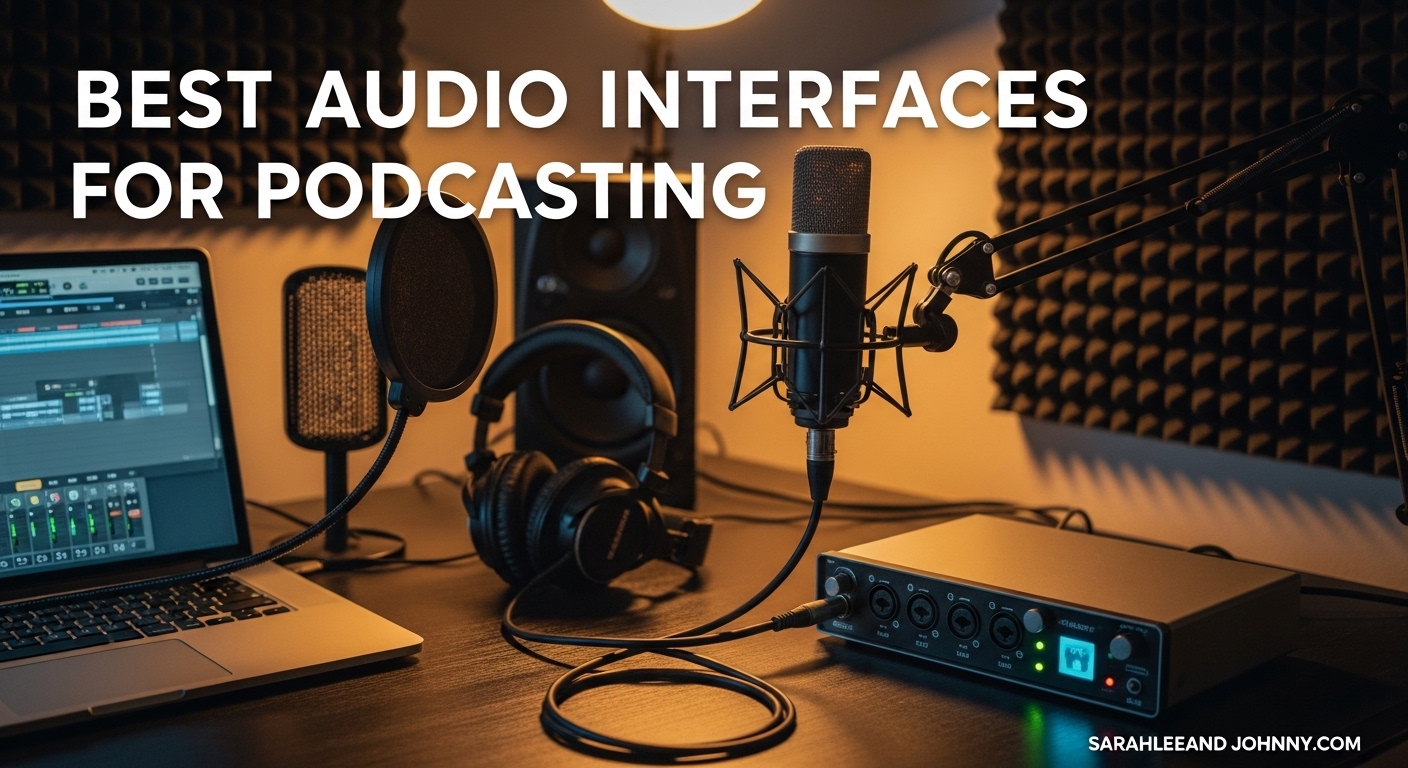
When I first started podcasting, I made the same mistake most beginners do: I relied on a USB microphone and hoped for the best. The result was decent but never quite professional. It was not until I upgraded to an XLR microphone paired with a proper audio interface that my recordings went from sounding like a bedroom hobby to something listeners actually wanted to hear. If you are reading this, you are probably at that same crossroads, wondering which of the best audio interfaces for podcasting will take your show to the next level.
A USB audio interface is the bridge between your XLR microphone and your computer. It converts the analog signal from your mic into clean digital audio, provides phantom power for condenser mics, and gives you real-time headphone monitoring with zero latency. In short, it is the single most important piece of podcast equipment you will buy after your microphone.
Our team spent weeks comparing the top options on the market, testing them with popular podcasting microphones like the Shure SM7B and Audio-Technica AT2020, and evaluating everything from preamp noise levels to ease of setup. Whether you are a solo podcaster recording at home, running a two-person interview show, or producing a roundtable discussion with four mics, we found the right interface for you. Here are our top picks for 2026.
Table of Contents
- Top 3 Picks for Best Audio Interfaces for Podcasting
- Best Audio Interfaces for Podcasting in 2026
- 1. Focusrite Scarlett 2i2 4th Gen – The Industry Standard
- 2. RODE RODECaster Pro II – The All-in-One Podcast Studio
- 3. Zoom PodTrak P4 – Best Portable Podcast Recorder
- 4. PreSonus AudioBox 96 – Best Budget Starter Interface
- 5. Behringer UMC404HD – Best for Multi-Person Podcasts
- 6. Solid State Logic SSL 2 Plus MKII – Best Premium Sound Quality
- Buying Guide: How to Choose the Best Audio Interface for Podcasting
- FAQs
- Conclusion
Top 3 Picks for Best Audio Interfaces for Podcasting


Best Audio Interfaces for Podcasting in 2026
| Product | Specifications | Action |
|---|---|---|
| Focusrite Scarlett 2i2 4th Gen |
|
Check Latest Price |
 RODE RODECaster Pro II RODE RODECaster Pro II |
|
Check Latest Price |
| Zoom PodTrak P4 |
|
Check Latest Price |
 PreSonus AudioBox 96 PreSonus AudioBox 96 |
|
Check Latest Price |
 Behringer UMC404HD Behringer UMC404HD |
|
Check Latest Price |
 SSL 2 Plus MKII SSL 2 Plus MKII |
|
Check Latest Price |
1. Focusrite Scarlett 2i2 4th Gen – The Industry Standard
Focusrite Scarlett 2i2 4th Gen USB-C Audio Interface
2 XLR/TRS combo inputs
120dB dynamic range
192kHz/24-bit
Auto Gain and Clip Safe
Air mode
USB-C
Pros
- Excellent preamp quality with low noise
- Auto Gain and Clip Safe prevent recording issues
- Air mode adds vocal presence
- Plug-and-play with most systems
- Rear XLR connections for cleaner desk
Cons
- Documentation could be clearer
- No DIN connectors for keyboard input
- Packaging could use better protection
The Focusrite Scarlett 2i2 is the interface I recommend more than any other, and for good reason. This is the best-selling audio interface in the world, sitting at number one in its Amazon category. I have used the 2i2 across three generations now, and the 4th Gen is by far the biggest leap forward. The preamps are noticeably cleaner, and the new Auto Gain feature alone is worth the upgrade if you are coming from an older model.
For podcasting specifically, the Scarlett 2i2 hits the sweet spot between simplicity and capability. The two combo XLR/jack inputs let you run a host mic and a guest mic simultaneously. The gain knobs have a satisfying, precise feel, and the halo indicators around them turn green when your levels are good and red when you are clipping. It is the kind of feedback that makes you feel confident during a recording session.
What sets this 4th Gen apart from previous versions and most competitors are the Auto Gain and Clip Safe features. Auto Gain listens to your voice for ten seconds and then sets the perfect input level automatically. Clip Safe runs in the background and catches any peaks you might miss. If you have ever ruined a great interview because your levels were too hot, you understand how valuable this is. The Air mode is another podcast favorite, adding presence and sparkle to vocals that makes voices sound more polished without any post-processing.
The build quality is solid at just 1.3 pounds, and the rear-facing XLR connections keep your desk looking clean. It connects via USB-C and works plug-and-play with Mac, Windows, and even iOS. Focusrite also bundles a serious software package including Pro Tools Intro+, Ableton Live Lite, and the Hitmaker Expansion suite.
Who Should Buy the Scarlett 2i2 4th Gen
This is the ideal interface for solo podcasters and two-person shows who want professional sound without a steep learning curve. If you are upgrading from a USB microphone and want something that just works right out of the box, the 2i2 is your best bet. The Auto Gain feature makes it especially good for beginners who are not yet comfortable manually setting gain levels.
It is also a strong choice for podcasters who also stream or record music, since the 192kHz sample rate and instrument inputs make it versatile enough for any recording scenario. The included software bundle alone justifies the investment.
Who Should Look Elsewhere
If your podcast regularly has three or more people around a table, the two inputs on the 2i2 will not be enough. You would need to look at the Behringer UMC404HD or the RODE RODECaster Pro II instead. Also, if you want built-in effects processing or sound pads, the 2i2 keeps things minimal and does not include those features.
2. RODE RODECaster Pro II – The All-in-One Podcast Studio
RØDE RØDECaster Pro II All-in-One Audio Production Studio
4 XLR/TRS combo inputs
Revolution preamps
Built-in APHEX processing
8 SMART pads
Bluetooth and WiFi
Quad-core processor
Pros
- All-in-one production console with mixer and sound board
- Revolution preamps provide crystal-clear audio
- 8 customizable SMART pads with 64 actions
- APHEX processing for studio-quality sound
- Touchscreen is intuitive and easy to navigate
Cons
- Expensive compared to simpler options
- Can be complex for beginners
- Some USB connectivity issues reported
- May require firmware updates
The RODE RODECaster Pro II is not just an audio interface. It is a complete podcast production studio in a single unit. I have seen professional studios with less capability than what this console packs into its 2.36-inch-tall frame. If you are serious about podcasting and want everything at your fingertips without touching a computer, this is the gold standard.
The four Revolution preamps deliver incredibly clean gain with plenty of headroom, even for demanding dynamic microphones like the Shure SM7B. Each input has its own processing chain including a compressor, de-esser, high-pass filter, noise gate, and EQ. The APHEX Aural Exciter and Big Bottom processing add that polished broadcast sound that would normally require expensive outboard gear.
The standout feature for podcasters is the eight SMART pads. These are fully customizable buttons that can trigger sound effects, jingles, voice FX, ad reads, or MIDI commands. With four banks, you get 64 total actions at your disposal. I set up mine with an intro jingle, outro music, a few transition sounds, and some pre-loaded ad spots. Being able to trigger these with a single tap during a live recording is a game-changer.
The color touchscreen makes navigating settings straightforward, and the unit supports Bluetooth, WiFi, and Ethernet connectivity alongside USB-C. You can record directly to a microSD card without a computer, which is perfect for field recordings or when you want a backup of your session. The RODE RODECaster Pro II also functions as a 2-in/2-out USB audio interface when connected to your DAW.
Who Should Buy the RODECaster Pro II
This is built for podcasters who want a professional production workflow without relying on software. If you record with multiple hosts or guests regularly, the four mic inputs, individual headphone outputs, and per-channel processing make this the most capable all-in-one solution available. It is also ideal for podcasters who livestream, since the built-in processing and SMART pads give you real-time control over your production.
Studios and serious content creators who want broadcast-quality sound with minimal post-production will find the APHEX processing alone saves hours of editing time each week.
Who Should Look Elsewhere
At this price point, the RODECaster Pro II is a significant investment. If you are just starting out or only need one or two mic inputs, the Focusrite Scarlett 2i2 or Zoom PodTrak P4 will serve you well at a fraction of the cost. Beginners may also find the sheer number of features overwhelming at first. RODE has improved the firmware significantly since launch, but be prepared to install updates when you first set it up.
3. Zoom PodTrak P4 – Best Portable Podcast Recorder
Zoom PodTrak P4 Podcast Recorder with 4 XLR Mic Inputs, 4 Headphone Outputs, Phone & USB Input for Remote Interviews, Sound Pads, 2-In/2-Out USB Audio Interface, Battery Powered
4 XLR mic inputs
4 headphone outputs
SD card recording
Automatic Mix-Minus
Sound pads
Battery powered
Pros
- 4 XLR inputs with individual headphone outputs
- Built-in recorder with SD card backup
- Automatic Mix-Minus for phone interviews
- Lightweight and portable at 130g
- Excellent value for features included
Cons
- 16-bit recording only
- Plastic build feels somewhat fragile
- Battery life around 3.5 hours
- Small screen can be hard to read
The Zoom PodTrak P4 is the interface I tell every new podcaster about when they ask about the best value option. It is purpose-built for podcasting, which means every feature on this unit exists because podcasters actually need it. Nothing feels like an afterthought. From the four XLR inputs to the sound pads to the Mix-Minus phone input, this device was designed by people who understand podcast workflows.
At just 130 grams, the P4 is the lightest unit in our lineup. It runs on two AA batteries for up to 3.5 hours or can be powered via USB. That portability makes it a favorite for podcasters who record on location, at conferences, or in situations where lugging a full studio setup is impractical. I have tossed mine into a backpack and recorded roundtable discussions in coffee shops without any issues.
The four XLR inputs with individual gain knobs and +48V phantom power cover most podcast configurations. Each input has its own headphone output with independent volume control, which is critical when you have four people who each want to hear themselves at different levels. The built-in limiter prevents clipping even when someone gets unexpectedly loud during an animated discussion.
One of the most appreciated features is the Automatic Mix-Minus on the TRRS phone input. This lets you bring in a remote caller through your phone without the echo and feedback that normally plague phone interviews. The caller hears the mix of all mics, but the mics do not pick up the caller’s voice coming back through the phone. It is a simple feature that eliminates a huge headache for interview-format podcasts.
Who Should Buy the Zoom PodTrak P4
This is the best choice for podcasters who need four mic inputs without spending a fortune. If you run a roundtable show with three or four regular hosts, the P4 gives you exactly what you need at a price that is hard to beat. It is also ideal for podcasters who record outside the studio, thanks to its battery power and compact size.
The ability to record directly to an SD card means you can use this as a standalone recorder without connecting to a computer. That is perfect for capturing live events, interviews on the go, or creating a backup recording alongside your DAW session.
Who Should Look Elsewhere
The 16-bit/44.1kHz recording resolution is the main limitation. While perfectly fine for spoken-word content and podcast distribution, it does not match the 24-bit/192kHz resolution you get from the Scarlett 2i2 or Behringer UMC404HD. If you also produce music or want the highest possible audio quality for archival purposes, you may want to step up to a higher-resolution interface.
4. PreSonus AudioBox 96 – Best Budget Starter Interface
PreSonus AudioBox 96 25th Anniversary USB Audio Interface
2 Class-A mic preamps
24-bit/96kHz
MIDI I/O
USB bus-powered
Studio One Artist DAW included
Phantom power
Pros
- Excellent value with included DAW software
- USB bus-powered for mobile recording
- MIDI I/O for keyboards and controllers
- Sturdy metal chassis
- Easy plug-and-play setup
Cons
- Gain knobs can feel crowded
- Limited to 96kHz sample rate
- Phantom power is global not per-channel
- Some units report noise issues
The PreSonus AudioBox 96 is the interface I wish I had started with. At under $100, it delivers the core features every podcaster needs without unnecessary extras that drive up the price. With over 3,100 reviews on Amazon and a solid 4.4-star rating, this unit has earned its reputation as the go-to budget interface for beginners. The 25th Anniversary Edition is the latest version, and it still represents one of the best values in audio recording.
What makes the AudioBox 96 special is the software bundle. PreSonus includes their Studio One Artist DAW, which is a full-featured recording environment that is far more capable than the free versions most competitors offer. You also get the Studio Magic Plug-In Suite and Ableton Live Lite. For a podcaster just starting out, this means you have everything you need to record, edit, and publish your show without buying additional software.
The two Class-A mic preamps deliver clean, usable gain for most podcasting microphones. I tested it with both a dynamic mic (Audio-Technica ATR2100x) and a condenser mic (Audio-Technica AT2020), and both sounded good with adequate gain available. The USB bus-powered design means you do not need a separate power adapter, which simplifies your setup and makes it easy to record on the go.
The metal chassis feels more rugged than the price suggests, and the overall footprint is compact enough to fit on any desk. The mixer knob on the front lets you blend between the direct input signal and the computer playback for zero-latency monitoring. This is essential for hearing yourself clearly while recording without the distracting delay that comes from monitoring through your computer.
Who Should Buy the PreSonus AudioBox 96
This is the perfect first audio interface for new podcasters on a tight budget. If you are upgrading from a USB mic and want to try an XLR setup without spending a lot, the AudioBox 96 gives you professional inputs and recording quality at the lowest entry point. The included Studio One Artist software makes it an especially good deal, since you will not need to pay for a separate DAW.
It is also a solid pick for podcasters who want a simple, no-frills setup for solo or two-person recording. The MIDI I/O is a bonus if you plan to incorporate any electronic instruments or controllers into your workflow.
Who Should Look Elsewhere
The 96kHz maximum sample rate is not a dealbreaker for podcasting, but if you want 192kHz recording for music production or higher-resolution archival, the Scarlett 2i2 or Behringer UMC404HD offer that. The global phantom power means you cannot enable 48V on just one channel, which is inconvenient if you mix condenser and dynamic mics. If you need more than two inputs, look at the Zoom PodTrak P4 or Behringer UMC404HD instead.
5. Behringer UMC404HD – Best for Multi-Person Podcasts
Behringer U-PHORIA UMC404HD Audiophile 4×4, 24-Bit/192 kHz USB Audio/MIDI Interface with Midas Mic Preamplifiers
4 Midas mic preamps
24-bit/192kHz
4 inputs/4 outputs
MIDI I/O
Metal chassis
Ultra-low latency
Pros
- Excellent value with 4 inputs at budget price
- Midas preamps provide great sound quality
- 24-bit/192kHz high-resolution audio
- Solid metal construction
- Works as standalone DAC
Cons
- Phantom power is global across all channels
- Headphone output monitors only 2 channels at a time
- Driver installation can be tricky
- May need cloudlifter for some ribbon mics
The Behringer UMC404HD answers one of the most common questions I get: how do you record four people on a podcast without spending a fortune? This is the answer. Four XLR inputs with Midas-designed preamps, 24-bit/192kHz resolution, and a price tag that significantly undercuts anything with comparable specs. It is the budget-friendly workhorse of multi-person podcast setups.
The Midas preamps are the real headline here. Midas is a legendary name in live sound, and these preamps deliver clean gain with low noise across all four channels. I ran four dynamic microphones through the UMC404HD for a panel discussion and was impressed by how consistent the gain and tonal quality were across all inputs. There was no noticeable difference in noise floor between channels, which is not always the case with budget multi-channel interfaces.
The 24-bit/192kHz converters are audiophile-grade and match what you find on interfaces costing two or three times as much. For podcasting, the higher resolution gives you more headroom and cleaner recordings, especially when guests speak at different volumes. The ultra-low latency USB 2.0 connection means real-time monitoring is comfortable and natural, with no perceptible delay.
Build quality is impressive for the price. The impact-resistant metal chassis weighs 2.65 pounds and feels like it could survive a tour van. The layout is straightforward with individual gain knobs, signal LEDs, and a master volume for the headphone output. It also functions as a standalone DAC and includes MIDI I/O for connecting controllers or keyboards.
Who Should Buy the Behringer UMC404HD
If you regularly record with three or four people and want high-resolution audio without paying premium prices, this is your interface. It is the most affordable way to get four quality XLR inputs with 192kHz recording capability. Podcasters who also produce music will appreciate the audiophile-grade converters and MIDI connectivity.
It is also a smart choice for podcasters who want to future-proof their setup. Starting with four inputs gives you room to grow from a solo show into a multi-host or interview format without needing to buy new gear.
Who Should Look Elsewhere
The global phantom power is the most common complaint. If you use a mix of condenser and dynamic mics, you cannot selectively enable 48V on just the condenser channels. The driver installation process can also be finicky on some Windows systems. If you need per-channel phantom power or want podcast-specific features like sound pads and Mix-Minus, the Zoom PodTrak P4 or RODE RODECaster Pro II are better suited despite costing more.
6. Solid State Logic SSL 2 Plus MKII – Best Premium Sound Quality
Solid State Logic 2 MKII Plus USB-C Audio Interface 2×4
2 SSL mic preamps
32-bit/192kHz
Legacy 4K mode
Dual headphone outputs
4 balanced outputs
Stereo loopback
Pros
- SSL Legacy 4K mode adds analog warmth and air
- 32-bit depth eliminates clipping concerns
- Dual headphone outputs for collaborative sessions
- Professional-grade mic preamps
- 4 balanced outputs for multiple monitors
Cons
- Plastic housing feels less premium
- Volume knob could be more durable
- No power on/off button
- Higher price point than 2-channel competitors
Solid State Logic is the name behind some of the most iconic recording consoles in music history. The SSL 2 Plus MKII brings that legacy to a compact USB interface that sits on your desk. This is the interface I reach for when sound quality is the absolute top priority and I am willing to pay a premium for it. With a 4.7-star rating across 151 reviews and 86 percent of those being five stars, the consensus is clear: this unit delivers exceptional audio.
The 32-bit/192kHz AD/DA converters are the highest specification in our lineup. The 32-bit depth is particularly noteworthy because it virtually eliminates the possibility of digital clipping. Even if a guest suddenly shouts or a door slams during recording, the converters have enough headroom to capture the transient cleanly. For podcasters who have ever lost a perfect take to clipping, this is a genuine relief.
The Legacy 4K mode is the feature that makes this interface truly special for podcasting. Engaging it adds the harmonic character and high-frequency air that SSL consoles are famous for. It is like running your vocals through a classic analog desk without any additional processing. Voices sound more present, more detailed, and more engaging. I compared recordings with and without the Legacy 4K engaged, and the difference was immediately noticeable. It is not a subtle EQ bump; it genuinely sounds like you upgraded your microphone.
The dual headphone outputs with individual volume controls make this excellent for two-person recording sessions where both the host and guest need their own monitoring. The four balanced line outputs give you flexibility for connecting multiple sets of studio monitors or routing audio to external processors. Stereo loopback is included for capturing computer audio, which is useful for podcasters who play clips from videos or other media during their recordings.
Who Should Buy the SSL 2 Plus MKII
This is for podcasters who prioritize audio quality above all else and are willing to invest accordingly. If you produce a professional or commercial podcast where sound quality directly impacts your brand, the SSL preamps and Legacy 4K mode deliver a noticeably superior result. It is also ideal for podcasters who simultaneously produce music, since the 32-bit converters and SSL character translate beautifully to any audio application.
The dual headphone outputs make it a strong choice for two-person recording setups where both participants need independent monitoring. The included SSL Production Pack software bundle adds further value to an already capable package.
Who Should Look Elsewhere
At this price for a two-channel interface, you are paying a premium for the SSL name and sound. If you need four or more inputs, the Behringer UMC404HD or RODE RODECaster Pro II offer more channels for similar or lower cost. The plastic housing and lack of a power button are minor gripes, but they feel out of place at this price point. If you are on a budget, the PreSonus AudioBox 96 or Focusrite Scarlett 2i2 deliver excellent results for significantly less.
Buying Guide: How to Choose the Best Audio Interface for Podcasting
Choosing the right audio interface comes down to understanding your specific podcast setup and matching it to the features that matter most. After testing these units and talking with dozens of podcasters, here are the key factors that should drive your decision.
Number of XLR Inputs
This is the most important spec to get right. Count how many microphones you need to connect simultaneously. Solo podcasters need just one input, though two is better for flexibility. A two-person show needs at least two. Three to four person roundtable discussions need four inputs. Getting an interface with too few inputs means you cannot record your show, while paying for more inputs than you need is wasted money. Our recommendations cover everything from two to four inputs.
Preamp Quality and Gain
The preamp is what amplifies your microphone signal to a usable level. Low-quality preamps introduce hiss and noise that is impossible to remove in post-production. Look for interfaces with clean gain up to at least 50-60dB for dynamic microphones, which typically need more gain than condensers. The Focusrite Scarlett 2i2, SSL 2 Plus MKII, and RODE RODECaster Pro II all have excellent preamps that deliver clean audio even with demanding mics like the Shure SM7B.
Phantom Power (48V)
Phantom power delivers 48 volts through the XLR cable to power condenser microphones. If you use or plan to use a condenser mic like the Audio-Technica AT2020 or Rode NT1, you need phantom power. All of our recommended interfaces include it. The key difference is whether phantom power is per-channel or global. Per-channel phantom power, found on the Focusrite Scarlett 2i2, lets you enable it only on the channels that need it. Global phantom power, found on the Behringer UMC404HD and PreSonus AudioBox 96, turns it on for all channels at once.
Sample Rate and Bit Depth
For podcasting, 24-bit/48kHz is the standard that exceeds what any podcast platform requires. Higher specs like 24-bit/192kHz (Focusrite Scarlett 2i2, Behringer UMC404HD) or 32-bit/192kHz (SSL 2 Plus MKII) give you more headroom and better dynamic range, which is valuable if you also produce music. The Zoom PodTrak P4 records at 16-bit/44.1kHz, which is adequate for spoken-word content but lower than most competitors.
Connectivity and Portability
USB is the standard connection for podcast audio interfaces. USB-C is the current preferred connector for its reversibility and widespread support. If you record on the go, look for bus-powered units that draw power from your computer’s USB port, like the PreSonus AudioBox 96 and SSL 2 Plus MKII. Battery-powered options like the Zoom PodTrak P4 offer true independence from any power source for field recording.
Built-in Processing and Extras
Some interfaces include DSP processing that runs on the hardware itself, independent of your computer. The RODE RODECaster Pro II leads this category with built-in APHEX processing, compression, EQ, and de-essing. The Focusrite Scarlett 2i2 includes the Air mode for enhanced vocal presence. Sound pads for triggering jingles and effects are available on the RODE RODECaster Pro II and Zoom PodTrak P4. Loopback recording, which captures computer audio alongside your microphone, is available on the SSL 2 Plus MKII and RODE RODECaster Pro II.
Matching Your Use Case
For solo podcasters, a two-input interface like the Focusrite Scarlett 2i2 or PreSonus AudioBox 96 is ideal. Two-person shows should look at two-input units with dual headphone outputs like the SSL 2 Plus MKII. Multi-person podcasts with three or four hosts need four-input units like the Zoom PodTrak P4 or Behringer UMC404HD. Professional studios and serious content creators should consider the RODE RODECaster Pro II for its all-in-one production capabilities.
FAQs
Which audio interface is recommended for a voice podcast with two mics?
For a two-mic podcast, the Focusrite Scarlett 2i2 4th Gen is our top recommendation. It provides two combo XLR/jack inputs with excellent preamps, Auto Gain for easy level setting, and the Air mode feature that adds presence to vocals. The RODE RODECaster Pro II is another strong option if you want built-in processing and sound pads, though it costs more.
What is a USB Audio Interface?
A USB audio interface is an external device that connects to your computer via USB and converts analog audio signals from XLR microphones into digital data your computer can process. It provides microphone preamps to boost the signal, analog-to-digital converters for clean digital audio, and headphone outputs for real-time zero-latency monitoring. Think of it as the professional alternative to a USB microphone, giving you better sound quality and the ability to use any XLR microphone.
Can an audio interface improve my podcast sound quality?
Yes, a quality audio interface will noticeably improve your podcast sound. Better preamps produce cleaner gain with less noise and hiss. Higher-quality analog-to-digital converters capture more detail and dynamic range. Features like direct monitoring eliminate latency, and dedicated gain controls let you dial in optimal levels. The improvement is most dramatic when upgrading from a USB microphone to an XLR mic paired with a good interface.
What is phantom power and do I need it for podcasting?
Phantom power is 48 volts sent through the XLR cable to power condenser microphones. If you use a condenser mic like the Audio-Technica AT2020 or Rode NT1, you need phantom power enabled on your interface. If you only use dynamic microphones like the Shure SM7B or Samson Q2U, you do not need it. All interfaces in our roundup include phantom power. The difference is whether it can be enabled per channel or only globally across all inputs.
Where are my recordings saved when using an audio interface?
When using an audio interface with your computer, recordings are saved to your computer’s hard drive through your recording software (DAW) like Audacity, GarageBand, or Studio One. The interface itself does not store files unless it has a built-in recorder. The Zoom PodTrak P4 and RODE RODECaster Pro II can also record directly to SD cards as standalone recorders without a computer connected.
Conclusion
Finding the best audio interfaces for podcasting does not have to be complicated. For most podcasters, the Focusrite Scarlett 2i2 4th Gen is the clear winner with its excellent preamps, Auto Gain convenience, and unbeatable value. If you need four mic inputs on a budget, the Zoom PodTrak P4 and Behringer UMC404HD are both outstanding choices. For those who want an all-in-one production powerhouse, the RODE RODECaster Pro II is worth every penny.
The right choice depends on your show format, budget, and how much you value features like built-in processing versus raw audio quality. Whichever interface you choose from this list, you will hear a genuine improvement over USB microphone recording. Your listeners will notice the difference, and once you experience clean XLR audio with proper gain staging, there is no going back.