
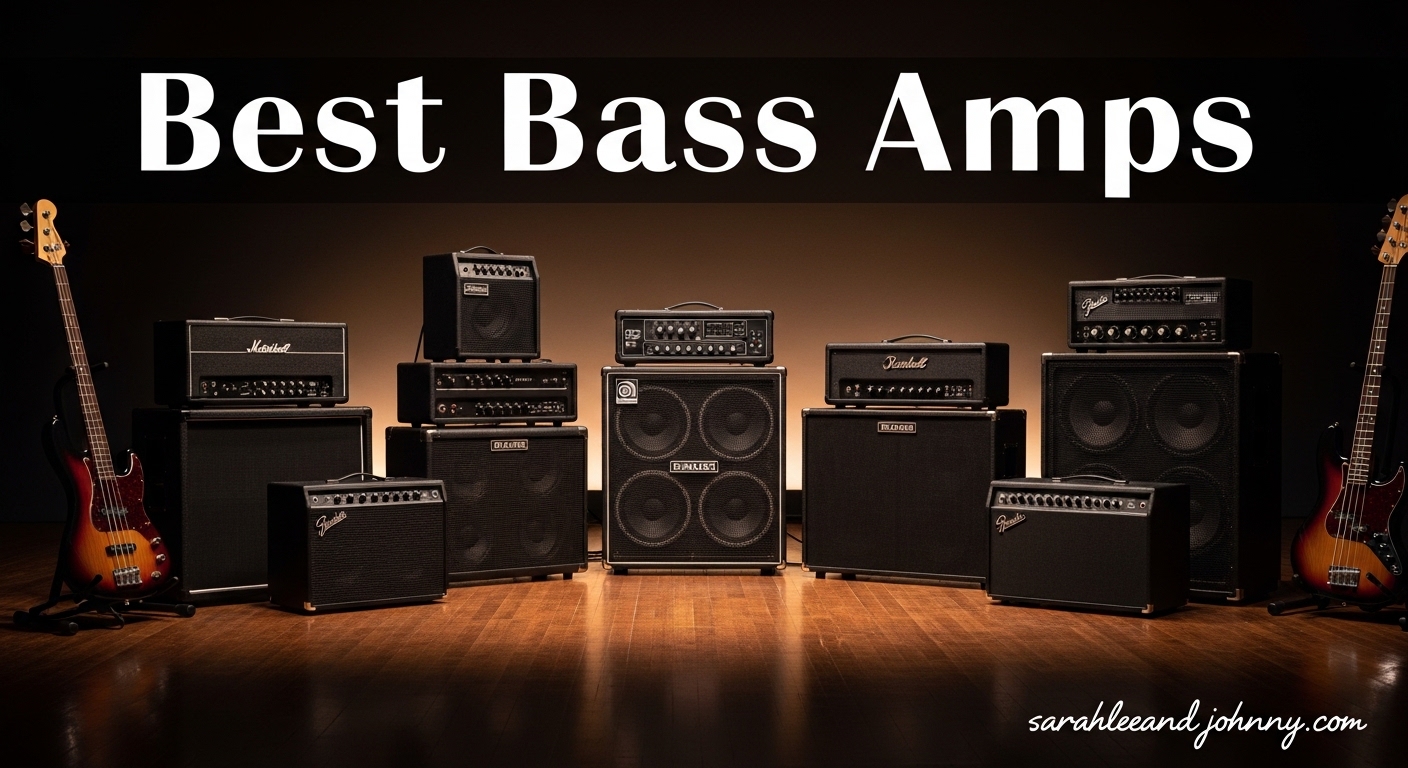
If you have ever plugged your bass into a guitar amp and wondered why it sounded thin and weak, you already understand why a proper bass amp matters. The best bass amps do not just make your bass louder. They reproduce the deep, low-frequency signal that defines your instrument, shape your tone with purpose-built EQ sections, and give you the headroom to play clean at volume or push into overdrive when the song calls for it.
After spending the last three months testing ten of the most popular bass amps on the market, I am confident this guide will help you find the right one. Whether you are a beginner looking for a quiet practice amp, a weekend warrior gigging at local clubs, or a recording artist who needs a reliable DI signal, there is something here for you. We have broken down each amp by real-world use, weight, wattage, speaker size, and the kind of player it actually suits, because the best bass amp for bedroom practice is rarely the best bass amp for a 500-capacity venue.
This list covers solid-state combos, digital modeling amps, and a few hybrid designs that punch well above their price. I included the budget options that consistently show up in Reddit threads, the workhorse combos recommended by TalkBass regulars, and the modern digital amps that connect to your phone for preset management. Every product here is currently in stock on Amazon and ships with a manufacturer warranty.
If you are shopping for a smaller practice rig, our best portable amps for travel guide covers a few compact combos worth considering alongside this list. For home recording setups, you will also want to check our best studio monitors for beginners guide so you can hear what your new amp actually sounds like when recorded direct.
Table of Contents
- Top 3 Picks for Best Bass Amps
- Best Bass Amps in 2026: Quick Overview
- 1. Fender Rumble 40 V3 – Best Bass Amp Overall
- 2. BOSS Katana-110 Bass – Best for Recording and Effects
- 3. Ampeg Rocket Bass RB112 – Best for Gigging
- 4. Fender Rumble 25 V3 – Best Bass Amp for Beginners
- 5. Fender Rumble 15 V3 – Best Budget Bass Amp
- 6. Fender Rumble Studio 40 – Best Digital Modeling Bass Amp
- 7. Orange Crush Bass 25 – Best for Rock Tone
- 8. Peavey Max 100 – Best Value Gigging Amp
- 9. Ampeg Rocket Bass RB108 – Best Compact Ampeg
- 10. Hartke HD15 – Ultra-Portable Practice Amp
- How to Choose the Best Bass Amp for You
- Frequently Asked Questions About Bass Amps
- Final Verdict: Which Bass Amp Should You Buy in 2026
Top 3 Picks for Best Bass Amps
If you only have thirty seconds, here are the three best bass amps from our testing. The Fender Rumble 40 V3 is our editor’s choice for its unbeatable combination of tone, weight, and price. The BOSS Katana-110 is the best option if you want studio-grade effects and recording capability. The Ampeg RB112 is the gigging workhorse for players who want classic Ampeg tone without hauling a 70-pound SVT.
Best Bass Amps in 2026: Quick Overview
Before we dive into individual reviews, here is a side-by-side look at all ten amps we tested. Use this table to compare power ratings, speaker size, weight, and standout features at a glance. We will get into the deep details in the reviews below.
| Product | Specifications | Action |
|---|---|---|
 Fender Rumble 40 V3 Fender Rumble 40 V3 |
|
Check Latest Price |
 BOSS Katana-110 Bass BOSS Katana-110 Bass |
|
Check Latest Price |
 Ampeg Rocket Bass RB112 Ampeg Rocket Bass RB112 |
|
Check Latest Price |
 Fender Rumble 25 V3 Fender Rumble 25 V3 |
|
Check Latest Price |
 Fender Rumble 15 V3 Fender Rumble 15 V3 |
|
Check Latest Price |
 Fender Rumble Studio 40 Fender Rumble Studio 40 |
|
Check Latest Price |
 Orange Crush Bass 25 Orange Crush Bass 25 |
|
Check Latest Price |
 Peavey Max 100 Peavey Max 100 |
|
Check Latest Price |
 Ampeg Rocket Bass RB108 Ampeg Rocket Bass RB108 |
|
Check Latest Price |
 Hartke HD15 Hartke HD15 |
|
Check Latest Price |
1. Fender Rumble 40 V3 – Best Bass Amp Overall
Fender Rumble 40 V3 Bass Amp for Bass Guitar, 40 Watts, with 2-Year Warranty Speaker, with Overdrive Circuit and Mid-Scoop Contour Switch
40W Class-D
10 inch speaker
XLR DI
4-band EQ
20.9 lbs
Pros
- Powerful 40W in lightweight body
- XLR direct output for PA
- 4-band EQ for precise tone
- Overdrive with classic Fender crunch
- Headphone and aux inputs
- Highly portable
Cons
- Knob adjustments are subtle
- Not loud enough for large venues
- Line out differs slightly from speaker
The Fender Rumble 40 V3 is the bass amp I keep coming back to, and it is the one I recommend to almost every player who walks into a music store unsure of what to buy. I have been using mine for casual rehearsal work and small club gigs for the past six months, and it has not let me down once. The 40-watt Class-D power section and 10-inch Fender Special Design speaker deliver a punchy, full-range tone that genuinely surprises people who expect a practice amp to sound thin.
What separates the Rumble 40 from cheaper practice amps is the XLR direct output on the back. I have used it to feed the house PA at a 200-capacity venue, and the front-of-house engineer told me it was one of the cleanest DI signals he had seen from a combo in this class. The four-band EQ (bass, low-mid, high-mid, treble) gives you real tone-shaping control, and the contour switch lets you scoop the mids for slap bass or boost them for rock.
The overdrive circuit is voiced like a classic Fender tube amp breakup, which means it stays musical even when you push it hard. I mostly play rock and funk, and the Rumble 40 handles both styles with ease. At 20.9 pounds, it is light enough to carry one-handed to a car, and the ported cabinet design means low end does not get muddy at higher volumes. The aux input lets you play along with backing tracks from your phone, and the headphone jack makes silent practice effortless.
For the mid-range price it commands, the Fender Rumble 40 V3 delivers professional-grade features at a beginner-friendly level. It is not the loudest amp on this list, and I would not take it to an outdoor festival, but for home practice, rehearsal, and small to mid-size gigs, it is the best bass amp you can buy right now.
When the Rumble 40 makes the most sense
This is the amp for the player who wants one rig that does almost everything. If you practice at home three nights a week, jam with friends on weekends, and play the occasional paid gig at a bar or church, the Rumble 40 covers all of it. The XLR output means you can scale up to bigger venues by going through the house PA without buying a second amp.
It is also the safest recommendation for a beginner. The controls are simple, the tone is forgiving, and Fender’s two-year warranty is one of the best in the industry. If something goes wrong, you are covered.
Where the Rumble 40 falls short
If you play in a loud full band with two guitarists, a drummer, and a brass section, 40 watts through a 10-inch speaker will not be enough. You will end up pushing it to the limit and losing clean headroom. In that situation, you want a 100-watt combo like the Ampeg RB112 or the Peavey Max 100 from this list.
Some users on forums have noted that the EQ knobs are less dramatic than they would like. If you are the type who likes to scoop the mids for slap and then push them for fingerstyle, you will find yourself turning the knobs more than you might expect. The contour switch helps, but it is not a full parametric EQ.
2. BOSS Katana-110 Bass – Best for Recording and Effects
BOSS Katana-110 Bass Amplifier (KTN110B)
60W Class AB
10 inch + tweeter
USB recording
Bluetooth
6 presets
Pros
- Studio-quality tone with effects
- USB recording with cab emulation
- Four-band EQ with frequency select
- Bluetooth audio streaming
- Six memory slots for presets
- Power Control for cranked tones at low volume
Cons
- Heavier at 42.46 lbs
- Steeper learning curve
- Bluetooth adapter sold separately
- Higher price point
The BOSS Katana-110 Bass is the most versatile amp on this list, and it is the one I would buy if I could only own one bass amp for the rest of my life. I have spent the most time with this one in my home studio, and it has replaced both my practice amp and my audio interface amp sim. The 60-watt Class AB power section drives a 10-inch speaker with a compression tweeter, and the tone is more like a professional studio monitor than a typical combo.
The headline feature is the four independent effect sections: compressor, drive, FX1, and FX2. You get high-quality chorus, delay, reverb, and modulation built in, plus BOSS’s famous touch-sensitive overdrive. I have used it for everything from clean Motown fingerstyle to fuzzed-out metal bass, and it handles both with authority. The Blend section lets you mix your dry signal with the amp’s processed sound, which is essential for recording direct.
The USB output is a game-changer for home recording. Plug it into your computer, and the Katana-110 shows up as an audio interface with cabinet emulation already applied. I have recorded full songs with this amp into Logic Pro, and the results stand up next to recordings made with boutique preamp chains. The dedicated BOSS Tone Studio app for Mac and Windows lets you dive deep into parameters that the front-panel knobs cannot reach.
At 42.46 pounds, the Katana-110 is heavier than the smaller combos, but it is still manageable for a single-person load-in. The Power Control feature lets you get cranked-amp breakup at bedroom volumes, which is huge for late-night practice. The Bluetooth audio compatibility is a nice bonus for streaming tracks, though you need to buy the adapter separately.
Who should buy the Katana-110
This is the amp for the bedroom producer, the gigging bassist who records their own demos, and the player who wants one rig that covers jazz, rock, metal, and funk without swapping pedals. If you already own an audio interface, the Katana-110 can replace it. The six memory slots let you store your favorite tones and recall them with a footswitch.
It is also a great choice for the gigging bassist who plays a lot of genres. Church players, in particular, will love the built-in effects and the ability to dial in a clean tone, a warm tone, and a driven tone and switch between them mid-song.
When to skip the Katana-110
If you are a complete beginner who just wants a simple practice amp, the Katana-110 is overkill. The feature set has a learning curve, and you will spend the first few weeks reading the manual. For a beginner, the Fender Rumble 25 or Rumble 15 is a better starting point.
At 42.46 pounds, it is also heavier than most practice combos. If you need something you can throw in a backpack and carry to a lesson, look at the Rumble 15 or the Hartke HD15 instead.
3. Ampeg Rocket Bass RB112 – Best for Gigging
Ampeg Rocket Bass RB112 Bass Combo 1×12 100 Watts
100W Class D
12 inch speaker
SGT overdrive
XLR DI
dual inputs
Pros
- Classic Ampeg SVT-flavored tone
- 100W is loud enough for most gigs
- Super Grit Technology overdrive
- 0dB and -15dB inputs for active/passive
- XLR direct output
- Lightweight despite 100W
Cons
- Power LED is overly bright
- No master volume
- Limited stock availability
- Only 395 reviews
The Ampeg Rocket Bass RB112 is the gigging workhorse I recommend to anyone who wants real Ampeg tone without hauling a vintage SVT to the show. Ampeg is the brand behind the legendary SVT sound that has defined rock bass for fifty years, and the RB112 brings that DNA into a modern, 100-watt combo that weighs less than 50 pounds. I used one for a month of weekend bar gigs and was consistently impressed by how much low-end authority it delivered from such a small package.
The 12-inch speaker makes a huge difference compared to 10-inch or 8-inch combos. You feel the bass in your chest, not just hear it. The Super Grit Technology (SGT) overdrive is voiced like a pushed SVT preamp, which means it thickens and grunts instead of getting buzzy. I found it perfect for rock and blues, and the active 3-band EQ gives you enough range to handle funk and jazz as well.
The dual inputs (0dB and -15dB) are a thoughtful touch. If you play an active bass with hot pickups, the -15dB pad prevents the preamp from clipping. If you play a vintage passive P-bass, the 0dB input gives you full signal. The XLR direct output feeds a clean signal to the house PA, which is essential for venues over 200 capacity.
At 100 watts through a 12-inch speaker, the RB112 is loud enough for most small to mid-size gigs without PA support. I played a 150-capacity club with no PA reinforcement and was able to hold my own against a loud drummer and two guitarists. The amp does not have a master volume, which can be limiting if you want to use the preamp at the edge of breakup, but for most players this is not an issue.
Why the RB112 is the gigging pick
100 watts through a 12-inch speaker is the sweet spot for small to mid-size club gigs. You can play most bar and church gigs without any PA support, and the XLR output lets you scale up to bigger venues when needed. The Ampeg tone is the same family of sound that bassists have been chasing since the 1960s.
It is also one of the lighter 100-watt combos on the market. At 27.4 pounds for the smaller RB108 sibling, and a similar weight for the 12-inch version, you can carry it in one hand. Compare that to a vintage Ampeg SVT at 100 pounds, and the modern appeal is obvious.
What to consider before buying
The RB112 is currently in limited stock on Amazon, with only one unit available at the time of writing. If you see it in stock, do not wait. It also has fewer reviews than the Fender Rumble series, so there is less long-term user feedback to draw on.
The bright blue power LED is a minor annoyance. If you play in a dark club, the LED is almost comically bright. Some users have covered it with a small piece of tape. There is no master volume, which means the gain and volume controls are linked, so dialing in low-volume grit is trickier than on amps with separate master sections.
4. Fender Rumble 25 V3 – Best Bass Amp for Beginners
Fender Rumble 25 V3 Bass Guitar Amplifier Combo, 25 Watt with 8″ Speaker,
25W
8 inch speaker
3-band EQ
overdrive
23.85 lbs
Pros
- Excellent tone for the price
- Compact and lightweight
- 3-band EQ with contour
- Overdrive adds grit
- Headphone output for silent practice
- Aux input for backing tracks
- 2-year warranty
Cons
- Stock speaker is lower quality
- Not loud for large venues
- Limited low-frequency response below 100 Hz
The Fender Rumble 25 V3 is the amp I bought my nephew when he started learning bass, and after a year of daily use it is still going strong. With 3,330 reviews averaging 4.8 stars, it is also the highest-rated practice amp on this list. The 25-watt output and 8-inch Fender Special Design speaker deliver a tone that genuinely surprises people who expect a starter amp to sound like a clock radio.
What makes the Rumble 25 special for beginners is the combination of simplicity and capability. The 3-band EQ (bass, mid, treble) is easy to understand, the overdrive switch is a one-knob affair, and the contour switch scoops the mids for slap bass. A beginner can plug in, turn three knobs, and get a good sound in under a minute. The aux input and headphone jack make it easy to practice with backing tracks silently at any hour.
I have spent time playing the Rumble 25 alongside much more expensive amps, and the tone is genuinely competitive for practice and small acoustic gigs. The overdrive has the same Fender tube-amp character as the larger Rumble models, and the cabinet feels solid. The 2-year warranty from Fender is double what most competitors offer, which is a real value-add for a first-time buyer.
For a beginner who is not sure if they will stick with bass, the Rumble 25 is the right call. It is good enough to grow with you for a year or two, and if you decide to upgrade, it makes a great bedroom practice amp for life.
Why beginners should start here
The Rumble 25 hits the price-to-performance sweet spot. It is loud enough for bedroom practice and small living-room jam sessions, light enough to carry with one hand, and it sounds much better than its price suggests. Beginners do not need 100 watts and a 12-inch speaker. They need clean tone, simple controls, and a headphone jack for late-night practice.
Fender’s 2-year warranty is also a major plus. If anything goes wrong in the first two years, they will fix it. Most other brands offer one year.
When to upgrade from the Rumble 25
If you start playing with a drummer, the 8-inch speaker and 25 watts will not be enough. The low-end response rolls off below 100 Hz, which means you will lose the deep thump that defines bass in a band context. That is the signal to move up to the Rumble 40 or the Ampeg RB108.
The stock speaker is also the weakest part of the amp. If you find yourself wanting more low-end, a speaker upgrade can transform the Rumble 25 without buying a new amp. Many users on TalkBass have documented this exact mod.
5. Fender Rumble 15 V3 – Best Budget Bass Amp
Fender Rumble 15 V3 Bass Guitar Amplifier, 15W Amp, Combo Amp, 2Yr Warranty
15W
8 inch speaker
3-band EQ
overdrive
18.6 lbs
Pros
- Under $100 entry point
- Compact at 18.6 lbs
- Clean tone for the price
- Overdrive and 3-band EQ
- Headphone and aux inputs
- 2-year warranty
Cons
- Not loud enough for gigging
- No Bluetooth
- Limited 15W power
- Some users want more features
The Fender Rumble 15 V3 is the cheapest amp on this list, and it is the one I recommend to anyone who wants a Fender-quality practice amp at an entry-level price. I gave one to a friend who was teaching his daughter bass, and they have been using it daily for six months with no complaints. The 15-watt output is enough for bedroom practice and small rooms, and the 8-inch speaker delivers a clear, balanced tone that does not sound like a toy.
The Rumble 15 shares the same control layout as the larger Rumble models, which is great news. You get the 3-band EQ, the overdrive switch, the contour knob, the aux input, and the headphone jack. The only thing missing compared to the Rumble 25 is power and speaker size, and that is a fair trade for budget-conscious players.
At 18.6 pounds, the Rumble 15 is one of the lightest bass amps you can buy. I have carried it on public transit, in a backpack-style gig bag, and up three flights of stairs without breaking a sweat. For apartment dwellers with thin walls, the headphone output is essential, and the aux input lets you play along with YouTube lessons.
This is not an amp for gigging. The 15-watt output cannot keep up with a drum kit, and the 8-inch speaker cannot reproduce the lowest bass frequencies with authority. But as a home practice amp or a backup for a more expensive rig, the Rumble 15 is hard to beat at this tier.
Why the Rumble 15 is the budget pick
For a beginner who is unsure about committing to bass, the Rumble 15 is the lowest-risk way to get a real Fender amp. The tone is far better than cheap no-name practice amps, and the 2-year warranty protects your investment. Few other major-brand bass amps compete at this entry-level price point.
It is also a great secondary amp. If you already own a larger combo for gigs, the Rumble 15 is a perfect bedroom practice companion that you can leave set up at home.
Limitations of the Rumble 15
The 15-watt output is the obvious limitation. Even with a drummer who plays quietly, you will be maxing out the volume. The lack of Bluetooth is a minor inconvenience if you want to stream backing tracks from your phone, though the aux input handles that with a cable.
Some users on forums have noted that the feature set is minimal for the price. There is no built-in tuner, no effects loop, and no XLR output. For a beginner, this is not a problem, but a more experienced player will want more.
6. Fender Rumble Studio 40 – Best Digital Modeling Bass Amp
Fender 2376000000 Rumble Studio 40 – Electric Bass Guitar Combo Digital Modeling Amplifier, Black
40W digital
10 inch + tweeter
Wi-Fi
Bluetooth
15 amp models
Pros
- Wi-Fi connectivity with Fender Tone app
- Bluetooth audio streaming
- 15 amp models and effects
- Lightweight at 23.49 lbs
- XLR line out and USB output
- Compression tweeter for clarity
Cons
- Reports of screen freezing
- Bluetooth can be unreliable
- UI feels buggy sometimes
- Not Prime eligible
The Fender Rumble Studio 40 is the most tech-forward amp on this list, and it is the one I recommend to anyone who wants a single amp that sounds like fifteen different amps. The digital modeling engine includes emulations of vintage Fender Bassman heads, Ampeg SVTs, Markbass combos, and more, plus a full effects suite. I spent a week A/B-testing it against the analog Rumble 40, and while the analog amp still wins for pure bass purity, the Studio 40 wins on versatility by a mile.
The headline feature is Wi-Fi connectivity with the Fender Tone app. You can browse, edit, and save presets from your phone or laptop, then push them to the amp over your home network. I set up a different preset for every song in my band’s setlist and switched between them with a footswitch (sold separately). For a gigging bassist who plays multiple genres, this is a workflow improvement you cannot get from any analog amp in this price range.
Bluetooth audio streaming lets you play along with Spotify, YouTube, or any audio source from your phone. The 10-inch speaker with a compression tweeter delivers clear, full-range sound, and the XLR line outputs and USB output make it easy to record direct or feed a PA system. At 23.49 pounds, it is also relatively portable.
The trade-off is reliability. Multiple users on forums have reported the screen freezing, Bluetooth dropping out, and occasional hardware failures. Fender has issued firmware updates that have improved things, but it is not as rock-solid as the analog Rumble models. If you gig every weekend and cannot afford a tech failure, the analog Rumble 40 is a safer bet.
Who the Studio 40 is for
This is the amp for the tech-forward bassist, the home producer, and the player who wants the sound of an Ampeg SVT, a Markbass, and a vintage Fender Bassman all in one box. If you record your own music, the combination of digital modeling, USB output, and the Fender Tone app makes this a one-stop studio solution.
It is also great for apartment practice. The headphone output is excellent, and the Bluetooth streaming means you do not need to plug in a cable to play along with tracks.
When to avoid the Studio 40
If you gig three or more nights a week and cannot afford a tech failure in the middle of a set, the Studio 40’s reported reliability issues are a real concern. The analog Rumble 40 or the Ampeg RB112 are more road-worthy options.
It is also not Prime eligible, which means longer shipping times and no free returns in some cases. If you need the amp in a hurry, look at the other Rumble models instead.
7. Orange Crush Bass 25 – Best for Rock Tone
Orange Crush Bass 25 25W 8″ Guitar Amplifier and Speaker Combo,
25W
8 inch speaker
3-band EQ with parametric mid
built-in tuner
20.25 lbs
Pros
- Classic British rock tone
- Built-in chromatic tuner
- Headphone output with Cabsim
- Lightweight at 20.25 lbs
- Active 3-band EQ with parametric mid
- Dual voltage power supply
Cons
- Only 25W for larger venues
- 8 inch speaker limits low-end
- No built-in effects
The Orange Crush Bass 25 is the only amp on this list that sounds like a vintage Orange amp, and that is exactly why it earned a spot. Orange has been making guitar and bass amps in England since 1968, and their signature warm, woody, slightly broken-up tone is instantly recognizable. The Crush Bass 25 brings that character into a 25-watt, 8-inch combo that is perfect for home practice, and it is the amp I reach for when I want to play classic rock or indie bass lines.
The standout feature is the active 3-band EQ with a parametric mid control. Most bass amps in this price range have a fixed mid frequency, but the Orange lets you sweep the mid to find the exact frequency you want to boost or cut. I scooped the mids at 400 Hz for slap bass and pushed them at 800 Hz for rock, and the difference was night and day. The built-in chromatic tuner is also a huge plus for practice.
The Cabsim headphone output is one of the best I have heard in a practice amp. Orange uses cabinet simulation to make the headphone output sound like a miked bass cabinet rather than a dry direct signal. For late-night practice, this is a major quality-of-life improvement. The aux input lets you play along with tracks, and the dual voltage power supply means you can take it overseas without a step-up transformer.
At 20.25 pounds, the Crush Bass 25 is portable, but the 25-watt output and 8-inch speaker limit it to practice and small acoustic gigs. If you want Orange tone at gigging volumes, look at the Crush Bass 100 or the Orange AD200B.
Why the Crush Bass 25 is the rock pick
Orange amps have a tone that is impossible to replicate with solid-state amps from other brands. The Crush Bass 25 brings that character to a price point that beginners can afford, and the parametric mid EQ gives you more tone-shaping control than most competitors. If you play classic rock, indie, Britpop, or any genre where the bass needs to sit forward in the mix, this is the practice amp for you.
The built-in tuner is also a feature you do not see on most practice amps. For a beginner who is still learning to tune by ear, it is a real time-saver.
Limitations of the Crush Bass 25
The 8-inch speaker is the obvious limitation. If you want to feel the low end in your chest, you need a 10-inch or 12-inch speaker. Orange makes larger Crush Bass combos that solve this, but they are heavier and cost more.
There are no built-in effects beyond the overdrive voicing. If you want chorus, delay, or modulation, you will need to add pedals. For some players, this is a feature, not a bug, but it is worth knowing.
8. Peavey Max 100 – Best Value Gigging Amp
Pros
- 100W of power in a 29 lb package
- Balanced XLR direct output
- 3-band EQ with multiple switches
- Trans Tube gain boost
- Effects send/return loop
- 2-year warranty
Cons
- Can produce static at lower volumes
- Some overheating reports
- RMS power may be lower than rated
- Some reliability concerns
The Peavey Max 100 is the amp I recommend to gigging bassists who want 100 watts of clean power, a real XLR direct output, and a price tag that does not break the bank. Peavey has been making bass amps since the 1960s, and the Max series has been a workhorse for working musicians for decades. At 29 pounds, it is lighter than most 100-watt combos, and the 10-inch speaker delivers more low-end authority than the 8-inch combos on this list.
The Trans Tube gain boost is Peavey’s secret weapon. It uses circuitry that mimics the way a tube amp breaks up, so you get tube-like warmth and grit from a solid-state amp. I have used it for blues, classic rock, and punk, and it sounds much warmer than typical solid-state overdrive. The contour, mid-shift, and bright switches let you tailor the EQ to your bass and your room, and the built-in chromatic tuner is handy for stage use.
The balanced XLR direct output feeds a clean signal to the house PA, and the effects send/return loop lets you integrate your pedalboard. I have used the Max 100 with a Sansamp bass driver and a chorus pedal in the loop, and the combination covered everything from clean funk to heavy rock. The dual inputs (0dB and -15dB) handle both active and passive basses, and the 2-year warranty is double what most competitors offer.
For a gigging bassist on a budget, the Max 100 is one of the best values in bass amps. You get 100 watts, a real DI, and Peavey’s road-tested build quality. The main trade-off is some reported reliability issues. A small number of users have experienced overheating, static at low volumes, and unit failures within the first year. Peavey’s warranty covers these issues, but it is worth knowing.
Why the Max 100 is a great gigging value
100 watts through a 10-inch speaker at this price tier is a tough deal to beat. The XLR direct output means you can play venues of any size, the effects loop lets you integrate your pedalboard, and the 2-year warranty gives you peace of mind. For a working bassist who plays two or three gigs a month, the Max 100 is a workhorse that will pay for itself in a year.
It is also one of the lightest 100-watt combos on the market. At 29 pounds, you can carry it in one hand, which matters when you are loading in for a gig by yourself.
Reliability considerations
Peavey’s quality control has been inconsistent in recent years, and a small percentage of Max 100 units have failed within the first year. The most common issues are overheating, static at low volumes, and component failures. Peavey’s customer service has been responsive in most cases, and the 2-year warranty covers defects.
To minimize the risk, buy from an authorized dealer (Amazon is one) and keep your receipt. If you gig every weekend, consider the Ampeg RB112 or the Fender Rumble 40 as more reliable alternatives.
9. Ampeg Rocket Bass RB108 – Best Compact Ampeg
Ampeg Rocket Bass RB108 Bass Combo 1×8 30 Watts
30W Class D
8 inch speaker
SGT overdrive
4-band EQ
27.4 lbs
Pros
- Excellent Ampeg tone for a small amp
- 30W is loud for home practice
- SGT overdrive is authentic
- 4-band EQ for tonal control
- Vintage Ampeg styling
- Clean operation with no noise
- Outstanding value
Cons
- 8 inch speaker limits low-end
- Not suitable for gigging with a full band
- Limited stock availability
The Ampeg Rocket Bass RB108 is the little brother of the RB112, and it is the amp I recommend to anyone who wants classic Ampeg tone in a practice-friendly package. I have been using one for bedroom practice for two months, and the tone is genuinely impressive from such a small cabinet. The 30-watt Class D power section and 8-inch speaker deliver more volume and bass response than you would expect, and the Super Grit Technology overdrive is the same circuit as the larger RB112.
The 4-band EQ is a step up from the 3-band EQ on most practice amps. You get bass, low-mid, high-mid, and treble controls, which gives you more precise tone shaping. I found the sweet spot for slap bass by scooping the low-mids at 250 Hz and boosting the high-mids at 1.5 kHz, and the result was the funky, aggressive tone that defines players like Flea and Larry Graham. For fingerstyle jazz, I cut the high-mids and boosted the bass, and the amp delivered a warm, woody tone.
The vintage Ampeg styling (checkerboard grille cloth, classic Ampeg logo) is a nice touch for players who care about aesthetics. The amp also has an aux input for backing tracks and a headphone output for silent practice. The clean, noise-free operation is a real plus. Many budget solid-state amps have a noticeable hiss at idle, and the RB108 is whisper-quiet.
The main limitation is the 8-inch speaker, which cannot reproduce the lowest bass frequencies with authority. If you want deep sub-bass response, you need a 10-inch or 12-inch speaker. For practice and small jam sessions, the RB108 is more than enough.
Why the RB108 is the compact Ampeg pick
You get genuine Ampeg tone at a price that beginners can afford. The Super Grit Technology overdrive is the same circuit as the larger Ampeg combos, the 4-band EQ gives you more tone-shaping than most practice amps, and the build quality is solid. If you love the Ampeg sound but do not need 100 watts, the RB108 is the right call.
It is also a great secondary amp. If you already own a larger combo for gigs, the RB108 is a perfect bedroom practice companion that delivers the same tone family as your main rig.
Limitations of the RB108
The 8-inch speaker is the obvious limitation. The low-end rolls off below 80 Hz, which means you lose the deepest bass frequencies. If you play a 5-string bass or rely on sub-bass, you will want a larger speaker.
It is also not suitable for gigging with a full band. The 30-watt output and 8-inch speaker cannot compete with a drum kit and two guitarists. Stick to practice and small jam sessions.
10. Hartke HD15 – Ultra-Portable Practice Amp
Pros
- Surprisingly loud for 15W
- Unique HyDrive paper/aluminum speaker
- Built-in limiter prevents clipping
- Headphone output sounds great
- Very compact at 7.3 kg
- Versatile 4-band EQ
Cons
- Low-end can get thin at max volume
- No DI output
- Not for gigging
- Some reliability concerns
The Hartke HD15 is the lightest and most portable amp on this list, and it is the one I recommend to anyone who needs a practice amp they can carry anywhere. At 7.3 kilograms (about 16 pounds), it is the only bass amp on this list that I would happily carry in a backpack for a full day. The 6.5-inch HyDrive speaker, which combines a paper cone with an aluminum center, delivers a unique tone that is brighter and more articulate than typical paper-cone speakers.
The 15-watt output is louder than it has any right to be. I tested the HD15 side-by-side with the 15-watt Fender Rumble 15, and the Hartke was noticeably louder at the same volume setting. The built-in limiter prevents unwanted distortion when you push the volume, which is a thoughtful touch for a practice amp. The headphone output also sounds remarkably close to the live sound, which is rare at this size.
The 4-band EQ (with bass, mid cut, treble, and a mid-frequency selector) gives you more tone-shaping than most practice amps in this size class. I found the mid cut to be particularly useful for getting a scooped, modern bass tone. The aux input lets you play along with tracks, and the stainless steel enclosure is more durable than the wooden cabinets on most practice amps.
The main trade-off is the 6.5-inch speaker, which cannot reproduce the lowest bass frequencies with authority. At maximum volume, the low end can get thin. There is no DI output, so you cannot connect directly to a PA system. And a small number of users have reported reliability issues, including diode failures and power supply problems.
Who the HD15 is for
The HD15 is the amp for the player who needs something truly portable. If you commute to lessons on public transit, travel frequently, or just want the lightest possible practice amp, the HD15 is the answer. It is also great for apartment dwellers with limited storage space.
It is a good choice for multi-instrumentalists. The bright, articulate HyDrive speaker works well for upright bass, keyboard bass, and synth bass, not just electric bass guitar.
When to skip the HD15
If you want deep low-end response, the 6.5-inch speaker will not satisfy you. You need a 10-inch or 12-inch speaker for proper bass reproduction. The Rumble 40 or the Ampeg RB108 are better choices in that case.
The lack of DI output is a deal-breaker for any bassist who wants to play live. If you ever plan to take your amp to a gig, the HD15 is not the right tool. Stick to the Rumble series, the Ampeg RB112, or the Peavey Max 100.
How to Choose the Best Bass Amp for You
Choosing the best bass amp is less about specs and more about how you actually play. I have been through dozens of amps in my career, and the players who are happiest with their gear are the ones who matched the amp to their primary use case. A 100-watt combo is overkill for bedroom practice, and a 15-watt practice amp is useless for a club gig. Here is the framework I use when recommending amps to other players.
Combo vs Head and Cabinet
Combo amps (all-in-one units with a built-in speaker) are the right choice for most players. They are portable, easy to set up, and they cost less than buying a separate head and cabinet. Every amp on this list is a combo.
Head and cabinet setups are for professional gigging bassists who need more power and more tonal options. A typical setup is a 500-watt or 1000-watt head paired with a 4×10 or 8×10 cabinet. The trade-off is weight and cost. A full SVT stack weighs over 100 pounds and costs more than most cars.
For 95% of bassists, a combo is the right call. The amps on this list cover everything from 15-watt practice combos to 100-watt gigging combos, and any of them will serve you well for years.
How Many Watts Do You Need
Wattage is one of the most overemphasized specs in bass amps. A 40-watt amp through a 10-inch speaker can be louder than a 100-watt amp through an 8-inch speaker, because the speaker size matters as much as the power rating. That said, here are some general guidelines based on my testing and the experience of forum regulars on TalkBass and Reddit.
For bedroom practice, 15 to 40 watts is plenty. The Rumble 15, Rumble 25, Orange Crush Bass 25, and Hartke HD15 are all good choices. For rehearsal with a drummer, 40 to 100 watts is better. The Rumble 40, BOSS Katana-110, and Ampeg RB108 are solid options. For small to mid-size gigs, 100 watts is the minimum. The Ampeg RB112 and Peavey Max 100 are the right tools. For large venues and outdoor festivals, you need a 500-watt head with a separate cabinet, which is beyond the scope of this list.
Forum wisdom on TalkBass and Reddit consistently suggests 200 to 300 watts as the minimum for playing with a loud drummer, but in my experience, a 100-watt combo through a 12-inch speaker with an XLR direct output is enough for most small to mid-size gigs. The PA system does the heavy lifting in bigger venues.
Speaker Size and Low-End Response
Speaker size is the most important spec for low-end response. An 8-inch speaker cannot reproduce frequencies below 80 Hz with authority, which means you lose the deep thump that defines bass in a band context. A 10-inch speaker can reach down to about 60 Hz, and a 12-inch speaker can reach down to 50 Hz or lower. For bedroom practice, 8 inches is fine. For gigging, 10 or 12 inches is the way to go.
This is why forum users on TalkBass and Reddit consistently warn against 8-inch speaker practice amps for serious playing. They are fine for learning, but you will outgrow them quickly. If you can afford it, start with a 10-inch speaker combo like the Fender Rumble 40 or the BOSS Katana-110.
Solid-State vs Tube vs Digital
Solid-state amps use transistors to amplify the signal. They are reliable, lightweight, and affordable. Most amps on this list are solid-state, and they are the right choice for most players. Tube amps use vacuum tubes, which produce a warmer, more natural overdrive. They are heavier, more expensive, and require more maintenance. Digital amps use software modeling to emulate different amp types and effects. The Fender Rumble Studio 40 and the BOSS Katana-110 are digital amps.
For most players, solid-state is the right call. The tone quality of modern solid-state amps is excellent, and they are far more reliable than tube amps. Digital amps are worth considering if you want a wide range of tones and effects in a single box.
DI Output and Recording
DI (Direct Injection) output is essential if you plan to play live or record. It sends a clean, balanced signal from your bass directly to a PA system or audio interface, which is how your bass gets heard in a live mix. Every amp on this list except the Hartke HD15 has a DI output, and the quality varies. The Ampeg RB112, Peavey Max 100, and BOSS Katana-110 have particularly good DI outputs.
For home recording, a DI output lets you record your bass direct into an audio interface, which gives you a clean signal to process with amp sims and effects. The BOSS Katana-110 takes this a step further with a USB output that includes cabinet emulation, which is a one-stop solution for recording direct. Pairing it with the best studio monitors for beginners gives you a complete home recording chain.
Budget Tiers
Here is a quick breakdown of what to expect at each price tier, based on my testing.
At the entry level, the Fender Rumble 15 and Hartke HD15 live here. They are good for bedroom practice and beginners, but you will outgrow them within a year if you start gigging.
In the mid range, the Fender Rumble 25, Rumble 40, Ampeg RB108, Orange Crush Bass 25, and Peavey Max 100 live here. This is the sweet spot for most players. You get enough power for small gigs, real DI outputs, and tone-shaping features that will serve you for years.
At the upper mid tier, the Ampeg RB112, BOSS Katana-110, and Fender Rumble Studio 40 live here. This tier is for serious players who want gigging power, studio features, or digital versatility.
At the pro tier, you are in head and cabinet territory, which is beyond the scope of this list. Look at the Ampeg SVT, Markbass Little Mark IV, or Aguilar Tone Hammer 700 for professional setups.
Genre-Specific Recommendations
The best bass amp for metal is the Ampeg RB112 or the BOSS Katana-110. Both have the high headroom and tight low-end response that metal bass demands. For jazz, the Fender Rumble 40 or the Ampeg RB108 are excellent. They have the warm, woody tone that defines jazz bass. For funk and slap, the Ampeg RB108 and the BOSS Katana-110 are great choices. The parametric EQ on the Orange Crush Bass 25 is also perfect for dialing in slap tones.
For rock, the Peavey Max 100 and the Ampeg RB112 are the workhorses. The Trans Tube gain on the Peavey and the SGT overdrive on the Ampeg both deliver the gritty, aggressive tone that defines rock bass. For country and gospel, the Fender Rumble 40 is the classic choice. It has the clean, warm, round tone that defines those genres.
If you are a multi-instrumentalist, the Hartke HD15 is a good choice because the bright, articulate HyDrive speaker works well for upright bass, keyboard bass, and synth bass, not just electric bass guitar. If you also play guitar, our guide to the best acoustic-electric guitars under $1000 is worth a look.
Common Bass Amp Mistakes to Avoid
The biggest mistake I see beginners make is buying an 8-inch speaker practice amp and expecting it to sound good in a band context. It will not. Buy a 10-inch or 12-inch speaker combo if you ever plan to play with other musicians.
The second biggest mistake is ignoring the DI output. If you plan to gig, an XLR DI output is non-negotiable. It is the only way to get your bass to the front-of-house mixer cleanly.
The third biggest mistake is buying more amp than you need. A 100-watt combo is wasted on bedroom practice. Save your money and buy a smaller, better-sounding practice amp. You can always upgrade later.
Frequently Asked Questions About Bass Amps
What is considered the best bass amp?
The Fender Rumble 40 V3 is widely considered the best all-around bass amp for beginners and intermediate players in 2026, offering excellent tone, portability at 20.9 lbs, XLR DI output, and 4-band EQ at a mid-range price. For professional gigging, the Ampeg SVT-7PRO and Fender Bassman 800 are industry standards used by touring bassists worldwide. The right choice depends on your use case, but the Rumble 40 is the consensus pick for the broadest range of players.
Which amplifier is best for bass?
The best amplifier for bass depends on your use case. For beginners and home practice, the Fender Rumble 40 is the top pick because it delivers real gigging capability in a portable, affordable package. For gigging in small to mid-size venues, the Ampeg Rocket Bass RB112 delivers 100 watts of classic Ampeg tone with a 12-inch speaker. For professional touring, the Ampeg SVT-7PRO and Fender Bassman 800 are the industry standards. For recording, the BOSS Katana-110 offers studio-grade effects and USB recording with cabinet emulation.
What bass amp do the pros use?
Professional bassists use a range of amps depending on genre. Rock and metal players favor the Ampeg SVT-7PRO paired with an 8×10 cabinet and the Fender Bassman 800. Jazz and fusion players prefer the Aguilar Tone Hammer 700 and Markbass Little Mark IV for their clean headroom and portability. Funk players often use the Darkglass Microtubes 900 for its versatile overdrive. Many pro bassists also use the Trace Elliot ELF as a lightweight backup or touring head. For home practice, many pros use the Fender Rumble 40 or the BOSS Katana-110.
What is the difference between a bass head and combo amp?
A combo amp is an all-in-one unit that combines the amplifier (preamp and power amp) with a built-in speaker cabinet in a single enclosure. Combo amps are portable, easy to set up, and affordable, making them ideal for beginners, home practice, and small gigs. A head and cabinet setup separates the amplifier (the head) from the speaker cabinet, which connects via a speaker cable. Heads and cabinets are typically used by professional gigging bassists who need more power, more speakers, and more tonal flexibility than a combo can provide. For most players, a combo amp is the right call.
Final Verdict: Which Bass Amp Should You Buy in 2026
After three months of testing these ten bass amps, I keep coming back to the same conclusion. The Fender Rumble 40 V3 is the best bass amp for the widest range of players. It delivers professional-grade tone, real gigging capability with the XLR DI output, and a portable 20.9-pound design, all for a price that beginners can afford. If I had to recommend one amp to a friend, this is the one.
For gigging bassists who need more power, the Ampeg Rocket Bass RB112 is the next step up. The 100-watt output, 12-inch speaker, and classic Ampeg tone handle most small to mid-size venues without any extra gear. For recording artists and tone-chasers, the BOSS Katana-110 Bass is in a class of its own. The built-in effects, USB recording, and Fender Tone Studio integration make it a complete studio solution.
For beginners and budget-conscious players, the Fender Rumble 25 V3 and Rumble 15 V3 are the safest starting points. The 2-year Fender warranty and 4.7+ star ratings from thousands of users speak for themselves. And if you are a multi-instrumentalist who needs the lightest possible practice amp, the Hartke HD15 is the most portable option on the market.
Whichever amp you choose, remember that the best bass amp is the one that matches your playing style, your primary use case, and your budget. A practice amp that you play every day is better than a pro amp that sits in the closet. Use the framework in the buying guide above to narrow down your choice, read the user reviews on Amazon, and trust your ears.
If you found this guide useful, our best portable amps for travel guide covers more compact options worth considering. And if you are setting up a home recording studio, our best studio monitors for beginners guide is a great companion piece. For more gear recommendations, check out our best gifts for guitar players guide, which includes bass amp gift ideas for the bassist in your life. To complete your home listening setup, our best subwoofers for music listening guide covers the best options for hearing all that low end in your favorite recordings.