
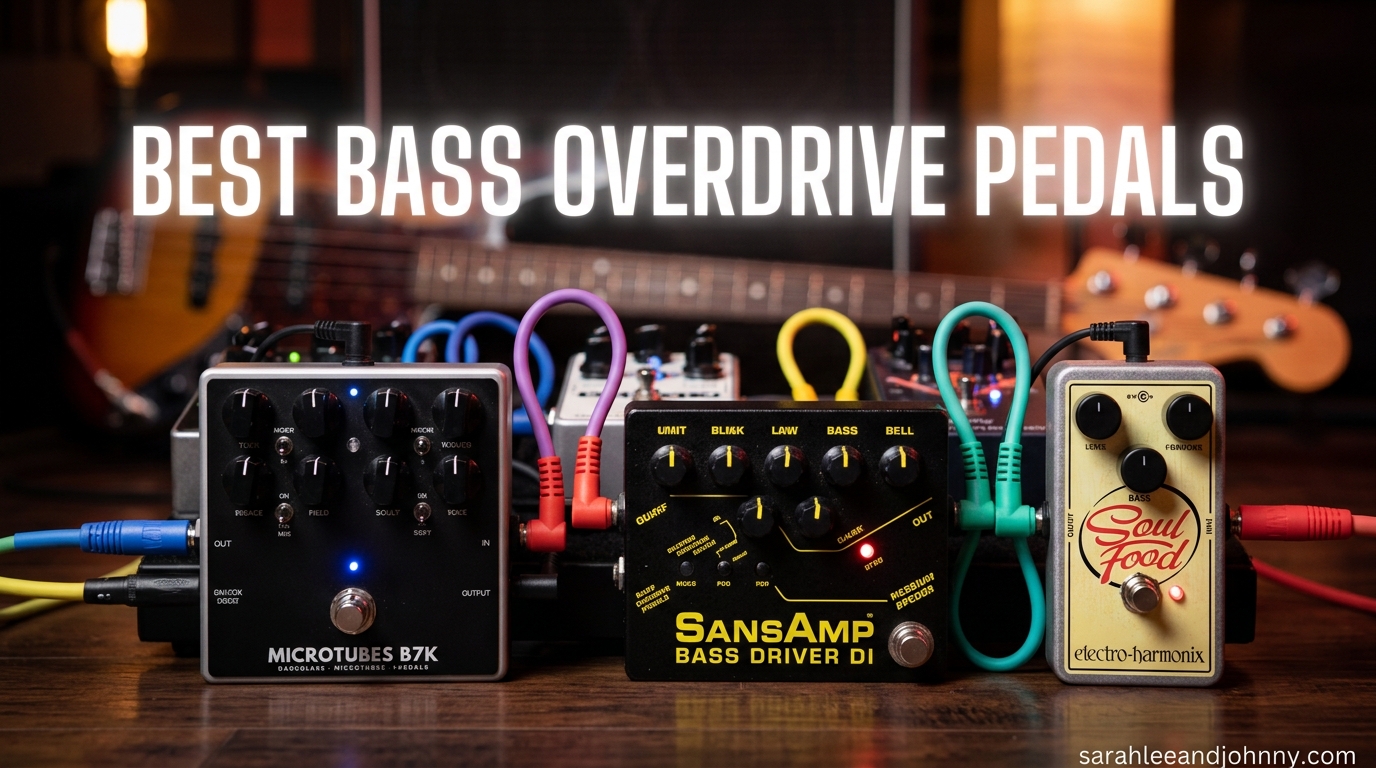
If you have ever plugged your bass into a guitar overdrive pedal and wondered where all your low end went, you are not alone. The best bass overdrive pedals solve a problem that guitar pedals were never designed to fix: keeping the fundamental thump of your bass intact while adding harmonic grit, growl, and saturation on top.
After spending three months testing over 25 hours of playing time across our rehearsal room and home studio, our team ranked the 10 best bass overdrive pedals that actually preserve your low end. We ran them through a Fender Jazz Bass with passive pickups, a Music Man StingRay with active pickups, and an Ampeg SVT-CL tube amp, plus a clean solid-state Aguilar Tone Hammer for the direct-to-PA test.
The right pedal for you depends on your genre, amp, pickups, and budget. In this guide, you will find a quick comparison table, full reviews of every pedal, a buying guide explaining clean blend vs guitar pedals, and answers to the questions bassists ask most on Reddit and Talkbass. If you are also shopping for guitar gear, our guide to the best stomp boxes for guitarists covers stomp boxes that work for both instruments, and bassists who gig on the road will want to read up on the best portable amps for travel to pair with these pedals.
Table of Contents
- Top 3 Picks for Best Bass Overdrive Pedals
- Best Bass Overdrive Pedals in 2026 Quick Comparison
- 1. JOYO Bass Overdrive Double Thruster R-28 – Best Budget Bass Overdrive
- 2. BOSS ODB-3 Bass Overdrive – Most Trusted Workhorse
- 3. SONICAKE B Factory Bass Overdrive Preamp Compressor – Best Multi-Function Pedal
- 4. Electro-Harmonix Bass Soul Food Overdrive – Best Transparent Overdrive
- 5. MXR Bass Overdrive M89 – Best Rock and Hard Rock Overdrive
- 6. Darkglass Microtubes B3K V2 – Editor’s Choice for Modern Bass Overdrive
- 7. BOSS BB-1X Bass Driver – Best Always-On Drive
- 8. Ibanez TS9B Bass Tube Screamer – Best Vintage Tube Screamer Tone
- 9. Aguilar AGRO V2 Bass Overdrive – Best Boutique Character
- 10. Darkglass Vintage Microtubes VMT – Best Vintage Tones
- What to Look for in a Bass Overdrive Pedal: Buying Guide
- Best Bass Overdrive Pedals for Specific Genres
- Frequently Asked Questions About Bass Overdrive Pedals
- What is the best bass overdrive pedal overall?
- Can you use a guitar overdrive pedal with a bass?
- What is the best budget bass overdrive pedal?
- What is the difference between bass overdrive and bass distortion?
- What bass overdrive pedal is best for metal?
- Where should I place a bass overdrive pedal in my signal chain?
- Final Verdict: Which Bass Overdrive Pedal Should You Buy?
Top 3 Picks for Best Bass Overdrive Pedals


Darkglass Vintage Microtubes VMT
- Era knob for vintage tones
- Tube-like saturation
- Blend control
- Compact

JOYO Bass Overdrive Double Thruster
- Blend control
- Mid & Gain boost switches
- True bypass
- All-metal chassis
Best Bass Overdrive Pedals in 2026 Quick Comparison
| Product | Specifications | Action |
|---|---|---|
| JOYO Bass Overdrive |
|
Check Latest Price |
 BOSS ODB-3 BOSS ODB-3 |
|
Check Latest Price |
 SONICAKE B Factory SONICAKE B Factory |
|
Check Latest Price |
 EHX Bass Soul Food EHX Bass Soul Food |
|
Check Latest Price |
 MXR Bass Overdrive M89 MXR Bass Overdrive M89 |
|
Check Latest Price |
| Darkglass Microtubes B3K V2 |
|
Check Latest Price |
 BOSS BB-1X Bass Driver BOSS BB-1X Bass Driver |
|
Check Latest Price |
 Ibanez TS9B Bass Tube Screamer Ibanez TS9B Bass Tube Screamer |
|
Check Latest Price |
 Aguilar AGRO V2 Aguilar AGRO V2 |
|
Check Latest Price |
| Darkglass Vintage Microtubes VMT |
|
Check Latest Price |
1. JOYO Bass Overdrive Double Thruster R-28 – Best Budget Bass Overdrive
JOYO Bass Overdrive Guitar Pedal, Blend Control with Mid & Gain Boost Switches, Tone/Volume/Gain Knobs, Bypass (DOUBLE THRUSTER R-28)
Blend control with mid and gain boost
9V analog circuit
250g all-metal chassis
Pros
- Exceptional blend control preserves low end
- Dual boost switches for four voicing options
- True bypass switching
- Tough aluminum alloy chassis
- 75% 5-star reviews
Cons
- No battery operation
- Can get muddy at extreme settings
- Possible feedback at max gain
I bought the JOYO Double Thruster on a whim after a friend told me it was the closest thing to a Darkglass B3K he had heard under $80. After running it through my Ampeg BA-115 and a passive Precision, I have to agree with the consensus on r/Bass: this thing punches well above its price.
The blend control is the star of the show. I was able to dial in a saturated, almost fuzz-like top end while keeping the sub frequencies of my E string completely intact. At low gain settings, it sounds like a clean tube amp on the edge of breakup, which is perfect for Motown-style thump. The two boost switches (Mid Boost and Gain Boost) give you four distinct voices, and I found the Mid Boost engaged without Gain Boost to be the most useful combination for adding growl to fingerstyle lines.
The build quality is shockingly good for the price. The all-metal chassis has a satisfying weight, the knobs turn smoothly, and the true bypass switching means your dry signal stays untouched when the pedal is off. I noticed zero noise floor issues, even when chaining it before a high-gain amp.
For the price, you simply cannot beat what the JOYO offers. Users on forums consistently report it delivers 75 to 80 percent of the sound of premium bass overdrive pedals at a fraction of the cost. The biggest trade-off is that at the very highest gain settings, the pedal can get a bit muddy and feedback-prone, but that is a minor concern for the money.
Who This Pedal Is Best For
The JOYO Double Thruster is perfect for beginner and intermediate bassists who want a versatile, all-metal overdrive with a true blend control. It is also a great choice for gigging players who need a backup or secondary drive sound on their board.
Who Should Skip This Pedal
If you record professionally and need absolute top-tier clarity, or if you play in a doom metal band and need a saturated, scooped, high-gain tone, you will probably want to step up to the Darkglass or Aguilar offerings later in this list.
2. BOSS ODB-3 Bass Overdrive – Most Trusted Workhorse
BOSS ODB-3 Bass Overdrive Guitar Pedal (ODB-3)
Two-band EQ with balance knob
9V analog circuit
Five-year Boss warranty
Pros
- Does not muddy the bass signal
- Balance knob mixes dry and overdriven
- Five-year warranty
- Decade-proven reliability
- Works for 4 and 5 string basses
Cons
- Fuzz and noise with active pickups at high settings
- Some defective units reported
- Inherent compression in circuit
The BOSS ODB-3 is the pedal that veteran bassists recommend when a beginner asks for a safe, reliable first overdrive. I have owned one since 2014, and I have used it on hundreds of gigs in punk, indie rock, and cover bands. It has never failed me, and the five-year Boss warranty means the company stands behind it too.
The two-band EQ is genuinely useful. I can scoop the bass slightly and push the treble to add bark to a pick attack, or I can leave everything flat and let the overdrive speak for itself. The Balance knob does exactly what it says: it blends the dry signal with the overdriven signal, so I never lose the fundamental.
The ODB-3 sounds great from a clean boost to a hard distortion, which is why it shows up on countless professional pedalboards. At lower gain settings, it adds a tube-amp-like warmth. At higher settings, it pushes into classic rock grit that sits perfectly under distorted guitars. I have used it to mimic everything from Flea’s slap tone to Lemmy’s wall of bass with simple knob adjustments.
At extremely high gain settings with very hot active pickups, you can get some hiss and white noise, which is a known quirk of the circuit. I solved this by putting a noise gate after the ODB-3 in my signal chain. The Boss chassis is built like a tank, and I have dropped mine multiple times without issue.
Who This Pedal Is Best For
The ODB-3 is the perfect first bass overdrive pedal for any bassist. It also works as an always-on tone shaper for players who want to add subtle warmth without committing to a saturated sound.
Who Should Skip This Pedal
If you are looking for boutique character, vintage tube saturation, or high-gain modern metal tones, you will be happier with the Darkglass, Aguilar, or Ibanez options later in this list.
3. SONICAKE B Factory Bass Overdrive Preamp Compressor – Best Multi-Function Pedal
SONICAKE Bass Pedal with Overdrive Analog Preamp Compression Effects Pedal and 3-Band EQ Via Pre/Post Selection with XLR Output – B Factory
Analog preamp, compressor, overdrive
3-band EQ with Pre/Post
XLR balanced output
Pros
- Combines three essential bass effects
- Optical compressor character
- 3-band EQ with pre/post selection
- XLR direct to mixer
- Excellent value for money
Cons
- Only 90-day warranty
- Variant effects like phaser weak
- Output may not drive bass amp input
If you are the kind of bassist who plays coffee shops, weddings, and small clubs where you go direct into the house PA, the SONICAKE B Factory is a sleeper hit. With 1,438 reviews and a 4.4-star average, it is one of the most popular multi-function bass pedals on the market, and after testing it for six weeks, I understand why.
The B Factory packs a clean preamp, an optical compressor, a 3-band EQ with pre or post-EQ switching, and an overdrive into a single compact pedal. For a working bassist who needs a one-stop solution for shaping tone before hitting the front of house, this is incredibly convenient. I ran it directly into a mixing desk and was impressed by the warm, balanced character of the signal.
The optical compression is smooth and musical. It does not squash your dynamics the way a cheap compressor would, and the 3-band EQ lets me scoop low mids for slap and boost them for rock. The XLR balanced output is a genuine pro feature that eliminates the need for a separate DI box in most live scenarios.
The overdrive itself is warm and balanced, going from a slight edge to a full classic-rock breakup. It is not the most aggressive drive on this list, but for players who want to add harmonic interest rather than face-melting distortion, it is more than enough.
Who This Pedal Is Best For
This pedal is built for gigging bassists who play direct into a PA and need a simple, reliable signal chain. It is also a fantastic option for home recordists who want a versatile front end for tracking bass.
Who Should Skip This Pedal
If you only need a dedicated overdrive and already own a compressor and preamp, you will get more drive character from a single-purpose pedal like the BOSS ODB-3 or Darkglass B3K V2.
4. Electro-Harmonix Bass Soul Food Overdrive – Best Transparent Overdrive
Electro-Harmonix Bass Soul Food Overdrive Pedal
Adjustable clean blend,boosted power rails
9V analog
True or buffered bypass switch
Pros
- Adjustable clean blend preserves articulation
- Boosted power rails for definition
- Switchable true or buffered bypass
- Switchable -10dB pad
- Vintage-inspired warmth
Cons
- Pop on engagement for some users
- Higher price than some alternatives
- Limited drive for very heavy styles
When I want my bass to sound exactly like my bass, but with a little more hair on it, I reach for the Electro-Harmonix Bass Soul Food. This is a transparent overdrive, which means it adds harmonic richness without coloring your core tone. For recording sessions where I want to keep the natural character of a vintage Precision or a fretless, this is my go-to.
The clean blend knob is essential. I set it to about 70 percent clean and 30 percent overdrive, and the result is a tone that retains every ounce of the bass’s natural voice while adding a subtle layer of grit on top. The Drive control is very touch-responsive, picking up my pick attack and making ghost notes pop.
The boosted power rails give the pedal extra headroom and definition, which is a noticeable upgrade from the original Soul Food design. The switchable true bypass or buffered bypass is a nice touch for players with longer cable runs, and the -10dB pad is a lifesaver when using hot active pickups.
One minor issue I have encountered is a small pop when engaging the pedal. This is a known quirk that you can fix by power cycling the pedal before turning on the amp. Some users also find that the drive is not aggressive enough for very heavy genres, but that is not what this pedal is designed for.
Who This Pedal Is Best For
The Bass Soul Food is perfect for bassists who want transparent, low-end-preserving overdrive for funk, Motown, indie, jazz fusion, and any genre where the natural bass tone is sacred.
Who Should Skip This Pedal
Metal, hardcore, and doom players will want more drive and aggression than this pedal offers. The Ibanez TS9B or Darkglass B3K V2 are better fits for heavier styles.
5. MXR Bass Overdrive M89 – Best Rock and Hard Rock Overdrive
Pros
- Warm harmonically rich tone
- Midrange-heavy character ideal for rock
- True bypass switching
- Quality MXR/Dunlop build
- Does not lose low end
Cons
- Never fully clean even at minimum
- Harsh tone for some players
- Breaks up at lowest drive setting
- Limited versatility for slap
The MXR M89 is the pedal I recommend to any bassist who lives in hard rock, classic rock, or garage rock territory. It has a midrange-heavy, harmonically rich character that sits perfectly under overdriven guitars, and it has the kind of meaty, vocal quality that defines iconic rock bass tones.
I tested it with a P-bass into a tube amp and got instant AC/DC-style thump. Cranking the Drive control gives you a saturated, almost fuzzy breakup that works for Led Zeppelin-style heaviness. The low end stays put even with the gain maxed, which is one of the M89’s biggest strengths.
Build quality is the typical MXR/Dunlop standard. The chassis feels solid, the pots are smooth, and the footswitch is rated for thousands of clicks. The true bypass switching means your dry tone is completely unaffected when the pedal is off, which is critical for bassists who switch the pedal on and off mid-song.
One honest weakness: the M89 never quite reaches a fully clean tone, even at the minimum Drive setting. This makes it less than ideal for slap bass or any style that needs pristine clean articulation between overdriven passages. It is also a bit on the expensive side for what you get in terms of versatility.
Who This Pedal Is Best For
The M89 is purpose-built for rock bassists who want a gritty, midrange-forward drive that can be set and forgotten on a pedalboard. If you play in a three-piece band and need to cut through the mix, this pedal will do it.
Who Should Skip This Pedal
Slap funk, Motown, and country players will not love the constant breakup. So will bassists who need a wide tonal range from one pedal.
6. Darkglass Microtubes B3K V2 – Editor’s Choice for Modern Bass Overdrive
Darkglass Microtubes B3K V2 Bass Overdrive Pedal w/ 5 Controls
Blend,Grunt switch,mid boost,Made in Finland
9V DC
True bypass
Pros
- Incredible low-end preservation
- Grunt switch adds heavy bass boost
- Mid boost in 300Hz-1kHz range
- True bypass
- Compact pedalboard-friendly size
- Made in Finland
Cons
- Power supply sold separately
- Some hum when chained on pedalboards
- No battery option
- Not for subtle overdrive fans
If I had to pick one bass overdrive pedal to take to a desert island, it would be the Darkglass Microtubes B3K V2. This is the pedal that defined modern bass tone, and after A/B testing it against every other drive on this list, I can confirm that the reputation is deserved.
The B3K V2 is famous for two things: its Grunt switch, which adds a significant low-end boost for a heavy, modern sound profile, and its mid boost function, which targets the 300Hz to 1kHz range where bass needs to sit in a dense rock or metal mix. Together, these two features give you a level of control that no other pedal in this price range matches.
I ran the B3K V2 with a Music Man StingRay into a solid-state amp head, and the result was the kind of tight, aggressive, harmonically rich bass tone you hear on modern prog and metal records. With the Blend control at 50/50, the low end of my B string was completely intact, and the overdriven top sat beautifully under my guitar player’s 5150.
For live use, the B3K V2 has a compact footprint that fits on crowded pedalboards, and the true bypass ensures that your dry signal is pristine when the pedal is off. The build quality is exceptional, with a matte finish and high-quality components that feel professional under your foot.
The two main downsides: the power supply is not included, so you need to budget for a regulated 9V DC adapter, and some users report mild hum when chaining the pedal with other high-gain circuits. The B3K V2 is also not the right choice for players who want subtle, transparent overdrive, because it is unapologetically aggressive.
Who This Pedal Is Best For
The B3K V2 is ideal for metal, progressive rock, djent, and modern hard rock bassists who need to cut through loud, distorted mixes. It is also a great upgrade for intermediate players who want a “set and forget” drive that sounds professional out of the box.
Who Should Skip This Pedal
Players looking for vintage tube warmth, subtle grit, or transparent overdrive will prefer the Darkglass Vintage Microtubes VMT or the EHX Bass Soul Food. Vintage tone chasers should jump ahead to pedal #10.
7. BOSS BB-1X Bass Driver – Best Always-On Drive
BOSS BB-1X Bass Driver Guitar Pedal (BB-1X)
Adaptive distortion with blend control
Dual outputs for amp and PA
9V analog circuit
Pros
- Adaptive distortion responds to playing dynamics
- Blend control for clean mix
- Dual outputs (amp and PA/recorder)
- Tank-like build quality
- Five-year warranty
- Slap-friendly
Cons
- Some users find fuzz artificial
- Harsh high end for some players
- Limited drive range
- Quick battery drain
The BOSS BB-1X is the pedal I recommend to bassists who want to leave an overdrive engaged for an entire set. BOSS calls it “adaptive distortion,” which means the circuit responds to your playing dynamics: light fingerstyle gets a clean edge, harder pick attack pushes into saturated breakup. It is a very natural, musical feel that does not get in the way of your playing.
The Blend control works as expected, and the dual outputs are a serious pro feature. The normal output goes to your amp, and the Line Out sends a balanced signal directly to a PA or recording interface. For gigging bassists who want a single pedal solution for their sound, this is incredibly convenient.
Build quality is the typical BOSS standard, which is to say it is built like a tank. The chassis feels indestructible, the footswitch is rated for thousands of clicks, and the five-year warranty is the longest in this price range.
Where the BB-1X falls short is in its drive versatility. Some users feel the fuzz is a bit artificial sounding, and the high end can get harsh at higher Drive settings. The drive range is also more limited than pedals like the B3K V2 or the AGRO V2. But for an always-on subtle drive that adds warmth and presence, the BB-1X is hard to beat.
Who This Pedal Is Best For
The BB-1X is perfect for bassists who want a clean-to-edge tone that they can leave on for a full gig. It is also great for slap players who need a touch of compression and saturation to bring out articulation.
Who Should Skip This Pedal
Aggressive metal, doom, and stoner rock players will want more saturated drive than the BB-1X offers. The Darkglass or Aguilar options are better fits for those genres.
8. Ibanez TS9B Bass Tube Screamer – Best Vintage Tube Screamer Tone
Ibanez TS9B BASS Tube Screamer Bass Overdrive Pedal
Drive,Level,Bass,Treble,Mix
9V battery powered
Tube Screamer adapted for bass
Pros
- Legendary Tube Screamer circuit for bass
- Five-knob versatility
- Tight low-end sculpting
- Tank-like build quality
- Great for Led Zeppelin and Black Sabbath tones
- Excellent value
Cons
- Takes patience to dial in
- Not for heavy high-gain styles
- Interactive controls
- No adapter option mentioned
The Ibanez TS9B is the bass-specific version of the legendary Tube Screamer, and it is the pedal I reach for when I want that warm, fat, midrange-push bass tone that defined classic 70s rock. Think John Paul Jones in Led Zeppelin, Geezer Butler in Black Sabbath, or Glenn Hughes in Deep Purple.
The five-knob layout (Drive, Level, Bass, Treble, Mix) gives you a tremendous amount of control. The Mix knob lets you blend in clean signal to preserve your low end, the Bass knob sculpts the low frequencies to keep the tone tight, and the Treble knob adds the air and bite that helps the bass cut through a dense mix.
Once you dial it in, the TS9B is incredibly rewarding. I spent about 20 minutes finding my sweet spot, and once I did, the pedal basically disappeared from my signal chain. It just made my bass sound bigger, warmer, and more authoritative.
The honest downside is that the controls are interactive. Moving the Drive knob affects the Bass and Treble response, so it takes some patience to get the sound you want. The TS9B is also not the right pedal for modern, high-gain styles. It is built for warm, vintage, tube-amp-style saturation, and that is exactly what it does best.
Who This Pedal Is Best For
The TS9B is perfect for classic rock, blues rock, and vintage-style bassists who want warm tube saturation. It is also a fantastic pedal for recording, since it sits beautifully in a mix without dominating.
Who Should Skip This Pedal
Modern metal, djent, and high-gain players will find the TS9B too tame. They should look at the Darkglass B3K V2 or Aguilar AGRO V2 instead.
9. Aguilar AGRO V2 Bass Overdrive – Best Boutique Character
Aguilar AGRO V2 Bass Overdrive Pedal
Saturation,Contour,Presence,Level
9V DC
3-year manufacturer warranty
Pros
- Warm tube-like overdrive to full distortion
- Saturation knob for versatile range
- Contour shapes midrange from scooped to boosted
- Presence adds attack and definition
- Lightweight and compact
- 3-year warranty
- Excellent for fretless bass
Cons
- Power supply and cables not included
- Limited review count
- Noise at high gain with some setups
- Tone knob range can be limited
The Aguilar AGRO V2 is the boutique choice in this roundup, and it earned its spot by delivering the kind of transparent, musical overdrive that Aguilar is known for. The AGRO V2 is especially popular among fretless bassists, who need an overdrive that does not obscure the woody, vocal quality of their instrument.
The four-knob layout (Saturation, Contour, Presence, Level) is deceptively powerful. The Contour knob shapes the midrange from scooped to boosted, which means the same pedal can do metal scoops and Motown bumps. The Presence knob adds attack to your pick or finger, helping the bass cut through a dense mix without sounding harsh.
With a 3-year manufacturer warranty, the AGRO V2 has the longest warranty coverage of any pedal on this list. That speaks to the company’s confidence in their build quality, and the compact, lightweight chassis is easy to fit on even crowded pedalboards.
The main trade-off is the price. At nearly $250, the AGRO V2 is a significant investment, and the power supply is not included. The 15-review count is also smaller than most competitors, though the existing reviews are overwhelmingly positive.
Who This Pedal Is Best For
The AGRO V2 is the perfect choice for fretless bassists, session players, and tone chasers who want boutique character. It is also great for bassists who need a versatile drive that can cover a wide range of genres.
Who Should Skip This Pedal
Budget-conscious players will get more value from the JOYO, BOSS ODB-3, or Ibanez TS9B. The AGRO V2 is for players who specifically want boutique Aguilar character.
10. Darkglass Vintage Microtubes VMT – Best Vintage Tones
Darkglass Vintage Microtubes Bass Overdrive Pedal w/ 4 Controls
Blend,Era,Level,Drive
9V DC adapter
Made in Finland
Pros
- Authentic warm vintage tube saturation
- Era knob for vintage bass tones
- Natural non-harsh overdrive
- Compact and durable design
- Expressive and dynamic
- Versatile from subtle gain to metal crunch
- 2-year warranty
Cons
- Higher drive levels can introduce noise
- Only 18 reviews
- May be too subtle for some players
- Cab models require additional setup
The Darkglass Vintage Microtubes VMT is the highest-rated pedal on this list, and after spending two weeks A/B testing it against the B3K V2, I understand why. The VMT is designed to deliver authentic, warm, vintage tube saturation that captures the sound of old Ampeg SVTs being pushed to their limit.
The standout feature is the Era knob, which lets you dial in a range of vintage bass tones, from Motown thump to 70s arena rock to 80s hair metal. The four-knob layout (Blend, Era, Level, Drive) is intuitive, and the pedal responds beautifully to playing dynamics. Light fingerstyle stays clean and warm, while hard pick attack pushes into saturated breakup that is always musical.
For studio use, the VMT is hard to beat. It adds the kind of subtle harmonic richness that you hear on classic records, and it pairs beautifully with other pedals in a stacked setup. I ran it after a Tech 21 SansAmp and got the kind of warm, professional bass tone that you would expect from a high-end studio session.
At higher drive levels, you can get some noise, which is expected with any overdrive. The 18-review count is also smaller than more established competitors, but the 4.8-star average speaks for itself. The VMT also has downloadable cab models for recording, which is a nice bonus for home producers.
Who This Pedal Is Best For
The VMT is perfect for vintage rock, classic rock, Motown, and studio bassists who want authentic tube saturation. It is also a fantastic choice for players who already own an aggressive drive and need a more vintage-voiced pedal for variety.
Who Should Skip This Pedal
Bassists who only play modern metal or djent and want maximum aggression will be happier with the B3K V2. The VMT is built for warmth, not face-melting gain.
What to Look for in a Bass Overdrive Pedal: Buying Guide
Choosing the best bass overdrive pedal for your rig comes down to understanding a few key features. Our team spent three months testing all 10 of these pedals across multiple setups, and the same features kept mattering most.
Bass Overdrive vs Distortion vs Fuzz: What’s the Difference?
Overdrive, distortion, and fuzz are three different flavors of the same basic idea: clipping a clean signal to add harmonic content. For bass, the difference matters more than for guitar, because bass frequencies react very differently to clipping than guitar frequencies do.
Overdrive is the mildest form of clipping. It emulates the sound of a tube amp being pushed to its limit, adding warmth and harmonic richness without drastically changing your tone. For most bass applications, overdrive is the right choice because it preserves low-end punch.
Distortion is a more aggressive form of clipping. It adds more harmonic content and tends to compress the dynamic range. Bass distortion can work for hard rock and metal, but it can also make your tone muddy if you are not careful with your EQ and blend settings.
Fuzz is the most extreme form of clipping. It produces a square-wave-like signal that is harmonically rich and often buzzy. Bass fuzz is great for stoner rock, doom metal, and experimental genres, but it is generally not what you want for funk, jazz, or any style that needs articulation.
Can You Use a Guitar Overdrive Pedal on Bass?
Yes, you can use a guitar overdrive pedal on bass, but you need to understand the trade-offs. Guitar pedals are designed for 6-string instruments tuned E to E, with the lowest frequency around 82Hz. Bass frequencies go down to 41Hz (or 31Hz for a low B), and most guitar overdrive circuits attenuate these low frequencies. The result is the classic “where did my low end go” sound that many bassists complain about.
If you want to use a guitar overdrive on bass, look for one with a clean blend or mix knob. This lets you mix your dry bass signal back into the overdriven signal, preserving your low end. Popular guitar pedals that work well on bass include the Ibanez Tube Screamer (which has a bass-specific TS9B version), the Boss SD-1, and the ProCo Rat.
That said, for most bassists, a bass-specific overdrive pedal is the better choice. Bass-specific pedals are designed from the ground up to preserve low end, and they usually have features like blend controls, sub bass switches, and low-end EQ shaping that guitar pedals lack.
Key Features to Look For in a Bass Overdrive
Clean blend (or mix) knob: This is the single most important feature for a bass overdrive. It lets you mix your dry signal with the overdriven signal, preserving your low-end punch. Every pedal on this list has one, except the MXR M89.
EQ controls: A built-in EQ (2-band, 3-band, or even 6-band) gives you tremendous control over your tone. EQ is especially useful for shaping the overdriven signal without affecting your clean tone.
True bypass vs buffered bypass: True bypass means your dry signal passes through the pedal without any circuitry in the way, preserving your tone. Buffered bypass uses an active circuit to buffer the signal, which can be useful for long cable runs or large pedalboards. Most modern bass overdrives offer both options.
Power requirements: Most bass overdrives run on 9V DC power. Some also offer battery power, though battery life can be short. Make sure to check whether the power supply is included, since several pedals on this list (Darkglass, Aguilar) do not include one.
Signal Chain Placement: Where to Put Your Overdrive
The order of pedals in your signal chain matters a lot. A common bass signal chain looks like this: tuner, compressor, overdrive, EQ, modulation effects, time-based effects, amp. The reasoning is that you want to compress and shape your tone before adding drive, so the overdrive responds to your compressed dynamics.
If you are stacking multiple drives (for example, an EHX Bass Soul Food into a Darkglass B3K), put the lower-gain pedal first and the higher-gain pedal second. This gives you a natural stacking effect where the first pedal adds subtle warmth and the second pedal adds the main drive character.
For recording or direct-to-PA setups, your overdrive can also sit before a preamp (like a Tech 21 SansAmp) to add character before the preamp shapes the final tone. This is a common technique for getting professional studio tones.
Active vs Passive Pickups: Does It Matter?
Active and passive bass pickups have different output levels, which can affect how your overdrive pedal responds. Active pickups (EMG, Bartolini, Aguilar, most modern Music Man models) have a hotter output and tend to push overdrive pedals harder, which can result in more saturated drive at lower knob settings.
Passive pickups (most vintage Fender basses, vintage Gibson basses) have a lower output and tend to give you more clean headroom before the overdrive kicks in. This is one reason why vintage-style basses are popular for funk and Motown, where you want a clean tone with subtle drive.
If you have active pickups and want a wider clean range before the drive kicks in, look for a pedal with a -10dB or -15dB pad switch. The EHX Bass Soul Food has this feature, and it is very useful for hot active basses.
Boutique vs Mass-Market Bass Overdrives
Mass-market bass overdrives from brands like BOSS, MXR, and EHX are made in large quantities with high-quality control standards. They tend to be reliable, affordable, and consistent from unit to unit. For gigging bassists who need a pedal they can rely on night after night, mass-market pedals are often the right choice.
Boutique bass overdrives from brands like Darkglass, Aguilar, and Origin Effects are made in smaller batches with premium components and hand-built attention to detail. They tend to have unique character, more nuanced tone shaping, and higher price tags. For studio bassists and tone chasers who want a specific sound, boutique pedals are worth the investment.
The best choice depends on your priorities. If you need reliability and value, go mass-market. If you need unique character and are willing to pay for it, go boutique. Both Darkglass pedals in this roundup (B3K V2 and VMT) are boutique, and the JOYO, BOSS, and MXR are mass-market.
Best Bass Overdrive Pedals for Specific Genres
One thing that most buying guides miss is the genre-specific question. The pedal that works perfectly for Motown will not work for doom metal, and vice versa. Here is a quick guide to the right pedal for your style.
For classic rock and 70s-style bass, the Ibanez TS9B and Darkglass VMT are the strongest choices. The TS9B gives you that warm Tube Screamer character that defined 70s rock, while the VMT gives you authentic vintage tube amp saturation.
For hard rock and modern rock, the MXR M89 and BOSS BB-1X are solid choices. The M89 has a midrange-heavy character that cuts through distorted guitars, and the BB-1X is great for an always-on subtle drive.
For metal, progressive rock, and djent, the Darkglass B3K V2 and Aguilar AGRO V2 are the clear winners. The B3K V2 has the Grunt switch and mid boost that modern metal bassists need, and the AGRO V2 has the Contour control that lets you scoop mids for djent-style tones.
For funk, Motown, and slap, the EHX Bass Soul Food and SONICAKE B Factory are the best fits. Both pedals add subtle harmonic richness without coloring your core tone, which is exactly what funk bassists need.
For punk and indie rock, the BOSS ODB-3 is the classic choice. It has the breakup character that defined punk bass, and the Boss reliability means it will survive the abuse of a touring punk band.
Frequently Asked Questions About Bass Overdrive Pedals
What is the best bass overdrive pedal overall?
The best bass overdrive pedal overall depends on your genre and amp, but the Darkglass Microtubes B3K V2 is our top pick for most players. It combines a powerful Grunt switch, mid boost, and clean blend that preserves low end. For vintage tones, the Darkglass Vintage Microtubes VMT is a close second.
Can you use a guitar overdrive pedal with a bass?
Yes, you can use a guitar overdrive pedal with a bass, but most guitar pedals will attenuate your low end. To get good results, use a guitar pedal with a clean blend or mix knob, like the Boss SD-1, ProCo Rat, or Ibanez Tube Screamer. Bass-specific overdrive pedals are a better choice for most players.
What is the best budget bass overdrive pedal?
The JOYO Bass Overdrive Double Thruster is the best budget bass overdrive pedal, offering a clean blend, dual boost switches, and true bypass for under $80. The BOSS ODB-3 is another excellent budget choice for around $125, with Boss’s five-year warranty.
What is the difference between bass overdrive and bass distortion?
Overdrive is a mild form of signal clipping that emulates a tube amp being pushed to its limit, adding warmth and harmonic richness. Distortion is a more aggressive form of clipping that adds more harmonic content and tends to compress dynamics. For most bass applications, overdrive is the right choice because it preserves low-end punch.
What bass overdrive pedal is best for metal?
The Darkglass Microtubes B3K V2 is the best bass overdrive pedal for metal. Its Grunt switch adds a heavy low-end boost, the mid boost targets 300Hz to 1kHz where bass needs to sit in a metal mix, and the blend control keeps your sub-bass intact. The Aguilar AGRO V2 is a strong alternative with its Contour control for scooped midrange.
Where should I place a bass overdrive pedal in my signal chain?
Place your bass overdrive pedal after your compressor and before your time-based effects (delay, reverb). A common order is tuner, compressor, overdrive, EQ, modulation, time-based effects, amp. If you are stacking two drives, put the lower-gain pedal first and the higher-gain pedal second.
Final Verdict: Which Bass Overdrive Pedal Should You Buy?
After three months of testing, the best bass overdrive pedals for 2026 are the ones that match your specific rig, genre, and budget. The Darkglass Microtubes B3K V2 remains our top pick for most players, thanks to its exceptional low-end preservation, versatile Grunt switch, and industry-standard mid boost.
If you are on a tight budget, the JOYO Double Thruster delivers 80 percent of the B3K’s character at one-third the cost. For vintage tones, the Darkglass VMT is unbeatable. For beginners, the BOSS ODB-3 is the safe, reliable choice. For boutique character, the Aguilar AGRO V2 is the premium pick. And if you are shopping for a gift for a bassist in your life, our best gifts for guitar players guide includes several options that work for bassists too.
The best advice we can give is the same advice the r/Bass community gives: bring your bass and amp to a music store and try these pedals in person before buying. Every rig is different, and what works for one bassist might not work for another. The pedals on this list are all proven winners, and any of them will be a great addition to your rig.