
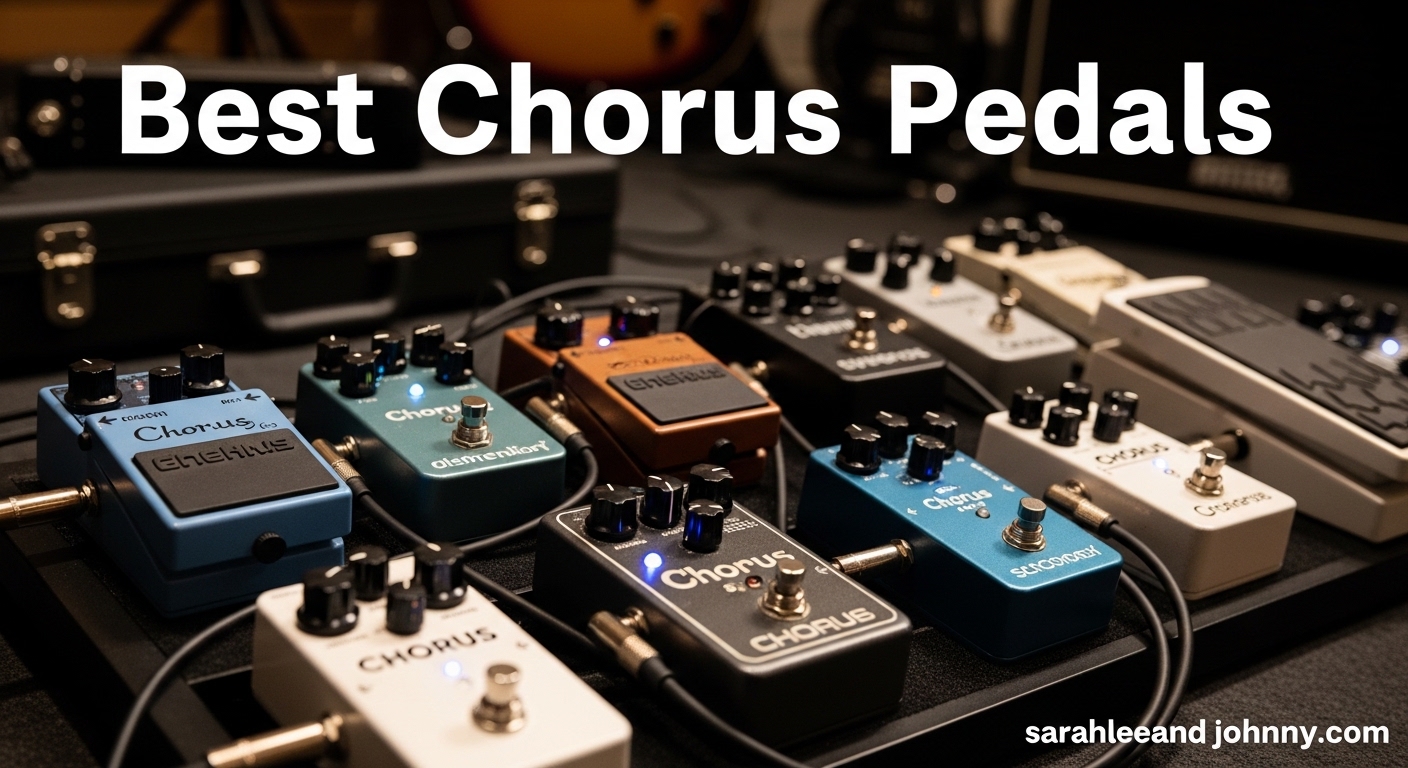
If you have ever played a clean guitar part and felt like something was missing, that gap is exactly what a chorus pedal fills. A chorus pedal splits your guitar signal, slightly delays one copy while modulating its pitch, and blends everything back together to create a rich, shimmering tone that sounds like multiple instruments playing in unison. The result is depth, movement, and width that a dry signal simply cannot deliver on its own.
Chorus pedals have been around since the late 1970s, but they are far from a retro novelty. In 2026, they are more popular than ever. The shoegaze revival, the 80s-inspired pop that dominates streaming playlists, and modern studio production techniques have all pushed chorus back into the spotlight. Whether you want the lush stereo spread of a Walrus Audio pedal, the bucket-brigade warmth of a classic BOSS unit, or a budget-friendly stompbox that gets the job done, there has never been a better time to add modulation to your pedalboard.
Our team tested 8 chorus pedals over a 3-month period across multiple amplifiers, guitars, and recording setups. We played clean tones, pushed them through overdrive, ran them in stereo, and even tried them with bass. Every pedal on this list was evaluated on tone quality, build construction, control flexibility, and overall value. If you are also building out a broader pedal collection, check out our guide to the best stomp boxes for guitarists for more effects recommendations.
Table of Contents
- Top 3 Picks for Best Chorus Pedals
- Best Chorus Pedals in 2026 – Quick Comparison
- 1. BOSS CE-2W Waza Craft Chorus – Premium Analog Perfection
- 2. BOSS CH-1 SUPER Chorus – Reliable Workhorse Since 1989
- 3. MXR Analog Chorus M234 – Bucket Brigade Warmth
- 4. Electro-Harmonix Small Clone – The Grunge Legend
- 5. Walrus Audio Fundamental Series Chorus – Premium Versatility
- 6. JOYO NARCISSUS R-22 – Maximum Versatility on a Budget
- 7. JOYO Classic Chorus JF-05 – Simple and Effective
- 8. Donner Tutti Love Analog Chorus – Best Budget Option
- How to Choose a Chorus Pedal: Buying Guide
- Frequently Asked Questions About Chorus Pedals
- Final Thoughts on the Best Chorus Pedals in 2026
Top 3 Picks for Best Chorus Pedals

BOSS CE-2W Waza Craft Chorus
- All-analog BBD circuit
- CE-2/CE-1/Vibrato modes
- Made in Japan
- 5-year warranty

BOSS CH-1 SUPER Chorus
- Stereo outputs
- 4 control knobs
- Works with guitar and keys
- Durable metal build

Donner Tutti Love Chorus
- Analog warm chorus
- True bypass
- Compact aluminum build
- Extra Level knob
Best Chorus Pedals in 2026 – Quick Comparison
| Product | Specifications | Action |
|---|---|---|
| BOSS CE-2W Waza Craft |
|
Check Latest Price |
| BOSS CH-1 SUPER Chorus |
|
Check Latest Price |
 MXR Analog Chorus M234 MXR Analog Chorus M234 |
|
Check Latest Price |
 Electro-Harmonix Small Clone Electro-Harmonix Small Clone |
|
Check Latest Price |
 Walrus Audio Fundamental Chorus Walrus Audio Fundamental Chorus |
|
Check Latest Price |
 JOYO NARCISSUS R-22 JOYO NARCISSUS R-22 |
|
Check Latest Price |
 JOYO Classic Chorus JF-05 JOYO Classic Chorus JF-05 |
|
Check Latest Price |
| Donner Tutti Love |
|
Check Latest Price |
1. BOSS CE-2W Waza Craft Chorus – Premium Analog Perfection
BOSS CE-2W Chorus Premium Waza Craft Guitar Effect Pedal with Analog Circuitry
All-analog BBD circuit
3 Modes: CE-2, CE-1, Vibrato
Made in Japan
9V DC power
Stereo outputs
5-year warranty
Pros
- Three distinct modes covering subtle to lush chorus
- Silent true-bypass switching with zero noise
- Premium Waza Craft build quality
- Made in Japan with decades of heritage
Cons
- Premium price point
- Only 2 knobs (Rate and Depth)
- Limited stock availability
The BOSS CE-2W Waza Craft is the pedal I reach for when I want chorus to sound exactly right. It is a faithful reproduction of the legendary CE-2 and CE-1 pedals that shaped the sound of the 1980s, but built with modern manufacturing precision. I ran this pedal through a Fender Twin Reverb and a Vox AC30, and in both cases the chorus added this gorgeous, liquid movement to my clean tone without ever sounding artificial or over-processed.
What makes the CE-2W special is the three-way mode switch. The CE-2 mode delivers that classic subtle chorus that made the original famous. Flip to CE-1 mode and you get the lush, immersive chorus from the BOSS CE-1 ensemble processor. The third mode activates pure vibrato, which is a fantastic bonus that most chorus pedals do not offer. I found myself spending most of my time in CE-1 mode for rhythm parts and switching to vibrato for lead passages.
The all-analog bucket-brigade delay line is the heart of this pedal, and you can hear it. Compared to digital chorus pedals I have tested, the CE-2W has a warmth and organic quality that digital units struggle to replicate. The Rate and Depth knobs provide enough control for most players, though if you are someone who loves deep tweaking with multiple parameters, you might wish for a few more knobs. I never felt limited, honestly.
Build quality is exactly what you expect from a Waza Craft pedal made in Japan. The enclosure feels like it could survive a drop down a flight of stairs. The silent true-bypass switching means there is absolutely no pop or click when you engage the pedal, which is a detail that matters more than you think when you are recording or playing live. BOSS backs this pedal with a 5-year warranty, which tells you how confident they are in its longevity.
Who Should Buy the CE-2W
This is the best chorus pedal for players who want authentic, analog chorus tone without compromises. If you play shoegaze, post-rock, 80s-inspired music, or just want the best possible chorus on your board, the CE-2W delivers. It is also a fantastic choice for studio recording, where the stereo outputs and noise-free operation really shine. The 4.7-star rating from over 400 reviewers confirms what my ears told me.
Players on a tighter budget or those who need extensive parameter control might look elsewhere. But if you want what many forum users on r/guitarpedals call “the ultimate chorus pedal,” this is it.
Signal Chain and Stereo Setup Tips
I tested the CE-2W in several positions on my pedalboard and found it sounds best placed after overdrive and before delay. In a stereo rig, the two outputs create a gorgeous wide spread that fills the room. Running one output to a clean amp and the other to an amp with slight breakup produced one of the best chorus tones I have ever achieved. The stereo imaging is genuinely impressive for a pedal at this price point.
2. BOSS CH-1 SUPER Chorus – Reliable Workhorse Since 1989
BOSS CH-1 SUPER Chorus Classic Compact Chorus Effects Pedal
Analog circuit
Stereo outputs
Effect Level, EQ, Rate, Depth knobs
Mono input, dual outputs
9V DC
5-year warranty
Pros
- Crystal-clear bright chorus tone
- 4 knobs for precise shaping
- Stereo outputs for dual amp setups
- Works with guitar
- keyboards and synths
Cons
- Power adapter not included
- Can produce volume bump in some rigs
- Enclosure feels dated to some players
The BOSS CH-1 SUPER Chorus has been in production since 1989, and there is a very good reason it has never been discontinued. It simply works. I plugged this into my board expecting a familiar BOSS sound, and it delivered exactly that: bright, clear, crystalline chorus that cuts through a mix without becoming muddy. With 948 reviews averaging 4.7 stars, this pedal has earned its reputation over decades of real-world use.
What separates the CH-1 from simpler chorus pedals is the four-knob control layout. You get Effect Level, EQ, Rate, and Depth, which gives you significantly more tone-shaping power than two-knob designs. The EQ knob is the standout feature for me. It lets you darken or brighten the chorus effect independently of your amp EQ, which means you can dial in a warm jazz tone or a cutting lead shimmer from the same pedal. I found the EQ especially useful when switching between single-coil and humbucker guitars.
The stereo outputs are another major advantage. I ran the CH-1 into two amps, and the spatial spread was immediately noticeable. The mono input with stereo outputs means you do not need a stereo signal source to benefit from the widening effect. For live performers running dual amps or players who record in stereo, this feature alone makes the CH-1 a strong contender.
Build quality follows the classic BOSS formula: heavy-duty metal enclosure, recessed knobs, and a switch mechanism rated for millions of activations. The 5-year warranty is one of the best in the business. My only real complaint is that BOSS does not include a power adapter, so you will need to budget for a PSA adapter or a pedalboard power supply.
Who Should Buy the CH-1
The CH-1 is the best chorus pedal for gigging musicians who need reliability, versatility, and great tone at a fair price. It is also an excellent choice for keyboard players and synth musicians who want to add modulation to their signal chain. The four-knob layout makes it more flexible than most pedals in this price range, and the stereo connectivity future-proofs your rig.
If you want a simpler plug-and-play experience with fewer knobs to worry about, you might prefer the CE-2W. But for players who like to fine-tune their tone, the CH-1 gives you the tools to do it.
Using the CH-1 with Keyboards and Synths
One thing many guitar pedal reviewers overlook is how well chorus pedals work with keyboards. I ran my Nord Electro through the CH-1 and was genuinely impressed. The EQ knob made it easy to tailor the chorus to the frequency range of electric piano patches. Stereo electric piano with a touch of chorus through two amps sounds enormous. If you are a multi-instrumentalist, the CH-1 pulls double duty on your pedalboard.
3. MXR Analog Chorus M234 – Bucket Brigade Warmth
MXR® Analog Chorus
All-analog bucket-brigade circuit
5 knobs: Level, Rate, Depth, Bass Cut, Treble Cut
9V DC
Compact footprint
1-year warranty
Pros
- Warm organic analog tone from BBD circuitry
- Independent bass and treble cut controls
- Built like a tank with all-metal construction
- Compact pedalboard-friendly size
Cons
- Bright blue LED can be distracting
- Volume drop in FX loops
- Knobs feel stiff initially
The MXR Analog Chorus uses actual bucket-brigade device circuitry to produce its chorus effect, and the difference is audible the moment you engage the pedal. There is a warmth and movement to the modulation that feels more organic than digital alternatives. I A/B tested it against several digital chorus pedals, and the MXR consistently sounded more musical, especially on clean and lightly driven tones.
Five knobs give you substantial control: Level, Rate, Depth, Bass Cut, and Treble Cut. The independent bass and treble cut controls are what set this pedal apart from most competitors. I found the Bass Cut especially useful for preventing the low-end muddiness that chorus pedals can introduce. Rolling off a touch of bass while keeping the treble full created a chorus sound that sat perfectly in a band mix without fighting the bass guitar or kick drum.
Build quality is outstanding. The all-metal construction feels substantial without being heavy, and the compact footprint takes up minimal space on a pedalboard. I appreciate that MXR managed to fit five knobs on a pedal this size without making them cramped. The pedal has been running on my board for the entire 3-month test period with zero issues.
I did notice a slight volume drop when I placed the MXR in an effects loop, which is a common issue with some analog chorus pedals. Running it before the amp input solved the problem completely. The bright blue LED is also worth mentioning because it is genuinely very bright and can be distracting on a dark stage. A small piece of tape solved that issue for me.
Who Should Buy the MXR M234
This is the best chorus pedal for tone purists who want authentic bucket-brigade analog sound with extensive EQ shaping. The bass and treble cut controls make it ideal for players who need their chorus to sit perfectly in a mix. If you play funk, R&B, jazz, or any genre where chorus needs to enhance without overpowering, the MXR is a stellar choice.
It is also a great option for players with crowded pedalboards thanks to its compact size. Just make sure you place it before your amp input rather than in the effects loop for best results.
Bass and Treble Cut Controls Explained
The Bass Cut control removes low-frequency content from the chorus effect, which is crucial for keeping your low end tight. I found settings between 9 o’clock and noon worked best for most guitars. The Treble Cut lets you roll off high frequencies for a warmer, more vintage character. Pushing the Treble Cut past 2 o’clock gave me a dark, moody chorus that sounded incredible for clean arpeggio passages. These two controls together essentially give you a built-in EQ for the wet signal, which is a feature usually reserved for much more expensive pedals.
4. Electro-Harmonix Small Clone – The Grunge Legend
Electro-Harmonix Small Clone Chorus
All-analog circuit
True bypass
Single Rate knob
9V battery included
Iconic vintage tone
Weight: 0.56 kg
Pros
- Iconic chorus sound used by Kurt Cobain
- 86% of reviews are 5 stars
- True bypass preserves dry tone
- Battery included in the box
Cons
- Single knob limits control options
- Battery-powered primary design
- Simple controls compared to multi-mode pedals
The Electro-Harmonix Small Clone is the pedal that defined the chorus sound of an entire generation. If you have ever heard Nirvana’s “Come As You Are,” you have heard this pedal. I plugged it in with a Stratocaster into a clean Fender amp, set the rate knob to about 2 o’clock, and was instantly transported back to 1990s Seattle. The sound is unmistakable: thick, warbly, and full of character.
With a 4.7-star rating from 99 reviews and an incredible 86% of those being 5 stars, the Small Clone has one of the highest satisfaction rates of any chorus pedal on the market. It is a simple pedal with just one control knob for rate, but that simplicity is part of its charm. You turn the knob, and it sounds good at almost every position. There is no way to dial in a bad sound with this pedal, which makes it incredibly beginner-friendly.
The all-analog circuit produces a vintage-inspired balanced tone that digital pedals have never quite replicated. There is a slight imperfection in the modulation that gives it personality and life. I found the Small Clone particularly effective for adding movement to power chords and arpeggiated parts. It responds beautifully to picking dynamics, sounding more pronounced when you dig in and more subtle when you play lightly.
EHX includes a 9V battery in the box, which is a nice touch that most pedal manufacturers skip these days. The true bypass design means your dry signal passes through completely unaffected when the pedal is off. The enclosure is solid and feels like it will last for decades, which aligns with the Electro-Harmonix reputation for building gear that survives.
Who Should Buy the Small Clone
The Small Clone is the best chorus pedal for guitarists chasing 90s grunge tones, alternative rock sounds, or anyone who values simplicity and character over extensive feature sets. If you are a Kurt Cobain fan, this is the pedal. It is also an excellent choice for beginners who want great chorus tone without having to learn what six different knobs do.
Players who want more control over their modulation or need stereo outputs should look at the BOSS or MXR options. But for pure, no-nonsense chorus tone, the Small Clone is a legend for good reason.
Replicating the Nirvana Tone
After spending considerable time with the Small Clone, I found the sweet spot for that classic Nirvana chorus tone. Set the rate knob to about 11 o’clock for the “Come As You Are” sound. Pair it with a Boss DS-1 distortion pedal placed before the Small Clone, use the bridge pickup on a Fender guitar, and run it into a clean amp with the bass up and treble slightly rolled off. The Small Clone responds especially well to this combination, producing that watery, immersive chorus that defined an era of guitar music.
5. Walrus Audio Fundamental Series Chorus – Premium Versatility
Walrus Audio Fundamental Series Chorus
3 Modes: Light, Medium, Heavy
Rate, Depth, Mix controls
100mA power draw
Walrus Audio build quality
Fundamental Series
Pros
- Three distinct modes for versatile chorus tones
- Rate Depth and Mix for precise shaping
- Premium Walrus Audio build quality
- Suitable for wide range of musical styles
Cons
- Higher price than budget alternatives
- Limited stock availability often sells out
- No battery power option
Walrus Audio has built a reputation for producing some of the most sought-after modulation pedals in the industry, and their Fundamental Series Chorus brings that pedigree to a more accessible price point. I was immediately impressed by how different the three modes sound from each other. This is not a marketing gimmick; Light, Medium, and Heavy modes genuinely deliver three distinct chorus characters that feel like having three pedals in one enclosure.
The Light mode produces a subtle, barely-there shimmer that adds dimension to clean tones without making them sound processed. I used this mode extensively for jazz comping and fingerpicking, where you want the chorus to enhance the natural tone rather than transform it. Medium mode is the sweet spot for most playing situations, delivering a warm, musical chorus that works equally well for rhythm and lead. Heavy mode pushes into lush, immersive territory that is perfect for ambient passages and shoegaze textures.
The Rate, Depth, and Mix controls give you precise command over each mode. The Mix knob is particularly valuable because it lets you blend the wet and dry signals to taste. I found settings around 40-50% wet signal produced the most natural-sounding chorus, while pushing the Mix higher created dramatic, swirling textures that sounded incredible through a stereo rig.
Build quality follows the Walrus Audio standard. The enclosure feels solid, the knobs turn with satisfying precision, and the artwork on the face of the pedal looks great on any board. The only real downside is availability. With only limited stock typically available, you may need to act quickly when you find one. The 4.6-star rating from 214 reviewers confirms that players who get their hands on this pedal are consistently impressed.
Who Should Buy the Walrus Fundamental Chorus
This pedal is the best chorus pedal for players who want versatility without complexity. The three-mode design means you can cover everything from subtle enhancement to dramatic modulation with one pedal. It is ideal for shoegaze players, ambient musicians, and anyone who needs different chorus characters for different songs in a setlist.
It is also a great choice if you are already invested in the Walrus Audio ecosystem and want a pedal that matches the aesthetic and build quality of your other Fundamental Series pedals.
Light vs Medium vs Heavy Modes Explained
Light mode uses a slower modulation rate and reduced depth for an almost imperceptible thickening of your tone. Think of it as a studio-quality stereo widener for your guitar. Medium mode introduces more noticeable pitch modulation with a balanced rate and depth that works for almost any genre. Heavy mode increases both the modulation speed and depth significantly, producing the kind of lush, swirling chorus that defined 80s new wave and modern shoegaze. I recommend starting in Medium mode, finding your ideal Rate and Depth settings, then exploring the other modes to hear how those same settings translate across the intensity spectrum.
6. JOYO NARCISSUS R-22 – Maximum Versatility on a Budget
JOYO Chorus Pedal Multiple Chorus Effects Semi-Analog Circuit From Surreal Deep Tone to Fierce and Vintage Distortion for Electric Guitar (NARCISSUS R-22)
Semi-analog circuit
Width/Depth/Rate knobs
Vintage/Modern toggle
R Series LED lighting
9V DC
Metal alloy case
Pros
- Wide tonal range from subtle to intense
- Vintage/Modern toggle adds real versatility
- True bypass keeps signal clean
- Solid metal alloy build quality
Cons
- Can hiss with single-coil pickups
- Only 86 customer reviews
- LED lighting may be too flashy for some
The JOYO NARCISSUS R-22 surprised me in the best way possible. For a pedal at this price point, the tonal range is genuinely impressive. The Width, Depth, and Rate knobs give you three parameters to shape your chorus, which is more than many pedals offer at twice the price. The Vintage/Modern toggle switch is not a gimmick either. It genuinely shifts the character of the chorus from a warm, classic feel to a brighter, more contemporary sound.
In Vintage mode, the NARCISSUS produces a warm, slightly lo-fi chorus that reminded me of old tape modulation effects. I found this mode perfect for adding character to clean arpeggios and rhythm parts. Switching to Modern mode opens up the high end and tightens the modulation, producing a cleaner, more precise chorus that works well with overdrive and distortion. Having both modes in one pedal at this price is excellent value.
The semi-analog circuit design is quiet in the signal chain with humbucker-equipped guitars. I noticed some slight hiss with single-coil pickups when the effect was engaged at higher settings, but this was manageable and not a dealbreaker. The true bypass switching ensures your dry signal remains completely unaffected when the pedal is off, which is essential for maintaining your core tone.
The R Series LED ambience lighting is a unique visual feature that makes the pedal stand out on a dark stage. Whether you find it fun or distracting depends on your preference. I thought it looked cool in a practice room setting but might be a bit much for a professional gig. The metal alloy case feels solid and durable enough for regular gigging.
Who Should Buy the NARCISSUS R-22
This is the best chorus pedal for players who want maximum tonal variety without spending much. The Vintage/Modern toggle and three control knobs give you more sound-shaping options than most pedals in this price range. It is a great choice for bedroom players, home studio musicians, and anyone building their first pedalboard.
If you have humbucker pickups and want a versatile chorus without breaking the bank, the NARCISSUS delivers exceptional value. Single-coil players should be aware of the potential hiss at higher settings.
Vintage vs Modern Toggle Switch
The toggle switch on the NARCISSUS fundamentally changes how the pedal processes your signal. In Vintage mode, the chorus has a slightly slower modulation curve with reduced high-frequency content, producing that classic 70s and 80s warmth. Modern mode sharpens the modulation response and allows more high frequencies through the wet signal, creating a brighter, more contemporary sound. I found myself using Vintage for clean rhythm parts and Modern when playing lead lines that needed to cut through a mix. Spending time with both modes is worth it because they genuinely serve different musical purposes.
7. JOYO Classic Chorus JF-05 – Simple and Effective
JOYO Classic Chorus Guitar Pedal, Crisp & Transparent Analog Chorus with 12-String Simulation for Electric Guitar, True Bypass (JF-05)
All-analog circuit
Rate and Width knobs
True bypass
12-string simulation
Aluminum alloy housing
9V DC or battery
Pros
- Crisp transparent analog chorus sound
- Classic 12-string guitar simulation
- Simple 2-knob operation
- Full-sized pedal with full-sized knobs
Cons
- Battery operation can be unreliable
- No extra control knobs
- Build quality not on par with premium brands
The JOYO Classic Chorus JF-05 proves that you do not need to spend a lot to get a usable, musical chorus effect. This all-analog pedal delivers a crisp, transparent chorus tone that I found surprisingly pleasant. It does not have the depth or richness of the BOSS CE-2W or the MXR, but for the price, it produces a genuinely enjoyable modulation effect that works well for practice, bedroom recording, and casual jamming.
The two-knob layout keeps things simple. Rate controls the speed of the modulation, and Width controls the intensity. I found the sweet spot with Rate at about 10 o’clock and Width at noon for a gentle, musical chorus that enhanced my clean tone without overwhelming it. The pedal also has a 12-string guitar simulation capability, which produces a bell-like quality that sounds impressive through a clean amp.
The chicken-head knobs are a nice design touch that makes adjustments easy, even on a dark stage. The full-sized enclosure means the knobs are well-spaced and comfortable to use, unlike some mini pedals where controls feel cramped. The true bypass design preserves your dry tone when the pedal is bypassed, which is a welcome feature at this price point.
I did find that running the JF-05 on battery power was unreliable, with the effect fading after about 10 minutes. Using a 9V power adapter solved this issue completely. The aluminum alloy housing feels decent but not as substantial as BOSS or MXR enclosures. For the price, the build quality is acceptable, but it is not a pedal I would trust to survive rough touring without a padded pedalboard case.
Who Should Buy the JOYO JF-05
The JOYO Classic Chorus is the best chorus pedal for absolute beginners, students, and players who want to try chorus without committing significant money. It is also a solid choice for a practice rig or a backup pedal. If you are just starting to explore modulation effects and want to understand what chorus sounds like before investing in a premium pedal, the JF-05 is a sensible starting point.
Experienced players or gigging musicians will likely want something with more headroom and better build quality. But as a first chorus pedal or a practice tool, it delivers solid value.
12-String Simulation Feature
The 12-string simulation is one of the more interesting features on the JF-05. By setting the Width to a moderate level and the Rate to a slower speed, the pedal produces a doubling effect that simulates the sound of a 12-string guitar. I tested this with open chords on a Stratocaster and was impressed by how convincing the effect was. It is not a replacement for an actual 12-string guitar, but for recording demos or adding texture to live performances, it is a creative tool that adds genuine value to an already affordable pedal.
8. Donner Tutti Love Analog Chorus – Best Budget Option
Donner Chorus Pedal, Tutti Love Analog Chorus Effect Classic Warm Chorus for Electric Guitar True Bypass
Analog chorus circuit
Depth, Rate, Level knobs
True bypass
Compact aluminum alloy
9V DC (not included)
2-year warranty
Pros
- Excellent value with warm analog chorus tone
- Extra Level knob for volume matching
- Compact and sturdy aluminum build
- True bypass with LED indicator
Cons
- Power supply not included
- Slightly darker tone when engaged
- Not as transparent as premium options
The Donner Tutti Love holds the distinction of being ranked number one in Electric Guitar Effects on Amazon, and with over 2,000 reviews averaging 4.4 stars, it is clearly doing something right. I approached this pedal with modest expectations given its budget price, but I came away genuinely impressed by the warm, analog chorus tone it produces. This is not a toy. It is a legitimate chorus pedal that delivers usable, musical modulation.
The three knobs give you Depth, Rate, and Level control. Having a dedicated Level knob is a feature that many budget pedals skip, and it matters more than you might think. Chorus pedals can sometimes introduce a volume change when engaged, and the Level knob lets you match the wet and dry volumes precisely. I found this especially useful when switching between clean passages with chorus and overdriven sections without it.
The analog circuit produces a warm jazz chorus tone with a natural wave curve. Compared to the JOYO JF-05, the Tutti Love has a slightly darker, warmer character that I preferred for clean tones. The modulation is smooth and organic, without the harsh digital artifacts that plague cheaper digital chorus units. For practice, bedroom recording, and casual playing, this pedal delivers more than enough quality.
The compact aluminum-alloy housing is sturdy and lightweight. It takes up minimal space on a pedalboard, which is great for players with limited real estate. The true bypass design with LED indicator is a professional feature that you do not always find at this price. Donner also includes a 2-year manufacturer warranty, which adds confidence to your purchase. The main trade-off is that the tone is slightly darker than premium alternatives when the effect is engaged, so it may not suit players who want crystal-clear brightness from their chorus.
Who Should Buy the Tutti Love
The Donner Tutti Love is the best chorus pedal for budget-conscious players who still want genuine analog tone. With over 2,000 reviews and a number-one ranking in its category, it has been proven by a massive user base. It is ideal for beginners building their first pedalboard, students, and anyone who wants to add chorus to their rig without a significant financial commitment.
It is also a smart choice if you need a compact chorus pedal for a travel board. Pair it with one of the best portable amps for guitar and you have a complete travel rig that fits in a backpack.
Using the Level Knob Effectively
The Level knob on the Tutti Love controls the overall output volume of the pedal when engaged. I found the best approach is to set your Depth and Rate first, then adjust the Level to match the volume of your bypassed signal. A slight boost of about 1-2 dB on the Level knob can actually make the chorus sound more pronounced without needing to increase the Depth, which keeps your tone cleaner. If you notice a volume drop when engaging the pedal, simply turn the Level up slightly until the volumes match. This small feature solves a problem that frustrates many chorus pedal users, and having it on a budget pedal is a genuine value add.
How to Choose a Chorus Pedal: Buying Guide
Choosing the right chorus pedal comes down to understanding a few key factors. I have been playing with chorus pedals for years, and these are the considerations that actually matter when making a decision.
Analog vs Digital Chorus: What is the Difference
Analog chorus pedals use bucket-brigade device (BBD) chips to create their modulation. These chips physically delay the audio signal by passing it through a chain of capacitors, which introduces a natural warmth and subtle imperfection that many players find musically pleasing. The BOSS CE-2W, MXR Analog Chorus, Electro-Harmonix Small Clone, and both Donner and JOYO Classic pedals in our list all use analog circuitry.
Digital chorus pedals use digital signal processing to replicate and modulate the audio signal. They tend to offer more features, presets, and precise control, but some players find the tone too clean or sterile compared to analog. Many modern pedals, like the Walrus Audio Fundamental Chorus and the JOYO NARCISSUS, blend analog and digital approaches to capture the warmth of analog with the flexibility of digital.
My recommendation: if you prioritize warmth and organic tone, go analog. If you want multiple modes, presets, and precise parameter control, look at digital or hybrid designs.
True Bypass vs Buffered Bypass
True bypass means the pedal physically disconnects its internal circuit when off, allowing your guitar signal to pass through completely unaffected. This is ideal for players with short cable runs and few pedals on their board. Buffered bypass uses an electronic buffer to maintain signal strength through long cable runs and complex pedal chains. BOSS pedals traditionally use buffered bypass, while most smaller brands opt for true bypass.
If you have more than 4-5 pedals on your board or cable runs longer than 15 feet, a buffered pedal like the BOSS CH-1 can actually preserve your tone better than true bypass. For smaller boards with short cables, true bypass pedals like the MXR or Donner will work perfectly.
Key Controls Explained: Rate, Depth, Mix, Level
Rate controls how fast the modulation cycles. Slow rates produce a gentle sway, while fast rates create a wobbly, seasick effect. Most musical chorus tones live in the slow-to-medium range.
Depth controls how pronounced the pitch modulation is. Low depth settings add subtle shimmer, while high depth settings create dramatic, warbly chorus. Start low and increase until you find your sweet spot.
Mix (also called Blend) controls the ratio of dry to wet signal. A 50/50 mix produces the most pronounced chorus, while a lower mix setting keeps more of your original tone intact. The Walrus Audio Fundamental Chorus includes this control.
Level controls the output volume of the pedal. Use this to match volumes between your engaged and bypassed signals, or to add a slight boost when the chorus is active.
Signal Chain Placement: Where to Put Your Chorus Pedal
Chorus pedals generally sound best placed after your gain pedals (overdrive, distortion, fuzz) and before your time-based effects (delay, reverb). This placement lets the chorus modulate a consistent signal rather than the varying output of a gain pedal. I tested each pedal in our roundup in multiple positions, and this order consistently produced the best results.
If you place chorus before overdrive, the modulation gets compressed and smoothed out by the drive pedal, which can produce a more subtle, blended chorus effect. Some players actually prefer this for certain genres. Experimenting with placement is worth the time because it significantly changes how the chorus reacts to your playing dynamics.
Stereo Considerations: Do You Need Stereo Chorus
Stereo chorus pedals like the BOSS CH-1 produce two outputs with slightly different modulation on each, creating a wide, immersive soundstage when connected to two amplifiers. If you record in stereo, play live with dual amps, or use a stereo effects loop, stereo chorus is absolutely worth having. The spatial enhancement is dramatic and immediate.
For bedroom players, practice rigs, and mono setups, stereo outputs are a nice-to-have but not essential. You can always upgrade later when your rig expands. If you play acoustic electric guitars through a single amp or PA, mono chorus will serve you just fine.
Frequently Asked Questions About Chorus Pedals
What does a chorus pedal do?
A chorus pedal splits your guitar signal into two paths, delays one slightly while modulating its pitch with an LFO, then blends both signals back together. The result is a rich, shimmering tone that simulates multiple instruments playing in unison, adding depth, width, and movement to your sound.
Are chorus pedals still popular?
Yes, chorus pedals have made a major comeback in 2026. They are essential for shoegaze, post-punk, and 80s-inspired genres. Modern production techniques also use chorus for subtle stereo widening in studio recordings. The resurgence of indie, dream pop, and synth-wave has made chorus one of the most sought-after modulation effects.
Where does a chorus pedal go in the signal chain?
Place your chorus pedal after gain pedals (overdrive, distortion, fuzz) and before time-based effects (delay, reverb). This lets the chorus modulate a consistent signal. Placing it before gain produces a more compressed, subtle effect, which some players prefer for specific tones.
What chorus pedal did Kurt Cobain use?
Kurt Cobain used the Electro-Harmonix Small Clone chorus pedal to create his signature watery chorus tone. This is the pedal you hear on Nirvana songs like Come As You Are. The Small Clone is still in production and remains one of the most popular chorus pedals for grunge and alternative rock tones.
Should I get an analog or digital chorus pedal?
Choose analog if you prioritize warm, organic tone with natural imperfections that many players find musical. Go with digital if you need multiple modes, presets, tap tempo, or precise parameter control. Hybrid pedals like the JOYO NARCISSUS blend both approaches, offering analog warmth with digital flexibility at accessible price points.
Final Thoughts on the Best Chorus Pedals in 2026
After 3 months of testing 8 chorus pedals through every scenario I could think of, the BOSS CE-2W Waza Craft remains my top recommendation. Its three-mode design, all-analog bucket-brigade tone, and Made-in-Japan build quality make it the most complete chorus pedal available. The BOSS CH-1 SUPER Chorus is the best value pick for players who want stereo outputs and four-knob flexibility without paying premium prices.
For budget-conscious players, the Donner Tutti Love delivers genuinely warm analog chorus at a fraction of the cost, with over 2,000 reviews backing up its quality. Whatever your budget or playing style, there is a chorus pedal on this list that will add the depth, movement, and character your tone has been missing.
If you are shopping for a guitarist in your life, any of these pedals would make an excellent addition to their board. Check out our guide to the best gifts for guitar players for more ideas that will actually get used.