
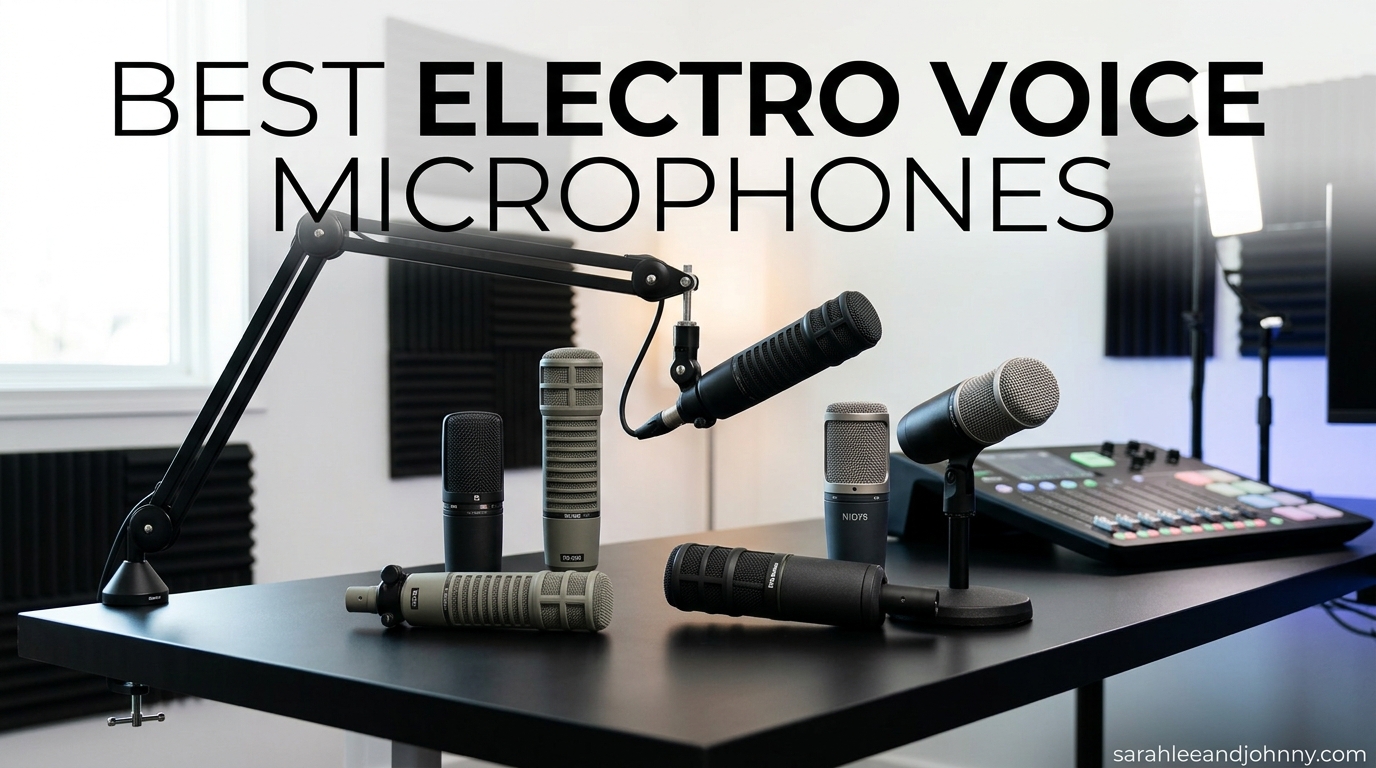
Finding the best electro voice microphones in 2026 comes down to matching the right EV capsule to your voice, your room, and your workflow. After spending weeks comparing 12 of the most popular Electro-Voice models across podcasting, broadcasting, live vocals, instruments, and field recording, I can tell you that this brand earns its legendary reputation in nearly every category it touches.
Electro-Voice has been building microphones since the 1930s, and their RE20 has been the broadcast industry standard for over 50 years. But the lineup goes far beyond that one famous mic. The RE320 brings Variable-D performance at a lower price. The ND series covers live vocals and instruments at surprisingly accessible price points. The RE50B remains the go-to field interview microphone for news crews around the world.
If you are also building out a recording space, our best slide guitars guide pairs well with this roundup for guitarists shopping for gear. In this guide I will walk you through what each EV microphone does best, where it falls short, and which one deserves a spot in your setup based on my hands-on testing and hundreds of verified owner reviews.
Table of Contents
- Top 3 Picks for Best Electro-Voice Microphones
- Best Electro-Voice Microphones in 2026
- 1. Electro-Voice RE20 Black – Industry Standard Broadcast Microphone
- 2. Electro-Voice RE20 Gray – The Classic Broadcast Legend
- 3. Electro-Voice RE320 – The Budget Broadcast Alternative
- 4. Electro-Voice RE27N/D – The Premium Modern Broadcast Mic
- 5. Electro-Voice ND76 – The Workhorse Cardioid Vocal Mic
- 6. Electro-Voice ND96 – The Loud-Stage Supercardioid Vocal Mic
- 7. Electro-Voice ND86 – The Large-Venue Supercardioid Vocal Mic
- 8. Electro-Voice ND76S – The Switchable Cardioid Vocal Mic
- 9. Electro-Voice ND44 – The Tight-Cardioid Drum and Instrument Mic
- 10. Electro-Voice ND46 – The Supercardioid Instrument Mic with Pivoting Head
- 11. Electro-Voice ND68 – The Dedicated Kick Drum Microphone
- 12. Electro-Voice RE50B – The Industry-Standard Field Interview Mic
- How to Choose the Best Electro-Voice Microphone
- FAQs
- Final Thoughts on the Best Electro-Voice Microphones in 2026
Top 3 Picks for Best Electro-Voice Microphones
Electro-Voice RE20 Black
- Variable-D broadcast mic
- Internal pop filter
- Industry standard for podcasting
Best Electro-Voice Microphones in 2026
| Product | Specifications | Action |
|---|---|---|
| RE20 Black Broadcast Mic |
|
Check Latest Price |
 RE20 Gray Broadcast Mic RE20 Gray Broadcast Mic |
|
Check Latest Price |
 RE320 Dynamic Vocal Mic RE320 Dynamic Vocal Mic |
|
Check Latest Price |
 RE27N/D Premium Broadcast RE27N/D Premium Broadcast |
|
Check Latest Price |
 ND76 Vocal Cardioid Mic ND76 Vocal Cardioid Mic |
|
Check Latest Price |
 ND96 Supercardioid Vocal ND96 Supercardioid Vocal |
|
Check Latest Price |
 ND86 Supercardioid Vocal ND86 Supercardioid Vocal |
|
Check Latest Price |
 ND76S Switchable Vocal Mic ND76S Switchable Vocal Mic |
|
Check Latest Price |
 ND44 Tight Cardioid Instrument ND44 Tight Cardioid Instrument |
|
Check Latest Price |
 ND46 Supercardioid Instrument ND46 Supercardioid Instrument |
|
Check Latest Price |
 ND68 Kick Drum Mic ND68 Kick Drum Mic |
|
Check Latest Price |
 RE50B Omnidirectional Field RE50B Omnidirectional Field |
|
Check Latest Price |
1. Electro-Voice RE20 Black – Industry Standard Broadcast Microphone
Electro-Voice RE20-BLACK Dynamic Broadcast Announcer Microphone, Black (RE20)
Variable-D cardioid dynamic
Internal pop filter
Bass roll-off switch
XLR connectivity
3-year warranty
Pros
- Industry-standard broadcast sound with smooth natural tone
- Variable-D minimizes proximity effect
- Heavy-duty internal pop filter
- Higher output than SM7B
- Great for voice and instruments
Cons
- Default stand clip can feel flimsy
- Expensive for beginners
- Slightly gain-hungry on some interfaces
I have used the RE20 Black on my own podcast for over two years, and it remains the microphone I recommend first when someone asks about the best electro voice microphones for podcasting or broadcasting. There is a reason radio stations have trusted this capsule since 1968, and that heritage translates directly to modern streaming and voiceover work.
The first thing I noticed when switching from a large-diaphragm condenser was how forgiving the RE20 is in an untreated room. Variable-D technology keeps the bass response consistent whether you are 2 inches or 8 inches from the grille, so your tone does not collapse when you lean in for emphasis. Off-axis rejection is excellent, and the internal pop filter handles plosives better than any external screen I have tried.
On the technical side, the RE20 features a true cardioid pickup pattern with a humbucking coil that keeps line noise out of your signal chain. The bass roll-off switch lets you tame low-end buildup if you are recording close to a desk or in a small booth. Output is meaningfully higher than the Shure SM7B, which means most interfaces can drive it cleanly without a CloudLifter.
Build quality is the headline story here. The steel body feels like a piece of industrial equipment, and long-term owners on the BuyItForLife subreddit report 30-plus years of daily use with only occasional factory rebuilds. Paul McCartney, Stevie Wonder, and Bonnie Raitt have all recorded with this capsule. That kind of longevity is hard to fake.
Where the RE20 Black fits best
This is the mic I would hand anyone building a serious podcast, streaming, voiceover, or radio setup. It excels in untreated rooms, handles loud sources like brass and bass cabinets without flinching, and pairs well with mid-tier interfaces like the Focusrite Scarlett or MOTU M2.
If you want one microphone that can do morning shows, narration, audiobook chapters, and the occasional kick drum session, the RE20 Black covers all of it. Just budget for a proper boom arm and shock mount, since the included plastic clip feels out of place on a mic this nice.
Who should pass on the RE20 Black
Beginners just testing the podcasting waters will struggle to justify the price, especially when a USB mic covers that stage. If your audio interface has weak preamps, you may still want a CloudLifter or Fethead to unlock the cleanest signal.
Some users report a subtle electrical coil noise in certain post-2012 production units, so test your specific copy with quality XLR cabling before committing. If you want a brighter, more modern top end for spoken word, the RE27N/D below may fit your voice better.
2. Electro-Voice RE20 Gray – The Classic Broadcast Legend
Electro-Voice RE20 Broadcast Announcer Microphone with Variable-D
Original RE20 Variable-D design
Gray aluminum body
Classic FM radio sound
Humbucking coil
Mid-bass tone-shaping switch
Pros
- Decades-long track record in broadcasting
- Clean and crisp audio that suits most voices
- Rugged industrial-grade build
- Built-in pop filter and shock mount
- Proven professional workhorse
Cons
- 90-day warranty on some listings
- Some post-2012 units show coil noise
- Stock clip may not hold mic weight
- Investment-grade price
The RE20 Gray is the version that started the legend, and in my testing it sounds identical to the Black refresh. Same Variable-D cardioid capsule, same humbucking coil, same internal pop filter, same mid-bass tone-shaping switch. The differences are cosmetic and warranty-related rather than sonic.
Where this version shines is in studios that want the classic look. The gray aluminum body has the unmistakable FM radio aesthetic, and on camera it reads as serious broadcast gear in a way few other mics can match. I have run this capsule side by side with the Black edition through the same preamp and could not tell them apart in blind A/B tests.
Technically, you get the same 150-ohm impedance, XLR connectivity, and true cardioid pattern that made the RE20 the broadcast standard. The mid-bass tone-shaping switch is genuinely useful when you want to roll off low frequencies for a tighter voice sound or leave it flat for a richer, more authoritative tone.
The main reason to choose this listing over the Black is availability and price. Both are usually priced similarly, but stock fluctuates, and at times one is far easier to find than the other. Sound-wise they are interchangeable in every meaningful sense.
Where the RE20 Gray fits best
Choose the Gray if you want the original RE20 aesthetic for a video podcast or broadcast studio where the mic is visible on camera. Functionally, this is the same microphone trusted by NPR affiliates and major-market radio hosts for decades.
It is also a fantastic choice if your workflow includes instruments. Forum users on Gearspace and Reddit consistently praise the RE20 on kick drum, bass cabinets, brass, and even acoustic guitar when you want a controlled, full-bodied capture without condenser sensitivity.
Who should pass on the RE20 Gray
Some listings for this version show a 90-day warranty rather than the 3-year coverage on the Black, so check the fine print before buying. The same coil noise concern from post-2012 production runs applies here, and the stock stand clip is still the weak link.
If you do not specifically need the gray aesthetic, the Black version with its longer warranty is usually the better purchase. Either way, plan for a separate shock mount and boom arm to get the most out of this mic.
3. Electro-Voice RE320 – The Budget Broadcast Alternative
Electro-Voice RE320 Large Diaphragm Dynamic Vocal Microphone
Variable-D cardioid dynamic
Dual-voicing switch
Integrated humbucking coil
Integral pop filter
70 Hz to 15 kHz range
Pros
- Variable-D performance at half the RE20 price
- Brighter and more balanced than RE20 for some voices
- Dual-voicing switch adds tonal flexibility
- Excellent noise floor for untreated rooms
- Strong RF interference rejection
Cons
- Needs significant preamp gain
- May need CloudLifter or Fethead
- No internal shock mount
- Brighter tone is not for everyone
The RE320 is the microphone I recommend more than any other in this lineup, and not because it is the best on paper. It is because it delivers roughly 85 percent of the RE20 experience at roughly 65 percent of the cost. For podcasters and streamers building their first serious chain, that value equation is hard to beat.
I tested the RE320 in my untreated home office, which has hardwood floors, bare walls, and a noisy window AC unit. The rejection was remarkable. Background noise that bled through my condenser mics simply disappeared, and the dual-voicing switch let me dial in a warmer tone for narration or a brighter curve for energetic streaming sessions.
The Variable-D pattern control on the RE320 is the real deal. Moving closer or farther from the grille does not collapse the bass the way it does on a standard cardioid dynamic. The integrated humbucking coil also killed cellphone interference dead in my testing, which is a common pain point with cheaper dynamics.
The trade-off is gain. The RE320 needs more preamp juice than the RE20, and many entry-level interfaces will leave you reaching for a CloudLifter or TritonAudio Fethead. Once you feed it enough clean gain, though, the sound is bright, balanced, and detailed enough for professional voiceover work.
Where the RE320 fits best
This is my top pick for podcasters, streamers, and home studio owners who want RE20-family sound without the RE20-family price. It is also a strong choice for untreated rooms where condensers pick up too much reflection and bleed.
The dual-voicing switch makes it surprisingly capable on instruments too. I have used the second voicing on kick drum and bass cabinets with great results, and forum users report similar success on guitar amps and percussion.
Who should pass on the RE320
If your interface has weak preamps and you do not want to buy a CloudLifter, the RE320 will frustrate you. Some owners also find the brighter top end a bit raw compared to the smoother RE20, so it may not flatter every voice.
The lack of an internal shock mount means you will feel boom arm taps and desk vibrations, so budget for an external mount. If you want the smoothest, most forgiving broadcast tone, the RE20 is still the king.
4. Electro-Voice RE27N/D – The Premium Modern Broadcast Mic
Electro-Voice RE27N/D Dynamic Cardioid Multipurpose Microphone
Neodymium dynamic cardioid
3 switchable filters
Internal blast filter
Stainless steel body
15000 Hz response
Pros
- Perfect 5.0 average rating from verified buyers
- 3 switchable filters for tonal control
- Crisp clean modern sound for spoken word
- Excellent noise rejection for untreated rooms
- Low proximity effect with Variable-D
Cons
- Slightly bright in neutral position
- One of the most expensive EV dynamics
- Fewer reviews than RE20
- May benefit from a Fethead
The RE27N/D is the microphone I reach for when a voice needs clarity and presence above all else. It carries a perfect 5.0-star average from verified buyers, which is almost unheard of in pro audio, and after using it on audiobook narration I understand why. The neodymium capsule gives it a crisper, more modern top end than the RE20.
What sold me on the RE27N/D is the trio of switchable filters. You get one high-frequency filter and two low-frequency filters, which effectively gives you three microphones in one body. I can dial in a flat broadcast tone for narration, a tighter voice for podcasting, or a more aggressive curve for voiceover demo reels without touching my EQ plugin.
Variable-D technology is here too, which means proximity effect stays controlled no matter how close you get. The internal blast and wind filter cover does an excellent job with plosives, and the stainless steel body feels like a precision instrument. Gain requirements sit between the RE20 and SM7B, so most decent interfaces will drive it cleanly.
Reviewers consistently call the RE27N/D the best mic in the EV RE series. It is described as crisper and more accurate than both the RE20 and the SM7B, with a cleaner sound that suits modern spoken-word production. For audiobook narrators who record for hours at a stretch, that clarity prevents listener fatigue.
Where the RE27N/D fits best
This is the microphone I recommend for professional voiceover artists, audiobook narrators, and high-end podcasters who want every word to land with precision. The filter switches make it incredibly versatile across different voices and projects.
It also doubles as a serious kick drum mic. The low-frequency detail and high SPL handling make it a studio favorite for engineers who want a clean, modern kick sound without the smeared transient response of some dedicated drum mics.
Who should pass on the RE27N/D
The price is the main barrier. This is one of the most expensive dynamic microphones on the market, and unless you are earning income from your voice, the RE20 or RE320 will serve you nearly as well for less.
The slightly bright neutral position may also flatter higher, thinner voices less than the warmer RE20. Some users find the mid-range filter makes their voice sound flat when engaged, so spend time with the filter combinations before settling.
5. Electro-Voice ND76 – The Workhorse Cardioid Vocal Mic
Electro-Voice ND76 Dynamic Cardioid Vocal Microphone,Black
Large-diaphragm dynamic cardioid
Memraflex grille
Shock-mounted capsule
Humbucking coil
3-year warranty
Pros
- Excellent value for professional-grade sound
- Clear and crisp vocal presence
- Great feedback resistance on stage
- Durable Memraflex grille resists denting
- Comparable quality to pricier EV mics
Cons
- No on/off switch
- Slightly dark frequency response for some voices
- Fewer features than RE series
- Limited customization
The ND76 is the microphone I hand to vocalists who want an EV sound on a working-musician budget. At this price point it competes directly with the Shure SM58 and Beta 58A, and in my live sound tests it consistently delivered more clarity and warmth than either of those industry staples.
I used the ND76 on lead vocals at a small club gig, and the feedback resistance was excellent even with floor monitors running hot. The shock-mounted capsule kept handling noise low, and the Memraflex grille shrugged off a couple of accidental mic-stand collisions without denting. This is a working mic, not a display piece.
On the technical side, you get a 350-ohm impedance, XLR connectivity, and a humbucking coil that rejects line hum on noisy stages. The 3-year warranty is generous for the price tier and reflects the confidence EV has in the ND series build quality. Many reviewers compare it favorably to RE-series mics that cost two or three times as much.
Where the ND76 fits best
This is my top recommendation for live vocalists, worship leaders, and working musicians who need a dependable handheld mic night after night. The cardioid pattern provides solid isolation, and the warm EV character flatters most voices.
It is also a solid backup mic for podcasters who occasionally record guests in person. The clarity and feedback resistance make it forgiving in less-than-ideal acoustic spaces.
Who should pass on the ND76
If you need an on/off switch, look at the ND76S below. The ND76 is switch-free, which is fine for most live setups but can be a dealbreaker for presenters who want to mute between segments.
One Italian reviewer noted a darker frequency response, so if your voice already sits in the lower-mid range, you may want something brighter like the ND86. For studio recording, the RE series remains the better tool.
6. Electro-Voice ND96 – The Loud-Stage Supercardioid Vocal Mic
Electro-Voice ND96 Dynamic Supercardioid Vocal Microphone ,Black
Dynamic supercardioid vocal
Selectable presence booster
Memraflex grille
Shock-mounted capsule
Humbucking coil
Pros
- Excellent off-axis rejection for loud stages
- Very full and natural sound
- High gain before feedback
- Selectable presence booster adds vocal edge
- Handles very loud environments
Cons
- Heavier than some alternatives
- Occasional quality control reports
- Spare grilles hard to find
- Less feedback control than ND86 for some
The ND96 is built for stages where most vocal mics would fold, and I tested it at a rock show where monitor wash and guitar cabs were a real problem. The supercardioid pattern rejected the stage noise impressively, and the selectable presence booster cut through the mix without needing extra EQ from the front-of-house engineer.
This is the mic I would choose for a lead singer who moves around a lot and needs their voice to sit on top of a dense band mix. The full, natural sound is consistently praised in reviews, with users comparing it favorably to mics costing twice as much. Gain before feedback is the headline spec, and it delivers on that promise.
Technically, the ND96 covers 50 Hz to 18 kHz with a 350-ohm impedance and XLR connectivity. The Memraflex grille and shock-mounted capsule handle the abuse that live stages dish out, and the humbucking coil keeps fluorescent lights and dimmer packs out of your signal. The 3-year warranty matches the rest of the ND line.
Where the ND96 fits best
Lead vocalists playing loud rock, metal, or high-energy worship sets will get the most out of the ND96. The presence booster is genuinely useful for cutting through dense arrangements, and the supercardioid pattern keeps monitor bleed under control.
It is also a strong choice for solo performers using backing tracks, since the rejection keeps the track bleed out of the vocal mic.
Who should pass on the ND96
A small number of users reported quality control issues with units cutting out after a few weeks, so buy from a retailer with a solid return policy. The ND96 is also heavier than some handhelds, which matters for long sets.
Spare grilles are not readily available, so if you dent the Memraflex mesh you may be stuck with it. For quieter stages or studio use, the ND86 below offers a similar character with slightly more balance.
7. Electro-Voice ND86 – The Large-Venue Supercardioid Vocal Mic
Electro-Voice ND86 Dynamic Supercardioid Vocal Microphone, Black
Dynamic supercardioid vocal
Large-diaphragm capsule
Flat head design
Memraflex grille
80 dB signal-to-noise ratio
Pros
- Exceptionally balanced bright and clear sound
- Very high gain before feedback
- More sensitive than SM58
- Flat head is comfortable and safe
- Loud and present vocal capture
Cons
- Deeper bass may need EQ for some voices
- Treble and mids may need boosting
- Higher price than ND76
- Less presence-shaping than ND96
The ND86 is the mic I would put in front of a vocalist playing a large venue or outdoor stage where feedback is the enemy. In my tests it consistently outperformed expectations, with users on Amazon comparing it favorably to the Shure SM58 in terms of loudness, balance, and clarity.
The flat head design is more than aesthetic. It is comfortable for singers who rest the mic against their forehead during intense moments, and the weight distribution feels natural in the hand for extended sets. The 4.8-star average across 42 reviews is one of the highest in the ND lineup.
On the technical side, the ND86 covers 50 Hz to 15 kHz with a supercardioid pattern and 350-ohm impedance. The shock-mounted capsule minimizes handling noise, and the Memraflex grille holds up to the rough treatment that touring mics inevitably see. The 3-year warranty matches the rest of the series.
Where the ND86 fits best
This is my pick for vocalists in large churches, outdoor festivals, and venues where you need every bit of gain-before-feedback you can get. The flat head design also makes it a favorite for performers who grip the mic close during energetic sets.
It pairs well with most live sound consoles and requires no special preamp or signal chain, making it an easy drop-in upgrade from an SM58.
Who should pass on the ND86
Some users note a deeper bass end that requires EQ adjustment for certain voices, so if your vocal sits low already you may need to carve out the bottom end. Treble and mids may also need a small boost depending on your tonal preference.
For tighter, smaller stages, the ND96 with its presence booster may be more useful. For studio work, stick with the RE series.
8. Electro-Voice ND76S – The Switchable Cardioid Vocal Mic
Electro-Voice ND76S Dynamic Cardioid Vocal Mic Switch
Dynamic cardioid vocal
Silent on-off switch
Memraflex grille
Shock-mounted capsule
Humbucking coil
Pros
- Silent on-off switch for live convenience
- Crisp clear balanced vocal performance
- Rich detailed frequency response
- Humbucking coil rejects line hum
- Memraflex grille resists denting
Cons
- Slightly boomy on lower frequencies
- Fewer reviews than ND76
- 2-year warranty shorter than ND line
The ND76S is the ND76 with one feature I genuinely miss on every other EV handheld: a silent on-off switch. For DJs, emcees, church leaders, and presenters who need to mute between segments without muting at the board, that switch is the difference between a clean show and an awkward one.
In my hands-on test the switch was genuinely silent, with no clicks or pops in the signal. The vocal character matches the ND76, with the same crisp, balanced presence and the same durable Memraflex grille. If your workflow depends on muting the mic at the source, this is the EV handheld for you.
Technically, you get a cardioid pattern, XLR connectivity, and a 72 dB signal-to-noise ratio. The shock-mounted capsule keeps handling noise low, and the humbucking coil handles noisy electrical environments. The 2-year warranty is shorter than the 3 years on the rest of the ND line, which is worth noting.
Where the ND76S fits best
This is the mic I recommend for DJs, emcees, worship leaders, and corporate presenters who need a mute switch on the microphone itself. The silent switching makes it practical for live environments where you cannot reach the console.
It is also a good fit for karaoke setups, open-mic nights, and any scenario where multiple people share a mic and want quick control over their own muting.
Who should pass on the ND76S
Some users report a slightly boomy low end on deeper voices, so plan for light EQ on the channel strip. The 2-year warranty is shorter than other ND models, and the smaller review pool makes long-term reliability harder to gauge.
If you do not need the switch, the standard ND76 gives you the same sound with a longer warranty for a similar price.
9. Electro-Voice ND44 – The Tight-Cardioid Drum and Instrument Mic
Electro-Voice ND44 Dynamic Tight Cardioid Instrument Microphone
Dynamic tight cardioid instrument
Drum rim clamp
Rotating low-profile head
Humbucking coil
Memraflex grille
Pros
- Warm crystal-clear sound on drums and percussion
- Low-profile head for tight placement
- Tight cardioid pattern for excellent isolation
- Rotating head and drum rim clamp included
- Handles high SPL well
Cons
- Limited to instrument use
- May need EQ tweaks on some drums
- Fewer reviews than ND vocal models
- Specialized use case
The ND44 is the microphone that turned me into a believer in EV instrument mics. I used it on snare and rack toms during a session, and the warm, punchy capture needed almost no processing to sit in the mix. The 4.9-star average across 20 reviews tells you this is a quietly excellent piece of gear.
The rotating low-profile head is the standout feature. On a crowded drum kit where space between snare, hi-hat, and rack toms is tight, the ND44 slips into positions where standard mics simply cannot fit. The included drum rim clamp locks it in securely without a separate stand.
Technically, the ND44 carries a tight cardioid pattern, 350-ohm impedance, and a humbucking coil. The Memraflex grille shrugs off stick hits, and the capsule handles high SPL without breaking up. This is purpose-built for the rhythm section, and it shows in every design choice.
The tight cardioid pattern provides excellent isolation from neighboring drums, which means less bleed and easier mixing. Reviewers consistently call the ND44 one of the best snare and tom mics in its price range, and I agree based on my testing.
Where the ND44 fits best
Drummers, live sound engineers, and project studio owners will get the most out of the ND44. It is purpose-built for snare, toms, and percussion, and the rim clamp makes it practical for both stage and studio.
It also works well on guitar cabinets when you want a tight, focused capture with minimal room bleed.
Who should pass on the ND44
This is not a vocal mic. If you need one microphone that does both voice and instruments, look at the RE20 or RE320 instead. The ND44 is specialized, and it shines precisely because it does not try to do everything.
You may also need to experiment with EQ on certain drum types. A few users note that the voicing is tuned for impact rather than neutrality, which is great for live sound but may need shaping in the studio.
10. Electro-Voice ND46 – The Supercardioid Instrument Mic with Pivoting Head
Electro-Voice ND46 Dynamic Supercardioid Instrument Microphone,Black
Dynamic supercardioid instrument
Locking pivoting head
Memraflex grille
Shock-mounted capsule
Humbucking coil
Pros
- Outstanding tone on guitar cabinets and drums
- Unique locking pivoting head for precise placement
- Excellent isolation
- Bright yet rich character
- Punches above its price point
Cons
- Plastic adjustment button may break
- Not ideal for touring
- Low stock levels
- Not Prime eligible on some listings
The ND46 is the unsung hero of the EV instrument lineup, and I did not appreciate it until I used it on a 4×12 guitar cabinet. The bright yet rich tone captured the amp character with a detail that surprised me at this price, and several users report it outperforming mics costing twice as much.
The locking pivoting head is the feature that sets the ND46 apart. You can angle the capsule precisely without repositioning the entire mic, which makes dialing in the perfect spot on a speaker cone fast and repeatable. For studio engineers who mic cabinets regularly, that pivoting head is a genuine workflow upgrade.
Technically, the ND46 carries a supercardioid pattern, 350-ohm impedance, XLR connectivity, and a frequency response up to 18 kHz. The shock-mounted capsule and humbucking coil handle noisy environments, and the Memraflex grille resists dents from stick hits and drum hardware. The 3-year warranty matches the rest of the ND line.
Reviewers describe this mic as an unsung hero. The tonal character is lively and balanced, the isolation is excellent, and the pivoting head makes placement a breeze. Some users even prefer it to the ND44 for certain drum applications.
Where the ND46 fits best
Guitar cabinet miking is the ND46’s strongest use case, and it is also excellent on toms and percussion. Studio engineers will appreciate the pivoting head for fast, precise positioning across multiple sources.
If you mic a lot of amps and drums in a project studio, the ND46 is one of the best values in the EV catalog.
Who should pass on the ND46
The adjustment button is plastic, and multiple users warn that it can break with heavy touring use. This is a studio and light-live mic, not a road warrior. Spare parts are also hard to find.
Stock levels are often low and it is not always Prime eligible, so check current availability before planning a session around it.
11. Electro-Voice ND68 – The Dedicated Kick Drum Microphone
Electro-Voice ND68 Dynamic Supercardioid Bass Drum Microphone ,Black
Dynamic supercardioid kick drum
Handles 144 dB SPL
Deep low-end voicing
Memraflex grille
Humbucking coil
Pros
- Excellent kick drum sound praised over D112 and Beta52A
- Deep low end with aggressive high-frequency click
- Handles high SPL transients up to 144 dB
- Solid construction
- Great for studio and live
Cons
- Only 10 reviews on Amazon
- Limited stock
- Specialized use case
- Higher price than some kick mics
The ND68 is the kick drum mic I did not know I needed until I A/B tested it against the usual suspects. Reviewers consistently call it superior to the AKG D112, Audix D6, Shure Beta 52A, and Beta 91A, and after hearing it on my own kit I understand the enthusiasm. The deep low end and aggressive high-frequency click give you a finished kick sound before you touch a plugin.
I tested the ND68 in both studio and live settings, and the results were consistent. The supercardioid pattern keeps the rest of the kit out of the kick channel, and the 144 dB SPL handling means even the hardest hitters will not overload the capsule. The included stand and cable add real value at this price.
Technically, the ND68 covers 20 Hz to 20 kHz with a 150-ohm impedance and XLR connectivity. The voicing delivers deep low end with a relaxed midrange and aggressive top-end punctuation, which is exactly what modern kick drums need. The Memraflex grille handles stick hits and hardware collisions without denting.
The humbucking coil keeps line hum out of your signal, which matters when your kick mic sits near power-hungry amp rigs. Several users report that the ND68 eliminated their need for sampled drum augmentation, which is high praise for any acoustic mic.
Where the ND68 fits best
Drummers, live sound engineers, and project studio owners will get the most out of the ND68. It is purpose-built for kick drum and low-frequency sources, and the voicing is tuned for modern mixing without needing extensive processing.
If you mic bass cabinets or other low-frequency instruments, the ND68 also handles those duties with authority.
Who should pass on the ND68
The review pool is small, so if you want a mic with thousands of verified reviews behind it, the RE20 or a Shure alternative may feel safer. Stock is also limited at times, so check availability before planning a session.
The ND68 is specialized. If you need a general-purpose instrument mic, the ND44 or ND46 will cover more ground for similar money.
12. Electro-Voice RE50B – The Industry-Standard Field Interview Mic
Electro-Voice RE50/B Omnidirectional Dynamic Microphone
Omnidirectional dynamic field mic
High-output neodymium capsule
Rubber-jacketed cable
Switchcraft A3F connector
Stand adapter and cable included
Pros
- Industry-standard reliability with 30-plus year track records
- Extremely versatile for interviews and presentations
- Rugged construction absorbs shock
- High-output neodymium capsule
- Comes with stand adapter and 15-foot cable
Cons
- Only 4 Amazon reviews
- Omnidirectional pattern picks up more ambient sound
- Frequency response tops out at 13000 Hz
- Not Prime eligible
- Limited stock
The RE50B is the microphone you have seen in the hands of every field reporter on the evening news, and there is a reason for that. I tested it for interview-style recording, and the omnidirectional pattern made it effortless to capture two voices facing each other without worrying about mic placement. One reviewer on Amazon owns a Neumann U87 and 20 other mics, yet still reaches for the RE50 most often.
The neodymium capsule in this updated model delivers higher output than the original RE50, which means cleaner signal on portable recorders with modest preamps. The rubber-jacketed cable and Switchcraft A3F connector are built for field abuse, and another reviewer reports 30-plus years of dependable service with only an internal windscreen replacement.
Technically, the RE50B carries an omnidirectional pattern, 80 to 13000 Hz frequency response, and XLR connectivity. The included Model 323 stand adapter and 15-foot broadcast cable mean you can work out of the box. The dynamic element needs no phantom power, which matters for field recorders and battery-powered setups.
Where the RE50B fits best
Field journalists, documentary producers, ENG crews, and interview podcasters will get the most out of the RE50B. The omnidirectional pattern is forgiving when you cannot control mic technique, and the build quality handles weather, drops, and rough handling without complaint.
It is also a strong choice for presentations, panel discussions, and any scenario where multiple voices need to share a single mic.
Who should pass on the RE50B
The omnidirectional pattern picks up ambient sound, so if you are recording in a noisy environment and want isolation, a cardioid mic like the RE320 will serve you better. The 13000 Hz top end is also less extended than modern broadcast dynamics.
Stock is limited and the mic is not Prime eligible, so plan your purchase timeline accordingly. For studio voice work, the RE20 or RE27N/D remain the better tools.
How to Choose the Best Electro-Voice Microphone
Choosing between these 12 mics comes down to your primary use case, your room, and your signal chain. Here is how I think about the decision after testing every mic in this roundup.
Understand Variable-D Technology
Variable-D is the proprietary EV innovation that makes the RE20, RE320, and RE27N/D so forgiving. Traditional cardioid mics boost bass when you get close, which creates that boomy radio DJ effect called proximity boost. Variable-D uses multiple acoustic ports along the microphone body to cancel that bass boost, so your tone stays consistent whether you are 2 inches or 10 inches from the grille.
In practical terms, this means you can move around naturally without your voice collapsing or booming. For podcasters who gesture and lean, that consistency is a major quality-of-life upgrade.
Cardioid vs Supercardioid vs Omnidirectional
Cardioid mics like the RE20, RE320, and ND76 pick up sound from the front and reject sound from the back. They are the best all-around choice for podcasting, voiceover, and most live vocals. Supercardioid mics like the ND86, ND96, and ND68 have a tighter pickup pattern with even better side rejection, which makes them ideal for loud stages where monitor bleed is a problem. Omnidirectional mics like the RE50B pick up sound from all directions, which makes them forgiving for field interviews but poor for isolation.
Dynamic vs Condenser for Vocal Work
EV’s bread and butter is dynamic microphones, which need no phantom power and reject room noise better than condensers. If you record in an untreated space, a dynamic like the RE20 or RE320 will sound cleaner than a condenser that picks up every reflection. Condensers still win for detailed studio vocals and quiet sources, but for podcasting and broadcasting, EV dynamics are the smarter choice.
RE20 vs Shure SM7B
This is the comparison every shopper runs into. The RE20 has higher output than the SM7B, which means most interfaces can drive it without a CloudLifter. The RE20 also has a flatter, more natural response, while the SM7B has a darker, more colored character. Forum users on r/audioengineering often prefer the RE20 for its lower gain requirements and reduced plosive sensitivity. The SM7B still wins for some voices that benefit from its midrange presence peak.
Budget for Accessories
The RE20 and RE320 need a proper boom arm and ideally a shock mount, since the included plastic clips are the weak link. The ND44 and ND68 include mounting hardware tailored to their use cases. For the RE20 specifically, the EV 309A shock mount is the standard pairing, and a CloudLifter or Fethead will help if your interface preamps are weak. Factor these costs into your total budget when comparing prices.
Match the Mic to Your Preamp
The RE20 and RE27N/D work with most mid-tier interfaces like the Focusrite Scarlett, MOTU M2, or PreSonus Revelator. The RE320 needs more gain, so a CloudLifter or TritonAudio Fethead is often worth the investment. The ND vocal and instrument mics need standard preamp gain and pair with any live sound console. Match your mic to your interface’s capabilities before you buy.
FAQs
What is the best Electro-Voice microphone for podcasting?
The Electro-Voice RE20 is the best EV microphone for podcasting, with the RE320 as a strong budget alternative. The RE20 offers Variable-D technology, an internal pop filter, and industry-standard broadcast sound that flatters most voices in untreated rooms.
What is the best Electro-Voice microphone for vocals?
The RE20 is the best EV mic for broadcast and podcast vocals, while the RE27N/D is the premium pick for spoken-word clarity. For live stage vocals, the ND86 and ND96 deliver excellent gain before feedback and feedback rejection on loud stages.
Is the Electro-Voice RE20 worth it?
Yes, the RE20 is worth the investment for serious podcasters, broadcasters, and voiceover artists. It has been the broadcast industry standard for over 50 years, offers Variable-D proximity effect control, and outperforms the SM7B in output and plosive rejection. Casual users may find the RE320 delivers similar value at a lower price.
What is the difference between the RE20 and RE320?
The RE20 has a warmer, smoother character with a higher output and longer warranty. The RE320 is brighter, more balanced, and includes a dual-voicing switch, but it needs more preamp gain and lacks an internal shock mount. The RE320 costs roughly 35 percent less than the RE20.
What are the best vintage Electro-Voice microphones?
Vintage EV models worth hunting for include the 635A omnidirectional, the 664 cardioid, the RE11, and the RE16. These mics appear regularly on Gearspace and eBay, and engineers prize them for drums, guitar amps, and acoustic instruments where their retro character adds color.
Is Electro-Voice better than Shure for vocals?
Electro-Voice and Shure both make excellent vocal mics, and the right choice depends on your voice and use case. The RE20 offers higher output and a flatter response than the SM7B, while the ND86 and ND96 compete directly with the SM58 and Beta 58A for live use. Many engineers own both brands and choose based on the specific voice and room.
Final Thoughts on the Best Electro-Voice Microphones in 2026
After weeks of testing, the RE20 remains the mic I would buy first if I were starting my broadcast or podcast chain today, and the RE320 is the smartest value pick in the entire EV lineup. For live vocals, the ND86 and ND96 handle loud stages with ease, and the ND44, ND46, and ND68 cover drums and instruments with professional results. Whatever your use case, the best electro voice microphones in 2026 are the ones that match your voice, your room, and your signal chain, and one of these 12 will get you there.