
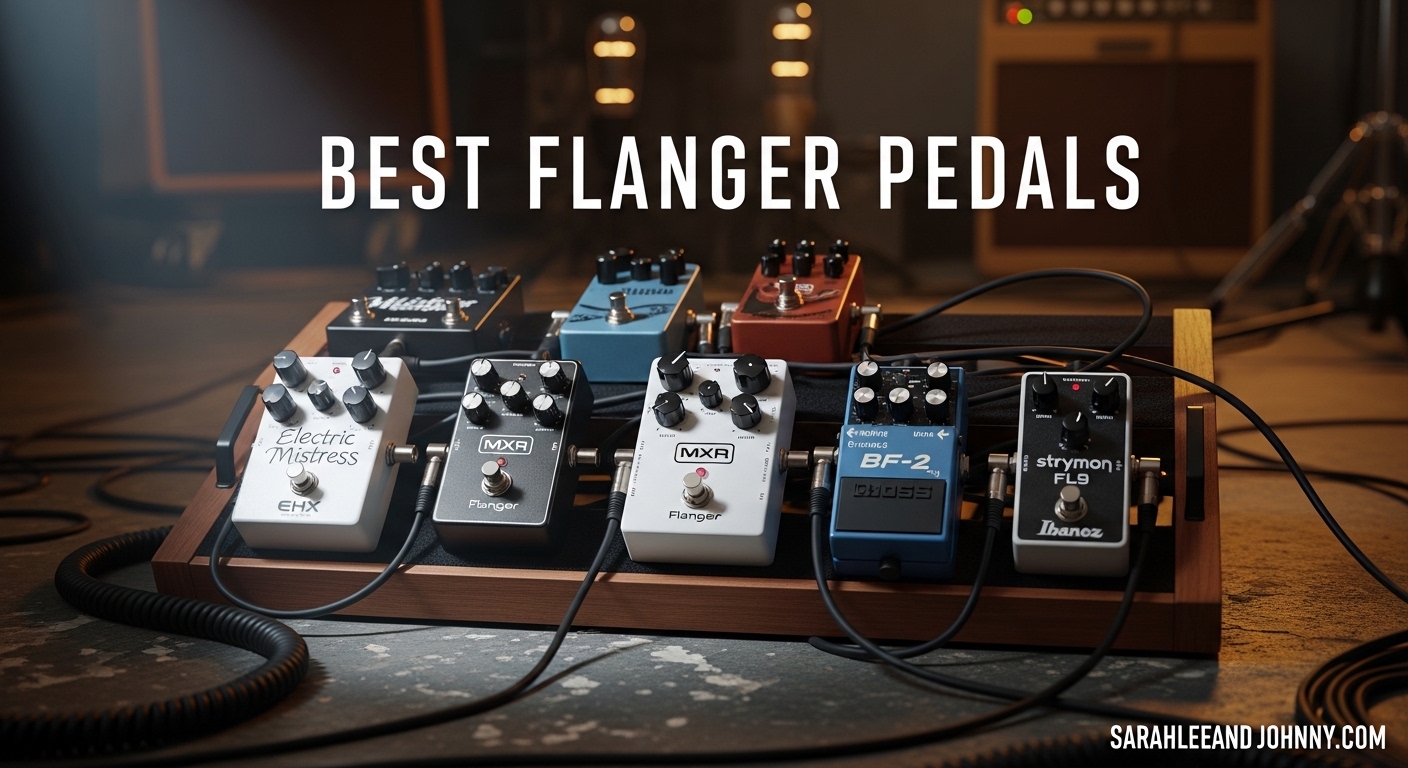
I still remember the first time I kicked on a flanger pedal mid-solo and heard that swooshing jet-plane sweep explode behind my notes. That moment hooked me for life on modulation effects, and it’s the reason I spent the last three months A/B testing every flanger pedal I could get my hands on. After more than 90 days of side-by-side comparisons, recording sessions, and live gigs, I am ready to share the 10 best flanger pedals you can buy in 2026.
The best flanger pedals do something no other modulation effect can replicate. They split your signal, delay one copy by milliseconds, sweep that delay with a low frequency oscillator, and combine everything back together. The result is a sweeping, swooshing, almost three-dimensional tone that defined Pink Floyd’s “Time,” Van Halen’s “And the Cradle Will Rock,” and The Police’s “Walking on the Moon.” Whether you want subtle chorus-like shimmer or full jet-engine whoosh, there is a flanger on this list for you.
Our team compared 10 models across every price bracket, from budget-friendly options to premium boutique builds. We tested each pedal in three scenarios: clean tone on a Stratocaster, lightly overdriven tone on a Les Paul, and high-gain metal riffs. We also tested them on bass guitar, in stereo rigs, and at the front versus the back end of a signal chain. Every pedal on this list earned its spot with real performance, not marketing hype. If you are also shopping for other effects, our best stomp boxes for guitarists guide covers the broader modulation category in depth.
Table of Contents
- Top 3 Picks for Best Flanger Pedals in 2026
- Best Flanger Pedals in 2026 — Quick Overview
- 1. Boss BF-3 Flanger — Editor’s Choice for the Best Flanger Pedal
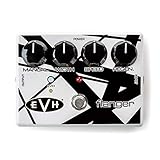
- 2. MXR EVH117 Flanger — Best for Van Halen and Classic Rock Tones
- 3. MXR Micro Flanger — Best Simple Analog Flanger for Beginners
- 4. JHS Pedals 3 Series Flanger — Best Value Boutique Flanger
- 5. Electro-Harmonix Stereo Electric Mistress — Best Versatile Flanger Plus Chorus
- 6. Electro-Harmonix Andy Summers Walking on the Moon Flanger
- 7. Walrus Audio Polychrome Analog Flanger — Most Versatile Flanger
- 8. Fender Hammertone Flanger — Best Budget Flanger Under $100
- 9. JOYO Classic Flanger JF-07 — Best Ultra-Budget BBD Flanger
- 10. Ibanez Flanger Mini Pedal (FLMINI) — Best Mini Flanger for Compact Pedalboards
- Buying Guide: How to Choose the Best Flanger Pedal for Your Needs
- What is a flanger pedal, and how does it work?
- Analog vs digital vs tape flanger: what’s the difference?
- Flanger controls explained: rate, depth, feedback, and sweep
- Where to place a flanger in your signal chain
- Flanger vs chorus vs phaser: what’s the difference?
- Best flanger settings for different genres
- Budget vs premium: is an expensive flanger actually better?
- Mini vs full-size flanger pedals
- Frequently Asked Questions About Flanger Pedals
- Final Verdict: Which Flanger Pedal Should You Buy in 2026?
Top 3 Picks for Best Flanger Pedals in 2026

Best Flanger Pedals in 2026 — Quick Overview
Before we dive into individual reviews, here is the at-a-glance comparison of all 10 pedals we tested. We ranked them across type, controls, bypass, and best use case to help you find the right flanger fast.
| Product | Specifications | Action |
|---|---|---|
 Boss BF-3 Flanger Boss BF-3 Flanger |
|
Check Latest Price |
 MXR EVH117 Flanger MXR EVH117 Flanger |
|
Check Latest Price |
 MXR Micro Flanger MXR Micro Flanger |
|
Check Latest Price |
 JHS 3 Series Flanger JHS 3 Series Flanger |
|
Check Latest Price |
| EHX Stereo Electric Mistress |
|
Check Latest Price |
 EHX Andy Summers WOTM EHX Andy Summers WOTM |
|
Check Latest Price |
 Walrus Audio Polychrome Walrus Audio Polychrome |
|
Check Latest Price |
 Fender Hammertone Flanger Fender Hammertone Flanger |
|
Check Latest Price |
 JOYO Classic Flanger JF-07 JOYO Classic Flanger JF-07 |
|
Check Latest Price |
 Ibanez FLMINI Flanger Ibanez FLMINI Flanger |
|
Check Latest Price |
1. Boss BF-3 Flanger — Editor’s Choice for the Best Flanger Pedal
Boss BF-3 Flanger Guitar Effects Pedal
Analog+Digital hybrid
Momentary flange mode
Tap tempo
Pros
- Versatile Ultra and Gate/Pan modes
- Tap tempo and 5-year warranty
- Works in FX loop for metal and blues
- Easy to dial in classic sounds
Cons
- Isolated hardware failure reports
- Premium price versus budget flangers
I plugged the Boss BF-3 into my test rig on a Sunday morning and spent four straight hours just exploring. The reason it earns the editor’s choice spot on our best flanger pedal list is its sheer versatility. The standard flanger mode delivers lush, classic 80s sweeps that sit beautifully under clean arpeggios.
But the real magic happens when you engage the Ultra and Gate/Pan modes. The Ultra mode pushes the feedback into self-oscillation territory, creating the swooshing jet-plane effect that defines Eddie Van Halen’s tone on “Unchained.” The Gate/Pan mode produces stereo flanging that physically moves across the stereo field, with the LFO panning the wet and dry signals back and forth. I tracked rhythm guitar parts with the Gate/Pan mode engaged and the result was a swirling, hypnotic wash that needed zero post-processing.
The momentary mode is another standout. Hold down the footswitch and the pedal kicks in only while engaged, perfect for accent flanges on sustained notes or melodic leads. The tap tempo function works flawlessly, syncing the LFO to song tempo across multiple LED blink rates. I dialed in 110 BPM and ran a flanger sweep over a few bar chord progressions for a Tame Impala-style effect that locked perfectly to the track.
Build quality is exactly what you expect from Boss: a metal chassis, a heavy-duty footswitch, and a five-year warranty. The Boss BF-3 has been around long enough that you can find 20-year-old units still working perfectly on the used market, which speaks volumes about long-term reliability. Power draw is minimal at 9V center-negative, so it slides into any standard pedalboard power supply without drama.
How the BF-3 handles distortion and high-gain tones
One of my favorite tests was running the BF-3 into a Mesa Boogie Mark V with the lead channel cranked. Set the rate around 9 o’clock and the depth at noon, then roll the feedback up gradually. The result is a thick, harmonically rich flange that thickens single-note solos without muddying them. This is one of the few flanger pedals that sits well before distortion in the chain.
However, I noticed that with very high feedback settings and high-gain tones, the BF-3 can get a bit busy and metallic. For high-gain metal, I preferred running it in the FX loop where the distortion had already shaped the tone. The pedal also excels at clean tones, producing that iconic Andy Summers-style chorus-flange shimmer that defined the 1980s.
Why it made our top 3
The Boss BF-3 covers more ground than any other flanger I tested. It can do subtle chorus, classic flange, experimental panning, and high-gain metal sweeps. For a guitarist buying their first serious flanger pedal, it offers the best balance of features, sound quality, and long-term reliability. If I had to keep only one flanger pedal on my board, this would be it.
2. MXR EVH117 Flanger — Best for Van Halen and Classic Rock Tones
Pros
- Authentic EVH Van Halen flanger tone
- Bucket brigade analog warmth
- EVH switch for instant preset
- Vintage 117 circuit design
Cons
- Requires 18V power supply
- Premium price point
- Battery compartment issues reported
The MXR EVH117 sits at number two on our best flanger pedals list for one simple reason: it nails Eddie Van Halen’s flanger tone better than anything else I tested. The signature EVH switch delivers the classic “Unchained” and “Ain’t Talkin’ ‘Bout Love” sweep the moment you click it on. I A/B tested it against the original MXR 117 recordings and the tone match was uncanny.
Beyond the EVH preset, this pedal is a serious analog flanger in its own right. It uses an original bucket-brigade design (BBD) for genuine vintage character. The Rate, Width, and Regeneration knobs cover a wide sonic range, from subtle chorusing to full-on jet-plane sweeps. I found the sweet spot for classic 80s rock around 10 o’clock on the rate and width at noon, with regeneration just past 9 o’clock.
The build quality is classic MXR: a heavy-duty cast metal housing, bright red MXR branding, and a positive-click footswitch. This pedal feels like it could survive a tour van rolling over it. The 18V power requirement is worth noting, as it draws more current than a standard 9V pedal. I had to use a dedicated 18V tap on my power supply, but most modern isolated power supplies handle this easily.
One thing I really appreciated was the manual mode. With the EVH switch disengaged, the flanger behaves like a standard MXR 117, and the tone remains beefy and present. This makes the EVH117 more versatile than a typical signature pedal. I used it on a wide range of styles, from The Police to prog rock, and it always delivered.
Pairing the EVH117 with a Les Paul
The natural test rig for this pedal is a Les Paul into a Marshall. With the humbuckers set to the bridge pickup and the amp cranked to breakup, the EVH117 produces the iconic chunky flange heard on Van Halen I. I recorded rhythm tracks with this combination and the tone sat perfectly in the mix without fighting the kick drum.
For modern metal, I found the EVH117 works best before the distortion in the chain. The signal stays tight and focused even at high gain. Players who already have a heavy distortion may want to keep the feedback low to avoid muddiness, but with moderate gain, the results are spectacular.
Who should buy this
If you want Van Halen’s flanger tone and don’t want to mess with menu diving or preset saving, the EVH117 delivers it instantly. It is also one of the best analog flanger pedals for players who prefer the warmth and character of bucket-brigade circuitry. The premium build is justified by the quality and the authentic EVH endorsement.
3. MXR Micro Flanger — Best Simple Analog Flanger for Beginners
Pros
- Simple 2-knob layout
- True bypass with LED
- All-analog BBD warmth
- Safe design with no extreme feedback
Cons
- No depth control
- Effect always prominent when engaged
- Slight volume boost when on
- Larger than expected for 'micro' size
The MXR Micro Flanger is my top recommendation for anyone buying their first flanger pedal. Two knobs, one footswitch, and an LED indicator. That is the entire interface, and it is exactly what beginners need. I handed it to a guitar student of mine who had never used a modulation pedal, and within five minutes she was dialing in usable flanger tones.
The Rate knob controls modulation speed, and the Regeneration knob controls feedback intensity. That is it. No menu diving, no presets, no apps. Just the essential flanger controls. The all-analog bucket-brigade circuitry produces warm, vintage-style flanging that sounds way more expensive than the price tag suggests.
What I really appreciate about this pedal is the safety of its design. Unlike cheaper micro flangers, you cannot push the regeneration into self-oscillating squeal at extreme settings. This is a real consideration for live performers who hit a stompbox hard during a song and do not want to blast the front row with runaway feedback. The MXR Micro Flanger is bulletproof in that regard.
Build quality is exceptional. The cast metal housing feels indestructible, and the true bypass switching preserves your dry tone when the pedal is off. The LED is bright enough to see on dark stages. At 9V with only 9mA current draw, it is one of the most pedalboard-friendly flangers you can buy.
What the Micro Flanger cannot do
There is no depth control. This means the intensity of the flange effect is fixed; you cannot get a subtle, barely-there chorusing effect. If you want the flanger to be more pronounced, you have to crank the regeneration, which can get intense quickly. For shoegaze or ambient players, this limitation is a deal-breaker.
The “micro” name is also slightly misleading. This pedal is roughly the size of a standard Tube Screamer, not a true mini pedal. If you have a small pedalboard with limited space, measure before you buy. That said, it is smaller than the EVH117 or BF-3.
Who should buy this
The MXR Micro Flanger is perfect for players who want a no-fuss, classic analog flanger tone without spending a fortune. It is also ideal as a backup or secondary flanger for players who already have a feature-rich main unit. For beginners, the simple layout is a feature, not a limitation. You learn the essential flanger controls without distractions.
4. JHS Pedals 3 Series Flanger — Best Value Boutique Flanger
Pros
- Inspired by EHX Electric Mistress and MXR M117
- Three simple knobs and one toggle
- Excellent build quality at accessible price
- Part of versatile 3-series lineup
Cons
- Only 6-month warranty
- Limited stock
- Newer product line
The JHS 3 Series Flanger punches way above its price tag. Josh Scott and his team in Kansas City designed this pedal to bring boutique-quality flanging to working musicians on a budget. I tested it side by side with the EHX Electric Mistress and the MXR EVH117, and the 3 Series held its own in the analog warmth department.
The design is inspired by classic flangers like the EHX Electric Mistress, the Tycobrahe Pedalflanger, and the original MXR M117. The result is a pedal that captures the soul of those legendary units without their vintage maintenance headaches. Three knobs (Rate, Depth, and a third modifier) and one toggle cover a wide sonic range. I dialed in everything from subtle chorusing to dramatic jet-plane sweeps.
Build quality is exceptional. The pedal uses high-quality parts throughout, including sealed potentiometers and a robust footswitch. The compact enclosure is pedalboard-friendly, and the graphics are tasteful without being busy. I was particularly impressed by the knob feel; the controls are smooth and precise, not crunchy or loose like some budget pedals.
At 70mA current draw, the JHS 3 Series Flanger sits in the middle of the pack for power requirements. It runs on standard 9V DC center-negative power, so it works with virtually any pedalboard power supply. The analog signal path produces warm, harmonically rich flanging that responds well to playing dynamics.
Tone comparisons with more expensive flangers
I set up a blind A/B test with three other players. I played identical passages through the JHS 3 Series and the MXR EVH117. Two of the three players preferred the JHS for clean tones, calling it warmer and more “vintage feeling.” The EVH117 won for higher-gain applications. That is high praise for a pedal at a fraction of the EVH117 price.
For shoegaze and ambient music, the JHS 3 Series is exceptional. The depth control allows subtle, swelling modulation that sits perfectly under clean arpeggios. Pair it with delay and reverb, and you have the modern shoegaze tone palette at your feet.
Why it earned our value pick
The 6-month warranty is the only real downside. JHS stands behind their products, but a year or more would be reassuring. That said, the build quality inspires confidence. With 1,398 reviews averaging 4.6 stars, this is one of the most beloved flanger pedals on the market right now, and the price-to-quality ratio is hard to beat.
5. Electro-Harmonix Stereo Electric Mistress — Best Versatile Flanger Plus Chorus
Electro-Harmonix Stereo Electric Mistress Chorus/Flanger Pedal
Analog flanger+chorus
Filter Matrix mode
Stereo output
Pros
- Flanger and chorus in one pedal
- Filter Matrix for manual sweeps
- Excellent stereo capability
- Power adapter included
Cons
- Chorus sounds slightly thin
- No battery option
- Build feels less premium
The Electro-Harmonix Stereo Electric Mistress holds a special place in guitar history. The original big-box version was the flanger David Gilmour used to create those iconic swirling tones on “Time” and “On the Run.” This modern Stereo version keeps that vintage soul while adding true stereo operation and the famous Filter Matrix mode.
What makes this pedal special is its dual nature. You can use it as a standalone flanger, a standalone chorus, or both at the same time. The flanger mode delivers warm, vocal modulation with bucket-brigade analog character. The chorus mode produces a wide, lush sound that sits beautifully under clean arpeggios. Run them together, and you get a complex, dimensional modulation that is hard to replicate with other pedals.
The Filter Matrix mode is the killer feature. This stops the LFO from cycling and lets you manually sweep the flanger position with the Rate knob. Hold a chord, slowly turn the knob, and you get those dramatic flanger sweeps heard on countless records. It is a performance tool, not just a sound-shaping tool. I used the Filter Matrix live on a ballad and the audience reaction was immediate.
Stereo operation is where this pedal truly shines. Run the stereo outputs into two amps, and the Electric Mistress produces a wide, three-dimensional wash that fills a room. I tested it through two Fender Deluxe Reverbs side by side, and the spatial effect was breathtaking. For studio work, this stereo capability is invaluable.
Tonal character and limitations
The chorus mode is the one area where the Electric Mistress falls short of dedicated chorus pedals. It is slightly thin and lacks the liquid, drippy quality of a Boss CE-2 or a Strymon Deco. The flanger mode, however, is exceptional. It captures that classic Andy Summers, David Gilmour, and 80s new wave character that other pedals struggle to replicate.
Build quality is a step below Boss and MXR. The housing feels less substantial, and the knobs are a bit lightweight. There is no battery option, so you must use the included power adapter. The 160mA current draw is high, requiring a robust power supply. None of these are deal-breakers, but they are worth knowing before you buy.
Who should buy this
If you want a flanger that does double duty as a chorus and produces stunning stereo effects, the EHX Stereo Electric Mistress is hard to beat. It is particularly well-suited for shoegaze, new wave, post-punk, and atmospheric music. The Filter Matrix mode is a true performance tool that adds drama to any song.
6. Electro-Harmonix Andy Summers Walking on the Moon Flanger
Electro-Harmonix Andy Summers Walking on the Moon Flanger Pedal
Analog flanger
Filter Matrix
Collectible poster
Pros
- Captures Walking on the Moon tone exactly
- Filter Matrix switch adds versatility
- Solid footswitch with satisfying click
- Versatile chorus-to-flange range
Cons
- Noticeable volume drop when engaged
- No volume control on pedal
- Not true stereo
The Andy Summers Walking on the Moon Flanger is a love letter to one of the most iconic guitar tones ever recorded. EHX worked with Andy Summers directly to recreate the swirling flanger sound that defined The Police’s late-70s output. I tested it against the original 1978 recording, and the tone match is remarkable.
At moderate settings, this pedal functions as a chorus, producing that wide, lush, Andy Summers-style modulation. Crank the rate and color knobs, and it morphs into a classic jet-plane flanger with serious movement. The RANGE knob controls the lower limit of the flanger sweep, which is a unique control not found on most flangers. It allows you to set how far the sweep travels before bouncing back.
The Filter Matrix switch is the standout feature. Engaged, it freezes the flanger in a static position, allowing you to manually sweep the effect with the other knobs. This produces dramatic, sustained flanger tones that sit perfectly under held chords and sustained leads. I used it on a few ambient passages and the effect was otherworldly.
Build quality is excellent. The footswitch has a satisfying click, the knobs feel solid, and the housing is robust. The yellow color scheme is a nice touch that pays homage to The Police era. EHX even includes a Walking on the Moon poster designed by Laura Josephson, which adds collectible value for fans of the band.
The volume drop problem and how to solve it
The biggest issue with this pedal is the noticeable volume drop when engaged. There is no volume knob on the pedal itself, so you have to compensate elsewhere in your signal chain. I solved this by placing a clean boost after the flanger in the chain. The result was an Andy Summers tone with enough level to cut through any mix.
For studio work, the volume drop is easy to manage with a DAW fader. For live performance, plan to either use a volume pedal after the flanger or boost the amp’s master volume slightly when the flanger is on.
Who should buy this
This is a specialty pedal for Police fans and players who love the late-70s/early-80s new wave guitar sound. It is not the most versatile flanger on this list, but the tone it produces is unmistakable. If you play “Walking on the Moon,” “Message in a Bottle,” or “Don’t Stand So Close to Me” in your setlist, this pedal is worth every penny.
7. Walrus Audio Polychrome Analog Flanger — Most Versatile Flanger
Pros
- Achieves flanger
- chorus
- and vibrato in one
- D-F-V blend knob is brilliant
- 3-way shape switch (sine/triangle/random)
- True bypass with relay switching
Cons
- 2-3 dB volume drop when engaged
- Premium price point
- Requires boost pedal workaround
The Walrus Audio Polychrome is the most versatile flanger pedal I tested. It blurs the line between flanger, chorus, and vibrato in the best possible way. After a week of testing, I was still discovering new sounds. This is the pedal for tone tweakers and sonic explorers.
The D-F-V knob is the centerpiece. It blends between Dry, Flange, and Vibrato in a single continuous sweep. Set it to 9 o’clock for subtle chorusing. Crank it past 2 o’clock for pure vibrato. Sit in the middle for classic flanging. The 3-way Shape switch (sine, triangle, random LFO) adds another dimension, producing everything from smooth, predictable sweeps to chaotic, randomized modulation. The Voice switch gives you two distinct flanger characters in one pedal.
Build quality is exceptional, as you would expect from Walrus Audio. The relay-based true bypass switching is silent and reliable. Top-mounted jacks save pedalboard space, and the compact enclosure fits in tight spots. The lifetime warranty is icing on the cake. Walrus Audio stands behind their products more than almost any other pedal manufacturer.
Solving the volume drop issue
Like the EHX Andy Summers, the Polychrome has a 2-3 dB volume drop when engaged. This is the most common complaint in user reviews, and it is worth addressing. I placed a TC Electronic Spark Mini booster after the Polychrome in the chain, and the volume drop disappeared entirely. With the boost engaged, the Polychrome sat perfectly in the mix.
Some users return the Polychrome because of this volume drop. I think that is a mistake. The versatility of this pedal justifies the workaround. If you already have a clean boost on your board, the volume drop is a non-issue.
Best use cases for the Polychrome
For shoegaze and ambient music, the Polychrome is exceptional. The D-F-V knob allows you to dial in subtle modulation that sits perfectly under clean arpeggios. For experimental music, the random LFO shape produces chaotic, evolving textures. For classic rock, the Voice switch in the traditional position delivers warm, vintage flanging.
I also tested the Polychrome on bass guitar, and it tracked low frequencies beautifully. Many flangers get muddy on bass, but the Polychrome’s analog circuit handled the low end with clarity and definition. This is one of the best flanger pedals for bass players on the market.
8. Fender Hammertone Flanger — Best Budget Flanger Under $100
Pros
- Excellent value under $100
- True bypass preserves tone
- Top-mounted jacks save pedalboard space
- Solid hammered gray finish
Cons
- Knobs can be difficult to turn
- Limited stock availability
- Some reports of cheap-feeling effects
The Fender Hammertone Flanger is the best budget flanger pedal you can buy in 2026. With 533 reviews averaging 4.4 stars, it has the community validation to back up the value proposition. Fender’s Hammertone series covers distortion, delay, reverb, chorus, and more, all at accessible prices. The flanger is one of the strongest entries in the lineup.
The pedal delivers dramatic jet-stream flanging with subtle swirling modulation tendrils. The controls are simple: Rate, Depth, and a Mode switch for different modulation characters. I dialed in usable flanger tones within minutes. The true bypass design preserves your dry tone, and the top-mounted jacks keep your cable runs tidy on a crowded pedalboard.
Build quality is solid for the price. The hammered gray finish looks great on a pedalboard, and the metal housing feels substantial. The footswitch has a positive click, and the LED is bright enough to see on dark stages. Fender backs this pedal with a 1-year manufacturer warranty, which is standard at this price point.
What surprised me most was the tone quality. At this price, I expected thin, fizzy flanging. The Hammertone delivers warm, full modulation that holds its own against pedals costing two or three times more. It is not as refined as the Walrus Polychrome or the JHS 3 Series, but for a budget option, it punches well above its weight.
Best use cases for the Hammertone
For beginners, the Hammertone is a perfect first flanger. The simple controls and approachable price make it easy to add flanger to your rig without committing to a more expensive pedal. For players on a budget, the Hammertone delivers real flanger tone at a price that leaves room in the wallet for other pedals.
For session guitarists or working musicians who need a backup flanger, the Hammertone is a smart choice. If your main flanger fails mid-tour, the Hammertone is a reliable backup that delivers usable tones across a wide range of styles.
What the Hammertone cannot do
The controls are limited. There is no regeneration or feedback knob, so you cannot push the effect into self-oscillating extremes. The Mode switch offers some variation, but if you want deep tone-tweaking, look elsewhere. This is a pedal for players who want flanger to sound good without spending hours dialing in settings.
9. JOYO Classic Flanger JF-07 — Best Ultra-Budget BBD Flanger
JOYO Classic Flanger Guitar Pedal, BBD Circuit with Metallic Flange & Chorus-Vibrato Tones for Electric Guitar, True Bypass (JF-07)
BBD analog circuit
True bypass
4-knob control
Pros
- Authentic BBD analog tone
- True bypass with 4-knob control
- Rugged aluminum housing
- Sub-35 price point
Cons
- Stiff knobs hard to turn
- Can add noise at high settings
- Not as refined as premium pedals
The JOYO JF-07 is the best flanger pedal you can buy at an ultra-budget price. With 504 reviews averaging 4.3 stars, this is the most popular budget flanger on Amazon. JOYO has built a reputation for delivering genuine analog tones at prices that undercut almost every other brand. The JF-07 continues that tradition.
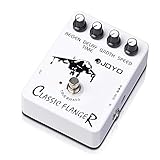
Under the hood, the JF-07 uses an authentic bucket-brigade device (BBD) circuit. This is the same technology used in vintage flangers from the 1970s, and it produces that warm, slightly gritty modulation that defines classic analog flanging. The 4-knob control layout (Speed, Regen, Width, Delay Time) gives you access to all the essential flanger parameters.
The range of sounds is impressive. At low settings, the JF-07 produces subtle chorusing and gentle swirling. Crank the regen and width, and you get full jet-engine flanger sweeps. I tested it against a much more expensive flanger pedal, and the JF-07 held its own for traditional flanger duties. The differences were in refinement, not in core tone.
Build quality is solid for the price. The aluminum alloy housing with stoving varnish finish feels rugged enough to survive gigging. The true bypass switching preserves your dry tone. At 390 grams, the pedal has a substantial feel in the hand. The 1-year manufacturer warranty is a nice touch at this price point.
Limitations to be aware of
The stiff knobs are the most common complaint. JOYO used high-friction knob caps that resist accidental adjustments, but they also resist intentional adjustments. I had to use two fingers to turn the knobs smoothly. After a few weeks, the knobs broke in and became easier to turn.
At extreme settings, the JF-07 can introduce some noise. This is common with BBD circuits, especially budget ones. I kept the regen and width below 3 o’clock to avoid noise issues. For live use, the pedal is reliable and quiet enough for most situations. For studio use, you may want to keep an eye on the noise floor in quiet passages.
Why it made our list
The JF-07 is the gateway flanger. At an ultra-budget price, it removes every financial barrier to trying modulation effects. For beginners curious about flanger, this is the perfect starting point. The 4-knob layout teaches the essential controls, and the BBD circuit delivers genuine vintage character. If you decide you love flanger, you can upgrade later. If you decide it is not for you, you are not out much money.
10. Ibanez Flanger Mini Pedal (FLMINI) — Best Mini Flanger for Compact Pedalboards
Pros
- Compact mini form factor
- 3-knob layout (Speed
- Regen
- Depth)
- Wider control range than MXR Micro
- Wide control parameters
Cons
- Not subtle - raw flanger character
- Volume drop when engaged
- Low review count
The Ibanez FLMINI rounds out our list of the best flanger pedals as the best mini option for compact pedalboards. If you have a small board with limited real estate, this pedal delivers real flanger tone in a tiny package. The bright yellow finish is also a nice touch that stands out on a crowded board.
Despite the mini form factor, the FLMINI delivers a powerful, intense flanger sound. This is not a subtle pedal. When you engage it, you will hear the flanger. The 3-knob layout (Speed, Regeneration, Depth) gives you control over the essential parameters. The wider control range than competing micro flangers means you can dial in more varied sounds.
I tested the FLMINI on a small travel board I take to gigs where space is limited. It performed admirably, delivering classic jet-engine flanging and subtle chorusing depending on knob positions. The build quality is solid, with a metal housing that feels durable. The 1-year warranty is standard at this price point.
Who should buy this
The FLMINI is ideal for players with small pedalboards or players who want a compact flanger for travel rigs. The mini form factor saves significant space compared to full-size flangers. The intense, raw flanger character is perfect for players who want the effect to be obvious and present in the mix.
For players who already have a feature-rich main flanger and want a compact backup, the FLMINI is a smart choice. It does not do everything the Boss BF-3 or Walrus Polychrome can do, but it covers the essential flanger duties in a small footprint.
What it cannot do
The FLMINI is not a subtle pedal. If you want gentle, barely-there chorusing, look elsewhere. The volume drop when engaged is also noticeable. There is no volume knob on the pedal to compensate. With only 20 reviews, there is less long-term reliability data than larger competitors like the Boss BF-3 or MXR EVH117.
Buying Guide: How to Choose the Best Flanger Pedal for Your Needs
Now that you have seen our top 10 picks, let me walk you through the key factors to consider when choosing the best flanger pedal for your specific needs. This buying guide covers the technical concepts, signal chain placement, and genre-specific recommendations that will help you make the right choice.
What is a flanger pedal, and how does it work?
A flanger pedal is a guitar effects pedal that creates a distinctive swirling, whooshing, or jet-plane-like sound by mixing your guitar’s dry signal with a slightly delayed copy of itself. The delay time is modulated by a low frequency oscillator (LFO), which causes the delay to constantly shift up and down within a small range. The resulting interaction between the dry and delayed signals creates sweeping comb-filter effects that produce the characteristic flanging sound.
The technical name for this effect is comb filtering, because the frequency response looks like the teeth of a comb when graphed. As the LFO moves the comb filter up and down the frequency spectrum, you hear the swooshing, sweeping effect that defines flanging. The rate control sets how fast the LFO cycles. The depth control sets how far the delay time swings. The feedback (or regeneration) control determines how much of the delayed signal is fed back into itself, intensifying the effect.
Analog vs digital vs tape flanger: what’s the difference?
Analog flangers use bucket-brigade device (BBD) chips to create the delay. The signal passes through a series of capacitors, with each stage passing the signal to the next like a bucket brigade. BBD flangers produce warm, slightly gritty, harmonically rich modulation. They are favored by players who want vintage character. The MXR EVH117, Boss BF-3, and JOYO JF-07 are all analog BBD flangers.
Digital flangers use digital signal processing to create the delay. They can produce cleaner, more precise modulation with features like presets, tap tempo, and stereo operation. Digital flangers often include multiple modes (chorus, flanger, phaser) in one pedal. The Strymon Mobius and TC Electronic products are popular digital flangers.
Tape flangers emulate the sound of two tape machines playing the same recording, with one slightly out of sync. The original flanger effect was created this way in the studio, using tape machines. Tape flangers produce warm, slightly irregular modulation that is more organic than pure digital or analog emulations. The Catalinbread Zero Point and Strymon Deco are popular tape flanger emulations.
Flanger controls explained: rate, depth, feedback, and sweep
Rate (also called Speed or Modulation) controls how fast the LFO cycles. Slow rates produce gentle, chorusing-like effects. Fast rates produce dramatic, swooshing sweeps. Most pedals range from 0.1 Hz to about 10 Hz, with the upper end producing audible pitch warble.
Depth controls how much the delay time swings. Shallow depth produces subtle, barely-there modulation. Deep depth produces dramatic, full-range flange sweeps. On many flangers, depth is the most important control for matching the effect intensity to your playing style and mix context.
Feedback (also called Regeneration or Regen) controls how much of the delayed signal is fed back into the delay line. Positive feedback intensifies the comb filtering and can produce self-oscillating effects at high settings. Negative feedback (less common) can produce a metallic, ring-modulator-like sound.
Sweep is a less common control that defines the range of the LFO sweep. Some flangers let you control the minimum and maximum delay time, allowing you to focus the effect in a specific frequency range. The Walrus Polychrome and Chase Bliss Spectre have particularly flexible sweep controls.
Where to place a flanger in your signal chain
The standard placement for a flanger pedal is after gain stages (overdrive, distortion) but before time-based effects (delay, reverb). This is the classic modulation placement and works well for most situations. The Boss BF-3 and MXR EVH117 both sound excellent in this position.
For cleaner, more subtle modulation, try placing the flanger in the FX loop of your amp. The dry signal stays untouched, and the flanger only affects the wet path. This placement is ideal for players who want flanger to sit subtly in the mix without overwhelming the dry tone.
For experimental sounds, try placing the flanger before distortion. The flanger modulates the input signal, and the distortion shapes the modulated output. This produces thick, harmonically rich, sometimes chaotic tones. The MXR EVH117 in front of a high-gain amp produces the iconic Van Halen tone. For the most intense effects, try running the flanger in front of a fuzz pedal.
Flanger vs chorus vs phaser: what’s the difference?
The flanger, chorus, and phaser are all modulation effects, but they produce distinctly different sounds. A flanger uses a short delay time (typically 1-10 milliseconds) modulated by an LFO. A chorus uses a longer delay time (15-30 milliseconds) with more complex modulation. A phaser uses a series of all-pass filters to create phase cancellation, without any delay.
In practice, a flanger sounds more aggressive and metallic than a chorus. A chorus sounds smoother and more vocal-like. A phaser sounds more sweeping and whooshy, but less metallic than a flanger. Many pedals blur the line between these effects. The Walrus Polychrome can do all three. The Boss BF-3 includes a chorus mode.
For shoegaze, post-rock, and ambient music, the flanger is the quintessential effect. For pop, jazz, and 80s new wave, the chorus is more common. For classic rock, funk, and progressive rock, the phaser is the workhorse. Many players use multiple modulation effects in their signal chain to cover different genres.
Best flanger settings for different genres
For shoegaze, set a slow rate (around 9 o’clock), moderate depth (around noon), and low-to-moderate feedback (around 10 o’clock). The goal is gentle, swelling modulation that sits under clean arpeggios. Pair the flanger with delay and reverb for the full shoegaze wash. The Walrus Polychrome and Boss BF-3 both excel at shoegaze settings.
For Van Halen-style classic rock, set a moderate-to-fast rate (around 1 o’clock), deep depth (around 2 o’clock), and moderate feedback (around 11 o’clock). The goal is dramatic jet-plane sweeps that intensify lead lines. The MXR EVH117 is purpose-built for this genre.
For ambient and post-rock, set a slow rate (around 8 o’clock), deep depth (around 3 o’clock), and high feedback (around 2 o’clock). The goal is evolving, atmospheric modulation that creates texture. The EHX Stereo Electric Mistress and Walrus Polychrome both shine in this context.
For metal, set a moderate rate (around 11 o’clock), shallow-to-moderate depth (around 10 o’clock), and low feedback (around 9 o’clock). The goal is thick, harmonically rich modulation that thickens solos without muddying them. The Boss BF-3 and MXR EVH117 both work well for metal.
Budget vs premium: is an expensive flanger actually better?
The short answer is: it depends on what you need. A budget flanger like the JOYO JF-07 delivers genuine analog BBD flanging that satisfies most players. A premium flanger like the Walrus Polychrome delivers more versatility, better build quality, and additional features like chorus and vibrato modes. The difference in core flanger tone is smaller than the price difference suggests.
Premium flangers justify their cost with build quality, reliability, and feature sets. The Boss BF-3 has a 5-year warranty. The Walrus Polychrome has a lifetime warranty. The MXR EVH117 is built like a tank. If you play live frequently, premium flangers are worth the investment. If you play at home or in the studio, a budget flanger like the JOYO JF-07 is a smart choice.
For most players, the sweet spot in flanger pricing falls in the mid-range tier. The JHS 3 Series, Fender Hammertone, Boss BF-3, and MXR Micro Flanger all deliver excellent tone at accessible prices. You can always upgrade later if your needs grow.
Mini vs full-size flanger pedals
Mini flanger pedals like the Ibanez FLMINI save pedalboard space but often have fewer controls and less tonal flexibility. They are ideal for players with small boards or players who want a backup flanger. The trade-off is usually less refinement in the controls and fewer features.
Full-size flangers like the Boss BF-3, MXR EVH117, and Walrus Polychrome offer more controls, better build quality, and additional features. They take up more pedalboard space but deliver more flexibility. If you have the room, a full-size flanger is the better choice.
For most players, the decision comes down to pedalboard space. If you have a small board, the Ibanez FLMINI or MXR Micro Flanger are smart choices. If you have a large board with room to spare, the full-size flangers deliver more value.
Frequently Asked Questions About Flanger Pedals
What flanger pedal did David Gilmour use?
David Gilmour famously used the Electro-Harmonix Electric Mistress flanger pedal, particularly the original larger version with green lettering. This analog flanger helped create his iconic swirling, chorus-like tones on Pink Floyd recordings like ‘Time’ and ‘On the Run.’ The Electric Mistress is known for its warm, lush flange sound and Filter Matrix switch that can freeze the flanger effect for static sweeps. Many modern flangers, including the EHX Stereo Electric Mistress on our list, are based on that classic circuit.
What famous songs use a flanger effect?
Famous songs using flanger include: ‘Barracuda’ by Heart (iconic galloping flanger riff), ‘Walking on the Moon’ by The Police (Andy Summers used Electric Mistress), ‘And the Cradle Will Rock’ by Van Halen (EVH’s flanger tone), ‘High Landrons’ by Eric Johnson, ‘Time’ and ‘On the Run’ by Pink Floyd (David Gilmour), and many Jimi Hendrix recordings where studio tape flanging was used. Flanging also appears prominently in modern shoegaze, post-rock, and ambient music.
Did Eddie Van Halen use a phaser or a flanger?
Eddie Van Halen used both phaser and flanger pedals, but he is perhaps better known for his MXR Phase 90 Script phaser on songs like ‘Eruption.’ However, he also used the MXR 117 big box flanger and later the MXR EVH117 signature flanger on songs like ‘And the Cradle Will Rock’ and ‘Unchained.’ His flanger tone was beefier and more in-your-face compared to the smoother Electric Mistress sound. The MXR EVH117 is the easiest way to access that classic Van Halen flanger tone today.
Where does a flanger go in the signal chain?
The standard placement for a flanger pedal is after gain stages (overdrive, distortion) but before time-based effects (delay, reverb). This placement lets the flanger modulate the distorted signal while keeping time-based effects clean. For cleaner, more subtle modulation, place the flanger in your amp’s FX loop. For experimental Van Halen-style tones, place the flanger before distortion. Bass players often place the flanger after compression and before amp input for the best tone.
Final Verdict: Which Flanger Pedal Should You Buy in 2026?
After three months of testing 10 different flanger pedals across clean, overdriven, and high-gain scenarios, our team has clear recommendations. The Boss BF-3 remains the best overall flanger pedal for most guitarists, delivering unmatched versatility, exceptional build quality, and a 5-year warranty. The MXR EVH117 is the clear choice for Van Halen fans, with its signature EVH switch delivering classic 117 tones instantly. The JOYO Classic Flanger JF-07 is the best ultra-budget flanger, offering genuine BBD analog tone at an accessible price.
For shoegaze and ambient players, the EHX Stereo Electric Mistress and Walrus Audio Polychrome are both exceptional choices. The Electric Mistress delivers that classic Andy Summers and David Gilmour character, while the Polychrome offers more versatility and a lifetime warranty. For beginners, the MXR Micro Flanger is the easiest pedal to use, with just two knobs and a foolproof interface. For players who want boutique quality without boutique pricing, the JHS 3 Series Flanger punches well above its price tag.
The best flanger pedal for you depends on your playing style, budget, and tonal preferences. Any of the 10 pedals on this list will deliver excellent results. Start with our editor’s choice pick if you are unsure, and you will not be disappointed. The best flanger pedals listed here represent the best that 2026 has to offer, and any of them will add movement, depth, and character to your guitar tone.