

I spent the last four months working through ten of the most recommended songwriting resources on the market, from Berklee Press textbooks to Jeff Tweedy’s creative manifesto. My goal was simple: figure out which ones actually make you a better songwriter and which ones just sound good on a syllabus.
Finding the best online songwriting courses in 2026 is harder than it looks. Reddit threads contradict each other, platform reviews are all over the place, and every instructor claims their method is the one that works. I wanted to cut through the noise with hands-on experience rather than marketing copy.
What I learned surprised me. The best resources were not always the most expensive ones, and some of the budget picks outperformed courses costing five times as much. Whether you are starting from zero or you have been writing for years and feel stuck, this guide breaks down what each resource does well, who it fits, and where it falls short. If you want to round out your setup beyond courses, check our guide on songwriting tools and gifts for practical extras.
Table of Contents
- Top 3 Picks for Best Online Songwriting Courses
- Best Online Songwriting Courses in 2026
- 1. How to Write One Song by Jeff Tweedy – Best for Creative Mindset
- 2. Writing Better Lyrics by Pat Pattison – Best for Lyric Mastery
- 3. Songwriting Without Boundaries by Pat Pattison – Best for Daily Practice
- 4. Beginning Songwriting by Andrea Stolpe – Best for Complete Beginners
- 5. Popular Lyric Writing by Andrea Stolpe – Best for Storytelling
- 6. Essential Guide to Rhyming by Pat Pattison – Best for Rhyme Technique
- 7. Tunesmith by Jimmy Webb – Best for Advanced Depth
- 8. Successful Lyric Writing by Sheila Davis – Best Workbook Format
- 9. The Songwriter’s Workshop: Harmony – Best for Chord Progressions
- 10. The 30-Day Lyric Writing Challenge by The Song Foundry – Best Budget Option
- Buying Guide: How to Choose the Right Songwriting Course
- FAQs
- Conclusion
Top 3 Picks for Best Online Songwriting Courses

How to Write One Song by Jeff Tweedy
- Creative mindset training
- Writer's block solutions
- Accessible for beginners

Writing Better Lyrics by Pat Pattison
- 50 practical exercises
- 5 rhyme types covered
- All skill levels

The 30-Day Lyric Writing Challenge
- 10-minute daily exercises
- Builds writing habit
- ADHD-friendly format
Best Online Songwriting Courses in 2026
1. How to Write One Song by Jeff Tweedy – Best for Creative Mindset
How to Write One Song: Loving the Things We Create and How They Love Us Back
176 pages
By Jeff Tweedy (Wilco)
Published 2020
Dutton Press
Pros
- Inspiring motivational approach
- Practical tips for writer's block
- Accessible to non-musicians
- Encourages creative imperfection
- Written by accomplished songwriter
Cons
- First 70 pages feel like padding
- Focuses mostly on lyrics
- Stream of consciousness style
I picked up this book during a stretch where I had not written anything worth keeping for three months. Within the first chapter, Tweedy reframed how I thought about the blank page. His core message is that the goal is not to write a good song but to write any song, then judge it later. That shift alone got me through a wall I had been hitting for weeks.
What makes this different from every other songwriting resource I worked through is the tone. Tweedy writes like a friend talking to you at 2 AM, not like a professor grading your work. He shares his own doubts, his own bad drafts, and his own process for pushing through. That vulnerability makes the advice land harder than a clinical textbook ever could.
The practical side of the book focuses on loosening up your creative machinery. Tweedy walks through his morning writing routine, his approach to stealing ideas from everywhere, and his method for turning fragments into finished songs. I tried his stream-of-consciousness exercise for two weeks and ended up with three song starts I actually liked.
Where the book struggles is depth. If you want technical instruction on chord progressions, song structure, or melody construction, you will not find it here. The first 70 pages especially feel like Tweedy warming up to his actual point. I found myself skimming in places, wishing he had gotten to the exercises sooner.
Who should grab this one
This is the book I would hand to anyone who has been afraid to start writing, or anyone who has been writing for years and lost the joy in it. If your problem is motivation rather than technique, Tweedy will get you moving again.
Who should skip it
If you already have a strong creative practice and you want to sharpen specific technical skills like rhyme, prosody, or harmonic movement, this will feel too soft. You would be better served by the Pattison books further down this list.
2. Writing Better Lyrics by Pat Pattison – Best for Lyric Mastery
Writing Better Lyrics
304 pages
By Pat Pattison (Berklee)
Second Edition
Writer's Digest Books
Pros
- Comprehensive analytical approach
- 50 practical exercises
- Covers 5 rhyme types in depth
- Great for rewriting songs
- Tools and templates included
- Author is recognized expert
Cons
- Requires significant time investment
- Very analytical approach
- Some find it too academic
- Exercises can be time-consuming
This is the book that changed how I think about every single word choice in a lyric. Pat Pattison teaches at Berklee, and his analytical approach pulls apart songs at the molecular level. After working through just the first three chapters, I was hearing rhymes in songs I had listened to a thousand times without noticing them.
The standout section covers five different rhyme types: perfect, family, additive and subtractive, assonance, and consonance. Pattison explains how each type creates a different emotional effect on the listener. Once I understood that perfect rhymes feel stable and resolved while additive rhymes feel unsettled and forward-moving, my lyric writing took a jump I did not expect.
The 50 exercises are where the real work happens. Some of them ask you to take a single object and write about it using all five senses, a technique Pattison calls object writing. I did this every morning for a month. The first week felt forced, but by week three I was generating imagery I never would have arrived at otherwise. That imagery started showing up in my actual songs.
The trade-off is that this book demands time and patience. It is not something you can skim for tips. Each chapter builds on the last, and skipping around means you miss the framework. Several reviews mention it feels academic, and I understand that criticism. If you want quick inspiration, this is the wrong book. If you want a system, it is the right one.
How much time you need to commit
Plan on at least three months of consistent work to get through the exercises properly. I spent roughly 30 minutes a day, five days a week, and that pace felt right. Rushing through it would waste the material.
Does it work for experienced writers
Yes, and maybe more than for beginners. I had been writing for years before I picked this up, and the analytical framework helped me fix problems I had been circling around without naming. Experienced writers who feel stuck in habitual patterns will get the most out of Pattison’s systems.
3. Songwriting Without Boundaries by Pat Pattison – Best for Daily Practice

Songwriting Without Boundaries: Lyric Writing Exercises for Finding Your Voice
240 pages
By Pat Pattison
4 writing challenges
Penguin Publishing
Pros
- Four 14-day writing challenges
- Daily structured exercises
- Builds consistent writing muscle
- Companion to Coursera course
- Helps overcome creative blocks
- Practical and actionable
Cons
- Requires daily time commitment
- Small format with tiny typeface
- Book does not lay flat
- Some wish it was workbook-style
Think of this as the workout program that pairs with Writing Better Lyrics. Where that book teaches the theory, this one forces you to practice every single day. Pattison built four separate 14-day challenges, each focused on a different aspect of lyric writing. I treated it like a fitness routine, and the results were noticeable within the first challenge.
The exercises push you to write using different senses, different perspectives, and different emotional registers. Some days you are describing a memory through sound only. Other days you are writing the same scene from three different distances. The variety keeps you from falling into habitual patterns, which is where most writers bloat their lyrics without realizing it.
One thing to know going in: this book works best alongside Pattison’s free Coursera course. The exercises reference concepts from the course, and having both running at the same time reinforced the material in a way neither would have alone. If you are serious about lyric writing, doing both together is the move I would recommend.
The format is the main complaint. The book is small, the typeface is tight, and it does not lay flat when you are trying to work through an exercise. Several reviewers mentioned wishing it was a proper workbook with space to write directly on the pages. I ended up using a separate notebook, which worked fine but added friction.
What a typical day looks like
Each exercise takes about 15 to 20 minutes. Pattison gives you a prompt, a constraint, and a time limit. The constraint is the secret weapon because it forces your brain out of default patterns and into creative problem-solving mode.
Is it worth it without the Coursera course
It stands on its own, but you will get more out of it with the course context. The Coursera class is free to audit, so there is no reason not to run them together if you have the time.
4. Beginning Songwriting by Andrea Stolpe – Best for Complete Beginners

Beginning Songwriting – Write Your Own Lyrics, Melodies, and Chords | Berklee Guide with Hands-On Exercises | Songwriting Book for Beginners | Includes Online Audio
160 pages
By Andrea Stolpe and Jan Stolpe
Berklee Guide
Includes audio examples
Pros
- Covers lyrics melody and chords
- Includes audio examples
- Uses current song examples
- Covers music theory fundamentals
- Modern music industry info
- Hands-on exercises
Cons
- Rhyme section less effective
- May be too basic for experienced writers
- Limited depth on advanced topics
This is the book I wish I had when I first started writing. Most songwriting books assume you already play an instrument or understand basic theory. Andrea Stolpe starts from further back, walking through lyrics, melody, and chords as interconnected pieces of the same puzzle. For someone who has never written a complete song, this is the gentlest on-ramp I found.
The integrated audio examples make a huge difference. Instead of reading about how a melody should resolve or how a chord change creates tension, you can hear it. I loaded the examples onto my phone and listened while commuting, which turned dead time into learning time.
Stolpe uses current commercial songs as examples, which helps if you are writing in pop, country, or contemporary styles. The analysis of recent hits shows how the techniques she teaches actually function in songs you already know. That connection between theory and practice is something a lot of academic books miss.
The weakness is the rhyme section, which feels rushed compared to Pattison’s deep treatment of the same topic. If rhyme is your main interest, skip to the Pattison books. But for a beginner who needs the full picture of how lyrics, melody, and harmony work together, this is a solid starting point.
Do you need to read music to use this
No. The book uses chord diagrams and audio examples, not standard notation. If you can play basic chords on guitar or piano, you have everything you need to work through the material.
How does it compare to Berklee Online courses
It covers similar ground to Andrea Stolpe’s Berklee Online courses but at a fraction of the cost. The trade-off is no instructor feedback and no peer interaction. For self-motivated learners, the book delivers most of the value on its own.
5. Popular Lyric Writing by Andrea Stolpe – Best for Storytelling
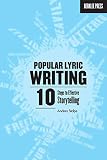
Popular Lyric Writing: 10 Steps to Effective Storytelling Songwriting | Learn Professional Lyric and Techniques Guide for Students and Artists | Creative Writing Method Book for Crafting Hit Songs
160 pages
By Andrea Stolpe
10-step method
Berklee Press
Pros
- Concise practical 10-step approach
- Focuses on storytelling
- Internal vs external detail technique
- Uses current commercial songs
- Easy to digest
- Applicable for immediate use
Cons
- Published in 2007 somewhat dated
- Short at 140 pages
- Lyrics only not melody
- Some concepts basic for experienced writers
This is the book that taught me the difference between internal and external detail in lyrics. Stolpe’s 10-step method walks you through building a lyric that moves between what is happening outside the character and what is happening inside their head. That back-and-forth movement is what makes a lyric feel alive rather than flat.
The method is genuinely practical. You can sit down with a song idea, run it through the 10 steps, and come out with a structured lyric draft. I have used this process on every song I have written since finishing the book. It does not write the song for you, but it gives you a map so you are not staring at a blank page.
The commercial song examples are useful for seeing the method in action. Stolpe breaks down real hits to show how the internal-external technique works in practice. Even though the book is from 2007, the songs she references were chosen for their structural value, not their trendiness, so the lessons still apply.
The main limitation is scope. This is strictly about lyrics, not melody or chords. At 140 pages, it is also shorter than I wanted. The 10-step method could have been expanded with more examples and exercises. What is there is excellent, but I finished it wanting another 50 pages.
What genre does this work best for
The storytelling approach fits naturally with country, pop, folk, and singer-songwriter material. If you write in those genres, the internal-external technique will feel like a missing puzzle piece. For genres where lyrics are less narrative-driven, the method still applies but requires more adaptation.
Can you use this without the companion Beginning Songwriting book
Absolutely. They cover different ground. Popular Lyric Writing is laser-focused on lyric structure and storytelling. Beginning Songwriting is the broader introduction. You can start with either one depending on what you need most.
6. Essential Guide to Rhyming by Pat Pattison – Best for Rhyme Technique

Pat Pattison s Songwriting Essential Guide to Rhyming | Step-by-Step Lyric Writing Book for Poets and Songwriters | Improve Rhyme Techniques and Wordplay | Berklee Press Second Edition
136 pages
By Pat Pattison
Second Edition
Berklee Press
Pros
- Systematic approach to rhyming
- Comprehensive rhyme categories
- Examples of all rhyme types
- Great for serious songwriters
- Pairs with free Coursera class
- Covers perfect through assonance rhymes
Cons
- Technical and dry at times
- Requires study and practice
- No answer key for exercises
- More workbook than reading book
If Writing Better Lyrics is Pattison’s broad survey course, this is his specialized seminar on a single topic. At 136 pages, it is short, but every page is dense with information about how rhymes work and why some rhymes hit harder than others. This is the highest-rated book on this list for a reason.
Pattison organizes rhymes from strongest to weakest: perfect, family, additive, subtractive, consonance, and assonance. He explains how moving from one type to another within a song creates forward motion or resolution. I had never thought about rhyme as a structural tool before reading this, and it completely changed how I approach verse construction.
The exercises are challenging. This is not a book you read passively. Pattison expects you to work through the material, practice identifying rhyme types, and apply them to your own writing. The lack of an answer key is a real frustration because you cannot check your work on the identification exercises. I ended up trading exercises with a friend who was also working through the book.
Pair this with Pattison’s free Coursera course on songwriting. The book and the course reference each other, and together they create a complete picture of how rhyme functions in modern songs. The book alone is excellent, but the combination is the gold standard that Reddit threads consistently recommend.
Do you need music theory to understand this
No. This is strictly about language and rhyme. You do not need to read music or understand harmony. Any songwriter who works with lyrics can benefit, whether or not they play an instrument.
How long does it take to work through
I spent about six weeks at a pace of two to three sessions per week. The material is dense enough that rushing through it would mean missing key concepts. Take your time and do the exercises properly.
7. Tunesmith by Jimmy Webb – Best for Advanced Depth

Tunesmith: Inside the Art of Songwriting
448 pages
By Jimmy Webb
Illustrated Edition
Grand Central Publishing
Pros
- Written by legendary songwriter Jimmy Webb
- Comprehensive craft coverage
- Excellent prosody discussion
- Fascinating stories about famous songs
- Technical depth from a master
- Covers melody harmony and lyrics
- Industry insights and business advice
Cons
- Technical level challenges beginners
- Music theory knowledge recommended
- Anecdotes can be drawn out
- More technical than expected
This is the deepest book on this list by a wide margin. Jimmy Webb wrote Wichita Lineman, By the Time I Get to Phoenix, and MacArthur Park. He is one of the few songwriters who can explain the craft at both the emotional and technical level, and Tunesmith is his master class in book form.
The section on prosody, the matching of musical and lyrical elements, is worth the price of the book alone. Webb explains how a melody can reinforce or undercut a lyric’s meaning, and how the best songs use that relationship intentionally. I went back to songs I had written years ago and immediately saw places where my melody was fighting my lyric without me realizing it.
Webb includes stories about working with Glen Campbell, Frank Sinatra, and other legends. These are not just name-dropping. He uses each story to illustrate a specific songwriting principle. The chapter on how Wichita Lineman came together is a lesson in how to serve a song’s emotional core through every structural choice.
Be aware that this book assumes some music theory knowledge. Webb talks about chord substitutions, voice leading, and harmonic analysis without much hand-holding. If you do not know what a secondary dominant is, you will need to look things up along the way. For beginners, this can feel like drinking from a fire hose. For experienced writers, it is exactly the depth they have been looking for.
What theory knowledge do you actually need
You should understand basic diatonic harmony, including major and minor scales, chord construction, and common chord progressions. If you can follow a chord chart and understand what a key signature means, you will be fine. If those concepts are unfamiliar, start with the Beginning Songwriting book instead.
Is it still relevant in 2026
The technical principles are timeless. The industry advice section is somewhat dated because the music business has changed significantly since 1999. But the songwriting instruction, which is most of the book, applies to any genre and any era.
8. Successful Lyric Writing by Sheila Davis – Best Workbook Format

Successful Lyric Writing: A Step-By-Step Course & Workbook
292 pages
By Sheila Davis
First Edition
Penguin Publishing
Pros
- Step-by-step course and workbook
- Covers various song forms
- Multiple concepts and angles
- Great examples and tips
- Good foundational tools
- Excellent for study groups
Cons
- Some case studies outdated
- Exercises described as shallow
- Better for generic pop songwriting
- Older publication from 1988
This is the oldest book on the list, published in 1988, and it shows in both good and bad ways. The good: Sheila Davis taught lyric writing for years, and her step-by-step course format walks you through song forms, rhyming placement, and lyric development in a structured way. The bad: the case study songs are decades old, and some of the exercises feel thin compared to what Pattison and Stolpe offer.
I worked through this book as part of a small study group with two other writers, and that is where it shines. The course format is designed for classroom or group use, with assignments that benefit from discussion and feedback. Doing it alone, I imagine it would feel less dynamic. But with a group, the exercises sparked conversations about song structure that I would not have had otherwise.
The section on song forms is the strongest part of the book. Davis breaks down AABA, verse-chorus, and other structures with clear examples showing how each form creates different dramatic effects. If you have ever wondered why some songs feel like they are constantly building while others feel circular, this section answers that question directly.
The weakness is depth. Compared to Pattison’s analytical frameworks or Stolpe’s storytelling method, Davis’s exercises can feel surface-level. Several reviewers described them as shallow and infrequent, and I understand that criticism. The book is better as a survey of concepts than as a deep training program.
Is it worth buying given its age
The structural and formal concepts are still valid. The specific song examples are dated, but you can apply the same analysis to current songs yourself. If you want a structured course format and do not mind older references, it still has value.
Would beginners get lost here
No. Davis writes for beginners and explains her terminology clearly. The step-by-step format is designed to build skills progressively. This is actually one of the more accessible entries on the list for someone just starting out.
9. The Songwriter’s Workshop: Harmony – Best for Chord Progressions

The Songwriter’s Workshop – Harmony | Chord Progressions and Songwriting Techniques | Learn to Write Hit Songs with Online Audio | Berklee Press Music Composition Book
224 pages
Berklee Press
Includes audio CD
Pap/Com edition
Pros
- Excellent for chord progression ideas
- Useful transposition chart
- Practical exercises
- Helps expand musical ideas
- Audio examples and drum tracks
- Applicable to commercial music
Cons
- Requires foundational theory knowledge
- Harmony-first approach criticized
- Can overwhelm beginners
This is the only book on the list focused on harmony rather than lyrics, and it fills a gap that the other resources do not address. If you already write decent lyrics but your chord progressions all sound the same, this is the fix. Berklee Press published it as part of their music composition series, and it operates at a level of practical detail I have not found elsewhere.
The included audio CD is essential. Each exercise is paired with audio examples and play-along drum tracks so you can hear how a progression works in context. I loaded these onto my phone and practiced changing chords against the drum tracks to internalize how different harmonic movements feel rhythmically.
The transposition chart alone is worth the purchase if you write in multiple keys. Instead of doing the math every time you want to move a progression to fit a different vocal range, the chart gives you the answer instantly. I laminated mine and keep it on my desk.
This book is not for beginners. It assumes you understand keys, scales, and basic chord construction. Several reviewers noted that the approach of writing harmony first, before melody or lyrics, is unconventional and did not work for their process. I found it useful as a complementary approach rather than a replacement for my usual workflow. When I am stuck melodically, starting with harmony using this book’s exercises has unblocked me more than once.
What theory background is required
You need to understand major and minor scales, diatonic chord construction, and basic chord progressions in common keys. If you cannot build a triad from a scale degree or identify the relative minor of a major key, start with a basic theory resource before tackling this book.
Does it work for genres outside pop and rock
The principles apply broadly, but the examples lean toward commercial pop and rock. The techniques cover roughly 95 percent of what you hear in contemporary commercial music. For jazz or classical composition, you would want a more specialized resource.
10. The 30-Day Lyric Writing Challenge by The Song Foundry – Best Budget Option
The 30-Day Lyric Writing Challenge: Transform Your Lyric Writing Skills in Only 30 Days (The Song Foundry 30-Day Challenges)
142 pages
By The Song Foundry
30-day challenge format
Book 1 of 4
Pros
- Daily 10-minute exercises
- ADHD-friendly focused practice
- Helps with writer's block
- Sparks creativity
- Practical and actionable
- Portable size for travel
- Builds consistent writing habit
Cons
- Some find content limited
- Small format
- Requires commitment to daily practice
At 142 pages and a budget price point, this is the most accessible entry on the list. The format is simple: one exercise per day for 30 days, each taking about 10 minutes. I completed the full challenge in a month and was surprised by how much it improved my daily writing discipline.
The exercises focus on specific lyric writing skills like metaphor, perspective, rhythm, and contrast. Each day gives you a prompt, a constraint, and a short explanation of what skill the exercise targets. The constraint-based approach is similar to Pattison’s method but in a more compact, less academic format.
Multiple reviews mention this being ADHD-friendly, and I understand why. The exercises are short enough to hold attention, the daily structure creates routine without rigidity, and the small format means you can carry it anywhere. I kept mine in my guitar case and did the exercises during lunch breaks.
The trade-off is depth. Each exercise gets a page or two of explanation, which is enough to get you started but not enough to fully understand the underlying concept. If you want deep instruction, pair this with one of the Pattison books. As a standalone habit-builder and creativity spark, it does exactly what it promises.
Can experienced writers benefit from this
Yes, but differently than beginners. Experienced writers will not learn new techniques here, but the daily structure forces you to practice fundamentals you might be skipping. I treated it as a warm-up routine before working on actual songs, and it made my writing sessions more productive.
What happens after 30 days
The Song Foundry publishes three more 30-day challenge books covering melody, harmony, and editing. If the lyric challenge works for you, the series gives you a full year of structured daily practice across all aspects of songwriting.
Buying Guide: How to Choose the Right Songwriting Course
Choosing from the best online songwriting courses comes down to five factors: your current skill level, what specifically you want to improve, your preferred learning format, your budget, and how much time you can commit. Here is how I would think through each one.
Skill level matters more than you think. If you are starting from zero, meaning you have never finished a complete song, begin with Andrea Stolpe’s Beginning Songwriting or Jeff Tweedy’s How to Write One Song. Both are written for people who need the full picture. Jumping straight into Pattison or Webb without foundational context will frustrate you.
Know what you want to fix. If your lyrics are weak but your melodies are strong, go straight to Pattison’s Writing Better Lyrics or Stolpe’s Popular Lyric Writing. If your chord progressions all sound the same, the Songwriter’s Workshop: Harmony is your target. If your problem is motivation rather than technique, Tweedy is the answer. Matching the resource to your specific weakness saves time and money.
Format preference is personal. Some people learn best from structured daily exercises, others from deep analytical reading, and others from inspirational narrative writing. Pattison’s books are analytical. Tweedy’s is inspirational. The 30-Day Challenge is exercise-based. Stolpe’s books are method-driven. Pick the format that matches how you actually learn, not the one you think you should prefer.
Budget versus value. The range on this list goes from around $11 to around $28. Price does not correlate cleanly with quality. The two budget picks, the 30-Day Challenge and Songwriting Without Boundaries, deliver as much practical value as books costing twice as much. Do not assume a higher price means better instruction.
Time commitment should match your life. Pattison’s books require months of consistent work. The 30-Day Challenge needs 10 minutes a day for a month. Tweedy’s book can be read in a weekend. Be honest about how much time you will actually put in, and choose accordingly. A book you never open because it demands too much time is a waste regardless of how good the material is.
If you are also shopping for an instrument to write on, our guide to acoustic guitars for songwriting covers options that work well for writers who want a rich, full sound while composing.
FAQs
What is the 80 20 rule in songwriting?
The 80 20 rule in songwriting means that 80 percent of a song’s impact comes from 20 percent of its elements. Practically, this usually refers to your hook, chorus melody, or title line. Focus your energy on making that core 20 percent as strong as possible, because listeners will remember it long after forgetting the rest of the song.
What is the rule of 3 in songwriting?
The rule of 3 in songwriting suggests that playing or singing a musical idea three times creates familiarity and satisfaction for the listener, while a fourth repetition feels stale. After the third repetition, change something: the lyric, the chord, the rhythm, or the melody. This principle keeps songs engaging without losing accessibility.
Can songwriting be self-taught?
Yes, songwriting can absolutely be self-taught. Many successful songwriters never took a formal course. However, structured resources like the books in this guide accelerate the process by teaching techniques that would take years to discover through trial and error. Self-taught writers benefit most from exercise-based books like Pat Pattison’s Songwriting Without Boundaries or The Song Foundry’s 30-Day Challenge.
Are online songwriting courses useful?
Online songwriting courses are useful for writers who want structured guidance, proven techniques, and a clear learning path. The best resources teach specific skills like rhyme types, prosody, and song structure that are difficult to pick up intuitively. However, courses cannot replace the actual practice of writing songs regularly. They work best as a complement to daily writing, not a substitute for it.
How long do songwriting courses take to complete?
Completion time varies by resource. The 30-Day Lyric Writing Challenge takes one month at 10 minutes per day. Pat Pattison’s Writing Better Lyrics takes roughly three months of consistent daily work. Berklee Online courses run 4 to 12 weeks depending on the program. Self-paced books can take anywhere from a weekend to several months depending on how deeply you engage with the exercises.
Conclusion
After working through all ten resources, my top recommendation for the best online songwriting courses in 2026 comes down to your starting point. Beginners should start with Jeff Tweedy’s How to Write One Song for motivation or Andrea Stolpe’s Beginning Songwriting for fundamentals. Serious writers who want to level up their lyrics should commit to Pat Pattison’s Writing Better Lyrics and the Essential Guide to Rhyming. Budget-conscious writers will get enormous value from The Song Foundry’s 30-Day Lyric Writing Challenge. Pick the one that matches where you are right now, and start writing today. If you want to expand beyond songwriting into new instruments, our guide on affordable mandolins for songwriters is a good next stop.