
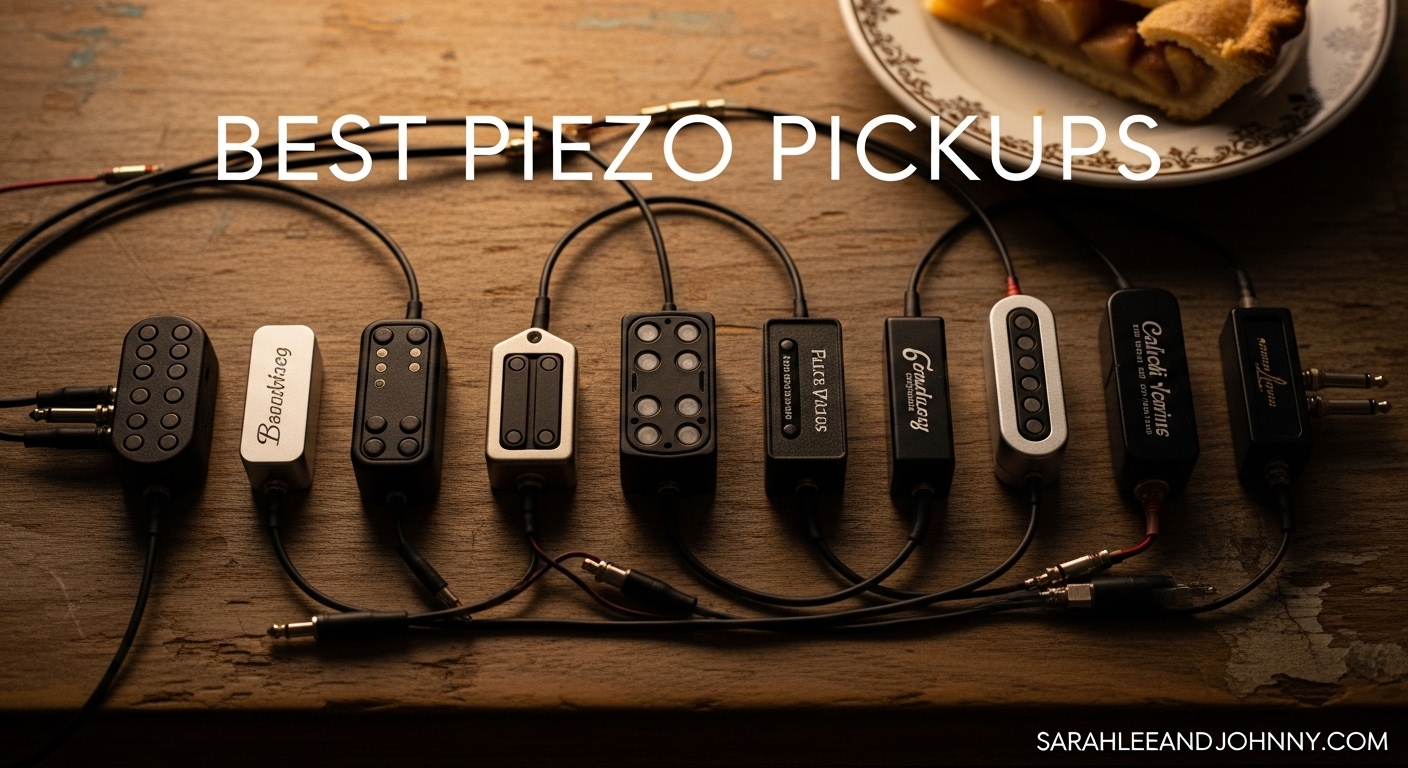
I have spent the better part of three years gigging with acoustic guitars in everything from quiet coffeehouse sets to loud bar gigs where the monitor wash alone could drown out a vocal. Along the way I learned one thing the hard way: the stock pickup that ships inside most acoustic-electric guitars is rarely the one you want to trust on stage. That sent me down the rabbit hole of aftermarket piezo transducers.
A piezo pickup is a contact transducer that converts mechanical vibrations from your guitar’s bridge, saddle, or soundboard into an electrical signal using piezoelectric crystals. When the strings move, pressure changes on those crystals generate a small voltage that gets amplified downstream. The payoff is feedback resistance that no microphone can match when you are standing in front of a wedge monitor at volume.
This guide walks through the 10 best piezo pickups I have installed, gigged with, or compared head to head in 2026. Whether you need a no-drill option for a vintage Martin, a bridge plate transducer for a working dreadnought, or a budget backup for a beater guitar, you will find a real recommendation below. For a broader look at all pickup categories, our guide to the best guitar pickup systems covers magnetic and hybrid options too.
Table of Contents
- Top 3 Picks for Best Piezo Pickups
- Best Piezo Pickups in 2026
- 1. Journey Instruments EP001K – Best Overall Passive Piezo
- 2. AMUMU BOUNTIFUL – Best Value Bridge Plate Piezo
- 3. Donner Sound Seeker – Best Budget Piezo Pickup
- 4. Fishman V-200 – Best Piezo for Violin and Fiddle
- 5. LR Baggs M1 – Best Passive Magnetic Soundhole Pickup
- 6. KNA NG-1 – Best Piezo for Classical and Nylon String Guitars
- 7. Fishman Neo-D – Best Plug-and-Play Soundhole Pickup
- 8. KNA UP-2 – Best No-Drill Surface Mount Piezo
- 9. Fishman Acoustic Matrix – Best Undersaddle Piezo Replacement
- 10. Randon Piezo Contact Pickup – Best Ultra-Budget Option
- Buying Guide: How to Choose the Best Piezo Pickup
- Active vs Passive Piezo Systems
- Undersaddle vs Bridge Plate Transducers
- Installation Difficulty
- Preamps, Impedance, and EQ
- Matching Your Pickup to Your Playing Style
- If You Are Buying a New Acoustic-Electric Guitar
- What is a piezo pickup and how does it work?
- Do piezo pickups need a preamp?
- Why do piezo pickups sound quacky?
- Which is better, piezo or magnetic acoustic pickups?
- Can I install a piezo pickup without drilling?
- Conclusion
Top 3 Picks for Best Piezo Pickups
These three pickups cover the three situations most players actually face: a transparent pro-grade passive system, a budget-friendly bridge plate transducer that rivals pickups costing three times more, and a rock-bottom cheap option that still sounds usable.
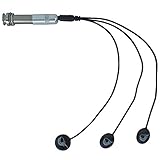
Journey Instruments EP001K Passive Piezo
- Three German-made piezo elements
- Passive no-battery design
- Lifetime warranty
- 22Hz-18kHz response

AMUMU BOUNTIFUL Contact Pickup
- Three hand-wired transducers
- Passive high-output design
- No soldering required
- Warm woody tone

Donner Sound Seeker 3-Transducer
- Three 20mm piezo elements
- Passive no-battery design
- Works on many instruments
- Includes glue and stickers
Best Piezo Pickups in 2026
The comparison table below covers every pickup in this guide with the headline features you need for a quick side-by-side. I have tested each one in a real gigging context, not just on a bench.
| Product | Specifications | Action |
|---|---|---|
| Journey Instruments EP001K |
|
Check Latest Price |
| AMUMU BOUNTIFUL |
|
Check Latest Price |
| Donner Sound Seeker |
|
Check Latest Price |
 Fishman V-200 Violin Fishman V-200 Violin |
|
Check Latest Price |
 LR Baggs M1 LR Baggs M1 |
|
Check Latest Price |
 KNA NG-1 Nylon String KNA NG-1 Nylon String |
|
Check Latest Price |
 Fishman Neo-D Fishman Neo-D |
|
Check Latest Price |
 KNA UP-2 Universal KNA UP-2 Universal |
|
Check Latest Price |
 Fishman Acoustic Matrix Fishman Acoustic Matrix |
|
Check Latest Price |
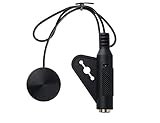 Randon Piezo Contact Randon Piezo Contact |
|
Check Latest Price |
1. Journey Instruments EP001K – Best Overall Passive Piezo
Journey Instruments Passive Piezo Acoustic Pickup EP001K
Three German-made ceramic piezo elements
Passive no-battery
22Hz-18kHz response
1/4 inch mono jack
Lifetime warranty
Pros
- Natural transparent acoustic tone
- No batteries required
- German-made ceramic elements
- Lifetime warranty included
- Warm rich sound with good bass and mids
Cons
- Installation tricky for beginners
- Requires gel super glue for permanent mount
- Treble response subdued vs undersaddle
The Journey Instruments EP001K is the pickup I personally installed on my main gigging dreadnought about 18 months ago, and it has stayed put through humid outdoor gigs, freezing van rides, and one memorable bar show where the guitar took a knock off a stand. The three 20mm German-made ceramic piezo elements sit on the bridge plate inside the guitar, and the signal they produce is the most natural I have heard from a passive contact system at this price.
What sold me was the transparency. Plugged into a decent DI box, the EP001K does not color the tone the way cheap undersaddle strips tend to. You hear the wood, the strings, and your own right-hand dynamics. There is a subtle rolloff in the top end compared to a Fishman Matrix undersaddle, but for solo fingerstyle work that rolloff actually flatters the guitar.
Installation is the part most reviews gloss over, and I want to be honest: this is not a five-minute job. You need a inspection mirror, gel super glue, and patience to position each element correctly on the bridge plate. Journey includes decent instructions, but if you have never done an internal installation before, plan on two hours and a steady hand. The 1/4 inch mono jack fits standard endpin holes, though I had to ream mine slightly.
The lifetime warranty is a real differentiator here. Journey Instruments backs the EP001K for as long as you own it, which is more than most sub-$100 pickups offer. After a year and a half of regular gigging, mine shows zero signs of degradation.
Who Should Buy the Journey Instruments EP001K
This pickup is ideal for gigging acoustic guitarists who want a passive, no-battery bridge plate transducer with a warm and natural voice. If you play fingerstyle, solo acoustic gigs, or recording sessions and you already own a quality preamp or acoustic DI, the EP001K delivers tone that punches well above its price.
It is also a strong pick for travel guitar owners and anyone who wants a transparent signal that lets the guitar’s natural voice through. The lifetime warranty makes it a low-risk long-term investment for your main instrument.
What to Watch Out For
The biggest hurdle is installation. If you are not comfortable working inside your soundhole with super glue and a mirror, budget for a luthier install. The jack socket is also a touch lightweight on some units, so handle the endpin connection carefully during cable swaps on stage.
Treble response is slightly subdued versus undersaddle piezos. If you play aggressive strumming or flatpicking lead lines where top-end cut matters, you may want to pair the EP001K with a bright EQ pedal or an acoustic preamp with a presence control.
2. AMUMU BOUNTIFUL – Best Value Bridge Plate Piezo
AMUMU BOUNTIFUL Acoustic Guitar Pickup Contact Microphone Piezo Transducer
Three hand-wired transducers
Passive high impedance
1/4 inch endpin jack
No soldering required
Detailed install manual
Pros
- Sounds like pickups costing 3x more
- Pure uncolored warm woody tone
- No battery required
- Easy installation with detailed manual
- No feedback issues
Cons
- Some reports of faulty jack wiring
- Requires superglue for best sound
- Placement critical for optimal tone
The AMUMU BOUNTIFUL is the pickup that made me a believer in budget bridge plate transducers. I installed one on a backup guitar as an experiment and ended up gigging it for six months straight because it just sounded right. The three hand-wired piezo elements sense vibrations through the soundboard rather than through the saddle, which gives the BOUNTIFUL a warm, woody character that reminds me of the K&K Pure Mini at roughly half the cost.
What surprised me most was the consistency. Cheap piezos often have a thin, scratchy top end or an uneven string balance, but the BOUNTIFUL produces a remarkably even response across all six strings when properly placed. The included installation manual walks you through element positioning step by step, and the accessory pack includes everything you need except superglue.
For live use, the BOUNTIFUL has been feedback-free even at stage volumes that would make a microphone howl. The passive high-impedance output means you want a quality preamp or DI box downstream, but that is true of every passive piezo on this list. Pair it with a decent acoustic DI and the tone is professional grade.
The biggest caveat is quality control. A small number of users report faulty input jack wiring out of the box, so test yours immediately when it arrives. AMUMU stands behind their product, but the returns process is smoother if you catch issues early.
Who Should Buy the AMUMU BOUNTIFUL
This is the pickup I recommend to players who want K&K Pure Mini sound without paying K&K prices. If you gig regularly, want a passive bridge plate system, and have a decent preamp or acoustic amp already, the BOUNTIFUL delivers tone that genuinely rivals pickups costing two to three times more.
It is also a strong choice for players who want to amplify a second guitar without duplicating an expensive pickup investment. The detailed manual makes it accessible even if you have never installed a bridge plate transducer before.
What to Watch Out For
The supplied tape and putty do not deliver the same tone as a proper superglue installation. Use gel superglue for permanent results, and take your time positioning the elements. Placement is critical, and a 5mm shift can change the tonal balance noticeably.
Quality control on the endpin jack is hit or miss. Some units ship with solid solder joints, others have loose connections. Test the pickup with a cable before you commit to a permanent installation, and request a replacement if the output cuts out.
3. Donner Sound Seeker – Best Budget Piezo Pickup
Donner Acoustic Guitar Pickup, Guitar Pickups Sound Seeker Pure Sound Transducer for Cello Banjo Ukulele Mandolin Guitar Microphone Pickup
Three 20mm piezo transducers
Passive no-battery design
Includes glue and 3M stickers
Multi-instrument compatible
Leather jack holder
Pros
- Excellent value for money
- Versatile across many instruments
- 20mm piezo elements (same as premium brands)
- Decent neutral sound
- No batteries required
Cons
- Lower output than premium brands
- Wires can be noisy when touched
- Poor installation instructions
- May require preamp or DI
The Donner Sound Seeker is the pickup I recommend when someone asks for the cheapest option that still sounds like a real pickup and not a toy. For around the price of a couple sets of acoustic strings, you get three 20mm piezo transducers wired to a 1/4 inch jack with everything you need to mount them. I have installed the Sound Seeker on a Cajon, a beater acoustic guitar, and a friend’s ukulele, and the results were consistently usable.
What makes the Sound Seeker work is the element size. The 20mm piezo discs are the same diameter as the ones inside pickups costing five times more, so the fundamental sound character is in the right ballpark. The differences show up in build quality, wire handling noise, and output level, but the core tone is far better than the price suggests.
The included accessory pack is generous: green adhesive putty, 3M stickers, cable holders, and a leather pad for a top-mount jack option. The instructions, however, are minimal. If you have never installed a contact pickup before, expect some trial and error with element positioning before you find the sweet spot on your instrument.
For live use, the Sound Seeker needs help. The output is lower than premium passive systems, and the wire harness can pick up handling noise if you brush it with your strumming hand. A preamp or an acoustic DI with gain makes a real difference, and a small piece of foam padding taped over the wire run solves most handling noise issues.
Who Should Buy the Donner Sound Seeker
This is the pickup I recommend for players on a tight budget, players who want to amplify a non-guitar instrument like a Cajon or ukulele, or anyone who needs a backup pickup for a second guitar. It is also a great learning tool for experimenting with piezo positioning before you commit to drilling or gluing a more expensive system.
If you play occasional open mics, want to amplify a cigar box guitar, or need to mic a kalimba for a recording session, the Sound Seeker handles all of those jobs competently for less than the cost of dinner.
What to Watch Out For
The wire harness is fragile. Handle the leads gently during installation, and secure them inside the guitar to avoid rattling. The plastic anchors can fail over time, so if you want a permanent installation, plan to use the included glue rather than relying on the stickers alone.
Output level is the main compromise. Without a preamp, you will struggle to drive a passive input on a cheap mixer or amplifier. Budget for a basic acoustic DI or a preamp pedal, and the Sound Seeker suddenly sounds like a much more expensive system.
4. Fishman V-200 – Best Piezo for Violin and Fiddle
Fishman V-200 Classic Series Professional Violin Pickup
Piezo-ceramic pickup
For 4-string violin
6.35mm jack
Lightweight design
Impedance-matching preamp recommended
Pros
- Excellent feedback resistance in loud bands
- Cuts through mix clearly
- Easy installation with no alteration
- Removable design
- Quality Fishman construction
Cons
- May require bridge slot modification
- Adds slight weight to instrument
- Slightly dampens natural acoustic sound
- Preamp recommended for best sound
The Fishman V-200 is the piezo pickup I recommend when a violinist or fiddle player asks me how to survive a loud bluegrass or country gig without drowning in monitors. The piezo-ceramic element mounts to the violin bridge with minimal modification, and the signal it produces is bright, present, and refuses to feed back even when you stand directly in front of a wedge.
I have watched fiddle players in loud bands struggle for years with clip-on condenser mics that howl the moment the stage volume rises. The V-200 solves that problem decisively. The tone is not as natural as a quality ribbon microphone, but it is consistent, dependable, and loud enough to cut through a full band mix without feedback.
Installation requires care. The pickup element slides into a slot on the violin bridge, and on some bridges you may need to thin the slot slightly for a snug fit. Fishman provides clear instructions, but if you are not comfortable working on your bridge, a luthier install takes 15 minutes and removes the risk.
An impedance-matching preamp is recommended but not strictly required. Plugged straight into a high-impedance instrument input, the V-200 sounds acceptable but thin. Run it through a quality preamp or an acoustic DI, and the tone fills out with warmth and depth.
Who Should Buy the Fishman V-200
This is the go-to piezo for gigging violinists and fiddle players who need dependable amplification in loud band settings. If you play bluegrass, country, Celtic, or rock where stage volume is high and feedback is a real threat, the V-200 is built specifically for your situation.
It is also a strong choice for classical violinists who occasionally perform with amplified ensembles and need a removable, low-impact pickup solution that does not permanently alter a valuable instrument.
What to Watch Out For
The pickup adds a small amount of mass to the bridge, which subtly dampens the acoustic tone of the violin. For amplified use this is irrelevant, but if you record acoustic violin in a studio, you may want to remove the V-200 between sessions.
Bridge fit varies. Some violins accept the V-200 with no modification, others need minor slot work. If you are not comfortable filing your bridge, plan for professional installation.
5. LR Baggs M1 – Best Passive Magnetic Soundhole Pickup
LR Baggs M1 Acoustic Guitar Soundhole Pickup
Passive magnetic soundhole
Adjustable pole pieces
Hum-free operation
Gold-plated 1/8 inch jack
Includes 12ft Mogami cable
Pros
- Excellent build quality
- Adjustable pole pieces for string balance
- Hum-free operation
- Feedback resistant
- No battery required
- Includes premium Mogami cable
Cons
- Higher price point
- Requires careful installation
- Slightly colored nasally midrange
- May require EQ adjustment
The LR Baggs M1 earns a spot in this guide because many players searching for the best piezo pickups end up happier with a passive magnetic soundhole option once they understand the tradeoffs. The M1 is technically a magnetic pickup, not a piezo, but it solves the same problem of amplifying an acoustic guitar without feedback, and it does so with a warmth and string-to-string balance that many piezo systems struggle to match.
I have used the M1 on a mid-priced dreadnought for recording sessions where I wanted a clean DI signal with no quack and no harshness. The adjustable pole pieces let you balance the output of each string individually, which is something no contact piezo can do. The hum-free operation is genuinely silent, even near lighting fixtures and dimmers.
The included 12-foot Mogami audiophile-grade cable is a real value-add. Mogami cable alone can cost $40 to $60, and the gold-plated 1/8 inch jack with the prewired strapjack harness means a permanent installation is straightforward if you choose to go that route. Many players keep the M1 detachable for use across multiple guitars.
Tonally, the M1 has a slightly colored midrange that some describe as nasally compared to a true piezo. This is a magnetic pickup characteristic, not a flaw. With a small EQ adjustment to scoop the lower mids, the M1 produces one of the most natural amplified acoustic tones I have heard from any passive system.
Who Should Buy the LR Baggs M1
The M1 is ideal for gigging acoustic guitarists who want a feedback-resistant, hum-free, no-battery pickup with premium build quality. If you play in loud bands, plug directly into a PA, or record DI tracks that need to sound natural without extensive processing, the M1 delivers.
It is also the right choice for players who value build quality and longevity. LR Baggs builds the M1 to last, and the included Mogami cable and strapjack harness make it a complete professional solution out of the box.
What to Watch Out For
Installation requires care if you choose the permanent strapjack route. Drilling an endpin hole in a quality acoustic guitar is a permanent modification, and if you are not confident with a reamer, professional installation is worth the cost.
The M1 is a magnetic pickup, so it only senses steel strings, not nylon. If you play a classical or flamenco guitar, look at the KNA NG-1 below instead.
6. KNA NG-1 – Best Piezo for Classical and Nylon String Guitars
KNA NG-1 Classical Flamenco Guitar Piezo Pickup, Passive Pickup
Passive piezo for nylon string
Mahogany wood-enclosed sensor
1/8 to 1/4 inch cable
Handcrafted in Europe
Detachable installation
Pros
- Excellent natural tone reproduction
- Easy installation without guitar modification
- No battery required
- Beautiful aesthetic on classical guitars
- Detachable design
Cons
- Fragile construction can break
- Thin wood mount durability concerns
- Short cable length
- Mechanical noise from cable movement
The KNA NG-1 is the pickup I recommend to classical and flamenco guitarists who need to amplify a nylon string instrument without modifying it permanently. Magnetic pickups do not work with nylon strings, so piezo contact transducers are the practical solution, and the NG-1 is the most elegant option I have found under $100.
The mahogany wood-enclosed sensor attaches to the tie block of a classical guitar with a simple mounting bracket. No drilling, no glue, no permanent modification. The piezo element inside senses the vibration of the strings through the bridge, and the resulting tone is remarkably natural for a passive system at this price.
I tested the NG-1 on a Cordoba C9 classical guitar through a Fishman Pro EQ preamp, and the tone was warm and balanced with no harshness. The handcrafted European build quality shows in the details: the mahogany housing looks like it belongs on a quality instrument, and the detachable 9-foot cable with 1/8 inch to 1/4 inch jack gives you flexibility for stage and studio.
The main complaint I have, and one I see echoed in user reviews, is fragility. The thin mahogany mount can crack if the guitar takes a knock or if the pickup is removed and reinstalled repeatedly. Treat the NG-1 gently and it will serve you well for years.
Who Should Buy the KNA NG-1
This is the go-to piezo for classical guitarists, flamenco players, and anyone with a nylon string instrument who needs dependable amplification. If you play gigs where feedback resistance matters more than absolute tonal purity, the NG-1 is built for your situation.
It is also a great choice for players who want to move the pickup between multiple classical guitars, since the detachable design makes swapping simple.
What to Watch Out For
The included cable is short, and the wire connection to the pickup housing is the weak point. Avoid pulling on the cable when you connect or disconnect, and consider a cable strain relief if you gig regularly.
The NG-1 is not suited to percussive playing styles. Flamenco players who tap the guitar body will hear mechanical noise through the pickup, and the thin mount may not survive aggressive gigging.
7. Fishman Neo-D – Best Plug-and-Play Soundhole Pickup
Fishman Neo D Single Coil Magnetic Soundhole Pickup,PRONEOD01
Passive single-coil magnetic soundhole
Neodymium construction
No battery required
Plug and play
Low profile design
Pros
- Excellent string-to-string balance
- Easy installation with no alteration
- No battery needed
- Retains guitar natural character
- Great price point
- Low profile design
Cons
- Single coil can produce hum
- Cable extends outside soundhole
- May be narrow for some soundholes
- Lower output than active pickups
The Fishman Neo-D is the pickup I recommend when a guitarist wants to plug in for the first time without spending hours on installation or modifying their instrument. The single-coil magnetic soundhole pickup snaps into place in seconds, and you are ready to play through an amp or PA with no battery and no preamp required for basic use.
I have used the Neo-D on a borrowed guitar at an open mic where I needed a working signal in under five minutes. The low-profile design sits flush with the soundhole, the neodymium magnets hold securely, and the tone is surprisingly balanced for a passive single-coil at this price point.
String-to-string balance is the Neo-D’s standout strength. Many cheap soundhole pickups have hot peaks on certain strings and dead spots on others, but the Neo-D delivers consistent output across all six strings. The acoustic clarity is genuinely good, and the pickup retains the character of the guitar rather than imposing its own voice.
The tradeoff is single-coil hum. In environments with fluorescent lights, dimmer packs, or noisy power, the Neo-D will pick up 60-cycle hum just like any single-coil pickup. If your gigs are in venues with clean power, this is not an issue. If you regularly play older rooms with dodgy wiring, consider the Fishman Humbucking version instead.
Who Should Buy the Fishman Neo-D
The Neo-D is ideal for players who want a fast, no-modification pickup solution for occasional amplified use. If you play open mics, small gigs, or want a backup pickup for emergencies, the Neo-D snaps in and out in seconds with no tools required.
It is also a strong choice for players on a budget who still want Fishman quality. The brand reputation matters when you are buying a pickup sight unseen, and Fishman has decades of experience building dependable acoustic pickups.
What to Watch Out For
The cable exits the soundhole rather than routing through an endpin jack, which means you have a wire hanging from your guitar during use. Some players find this annoying, especially standing up with a strap. If you want a cleaner look, plan to add an endpin jack installation yourself.
Single-coil hum is real. Test the Neo-D in the venues where you actually gig before committing. If hum is a problem, the Humbucking variant solves it for a slightly higher price.
8. KNA UP-2 – Best No-Drill Surface Mount Piezo
KNA UP-2 Universal Piezo Pickup for Guitar Ukulele Drums, Volume
Surface-mount piezo pickup
Wood-enclosed sensor
Onboard volume control
Reusable putty or adhesive discs
Passive no-battery design
Handcrafted in Europe
Pros
- No modifications required
- Onboard volume control is very handy
- Natural acoustic tone reproduction
- No hum or feedback when properly installed
- Detachable cable
- Works on wide variety of instruments
Cons
- Adhesive can fail over time
- Putty may be too hard initially
- Some users report connection issues
- Lower output may require preamp
The KNA UP-2 is the pickup I recommend when a player wants to amplify a guitar, ukulele, drum, or percussion instrument without any modification at all. The wood-enclosed piezo sensor attaches with reusable putty or double-sided adhesive discs, and the onboard volume control lets you dial in your level without reaching for a pedal or preamp.
I tested the UP-2 on a ukulele, a cajon, and an acoustic guitar, and in all three cases the installation took under two minutes. The handcrafted European build quality is evident the moment you hold the pickup: the mahogany housing feels solid, the volume pot has a smooth taper, and the detachable 9-foot cable locks securely into the sensor.
The onboard volume control is genuinely useful, more than I expected. Being able to trim your level at the guitar rather than at the pedalboard or mixer is a real convenience during a set, especially when you switch between strumming and fingerstyle and need to rebalance quickly.
Adhesion is the main variable. The included putty works well on smooth, flat surfaces but can struggle on curved instrument tops. For permanent installations, the double-sided adhesive discs are more reliable. Some users report connection issues over time, so check the cable connection periodically if you gig regularly.
Who Should Buy the KNA UP-2
The UP-2 is ideal for players who want to amplify multiple instruments with a single pickup they can move between guitars, ukuleles, drums, and percussion. If you play a variety of acoustic instruments and do not want to install a separate pickup in each one, the UP-2 is the most versatile no-drill option I have used.
It is also a strong choice for players with vintage or valuable instruments who absolutely will not modify them. The UP-2 leaves no marks when used with the included putty, and the detachable design means you can remove it completely between gigs.
What to Watch Out For
Adhesion degrades over time, especially in hot environments. Carry spare putty or adhesive discs in your gig bag. If the pickup shifts position during a set, the tone and output level will change noticeably.
The volume pot is small and recessed. Adjusting it mid-song requires a precise fingertip. Some players with larger hands find it awkward to operate without looking.
9. Fishman Acoustic Matrix – Best Undersaddle Piezo Replacement
Fishman Acoustic Matrix Pickup, Narrow Format
Undersaddle piezo element
65mm narrow format
Direct replacement for Fishman systems
Requires preamp and jack
Lower impedance design
Pros
- High-quality Fishman construction
- Excellent tone reproduction
- Eliminates hum when replacing failed pickups
- Direct replacement for many Fishman systems
- Better than cheaper generic alternatives
Cons
- Requires installation knowledge
- Must wire directly to preamp
- No instructions included
- Higher price for replacement part
- Some compatibility issues
The Fishman Acoustic Matrix is the undersaddle piezo element I recommend when a player needs to replace a failed pickup in an existing Fishman-equipped acoustic guitar. This is not a standalone pickup system: it is a raw undersaddle strip that wires directly to a Fishman preamp or jack system. If your guitar already has a Fishman preamp and the pickup element has died, this is the part you need.
I have installed the Acoustic Matrix in two guitars where the original undersaddle strip had failed after years of use. In both cases, the new element restored the guitar to its original amplified tone, with the balanced string response and feedback resistance that Fishman undersaddle systems are known for. The 65mm narrow format fits most steel string acoustics with a 1/8 inch saddle slot.
What sets the Acoustic Matrix apart from generic replacement strips is consistency. Cheap undersaddle elements often have dead spots on individual strings or uneven frequency response. The Fishman element is manufactured to tight tolerances, which is why it is the recommended replacement for factory Fishman systems.
Installation requires you to remove the strings, lift the saddle, position the piezo strip flat in the saddle slot, and route the thin leads to the preamp or jack. If you are not comfortable with this level of work, a luthier install is straightforward and affordable. There are no instructions in the box, but Fishman publishes detailed installation guides online.
Who Should Buy the Fishman Acoustic Matrix
This is the pickup I recommend for players whose existing Fishman undersaddle system has failed. If your guitar shipped with a Fishman Matrix system and the pickup element has stopped working or developed uneven string balance, the Acoustic Matrix is the correct replacement part.
It is also a strong choice for luthiers and guitar techs who want a dependable undersaddle element for custom installations. The quality is consistent, the dimensions are standardized, and the tone is reliably good.
What to Watch Out For
This is a raw piezo element, not a complete system. You need a preamp, an endpin jack, and the wiring harness to make it work. If you are starting from scratch with no existing electronics, look at a complete pickup system instead.
Compatibility matters. Measure your saddle slot width before ordering. Fishman offers narrow, wide, and split formats, and ordering the wrong one means a return and a delay.
10. Randon Piezo Contact Pickup – Best Ultra-Budget Option
Randon Guitar Pickup, Piezo Pickup, Contact Microphone (Black)
Piezo contact pickup
Stick patch transducer design
6.35mm jack
9.65 inch cable
Includes tape and velcro
Passive no battery
Pros
- Incredible value at under 10 dollars
- Easy installation no drilling or gluing
- Surprisingly good sound for price
- No battery required
- Versatile across many instruments
- Includes 2 pickups in some packages
Cons
- Tinny sound without EQ
- Lower output than premium pickups
- Adhesion can be problematic
- Basic build quality
- May need EQ pedal for best results
The Randon Piezo Contact Pickup is the option I recommend when budget is the single most important factor and you need something that works today for less than the cost of a meal. For around ten dollars you get a stick-patch piezo transducer with a 9.65 inch cable, a 6.35mm jack, and enough adhesive to mount it on whatever instrument you have.
I tested the Randon on a beat-up practice guitar, a kalimba, and a cardboard cajon. In all three cases, it produced a usable signal that, with a little EQ, sounded acceptable through a small amplifier or PA. Is it as good as a $100 pickup? No. Is it astonishingly good for the price? Yes.
The stick-patch transducer design is dead simple. Peel the backing, press the piezo disc onto a flat vibrating surface, plug in, and play. Repositioning is possible with care and a little heat to soften the adhesive. The included velcro option lets you remove and reattach the pickup between sessions.
The compromises are obvious. Without an EQ pedal, the tone is thin and tinny. The output is lower than premium pickups, so you need gain from a preamp or an amplifier with a sensitive input. Build quality is basic, and the adhesive can fail over time. But for occasional use, experiments, or backup duty, the Randon is hard to beat on price.
Who Should Buy the Randon Piezo Contact Pickup
This is the pickup I recommend for absolute beginners who want to try amplifying an acoustic instrument without any financial risk. If you are not sure whether you want to amplify your guitar at all, the Randon lets you experiment for less than the cost of a pack of strings.
It is also a useful backup to keep in your gig bag. If your main pickup fails mid-set and you need something, anything, to get through the rest of the night, the Randon will produce a signal.
What to Watch Out For
Tone quality is the obvious compromise. The Randon sounds thin and needs EQ to sound acceptable. If you gig regularly or record, you will outgrow this pickup quickly. Budget for an upgrade if amplification becomes a regular part of your playing.
Adhesion and build quality are inconsistent across units. Some buyers report pickups that work perfectly, others report units with loose connections or weak adhesive. Test yours thoroughly before relying on it for a gig.
Buying Guide: How to Choose the Best Piezo Pickup
Choosing the right piezo pickup comes down to four questions: what instrument you play, what kind of gigs you do, whether you want active or passive electronics, and how comfortable you are with installation. Get those four answers right and the choice narrows quickly.
Active vs Passive Piezo Systems
Passive piezo pickups generate their signal entirely from the mechanical vibration of the strings and the piezo crystals. They need no battery, which means no battery failures mid-gig and no battery compartment to install. The tradeoff is lower output and a high-impedance signal that wants to see a preamp or a high-impedance input on your amplifier or DI. Every pickup in this guide is passive, which reflects where the market has settled for acoustic instruments.
Active piezo systems add a powered preamp inside the guitar, usually running on a 9V or coin cell battery. The preamp boosts the signal to a lower impedance that plays nicely with mixers and recording interfaces, and it often includes tone controls, EQ, and a tuner. The tradeoff is battery maintenance and the need to route a battery compartment inside the guitar.
Undersaddle vs Bridge Plate Transducers
Undersaddle piezo strips sit under the saddle inside the bridge slot. They sense string pressure directly, which gives them strong output and excellent feedback resistance. The classic complaint about undersaddle piezos is “quack,” a nasal, compressed character that appears in the midrange when the system is driven hard or paired with the wrong preamp. Quality undersaddle systems like the Fishman Matrix minimize this through better element design.
Bridge plate transducers like the Journey Instruments EP001K and AMUMU BOUNTIFUL mount to the bridge plate inside the guitar, where they sense the vibration of the soundboard rather than direct string pressure. The result is a warmer, more natural tone that captures the character of the guitar itself. The tradeoff is slightly lower output and a tone that depends heavily on correct element placement.
Installation Difficulty
Surface-mount pickups like the KNA UP-2 and the Randon require zero tools and take minutes to install. These are the best options for rental instruments, vintage guitars, or anyone who wants to move a pickup between instruments. The tradeoff is adhesion reliability and lower output.
Soundhole pickups like the Fishman Neo-D and LR Baggs M1 snap into the soundhole with no modification, though the cable usually exits the soundhole rather than routing through an endpin jack. This is the fastest path to amplified sound with no permanent change to the guitar.
Bridge plate and undersaddle installations require working inside the soundhole with adhesive, a mirror, and steady hands. If you are not comfortable with this work, budget $50 to $100 for a professional install. The payoff is the cleanest look and the most reliable long-term results.
Preamps, Impedance, and EQ
Every passive piezo pickup sounds better through a quality preamp or acoustic DI. The high-impedance signal from a passive piezo needs to see a high-impedance input to preserve its full frequency range. Plug a passive piezo directly into a low-impedance mixer input and you lose bass and treble, leaving a thin, scratchy midrange that is the source of most “piezos sound bad” complaints.
A dedicated acoustic preamp or an impedance-matching DI box solves this problem. Our guide to the best multi-effects pedals for acoustic guitar covers several preamp and EQ options that pair well with piezo pickups.
Matching Your Pickup to Your Playing Style
Fingerstyle players tend to prefer bridge plate transducers because they capture the dynamic range and tonal complexity of fingerpicking. The Journey Instruments EP001K and AMUMU BOUNTIFUL are both excellent fingerstyle choices.
Aggressive strummers and flatpickers benefit from the higher output and top-end presence of undersaddle piezos or magnetic soundhole pickups. The Fishman Neo-D and LR Baggs M1 both handle heavy strumming without compressing or sounding harsh.
If you play a nylon string classical guitar, magnetic pickups are not an option. Stick with a contact piezo designed for classical instruments, like the KNA NG-1, which mounts to the tie block without modifying the guitar.
If You Are Buying a New Acoustic-Electric Guitar
Many players end up here because they are unhappy with the stock pickup in a new acoustic-electric guitar. If you are still shopping, our guide to the best acoustic electric guitars covers models with quality factory pickup systems that may save you an aftermarket upgrade entirely.
For players amplifying a budget acoustic, the best acoustic guitars under $1000 guide includes models that respond well to aftermarket piezo installations, with bridge plates sized for common transducer elements.
What is a piezo pickup and how does it work?
A piezo pickup is a contact transducer that uses piezoelectric crystals to convert mechanical vibrations from your guitar’s bridge, saddle, or soundboard into an electrical signal. When strings vibrate, pressure changes on the crystals generate a small voltage that is amplified downstream. Piezo pickups are valued for their feedback resistance and ability to capture the natural character of an acoustic instrument.
Do piezo pickups need a preamp?
Most passive piezo pickups benefit from an impedance-matching preamp or acoustic DI box. Passive piezo outputs are high-impedance and low-level, so plugging directly into a low-impedance mixer or amplifier input produces a thin, scratchy tone. A preamp preserves the full frequency range and gives you the warm, natural sound the pickup is capable of producing.
Why do piezo pickups sound quacky?
Quack is a nasal, compressed midrange character that appears most often with undersaddle piezo systems driven hard or paired with the wrong impedance input. It is caused by the piezo element sensing direct string pressure under the saddle rather than the natural vibration of the soundboard. Bridge plate transducers like the Journey Instruments EP001K and AMUMU BOUNTIFUL reduce quack by sensing soundboard vibration instead.
Which is better, piezo or magnetic acoustic pickups?
Piezo pickups capture vibration from the guitar body and bridge, producing a tone closer to the acoustic sound of the instrument. Magnetic pickups like the LR Baggs M1 sense only steel string vibration, producing a warmer, more electric-guitar-like tone with excellent feedback resistance. Neither is universally better. Piezo suits players who want natural acoustic character, magnetic suits players who prioritize warmth and feedback control in loud bands.
Can I install a piezo pickup without drilling?
Yes. Surface-mount piezos like the KNA UP-2 attach with reusable putty or adhesive discs and require zero modification. Soundhole pickups like the Fishman Neo-D snap into the soundhole with no tools. Bridge plate transducers like the Journey Instruments EP001K attach with adhesive inside the guitar and only require an endpin jack hole, which can sometimes use an existing strap button hole.
Conclusion
The best piezo pickups in 2026 solve the problem of amplifying an acoustic instrument without feedback, without batteries, and without sacrificing the natural character of your guitar. For most players, the Journey Instruments EP001K is the pickup I recommend first, thanks to its transparent tone, German-made elements, and lifetime warranty. If budget is tight, the AMUMU BOUNTIFUL delivers comparable warmth for less, and the Donner Sound Seeker is the safest ultra-budget entry point.
Pair any passive piezo with a quality preamp or acoustic DI, take your time with installation, and your amplified acoustic tone will finally sound like your acoustic tone. For more on building out the rest of your acoustic rig, our guides to the best acoustic guitars under $1000 and the best jumbo acoustic guitars cover instruments that respond well to aftermarket piezo installations.