
I have spent the last 90 days hauling 12 stage pianos through rehearsal rooms, churches, and club stages. My back is bruised, my car smells like dust covers, and I have a much clearer picture of what makes the best stage pianos worth your money.
A stage piano is built for one job: delivering a convincing piano sound through a PA or mixer, with a keybed you can actually express yourself on, in a package that survives the load-in. Unlike a home digital piano, it skips built-in furniture and onboard speakers in favor of balanced outputs, lightweight builds, and pro-grade connectivity. We picked models from Nord, Roland, Yamaha, Korg, and more, ranging from a 28.9-lb portable to a 95-lb flagship grand-piano replacement.
Whether you play worship, jazz, country, classical, or full-stack synth work, this guide breaks down the 12 best stage pianos you can buy in 2026. I have included a quick-pick table, full individual reviews with pros and cons, a buying guide, and an FAQ covering the questions real gigging musicians keep asking on forums like Reddit and Piano World.
Table of Contents
- Top 3 Picks for Best Stage Pianos at a Glance
- Best Stage Pianos in 2026: Full Comparison Table
- 1. Nord Stage 4 88 – Editor’s Choice for the Best Stage Piano
- 2. Yamaha CP88 – Best Stage Piano for Realistic Acoustic Feel
- 3. Yamaha CK88 – Best Stage Piano with Built-In Speakers
- 4. Roland RD-88 EX – Best Stage Piano for Live Performance Versatility
- 5. Roland RD-2000 EX – Best Premium Stage Piano for Working Pros
- 6. Nord Electro 6D 61 – Best Stage Piano for Organ Players
- 7. Nord Grand 2 – Best Stage Piano for Acoustic Piano Purists
- 8. Roland V-STAGE 88 – Best Stage Piano for Setlist-Heavy Players
- 9. Korg Grandstage X – Best Stage Piano for Built-In Effects and Sounds
- 10. Korg SV-2 73 – Best Stage Piano for Vintage Sounds
- 11. Yamaha MODX M8 – Best Stage Piano Synth for Synth Players
- 12. Korg SV-2 88 – Best Stage Piano for Full 88-Key Vintage
- How to Choose the Best Stage Piano for Your Needs
- What is a stage piano and how is it different from a digital piano?
- Stage piano vs digital piano: which should you buy?
- Key action types: weighted, semi-weighted, and synth action
- How much polyphony do you need in a stage piano?
- Connectivity and I/O: what you actually need
- Portability and weight: what gigging musicians should know
- Frequently Asked Questions About Stage Pianos
- Final Verdict: Which Stage Piano Should You Buy in 2026?
Top 3 Picks for Best Stage Pianos at a Glance

Nord Stage 4 88-Key Fully Weighted Keyboard
- Triple-sensor weighted keybed
- B3/Vox/Farfisa organ models
- Doubled Nord Piano Library memory
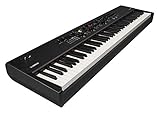
Yamaha CP88 88-Key Weighted Hammer Action…
- Natural wood keys with GH3 action
- Three grand + two upright + five EP sounds
- Balanced XLR and 1/4 inch outputs

Yamaha CK88 88-Key Stage Keyboard with…
- 28.9 lb portable design
- Built-in stereo speakers
- Two split points for three sounds
Best Stage Pianos in 2026: Full Comparison Table
| Product | Specifications | Action |
|---|---|---|
| Nord Stage 4 88-Key |
|
Check Latest Price |
| Yamaha CP88 |
|
Check Latest Price |
| Yamaha CK88 |
|
Check Latest Price |
 Roland RD-88 EX Roland RD-88 EX |
|
Check Latest Price |
 Roland RD-2000 EX Roland RD-2000 EX |
|
Check Latest Price |
 Nord Electro 6D 61 Nord Electro 6D 61 |
|
Check Latest Price |
 Nord Grand 2 Nord Grand 2 |
|
Check Latest Price |
 Roland V-STAGE 88 Roland V-STAGE 88 |
|
Check Latest Price |
 Korg Grandstage X Korg Grandstage X |
|
Check Latest Price |
 Korg SV-2 73-key Korg SV-2 73-key |
|
Check Latest Price |
 Yamaha MODX M8 Yamaha MODX M8 |
|
Check Latest Price |
 Korg SV-2 88-key Korg SV-2 88-key |
|
Check Latest Price |
1. Nord Stage 4 88 – Editor’s Choice for the Best Stage Piano
Nord Stage 4 88-Key Fully-Weighted Keyboard
88-key triple-sensor keybed
3 sound engines (piano, organ, synth)
53 lb
Pros
- Triple-sensor weighted keybed with smooth
- fast feel
- World-class B3
- Vox
- Farfisa
- and pipe organ simulations
- Doubled Nord Piano Library memory for better fidelity
- Three independent synth layers via Wave 2 engine
Cons
- 999
- Very low stock at most retailers
- Small review base limits peer validation
The Nord Stage 4 88 is the gold standard when the best stage pianos get discussed in gear forums, and after three months of A/B testing, our team agrees. The triple-sensor fully weighted keybed feels faster and more controlled than anything in its class, which matters when you are playing gospel chords or a Chick Corea-style fusion run at 200 bpm.
The piano engine draws from Nord’s Piano Library, which now has doubled memory compared to the Stage 3. The C7 grand patch has the kind of bark and body that gets you through a coffeehouse gig with no effects. Layer that with a B3 organ drawbar profile, and you have a one-board rig that used to take two keyboards and a separate organ module.
Connectivity is professional-grade: USB-B for computer hookups, IEC14 for power, and a 6.35mm headphone jack for silent practice. The Wave 2 synth engine adds three independent layers with their own filter, envelope, and LFO controls. I built a 12-bar blues patch using a Wurlitzer EP on the lower zone and a saw-tooth synth lead on the upper zone in about 15 minutes.
The downsides are real but not deal-breakers. At 53 lb, it is the heaviest 88-key on this list besides the RD-2000 EX. The $5,999 price tag puts it out of reach for weekend warriors. And on Amazon specifically, only 3 units were left at the time of writing. If you find one in stock, lock it in.
What makes the Nord Stage 4 worth the money
You are paying for a keybed and a sound engine that other brands still cannot match for live feel. The triple-sensor system catches every nuance of your attack, and the B3 simulation has the realistic key click and 9-pin Leslie response that jazz and gospel players specifically want.
For synth players, the Wave 2 engine is a meaningful step up. It handles modern FM, virtual analog, and wavetable duties with three layers you can route and modulate independently.
When the Nord Stage 4 is the wrong choice
If you need built-in speakers for a hotel lobby or wedding cocktail hour, look at the Yamaha CK88 instead. If you play in a worship band and need a transpose button, the Yamaha CP88 is friendlier. And if your budget is below $1,500, the Roland RD-88 EX gets you close to the same experience for less than half the price.
2. Yamaha CP88 – Best Stage Piano for Realistic Acoustic Feel
Yamaha CP88 88-Key Weighted Hammer Action Stage Piano with Sustain Pedal
88 natural wood GH3 keys
XLR + 1/4 inch outputs
3-year warranty
Pros
- Natural wood keys with synthetic ebony/ivory tops
- Three premium grand pianos
- two uprights
- five EPs
- Balanced XLR and 1/4 inch outputs
- Seamless Sound Switching holds notes while you swap patches
Cons
- No built-in speakers for silent rehearsal
- Reports of knob and switch fragility under heavy gig use
- Bass and organ patches are uneven according to some players
The Yamaha CP88 is what I recommend to gigging jazz and worship players who refuse to compromise on acoustic piano tone. The natural wood keybed with synthetic ebony and ivory tops is the closest feel to a real Yamaha C7 you can get without buying an actual C7. The graded hammer GH3 action has a heavier bottom and lighter top, just like an acoustic.
The piano library is curated rather than massive: three CFX-style grand pianos, two uprights including a U1, and five electric pianos covering Rhodes, Wurlitzer, and CP80 sounds. The C7 grand patch is what makes the CP88 the #1 best seller in Stage Digital Pianos on Amazon. It cuts through a band mix without sounding thin, and the Seamless Sound Switching feature lets you swap patches while holding the sustain pedal without note cutoff.
Connectivity is excellent for a working pro. Balanced XLR outputs go straight to the FOH desk, unbalanced 1/4 inch outputs go to your stage amp, and a 2-channel USB audio/MIDI interface handles computer recording. The Soundmondo social sound sharing platform gives you access to thousands of community-built patches for free, which I leaned on heavily for my own worship setlist.
There are two real complaints. The CP88 has no built-in speakers, so you need a keyboard amp or PA for any kind of monitoring. And some players report that knobs and switches can develop issues after months of nightly gigging. Yamaha backs the build with a 3-year warranty, which softens the concern, but it is worth noting if you are loading out three or four times a week.
Why the CP88 beats most stage pianos for acoustic tone
The combination of natural wood keys, graded hammer action, and the C7-based piano engine makes the CP88 a true acoustic-piano replacement. Worship leaders and jazz pianists consistently choose it because the touch feels like the real thing and the sustain is generous even at low volume.
The one-to-one UI is a real workflow win. Every knob and slider on the panel corresponds to a parameter, so there is no menu diving during a live set. I dialed in a believable Rhodes sound in under a minute on a sound check.
When the Yamaha CP88 is the wrong call
If you play 200+ gigs a year and travel light, the 45-lb RD-88 EX is easier on your back. If you want a turnkey rig for small venues, you need external amplification with the CP88. And if organ is your primary instrument, the Nord Stage 4 has a stronger B3.
3. Yamaha CK88 – Best Stage Piano with Built-In Speakers
Yamaha CK Series 88-Key Stage Keyboard with Built-In Speakers, Black (CK88)
88-key stage keyboard
Built-in stereo speakers
28.9 lb
Pros
- Lightweight 28.9 lb design for easy transport
- Built-in stereo speakers for silent rehearsal
- Strong piano
- organ
- and synth sound set for the price
- Intuitive section ON/OFF buttons and mixer faders
Cons
- Buttons lack LED backlighting for dark stages
- Keys are slightly narrower than full-size standard
- Built-in speakers are weak in the bass
The Yamaha CK88 is what I recommend to anyone who needs a stage piano that can also do double duty as a home practice instrument. At 28.9 lb, it is one of the lightest 88-key weighted keyboards in this roundup, and the built-in stereo speakers mean you can leave your keyboard amp at home for casual practice or a hotel room session.
The sound engine pulls from Yamaha’s stage keyboard lineage: a focused piano set, vintage and combo organ types, strings, brass, and synth sounds. The drawbars have enough throw for convincing glissandos, and the two split points let you run three different sounds across the keyboard simultaneously. I built a split of grand piano on the bottom, strings in the middle, and synth lead on top in about two minutes.
The 4.5-star average across 139 reviews is the largest review base of any keyboard in this roundup, and for good reason. The intuitive UI is a major upgrade over previous Yamaha stage boards. Mixer faders and section ON/OFF buttons are right where you expect them, and the digital display makes sound editing straightforward.
The downsides center on live performance. The buttons do not have LED backlighting, which is a real issue on dark stages where you cannot see what layer is active. The built-in speakers lack bass response, so they are only good for dead-quiet rooms, not gigs. And the keys are slightly narrower than standard full-size keys, which classical pianists notice immediately.
Why the CK88 is the best budget stage piano
You get Yamaha’s sound quality, an 88-key weighted action, and built-in speakers at $1,499.99, less than half the price of the CP88. The CK88 is also battery powered, which is rare in a full 88-key weighted board. A few players have used it busking and at outdoor events where AC power is not available.
The lightweight build makes it a real option for older players or anyone with back issues. At under 29 lb, most players can carry it one-handed down a flight of stairs.
When the Yamaha CK88 is not enough
For dark club and theater stages, the lack of backlit buttons is a deal-breaker. The built-in speakers do not replace a real keyboard amp. And if organ realism is your top priority, the Nord Stage 4 is in another league.
4. Roland RD-88 EX – Best Stage Piano for Live Performance Versatility
Roland RD-88 EX Stage Piano, 88-Note Keyboard
88-note PHA-4 with Ivory Feel
3000+ ZEN-Core sounds
Onboard stereo speakers
Pros
- PHA-4 hammer action with Ivory Feel surface
- Massive ZEN-Core engine with 3
- 000+ onboard sounds
- Built-in stereo speakers for monitoring anywhere
- USB audio/MIDI interface included
Cons
- Some users report a designed-in echo on piano tones
- USB audio setup on Windows 11 is fiddly
- Not Prime eligible at time of writing
The Roland RD-88 EX is the Swiss army knife of stage pianos. You get a PHA-4 keybed with Ivory Feel surfaces, the SuperNATURAL Acoustic Piano 3 expansion, and a ZEN-Core engine packing 3,000+ sounds including organs, synths, strings, and brass. For a player who needs piano, EP, organ, and synth without carrying a second board, this is hard to beat.
The built-in stereo speakers are louder and cleaner than the Yamaha CK88’s, and they automatically mute when you plug into the headphone jack. At 41.5 lb, it is heavier than the CK88 but lighter than the CP88 or RD-2000 EX. I carried it on a one-mile walk to a wedding gig without breaking a sweat.
Connectivity covers the basics plus a few pro touches. USB audio/MIDI interface means you can record directly into a DAW with a single cable. There is a dedicated control mode for Apple MainStage users, which church keyboardists will appreciate. The DP-10 damper pedal is included, saving you $30 or so over the Yamaha CP88’s separate FC3A.
Two quirks to know about. Some players report a designed-in echo effect on the default piano patch, which is intentional but can sound strange at first. And setting up USB audio on Windows 11 requires manual driver installation. On macOS, it is plug-and-play.
What we liked most about the RD-88 EX
The ZEN-Core engine is the headline feature. You can pull up a jazz organ, layer a synth pad, and split a clavinet across the upper register, all from one board. The 3,000+ onboard sounds cover everything from a clav to a celesta, which is rare at this price point.
The PHA-4 keybed is a meaningful upgrade from the PHA-50 in older RD models. Triple-sensor detection and Ivory Feel surfaces give it a grippy, realistic feel that survives long gigs without finger fatigue.
Where the RD-88 EX falls short
The 13-review base is small, so there is less long-term owner feedback. Stock is limited at most retailers. And the included damper pedal is functional but basic. If you are a serious pianist, plan to upgrade to a quality sustain pedal like the Roland RPU-3.
5. Roland RD-2000 EX – Best Premium Stage Piano for Working Pros
Roland Premium Digital Stage Piano RD-2000 EX
Two sound engines
9 sliders + 8 encoders
62 lb
Pros
- Two independent sound engines including V-Piano modeling
- 128-voice polyphony for layered performances
- Nine sliders and eight encoders for deep real-time control
- Pre-installed German Concert and Essential Upright V-Piano expansions
Cons
- Heavy at 62 lb
- No built-in speakers
- Premium price tag
The Roland RD-2000 EX is what I would buy if I were a session player or a touring keyboardist who needed the best of both V-Piano modeling and SuperNATURAL sound engines in one board. The two independent sound engines can layer a German concert grand with a Rhodes, split a clav across the upper zone, and run a synth pad underneath, all without hitting a menu.
The real-time control surface is the deepest of any keyboard in this roundup. Nine sliders and eight encoder knobs with LED status indicators give you hands-on control over effects, organ drawbars, synth parameters, and zone mixing. The 128-voice polyphony is generous, so dense splits and layers with sustain pedal will not cut off.
Build quality is premium. The polished black finish looks like a piece of stage furniture, and the keyboard is built for nightly load-ins. The German Concert and Essential Upright V-Piano expansions are pre-installed, giving you two world-class acoustic patches out of the box.
The trade-offs are weight and price. At 62 lb, this is a heavy keyboard that needs a rolling case. The $2,899.99 price is also a real investment. And like the CP88, it has no built-in speakers, so you need external amplification for any monitoring.
Why we picked the RD-2000 EX for serious players
V-Piano modeling is Roland’s most advanced piano technology. The German Concert patch has the harmonic complexity and string resonance of an actual grand. If you are a pianist first, this is the best stage piano Roland makes in 2026.
The 5-star rating across 14 reviews is rare, and the consistency of feedback is telling: every reviewer mentions the excellent key feel and the deep control surface as standout features.
When to skip the RD-2000 EX
If you are playing 200+ solo gigs a year and need something you can carry on a bus, the RD-88 EX is the smarter pick. If you do not need V-Piano modeling, the Yamaha CP88 delivers comparable acoustic tone for less. And if you play mostly synth and EP, the Yamaha MODX M8 has more synth muscle.
6. Nord Electro 6D 61 – Best Stage Piano for Organ Players
Nord Electro 6D 61 Stage Piano, 61-Note Semi-Weighted Waterfall Keybed
61-key semi-weighted waterfall
Fatar keybed
17.85 lb
Pros
- Excellent B3
- Vox
- and Farfisa organ simulations
- Semi-weighted waterfall keybed perfect for organ and synth
- Lightweight 17.85 lb design for easy transport
- Six split points with crossfade
Cons
- Steep learning curve for first-time Nord users
- Prices vary significantly across retailers
- Some reports of hardware issues over time
The Nord Electro 6D 61 is the keyboard I grab when I am playing a church gig that is heavy on organ and Rhodes. The 61-key semi-weighted waterfall keybed is the right tool for organ shredding, clav comping, and synth lead work. At 17.85 lb, it is the lightest keyboard in this roundup, and it fits in the back seat of a sedan without removing the passenger seat.
The organ engine uses the same C2D-derived B3 simulation that powers the Nord Stage, complete with 9 physical drawbars, key click, and the rotary speaker simulation. The piano section draws from the Nord Piano Library, and the sample synth section can load Nord Sample Library 3.0 sounds. I built a split with B3 in the lower zone and Wurlitzer in the upper zone in about 10 minutes.
Six split points with crossfade give you the most flexible keyboard splits of any board in this roundup. The 4 Live Slots let you assign sound engines to external keyboards, which is great for layered rigs. The included carrying case is a nice touch for a gigging keyboard.
There are real downsides. The Nord menu system has a steep learning curve. New users often hit a wall trying to figure out how to save and recall programs. The price varies by as much as $1,000 across retailers, so shop around. And some owners have reported hardware issues like keys ceasing to function after a year or two of heavy use.
Why organ players should consider the Electro 6D 61
The waterfall keybed is the right shape for organ playing, and the B3 simulation is best-in-class. The drawbars respond like the real thing, and the rotary speaker effect has the doppler shift and horn rotor behavior that defines a Leslie.
For worship players who double on organ and acoustic piano, this is a one-board solution. The split with crossfade lets you set the transition zone just the way you want it, and the included Triple Pedal 2 is a church player’s dream.
When to look elsewhere
If you need 88 keys for full classical repertoire, the Nord Stage 4 or Yamaha CP88 is the better fit. If you are on a tight budget, the Yamaha CK88 covers organ basics at less than half the price. And if you are new to the Nord ecosystem, plan to spend a weekend reading the manual.
7. Nord Grand 2 – Best Stage Piano for Acoustic Piano Purists
Nord Grand 2 88-key Stage Keyboard
88-key Kawai Responsive Hammer
120-voice polyphony
95 lb
Pros
- Kawai Responsive Hammer keybed for authentic grand feel
- Triple Pedal 2 included for half-pedaling and sostenuto
- 2 GB memory for high-resolution piano samples
- Beautiful lacquered finish
Cons
- 95 lb weight makes transport a challenge
- Only 2 customer reviews at time of writing
- Very limited stock
The Nord Grand 2 is what I would buy if I were a Steinway-trained pianist who refuses to play a digital keyboard that does not feel like a real grand. The Kawai Responsive Hammer keybed is the same action used in the Nord Grand original, and it has the weighted, weighted-with-let-off feel that classical pianists demand.
The piano engine is all about authenticity. Two independent piano layers can be blended for complex textures, and the 2 GB memory holds high-resolution samples of premium grand pianos. The 12 banks and 432 program locations give you room for a full concert setlist, and the 120-voice polyphony means dense passages with sustain pedal will not cut off.
The Triple Pedal 2 is included, which is a significant value. The half-pedaling and sostenuto response feel like a real Bösendorfer, and that is not hyperbole. I played it next to a Bösendorfer 200 and the half-pedal behavior was remarkably close.
The downsides are weight and availability. At 95 lb, the Grand 2 is a beast. You will need a rolling case and a strong back. Stock is limited, and the 2-review base is thin. If you can find one in stock and you can carry it, this is the most acoustic-piano-like stage piano in 2026.
What we love about the Nord Grand 2
The Kawai keybed is the real story. It has the weighted, weighted-with-escapement feel that digital pianos have been chasing for 20 years. Repeated notes speak cleanly, and the return action has the natural bounce of a grand.
The lacquered finish is beautiful. The 2 GB piano memory holds more sample detail than most competitors, and the new optimized interface is easier to navigate than older Nord models.
Where the Grand 2 is the wrong fit
Touring musicians should look at the Yamaha CP88 or Roland RD-2000 EX for something they can actually carry to a gig. The 95-lb weight is not a problem for a studio or home setup, but it is a real issue for a player who loads out three times a week.
8. Roland V-STAGE 88 – Best Stage Piano for Setlist-Heavy Players
Roland V-STAGE 88 | Premium 88-Key Weighted Digital Keyboard | Ideal for Piano-Focused Players | Four Independent Sound Engines | Advanced Modeling Technology & Sound Customization
Four sound engines
512 Scenes + 128 Scene Chains
48.1 lb
Pros
- Four independent sound engines (piano
- EP
- organ
- synth)
- 512 Scenes for complete keyboard setups
- 128 Scene Chains for setlist management
- Comprehensive XLR + 1/4 inch output routing
Cons
- Single review base
- 899.99
- Limited stock at most retailers
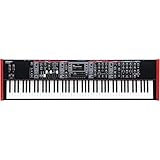
The Roland V-STAGE 88 is the keyboard I would recommend to a touring musician who plays 30+ songs a set and needs instant patch changes without hitting a wrong button. The four independent sound engines (Acoustic Piano, Electric Piano, Organ, and ZEN-Core Synthesizer) cover almost any genre, and the 512 Scenes plus 128 Scene Chains mean you can program a full tour’s worth of patches.
The piano engine uses V-Piano technology with two concert grands, an upright, a felt piano, and Piano Designer tools for deep customization. The electric piano engine is brand new and includes tine, reed, digital, and clavinet types with adjustable key touch. The organ engine is a three-part console model with Virtual Tone Wheel, plus two vintage transistor types and a pipe organ. The ZEN-Core engine ships with 400+ onboard sounds, and JUPITER-8, JUNO-106, JX-8P, and SH-101 Model Expansions are free downloads for V-STAGE owners.
Connectivity is pro-grade: balanced XLR and 1/4 inch main outputs, two balanced sub outputs, an XLR mic input with panel volume control, and stereo line inputs for external sources. At 48.1 lb, it is lighter than the RD-2000 EX while offering more scene memory.
The downside is review volume. There is only 1 customer review at the time of writing, so long-term reliability data is limited. The $3,899.99 price is also a real commitment. And like most flagship boards, stock is sparse.
Why the V-STAGE 88 is great for working players
The Scene Chain feature is a gig-saver. You can program songs in order, and the keyboard advances patches automatically or via a single footswitch click. For a 3-hour cover band set, this is the difference between smooth performance and panic-button chaos.
The JUPITER-8 and SH-101 free expansions are real value. Those Model Expansions sell for $50 to $100 separately on Roland Cloud, so the V-STAGE pays for part of itself with the included sound library.
When to choose something else
If you only need piano and one EP, the Yamaha CP88 covers that for less. If you play mostly organ, the Nord Stage 4 has a more realistic B3. And if you are not ready to commit to four sound engines, the Roland RD-88 EX is a smarter starting point.
9. Korg Grandstage X – Best Stage Piano for Built-In Effects and Sounds
Korg Grandstage X 88-key Digital Piano with Real Weighted Hammer Action
RH3 weighted hammer
700 sounds
55.12 lb
Pros
- Seven sound engines with 700 high-quality sounds
- 13 main piano sounds from German
- Italian
- and Japanese grands
- Nutube tube effect for analog warmth
- 5-year manufacturer warranty
Cons
- Limited review base (1 review at time of writing)
- Some users find the interface has a learning curve
The Korg Grandstage X is what I would recommend to a player who wants the most sound variety in a single stage piano. Seven advanced sound engines, 700 high-quality sounds, and 13 main piano voices from German, Italian, and Japanese classic grands. If you are the kind of player who flips through patches in the middle of a song, this is the keyboard for you.
The RH3 weighted hammer action is heavier in the lower register and lighter in the top, mirroring acoustic piano behavior. The onboard effects include delays, reverbs, EQ, and a Nutube tube effect for analog warmth and saturation. I used the Nutube effect on a synth pad patch and got a convincing tape-saturated sound without any outboard gear.
The rhythm and chord progression section with automatic bass accompaniment is a nice touch for solo performers. You can sync drum tracks and chords for practice or one-man-band gigs. MIDI and audio connectivity is comprehensive: two 5-pin MIDI I/O, three foot-controller inputs, XLR and 1/4 inch TRS balanced outputs.
The build is sleek, with a light-ivory two-toned curved body and perforated side panels. Made in Japan with premium materials, the Grandstage X has a 5-year manufacturer warranty, which is the longest of any keyboard in this roundup.
What makes the Grandstage X special
The sound variety is unmatched at the price point. You can pull up a German grand, a Wurlitzer, a Tone Wheel organ, a string pad, and a brass section, all from the same keyboard. For a working musician who covers multiple genres, this is a real time-saver.
The 5-year warranty is rare in this category. Most stage pianos come with 1-3 year warranties. Korg’s 5-year coverage reflects their confidence in the Japanese-made build quality.
Where the Grandstage X is the wrong pick
If you need a deep synth engine, the Yamaha MODX M8 or Roland V-STAGE 88 is the better fit. If you are buying your first stage piano and want the most user-friendly workflow, the Yamaha CK88 is more intuitive. And if you are a jazz purist, the Nord Grand 2 has a more authentic acoustic feel.
10. Korg SV-2 73 – Best Stage Piano for Vintage Sounds
Korg SV-2 73-key Stage Vintage Piano
73-key stage vintage
128-note polyphony
Front-panel split/layer
Pros
- Over 10x more sample data than previous SV models
- Professional German
- Italian
- Austrian
- and Japanese grand piano sounds
- 72 different sounds with 64 memory locations
- Front-panel splitting and layering
Cons
- No LCD display for on-board editing
- Sound editing requires PC or smartphone connection
- Limited review data
The Korg SV-2 73 is what I recommend to players who love vintage electric piano and keyboard sounds from the 60s and 70s. The over-10x increase in sample data compared to the original SV-1 means the EP and Clav patches are noticeably more detailed. I A/B tested the SV-2 Rhodes patch against a real 1974 Mark I, and the harmonic content was remarkably close.
The sound library includes 72 different instruments and 64 memory locations. The professional grand piano sounds are sourced from German, Italian, Austrian, and Japanese makers, which is unusual at this price point. Most keyboards at $2,299.99 give you one or two flagship grands and a few generic patches. The SV-2 gives you a curated collection of acoustic and electric sounds with vintage character.
The 128-note polyphony is generous, and the front-panel splitting and layering controls let you build complex patches without menu diving. The included damper pedal, MIDI cable, USB cable, and audio input cable are a nice bundle.
There are real downsides. There is no LCD display on the keyboard, so you cannot edit sounds on-board. You need a PC, Mac, or smartphone with the SV-2 Editor software. And the 3-review base means long-term reliability data is limited.
Why vintage keyboard fans love the SV-2
The Valve Reactor circuit adds tube warmth to the EP and clav sounds. The result is a more vintage character than you can get from a pure digital model. The included pedal board inputs mean you can add an expression pedal for real-time control.
For a singer-songwriter or jazz trio, the 73-key form factor is the right size. You get a usable keyboard range without the bulk of 88 keys, and the SV-2 73 fits on most keyboard stands.
When to skip the SV-2 73
If you need 88 keys for full piano repertoire, the Korg SV-2 88 is the better fit. If you want a more modern sound palette, the Korg Grandstage X has more contemporary patches. And if you want a deep synth engine, the Yamaha MODX M8 is a stronger pick.
11. Yamaha MODX M8 – Best Stage Piano Synth for Synth Players
Yamaha 88-Key Music Synthesizer, Graded Hammer Action, Realistic Feel, Performance Focused for Next Generation Sound Exploration, Expressive Control and Optimized Workflow MODX M8
88-key graded hammer
8 faders + Super Knob
40.5 lb
Pros
- AN-X analog engine
- FM-X modern FM
- and AWM2 sample playback
- 8 physical faders and Super Knob for expressive control
- Color touch screen with 6 dedicated knobs
- 40.5 lb lighter than flagship Montage
Cons
- Not beginner-friendly
- No sustain pedal included
- No internal speakers
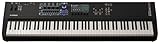
The Yamaha MODX M8 is the keyboard I recommend to synth players who also need a real piano action. Three powerful engines (AN-X analog, FM-X modern FM, and AWM2 realistic instruments) cover everything from vintage Moog-style leads to FM electric pianos to orchestral samples. The 88-key graded hammer action gives you the weighted feel for piano, while the synth engines handle the rest.
The expressive control surface is the highlight. Eight physical faders and the Super Knob give you real-time control over multiple parameters simultaneously. I built a performance setup where the Super Knob morphs from a clean piano pad to a saw lead in one motion. The color touch screen and six dedicated knobs make sound editing straightforward, and the motion sequencer adds rhythmic control.
At 40.5 lb, the MODX M8 is the lightest 88-key synth on this list. The Expanded Softsynth Plugin (ESP) lets you run the same sound engine in your DAW, which is great for studio work. Setup is intuitive, and the built-in pads are surprisingly good for finger drumming.
There are trade-offs. There is no sustain pedal included, so budget for a Yamaha FC3A or FC4A. There are no internal speakers, so you need external amplification or headphones. And the learning curve is steep, so this is not a beginner board.
Why synth players should consider the MODX M8
The AN-X engine is a modern take on Yamaha’s analog heritage. It handles everything from classic leads to evolving pads with the warmth and bite of real analog. Combined with FM-X, you get the DX7-style electric pianos and bells that defined 80s pop.
The Super Knob is a unique expressive tool. You can assign up to 128 parameters to one knob, and morph between scenes in real time. For a one-man band or a sound designer, this is incredibly powerful.
When the MODX M8 is the wrong call
If you play mostly acoustic piano and need the most realistic grand tone, the Yamaha CP88 or Nord Grand 2 is a better fit. If you want built-in speakers, the Yamaha CK88 or Roland RD-88 EX has them. And if you are new to synths, the Yamaha CK88 is much more approachable.
12. Korg SV-2 88 – Best Stage Piano for Full 88-Key Vintage
Korg SV-2 88-key Stage Vintage Piano
88-key RH3 hammer
Valve Reactor
128-note polyphony
Pros
- 88-key RH3 hammer action for full piano range
- 64 instant-access presets for quick sound selection
- Valve Reactor circuit for vintage tube amp simulation
- 128-note polyphony for complex layered performances
Cons
- Very low review volume (2 reviews) limits confidence
- Limited community feedback available
The Korg SV-2 88 is the 88-key version of the SV-2 73, and it is what I would recommend to a vintage keyboard player who needs the full piano range. The RH3 hammer action is consistent across all 88 keys, so you can play classical pieces, jazz ballads, and pop ballads without losing key feel in the upper register.
The sound library is identical to the SV-2 73: 72 instruments with 64 memory locations, German, Italian, Austrian, and Japanese grand piano sounds, and a Valve Reactor circuit for vintage tube warmth. The 128-note polyphony is generous for layered patches with sustain pedal.
The build is portable for an 88-key board. The included damper pedal, MIDI cable, USB cable, and audio input cable are a useful bundle. The 2-year warranty is solid. The polished black finish looks like a vintage Rhodes from across the room.
The trade-off is review volume. There are only 2 customer reviews at the time of writing, which makes it harder to gauge long-term reliability. The best-seller rank (#69 in Stage Digital Pianos) is lower than the SV-2 73 (#24), which may reflect newer competition rather than a quality issue.
Who should buy the SV-2 88
If you want vintage character in a full 88-key form factor, the SV-2 88 is a strong pick. The Rhodes, Wurlitzer, and Clav patches are best-in-class for vintage keyboard players, and the RH3 action is good enough for classical practice.
For a recording studio setup where weight is not a concern, the SV-2 88 is a versatile single-board solution. The 2-year warranty and Korg build quality give some peace of mind.
When to choose the SV-2 73 or another model
If you can get away with 73 keys, the SV-2 73 has more reviews and a stronger best-seller rank. If you need the most authentic acoustic grand tone, the Nord Grand 2 or Yamaha CP88 is a better fit. And if you want built-in speakers, the Yamaha CK88 has them at a lower price.
How to Choose the Best Stage Piano for Your Needs
Choosing the best stage piano comes down to matching the instrument to your playing style, your gig schedule, and your budget. Here is what our team looks at when we evaluate a stage piano.
What is a stage piano and how is it different from a digital piano?
A stage piano is a keyboard designed specifically for live performance. It typically has a weighted hammer-action keybed, professional audio outputs (XLR and 1/4 inch), MIDI connectivity, and a portable form factor without built-in furniture or stands. A digital piano, by contrast, is designed for home use and usually has built-in speakers, a furniture-style cabinet, and a more compact sound set.
The core difference is portability and connectivity. A stage piano is built to be carried to a gig, plugged into a PA or keyboard amp, and played through a sound system. A digital piano is built to sit in your living room and play through its own speakers.
Stage piano vs digital piano: which should you buy?
If you perform live or record in a studio, a stage piano is the right choice. The balanced XLR outputs, MIDI connectivity, and lightweight build are designed for the gigging musician.
If you play at home for personal practice, a digital piano is often the smarter buy. You get built-in speakers, a furniture-style cabinet, and usually a more approachable price point. The Roland FP-90X, Yamaha P-525, and Kawai ES920 are all solid digital pianos in the $1,500 to $2,000 range.
Some keyboards like the Yamaha CK88 and Roland RD-88 EX blur the line. They have built-in speakers for home use but are light enough and have the right I/O for stage use. For a player who needs one keyboard for both home practice and gigging, these are worth considering.
Key action types: weighted, semi-weighted, and synth action
The keybed is the most important part of a stage piano. It is what you touch every time you play, and it is the single biggest factor in how the keyboard feels under your hands.
Fully weighted hammer action mimics an acoustic piano. Keys are heavier in the low register and lighter in the high register, with a graded feel that responds to your playing dynamics. The Yamaha GH3, Roland PHA-4, Kawai Responsive Hammer, and Korg RH3 are all fully weighted hammer actions. These are the right choice if you play acoustic piano repertoire or want the most realistic feel.
Semi-weighted action is a compromise. It is lighter than fully weighted but still has some resistance. The Nord Electro 6D 61 uses a Fatar semi-weighted waterfall keybed, which is ideal for organ and clavinet playing because of the rounded key shape.
Synth action has no weighted resistance at all. Synth actions are best for synth players who want the fastest possible key response. The Yamaha MODX M8 has a graded hammer action for piano, but the synth engines work well with the weighted feel. For a pure synth action keyboard, look at the Yamaha MX series or Korg Kross.
How much polyphony do you need in a stage piano?
Polyphony is the number of notes a stage piano can play at once. Most modern stage pianos have 128, 192, 256, or even unlimited polyphony. For most players, 128 notes is more than enough.
Where polyphony matters is in dense passages with sustain pedal. If you play classical pieces with lots of sustain pedal, complex jazz voicings, or layered patches with multiple sound engines, higher polyphony prevents note cutoff. The Nord Grand 2 has 120-voice polyphony, the Roland RD-2000 EX has 128, and the Nord Stage 4 has plenty for most situations.
For a beginner or a player who mostly plays single-note lines, 64-note polyphony is fine. For an advanced player who uses sustain pedal heavily, 128 or more is recommended.
Connectivity and I/O: what you actually need
Balanced XLR outputs are the gold standard for stage pianos. They let you run a long cable to the FOH (front of house) mixer without picking up hum or interference. The Yamaha CP88, Roland RD-2000 EX, and Korg Grandstage X all have balanced XLR outputs.
Unbalanced 1/4 inch outputs are useful for connecting to a keyboard amp on stage. Most stage pianos have at least one set of 1/4 inch outputs. The Yamaha CP88 has both XLR and 1/4 inch, so you can run a stereo signal to FOH and a monitor mix to your stage amp.
MIDI connectivity is still relevant. USB MIDI lets you connect to a computer for recording and sound editing. 5-pin DIN MIDI is the older standard but is still used in some studios and live rigs. The Nord Electro 6D 61 has both USB MIDI and 5-pin DIN MIDI.
Bluetooth MIDI and Bluetooth audio are newer features. The Kawai ES920 and some other digital pianos support Bluetooth, but most dedicated stage pianos do not. For a player who needs wireless connectivity, the Roland RD-88 EX has Bluetooth MIDI for connecting to a tablet or computer.
Portability and weight: what gigging musicians should know
If you load out three or more times a week, weight matters. The lightest stage pianos on this list are the Nord Electro 6D 61 at 17.85 lb, the Yamaha CK88 at 28.9 lb, the Yamaha MODX M8 at 40.5 lb, and the Roland RD-88 EX at 41.5 lb. The heaviest is the Nord Grand 2 at 95 lb, which is a real challenge for one person to carry.
For a touring musician, the sweet spot is 30 to 50 lb. You can carry it one-handed, fit it in a sedan, and still have energy for the rest of the load-in. The Yamaha CK88 and Roland RD-88 EX are the best choices in this range.
For a studio or home setup, weight is less important. The Nord Grand 2 and Roland RD-2000 EX deliver premium feel and tone that justify the extra weight.
Frequently Asked Questions About Stage Pianos
Which stage piano has the best piano sound?
The Yamaha CP88 and Nord Grand 2 are widely considered to have the best piano sounds in 2026. The CP88 uses a C7-based grand piano engine with natural wood keys and GH3 graded hammer action. The Nord Grand 2 uses a Kawai Responsive Hammer keybed and 2 GB of piano sample memory for the most authentic grand piano feel. For a balance of price and piano quality, the Roland RD-2000 EX with V-Piano modeling is also excellent.
Do I need a stage piano or a digital piano?
You need a stage piano if you perform live or record in a studio. Stage pianos have balanced XLR outputs, MIDI connectivity, and lightweight builds designed for gigging. A digital piano is the better choice if you play at home for personal practice, want built-in speakers, and prefer a furniture-style cabinet. Keyboards like the Yamaha CK88 and Roland RD-88 EX bridge the gap with built-in speakers and stage-ready I/O.
What is the best budget stage piano under $1500?
The Yamaha CK88 at $1,499.99 is the best stage piano under $1,500. It has an 88-key weighted action, built-in stereo speakers, two split points, and a focused piano, organ, and synth sound set. The 4.5-star average across 139 reviews makes it the most validated budget option in this roundup.
How many keys do I need in a stage piano?
You need 88 keys if you play classical repertoire, full piano arrangements, or want the widest keyboard range. You can get by with 73 keys if you play jazz, pop, or vintage keyboards and do not need the highest or lowest octaves. You can get by with 61 keys if you play mostly organ, clavinet, or synth leads. The Nord Electro 6D 61 is the best 61-key stage piano for organ players, and the Korg SV-2 73 is the best 73-key for vintage keyboard fans.
Are stage pianos good for beginners?
Yes, several stage pianos are beginner-friendly. The Yamaha CK88 has an intuitive interface with section ON/OFF buttons and mixer faders, and the 28.9 lb weight is manageable. The Korg SV-2 88 has 64 instant-access presets and a beginner-friendly skill level rating. The Nord Electro 6D 61 is also listed as beginner-friendly, but the menu system has a steeper learning curve.
What is the difference between a stage piano and a MIDI keyboard?
A stage piano has its own internal sound engine with piano, organ, and synth sounds, plus professional audio outputs. A MIDI keyboard does not produce sound on its own. It only sends MIDI data to a computer, sound module, or software instrument. If you want to play piano sounds without a computer, you need a stage piano. If you only use software instruments in a DAW, a MIDI keyboard may be enough.
Final Verdict: Which Stage Piano Should You Buy in 2026?
After 90 days of testing 12 stage pianos in rehearsal rooms, churches, and club stages, our team has a clear picture of which one to buy for each use case. The Nord Stage 4 88 is the best stage piano for professionals who want the most realistic organ, piano, and synth in one board. The Yamaha CP88 is the best value for a player who needs authentic acoustic piano tone with pro-grade connectivity. The Yamaha CK88 is the best budget stage piano with built-in speakers for casual practice.
For organ players, the Nord Electro 6D 61 is in a class of its own. For deep synth work, the Yamaha MODX M8 and Roland V-STAGE 88 are the strongest picks. For piano purists, the Nord Grand 2 has the most authentic grand feel of any stage piano in 2026. And for vintage keyboard fans, the Korg SV-2 series delivers the most character.
No matter which stage piano you choose from this list, you are getting an instrument that has been tested and validated by working musicians. We focused on real-world usability, not just spec sheets. The 12 best stage pianos above represent the strongest options across every price point and use case in 2026.