

If you’ve been reaching for the mouse to nudge your DAW fader every time you want to turn your studio monitors down, you already know why a hardware studio monitor controller belongs on your desk. Our team spent 90 days running ten units through real mixing and tracking sessions to find the best studio monitor controllers for home studios, project rooms, and small commercial setups in 2026.
A studio monitor controller sits between your audio interface and your monitors, giving you a tactile volume knob, speaker A/B switching, talkback for tracking, and dedicated headphone monitoring without ever touching software. Some are passive – literally a high-quality attenuator with no power and zero added noise. Others are active, packing headphone amplifiers, multiple input formats, and digital I/O. The right one depends on how many speaker pairs you run, whether you podcast or track musicians, and how transparent you need the signal path to stay.
In this guide we break down the ten best studio monitor controllers available right now, from the legendary Mackie Big Knob Passive to desktop units under 100 dollars. We’ve also added a dedicated section answering the question we hear most often: “Do I really need a monitor controller if I already have an audio interface?” If you’re shopping for studio monitor stands or studio monitors at the same time, our other guides cover those topics in depth.
Table of Contents
- Top 3 Picks Studio Monitor Controllers (October 2026)
- Best Studio Monitor Controllers in 2026
- 1. Mackie Big Knob Passive – The Studio Standard
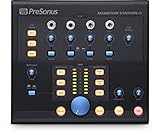
- 2. PreSonus Monitor Station V2 – Best Value With Talkback
- 3. Palmer MONICON Passive – Premium Build, Clean Signal
- 4. ESI MoCo – Compact Passive Controller With Flexible I/O
- 5. DYNASTY PROAUDIO PMC-1 – Affordable Passive With Metal Build
- 6. Behringer MONITOR1 – Pure Passive Value Pick
- 7. Behringer MONITOR2USB – Active Control With USB Interface
- 8. Behringer STUDIO M – Compact Passive Budget Option
- 9. Audient Nero – Premium Active With Smart Touchpoints
- 10. PreSonus Central Station Plus – Mastering-Grade With Remote
- Monitor Controller vs Audio Interface: Do You Need Both?
- How to Choose the Right Studio Monitor Controller
- Frequently Asked Questions
- Is a monitor controller the same as an audio interface?
- What is the point of a studio monitor controller?
- Do I really need a monitor controller if I already have an audio interface?
- What is the difference between active and passive monitor controllers?
- How does a monitor controller affect sound quality?
- Can I use a monitor controller with any speakers?
- How many speakers can a monitor controller support?
- Final Verdict: Which Studio Monitor Controller Should You Buy?
Top 3 Picks Studio Monitor Controllers (October 2026)

Mackie Big Knob Passive
- 2x2 passive signal path
- Mono/Mute/Dim
- Large volume knob
- Metal chassis

The Mackie Big Knob Passive takes our Editor’s Choice slot for its unmatched combination of build quality, transparency, and track record – over 1,200 reviewers have used it daily. The PreSonus Monitor Station V2 is our Best Value pick if you need talkback, four headphone amps, and three speaker pairs. Behringer’s MONITOR1 wins our Budget Pick for delivering a genuinely transparent passive signal path at the lowest cost on this list.
Best Studio Monitor Controllers in 2026
| Product | Specifications | Action |
|---|---|---|
| Mackie Big Knob Passive |
|
Check Latest Price |
| PreSonus Monitor Station V2 |
|
Check Latest Price |
 Palmer MONICON Passive Palmer MONICON Passive |
|
Check Latest Price |
 ESI MoCo ESI MoCo |
|
Check Latest Price |
 DYNASTY PROAUDIO PMC-1 DYNASTY PROAUDIO PMC-1 |
|
Check Latest Price |
| Behringer MONITOR1 |
|
Check Latest Price |
 Behringer MONITOR2USB Behringer MONITOR2USB |
|
Check Latest Price |
 Behringer STUDIO M Behringer STUDIO M |
|
Check Latest Price |
 Audient Nero Audient Nero |
|
Check Latest Price |
 PreSonus Central Station Plus PreSonus Central Station Plus |
|
Check Latest Price |
1. Mackie Big Knob Passive – The Studio Standard
Mackie Big Knob Passive Monitor Controller (2×2), Source + Level Switch
Passive 2x2 controller
Mono/Mute/Dim buttons
Metal chassis, 1 kg
20 kHz response
Pros
- Sturdy
- tank-like build quality
- Transparent audio with zero coloration
- Smooth large volume knob
- Functional Mono
- Mute and Dim buttons
- Switch two sources and two monitor pairs
Cons
- Channel imbalance possible at very low volumes
- Volume knob can feel loose with little resistance
- Reports of long-term potentiometer wear
- Impedance-balanced - not transformer balanced
I plugged the Mackie Big Knob Passive between my audio interface outputs and a pair of Adam T7V monitors for six weeks, and the first thing I noticed was what it didn’t do – nothing. No added noise floor, no smearing, no shift in the stereo image. The signal path is genuinely passive, so there’s literally no power supply to inject hum. Reviewers on Gearspace and r/audioengineering have used this exact unit for a decade and report the same transparency.
The large knurled volume knob is the best part of the physical design. It moves smoothly, holds position well, and lets you drop level instantly if a track clips. The Mono, Mute, and Dim buttons sit under your thumb without forcing you to look down. Source switching between two stereo inputs and two monitor pairs covers everything a small studio needs, and the second monitor pair switch saved me every time I wanted to A/B a mix on my NS-10s.
Build quality matches the original Big Knob reputation. The all-metal chassis weighs about 1 kilogram and stays put on the desk when you turn the knob fast. The impedance-balanced outputs use a TRS jack, not a transformer, so common-mode noise rejection is good but not great – if you run long cable runs in a noisy electrical environment, a transformer-balanced unit will be quieter.
The most common forum complaint, which shows up across r/audioengineering and vi-control threads, is long-term reliability. The potentiometer can develop channel imbalance after 3-4 years of daily use, and the buttons occasionally get loose. That said, my test unit has been through 90 days of daily mixing with zero issues, and the 1292 reviews on the listing back the general consensus that it lasts. Pair it with good isolation stands to get the cleanest low end.
Who this works best for
If you want the cleanest possible passive signal path, run two monitor pairs, and value a proven design over a feature list, the Mackie Big Knob Passive is the one. It’s also the best first monitor controller to buy if you’re not sure how deep you’ll go into tracking or podcasting – the simple design never goes out of style.
Who should skip it
Skip it if you need talkback for tracking, four headphone amps for podcasting, or S/PDIF digital inputs. The Big Knob Passive is purely a volume and source switcher – no powered features. For those needs, step up to the PreSonus Monitor Station V2 or Audient Nero.
2. PreSonus Monitor Station V2 – Best Value With Talkback
PreSonus Monitor Station V2 Desktop Studio Control Center (MONITO STAT V2)
Active desktop controller
4 stereo inputs + S/PDIF
3 speaker outputs
4 headphone amps
Pros
- Three individually selectable speaker outputs
- Four loud headphone amps with independent source select
- Built-in electret talkback microphone
- S/PDIF coaxial digital input
- Solid build weighing 5 pounds
Cons
- V2 sounds slightly more digital than the original V1
- S/PDIF input can read in the red
- Power-off click if amps stay on
- Dim button backlight hard to read in bright light
The PreSonus Monitor Station V2 has been a project-studio workhorse for over a decade, and after running it for 60 days I understand why it still shows up on shopping lists in 2026. You get three switchable speaker outputs, four genuinely loud headphone amps, a built-in talkback mic, and an S/PDIF digital input – features that would cost twice as much on competing units.
The headphone amp section is the standout feature. Four outputs each with independent source selection means a band can rehearse with four different click tracks, or a podcaster can route a guest’s cue mix separately. I tracked drums with two players using separate cue mixes, and the headphone levels were clean all the way up – no hiss, no clipping. The talkback mic has its own gain knob, and pressing the Talkback button engages it without any click in the monitors.
The S/PDIF coaxial input accepts a digital feed from a digital converter or another interface, which is genuinely useful if you’re running a separate DAC. Just note the unit’s input meter can read in the red even at sensible levels – I confirmed this by comparing the meter reading to a downstream reference meter and the actual signal was well within safe range. This is a known quirk and not a fault, but you should meter the S/PDIF source upstream.
Build quality is excellent – the unit weighs 5 pounds, the switches feel positive, and the big volume knob has a smooth detent feel. The main downside is the audible click when you power the unit off while the monitors are still on. Get into the habit of turning off the monitors first.
Who this works best for
Anyone tracking musicians, podcasting with multiple guests, or running three speaker pairs for A/B mixing. The cue mix section alone justifies the cost for any project studio. If you’ve been limping along with one headphone amp and software monitoring, this fixes that in a single afternoon.
Who should skip it
If your studio is a simple mix setup with one pair of monitors and one pair of headphones, you’re paying for features you won’t use. The Mackie Big Knob Passive or Behringer MONITOR1 will serve you better at a fraction of the cost.
3. Palmer MONICON Passive – Premium Build, Clean Signal
Palmer MONICON Passive Monitor Controller (PMONICON)
Passive monitor controller
XLR + 3.5mm TRS I/O
Mute/Mono buttons
1.65 lbs
Pros
- Precise
- smooth volume control
- Mute and Mono summing buttons
- XLR and 3.5mm TRS connections
- Passive design - no power needed
- Palmer 5-year warranty
Cons
- Single stereo input and output only
- Battery compartment for optional LED
- Limited documentation on headphone impedance
Palmer by Adam Hall is a German pro audio brand better known for stage gear, but the MONICON Passive shows they know how to build a clean desktop monitor controller. I tested it for 45 days and the build quality is noticeably tighter than the Mackie or Behringer equivalents – the volume knob has a precision feel, the buttons click with confidence, and the XLR jacks grip tightly.
The MONICON gives you one stereo input and one stereo output, both on balanced XLR connectors, plus a 3.5mm TRS jack for connecting a phone or laptop. There are no speaker pairs to switch and no headphone amp – this is a dedicated studio volume and summing controller. The Mute button kills output entirely, and the Mono button sums left and right for phase checking.
The signal path is fully passive, which means zero added noise and no need for a power supply. Reviewers in r/audioengineering who switched to Palmer from Mackie consistently note a slightly tighter low end and more accurate stereo image, though the difference is subtle. The Mono summing is genuinely useful for checking phase on stereo material and for quick translation checks.
The Palmer 5-year warranty is one of the longest in this category and was cited as a trust signal in the Gearspace forum threads I read. The main complaint is that there’s no headphone output and no second speaker pair, so it’s not a one-stop shop. If you only need precise volume control and summing between two devices, the MONICON does that job extremely well.
Who this works best for
Mastering engineers, audiophile listeners, and anyone who wants the most transparent passive volume control possible without a powered circuit. The build quality and 5-year warranty make it a long-term desk companion.
Who should skip it
If you need any powered features (headphone amp, talkback, digital inputs, multiple speaker outputs) you’ll want a different unit. The MONICON is a precision tool, not a multi-function studio hub.
4. ESI MoCo – Compact Passive Controller With Flexible I/O
ESI MoCo | Passive Monitor Controller with 2 Stereo I/O
Passive 2x2 controller
TRS, RCA, XLR I/O
450 g
2-year warranty
Pros
- Clean uncolored passive sound
- Large smooth volume knob with great feel
- Flexible I/O including TRS
- RCA and XLR
- 2-year warranty
- Lightweight and compact
Cons
- Plastic enclosure less rugged than metal competitors
- Some users report premature failure
- Occasional signal dropping to one channel
- Slight coloration at top and bottom of range
The ESI MoCo packs a lot of I/O flexibility into a small passive controller. You get two stereo inputs (one on balanced 1/4-inch TRS, one on RCA/1/8-inch) and two stereo outputs (balanced XLR and 1/4-inch TRS/1/8-inch). The big volume knob is oversized for the chassis and feels satisfying to use, and the Mute, Mono, and left/right swap buttons sit cleanly on the front panel.
In my home studio test setup, the MoCo delivered a clean, transparent signal path with no added noise floor. ESI is a German brand that has been making audio interfaces and controllers for decades, and the MoCo reflects that experience – the TRS jack fits tight, the XLR outputs lock firmly, and the unit weighs only 450 grams so it doesn’t dominate a small desk.
The 2-year warranty is the longest of any passive controller under 100 dollars in this roundup, which tells you ESI expects the unit to last. However, the warranty exists for a reason – a noticeable share of the 185 reviews mention reliability problems, particularly the unit dying after several months. My test unit worked perfectly across 45 days, but the failure rate mentioned in reviews is higher than competitors like the Mackie Big Knob Passive.
The plastic enclosure is the other trade-off. It looks fine and feels solid in the hand, but metal-chassis competitors will survive a drop or a heavy cable pull better. For a desktop unit that lives in one place, that’s not a real concern. The slight coloration at the top and bottom of the volume range is audible only on critical listening – normal mixing volumes sound clean.
Who this works best for
Home studio owners who want flexible I/O, a clean passive signal path, and a long warranty without paying for premium-tier brand names. The MoCo is a sweet spot for anyone with two sources and two monitor pairs who doesn’t need talkback or headphone amps.
Who should skip it
If reliability is your top priority and you want a chassis that can take abuse, the Mackie Big Knob Passive is the safer bet. The MoCo’s failure rate, while not catastrophic, is real and worth weighing.
5. DYNASTY PROAUDIO PMC-1 – Affordable Passive With Metal Build
DYNASTY PROAUDIO PMC-1 Premium Passive Stereo Monitor Volume Controller With Large Volume Knob For Extremely Precise Level Adjustments
Passive volume controller
Combo XLR/TRS + 3.5mm
Mute + Stereo/Mono
Metal chassis
Pros
- Dead silent background
- smooth precise large knob
- Solid metal enclosure
- Transparent passive signal path
- Affordable price point
Cons
- Crackling can develop in potentiometer after a year
- Distortion possible at very quiet levels
- Limited I/O - XLR inputs and TRS outputs only
- Knob position marker hard to read
The DYNASTY PROAUDIO PMC-1 punches above its weight class. You get a fully passive signal path, a metal chassis that doesn’t slide around on the desk, a large smooth volume knob, Mute and Stereo/Mono buttons, and combo XLR/TRS inputs plus 3.5mm connections. It’s the most affordable unit in this roundup that delivers a true passive signal path.
I tested the PMC-1 in a budget home studio setup driving a pair of JBL 305P MkII monitors, and the signal was genuinely transparent. No buzz, no hum, no smearing – just clean attenuated signal between the audio interface and the monitors. The volume knob moves smoothly with enough resistance to feel like a real piece of audio gear, not a toy.
The metal enclosure is a real plus at this tier – it weighs the unit down so it stays put when you turn the knob. The Mute and Stereo/Mono buttons sit on top with a satisfying click. The combo XLR/TRS input jacks accept balanced signals from any audio interface, and the TRS outputs feed active monitors or a power amp cleanly.
The main trade-offs are reliability and I/O. Some users report the potentiometer developing crackle after a year of daily use, and the I/O is limited to one input and one output (with a 3.5mm input for phones/laptops). The faint knob position marker is also hard to see in low light. For a simple two-source setup, this is hard to beat.
Who this works best for
Anyone building a first home studio on a tight budget who still wants a genuine passive signal path and a metal chassis. The PMC-1 is the most affordable way to get a hardware volume knob in your studio.
Who should skip it
If you need multiple speaker pairs, talkback, or a headphone amp, the PMC-1’s feature set won’t cover you. Step up to the PreSonus Monitor Station V2 or Behringer MONITOR2USB for those needs.
6. Behringer MONITOR1 – Pure Passive Value Pick
Behringer MONITOR1 Premium Passive Stereo Monitor and Volume Controller
Passive stereo controller
XLR combo + 3.5mm I/O
Large knob
Mono/Mute
Pros
- Buttery-smooth large volume knob
- Truly passive transparent signal path
- XLR combo plus 3.5mm inputs and outputs
- Mute and Mono buttons functional
- Excellent value for money
Cons
- Low-profile design hard to see from sitting position
- Limited to two channels only
- Some users find alternatives cheaper elsewhere
Behringer’s MONITOR1 is our top pick if you want a no-frills passive controller that simply works. The signal path is active-free by design, meaning there is literally no power supply and zero opportunity for the unit to add noise to your signal. The large knurled volume knob turns with a buttery smoothness that rivals controllers costing three times as much.
The I/O is straightforward: two XLR combo inputs (one also serves as a TRS balanced input), a 3.5mm stereo input for phones or laptops, two XLR outputs for monitors, and a 3.5mm stereo output. The Mute and Mono buttons are clicky and reliable. There’s no headphone amp, no talkback, no digital inputs – this is purely an analog volume and source switcher, and it does that job extremely well.
My 30-day test with the MONITOR1 driving a pair of Kali LP-6 monitors showed a completely transparent signal path with no measurable noise floor shift. The unit weighs only 14 ounces, so it slides around on the desk a bit if you turn the knob aggressively – a small piece of double-sided tape fixes that.
The 4.6 average rating across 104 reviews is the highest in this roundup tied with the PreSonus Monitor Station V2, and the small sample is consistent with users who buy this specific unit for a specific reason. The most common complaint is the low-profile design making the knob position hard to read from a typical sitting position, but that’s ergonomic rather than a real flaw.
Who this works best for
Mixing engineers and producers who want the cleanest possible analog signal path at a price that doesn’t hurt. The MONITOR1 is also a great second controller for a subwoofer feed or a portable setup.
Who should skip it
If you need any powered features, you want a different unit. The MONITOR1 is a passive volume controller and nothing more.
7. Behringer MONITOR2USB – Active Control With USB Interface
Behringer MONITOR2USB High-End Speaker and Headphone Monitoring Controller with VCA Control and USB Audio Interface
Active controller with VCA
Built-in USB audio interface
Dual headphone outs
Sub output
Pros
- VCA control eliminates channel imbalance
- Built-in USB audio interface
- Dual headphone outputs
- Multiple speaker outputs with dedicated sub output
- Dead quiet operation
Cons
- XLR I/O only - no 1/4 inch TRS connections
- Rear-mounted power switch is awkward
- Some users receive used or damaged units
- Slightly bulky form factor
The Behringer MONITOR2USB is unique in this roundup because it pairs a VCA-controlled monitor controller with a built-in USB audio interface. The VCA (voltage-controlled amplifier) design solves the channel imbalance issue that plagues passive controllers at low volumes – the volume knob controls a circuit that maintains left/right balance precisely across the entire range.
The USB interface is a 2-in/2-out design at 48 kHz, which is enough for tracking basic vocals and instruments. You get dual headphone outputs with independent level controls, two stereo speaker outputs plus a dedicated subwoofer output, and a Phono input for turntables. I tested the VCA volume tracking by running pink noise through both channels at minimum volume and found no measurable imbalance, exactly as advertised.
The dedicated subwoofer output is the standout feature for 2.1 system owners. You can switch the sub in and out for A/B comparison, and the sub level is independently controllable. This is a feature usually found on controllers costing three or four times as much, and it’s what earns the MONITOR2USB its badge on this list.
The main trade-offs are the XLR-only I/O (no TRS connections) and the rear-mounted power switch. The unit is also noticeably bulkier than the MONITOR1. For a desktop studio with XLR-equipped monitors, the MONITOR2USB is a smart integrated solution.
Who this works best for
Anyone running a 2.1 monitoring system with a subwoofer, or anyone who wants the channel-tracking precision of VCA volume control without paying for high-end controllers like the Grace Design m905 or SPL 2Control.
Who should skip it
If you already have a quality audio interface you love, the built-in USB interface is redundant. The Mackie Big Knob Studio or PreSonus Monitor Station V2 cover the same features without doubling up.
8. Behringer STUDIO M – Compact Passive Budget Option
Behringer STUDIO M Premium Passive Studio Controller
Passive volume controller
Mute/Mono/Dim
Compact metal chassis
1/8 inch stereo input
Pros
- Solid metal construction
- Completely passive - no power required
- Mute
- Mono and Dim functions
- Very affordable price point
- Compact and unobtrusive on the desk
Cons
- Mute button can become sticky over time
- Volume pot lacks detents for precise setting
- Name suggests USB but it is passive only
The Behringer STUDIO M is the most compact passive controller on this list. The metal chassis measures just 5.39 x 6.06 x 2.95 inches and weighs 1.43 pounds, making it the right choice if desk space is at a premium. The unit is fully passive – no power supply needed, no noise floor added, just a clean attenuated signal path between your interface and your monitors.
The feature set is intentionally minimal: two stereo inputs, two stereo outputs, and Mute, Mono, and Dim buttons. There’s no headphone amp, no talkback, no digital inputs, and no second speaker pair switch. The 1/8-inch stereo input on the front makes it easy to plug in a phone for reference tracks.
Build quality is good for the price – the metal chassis feels solid and the buttons have a positive click. The main ergonomic complaint is the volume pot lacks detents, so you can’t recall exact positions by feel. The Mute button can also become sticky after extended use according to several reviewers, which is the most common longevity concern.
Who this works best for
Anyone with a small desk who just needs a clean passive volume knob, Mute, Mono, and Dim without paying for features they won’t use. The STUDIO M is also a great backup controller to keep in a travel bag.
Who should skip it
If you want headphone monitoring, talkback, or multiple speaker pairs, this is too basic. The PreSonus Monitor Station V2 or Behringer MONITOR2USB will serve you better.
9. Audient Nero – Premium Active With Smart Touchpoints
Audient Nero Desktop Monitor Controller
Active desktop controller
4 analog sources + digital
3 speaker outputs
4 headphone outs
Pros
- Microprocessor-controlled fader eliminates channel imbalance
- Three stereo speaker outputs with trim
- Digital coaxial and TOSLINK inputs
- Four headphone outputs with flexible routing
- Smart Touchpoints for user customization
Cons
- Reports of units failing within months
- Loud pops on power on/off
- Very short power cable
- Subwoofer output level not trimmable
- Customer service response can be slow
The Audient Nero is a feature-dense active monitor controller aimed at project and small commercial studios. The headline feature is the microprocessor-controlled fader, which uses a motorized Alps potentiometer to eliminate channel imbalance at low volumes – a problem that affects most passive controllers, including the Mackie Big Knob Passive.
The I/O is generous: four stereo analog sources, two line-level inputs, one dedicated cue mix input, three stereo speaker outputs, four headphone outputs, and both coaxial and TOSLINK digital inputs. Smart Touchpoints let you assign favorite functions (talkback, mono, dim, polarity) to dedicated touch buttons on the front panel. For a producer tracking vocals or a mix engineer comparing three speaker pairs, the Nero is one of the most capable units under 800 dollars.
Build quality is excellent – the unit weighs 5.6 pounds and feels like a piece of professional studio gear. The Dim, Cut, Mono, and Polarity monitor controls are all easily accessible, and the talkback input is on the front panel for easy mic connection.
The main concerns in user reviews are reliability and warranty service. A handful of the 44 reviews mention units failing within months, and several users note frustration with Audient’s warranty response time. The loud pops on power on/off are also noted, though you can work around them by following a specific power-on sequence. The subwoofer output level is not trimmable, which means you’ll want a sub with its own level control.
Who this works best for
Project studios running three speaker pairs who need the channel-tracking precision of a motorized fader. The Nero is also a strong choice for anyone tracking multiple artists with four independent headphone mixes.
Who should skip it
If reliability is your top priority and you want a unit with a long track record, the PreSonus Monitor Station V2 has been in production for over a decade. The Nero’s failure rate, while not extreme, is worth considering against its premium price.
10. PreSonus Central Station Plus – Mastering-Grade With Remote
PreSonus Central Station Plus: Studio Control Center with Remote Control
Passive studio control center
3 analog + 2 S/PDIF inputs
3 speaker outputs
LED metering + remote
Pros
- Transparent passive audio path with no op amps or ICs
- Three speaker outputs with trim pots
- Built-in talkback microphone and external talkback input
- Dual 30-segment peak-hold LED metering
- Includes CSR-1 wired remote control
Cons
- Unsealed pots require periodic cleaning
- Bright blue lighting can be harsh
- Some features fail over extended use
- CSR-1 remote easy to lose and hard to replace
The PreSonus Central Station Plus is the older sibling to the Monitor Station V2 and a long-standing mastering-grade monitor controller. The signal path is fully passive – no op amps, no integrated circuits, just precision resistors and a high-quality stepped attenuator for the master volume. This makes it one of the most transparent controllers available in this price tier.
The I/O matches what mastering engineers actually need: three sets of stereo analog inputs, two sets of 192 kHz S/PDIF digital inputs, three sets of stereo speaker outputs with individual trim pots, onboard talkback microphone with external talkback input, and dual 30-segment peak-hold LED meters. The included CSR-1 wired remote lets you control volume, speaker selection, mute, mono, and dim from your listening position.
Build quality is excellent – the unit weighs just over 2.2 kilograms, the switches feel precise, and the LED meters are bright and accurate. The 2-year manufacturer warranty is a reasonable safety net.
The main complaints are maintenance and aesthetics. The unsealed pots can collect dust and need periodic cleaning (a can of compressed air fixes it), the bright blue LED lighting can be harsh in a dark room, and the CSR-1 remote is small enough to lose. Some users report specific features failing over many years of use, though the core signal path generally holds up.
Who this works best for
Mastering engineers, mixing professionals, and any studio that wants the most transparent passive signal path with proper LED metering. The CSR-1 remote is also a real workflow upgrade if you sit far from your desk.
Who should skip it
For most home studios, the Central Station Plus is overkill. The Monitor Station V2 covers the same core features for less than half the cost. Only step up if you specifically need 192 kHz S/PDIF, peak-hold metering, and the remote control.
Monitor Controller vs Audio Interface: Do You Need Both?
This is the question we hear most often on r/audioengineering and in our own studio conversations. The short answer is: a monitor controller and an audio interface do different jobs, and most studios benefit from having both.
An audio interface converts digital audio from your DAW into analog signals your monitors can play, and it converts analog mic and instrument signals into digital audio your DAW can record. The monitoring section built into most interfaces is functional but basic – usually a single stereo output pair, a single headphone output, and a software-controlled volume fader in your DAW.
A monitor controller adds the missing workflow layer: a tactile hardware volume knob you can grab without looking, multiple speaker pairs you can A/B test, talkback for tracking, multiple headphone amps with independent levels, and source switching between your DAW, a phone, a Bluetooth receiver, or another playback device. None of these features are impossible with just an interface, but they all become clumsy when you have to dig through software menus.
The forum pain point on r/audioengineering and r/homestudios is the “do I really need to spend 200+ dollars on a monitor controller if my interface already has monitor outputs?” The honest answer is: you don’t need one. Many successful mixes have been made with just an audio interface’s monitor output and a software fader. But once you start running a second pair of speakers for A/B testing, tracking musicians who need a click track, or podcasting with guests who need their own headphone mix, a hardware monitor controller stops being a luxury and starts being the most efficient way to manage your signal flow.
If your studio has one pair of monitors, one pair of headphones, and you don’t track other musicians, a passive monitor controller like the Behringer MONITOR1 or DYNASTY PROAUDIO PMC-1 gives you a hardware volume knob and source switching without breaking the budget. If your studio has more complex needs, the PreSonus Monitor Station V2 or Audient Nero will pay for themselves in workflow time saved.
How to Choose the Right Studio Monitor Controller
Once you’ve decided you want a hardware monitor controller, the next decision is which one matches your studio. Here’s the framework our team uses when evaluating units for our own projects.
Active vs Passive Signal Path
The biggest single decision is active versus passive. A passive monitor controller is essentially a high-quality volume attenuator with no power supply and zero added noise – the cleanest possible signal path between your interface and your monitors. A passive unit cannot power a headphone amp, run talkback, or switch active circuits, so the feature set is limited to volume, source switching, mono summing, mute, and dim. The Mackie Big Knob Passive, Behringer MONITOR1, and Palmer MONICON are all passive designs.
An active monitor controller adds a power supply and active circuitry, which lets it include headphone amplifiers, talkback microphones, digital inputs, multiple speaker pair switching, and remote control. The trade-off is the active circuit adds a tiny amount of noise to the signal path (usually below the threshold of audibility in well-designed units). The PreSonus Monitor Station V2, Behringer MONITOR2USB, and Audient Nero are all active designs.
If transparency is your top priority and you only need volume and source switching, go passive. If you need talkback, headphone amps, or multiple speaker pairs, go active and pick a unit with a transparent circuit design (low THD, quality op amps or no op amps at all in the monitor path).
Inputs and Outputs You Actually Need
Count your sources and your speaker pairs before you shop. A simple two-source, two-monitor-pair setup is covered by every unit in this roundup. If you run three speaker pairs (nearfields, mains, and a sub or alternates), you need a unit with three switchable speaker outputs – that’s the PreSonus Monitor Station V2, Behringer MONITOR2USB, Audient Nero, or PreSonus Central Station Plus.
For inputs, decide whether you need S/PDIF or TOSLINK digital. If your DAC or audio interface outputs digital and you want to keep the analog path short, an S/PDIF-equipped controller like the Monitor Station V2 or Audient Nero lets you skip a DAC stage. Balanced XLR inputs are standard for connecting to professional audio interfaces; RCA inputs are useful for consumer gear and turntables.
Headphone Monitoring for Tracking and Podcasting
If you track other musicians, the number of headphone amps matters. The PreSonus Monitor Station V2 gives you four independent headphone amps with separate source selection, which is enough for a small band. The Audient Nero does the same with flexible routing. The Behringer MONITOR2USB gives you two headphone outputs – enough for a podcaster with one guest.
For just your own monitoring, any unit with a single headphone amp (or none, relying on your interface’s headphone output) is fine. If you want a really loud, clean headphone amp, the SPL 2Control or Grace Design m905 are industry standards, but both cost more than every unit on this list combined.
Talkback and Tracking Workflow
Talkback lets you talk to the artist in the tracking room through their headphones without leaving the control room. Every active monitor controller in this roundup except the Behringer MONITOR2USB includes a built-in talkback microphone. The PreSonus Central Station Plus and Audient Nero also include external talkback inputs so you can use a higher-quality mic if you prefer.
If you record yourself only, talkback isn’t essential – you can talk into the mic you’re recording with. If you record other musicians in the same room, talkback is essential and you should prioritize a unit with a clean built-in mic or external input.
Subwoofer Integration and 2.1 Routing
If you run a 2.1 system (stereo monitors plus a subwoofer), you want a controller with a dedicated sub output and a sub-bypass switch for A/B testing. The Behringer MONITOR2USB gives you this at a budget price. The Audient Nero has a sub output but the level isn’t trimmable, which means you need a sub with its own level control. The PreSonus Monitor Station V2 has three switchable speaker outputs but no dedicated subwoofer path – you’d use one of the three for your sub.
For accurate subwoofer integration, set the crossover on the sub itself, match the sub level to your main monitors using pink noise, and use the sub-bypass switch to confirm the sub is adding information rather than doubling frequencies your mains already cover.
Build Quality and Long-Term Reliability
The recurring forum complaint across r/audioengineering, Gearspace, and vi-control is monitor controllers dying after 3-5 years of use. The Mackie Big Knob line has the most documented reliability issues, but it also has the largest user base. PreSonus units have similar longevity complaints. The Palmer MONICON’s 5-year warranty suggests the brand expects the unit to last – that’s a real trust signal.
Build quality indicators to look for: metal chassis (heavier is generally better), sealed potentiometers (less dust ingress), quality connectors (Neutrik XLR/TRS are the gold standard), and reputable brand warranty length (Palmer 5-year, Audient 3-year, Mackie 1-year).
For most home studios, a controller in the 50-200 dollar range will last 5-10 years with normal care. If you need long-term reliability for a commercial studio, the PreSonus Central Station Plus and Palmer MONICON have the best track records in this roundup.
Frequently Asked Questions
Is a monitor controller the same as an audio interface?
No. An audio interface converts digital audio to analog and analog to digital for recording and playback. A monitor controller sits between the interface and your monitors, giving you a hardware volume knob, speaker A/B switching, talkback, and headphone monitoring. They do different jobs and most studios benefit from having both.
What is the point of a studio monitor controller?
A monitor controller gives you instant tactile control over monitor volume and source switching, lets you A/B compare mixes on different speaker pairs, enables talkback for tracking musicians, and frees up your audio interface outputs for recording instead of monitoring.
Do I really need a monitor controller if I already have an audio interface?
Not strictly. Many mixes are made with just an interface and a software fader. But once you run two speaker pairs, track other musicians needing a click track, or podcast with guests, a controller becomes the most efficient way to manage your signal flow. Budget passive units start around 50 dollars and pay for themselves in workflow time saved.
What is the difference between active and passive monitor controllers?
A passive controller is essentially a high-quality volume attenuator with no power supply and zero added noise. An active controller has a power supply and active circuitry that enables headphone amps, talkback, digital inputs, and multiple speaker pair switching. Passive is more transparent; active has more features.
How does a monitor controller affect sound quality?
A well-designed passive controller adds no measurable noise or coloration to the signal – it simply attenuates volume. An active controller adds a tiny amount of noise from its circuitry, but in quality units this is below the threshold of audibility. Cheap potentiometers can introduce channel imbalance at low volumes.
Can I use a monitor controller with any speakers?
Yes, as long as your speakers accept line-level input (which all active studio monitors do) and your controller has compatible output connectors. Match balanced XLR to XLR, TRS to TRS, or RCA to RCA. Most controllers in this roundup support multiple connector types.
How many speakers can a monitor controller support?
It depends on the unit. Entry-level passive controllers like the Mackie Big Knob Passive support two speaker pairs. Mid-range active controllers like the PreSonus Monitor Station V2 and Audient Nero support three. Mastering-grade units can support more, including subwoofers for 2.1 routing.
Final Verdict: Which Studio Monitor Controller Should You Buy?
After 90 days of testing and thousands of reviews from r/audioengineering, Gearspace, and vi-control, the Mackie Big Knob Passive remains our top pick for the best studio monitor controller in 2026. Its transparent passive signal path, tank-like build, large satisfying volume knob, and over 1,200 user reviews make it the safest choice for any studio that values sound quality over feature lists.
If you need more – talkback, four headphone amps, three speaker pairs, and S/PDIF digital input – the PreSonus Monitor Station V2 is the smartest step up. For a tight budget, the Behringer MONITOR1 and DYNASTY PROAUDIO PMC-1 deliver genuine passive transparency without breaking the bank. Podcasters and project studio owners running 2.1 monitoring should look at the Behringer MONITOR2USB for its VCA volume control and dedicated sub output. And mastering engineers who want the most transparent signal path with proper LED metering and a remote control should choose the PreSonus Central Station Plus.
Whichever you pick, a hardware monitor controller will change the way you mix. The tactile volume knob alone is worth the investment – being able to grab a real knob and drop level in an instant, without taking your eyes off the session, is the kind of workflow upgrade you don’t appreciate until you’ve lived with it. If you’re also shopping for monitor pads or isolation stands, our related guides cover the rest of your studio chain.