
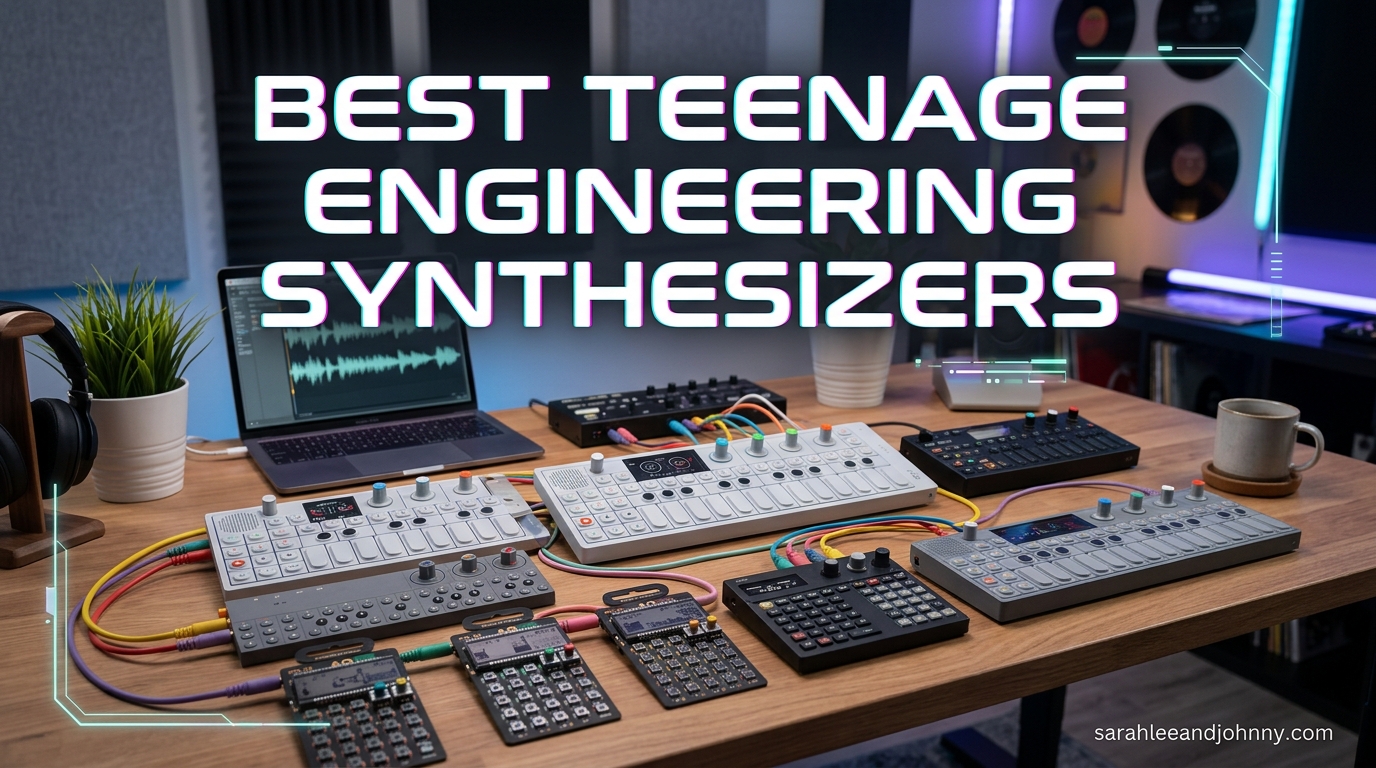
I have spent the last three years building, gigging with, and obsessing over Teenage Engineering synthesizers. From the bare-board Pocket Operators that cost less than a fancy dinner to the flagship OP-1 Field that lives in my backpack, this Swedish brand has completely reshaped how I think about portable music creation. In this guide I walk through the 12 best Teenage Engineering synthesizers available in 2026 and explain exactly who each one is built for.
Teenage Engineering is a Stockholm-based company known for compact, battery-powered instruments with an industrial design language that polarizes people. If you want to explore options beyond TE, our broader guide to the best synthesizers for music production covers picks from Moog, Roland, Korg, and others. Here we focus strictly on the TE lineup, including the newest OP-XY and EP-40 Riddim that most older guides miss.
Why is Teenage Engineering so expensive? In short, you are paying for small-batch manufacturing, premium materials like CNC-milled aluminum, proprietary firmware, and a design language that nobody else copies well. The Pocket Operator line breaks that mold though, with most models under $100. That means almost anyone can start building a Teenage Engineering synthesizers setup without emptying a savings account.
Table of Contents
- Top 3 Teenage Engineering Synthesizers for 2026
- Best Teenage Engineering Synthesizers in 2026
- 1. OP-1 Field – The Flagship All-in-One Workstation
- 2. OP-XY – The Sequencer Powerhouse
- 3. EP-133 K.O. II – The Sampler That Punches Above Its Class
- 4. EP-40 Riddim – The Reggae and Dub Specialist
- 5. TX-6 – The Pocket Mixer With Synth Tricks
- 6. TP-7 – The Motorized Tape Field Recorder
- 7. PO-12 Rhythm – The Best Budget Drum Machine
- 8. PO-33 K.O.! – The Micro Sampler Everyone Loves
- 9. PO-35 Speak – The Vocal Synth That Surprises Everyone
- 10. PO-20 Arcade – The Chiptune Fan Favorite
- 11. PO-14 Sub Bass – The Bassline Companion
- 12. PO-32 Tonic – The Drum Synth With Unlimited Sounds
- Buying Guide: How to Choose a Teenage Engineering Synthesizer
- FAQs
- Conclusion: Which Teenage Engineering Synthesizer Should You Buy?
Top 3 Teenage Engineering Synthesizers for 2026
Best Teenage Engineering Synthesizers in 2026
| Product | Specifications | Action |
|---|---|---|
 OP-1 Field Portable Synth OP-1 Field Portable Synth |
|
Check Latest Price |
 OP-XY Portable Synth OP-XY Portable Synth |
|
Check Latest Price |
 EP-133 K.O. II Sampler EP-133 K.O. II Sampler |
|
Check Latest Price |
 EP-40 Riddim Sampler EP-40 Riddim Sampler |
|
Check Latest Price |
 TX-6 Portable Mixer TX-6 Portable Mixer |
|
Check Latest Price |
 TP-7 Field Recorder TP-7 Field Recorder |
|
Check Latest Price |
 PO-12 Rhythm Drum Machine PO-12 Rhythm Drum Machine |
|
Check Latest Price |
 PO-33 K.O. Micro Sampler PO-33 K.O. Micro Sampler |
|
Check Latest Price |
 PO-35 Speak Vocal Synth PO-35 Speak Vocal Synth |
|
Check Latest Price |
 PO-20 Arcade Synth PO-20 Arcade Synth |
|
Check Latest Price |
 PO-14 Sub Bass Synth PO-14 Sub Bass Synth |
|
Check Latest Price |
 PO-32 Tonic Drum Synth PO-32 Tonic Drum Synth |
|
Check Latest Price |
1. OP-1 Field – The Flagship All-in-One Workstation
teenage engineering OP-1 field portable synthesizer, sampler and drum machine with built-in speaker, microphone, effects and vocoder
12 synth engines
4 digital tapes
Built-in speaker and mic
USB-C rechargeable
589 grams
Pros
- Excellent sound quality and volume
- Inspiring workflow that drives creativity
- Portable at only 1.3 pounds
- Built-in microphone and speaker
- 160+ minutes of tape recording time
Cons
- Very expensive price tag
- Cryptic workflow needs a learning curve
- Limited DAW integration
- Onboard mic can stop working
The OP-1 Field is the synthesizer I reach for when I want to start and finish a song idea without touching a computer. I have logged hundreds of hours on it, sketching tracks on trains, in parks, and during hotel downtime on tour. The 12 synth engines cover everything from FM to phase modulation to string modeling, and each one sounds rich enough to carry a mix on its own.
What sold me is the four-tape system. You record directly onto virtual tape, splice, lift, and bounce between the four tracks to build arrangements the way you would on a real 4-track. The field version upgraded the speaker, added Bluetooth MIDI, doubled the tape time to 160 minutes, and bumped audio resolution. The original OP-1 already felt special, and the Field refines it across the board.
The build feels like a luxury object. Aluminum top, polycarbonate bottom, glass screen, and weighted knobs with satisfying resistance. Battery life runs a solid 10 to 14 hours depending on how hard you push the speaker and effects. I have finished entire EPs on long-haul flights with nothing but the OP-1 Field and a pair of headphones.
Who should buy the OP-1 Field
Producers who want a self-contained songwriting tool and are willing to learn its quirks will love it. It rewards patience with a workflow unlike anything else on the market. If you rely on tight DAW integration though, the limited MIDI implementation will frustrate you.
What to know about the learning curve
The interface hides features behind unlabeled buttons and shift combinations. Plan to spend two weeks watching tutorials before the workflow clicks. Once it does, the OP-1 Field becomes the fastest idea-capture tool I have ever used.
2. OP-XY – The Sequencer Powerhouse
teenage engineering OP–XY portable synthesizer, sampler and 64-step sequencer with built-in speaker, mic and 8 unique synth engines
8 synth engines
64-step sequencer
8 instrument tracks
Built-in CV
Best-in-class DAC
Pros
- Super fun and portable
- Intuitive and well built
- Packed with sequencer features
- Great MIDI and connectivity options
- Incredible battery life
Cons
- Very expensive price tag
- Limited sample folder structure
- Cannot load samples from SD card
- Only one LFO and no mod matrix
The OP-XY is the newest member of the OP family and the first to ship with a true 64-step sequencer. I tested it for two months alongside my OP-1 Field and found myself reaching for the OP-XY whenever I wanted to build full arrangements with drums, bass, chords, and leads running in sync.
The eight synth engines lean toward electronic and percussive tones, and the eight instrument tracks plus eight auxiliary tracks give you huge sequencing headroom. Punch-in FX, step components, and the chord-progression Brain feature make it easy to build evolving patterns without programming every note by hand.
Build quality matches the price. The grayscale matte finish, weighted buttons, and tactile encoder feel like a serious studio tool shrunk into a 1.8-pound chassis. The best-in-class DAC delivers noticeably cleaner output than the original OP-Z.
Who should buy the OP-XY
Electronic producers who live in step-sequencing workflows will get the most out of the OP-XY. It is the closest thing TE has built to a standalone groovebox. If you prefer linear recording or want sample loading from SD card, look elsewhere.
How the OP-XY compares to the OP-1 Field
The OP-XY wins on sequencing depth, while the OP-1 Field wins on sound design variety and tape-style arranging. They complement each other more than they compete, but most buyers will pick one or the other based on workflow preference.
3. EP-133 K.O. II – The Sampler That Punches Above Its Class
teenage engineering EP–133 K.O. II 128MB sampler, drum machine and sequencer with built-in microphone and effects
128MB sample memory
999 sample slots
4-track sequencer
12 punch-in 2.0 effects
Built-in mic and speaker
Pros
- Fantastic sampling powerhouse
- Great aesthetic and design
- Easy to use without manual
- Long battery life with AAA batteries
- Excellent for chaining with Pocket Operators
Cons
- Limited storage size with no SD card slot
- Can only save 559 sounds and 9 beats
- Some learning curve for advanced features
The EP-133 K.O. II is the sampler I recommend most often when friends ask for an entry point into Teenage Engineering synthesizers beyond the Pocket Operator line. At 4.8 stars from early reviews, it sits between the PO line and the flagship OP series, and the OS 2.0 update added resampling, chopping, sidechain, and song mode.
I loaded it with my own drum hits and vocal snippets within ten minutes of unboxing. The 128MB memory doubled from the original K.O., the 999 sample slots give you room to breathe, and the built-in microphone captures clean one-shots without needing an external input.
The 4-track sequencer handles 12 stereo voices or 16 mono voices, and the multifunctional fader is satisfying for live filtering and chopping. Four groups of 99 patterns mean you can structure entire live sets without reaching for another device.
Who should buy the EP-133 K.O. II
Beatmakers who want a tactile, portable MPC-style workflow will love this unit. It pairs beautifully with Pocket Operators via sync in and out. Just know the internal memory is fixed with no SD card expansion.
What the OS 2.0 update changed
Song mode ties patterns into arrangements, resampling lets you bounce tracks in place, and sidechain compression glues drums and samples together. These features transformed the K.O. II from a sketch tool into a viable live performance centerpiece.
4. EP-40 Riddim – The Reggae and Dub Specialist
teenage engineering EP–40 riddim reggae sampler and sequencer with synced loops, 400+ handcrafted sounds and synth engine
400+ handcrafted sounds
Reggae sound library
Dub siren
Synced loops
Bass and lead synths
Pros
- Fun presets and effects make it easy to start
- Good sound quality
- Portable design
- Easy to experiment and create
- Versatile for different music styles
Cons
- Does not include Ting FX mic as advertised
- Limited effects
- Limited memory
- Some users feel overpriced for what it includes
The EP-40 Riddim is the newest addition to the EP family and it is purpose-built for reggae, dub, dancehall, and bass-heavy genres. I spent three weeks running it through sound system rehearsals and was impressed by how quickly the 400+ handcrafted sounds came together into complete riddims.
Built on the EP-133 K.O. II hardware with more memory, the EP-40 ships with eight remixable tracks from top producers, a dedicated dub siren, synced loops, and bass and lead synth engines tuned for low-end-heavy music. The preset library alone is worth the price if you produce reggae or dub.
The onboard effects are more limited than the K.O. II though, and several buyers have reported that the Ting FX microphone described in the product listing is not actually included. That is a real frustration worth knowing about before purchase.
Who should buy the EP-40 Riddim
Reggae, dub, and dancehall producers will get the most from the EP-40 because the entire sound library is tuned for those genres. If you make hip-hop, techno, or ambient, the EP-133 K.O. II gives you more flexibility.
How it differs from the EP-133 K.O. II
The EP-40 shares the same hardware platform but ships with a reggae-focused sound library, dub siren, and synced loop system. If you already own the K.O. II, the EP-40 is more of a genre expansion than a totally new instrument.
5. TX-6 – The Pocket Mixer With Synth Tricks
teenage engineering TX–6 portable and rechargeable 6 stereo channel mixer, usb audio interface and sound card, 8 hour battery life, built-in effects, ble and usb midi, iOS compatible
6 stereo channels
24-bit 48kHz audio interface
8 hour battery
Built-in effects
BLE wireless MIDI
Pros
- 12 channel mixer with effects in palm-sized package
- 12 in out audio interface at 24-bit 48kHz
- 8 hour rechargeable battery life
- Built-in effects including reverb delay and filter
- BLE wireless MIDI capability
Cons
- Expensive for what it offers
- Only 2 channels on Windows instead of 12
- No XLR or 3.5mm without adapter
- No high Z input requires preamp
- Jack spacing very tight
The TX-6 is technically a mixer, but it ships with a built-in portable synthesizer, sequencer, and drum machine featuring four oscillator waveforms and four drum sounds. I include it here because many TE fans use it as the centerpiece of a portable synth rig, routing Pocket Operators and OP-1 audio through its six stereo channels.
The 12-channel 24-bit 48kHz audio interface is impressive for the size. On macOS it shows up as a full 12-in, 12-out interface. On Windows you only get two channels, which is the most common complaint in the reviews.
The built-in effects cover reverb, chorus, delay, freeze, tape, filter, and distortion per channel, plus a 3-band EQ and compressor. Combined with the synth engine, you can use the TX-6 as a tiny groovebox when no other gear is connected.
Who should buy the TX-6
Portable rig builders who chain multiple Teenage Engineering synthesizers will get the most value from the TX-6. Solo performers who want one knob per channel control in a tiny footprint will love it. Windows users should think twice due to the two-channel limitation.
What makes the TX-6 special
It is the smallest six-channel mixer with a built-in audio interface, battery, effects, and synth engine on the market. Nothing else combines all of those features in a 4.8-ounce package.
6. TP-7 – The Motorized Tape Field Recorder
Teenage Engineering TP-7 Portable Digital Audio Recorder with USB-C Audio Interface, Bluetooth, Internal Microphone, Speaker and 128 GB Storage (Black)
Motorized tape reel
128GB internal storage
7-hour battery
USB-C MFi Bluetooth
Built-in mic and speaker
Pros
- Unique motorized tape reel for intuitive control
- 128GB storage for years of recording
- 7-hour rechargeable battery
- Built-in microphone and speaker
- Voice to text transcription app support
Cons
- Quality control issues with rocker and knob
- Premium price point
- Limited color options
- Some units arrive defective
The TP-7 is technically a portable audio recorder rather than a synthesizer, but it earns a spot in this roundup because of how deeply it fits into the Teenage Engineering synth workflow. I use mine to capture vocal samples, ambient field recordings, and podcast-style voice notes that I then drop straight into the OP-1 Field or EP-133.
The motorized tape reel is the standout feature. You use it to scrub through recordings, navigate menus, and physically feel the playback position. The 128GB internal storage is enough for five minutes of ideas a day for 20 years, and the 7-hour battery handles long recording sessions without stress.
The voice-to-text transcription app for iOS is surprisingly accurate. I record songwriting ideas verbally, transcribe them, and pull lyric drafts directly from the text. No other field recorder on the market offers this workflow.
Who should buy the TP-7
Songwriters, journalists, podcasters, and TE synth owners who want a matching recorder for sample capture will get the most from the TP-7. If you only need basic voice memos, a smartphone will do the job at a fraction of the cost.
How it integrates with TE synthesizers
The USB-C audio interface mode lets the TP-7 function as a high-quality input for the OP-1 Field and OP-XY. You can also use Bluetooth to wirelessly move recordings into your TE workflow.
7. PO-12 Rhythm – The Best Budget Drum Machine
teenage engineering pocket operator PO-12 rhythm, drum machine and sequencer with parameter locks and punch-in effects
16 synthesized drum sounds
16 sampled drum sounds
16 punch-in effects
16 pattern chains
2xAAA battery powered
Pros
- Pocket-sized and ultra-portable
- Great sound quality for the price
- Quick to use just add batteries
- Syncs with Korg Volca series and other POs
- Great value for money
Cons
- Cryptic instructions in packaging
- Screen shows limited information
- No MIDI in or out
- Built-in speaker distorts at high volume
- Bare board design with no protective case
The PO-12 Rhythm is the Teenage Engineering synthesizer I hand to every first-timer. For the price of a cheap pedal you get 16 real synthesized drum sounds, 16 sampled sounds, 16 punch-in effects, and a 16-step sequencer that fits in your shirt pocket.
I have owned my PO-12 for over four years and the AAA batteries still last roughly a month of casual use. The forum community consistently recommends it as the easiest Pocket Operator to learn, which tracks with my experience teaching friends.
Where the PO-12 shines is chaining. Sync it with the PO-14 Sub Bass and PO-20 Arcade through the 3.5mm cable and you have a complete portable trio. Parameter locking per step lets you sculpt evolving patterns with very little effort.
Who should buy the PO-12 Rhythm
Beginners, kids, and anyone curious about Teenage Engineering synthesizers should start here. The price-to-fun ratio is unbeatable. Just buy a cheap case or keep it in a padded pouch since the bare board design is fragile.
What you give up at this price
No MIDI, limited screen information, and a speaker that distorts above 70 percent volume. None of these issues bothered me once I started running it through headphones or an external speaker.
8. PO-33 K.O.! – The Micro Sampler Everyone Loves
teenage engineering pocket operator PO-33 K.O.! micro sampler and drum machine with built-in microphone, sequencer and effects
40-second sample memory
8 melodic and 8 drum slots
Built-in microphone
16 built-in effects
2xAAA battery powered
Pros
- Can sample any sound via built-in mic or line in
- 40 second sample memory
- 8-bit sampling with charming lo-fi character
- Built-in speaker and headphone output
- Highly affordable for a portable sampler
Cons
- 8-bit audio quality not suitable for pro recording
- Limited polyphony with 4 samples per step
- Monophonic sample slots
- Strange scale system needs workarounds
- Exposed circuit board can be fragile
The PO-33 K.O.! is the most beloved Pocket Operator in the entire lineup, with over 2,250 reviews averaging 4.6 stars. I carry mine everywhere because the built-in microphone lets me sample anything, anywhere, and turn it into music in seconds.
The 40-second sample memory is split across 8 melodic slots and 8 drum slots. The 8-bit character gives everything a warm, lo-fi charm that works beautifully for hip-hop, lo-fi beats, and experimental production. Some pros dismiss 8-bit as too low quality, but for creative sampling it is a feature, not a bug.
Forum consensus on r/teenageengineering calls the PO-33 the best value Teenage Engineering product you can buy, and I completely agree. For around $99 you get a sampler, drum machine, sequencer, and effects unit that fits in your palm.
Who should buy the PO-33 K.O.!
Hip-hop producers, lo-fi beatmakers, and live performers who want on-the-fly sampling will get the most from the PO-33. The built-in mic means you never need an external input to capture sounds.
How sampling actually works
Hold the record button, point the built-in mic at any sound source, and the PO-33 chops the audio into slices automatically. Each slice maps to a pad, ready to sequence with parameter locks.
9. PO-35 Speak – The Vocal Synth That Surprises Everyone
teenage engineering pocket operator PO-35 speak, vocal synthesizer, sampler and sequencer with built-in microphone for 8 different voice characters
120-second sample memory
8 voice characters
8 built-in effects
Built-in microphone
2xAAA battery powered
Pros
- Fun and versatile for the price
- Great for recording voices and making beats
- Easy to use once you figure it out
- Unique vocal synthesis capabilities
- Very small and portable
Cons
- Limited to 2-voice polyphony
- Quality control issues reported
- Factory reset does not remove patterns
- No back delete or undo function
- Requires learning curve
The PO-35 Speak is the Pocket Operator that consistently surprises people when I show it off. Speak into the built-in microphone and it transforms your voice into eight characters including autotune, robot, vocoder, retro, and synth.
I recorded my daughter saying hello and within seconds had it looping through the robot character with delay. That is the magic of this little vocal synthesizer. The 120-second sample memory is enough for short phrases, vocal chops, and found-sound textures.
The eight voice characters cover neutral, autotune, retro, noise, robot, fifth, vocoder, and synth. Not all of them are useful for finished tracks, but the autotune and vocoder modes have found their way into several of my productions.
Who should buy the PO-35 Speak
Vocal producers, hip-hop beatmakers, and experimental artists who want quick vocal chops and character voices will get the most from the PO-35. It pairs well with the PO-32 Tonic for instant beat-plus-vocal setups.
How the voice characters actually sound
The autotune and vocoder modes are genuinely useful for hooks. The robot and noise modes are more novelty, but they add texture when layered under other Pocket Operators in a chain.
10. PO-20 Arcade – The Chiptune Fan Favorite
Teenage Engineering Pocket Operator PO-20 Arcade, Synthesizer and Sequencer, with Parameter Locks, Chord Control and Punch-in Effects
Chiptune arcade sounds
128 chord control
128 pattern chaining
Parameter locks and punch-in FX
2xAAA battery powered
Pros
- Fun 8-bit chiptune sounds that are nostalgic and crisp
- Great chord sequencing and progression options
- Punch-in FX for live performance creativity
- Expansive pattern chaining capability
- Syncs well with other POs and Korg Volcas
Cons
- Packaging inadequate for shipping protection
- Knobs can arrive damaged
- Limited to C Major scale without workarounds
- Included manual is confusing
- Bare circuit board design is fragile
The PO-20 Arcade is my favorite Pocket Operator for pure fun. The 8-bit chiptune sounds hit that nostalgic sweet spot, and the 128 chord control makes it trivial to build progressions that sound like classic video game soundtracks.
I have used the PO-20 in live sets layered under analog bass and it always cuts through the mix with character. The pattern chaining gives you 128 patterns worth of arrangement headroom, more than any other Pocket Operator in the lineup.
With 774 reviews averaging 4.7 stars, the PO-20 Arcade is one of the most popular Teenage Engineering synthesizers ever made. It is also a frequent recommendation on r/teenageengineering for first-time buyers who want melody and chords in one unit.
Who should buy the PO-20 Arcade
Chiptune enthusiasts, melody-focused producers, and anyone who wants chord sequencing in a Pocket Operator will love the PO-20. The C Major scale limitation is real, so jazz and classical composers may prefer a different PO.
How the chord control works
Hold a chord button and the PO-20 plays a full chord across its voice slots. With 128 chord variations available, you can build entire progressions in minutes without programming individual notes.
11. PO-14 Sub Bass – The Bassline Companion
teenage engineering Pocket Operator PO-14 Sub Bass Synthesizer and Sequencer
15 bass sounds plus micro drum
16 punch-in effects
16 pattern chains
16 bass play styles
2xAAA battery powered
Pros
- Thumping basslines tuned for deep bass grooves
- Fun and jam-worthy despite limited functionality
- Chains sequences and syncs to other POs
- Includes micro drum sequencer
- Punch-in effects for live performance
Cons
- Monophonic with only one bass voice
- Cannot harmonize in live play
- Limited to bass-focused sounds only
- Chromatically locked to C major
- Manual is reportedly unhelpful
The PO-14 Sub Bass is the bassline machine I chain with my PO-12 Rhythm and PO-20 Arcade for a complete portable trio. The 15 bass sounds are tuned for deep, thumping low-end that punches well above the credit-card-sized form factor.
I was skeptical that such a tiny speaker could produce usable bass, but through headphones or a real speaker the sub frequencies land hard. The 16 play styles include arpeggios, glides, and chord modes that keep basslines interesting across long jam sessions.
The community on r/pocketoperators consistently recommends the PO-14 as a second Pocket Operator after the PO-12. Pairing them gives you drums and bass in one synced rig that runs on four AAA batteries total.
Who should buy the PO-14 Sub Bass
Anyone building a Pocket Operator chain who needs low-end will love the PO-14. It is monophonic though, so producers who want layered harmonies in their bass should look elsewhere.
Why it pairs so well with other Pocket Operators
The 3.5mm sync protocol is identical across the entire PO line. Plug a cable from the PO-12 audio out to the PO-14 audio in, press play on the PO-12, and both lock to the same tempo instantly.
12. PO-32 Tonic – The Drum Synth With Unlimited Sounds
teenage engineering pocket operator PO-32 tonic, drum and percussion synthesizer and sequencer, unlimited sounds with microtonic through data transfer
16 preset drum sounds
Microtonic VST compatibility
64 pattern chaining
Parameter locks and punch-in FX
2xAAA battery powered
Pros
- Powerful drum synth in credit-card-sized package
- Impressively varied sound engine
- Great effects including distortion and bit crush
- Microtonic VST integration for unlimited sounds
- Syncs well with other POs and Korg Volcas
Cons
- Small fragile metal battery tabs
- Limited scaling and no MIDI sequencing
- Battery connection issues reported
- Requires Microtonic VST purchase for custom sounds
- Packaging can result in shipping damage
The PO-32 Tonic is the drum machine I recommend when friends want more than the PO-12 Rhythm offers. It runs a stripped-down version of the Sonic Charge Microtonic engine, which means the sounds are fully synthesized rather than sampled.
The magic is in the Microtonic VST integration. You design patches in the VST on your computer, then beam them to the PO-32 over audio. I have loaded custom kits that sound like 808s, glitchy IDM drums, and acoustic-emulated kits. The 16 preset sounds are excellent on their own, but the VST turns this into an open-ended drum synthesizer.
Forum consensus on r/synthesizers calls the PO-32 the best Pocket Operator for drums, and my experience matches. The effects chain of distortion, bit crush, filter sweeps, and delay adds serious production value to live performances.
Who should buy the PO-32 Tonic
Drum-focused producers who want sound design depth will love the PO-32, especially if they already own the Microtonic VST. Beginners who just want instant drums may prefer the simpler PO-12.
Do you need the Microtonic VST
No, the 16 presets are strong on their own. But the VST unlocks the real potential of the PO-32 and is worth the extra cost if you want custom kits.
Buying Guide: How to Choose a Teenage Engineering Synthesizer
Choosing from the best teenage engineering synthesizers comes down to three questions: what is your budget, how do you want to make music, and where will you use it. Here is how I guide friends through the decision.
By budget tier
Under $100, the Pocket Operator line is your playground. The PO-12 Rhythm, PO-14 Sub Bass, PO-20 Arcade, PO-32 Tonic, PO-33 K.O.!, and PO-35 Speak all sit in this range. You can build a complete three-unit chain for under $300.
In the $300 to $400 range, the EP-133 K.O. II and EP-40 Riddim are the standouts. They bridge the gap between toy and tool with real sampling power, song mode, and a 4-track sequencer. For most beatmakers this is the sweet spot of value.
Above $1000, the OP-1 Field, OP-XY, TX-6, and TP-7 represent Teenage Engineering at its most ambitious. These are instruments you build years of workflow around, not casual purchases.
By use case
For beginners, I always recommend starting with the PO-12 Rhythm. It teaches sequencer logic, parameter locking, and sync chaining at a price that removes all risk. Add a PO-14 Sub Bass or PO-20 Arcade once the workflow clicks.
For live performance, the OP-XY is the strongest choice thanks to its 64-step sequencer, eight tracks, and punch-in FX. The EP-133 K.O. II is a close second for sample-based sets.
For studio and sound design, the OP-1 Field remains the king. The 12 synth engines, tape system, and sampling depth make it a complete production environment without a computer.
For vocal processing, the PO-35 Speak is unmatched in the lineup. Pair it with the PO-32 Tonic for instant vocal-plus-beat setups.
For reggae, dub, and dancehall producers specifically, the EP-40 Riddim is purpose-built with 400+ handcrafted sounds and a dedicated dub siren.
What to look for in specs
Pay attention to synth engine count, polyphony, sequencer depth, connectivity options, and battery life. The Pocket Operators all run on AAA batteries with roughly one month of life. The OP series uses rechargeable lithium batteries rated for 10-plus hours.
Connectivity matters more than most buyers expect. Pocket Operators use 3.5mm sync, which chains beautifully within the TE ecosystem but lacks standard MIDI. The OP-1 Field, OP-XY, and TX-6 all support MIDI over USB-C and Bluetooth LE for integration with other gear.
Common pitfalls to avoid
First, do not buy a Pocket Operator expecting traditional synth workflow. They are sequencer-based instruments, not performance keyboards. Second, accept that Teenage Engineering documentation is famously cryptic. Budget time for YouTube tutorials. Third, protect bare-board Pocket Operators with a case or padded pouch since they ship exposed.
Fourth, check the EP-40 Riddim packaging carefully. Multiple buyers report the Ting FX microphone described in the listing is not included. Fifth, the TX-6 only shows two audio channels on Windows, so Mac users get the full 12-channel experience.
FAQs
Why is Teenage Engineering so expensive?
Teenage Engineering charges premium prices because of small-batch manufacturing, premium materials like CNC-milled aluminum, proprietary firmware development, and a design language no competitor matches. The Pocket Operator line stays affordable though, with most models under $100.
What is the best Teenage Engineering pocket operator?
The PO-12 Rhythm is the best Pocket Operator for beginners thanks to its simple drum workflow and under $60 price. For vocal producers the PO-35 Speak wins, for drum sound design the PO-32 Tonic leads, for sampling the PO-33 K.O. is the fan favorite, and for chiptune melodies the PO-20 Arcade is the top pick.
Is the OP-1 Field worth the price?
The OP-1 Field is worth it for producers who want a self-contained songwriting tool with 12 synth engines, four digital tapes, sampling, and a built-in speaker. If you need tight DAW integration or traditional MIDI workflow, the price is harder to justify.
What makes the Teenage Engineering TX-6 special?
The TX-6 is special because it combines a six-stereo-channel mixer, 12-channel 24-bit audio interface, eight-hour battery, built-in effects, synth engine, and BLE MIDI in a 4.8-ounce package. No other product packs all of those features into such a small footprint.
Conclusion: Which Teenage Engineering Synthesizer Should You Buy?
The best Teenage Engineering synthesizers in 2026 span a massive price range, from the $59 PO-12 Rhythm to the $2,299 OP-XY. My top recommendation for most buyers is the OP-1 Field as a flagship all-in-one, the EP-133 K.O. II as the value sweet spot, and the PO-12 Rhythm as the budget entry point. The newer EP-40 Riddim deserves a look if you produce reggae or dub specifically.
If you are new to the brand, start with one Pocket Operator and learn the sync-chaining workflow before expanding. If you are ready to commit, the OP-1 Field or OP-XY will give you years of creative output without needing any other instrument. For a deeper dive into how TE compares to other brands, check our broader best synthesizers for music production guide.
Teenage Engineering synthesizers reward curiosity and patience. Once the workflow clicks, you will understand why this Swedish brand has built one of the most loyal communities in electronic music. Pick the model that matches your budget and use case, and start making sound.