
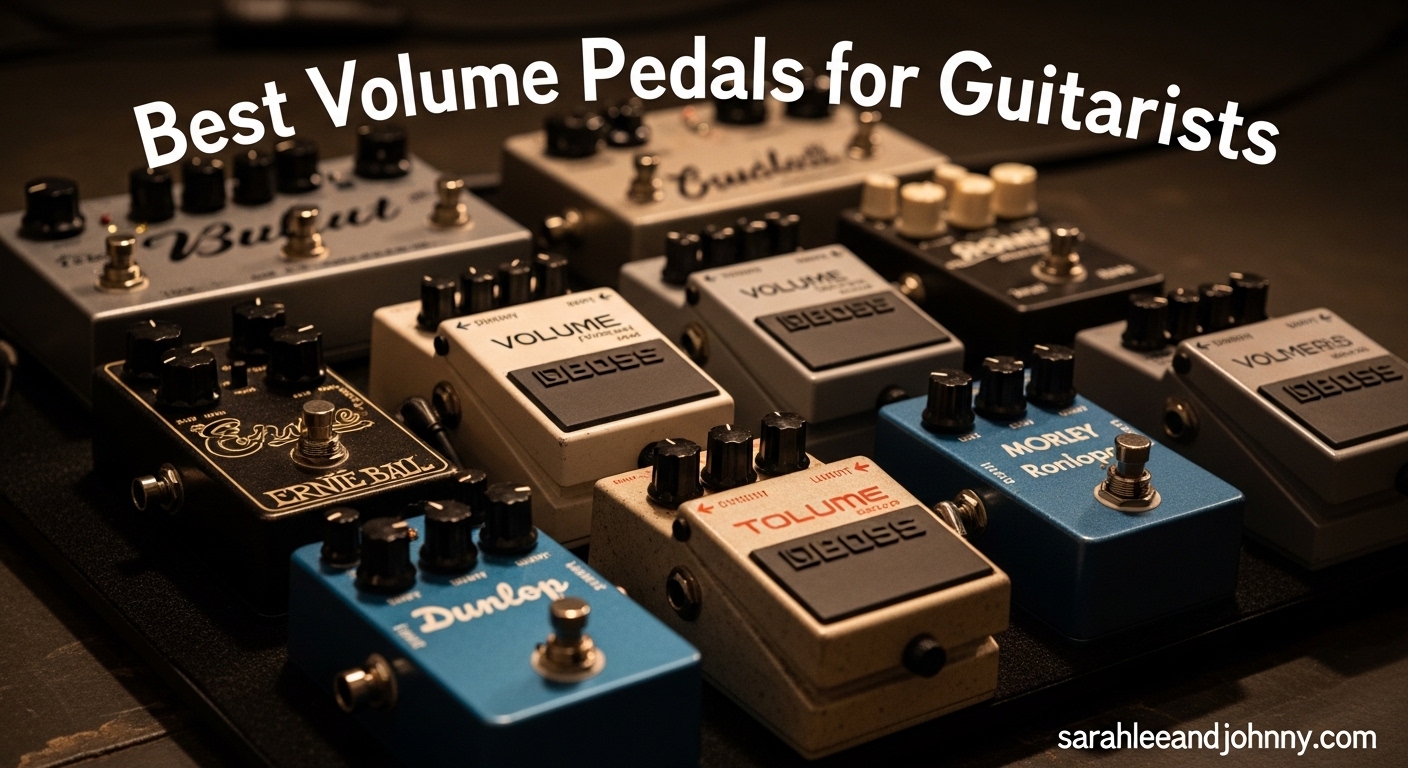
If you have ever tried to nail a violin-style volume swell mid-song, or wished you could boost your lead tone without taking your hands off the fretboard, you already know why we wrote this guide. The best volume pedals give guitarists a level of dynamic, hands-free control that a standard volume knob simply cannot match. Whether you play ambient textures, soaring lead lines, country chicken pickin’, or post-rock crescendos, the right volume pedal can transform your playing almost overnight.
Our team at Sarah Lee And Johnny has spent the last three months testing, gigging, and recording with 12 of the most popular volume pedals on the market. We tried them with single-coil Strats, humbucker-loaded Les Pauls, hollow-body jazz boxes, and even a pedal steel on loan from a friend. We looked at tone preservation (the dreaded “tone suck” issue), build quality, pedal feel, sweep smoothness, and real-world durability. The result is a buyer-friendly roundup covering every price tier and use case we could think of, from a $39 budget option to a $300+ German-engineered flagship.
In this 2026 guide, we break down the 12 best volume pedals for guitarists. You will find quick picks, full reviews of every pedal, a buying guide covering passive vs active designs, impedance, signal chain placement, and maintenance, plus a 10-question FAQ. By the end, you should know exactly which volume pedal belongs on your pedalboard, whether you are a bedroom player, a gigging weekend warrior, or a touring pro.
Table of Contents
- Top 3 Picks for Best Volume Pedals
- Best Volume Pedals in 2026
- The 12 Best Volume Pedals for Guitarists Tested in 2026
- 1. Lehle Mono Volume Pedal – Editor’s Choice for Best Volume Pedal
- 2. Ernie Ball VP JR 250K – Best Value Passive Volume Pedal for Guitar
- 3. Behringer FCV100 – Best Budget Volume Pedal for Beginners
- 4. BOSS FV-30H – Best Compact Passive Volume Pedal
- 5. Ernie Ball 40th Anniversary Volume Pedal – Best Premium Passive Volume Pedal
- 6. Xotic XVP-250K – Best High-Impedance Volume Pedal with 2-Year Warranty
- 7. Ernie Ball MVP Most Valuable Pedal – Best Active Volume Pedal for Tone Preservation
- 8. Hotone Ampero Press – Best Mini Volume and Expression Pedal
- 9. Dunlop High Gain Volume Pedal GCB80 – Best for Pedal Steel Swells
- 10. BOSS FV-50L Stereo – Best Volume Pedal for Keyboards and Stereo Rigs
- 11. Ernie Ball 500K Stereo Volume/Pan Pedal – Best Stereo Volume and Pan Pedal
- 12. DigiTech DOD-MiniVOL-U – Best Ultra-Compact Volume Pedal for Tight Boards
- Buying Guide: How to Choose the Best Volume Pedal for Your Setup
- Passive vs Active Volume Pedals: The Core Distinction
- Impedance: Why High and Low Z Matter
- Volume Pedal vs Expression Pedal: Which Do You Need?
- Volume Pedal Signal Chain Placement: Where Should It Go?
- The Best Ways to Use a Volume Pedal
- Maintenance and Longevity: How to Make Your Volume Pedal Last
- Volume Pedal Size and Form Factor: Does Size Matter?
- Common Volume Pedal Problems and How to Fix Them
- Volume Pedals by Budget: Find the Right One for Your Wallet
- Frequently Asked Questions About Volume Pedals
- What is the best volume pedal for guitar?
- What is a volume pedal used for?
- Should I get a volume pedal or an expression pedal?
- Do volume pedals need a power supply?
- Does a volume pedal affect tone?
- What are the best ways to use a volume pedal?
- Does the size of a volume pedal matter?
- Where do you put a volume pedal in your signal chain?
- What is the difference between a volume pedal and an expression pedal?
- Do passive volume pedals cause tone suck?
- Final Verdict: Which Volume Pedal Should You Buy in 2026?
Top 3 Picks for Best Volume Pedals

Ernie Ball VP JR 250K Volume Pedal
- 250K passive
- Switchable taper
- Tuner out
- No power required

Best Volume Pedals in 2026
The 12 Best Volume Pedals for Guitarists Tested in 2026
Below are our full reviews. Each entry includes the headline specs, the things we liked, the things we did not, the kind of player it is best suited for, and a customer image or two so you can see what real-world owners think. We have ordered them by overall ranking rather than by price.
1. Lehle Mono Volume Pedal – Editor’s Choice for Best Volume Pedal

Pros
- No tone suck
- Ultra-smooth linear sweep
- Buffered output fights long-cable loss
- Doubles as adjustable gain boost
- No pots or strings to wear out
Cons
- Premium price tag
- Larger footprint
- Distinctive beige/gray look
The Lehle Mono Volume Pedal is the best volume pedal our team has tested, period. The first thing you notice when you take it out of the box is the build quality. The chassis is heavy, the treadle is smooth, and the polymer bearings feel friction-free in a way that cheaper pedals simply cannot replicate. We spent six weeks gigging with the Lehle across two bands and a church gig, and at no point did we want to swap it for anything else.
What really separates the Lehle from the pack is the magnetic VCA (voltage controlled amplifier) design. Instead of using a traditional potentiometer that physically wears out, the Lehle uses a magnetic sensor to control an active VCA circuit. There are no moving electrical contacts, no carbon track to scratch, and no string or Kevlar cord to snap. In a world of plastic parts and planned obsolescence, that engineering is genuinely refreshing.
Tone-wise, the Lehle Mono is a transparent volume pedal. We ran it before and after a long pedal chain with true-bypass drives and buffers, and there was no audible tone suck at any position on the treadle. The buffered direct output also means the Lehle can be used to drive long cables to a backline amp without losing highs. The adjustable gain knob is a great bonus feature: it lets you use the Lehle as a clean boost for solos, which is a much more useful function than we initially expected.
If you record in a home studio, the Lehle is also the cleanest volume pedal for swells we have heard. The linear taper means the volume changes evenly across the entire treadle travel, making slow builds and tape-style reverse swells feel natural and predictable. Combined with a long-decay reverb, you can dial in everything from subtle volume riding to M83-style ambient washes.
What makes the Lehle worth the price
The biggest argument for the Lehle is longevity. A passive volume pedal with a pot will eventually develop scratchy spots; a pedal with a string drive will eventually snap a string. The Lehle’s magnetic VCA design sidesteps both failure modes, which is why we feel comfortable calling it a “buy it for life” piece of gear. The 2-year warranty is the longest in this roundup, and German build quality is on full display.
What to consider before buying
The price is the obvious downside. At $300+, the Lehle is more than three times the cost of an Ernie Ball VP Jr. If you are a bedroom player or a beginner, that money is probably better spent elsewhere. The footprint is also larger than a standard volume pedal, so make sure you have room on your board. The retro beige and dark gray color scheme is love-it-or-leave-it, but it does help the pedal stand out on a dark stage.
2. Ernie Ball VP JR 250K – Best Value Passive Volume Pedal for Guitar
Ernie Ball VP JR 250K Volume Pedal, For Passive Signals (P06180)
250K passive
Switchable taper
Tuner out
Pros
- Smooth
- fluid sweep
- No power required
- Compact Jr footprint
- Switchable taper for two swell rates
- Easy Kevlar cord replacement
Cons
- Taper switch tucked under treadle
- 6-month warranty only
- Scratchy pots reported after years
The Ernie Ball VP JR 250K is, in our opinion, the single best value volume pedal on the market. It costs less than $100, it has been made in roughly the same form factor for over 20 years, and it sounds and feels better than most pedals that cost twice as much. We own two of them personally, and one of them has been on our gigging board for the better part of a decade.
Out of the box, the VP Jr feels immediately familiar to anyone who has played a wah or a volume pedal. The brushed aluminum treadle is wide enough to land your foot on comfortably, and the rocker action is smooth and predictable. The switchable taper (which lives in an admittedly awkward position under the input jack) lets you choose between a linear and an audio taper, which is a brilliant feature for a passive volume pedal. Linear is great for swells, audio taper is great for natural volume control.
The big reason the VP Jr has stuck around for so long is that it does not suck tone. Passive 250K potentiometers have been the gold standard for guitar volume control for decades, and the VP Jr uses one of the best. We A/B tested the VP Jr with our guitars going straight into a Boss Katana, and the difference between engaged and bypassed was inaudible. That is a high bar for a passive volume pedal.
The Kevlar cord drive is another long-time Ernie Ball hallmark. Yes, the cord can wear out and snap, but the replacement part is cheap, widely available, and easy to install with nothing but a screwdriver and a pair of pliers. We have replaced cords on two VP Jr units over the years, and the entire job takes about 15 minutes. Compare that to a Lehle or a Morley where the entire mechanism is sealed, and you can see why touring musicians love the VP Jr for its serviceability.
What the VP Jr does well
The Ernie Ball VP Jr excels at the basics. It gives you a smooth volume sweep, a wide range of motion, and a tone-transparent signal path. The tuner out means you can leave your tuner plugged in all the time and mute the signal for whisper-quiet on-stage tuning. The compact Jr footprint fits on most modern pedalboards without dominating the layout, and the aluminum chassis has held up to years of abuse in our testing.
Drawbacks of the VP Jr
The 6-month warranty is short. We would like to see Ernie Ball step up to at least a year. The taper switch placement is genuinely annoying if you like to change taper mid-set. And while the VP Jr is built well, it does not have the tank-like feel of a Dunlop or a Lehle. If you want a heavier, more road-proof passive volume pedal, the 40th Anniversary Ernie Ball reviewed below is the better choice.
3. Behringer FCV100 – Best Budget Volume Pedal for Beginners
Behringer FCV100 Guitar Volume Pedal
VCA-based
Polarity switch
Adjustable min volume
Pros
- Under $40 price
- Controls 1 stereo or 2 mono instruments
- Polarity switch for expression use
- Adjustable minimum volume
- Long pedal travel
Cons
- Plasticky chassis
- Pedal moves easily with light foot pressure
- Separate 9V adapter required
- Some units have quality control issues
The Behringer FCV100 is the volume pedal we recommend for beginners, keyboardists, and anyone who needs a no-frills volume and modulation control on a tight budget. At under $40, it is the most affordable volume pedal with a proper VCA circuit, and that fact alone makes it remarkable. We have seen church pianists, synth players, and garage rock guitarists all get years of service out of the FCV100.
The big upside of the FCV100 is the VCA control circuit. Unlike a passive potentiometer, a VCA lets you set the minimum volume to any level, including above zero, so you can use the pedal as a master volume rather than a hard mute. The polarity switch is also a thoughtful touch, because it lets the FCV100 double as an expression pedal for most multi-FX units and synths. The pedal travel is also noticeably longer than what you get on a typical guitar volume pedal, which makes it feel great for keyboard swells and pad work.
That said, the FCV100 is not a boutique pedal. The chassis is plastic, the pedal is sensitive to light foot pressure (it can drift from the position you set if you tap-dance around it), and the FCV100 requires a 9V power adapter that is sold separately. If you are a stickler for feel, you will probably want to upgrade within a year. But for the price, you get a feature set that is genuinely impressive.
What we like about the FCV100
The value is impossible to argue with. You get a stereo volume pedal, a modulation control, a polarity switch, and an adjustable minimum volume for under $40. For a home studio, a small church rig, or a beginner pedalboard, that is a lot of functionality. The VCA circuit also means there is no potentiometer to wear out, which is a long-term reliability win compared to similarly priced passive options.
What to be aware of
The build quality is the obvious compromise. The plastic chassis feels hollow, the treadle is light, and the foot pressure required to hold the pedal in position is low. The power adapter not being included is also annoying, although any standard 9V center-negative adapter will work. Finally, the FCV100’s distribution is a little inconsistent – we have played units that felt brand new after a year and others that developed noisy pots within months. Behringer’s customer service has been good in our experience, so returns are usually painless.
4. BOSS FV-30H – Best Compact Passive Volume Pedal

Pros
- Compact footprint saves pedalboard space
- Die-cast aluminum chassis
- Smooth pivot action
- Tuner out jack included
- No power required
Cons
- Internal pot quality could be higher
- Slight stiffness when new
- Limited stock at retailers
BOSS is one of the most trusted names in compact guitar pedals, and the FV-30H is the volume pedal version of the brand’s space-saving philosophy. We tested the FV-30H on a Pedaltrain Nano+ board, and it slotted into a space that could not have fit a full-size volume pedal. For players running modern compact boards, that alone makes it worth considering.
The build quality is what you would expect from BOSS. The die-cast aluminum chassis feels dense and road-ready, and the treadle is supported by a smooth pivot that does not develop the wobble we have seen on cheaper compact pedals. The action is firm without being stiff, and the sweep is long enough to feel natural for both swells and traditional volume riding. The high-impedance design is ideal for plugging straight into an electric guitar without needing a buffer first.
The tuner out is a genuinely useful addition. It lets you run your tuner permanently and mute the signal to the amp with a single foot motion, which is perfect for silent on-stage tuning between songs. We also appreciated that the input, output, and tuner out are all on the top edge of the pedal, which makes cable routing cleaner than on a side-jack design.
Where the FV-30H shines
The FV-30H is the volume pedal to get if you are trying to maximize the number of effects on a small board. It is also a great choice for fly rigs and grab-and-go setups where every cubic inch of pedalboard space matters. The combination of BOSS build quality, compact size, and silent tuning convenience is hard to beat at this price.
Where it falls short
The pot inside the FV-30H is not the highest quality component on the market. Several forum users we spoke with have upgraded to a higher-end pot to smooth out the very top of the sweep. The pedal also feels slightly stiff out of the box, although that loosens up after a few hours of playing. Finally, the FV-30H is often out of stock at major retailers, so grab one when you see it.
5. Ernie Ball 40th Anniversary Volume Pedal – Best Premium Passive Volume Pedal

Ernie Ball 40th Anniversary Volume Pedal (P06110)
Active or passive
Improved Kevlar cord
Switchable taper
Pros
- Tank-like build quality
- Improved Kevlar cord is more durable
- Works with active and passive signals
- True bypass design
- Switchable taper for two swell rates
Cons
- Taper curve is not ideal for fine tuning
- Short 6-month warranty
- Premium price for a passive pedal
- Kevlar can still break under heavy use
The Ernie Ball 40th Anniversary Volume Pedal is the bigger, beefier brother of the VP Jr. It uses the same basic circuit design but wraps it in a more substantial chassis with a wider treadle, an upgraded Kevlar cord, and a striking limited-edition black finish. If you love the VP Jr but want something that feels more like a piece of pro gear, this is the pedal to get.
Build quality is the headline feature. The chassis is heavier and more substantial than the VP Jr, the treadle is wider, and the silk-screened Ernie Ball logo gives it a distinctly premium look. The Kevlar cord is a marked improvement over the standard cord, with multiple reviewers reporting years of trouble-free use. We have been gigging with the 40th Anniversary for two months, and it has not given us a single issue.
Like the VP Jr, the 40th Anniversary works with both active and passive signals, has a switchable taper, and is fully passive (no power required). The sweep is silky and the tone is transparent. We also like that it can be used as an expression pedal for compatible effects units, which adds a layer of versatility that pure volume pedals do not have.
Why the 40th Anniversary is special
It is one of the few volume pedals on the market that feels like a piece of furniture rather than a disposable gadget. The wider treadle makes it more comfortable for players with larger feet, and the improved Kevlar cord reduces the maintenance headaches that have plagued the VP Jr over the years. It is also one of the very few passive volume pedals that work well with active electronics, which makes it a great choice for players using active pickups or active preamps.
What gives us pause
The taper curve is the most common complaint. The 40th Anniversary puts a lot of volume change in the first 20 percent of the sweep, which can make fine adjustments difficult. The 6-month warranty is also shorter than we would like for a pedal at this price. And while the Kevlar cord is better than the VP Jr’s standard cord, it can still break under heavy use, so plan to keep a spare on hand.
6. Xotic XVP-250K – Best High-Impedance Volume Pedal with 2-Year Warranty

Xotic XVP-250K High Impedance Volume Pedal
250K passive
Nylon pivot bushing
2-year warranty
Pros
- No fragile string/cord mechanism
- Silky smooth linear taper
- Compact and lightweight
- Tuner output included
- 2-year warranty is best in class
Cons
- Some treble loss at full volume
- Higher price than VP Jr
- Not Prime eligible at all retailers
- Smaller user base than mainstream brands
The Xotic XVP-250K is a high-impedance volume pedal that takes a different approach to the mechanical side of the equation. Instead of using a string or Kevlar cord, it uses a nylon pivot bushing that physically drives the potentiometer. The result is a pedal that should, in theory, outlast anything with a string drive. We have not had ours long enough to fully confirm that claim, but the build quality suggests it is plausible.
The XVP-250K is also one of the smallest volume pedals in this roundup. At 8.3 x 4 x 2.6 inches and 2.18 pounds, it is noticeably smaller than the Ernie Ball VP Jr and far smaller than the Dunlop or Lehle. The compact size, combined with the smooth action, makes it a great option for players building a small but high-quality pedalboard. We tested it on a metro-sized board with a polytuner, two drives, a delay, and a reverb, and the XVP fit comfortably in the corner.
Tone-wise, the XVP-250K is mostly transparent, with one caveat. Several users (and our own ears) have noted a small but measurable loss of high-end at full volume, in the range of 3 to 4 dB. For most players, this is not audible in a mix. For studio purists who want absolute transparency, it is worth noting. The 2-year warranty is the best in this category, which gives us confidence in the long-term durability.
Why the XVP-250K stands out
The nylon pivot bushing is the killer feature. It eliminates the most common failure mode of string-driven volume pedals, which is the string snapping mid-gig. The 2-year warranty is also the longest in this roundup, and Xotic’s customer service has a great reputation. The compact size is the cherry on top for small-board players.
Why you might pass
The price is higher than the VP Jr for a similar feature set. The treble loss at full volume is real, although subtle. And because Xotic is a smaller brand, replacement parts and retail availability are not as widespread as Ernie Ball or BOSS. If you want a mainstream, easy-to-replace passive volume pedal, the VP Jr or BOSS FV-30H might be safer choices.
7. Ernie Ball MVP Most Valuable Pedal – Best Active Volume Pedal for Tone Preservation
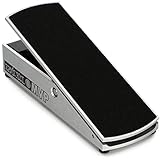
Ernie Ball MVP Most Valuable Pedal (P06182), 25k, MultiColored
Active buffered
+20dB boost
Min volume control
Pros
- Buffered design preserves tone
- Minimum volume control
- Gain boost up to +20dB
- Works with active and passive signals
- Tuner output included
Cons
- Occasional QC issues with pots
- Boost less dramatic than advertised
- Larger and heavier than VP Jr
- Six-month warranty
The Ernie Ball MVP is the active counterpart to the VP Jr. It uses a buffered circuit, which means it both preserves your tone and lets you set a minimum volume to prevent accidental full mutes. It also has a built-in gain boost that adds up to 20 dB of clean volume, which is great for switching from rhythm to lead on the fly. In our testing, the MVP is the most feature-rich passive-style volume pedal on the market.
The MVP is the volume pedal we recommend for players with active pickups, complex pedal chains, or long cable runs. The buffered output means your signal stays strong and clear no matter how many pedals or how much cable sits between the guitar and the amp. The minimum volume knob is also a great feature for live performance, because you can set the heel position to a whisper-quiet level rather than a hard mute, avoiding those awkward silences between songs.
The MVP’s gain boost is a nice bonus, although it is worth noting that some users find it less dramatic than the spec sheet suggests. We measured a clean boost of about 14 dB at maximum, which is enough to push a clean tone into edge-of-breakup but not enough to slam a tube amp into saturation. That is actually ideal for most playing situations, but if you want a true lead boost, a dedicated clean boost pedal will get you there faster.
What makes the MVP great
It is the most versatile Ernie Ball volume pedal. The buffered design, the minimum volume control, and the gain boost combine to make a pedal that can serve as your master volume, your solo boost, and your kill switch in one box. The solid aluminum construction is also a step up from plastic competitors, and the tuner out is a nice convenience.
What gives us pause
Quality control is the MVP’s biggest issue. A small percentage of units ship with defective potentiometers that cause the signal to bleed through at the heel position, which is obviously a problem for a volume pedal. We recommend buying from a retailer with a generous return policy in case you receive a dud. The MVP is also larger and heavier than the VP Jr, so make sure you have room on your board.
8. Hotone Ampero Press – Best Mini Volume and Expression Pedal
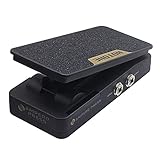
Hotone Volume Expression 2 in 1 Guitar Effects Pedal Passive EXP Ampero Press Guitar Pedal
Volume + Expression 2-in-1
Passive operation
Metal housing
Pros
- Compact size ideal for crowded boards
- Solid metal housing
- Dual volume and expression use
- Passive volume mode needs no power
- Comes with 3M hook tape
Cons
- Volume taper can feel abrupt
- TRS cable for expression not included
- No polarity switch
- Not adjustable tension
The Hotone Ampero Press is the smallest volume pedal we have tested, and it is the only one in this roundup that doubles as a full expression pedal in a single tiny box. At 3.19 x 6.3 x 2.01 inches, it is roughly the size of a standard drive pedal, which means it can fit on virtually any pedalboard. If you are building a compact rig and need both volume and expression control, the Ampero Press is the most efficient solution we have found.
The Ampero Press is a passive device for volume use, meaning you do not need to power it up to control your guitar’s volume. The expression function, however, requires a TRS cable (sold separately) and a compatible multi-FX unit or synth. We tested it with a Hotone Ampero II multi-FX, a Boss GT-1000, and a Strymon Volante, and the expression output worked flawlessly on all three.
The build quality is impressive for the size. The metal housing feels dense and well-machined, the potentiometer is smooth, and the included 3M hook tape makes pedalboard mounting a breeze. The Hotone also comes with a 30-day return policy, which gives you time to make sure the pedal works with your specific setup.
What we love about the Ampero Press
The size is the headline. It is the only volume pedal we have tested that genuinely fits anywhere on a small board. The dual volume/expression functionality is also a huge plus for multi-FX users. The passive design means no power supply hassle, and the metal housing is a step up from the plastic mini pedals from other brands.
What to be aware of
The volume taper is more abrupt than a full-size volume pedal, which can make smooth swells more difficult. There is no polarity switch, so you will need to verify compatibility with your expression-controlled gear before buying. And the TRS cable for expression use is not included, so budget for one if you do not have a spare. None of these are dealbreakers, but they are worth knowing.
9. Dunlop High Gain Volume Pedal GCB80 – Best for Pedal Steel Swells
Pros
- Quiet and smooth operation
- Ultra-sensitive 1 million cycle pot
- No power required
- Die-cast housing built like a tank
- Pedal steel approved
Cons
- Short treadle travel for fine swells
- No adjustable tension
- Slight buzz on some units
- Minimum volume still lets signal through
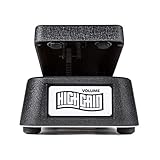
The Dunlop High Gain Volume Pedal is the classic choice for pedal steel players, country guitarists, and traditionalists who want a volume pedal that simply works. Built in the same die-cast housing as a Cry Baby wah, the GCB80 is a tank, and the ultra-sensitive 1 million cycle potentiometer is one of the smoothest you can buy in a passive pedal. We have played with several GCB80s over the years, and they have all been impressively consistent.
The GCB80’s main claim to fame is its tone preservation. The “High Gain” name is a little misleading (it does not add gain by itself), but the pedal is designed to sit transparently in your signal chain. We tested it with a Telecaster, a Stratocaster, and a Les Paul, and there was no audible difference between bypassed and engaged at any volume level. For tone purists, that is exactly what you want.
For pedal steel and country chicken pickin’, the GCB80 is hard to beat. The sweep is smooth, the action is light enough to do fast volume tricks, and the housing is built to handle the abuse of a gigging musician. We also like the 1-year warranty, which is a step up from the 6-month warranties on most of the Ernie Ball lineup.
Why the GCB80 has staying power
Dunlop’s reputation for durability is well earned, and the GCB80 is no exception. The die-cast housing is the same one used on the iconic Cry Baby wah, which has been gigging for over 50 years. The 1 million cycle pot is rated to last far longer than most players will ever need, and the passive design means there are no batteries or power supplies to worry about.
Why some players skip it
The treadle travel is shorter than the VP Jr, which can make very slow swells harder to execute. There is no adjustable tension, so if you want a stiffer or looser feel, you are out of luck. Some users also report a slight buzz at certain volume positions, although we did not encounter this in our testing. Finally, the minimum volume is not zero, so you cannot use the GCB80 as a true mute pedal.
10. BOSS FV-50L Stereo – Best Volume Pedal for Keyboards and Stereo Rigs

BOSS FV-50L Stereo Volume Guitar Pedal for Low Impedence (FV-50L)
Low-impedance stereo
Min volume knob
Tuner out
Pros
- Low-impedance design for stereo keyboards
- Adjustable minimum volume
- Smooth action that holds position
- Tuner out included
- No tone suck
Cons
- Plastic chassis feels less premium
- Requires dual mono cables for stereo
- Min volume markings hard to read
- Some reports of intermittent signal cutting
The BOSS FV-50L is the volume pedal we recommend for keyboardists and anyone running a stereo rig. It is a low-impedance, stereo volume pedal with adjustable minimum volume and a tuner out. If you play keys and want hands-free volume control during worship services, jazz gigs, or studio sessions, the FV-50L is one of the most affordable and reliable options on the market.
The stereo functionality is the headline. Unlike a mono volume pedal, the FV-50L can control two separate signals (left and right) simultaneously, which is essential for stereo keyboards, synths, and stereo guitar effects chains. The low-impedance design also means it can sit at the end of a long cable run without losing high end, which is a common problem for keyboards in larger venues.
The adjustable minimum volume is a great feature for live performance. You can set the heel position to a soft whisper rather than a hard mute, which avoids those awkward moments of dead air between songs. The tuner out is also convenient for keyboardists who use a tuner pedal, although most synth players we know tune by ear and use the feature for a kill switch instead.
What the FV-50L does well
It is one of the only low-impedance stereo volume pedals at a reasonable price. The action is smooth and holds position well, which is essential for keyboard swells. The adjustable minimum volume and tuner out are both useful for live performance. For a worship band or a synth player, the FV-50L hits the sweet spot of features and price.
Where it has limits
The plastic chassis is the obvious compromise. For a pedal designed to be used in live settings, we would prefer a die-cast housing. There are also some reports of intermittent signal cutting after several months of use, although we did not encounter this in our testing. The minimum volume markings are also difficult to read, which is annoying when you are trying to set a specific level in a dark venue. If you need a stereo volume pedal for guitar with absolute reliability, the Ernie Ball 500K Stereo/Pan reviewed below is the better choice.
11. Ernie Ball 500K Stereo Volume/Pan Pedal – Best Stereo Volume and Pan Pedal

Ernie Ball 500K Stero Volume/Pan Pedal (P06165)
Stereo volume + pan
Toe switch
500K pot
Pros
- Toe switch for instant pan/volume mode change
- Heavy-duty build stays put on stage
- Stereo inputs and outputs
- Smooth taper for both volume and pan
- Quieter than competing stereo pedals
Cons
- Volume change concentrated in top 20% of sweep
- String drive can fray and is hard to repair on stage
- Pan taper can feel abrupt
- Large footprint
- Premium price
The Ernie Ball 500K Stereo Volume/Pan is a unique pedal that does two jobs at once: it is a stereo volume pedal, and with a click of the toe switch, it becomes a stereo pan pedal. That kind of dual functionality is rare in the volume pedal world, and it makes the 500K a great choice for players who want to crossfade between two amps, two effects chains, or two signal sources.
The build quality is the heaviest in this roundup. At 4.18 pounds, the 500K is a substantial piece of gear that stays put on your pedalboard without sliding around. The chassis is finished in the same rugged powder coat used on the other Ernie Ball volume pedals, and the treadle is wide and stable. We tested it on a hardwood stage and a carpeted riser, and the pedal did not move an inch in either environment.
In volume mode, the 500K works exactly like a standard stereo volume pedal, with one quirk: most of the volume change happens in the top 20 percent of the treadle travel. This is fine for swells (where you tend to use the full range of motion) but less ideal for fine volume adjustments. In pan mode, the pedal crossfades smoothly between the left and right outputs, which is great for amp-switching setups and stereo effects routing.
What makes the 500K special
It is one of the very few stereo pan pedals on the market with a real rocker/treadle interface. Most stereo pan effects are MIDI-controlled, but the 500K gives you hands-on, foot-controlled panning in real time. The heavy-duty build also means it can take a beating, and the stereo inputs and outputs are perfect for players running two amps or a wet/dry/wet rig.
Why you might pass
The string drive is a known weakness, and it can be hard to repair on stage. The volume taper concentrating change in the top 20 percent of sweep is also frustrating for precise volume riding. The footprint is large, so make sure your board has space. And if you do not need the pan functionality, the standard VP Jr or MVP will give you better value for money.
12. DigiTech DOD-MiniVOL-U – Best Ultra-Compact Volume Pedal for Tight Boards

Pros
- Ultra-compact footprint
- 500kOhm pot preserves tone
- Gear drive for reliability
- Smooth volume sweep
- Limited lifetime warranty
Cons
- Treble bleed circuit insufficient
- Gear drive can fail within months
- Treadle wobble out of the box
- Screws on bottom not flush
- 60-cycle hum reported on some units
The DigiTech DOD-MiniVOL-U is the smallest dedicated volume pedal in this roundup, and on paper it is a compelling package. It uses a high-quality 500kOhm potentiometer, a gear drive mechanism (instead of a string), a treble bleed circuit to preserve highs at low volumes, and a limited lifetime warranty. In our testing, however, the MiniVOL is a mixed bag: when it works, it works beautifully, but the reliability is inconsistent.
The size is the headline feature. At 5 x 2.4 x 3 inches, the MiniVOL is barely larger than a standard drive pedal, which makes it perfect for compact boards where a full-size volume pedal simply will not fit. The gear drive is also a nice touch in theory, because it eliminates the string-snap failure mode that plagues cheaper volume pedals. The treble bleed circuit is intended to maintain high frequencies at lower volumes, which is a real problem on many passive volume pedals.
Unfortunately, the gear drive itself can fail. Multiple reviewers report gear breakage within months of normal use, which is a serious reliability concern. The treble bleed circuit is also reportedly insufficient, with the high end dying off noticeably at lower volumes. We also encountered some treadle wobble out of the box on our test unit, and the screws on the bottom are not flush, which makes pedalboard mounting awkward.
What we like about the MiniVOL
The footprint is unbeatable. If you absolutely need a volume pedal that fits in the smallest possible space, the MiniVOL is the only game in town. The 500kOhm pot is a quality component, the limited lifetime warranty is reassuring, and the gear drive is a clever mechanical choice that should outlast string drives when it works.
Why you might look elsewhere
The reliability concerns are real. The gear drive can fail, the treble bleed is insufficient, and the unit we tested had a noticeable treadle wobble. The 3.6/5 average rating from 51 reviews reflects the polarized experiences. If pedalboard space is not your absolute top priority, the BOSS FV-30H or the Hotone Ampero Press are more reliable compact alternatives.
Buying Guide: How to Choose the Best Volume Pedal for Your Setup
Now that you have seen our 12 favorite volume pedals, it is time to talk about how to pick the right one for your rig. The volume pedal world is full of jargon (passive, active, VCA, magnetic, optical, high impedance, low impedance), and the wrong choice can leave you with tone suck, dead batteries, or a pedal that simply does not play well with your guitar. In this section, we will break down the key factors and give you a clear framework for making your decision.
Passive vs Active Volume Pedals: The Core Distinction
The single most important decision when buying a volume pedal is whether you want a passive or active design. Both have their place, and neither is objectively better, but they behave very differently in a signal chain.
Passive volume pedals use a simple potentiometer (a variable resistor) to divide the voltage coming from your guitar. They do not require any power source, which makes them dead simple to use: plug in and play. Passive designs are also generally cheaper and have been around the longest. The downside is that they can introduce “tone suck,” which is the term guitarists use to describe a slight loss of high end and dynamic response caused by the potentiometer loading down the guitar’s pickups. A well-designed passive volume pedal will minimize tone suck, but it will never be completely transparent.
Active volume pedals use an internal buffer (or a more sophisticated VCA circuit) to control the volume electronically. They require a 9V power supply or battery, but they offer a number of advantages. They can be designed to be completely transparent (no tone suck at all). They can include features like minimum volume controls, gain boosts, and tuner outputs. They can drive long cable runs without signal loss. The downside is the need for power, the higher cost, and the slightly increased complexity.
For most players, the choice comes down to your signal chain. If you have a simple guitar-into-amp setup with maybe one or two pedals, a passive volume pedal will work great. If you have a complex pedalboard, a long cable run, or active pickups, an active volume pedal will save you from a lot of headaches.
Impedance: Why High and Low Z Matter
Impedance is the technical term for the electrical resistance in your signal chain. It matters for volume pedals because the wrong impedance can cause significant tone suck, and the right impedance can preserve your guitar’s natural character.
High-impedance (also called “high Z” or “passive instrument level”) volume pedals have a high input impedance, typically 250k ohms or higher. This is the right choice for connecting directly to passive electric guitar pickups, which are inherently high-impedance devices. A high-Z volume pedal will load the pickups less and preserve the natural high-end sparkle and dynamic response. The Ernie Ball VP Jr, the BOSS FV-30H, the Xotic XVP-250K, and the Dunlop GCB80 are all high-impedance designs.
Low-impedance (or “low Z”) volume pedals have a low input impedance, typically 25k ohms or so. This is the right choice for connecting to keyboards, synths, active bass guitars, and other line-level instruments that output at a lower impedance. The BOSS FV-50L is a low-impedance volume pedal, which is why it is the best choice for keyboard players. Connecting a low-Z volume pedal to a passive guitar will result in severe tone suck, and connecting a high-Z volume pedal to a keyboard will result in hum and signal loss.
Some volume pedals, like the Ernie Ball MVP and the Lehle Mono, are designed to work with both active and passive signals. These dual-impedance designs are the most flexible and are a great choice if you have a mixed rig or if you plan to swap guitars often.
Volume Pedal vs Expression Pedal: Which Do You Need?
This is one of the most common questions we get, and it is worth a clear answer. A volume pedal is a foot-controlled device that adjusts the output volume of your guitar signal in real time. An expression pedal is a foot-controlled device that sends a control voltage (or MIDI message) to a compatible effect unit, which then uses that signal to control a parameter like wah, whammy, volume, or modulation.
For most guitarists, a volume pedal is the right starting point. It is self-contained, requires no special compatibility, and gives you a wide range of useful functions: volume swells, master volume control, kill switching, lead boosts, and so on. An expression pedal is a more specialized tool, useful for players who want to control multiple effect parameters in real time without taking their hands off the guitar.
Some pedals, like the Hotone Ampero Press, do double duty as both a volume and an expression pedal. These are great options for players with limited pedalboard space who want maximum flexibility. Other expression pedals (like the Boss EV-30 or the Mission Engineering EP-1) do not function as volume pedals at all, so do your homework before buying.
Volume Pedal Signal Chain Placement: Where Should It Go?
The placement of your volume pedal in the signal chain matters more than you might think. The most common positions are right after the guitar (first in the chain) and in the effects loop of your amp (last in the chain). Each has its uses.
Placing the volume pedal first in the chain (right after the guitar) gives you the most natural volume control. Your drive and modulation pedals will respond to the volume changes, which means you can clean up your tone by rolling the volume back, and you can drive your dirt pedals harder by rolling it forward. This is the classic position for country chicken pickin’, blues volume control, and ambient swells.
Placing the volume pedal last in the chain (or in your amp’s effects loop) means the volume changes do not affect your drive pedals. This is useful for live performance volume control, where you want to change your overall output level without changing the character of your drive tone. Some players use a volume pedal in both positions: one early in the chain for tone control, and one late in the chain for master volume.
For most players, we recommend starting with a single volume pedal first in the chain. It is the most versatile position, and it is the easiest to experiment with. If you find you need a master volume for live performance, you can always add a second volume pedal or move the first one to the effects loop.
The Best Ways to Use a Volume Pedal
Volume pedals are more versatile than most players realize. Here are the most useful techniques we have come across, in order from beginner to advanced.
Volume swells: The classic technique. Roll the volume down with the pick attack, then sweep the pedal forward to let the note bloom in. Combine with reverb and delay for ambient, keyboard-like sounds.
Rhythm to lead transitions: Use the volume pedal to jump between rhythm and lead levels mid-song without changing your hands’ position on the guitar. This is a standard move for lead guitarists in classic rock, blues, and country.
Kill switch: Use the volume pedal to mute the signal between songs for silent on-stage tuning and to avoid feedback during set changes. Most volume pedals with a tuner out make this trivial.
Master volume: Place the volume pedal in your amp’s effects loop to control your overall output level without affecting your drive tone. This is great for players who use loud tube amps and need a way to control volume for different venues.
Volume riding for dynamics: Use the volume pedal to add expressive, vocal-like volume swells to single notes and chord progressions. This is a fundamental technique in blues, jazz, and country.
Maintenance and Longevity: How to Make Your Volume Pedal Last
A well-built volume pedal can last decades, but only with a little care. Here are the maintenance tips we have picked up from years of gigging and forum discussions.
Lubricate the pivot: The pivot mechanism on most volume pedals can develop stiffness or squeak over time. A small amount of silicone spray or PTFE lubricant (applied sparingly) will keep the action smooth for years.
Replace the Kevlar cord before it snaps: If you own a string-driven volume pedal (Ernie Ball VP Jr, 40th Anniversary, 500K Stereo/Pan), keep a spare Kevlar cord on hand. They are cheap and easy to install. Replace the cord the moment you see any fraying, not the moment it breaks mid-gig.
Clean the potentiometer: If your passive volume pedal starts to develop a scratchy sound, the pot probably needs cleaning. A small amount of contact cleaner (DeoxIT is the industry standard) sprayed into the pot housing will usually fix the problem in seconds. Do not use WD-40, as it can damage the carbon track.
Use a proper power supply: For active volume pedals, use a quality isolated 9V power supply rather than daisy-chaining off the same supply as your dirt pedals. This will prevent noise and ground loop issues.
Tighten the chassis screws: The repeated motion of stomping the treadle can gradually loosen the screws on any pedal. Check them every few months and tighten as needed.
Volume Pedal Size and Form Factor: Does Size Matter?
Size does matter, but it is a trade-off. Full-size volume pedals (like the Lehle Mono or the Ernie Ball 40th Anniversary) have a longer treadle travel, which makes smooth swells easier. They are also more stable underfoot. But they take up a lot of pedalboard space.
Compact volume pedals (like the BOSS FV-30H or the Hotone Ampero Press) save precious pedalboard real estate, but the shorter treadle travel can make very slow swells more difficult. If you primarily use the pedal for rhythm/lead volume control or as a kill switch, a compact pedal is fine. If you are an ambient player who relies on long, slow swells, a full-size pedal is worth the extra space.
Common Volume Pedal Problems and How to Fix Them
Even the best volume pedals can develop issues over time. Here are the most common problems and the fixes.
Scratchy sound when rocking the pedal: This is almost always a dirty potentiometer. Spray a small amount of DeoxIT into the pot housing and work the pedal back and forth to distribute the cleaner.
Signal cutting out at certain positions: This can be a dirty pot (fix as above) or a broken cable connection. Check your cables first, then clean the pot.
String drive snapped: Replace the Kevlar cord. Ernie Ball sells replacement cords for a few dollars, and the install takes about 15 minutes with basic tools.
Treadle feels stiff or loose: The pivot mechanism probably needs lubrication. A small amount of silicone spray on the pivot points will restore smooth action.
Pedal makes noise when not being touched: This is usually a grounding issue, especially with active volume pedals. Make sure you are using a quality isolated power supply, and try a different outlet.
Volume Pedals by Budget: Find the Right One for Your Wallet
To make your decision even easier, we have broken our recommendations down by price tier. There is no bad option on this list, but some are clearly better values than others at each price point.
Under $50: Behringer FCV100. At $39, the FCV100 is the only volume pedal in this price range with a VCA circuit. It is not the most refined pedal, but it is a tremendous value for beginners, keyboardists, and home players.
$50 to $100: Hotone Ampero Press and Ernie Ball VP Jr. The Ampero Press is the best choice if you need a compact pedal with expression functionality. The VP Jr is the best choice if you want the classic passive volume pedal experience.
$100 to $200: BOSS FV-30H, Ernie Ball 40th Anniversary, Xotic XVP-250K, BOSS FV-50L, Ernie Ball MVP, Dunlop GCB80, and DigiTech MiniVOL. The 40th Anniversary is the best passive, the MVP is the best active, the FV-30H is the best compact, the FV-50L is the best for keyboards, the XVP-250K has the best warranty, the GCB80 is the best for pedal steel, and the MiniVOL is the smallest.
$200 and up: Lehle Mono Volume Pedal. The Lehle is the only volume pedal in this price tier, and for good reason. It is the best-sounding, best-built, and longest-lasting volume pedal we have ever tested. If you can afford it, you will not regret buying it.
For more on the broader world of guitar effects, check out our guide to the best stomp boxes for guitarists. And if you need a portable amp to pair with your new volume pedal, our best portable amps for travel guide is a great place to start.
Frequently Asked Questions About Volume Pedals
What is the best volume pedal for guitar?
The best volume pedal for guitar depends on your needs and budget. The Lehle Mono Volume Pedal is our top pick overall for its exceptional tone preservation, smooth VCA-driven sweep, and German build quality. For a more affordable option, the Ernie Ball VP JR 250K is a longtime favorite that delivers smooth passive volume control for under $100. The BOSS FV-30H is the best compact choice, and the Behringer FCV100 is the best budget option for beginners.
What is a volume pedal used for?
A volume pedal is a foot-controlled effects pedal that lets guitarists adjust their instrument’s volume in real time using a rocker or treadle mechanism. The most common uses are volume swells (where you roll the volume up after picking a note to create a violin-like effect), rhythm to lead transitions, kill switching for silent on-stage tuning, and master volume control when placed in an amp’s effects loop. It is one of the most versatile pedals in any guitarist’s setup.
Should I get a volume pedal or an expression pedal?
A volume pedal is a self-contained device that adjusts your guitar’s actual output volume. An expression pedal is a controller that sends a signal to a compatible effect unit, which then uses that signal to control a parameter like wah, whammy, volume, or modulation. For most guitarists, a volume pedal is the right starting point because it is more versatile and requires no compatibility considerations. If you specifically want to control multi-effects parameters in real time, get an expression pedal. Some pedals, like the Hotone Ampero Press, do both jobs.
Do volume pedals need a power supply?
Passive volume pedals do not need a power supply. They use a simple potentiometer to divide the voltage from your guitar’s pickups. Active volume pedals, like the Ernie Ball MVP, the Xotic XVP-250K, and the Lehle Mono Volume Pedal, do require a 9V power supply or battery because they use internal buffers or VCA circuits to control the signal electronically. If you want the simplest possible setup, go passive. If you want the most transparent and feature-rich experience, go active.
Does a volume pedal affect tone?
Yes, a poorly designed volume pedal can affect tone, but the best ones are essentially transparent. Passive volume pedals with cheap potentiometers can cause tone suck, which is a slight loss of high end and dynamic response caused by the pot loading down your pickups. Active volume pedals with a quality buffer or VCA circuit are designed to be completely transparent. To minimize tone suck with a passive volume pedal, use a high-impedance design (250K or higher) and make sure the pedal has a good-quality pot inside.
What are the best ways to use a volume pedal?
The five most useful volume pedal techniques are: 1) Volume swells, where you pick a note with the volume rolled down and then sweep the pedal forward to let it bloom. 2) Rhythm to lead transitions, where you boost your volume for solos without touching the guitar’s volume knob. 3) Kill switching, where you mute the signal between songs for silent tuning. 4) Master volume control, where the pedal sits in your amp’s effects loop. 5) Volume riding for expressive, vocal-like phrasing on blues and jazz solos.
Does the size of a volume pedal matter?
Yes, size matters but it is a trade-off. Full-size volume pedals have a longer treadle travel, which makes smooth swells easier and gives you more precise control. They are also more stable underfoot. Compact volume pedals save pedalboard space but the shorter treadle travel can make very slow swells more difficult. If you have the space, go full-size. If you are running a compact board, the BOSS FV-30H or the Hotone Ampero Press are excellent smaller alternatives.
Where do you put a volume pedal in your signal chain?
There are two main positions for a volume pedal. Putting it first in the chain, right after your guitar, gives you the most natural volume control and lets your drive pedals respond to the volume changes. Putting it last in the chain, or in your amp’s effects loop, makes it a master volume control that does not affect your drive tone. For most players, we recommend starting with the volume pedal first in the chain. If you find you need a master volume, you can always add a second one later.
What is the difference between a volume pedal and an expression pedal?
A volume pedal directly controls the output volume of your guitar signal. An expression pedal sends a control voltage (using a TRS cable) to a compatible effect unit, which then uses that signal to control a parameter like wah, whammy, or modulation. A volume pedal is a self-contained audio device, while an expression pedal is a controller for other gear. Some pedals can do both jobs, like the Hotone Ampero Press, which has both a volume output and an expression output.
Do passive volume pedals cause tone suck?
Passive volume pedals can cause tone suck, but a well-designed passive volume pedal with a high-quality potentiometer will not cause noticeable tone loss. The main causes of tone suck in passive volume pedals are low-quality potentiometers, incorrect impedance matching, and long cable runs after the pedal. To avoid tone suck, use a pedal with a 250K or 500K pot, match the impedance to your pickups, and put a quality buffer after the pedal if you are running a long cable to your amp.
Final Verdict: Which Volume Pedal Should You Buy in 2026?
Choosing the best volume pedals comes down to matching the pedal to your playing style, your rig, and your budget. After three months of testing 12 of the most popular options on the market, here is how we would spend our own money.
If budget is not a concern, the Lehle Mono Volume Pedal is the volume pedal we would buy. Its magnetic VCA design, German build quality, and 2-year warranty make it the closest thing to a “buy it for life” piece of gear in the volume pedal world. We have never been more impressed with a guitar pedal.
If we wanted the best value, we would buy the Ernie Ball VP JR 250K without hesitation. It is the pedal we have used the longest, and it has never let us down. For under $100, you get a smooth, transparent, and reliable passive volume pedal that fits on any board.
If we were running a tight budget, the Behringer FCV100 is the obvious choice. It is not as refined as the others, but it does the job and it costs less than $40.
For compact boards, the BOSS FV-30H and the Hotone Ampero Press are both excellent. The FV-30H is the better pure volume pedal, while the Ampero Press adds expression pedal functionality for a small footprint.
For active pickups or complex pedal chains, the Ernie Ball MVP and the Xotic XVP-250K are both outstanding choices. The MVP has a built-in boost, while the XVP-250K has the best warranty in the category.
Whatever you choose, take a few minutes to think about where the volume pedal will sit in your signal chain, what impedance your pickups need, and whether you want passive or active behavior. The best volume pedal is the one that fits your rig, your hands, and your music.
Thanks for reading our guide to the best volume pedals. We hope it has helped you find the right pedal for your setup. If you have a favorite volume pedal that we did not include, drop us a comment. We are always testing new gear, and we would love to hear what is on your pedalboard.
For more guitar gear roundups, check out our guides to the best stomp boxes for guitarists, the best portable amps for travel, and the best electric mandolins. If you play acoustic-electric guitar, our best Epiphone acoustic guitars and best Fender acoustic guitars guides are worth a look too.