
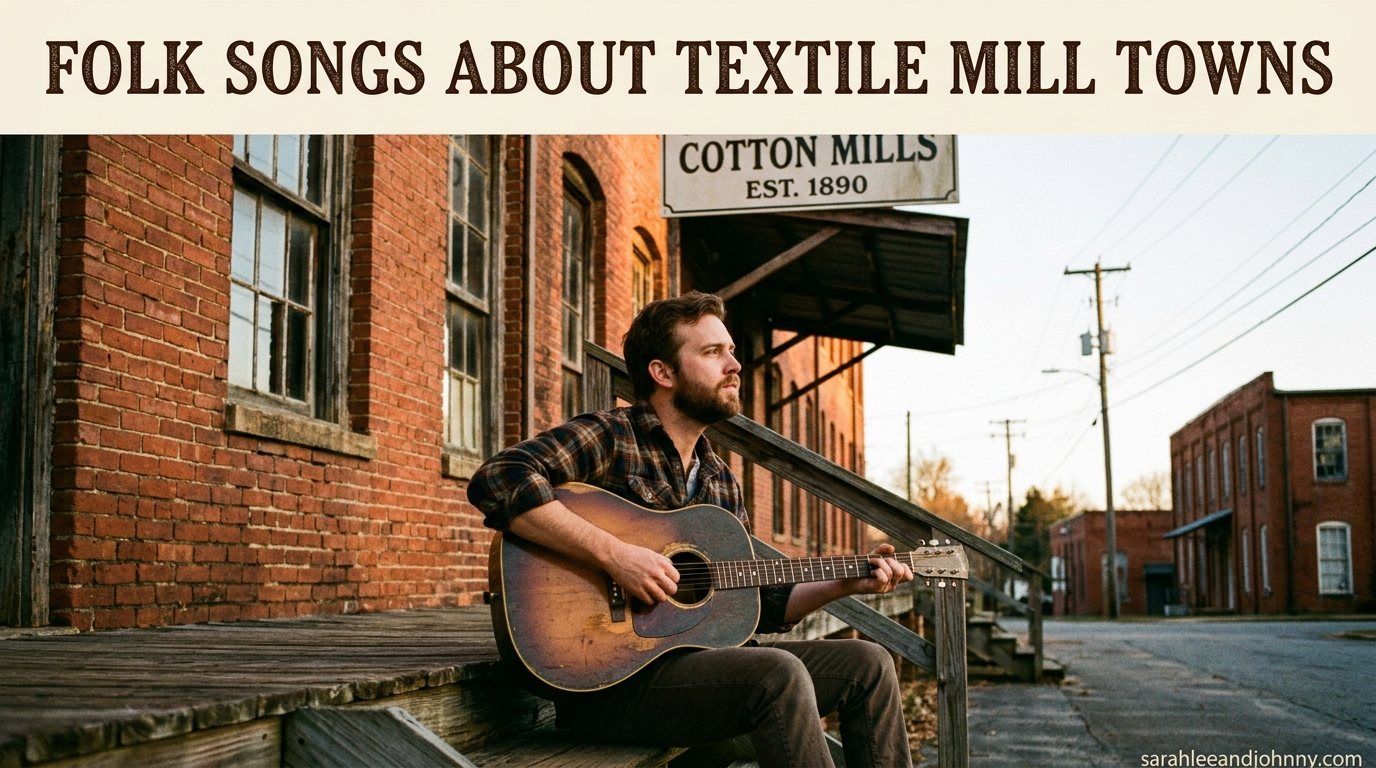
There is a rhythm to the textile mill that shaped American folk music in ways most people never consider. The relentless clatter of the shuttle, the hum of spinning frames, the thud of bobbins against the floorboards — these sounds became the backbeat for generations of working-class songs. Folk songs about textile mill towns emerged from the factories and mill villages of the American South, New England, and beyond, carrying the stories of workers who labored long hours for little pay. These ballads document the struggles, heartbreak, and defiance of the people who kept the looms running from the late 1800s through the mid-1900s.
I have spent years studying these songs, tracking down archival recordings from the Library of Congress and the Smithsonian, and what strikes me most is their raw emotional honesty. These are not polished compositions written for concert halls. They are working-class testimony set to simple melodies — songs born on factory floors, in cramped boarding houses, and on picket lines. They tell us about company stores that kept families in perpetual debt, about children who grew up tending machines instead of attending school, and about communities that fought back when conditions became unbearable.
In this guide, I will walk you through the most important folk songs about textile mill towns, the historical context that gave rise to them, the songwriters who gave voice to the movement, and the regional variations that make this tradition so rich. Whether you are a folk music enthusiast, a student of labor history, or simply someone who wants to understand what life was really like in a company town, these songs open a window into a world that shaped modern America.
Table of Contents
The Historical Context of Textile Mill Towns
Textile mills transformed the American landscape throughout the 19th and early 20th centuries. What began in New England with the famous mills of Lowell and Lawrence eventually shifted southward, drawing hundreds of thousands of workers — many of them displaced farmers — into company-owned villages scattered across the Piedmont region of the Carolinas, Georgia, and Alabama. These mill towns were often self-contained worlds. The company owned the houses workers lived in, the stores where they bought food and clothing, and sometimes even the churches where they worshipped.
Conditions inside the mills were harsh by any standard. Workers — including children as young as ten — typically spent 10 to 12 hours a day standing at their machines in rooms thick with cotton dust and deafening noise. The “stretch-out” system, introduced in the 1920s, forced weavers to tend more and more looms at once without any increase in pay. A worker who had previously managed 12 looms might suddenly be expected to run 24, then 36. The speed-up was relentless, and the physical toll was enormous.
Pay came in the form of company scrip rather than real currency, keeping workers tethered to the company store where prices were marked up well beyond what anyone might pay in a regular town. Debt was not an accident of this system; it was the design. Families who fell behind on rent or store credit had nowhere else to go, and the company held every lever of control.
This is the world that produced the folk songs about textile mill towns. When people are pushed to their limits, they sing. They sing to pass the grueling hours. They sing to commiserate with neighbors who share the same burdens. And they sing to rally one another when the time comes to fight back. The songs that emerged from these communities are equal parts lament, protest, and oral history — a record of working-class life that no newspaper or government report captures with the same intimacy.
Essential Folk Songs About Textile Mill Towns
The body of folk songs about textile mill towns spans decades and includes everything from wry humor to bitter protest. Below are some of the most important songs in this tradition, along with the context that gives each one its power.
Cotton Mill Colic — Dave McCarn (1930)
Perhaps no single song captures the daily frustration of mill life better than “Cotton Mill Colic,” recorded by Dave McCarn in 1930. McCarn was a mill worker himself in Gastonia, North Carolina, and he wrote from direct experience. The song’s title alone tells you what you need to know: the “colic” is the sick feeling of being trapped in a system that grinds you down. With verses delivered in a matter-of-fact half-spoken style over a simple guitar accompaniment, McCarn lays out the impossible math of mill town economics.
Key lyrics include:
“I ain’t got no home, I’m just a-ramblin’ ’round,
I’m just a po’ boy, and I’m a long ways from home.”
“They say times are gettin’ better, but I can’t see how,
If a man works all day, he can’t live nohow.”
McCarn describes how workers give their labor to the mill all week only to end up owing more at the company store than they earned. The song became an anthem for mill workers throughout the Piedmont because it told their exact story in plain, unadorned language. It was not a call to revolution — it was a weary, darkly funny confession of helplessness that resonated with anyone who had ever stared at a company store receipt and wondered where the money went.
Mill Mother’s Lament — Ella May Wiggins (1929)
Ella May Wiggins wrote “Mill Mother’s Lament” during the 1929 Loray Mill Strike in Gastonia, North Carolina, and it stands as one of the most powerful folk songs about textile mill towns ever composed. Wiggins was a 29-year-old mill worker and single mother of five who became a union organizer and balladeer for the National Textile Workers Union. She wrote songs on scraps of paper and sang them at union meetings to rally workers and keep spirits high during the bitter strike.
The song is a direct, heart-wrenching address from a mother to her children:
“Now listen to me, children, and I will tell you
How the bosses brought distress upon our land.
They’ve laid off half the hands and cut the wages down
And they’ve put the weavers on the stretch-out plan.”
“We leave our homes in the morning, we kiss our children goodbye,
We can’t even talk to them as off to the mill we hie.
But we’re going to have a union, and they’ll have to treat us right,
And we’ll have a shorter day and we’ll get more pay.”
Wiggins was killed on September 14, 1929, when a group of armed men attacked a caravan of striking workers on their way to a union meeting. She was shot through the chest and died at the scene. Her death galvanized the labor movement across the South and turned “Mill Mother’s Lament” into a martyr’s song — one that Pete Seeger later recorded on his album American Industrial Ballads, ensuring that Wiggins’s voice reached audiences far beyond the Carolina Piedmont.
Weave Room Blues
“Weave Room Blues” is a traditional mill song that circulated orally among textile workers for years before being collected and recorded by folklorists. Unlike the overtly political songs of Wiggins or McCarn, “Weave Room Blues” is a song of pure exhaustion — a musical sigh from workers who spend their lives surrounded by the din of looms and the fog of cotton lint. The lyrics describe the physical and emotional toll of the weave room: the noise that never stops, the heat that builds up around the machinery, the monotony of watching thread break and retying it thousands of times a shift.
The song captures what folklorists call the “occupational ballad” tradition — songs written by workers, for workers, about the shared experience of a specific job. In the weave room, where multiple looms run simultaneously and a single weaver must patrol a long aisle of clattering machines, the blues were not metaphorical. They were a direct description of what the job did to your body and your spirit.
Cotton Mill Man
“Cotton Mill Man” tells the story of a worker whose entire identity has been shaped by the mill. He was born in a company house, grew up working as a doffer (the child whose job it was to replace full bobbins with empty ones on spinning frames), and graduated to running looms as an adult. The song traces a life cycle that was common across the Southern Piedmont: three generations of a family all working in the same mill, all living in the same company village, all shopping at the same company store.
What makes this song notable is its matter-of-fact tone. There is no outrage in the singing, no call to action. Instead, it simply describes what life looked like for thousands of mill families, and that plainness is what gives it its emotional weight. The listener understands the confinement without being told explicitly. The mill is not described as a prison, but the way the narrator lists the generations — grandfather, father, son — makes the hereditary nature of mill work clear.
Birmingham — Merle Travis
Merle Travis, the Kentucky-born songwriter famous for “Sixteen Tons” and “Dark as a Dungeon,” also turned his attention to the textile industry with “Birmingham.” While Travis is more closely associated with coal mining songs, his writing about Birmingham, Alabama, addresses the city’s massive industrial complex, which included some of the largest textile operations in the South. The song describes a town where the mills dominate every aspect of life — where the whistle controls the daily schedule, where the company name is on every building, and where leaving means starting over with nothing.
Travis had an gift for turning complex economic arrangements into simple, memorable lines. His approach to the textile mill town song follows the same pattern: he describes what the worker sees, hears, and feels, and lets the injustice reveal itself through accumulated detail rather than direct argument.
Notable Songwriters and Voices of the Mills
The folk songs about textile mill towns were not the product of a single movement or moment. They came from a range of voices — mill workers who wrote songs in the evening after their shifts, union organizers who used music as a recruiting tool, and folk revivalists who recognized the historical value of these songs and brought them to wider audiences.
Ella May Wiggins: The Balladeer of Gastonia
Ella May Wiggins deserves special attention because her story embodies both the power and the danger of using music as protest. Born in 1900 in rural North Carolina, Wiggins went to work in the mills as a young woman and became involved with the National Textile Workers Union during the 1929 Loray Mill Strike. She wrote at least a dozen songs that we know of, though only a handful were ever recorded or transcribed. Her writing was direct and unsentimental, drawing on the Appalachian ballad tradition she grew up with but filling it with contemporary industrial content.
Her significance extends beyond her songs. Wiggins was one of the few women in the Southern labor movement to take such a public role, and she did it while raising five children alone. Her murder during the Gastonia strike made her a symbol of the risks workers took when they organized. Folklorists and historians have compared her to Joe Hill, the labor songwriter executed in Utah in 1915, as a martyr whose songs outlived them and continued to inspire movements they never lived to see.
Dorsey Dixon: The Poet of the Piedmont
Dorsey Dixon, born in 1897 in Darlington, South Carolina, worked in textile mills for most of his life while writing songs that captured the full range of mill village experience. His best-known composition, “Weave Room Blues,” became a standard among mill workers throughout the Carolinas. Dixon’s genius was his ability to write songs that felt like conversations — as if he were simply telling you about his day, except the telling happened to be set to music and rhymed perfectly.
Dixon also wrote religious songs and sentimental ballads, reflecting the full cultural world of the mill village. Church and family were as much a part of mill town life as the factory itself, and Dixon’s catalog mirrors that complexity. He recorded for several labels during the 1930s, and his work was later rediscovered during the folk revival of the 1960s.
Joe Glazer: The Collector and Advocate
Joe Glazer was not a mill worker — he was a union organizer and folklorist who understood the power of song as an organizing tool. His 1975 album Textile Voices: Songs and Stories of the Mills, released on Smithsonian Folkways, collected 16 songs from the textile tradition and provided extensive liner notes that gave each song its historical context. Glazer recorded both traditional songs and new compositions, working with former mill workers to capture material that might otherwise have been lost.
Glazer’s contribution was not creative but preservational. He recognized that as the textile industry shifted overseas and Southern mills began closing in the 1970s and 1980s, the songs of the mill villages were at risk of disappearing entirely. His recordings became a primary source for later historians and musicians who wanted to understand this tradition.
Pete Seeger and the Folk Revival
Pete Seeger played a critical role in bringing folk songs about textile mill towns to national audiences. His album American Industrial Ballads, released on Folkways Records, included songs by Ella May Wiggins alongside ballads about miners, railroad workers, and other industrial laborers. Seeger’s versions were polished and accessible in a way that raw field recordings were not, which meant that college students and northern folk audiences heard these songs for the first time in the 1950s and 1960s.
Seeger’s interpretive choices mattered. When he sang “Mill Mother’s Lament,” he framed it with historical context, telling audiences about Wiggins’s death and the Gastonia strike. He transformed a regional labor song into a national story about workers’ rights and the cost of organizing. Whether that framing serves the song or simplifies its origins is a matter of ongoing debate among folklorists, but the result was undeniable: the songs reached people who never would have encountered them otherwise.
Regional Variations in Mill Town Folk Music
One of the most fascinating aspects of folk songs about textile mill towns is how the tradition varies from region to region. The mills of New England, the American South, and Ireland each produced their own distinct musical responses to industrial textile work, shaped by local culture, accent, and the specific conditions workers faced.
The Southern Piedmont Tradition
The largest and most documented body of mill town folk songs comes from the Piedmont region of the American South — the band of rolling hills stretching from Virginia through the Carolinas and into Georgia and Alabama. Textile mills began appearing here in the 1880s, and by the 1920s, the region was dotted with hundreds of mill villages. The songs from this area draw heavily on the Appalachian ballad tradition, with its narrative storytelling style and modal melodies. They are typically performed solo with guitar or banjo accompaniment, and their lyrics tend toward the specific and personal: a description of a particular stretch-out quota, the name of a real mill town, the daily wage that will not cover the company store bill.
Key characteristics of Southern Piedmont mill songs include a direct, unadorned lyrical style, frequent references to the company store and company housing, an undercurrent of dark humor (especially in songs like “Cotton Mill Colic”), and a tension between resignation and resistance that reflects the political realities of the segregated, anti-union South.
New England Mill Songs
The textile mills of New England predate the Southern mills by decades. Lowell, Massachusetts, became the model for the company town when the Boston Manufacturing Company built its first mill there in the 1820s. The “Lowell Mill Girls” — young women recruited from farms across New England to work in the textile factories — developed their own song tradition that differed significantly from the Southern pattern.
New England mill songs often draw on hymn tunes and parlor music rather than Appalachian ballad forms. The lyrics tend to be more literary and formal, reflecting the educational background of many Lowell workers. These songs protest working conditions, but they also celebrate the independence that factory work gave women who might otherwise have had no income of their own. There is a complexity to the New England tradition that reflects the ambivalence many workers felt about mill employment — it was exploitative, but it was also liberating in ways that rural farm life was not.
Songs from the Lawrence textile strike of 1912, known as the “Bread and Roses” strike, belong to this tradition as well. The slogan “Bread and Roses” — meaning the right to both sustenance and beauty — became one of the most enduring phrases of the American labor movement, and the songs associated with the Lawrence strike reflect that dual demand.
Irish Linen Mill Songs
The Irish tradition of textile mill songs is older and in many ways richer than the American one. In the linen-producing regions of Ulster — particularly around Belfast and the Mourne Mountains — songs about mill work go back centuries. The connection between weaving and music in Ireland is deep and organic: the rhythm of the loom naturally suggested rhythmic accompaniment, and the communal nature of textile work (especially in the pre-industrial waulking tradition, where groups of women worked together to shrink and finish cloth) made singing a natural part of the labor process.
Irish mill songs differ from their American counterparts in tone. Where the American songs tend toward complaint and protest, the Irish tradition includes a broader emotional range: songs about the beauty of finished linen, about courtships that began in the mills, about emigration from mill towns, and about the political dimensions of the linen trade in a colonized country. The role of the “doffer” — the young worker who replaced bobbins on spinning frames — appears frequently in Irish mill songs, and entire ballads are built around the doffer’s experience in ways that have no direct parallel in the American tradition.
Tommy Sands, the Northern Irish folk singer from the Mourne region, has been instrumental in keeping this tradition alive, performing and recording songs from the Belfast linen mills and connecting them to the broader story of Irish working-class life. His work demonstrates how the Irish mill song tradition, unlike the American one, never fully broke its connection to contemporary performance.
Folk Songs and Labor Union Organizing
Folk songs about textile mill towns were not just cultural artifacts — they were tools. During the most intense periods of labor organizing in the American textile industry, songs served practical functions on picket lines, at union meetings, and in the daily work of building solidarity among workers who had been taught to fear organized labor.
The American textile industry was one of the last major industries to unionize, and the resistance was fierce. Mill owners in the South in particular employed private detectives, local police, and the National Guard to break strikes. In this environment, singing together was not just morale-building — it was an act of courage. A group of workers singing a union song on a picket line was making a public declaration of solidarity that could cost them their jobs, their homes, and, as Ella May Wiggins’s story demonstrates, their lives.
The 1929 Loray Mill Strike
The Loray Mill Strike in Gastonia, North Carolina, was one of the most consequential labor conflicts in American history, and it produced some of the most important folk songs about textile mill towns. The strike began in April 1929 when the National Textile Workers Union called for walkouts at the massive Loray Mill, which employed nearly 3,000 workers. The issues were familiar: the stretch-out system had dramatically increased workloads, wages had been cut, and living conditions in the company village had deteriorated.
The strike turned violent within weeks. Mill owners evicted strikers from company housing, private guards attacked picket lines, and the situation escalated until the mill superintendent was killed in a confrontation. The subsequent trial became a national cause, drawing attention from labor organizations, Communist Party organizers, and journalists from across the country. Ella May Wiggins’s death during this period — shot while riding in a truck caravan of strikers — became the defining tragedy of the strike and the inspiration for songs that circulated through mill villages for decades afterward.
The 1934 General Textile Strike
The General Textile Strike of 1934 was the largest labor strike in American history at the time, involving over 400,000 workers across 20 states. It was a direct response to the conditions described in decades of mill songs: the stretch-out, the wage cuts, the company store system, and the lack of any legal protections for workers. Songs from this period are more overtly political than earlier mill ballads, with lyrics that name specific union locals, call out specific mill owners by name, and explicitly demand collective bargaining rights.
The strike ultimately failed in many of its immediate objectives, but the songs it produced lived on. They became part of the standard repertoire of the Congress of Industrial Organizations (CIO) as it organized textile workers in the late 1930s and 1940s, and they informed the protest song tradition that would flower during the folk revival of the 1950s and 1960s. The connection between mill town folk songs and the broader tradition of American protest music — from Woody Guthrie to Bob Dylan — runs directly through these organizing campaigns.
How Songs Built Solidarity
The function of song in labor organizing went beyond simple morale. When workers from different mills and different towns came together for regional strikes or union conventions, shared songs gave them an instant common language. A worker from a cotton mill in Spartanburg, South Carolina, could meet a worker from a woolen mill in Lawrence, Massachusetts, and they could sing “Solidarity Forever” together despite their different backgrounds and different industries. The songs created a sense of shared identity that transcended individual mills and individual towns.
Songs also served as information networks. New verses could be written and spread quickly, carrying news about strike developments, scabs, and management tactics through mill villages faster than printed leaflets. In a largely rural region where many workers had limited access to newspapers or telephones, the song tradition functioned as a grassroots communication system that management struggled to suppress.
The Modern Legacy of Textile Mill Songs
The American textile industry has changed enormously since the peak of mill town culture. The great mills of the Piedmont began closing in the 1970s and 1980s as production shifted overseas, and the mill villages that once defined communities from Gastonia to Greenville have been repurposed as historic districts or demolished entirely. But the songs have not disappeared — they have found new life through archives, folk festivals, and a new generation of musicians who recognize their historical and artistic value.
The Smithsonian Folkways collection remains the single most important repository of recorded textile mill songs. Joe Glazer’s Textile Voices album, along with field recordings collected by folklorists like Alan Lomax and Archie Green, is available digitally, which means that anyone with an internet connection can hear the actual voices of mill workers singing the songs they lived by. These recordings carry an emotional weight that written lyrics alone cannot convey — you hear the accents, the weariness, the defiance, the dark humor that animates the best of these songs.
Contemporary folk artists have also returned to this material. Musicians working in the Americana and roots music traditions have recorded new versions of classic mill songs, sometimes updating the arrangements while preserving the original lyrics. This is not just nostalgic revivalism. These songs address themes — economic inequality, workers’ rights, the human cost of industrial production — that remain as relevant in 2026 as they were in 1929. The revival of interest in labor history and working-class culture has given these songs a new audience that extends well beyond the folk music community.
University archives and digital history projects have also made primary source materials more accessible than ever before. The Southern Folklife Collection at the University of North Carolina holds extensive recordings and manuscript materials related to Ella May Wiggins and the Gastonia strike. The Library of Congress’s American Folklife Center preserves field recordings from mill villages throughout the South. These collections ensure that the songs will survive even as the last generation of people who lived in working mill villages passes on.
There is also a growing recognition that folk songs about textile mill towns are not just historical curiosities. They are primary sources for understanding American labor history, women’s history, and Southern cultural history. Scholars have begun using these songs as evidence in studies of working-class consciousness, community formation, and the cultural dimensions of economic exploitation. The songs tell us things about daily life, emotional experience, and community values that no statistical report or legislative hearing could capture.
FAQs
What are the most famous folk songs about textile mills?
The most well-known folk songs about textile mills include “Cotton Mill Colic” by Dave McCarn (1930), “Mill Mother’s Lament” by Ella May Wiggins (1929), “Weave Room Blues,” “Cotton Mill Man,” and Merle Travis’s “Birmingham.” Pete Seeger also recorded several textile mill songs on his album American Industrial Ballads, bringing them to a national audience during the folk revival.
What was the role of folk music in the labor movement?
Folk music served as an organizing tool, a morale builder, and a communication network within the labor movement. Workers sang together on picket lines to maintain solidarity and courage. Songs spread news about strikes and working conditions faster than printed materials could in rural mill villages. They also created a shared identity among workers from different mills and regions, uniting them around common demands for better wages, shorter hours, and collective bargaining rights.
How did textile mill workers use songs to express their struggles?
Textile mill workers wrote and sang songs that directly described their daily experiences: the noise and dust of the weave room, the impossible math of company store prices, the stretch-out system that doubled workloads without raising pay, and the danger of organizing in company towns where the employer controlled housing, shopping, and even worship. These songs functioned as both personal expression and collective testimony — a way for workers to process their experiences and share them with others who understood.
What historical events inspired folk songs about mill towns?
The two most significant events were the 1929 Loray Mill Strike in Gastonia, North Carolina, which produced Ella May Wiggins’s ballads, and the 1934 General Textile Strike, the largest labor strike in American history at that time, involving over 400,000 workers across 20 states. Other events include the Lawrence Textile Strike of 1912 (the Bread and Roses strike) in Massachusetts and the daily conditions of the company town system throughout the Southern Piedmont.
Who were notable songwriters of textile worker ballads?
The most important songwriters include Ella May Wiggins, a mill worker and union organizer in Gastonia, North Carolina, who wrote “Mill Mother’s Lament” before being killed during the 1929 Loray Mill Strike; Dave McCarn, who recorded “Cotton Mill Colic” in 1930; Dorsey Dixon, a South Carolina mill worker who wrote “Weave Room Blues”; Joe Glazer, who collected and recorded 16 textile songs on his Smithsonian Folkways album; and Pete Seeger, who popularized these songs during the folk revival through his album American Industrial Ballads.
Preserving the Songs of the Mills
Folk songs about textile mill towns are more than historical curiosities or museum pieces. They are living documents that capture the voice of a class of people whose perspectives are too often absent from official historical records. When Ella May Wiggins wrote about kissing her children goodbye before a shift, she was not composing literature — she was describing her Tuesday. When Dave McCarn sang about a paycheck that vanished at the company store, he was not exaggerating for effect — he was doing arithmetic. The power of these songs lies in their specificity, their groundedness in real experience, and their refusal to dress up injustice in polite language.
I believe that preserving these songs means more than keeping old recordings in an archive. It means understanding the world that produced them and recognizing the conditions that made them necessary. The textile mills are largely gone from the American landscape now, but the patterns they established — the concentration of economic power, the exploitation of vulnerable workers, the resistance of communities pushed too far — repeat themselves in new forms in every generation. These songs remind us that ordinary people have always found ways to speak back to power, even when the only instrument available is their own voice.
If you want to hear these songs for yourself, I recommend starting with the Smithsonian Folkways recording of Joe Glazer’s Textile Voices and Pete Seeger’s American Industrial Ballads. Both are available on streaming platforms, and both include liner notes that provide essential historical context. For a deeper dive, the Southern Folklife Collection at the University of North Carolina and the Library of Congress American Folklife Center hold field recordings and manuscript materials that bring the world of the mill village to life in ways that no single article can match. The songs are waiting. They have been waiting for a long time. And they still have plenty to say.