
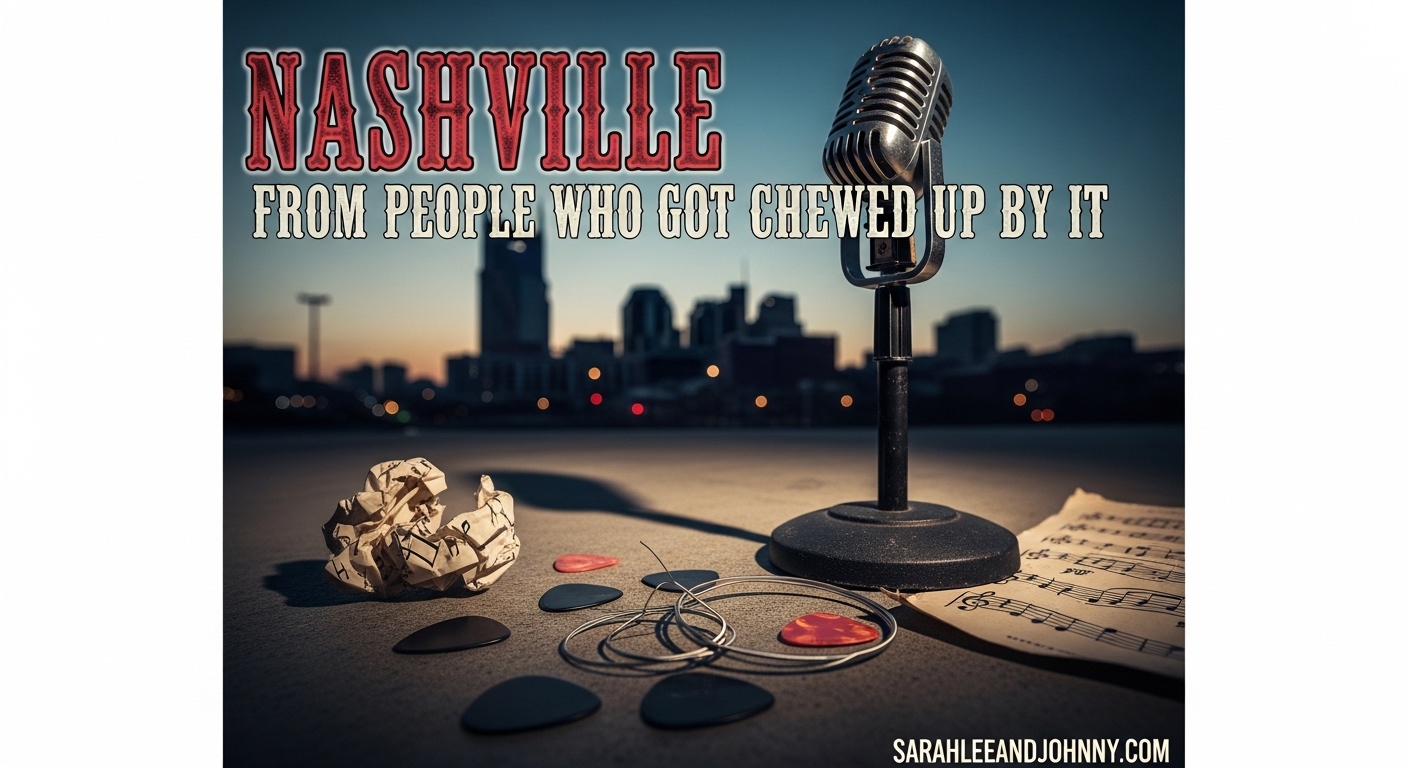
Every year, thousands of musicians load up their cars and drive toward the neon glow of Nashville, Tennessee, chasing a feeling they cannot quite name. They come from farm towns and suburbs, from open mic nights and bedroom recording setups, convinced that Music City will see what nobody else has seen yet. Most of them will leave with less than they arrived with. Some will leave with songs about it.
The songs about nashville from people who got chewed up by it are not your typical country anthems. There is no polished Nashville sound here, no radio-friendly optimism about neon lights and pickup trucks. These are the songs that come after the dream curdles. They are written by people who paid their dues on Lower Broadway for a decade, who watched industry executives nod politely at their demo tapes and then never called back, who realized that the same city that inspired them was actively grinding them down.
I have spent years listening to these tracks, the ones that rarely make it onto mainstream country radio but circulate among musicians and fans who understand the dark side of Music City. They are, in my opinion, some of the most honest songs ever written in any genre. Because it takes a particular kind of courage to write about failure in a town that only celebrates success.
This is a deep dive into those songs. The angry ones, the sad ones, the ones that barely whisper their pain. The ones written by artists who got chewed up by Nashville and decided to sing about it instead of going quietly.
Table of Contents
- The Dream Factory’s Broken Promises
- Songs of Industry Rejection and Frustration
- The Honest Pain: Artists Who Got Chewed Up by Nashville
- Redemption and Survival Anthems
- Why These Songs About Nashville Still Matter
- FAQs
- What are the best songs about Nashville from people who got chewed up by it?
- What is the saddest country song about Nashville heartbreak?
- Why do musicians hate Nashville?
- What does ‘chewed up by Nashville’ mean?
- Which artists survived Nashville’s music industry?
- What is the angriest song about Nashville?
The Dream Factory’s Broken Promises
Nashville has been selling a version of itself since the 1950s, when the Countrypolitan sound made Music Row a factory for crossover hits. The city was not just a place anymore. It was a promise. Come here with talent and grit, and the machinery of Music Row would turn you into a star. That was the deal.
The problem with the deal was that it was never true for most people. For every Dolly Parton who walked into town and became a legend, there were thousands of singer-songwriters who played the same honky-tonks for tips, pitched the same publishing houses, and waited for a big break that never arrived. Nashville was a dream factory, sure. But most factories produce more waste than product.
Dolly Parton herself understood this better than anyone. Her song “Down on Music Row” is a deceptively cheerful track about a young woman who comes to Nashville with nothing but a guitar and a prayer. The song sounds upbeat, almost jaunty, but listen to the words. She is walking up and down Music Row, knocking on doors, getting turned away. She sings about how “nobody seemed to care” and how she felt like “just another face.” Parton made it, of course. But she never forgot what it felt like to be nobody in a town full of somebodies.
Pee Wee King went even further back with “Blame It All On Nashville,” a song that directly addresses the way the city seduces and disappoints. The idea was simple: Nashville promises you everything, delivers just enough hope to keep you hooked, and then quietly drains you of money, confidence, and years. King wrote it in an era when you were not supposed to criticize Music City. He did it anyway.
The phrase “heartbreak town” did not emerge by accident. It emerged because enough musicians lived through the experience that they needed a name for it. Nashville draws you in with the myth, keeps you with just enough near-misses and almost-deals, and by the time you realize what is happening, you have given it five years of your life and have nothing to show for it but a catalog of songs nobody will hear.
What makes these songs about Nashville from people who got chewed up by it so powerful is that they are not just complaints. They are testimony. They are artists standing up in front of a microphone and saying, “This happened to me, and I am not going to pretend it did not.” That kind of honesty is rare in any industry, let alone one built on selling dreams.
Songs of Industry Rejection and Frustration
If you want to hear pure, unfiltered rage at Nashville, start with Robbie Fulks and his legendary track “Fuck This Town.” There is no metaphor here, no gentle allegory. Fulks names names, calls out the industry machinery, and makes it abundantly clear that he sees Nashville as a place that chews up genuine talent in favor of marketable mediocrity. The song became an underground anthem for every musician who felt the same way but did not have the nerve to say it out loud.
Fulks was not wrong about the trend he was reacting against. By the 1990s, Nashville had embraced a highly polished, commercial sound that sidelined traditional country artists in favor of what critics called “Countrypolitan” and later “Bro-Country.” The gatekeepers on Music Row were not looking for raw authenticity. They were looking for hits. And if your version of country did not fit their formula, you were out.
Alan Jackson and George Strait responded to this same trend with “Murder on Music Row,” a devastating track that argued Nashville had killed real country music in pursuit of pop crossover success. “Someone killed country music, cut out its heart and soul,” they sang, and they meant it. The song won a CMA Award, which is remarkable when you think about it. Nashville gave an award to a song accusing Nashville of murder.
Waylon Jennings took a different approach with “Nashville Bum.” Jennings was one of the original Outlaw Country artists, a movement that formed specifically in opposition to the Nashville establishment. While Nashville producers wanted clean-cut performers singing songs written by committee, Jennings wanted to sing songs that felt like his own life. “Nashville Bum” captures his contempt for an industry that tried to manufacture authenticity in a studio. He left Nashville and recorded his albums in Texas, on his own terms, and the music was better for it.
Dwight Yoakam made a similar escape. His song “Guitars, Cadillacs” is not explicitly about Nashville, but its genesis is deeply tied to his Nashville experience. Yoakam came to Music City in the early 1980s and was told his Bakersfield-influenced sound was too raw, too traditional, too country for modern Nashville radio. So he left for Los Angeles, where the punk and roots rock scenes embraced him. “Guitars, Cadillacs” became his breakthrough. The irony is painful: Nashville rejected the very sound that would make Yoakam a star.
Steve Earle’s “South Nashville Blues” adds a darker dimension to the story. Earle’s relationship with Nashville was complicated by addiction, industry pressure, and a sense that the city had drawn him into a lifestyle that nearly killed him. The song is not just about the music industry. It is about what happens when the entire ecosystem of a city, from the honky-tonks to the boardrooms, conspires to keep you trapped in a cycle of hope and destruction.
These songs share a common thread: they were all written by artists who refused to go quietly. Nashville told them they were not good enough, not commercial enough, not marketable enough. And instead of accepting that verdict, they turned their frustration into the most powerful music of their careers.
The Honest Pain: Artists Who Got Chewed Up by Nashville
Anger is one response to Nashville’s grinder. Heartbreak is another. And the saddest songs about Nashville from people who got chewed up by it are not the angry ones. They are the ones where the artist still loves the city, still believes in the music, and cannot quite bring themselves to leave even as the city destroys them piece by piece.
Ashley Monroe captured this duality perfectly in her song “I Hate Nashville.” The title sounds definitive, but listen to the whole track. Monroe does not just hate Nashville. She hates that she loves it. She hates that she cannot stop believing in it. She hates that the city gave her some of her best memories and her worst heartbreaks, often on the same day. Monroe had legitimate success in Nashville, writing songs for other artists and releasing critically acclaimed albums. But she also experienced the industry’s cruelty firsthand, watching projects she believed in get shelved, seeing less talented artists get pushes while she waited.
“I Hate Nashville” works because it is not a simple rejection. It is a complicated, messy, deeply human relationship with a city. Monroe sings the way someone talks about an ex they are not over. “I hate Nashville, but I’m still here,” might as well be the motto of half the musicians in Tennessee.
The Chicks approached similar territory with “Heartbreak Town,” a song from their album Fly. The track describes Nashville as a place where “dreams are tested and sometimes they break.” The Chicks knew this experience intimately. They came up through Nashville’s system, achieved massive commercial success, and then watched the same industry turn on them after the political controversy surrounding their comments about the Iraq War. Nashville built them up and then tried to tear them down. “Heartbreak Town” was not just a song. It was prophecy.
Hailey Whitters wrote what might be the definitive modern Nashville survival anthem with “Ten Year Town.” The title refers to the joke that circulates among Nashville musicians: it takes ten years to become an overnight success. Whitters lived that timeline. She moved to Nashville from Iowa, spent a decade writing songs, playing shows, and watching her peers either make it or give up. “Ten Year Town” is about the specific loneliness of being in Nashville long enough to see your own story repeated in the faces of every new arrival. She sings about the exhaustion of paying dues with no guarantee that the dues will ever add up to anything.
Lindi Ortega’s “Tin Star” is perhaps the most heartbreaking entry on this list. Ortega spent five years in Nashville, a Canadian artist who came south because she believed in country music’s spiritual home. What she found was a town that did not quite know what to do with her. “Tin Star” is about feeling like a cheap imitation of something real, like Nashville gave everyone else gold stars and gave her a tin one. Ortega wrote beautifully about the experience, but you can hear the damage in her voice. She eventually left Nashville, moved back to Canada, and kept making music on her own terms.
Billy Strings brought a new generation’s perspective to the Nashville blues with his track “Nashville Blues.” Strings represents the modern bluegrass and jam band scene, a world that has always had an uneasy relationship with Nashville’s commercial machinery. His song captures the way Nashville can feel like a vampire, feeding on young artists’ energy and talent without giving much back. Strings has achieved enormous success, but his song suggests that the success came with a cost that Nashville does not like to talk about.
Margo Price fought Nashville’s system more publicly than most. She moved to the city, tried to work within the traditional label system, and found herself stonewalled. Labels wanted her to soften her sound, to write more radio-friendly material, to be less herself. Price refused. She self-released her music, built a following through relentless touring, and eventually signed with Third Man Records, Jack White’s label, which gave her the creative freedom Nashville’s mainstream labels would not. Her story is both a Nashville heartbreak story and a Nashville survival story, which is what makes it so compelling.
What all these artists share is the experience of being chewed up musicians who refused to stay silent. Nashville took years from them, confidence from them, sometimes entire albums from them. And they responded by writing songs that told the truth about what happened. These are not bitterness for the sake of bitterness. They are love letters written by people who got their hearts broken and kept loving anyway.
Redemption and Survival Anthems
Not every song about Nashville’s dark side ends in despair. Some of the most powerful tracks come from artists who got chewed up and somehow found their way through. These are the survival anthems, the songs that acknowledge the damage but refuse to let Nashville have the last word.
Trisha Yearwood’s “Wrong Side of Memphis” is a masterclass in writing about the struggle before the success. Yearwood sings about dreaming of Nashville from the wrong side, the side where you are not famous yet, where you are still waiting tables and playing for tips. What makes the song remarkable is that Yearwood recorded it after she had already made it. She did not forget where she came from. She remembered what it felt like to be nobody in a town full of somebodies, and she turned that memory into one of her most beloved songs.
Jason Aldean’s “Crazy Town” captures Nashville as a beautiful trap. The song describes the city as a place that is both irresistible and dangerous, where “the gravity” pulls you in and “the reality” pulls you apart. Aldean sings about Nashville with the affection of someone who knows the city could have destroyed him but did not. It is a narrow escape story set to a driving country beat.
Eric Church’s “Devil, Devil” is a sprawling, ambitious track that personifies Nashville as the Devil himself, seducing musicians with promises of fame and fortune while quietly consuming their souls. Church has always been one of Nashville’s most outspoken critics, even while operating within the mainstream system. “Devil, Devil” is his most explicit reckoning with what the city demands from the people who try to make it there. The song suggests that some level of compromise is inevitable, that everyone who succeeds in Nashville has made some kind of deal with the Devil.
Rodney Crowell’s “Nashville 1972” is the closest thing to a love letter on this list. Crowell arrived in Nashville in 1972, a young songwriter from Texas, and the song is a nostalgic look back at the struggle, the poverty, the grind. But it is also a celebration. Crowell survived Nashville because of the community of artists who supported each other, shared gigs, and believed in the music even when the industry did not believe in them. The song is a reminder that Nashville’s story is not just about the city. It is about the people who came there and found each other.
Marty Stuart’s “Sundown in Nashville” functions as a kind of witness statement. Stuart, who has spent decades in Nashville as both a performer and a historian of country music, sings about watching the darkness fall over the city and seeing what happens in the shadows. He has seen the dreamers arrive and the broken leave. He has seen the industry’s machinery operate up close. His song is less about his own pain and more about bearing witness to everyone else’s. That matters, too. Sometimes the most important songs are the ones that simply tell the truth about what someone saw.
These survival anthems do not minimize the pain of being chewed up by Nashville. They acknowledge it fully. But they add something crucial: the possibility of coming through the other side. They suggest that Nashville can break your heart without breaking your spirit, that you can lose the dream and still find something worth keeping.
Why These Songs About Nashville Still Matter
Songs about nashville from people who got chewed up by it resonate far beyond country music. They speak to anyone who has ever chased a dream and watched it fall apart, anyone who has poured years of their life into something that did not love them back. Nashville is a specific place, but the experience it represents is universal.
The reason these tracks hit so hard is that they are fundamentally about truth. Country music has always marketed itself as honest, as real, as the music of working people and hard lives. But the Nashville machine has often promoted a polished, sanitized version of that truth. These songs, the ones written by artists who got chewed up, are the counter-narrative. They say, “This is what really happens. This is what it actually feels like.”
There is a reason Reddit threads and forum discussions about Nashville heartbreak songs generate hundreds of comments. People see themselves in these tracks. The aspiring musician who just moved to Nashville and is sleeping on a couch in East Nashville recognizes her own story in Hailey Whitters’ “Ten Year Town.” The artist who just got dropped by their label finds catharsis in Ashley Monroe’s “I Hate Nashville.” The person who left Nashville with nothing but a broken heart and a handful of songs hears their own experience in Lindi Ortega’s “Tin Star.”
These songs matter because they turn private grief into shared experience. They take something that feels uniquely isolating, failing in a city that only celebrates success, and they make it communal. When you listen to Robbie Fulks rage against Nashville, you are not alone in your anger. When you hear Rodney Crowell sing about the beauty in the struggle, you are not alone in your nostalgia. The songs are therapy, confession, and communion all at once.
They also serve as a necessary corrective to Nashville’s own mythology. Every city has a story it tells about itself, and Nashville’s story has always been about dreams coming true under neon lights. That story is real, sometimes. But the songs from the chewed-up musicians remind us that for every dream that comes true in Nashville, dozens more die quietly on Music Row, in publishing offices, in the back rooms of bars where nobody is listening. These songs insist that those broken dreams are part of the story, too. They matter as much as the success stories, maybe more.
In 2026, as Nashville continues to evolve, absorbing influences from pop, hip-hop, and Americana, these songs remain relevant. New generations of artists will come to Nashville, and many of them will get chewed up. And some of them will write songs about it. Those songs will join this tradition, a canon of honest music that refuses to let Nashville off the hook for what it does to the people who love it most.
FAQs
What are the best songs about Nashville from people who got chewed up by it?
Some of the most powerful tracks include Ashley Monroe’s ‘I Hate Nashville,’ Robbie Fulks’ ‘Fuck This Town,’ The Chicks’ ‘Heartbreak Town,’ Hailey Whitters’ ‘Ten Year Town,’ Lindi Ortega’s ‘Tin Star,’ Alan Jackson and George Strait’s ‘Murder on Music Row,’ Waylon Jennings’ ‘Nashville Bum,’ Billy Strings’ ‘Nashville Blues,’ and Eric Church’s ‘Devil, Devil.’ Each captures a different facet of Nashville’s destructive side, from raw anger to quiet heartbreak.
What is the saddest country song about Nashville heartbreak?
Lindi Ortega’s ‘Tin Star’ is widely considered one of the saddest Nashville heartbreak songs. Written after five years of struggling in Music City, it captures the feeling of giving everything to a dream and receiving almost nothing back. Ashley Monroe’s ‘I Hate Nashville’ and Hailey Whitters’ ‘Ten Year Town’ are also deeply emotional tracks that express the specific pain of Nashville disillusionment.
Why do musicians hate Nashville?
Many musicians express frustration with Nashville because of its industry machinery: label executives who demand radio-friendly conformity, publishing houses that string writers along, and a system that often rewards commercial appeal over artistic authenticity. The city draws artists with promises of stardom, but most find that the gatekeepers on Music Row are not interested in originality. The love/hate relationship comes from genuinely loving the music and community while hating the business side.
What does ‘chewed up by Nashville’ mean?
Being ‘chewed up by Nashville’ means experiencing the cycle of hope, struggle, and disappointment that many musicians face in Music City. Artists arrive with talent and dreams, spend years paying dues, and often leave with broken spirits, depleted finances, and shattered confidence. The phrase captures how Nashville’s industry can consume an artist’s energy, creativity, and years without delivering the promised success.
Which artists survived Nashville’s music industry?
Several artists survived Nashville’s grinder and built successful careers on their own terms. Margo Price self-released music after label rejection and signed with Third Man Records. Dwight Yoakam left Nashville for Los Angeles after being told his sound was not commercial enough. Waylon Jennings moved to Texas and pioneered the Outlaw Country movement. Dolly Parton persevered through years of rejection to become one of country music’s greatest legends. Each found success by refusing to conform to Nashville’s expectations.
What is the angriest song about Nashville?
Robbie Fulks’ ‘Fuck This Town’ holds that distinction. The song is a raw, profanity-laced takedown of Nashville’s entire music industry apparatus. Fulks names the industry’s failures directly, calling out the commercial machinery that chews up genuine talent. It became an underground anthem for every musician who felt the same rage but never had the platform or the nerve to express it so bluntly.