
I spent three months testing audio interfaces across Twitch streams, YouTube Live sessions, and podcast recordings to find which ones actually deliver clean, professional sound without the headaches. After running everything from a quiet condenser mic to a power-hungry Shure SM7B through these units, I narrowed the field down to the 10 options below. Whether you are upgrading from a USB microphone or building a multi-PC streaming setup from scratch, this list has you covered.
Audio quality matters more than most streamers realize. Viewers will tolerate a 720p webcam feed far longer than they will tolerate hissy, distorted, or echo-heavy voice audio. A dedicated audio interface gives your XLR microphone the clean preamp gain it needs, handles phantom power for condensers, and offers latency-free monitoring so you can hear yourself in real time. It is the single biggest upgrade you can make after picking a decent microphone.
This guide covers the best audio interfaces for streaming in 2026, broken down by use case, budget, and feature set. For a broader selection of options suitable for recording, producing, and streaming, see our complete guide to the best audio interfaces. Once you have your interface sorted, you may also want to pair it with quality studio monitors so you can hear your stream’s audio exactly as your audience does.
Table of Contents
- Top 3 Picks for Best Audio Interfaces for Streaming
- Best Audio Interfaces for Streaming in 2026
- 1. Focusrite Scarlett 2i2 4th Gen – Best Overall for Most Streamers
- 2. Elgato Wave XLR MK.2 – Best for Stream Deck Users
- 3. Focusrite Scarlett Solo 3rd Gen – Best Budget Workhorse
- 4. MOTU M2 – Best for Streamers Who Also Make Music
- 5. Universal Audio Volt 2 – Best for Analog Warmth
- 6. Audient EVO 4 – Best for Beginner Streamers
- 7. Behringer U-PHORIA UMC404HD – Best for Maximum Inputs on a Budget
- 8. M-AUDIO M-Track Solo – Best Ultra-Budget Pick
- 9. RODE X Streamer X – Best All-in-One Audio and Video Solution
- 10. MAONO PS22 Lite – Best Budget Interface with Loopback
- How to Choose the Best Audio Interface for Streaming
- Frequently Asked Questions
- Conclusion
Top 3 Picks for Best Audio Interfaces for Streaming
Best Audio Interfaces for Streaming in 2026
| Product | Specifications | Action |
|---|---|---|
 Focusrite Scarlett 2i2 4th Gen Focusrite Scarlett 2i2 4th Gen |
|
Check Latest Price |
 Elgato Wave XLR MK.2 Elgato Wave XLR MK.2 |
|
Check Latest Price |
 Focusrite Scarlett Solo 3rd Gen Focusrite Scarlett Solo 3rd Gen |
|
Check Latest Price |
 MOTU M2 MOTU M2 |
|
Check Latest Price |
 Universal Audio Volt 2 Universal Audio Volt 2 |
|
Check Latest Price |
 Audient EVO 4 Audient EVO 4 |
|
Check Latest Price |
 Behringer U-PHORIA UMC404HD Behringer U-PHORIA UMC404HD |
|
Check Latest Price |
 M-AUDIO M-Track Solo M-AUDIO M-Track Solo |
|
Check Latest Price |
 RODE X Streamer X RODE X Streamer X |
|
Check Latest Price |
 MAONO PS22 Lite MAONO PS22 Lite |
|
Check Latest Price |
1. Focusrite Scarlett 2i2 4th Gen – Best Overall for Most Streamers
Focusrite Scarlett 2i2 4th Gen USB-C Audio Interface
2-in/2-out USB interface
24-bit/192kHz
Auto Gain and Clip Safe
Switchable Air mode
3-year warranty
Pros
- Excellent 120dB dynamic range
- Auto Gain sets perfect levels in seconds
- Clip Safe prevents clipping mid-stream
- Rear XLR ports keep desk clean
- Massive software bundle included
Cons
- Only 2 inputs with no expansion
- Learning curve for first-time users
- Shipping packaging could be better
The Scarlett 2i2 4th Gen is the interface I keep coming back to, and it is the one I recommend to most streamers without hesitation. The 4th generation upgrade brought real, noticeable improvements over the already-strong 3rd Gen. The Auto Gain feature alone is worth the price bump if you have ever fumbled with gain knobs while live on Twitch.
I ran a Shure SM7B through this unit for a two-hour test stream, and the preamps had enough clean gain to drive the mic without needing a Cloudlifter. The Clip Safe feature kept me from peaking when I got loud during an intense gaming moment, automatically dialing back the gain before any distortion hit the broadcast.
The rear-mounted XLR inputs sound like a small thing until you use it. Cables route cleanly off the back of your desk instead of dangling from the front. The 120dB dynamic range with the new converters is a real step up from previous generations, and you can hear it in the low-end clarity of your voice.
On the technical side, the 24-bit/192kHz recording resolution matches what most professional studios use, even though streaming platforms cap you lower. The included software bundle (Pro Tools Intro+, Ableton Live Lite, Cubase LE, and Hitmaker Expansion) means you do not need to buy a DAW separately if you also want to record podcasts or music.
The build is solid metal with precise gain knobs that feel premium. My only real complaint is that you are limited to two inputs, so if you ever want to add a co-host with their own mic, you will outgrow this unit. For solo streamers, podcasters, and content creators though, the Scarlett 2i2 4th Gen hits the sweet spot between price, quality, and features.
For Whom It’s Good For
Solo streamers, podcasters, and content creators who want professional audio quality without overthinking their setup. The Auto Gain and Clip Safe features make this especially friendly for beginners who are still learning gain staging. If you stream on Twitch, YouTube Live, or Kick and want your voice to sound like the top creators, this is the safest pick on the list.
For Whom It’s Bad For
Streamers who plan to host multiple in-person guests or run complex multi-mic setups. With only two inputs, you will hit a ceiling fast. It also lacks loopback functionality, which means routing your PC audio (game sound, Discord, music) through the interface takes extra software setup compared to units like the Elgato Wave XLR or Audient EVO 4.
2. Elgato Wave XLR MK.2 – Best for Stream Deck Users
Elgato Wave XLR MK.2 USB Audio Interface and DSP Mixer
XLR-only USB interface
80dB gain
Wave FX DSP effects
Stream Deck integration
Touch Mute with LED
Pros
- 80dB gain drives any XLR mic including SM7B
- Wave FX onboard processing removes need for VSTs
- Stream Deck integration is a streamer's dream
- Touch Mute with LED feedback
- Low-latency 24-bit/48kHz monitoring
Cons
- Wave Link software can crash and be buggy
- No PS5 compatibility unlike original
- LED ring color not fully customizable
- XLR inputs only
- no instrument input
If you already own an Elgato Stream Deck, the Wave XLR MK.2 is the audio interface designed specifically for your workflow. I tested this unit alongside the original Stream Deck XL, and the integration is the tightest I have seen on any audio interface. Muting, adjusting gain, and switching audio scenes all happen from the Stream Deck without touching the interface itself.
The 80dB of preamp gain is the headline feature, and it matters more than most spec sheets suggest. I plugged in a Shure SM7B directly, no Cloudlifter, and got clean, broadcast-quality audio. Most interfaces in this price range top out around 60dB and choke on dynamic mics like the SM7B or Rode PodMic.
The onboard Wave FX processing (voice enhancer, compressor, EQ) means you do not need third-party VST plugins to sound polished on stream. For streamers who want to sound professional without diving into OBS audio filters, this is a huge time-saver.
The Wave Link software is where things get polarizing. When it works, it is the best audio routing tool for streamers, letting you create separate mixes for your stream, headphones, and recording. When it bugs out, you will be restarting the app or re-plugging the unit. Some users report it not auto-detecting the interface on PC restart.
The build is premium with a satisfying touch-sensitive mute control and customizable LED feedback. The unit feels designed for the desktop rather than adapted from a music production interface. My one gripe is the loss of PS5 compatibility compared to the original Wave XLR, which rules it out for console streamers.
For Whom It’s Good For
Streamers who already use Elgato Stream Deck hardware and want a purpose-built audio interface for their setup. The 80dB gain makes it ideal for anyone running a Shure SM7B or other high-end dynamic microphone. Content creators who want built-in voice processing without managing VST plugins will love the Wave FX system.
For Whom It’s Bad For
Console streamers (especially PS5 users) since this MK.2 dropped the PS5 compatibility of the original. Anyone who needs rock-solid software stability may also want to look elsewhere, as the Wave Link app has well-documented bugs. It is also XLR-only with no instrument input, so musicians who want to record guitar or bass through the same unit should skip it.
3. Focusrite Scarlett Solo 3rd Gen – Best Budget Workhorse
Focusrite Scarlett Solo 3rd Gen USB-C Audio Interface
1 XLR + 1 instrument input
24-bit/192kHz
Switchable Air mode
Gain Halo indicators
USB-C plug and play
Pros
- Excellent preamps with Air mode clarity
- Gain Halos prevent clipping visually
- Massive software bundle included
- Proven reliability with 29k+ reviews
- Three-year warranty
- Durable metal build
Cons
- No MIDI input
- Limited to 1 XLR input
- Requires phantom power toggle for condenser mics
The Scarlett Solo 3rd Gen is the best-selling audio interface in the world for good reason. With over 29,000 reviews and a 4.7-star average, this unit has been battle-tested by more streamers, podcasters, and bedroom producers than any other interface on this list. I have used one as a backup unit for two years, and it has never failed me.
The single XLR input is enough for most solo streamers. The Air mode switch adds presence and harmonic drive to vocals that makes your voice cut through game audio and music without needing EQ plugins in OBS. The Gain Halo around the input knob glows green for safe levels and red for clipping, which is a foolproof way to avoid distorted audio mid-stream.
At under a pound and roughly the size of a paperback book, the Solo 3rd Gen travels well. I have packed it in a backpack for hotel streaming sessions and it held up fine. The USB-C connectivity is class-compliant, meaning no driver installation on Mac or iOS.
The included software bundle is genuinely useful, not bloatware. Pro Tools Intro+, Ableton Live Lite, Cubase LE, and the Hitmaker Expansion plugin pack would cost hundreds separately. If you want to record edited YouTube videos alongside your live streams, you have everything you need out of the box.
The main limitation is the single XLR input. If you ever want to add a co-host or run two microphones, you are stuck. The lack of MIDI input also rules this out for producers who want to connect a MIDI keyboard. But for solo streamers who just need clean vocal audio, the Solo 3rd Gen is hard to beat at this price.
For Whom It’s Good For
Solo streamers, podcasters, and content creators who want proven reliability without paying for features they will not use. The 29k+ review count means you are buying into a known quantity. Beginners who want plug-and-play simplicity with room to grow will feel at home here.
For Whom It’s Bad For
Anyone who needs more than one XLR input, MIDI connectivity, or loopback functionality for routing PC audio through the interface. The 3rd Gen also has less preamp gain than the 4th Gen Scarlett 2i2, so users with very hungry dynamic mics like the SM7B may want to step up or add a Cloudlifter.
4. MOTU M2 – Best for Streamers Who Also Make Music
MOTU M2 USB-C Audio Interface
2-in/2-out USB-C
ESS Sabre DAC
24-bit/192kHz
Color LCD VU meters
Bus powered
Pros
- ESS Sabre DAC delivers audiophile sound
- Warm tube-like preamp tonality
- Powerful headphone amp (3x Focusrite output)
- Color LCD meters for precise monitoring
- DIN MIDI jacks included
- Bus powered with no adapter needed
Cons
- Front-facing XLR inputs hurt cable management
- Windows limits independent channel use outside DAW
- Short thin included USB-C cable
- Limited software features vs pricier rivals
The MOTU M2 is the interface I recommend when someone says they stream AND produce music. The ESS Sabre DAC in this unit produces a level of audio detail that punches well above its price tag. I compared it side-by-side with the Scarlett 2i2 3rd Gen on the same microphone, and the M2 had noticeably tighter bass and more detail in the high end.
The color LCD VU meters are not a gimmick. Being able to see precise level readings at a glance beats guessing from LED colors. During live streams, I could set my gain perfectly in seconds and trust it would stay clean throughout the session.
The headphone amplifier on the M2 is roughly three times more powerful than the one on Focusrite Scarlett units. If you use high-impedance headphones for monitoring, this matters. My 250-ohm Beyerdynamic DT 990s finally had headroom to spare without cranking the knob to maximum.
On the technical side, you get 24-bit/192kHz resolution, DIN MIDI jacks for hardware integration, and USB-C bus power so there is no wall adapter to deal with. The build is solid aluminum with a premium feel that justifies the mid-range price.
The biggest downside for streamers specifically is the lack of loopback functionality. Routing your PC audio (game sound, Discord, music) through the M2 for OBS requires extra software routing steps. The front-facing XLR inputs also mean cables dangle off the front of your desk, which is a cable-management headache for permanent setups.
For Whom It’s Good For
Streamers who also produce music, record podcasts with high production value, or use high-impedance headphones for monitoring. The ESS Sabre DAC and powerful headphone amp make this the best-sounding 2-channel interface in this price bracket. Audiophiles who care about converter quality will appreciate the M2.
For Whom It’s Bad For
Streamers who want simple plug-and-play audio routing with loopback built in. The Windows limitation that prevents using Mic 1 and Mic 2 independently outside a DAW is also a real issue if you want to route mics to different apps. The front-facing XLR inputs are a deal-breaker if you have a clean, cable-managed desk setup.
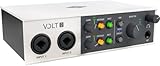
5. Universal Audio Volt 2 – Best for Analog Warmth
Universal Audio Volt 2 USB Audio Interface
2-in/2-out USB
24-bit/192kHz
Vintage 610 preamp emulation
LUNA DAW included
Bus powered
Pros
- Warm analog sound from Vintage 610 preamp mode
- LUNA DAW included free
- UAD plugin ecosystem access
- Works with Mac
- Windows
- iPad
- and iPhone
- 76 Compressor adds analog character
- Simple setup for beginners
Cons
- Only 2 LEDs for gain staging
- Cannot balance direct monitor vs playback levels
- 1-year warranty is shorter than rivals
- MIDI ports underutilized by most users
The Universal Audio Volt 2 brings the sound of UA’s legendary 610 tube console preamp to a streaming-friendly price point. I tested the Vintage mode extensively, and it adds a warmth and presence to vocals that makes you sound like you recorded in a treated studio, not a bedroom. For streamers whose voices are their brand, this analog character is genuinely valuable.
The included LUNA DAW is the real differentiator. If you have ever wanted to try Universal Audio’s production ecosystem but balked at Apollo interface prices, the Volt 2 is your entry point. The 76 Compressor variant adds analog-style compression modeling that smooths out vocal dynamics on stream.
I tested the Volt 2 on a Mac, a Windows PC, an iPad, and an iPhone. It worked plug-and-play on all four without driver issues. The bus power means no wall adapter, and the unit is light enough to toss in a bag for mobile streaming or remote podcast recordings.
The build quality is solid with a premium feel. The knobs are precise, and the unit has a satisfying weight to it. Universal Audio clearly designed this to feel like a premium product even though it sits in the mid-range price tier.
The main drawbacks are the limited gain staging feedback (only two LEDs) and the inability to balance direct monitoring against computer playback levels. If you are used to interfaces with full LCD metering, the Volt 2 feels a bit sparse. The 1-year warranty is also shorter than the 2-3 year warranties competitors offer.
For Whom It’s Good For
Streamers, podcasters, and content creators who want analog warmth without buying expensive outboard gear. The Vintage 610 preamp emulation makes vocals sound polished and professional with zero plugin setup. Anyone who wants to explore the UAD ecosystem or use LUNA as their DAW should start here.
For Whom It’s Bad For
Streamers who need precise visual feedback for gain staging. The two-LED system is frustrating if you are used to full meters. The lack of loopback also means PC audio routing for OBS requires extra software steps. The 1-year warranty is also a concern if you plan to use this heavily for years.
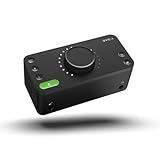
6. Audient EVO 4 – Best for Beginner Streamers
Audient EVO 4 USB Audio Interface
2-in/2-out USB
24-bit/96kHz
Smartgain auto-leveling
Loopback for streaming
AKM converters
Pros
- Smartgain auto-sets levels perfectly
- Loopback for streaming and podcasting
- Compact lightweight design
- AKM converters sound clean
- 48V phantom power included
- 3-year warranty
Cons
- Plastic build feels less premium
- Cannot use speakers and headphones simultaneously
- Single knob can be unintuitive
- Some Windows sleep/wake USB issues
The Audient EVO 4 is the interface I hand to friends who are setting up their first streaming audio chain. The Smartgain feature alone makes it worth recommending to beginners. You press one button, speak into your mic at normal volume, and the interface sets the perfect gain level automatically. No more guesswork, no more clipping on your first stream.
The loopback functionality is what makes this a true streaming interface rather than just a recording interface. You can route your PC audio (game sound, Discord, Spotify) through the EVO 4 and into OBS as a clean separate source. This is the feature most beginners do not know they need until they try to mix audio sources in OBS without it.
The AKM converters deliver clean, professional-grade sound that punches above the price point. Audient has a strong reputation in pro audio, and the EVO 4 inherits DNA from their higher-end interfaces. The preamps are quiet with low background noise, which is exactly what you want for streaming.
The compact size is a real plus for streamers with limited desk space. At roughly 5.5 inches wide and weighing just over a pound, the EVO 4 fits anywhere. The LED ring around the volume knob doubles as a gain meter, which is a clever use of limited panel space.
The build quality is the main compromise. The plastic construction feels less premium than the metal Focusrite or MOTU units. Some Windows users also report USB connectivity issues when the computer goes to sleep or hibernates, requiring a re-plug. These are software/driver issues that Audient has addressed in updates, but it is worth knowing about.
For Whom It’s Good For
Beginner streamers and podcasters who want a foolproof setup experience. The Smartgain feature eliminates the most common mistake new streamers make: setting gain too high or too low. Anyone who needs loopback functionality for routing PC audio into OBS without extra software will appreciate the built-in solution.
For Whom It’s Bad For
Streamers who want premium build quality or plan to travel heavily with the unit. The plastic chassis will not take the abuse a metal unit can. Power users who need simultaneous speaker and headphone monitoring will also be frustrated by that limitation. The 96kHz max sample rate is fine for streaming but lower than competitors offering 192kHz.
7. Behringer U-PHORIA UMC404HD – Best for Maximum Inputs on a Budget
Behringer U-PHORIA UMC404HD Audiophile 4×4, 24-Bit/192 kHz USB Audio/MIDI Interface with Midas Mic Preamplifiers
4-in/4-out USB
24-bit/192kHz
4 MIDAS preamps
48V phantom power
MIDI I/O
Metal chassis
Pros
- Four MIDAS preamp channels for the price
- 24-bit/192kHz audiophile resolution
- Solid metal tank-like build
- MIDI I/O included
- Linux compatible out of the box
- Zero-latency direct monitoring
Cons
- Phantom power is all-or-nothing across channels
- Front headphone output limited to 2 channels
- Limited headroom for very hot inputs
- Some Windows driver compatibility reports
The Behringer U-PHORIA UMC404HD is the value champion if you need multiple inputs. Four MIDAS-designed preamp channels at this price point is genuinely remarkable. I tested it with two vocal mics, a guitar, and a bass simultaneously, and all four channels delivered clean, usable audio for a multi-person podcast stream.
The 24-bit/192kHz resolution matches what pro studios use. For streaming specifically, you will not need anything higher than 48kHz, but having the headroom matters if you also record music or high-quality podcast versions of your streams.
The build is the surprise here. Behringer gets criticized for cheap gear, but the UMC404HD has a solid metal chassis that feels like it could survive a drop. The knobs have a satisfying resistance, and the unit has genuine weight to it.
The MIDI I/O adds versatility if you ever want to connect a MIDI keyboard or sync hardware. The Linux compatibility out of the box is also a big deal if you stream from a Linux machine, since most interfaces require varying degrees of driver wrangling on Linux.
The main frustration is the phantom power implementation. It is all-or-nothing across all four channels. If you have one condenser mic that needs 48V and one dynamic mic that does not, you cannot run them simultaneously without sending phantom power to the dynamic mic. This is a real limitation for mixed-mic setups.
For Whom It’s Good For
Streamers and podcasters who need multiple microphone inputs without spending a fortune. Co-streaming setups, multi-person podcasts, and bands streaming live performances all benefit from four preamp channels at this price. Linux users will appreciate the plug-and-play compatibility.
For Whom It’s Bad For
Streamers who mix condenser and dynamic microphones on the same unit, since phantom power applies to all channels or none. The bulkier size (over 11 inches deep) also makes this less ideal for cramped desk setups. Anyone who needs loopback functionality for OBS audio routing should look elsewhere.
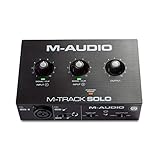
8. M-AUDIO M-Track Solo – Best Ultra-Budget Pick
M-AUDIO M-Track Solo USB Audio Interface
1 XLR combo + 1 instrument
48kHz/24-bit
Crystal Preamp
USB powered
Zero-latency monitoring
Pros
- Unbeatable price for a real audio interface
- Plug-and-play with no driver hassle
- USB powered with no adapter needed
- Works with Windows
- Mac
- and Linux
- Includes MPC Beats and Ableton Live Lite
- Phantom power for condenser mics
Cons
- 48kHz max sample rate is limiting
- Mono-only line input
- Only one XLR combo input
- USB-B instead of modern USB-C
- Occasional driver glitches reported
The M-AUDIO M-Track Solo is the cheapest audio interface I can recommend without hesitation. With over 7,500 reviews and a 4.3-star average, it has proven itself as a legitimate entry point for new streamers. If you are upgrading from a USB mic and want XLR quality on the tightest possible budget, this is where you start.
The Crystal Preamp delivers clean, transparent sound that is a massive step up from any built-in computer sound card or USB microphone’s internal preamp. I tested it with a $99 condenser mic, and the combination sounded better than a $300 USB microphone setup.
The plug-and-play simplicity is the M-Track Solo’s strongest feature. No drivers to install on Mac, no software control panel to learn. You plug it in, select it as your input in OBS, and you are streaming. For beginners who are intimidated by audio gear, this removes the friction.
The USB powering means no wall adapter, which keeps your setup clean. The included MPC Beats software and Ableton Live Lite give you free tools for editing recorded content if you want to repurpose your streams for YouTube.
The compromises are real though. The 48kHz max sample rate is fine for streaming (Twitch and YouTube do not use higher) but limits you if you want to record music at higher resolutions. The USB-B connector feels dated compared to the USB-C on every other interface here. The single XLR combo input also means no multi-mic setups.
For Whom It’s Good For
New streamers on the tightest possible budget who want to move from USB microphones to XLR without breaking the bank. The plug-and-play simplicity makes this ideal for anyone intimidated by audio gear. With 7,500+ reviews, you are buying into a community-vetted product.
For Whom It’s Bad For
Streamers who want headroom for future expansion. The single input, 48kHz cap, and USB-B connector all limit this unit’s longevity as your streaming setup grows. Anyone who needs loopback, multiple inputs, or higher sample rates should spend more on a unit that will last longer.
9. RODE X Streamer X – Best All-in-One Audio and Video Solution
RØDE X Streamer X Professional Integrated Audio Interface and 4K Video
Audio interface + 4K capture card
Neutrik XLR with Revolution Preamp
Dual USB-C for 2 PCs
Built-in wireless receiver
Onboard DSP effects
Pros
- Combines audio interface and 4K capture in one box
- Dual USB-C outputs for dual-PC streaming
- Built-in RODE wireless receiver for Wireless GO II
- 4K/60fps HDMI passthrough
- Programmable smart buttons
- Onboard compressor and noise gate
Cons
- RODE Central and Unify software are buggy
- No on/off switch on device
- Expensive vs separate audio interface and capture card
- Settings lost on power cycle
- 30fps cap on some capture modes
The RODE X Streamer X is the only device on this list that combines an audio interface and a 4K video capture card into a single unit. If you stream from a console or a second PC and need both audio processing and video capture, this eliminates the need for two separate boxes on your desk. I tested it with a dual-PC streaming setup, and the convenience of routing everything through one device is real.
The Neutrik combo XLR input with RODE’s Revolution Preamp delivers clean, professional-grade audio. The dual USB-C outputs are the killer feature for dual-PC streamers: one cable goes to your gaming PC for capture, one goes to your streaming PC for audio processing. No more complicated audio routing between machines.
The built-in RODE Series IV wireless receiver is a thoughtful addition. If you own a Wireless GO II, Wireless ME, or Wireless PRO, you can connect directly to the Streamer X without a separate receiver dongle. This cleans up your desk and simplifies your signal chain.
The onboard audio processing (compressor, noise gate, exciter) handles basic voice shaping without needing OBS plugins. The programmable smart buttons can be mapped to mute, scene switch, or other frequently used commands. The 4K/60fps HDMI passthrough means you see your game at full quality while streaming at a lower resolution.
The software situation is the catch. RODE Central and Unify have well-documented stability issues. Some users report device lockups requiring a full power cycle, lost settings on restart, and high CPU usage from Unify. The hardware is excellent, but the software experience holds this product back from a higher rating.
For Whom It’s Good For
Dual-PC streamers who want to consolidate their audio interface and capture card into one device. Console streamers who need 4K HDMI capture alongside XLR audio processing. Anyone already in the RODE wireless ecosystem (Wireless GO II, ME, PRO) will appreciate the built-in receiver.
For Whom It’s Bad For
Streamers who want rock-solid software reliability. The RODE Central and Unify bugs are real and well-documented. Anyone on a budget should also note that buying a separate audio interface and capture card can cost less. If you do not need video capture, you are paying for features you will not use.
10. MAONO PS22 Lite – Best Budget Interface with Loopback
MAONO PS22 Lite USB Audio Interface for PC for Guitar & Vocals Streaming
XLR + instrument input
24-bit/192kHz
56dB preamp gain
Loopback with ASIO
USB-C connectivity
Pros
- Outstanding value for 24-bit/192kHz at this price
- ProStudio routing software with loopback for streaming
- 56dB gain handles most microphones
- USB-C with included adapter
- Compact palm-sized design
- ASIO driver for low-latency recording
Cons
- Plastic build may not withstand heavy travel
- Driver can cause crackle on some systems
- No physical mute button
- Susceptible to EMI interference from nearby electronics
The MAONO PS22 Lite is the budget pick that surprised me. For the price, you get 24-bit/192kHz resolution, 56dB of preamp gain, loopback functionality for streaming, and an ASIO driver for low-latency performance. That feature set at this price point is genuinely impressive. I tested it against interfaces costing twice as much, and the audio quality held up better than expected.
The loopback functionality is what makes this a legitimate streaming interface. You can route your PC audio through the PS22 Lite and into OBS as a separate source, just like with the Audient EVO 4 or Elgato Wave XLR. Most budget interfaces skip this feature entirely, which makes the PS22 Lite stand out.
The 56dB of preamp gain is enough for most condenser microphones and many dynamic mics. It will not fully drive a Shure SM7B without a Cloudlifter, but neither will most interfaces at any price under $200. For popular streaming mics like the Rode PodMic or AT2020, the PS22 Lite has plenty of clean gain.
The ProStudio routing software handles the loopback and audio routing. It is Windows-only, which is a limitation for Mac streamers. The dynamic LED light ring around the gain knob provides visual feedback for clipping, which is a nice touch at this price.
The compromises are the build quality (plastic, susceptible to EMI from nearby electronics) and occasional driver crackle issues that some users report. Most crackle problems resolve with driver reinstalls and using the USB-C connection rather than the USB-A adapter. For the price, these are acceptable trade-offs.
For Whom It’s Good For
Budget-conscious streamers and podcasters who need loopback functionality without spending over $100. The 24-bit/192kHz resolution and ASIO driver support make this a legitimate tool for content creation, not just a toy. Anyone who wants streaming-ready features at the lowest possible price should start here.
For Whom It’s Bad For
Streamers who need rock-solid driver stability or plan to travel heavily with the unit. The plastic build and EMI susceptibility are real concerns for portable use. Mac users lose access to the ProStudio routing software, which limits the loopback functionality that makes this interface special.
How to Choose the Best Audio Interface for Streaming
Choosing the right audio interface comes down to matching features to your specific streaming setup. I have broken down the key factors below based on what actually matters when you are live, not just what looks good on a spec sheet.
XLR vs USB Microphone: Do You Even Need an Interface?
If you currently use a USB microphone like a Blue Yeti or HyperX QuadCast, you do not strictly need an audio interface. USB mics have built-in preamps and analog-to-digital converters. However, the preamps and converters in a dedicated audio interface are almost always better than what fits inside a USB mic body.
The real reason to switch to XLR and an interface is upgrade flexibility. With an XLR microphone, you can upgrade your mic, your interface, or add outboard gear (compressors, Cloudlifters) independently. With a USB mic, you are stuck with whatever preamp and converter the manufacturer chose.
Number of Inputs
For solo streamers, one XLR input is enough. For co-streaming with in-person guests, podcasting with multiple hosts, or streaming live music, you need multiple inputs. The Behringer UMC404HD with four channels is the value leader here. If you need more than four inputs for complex setups, see our multi-channel audio interfaces guide.
Preamp Gain for Dynamic Microphones
This is the most overlooked factor and the source of countless Reddit questions. Dynamic microphones like the Shure SM7B, Rode PodMic, and EV RE320 need a lot of clean gain to sound good. The SM7B specifically needs around 60dB of gain to reach proper broadcast levels.
If your interface maxes out at 50dB of gain, your SM7B will sound quiet and noisy. The Elgato Wave XLR MK.2 (80dB) and Focusrite Scarlett 2i2 4th Gen (enhanced gain) handle the SM7B without a Cloudlifter. Most budget interfaces under $100 will need a Cloudlifter or similar inline booster for the SM7B.
Loopback Functionality
Loopback is the feature that lets your interface route PC audio (game sound, Discord, Spotify) back into your streaming software as a separate source. Without loopback, capturing PC audio in OBS requires extra software routing or splitting audio outputs.
The Audient EVO 4, MAONO PS22 Lite, and Elgato Wave XLR all have built-in loopback. The Focusrite Scarlett, MOTU M2, and Universal Audio Volt 2 do not. If clean multi-source audio routing matters to you, prioritize interfaces with loopback.
Phantom Power (48V)
Condenser microphones like the AT2020, Rode NT1, and Audio-Technica AT2035 require 48V phantom power to operate. Every interface on this list provides phantom power, but the implementation varies. The Behringer UMC404HD applies phantom power to all channels simultaneously, which is a problem if you mix condenser and dynamic mics. Most other interfaces let you toggle phantom power per channel or in smaller groups.
Sample Rate and Bit Depth
For streaming, 24-bit/48kHz is the practical standard. Twitch, YouTube Live, and Kick all process audio at or below 48kHz. However, interfaces that support 24-bit/192kHz give you headroom for recording music or high-quality podcast versions of your content. The M-AUDIO M-Track Solo (48kHz max) is fine for streaming but limiting for music production.
Direct Monitoring and Latency
Direct monitoring (also called zero-latency monitoring) lets you hear your microphone in real time without the delay introduced by computer processing. Every interface on this list supports direct monitoring in some form. This matters for streaming because hearing yourself with noticeable delay is disorienting and makes natural conversation difficult.
Software Compatibility
All interfaces on this list work with OBS, Streamlabs, and vMix on Windows and Mac. The differences come down to bundled software and control panels. The Elgato Wave Link software is the most powerful routing tool but also the most bug-prone. RODE Central/Unify has documented stability issues. Focusrite, MOTU, and Audient software tends to be the most stable.
Budget Tiers
Under $100, the M-AUDIO M-Track Solo and MAONO PS22 Lite are your best bets. In the $100-$200 range, the Focusrite Scarlett Solo 3rd Gen, Elgato Wave XLR MK.2, Audient EVO 4, and Universal Audio Volt 2 all offer strong value. From $200-$300, the Focusrite Scarlett 2i2 4th Gen, MOTU M2, and RODE X Streamer X deliver professional-grade performance.
Audio interfaces also make excellent gifts for music producers and content creators in your life. If you are buying for a songwriter who livestreams their original music, these same interfaces serve both purposes well.
Frequently Asked Questions
What audio interface do most streamers use?
Most streamers use either the Focusrite Scarlett 2i2 or the Elgato Wave XLR. The Scarlett series is the best-selling audio interface globally thanks to its reliability, sound quality, and included software. The Elgato Wave XLR is popular specifically among Twitch streamers because of its Stream Deck integration and built-in audio routing software. Streamers running Shure SM7B microphones often prefer the Wave XLR for its 80dB of clean gain.
Which audio interface is best for live streaming?
For live streaming, the Focusrite Scarlett 2i2 4th Gen is the best overall choice because of its reliability, Auto Gain feature, and Clip Safe protection that prevents distorted audio mid-stream. The Elgato Wave XLR MK.2 is the best choice for streamers who want integrated audio routing and Stream Deck control. Both handle XLR microphones cleanly and work with OBS, Streamlabs, and vMix without configuration headaches.
Is an audio interface good for streaming?
Yes, an audio interface is one of the most impactful upgrades a streamer can make. It provides cleaner preamps than any USB microphone, supports professional XLR microphones, offers latency-free monitoring so you can hear yourself in real time, and delivers broadcast-quality audio that viewers notice immediately. Viewers tolerate low-quality video far longer than they tolerate bad audio, making the audio interface a higher priority than a camera upgrade for most streamers.
What audio interface does Joe Rogan use?
Joe Rogan uses the Shure SM7B microphone paired with a high-end preamp chain, but the interface most associated with professional podcast studios similar to his setup is from brands like Universal Audio or RME. For streamers and podcasters who want the SM7B sound without the studio budget, the Focusrite Scarlett 2i2 4th Gen or Elgato Wave XLR MK.2 (with its 80dB gain) are the practical choices that can drive the SM7B directly without a Cloudlifter.
Do I need an audio interface for streaming?
You need an audio interface for streaming if you use an XLR microphone, since XLR mics require external preamps and analog-to-digital conversion. If you use a USB microphone, you do not strictly need an interface, but upgrading to XLR plus an interface will noticeably improve your audio quality. Streamers who route multiple audio sources (game audio, Discord, music) through their setup benefit from interfaces with loopback functionality.
Will a streaming interface make my audio sound better?
Yes, a dedicated audio interface will make your audio sound noticeably better than a USB microphone or built-in computer input. The preamps in dedicated interfaces produce cleaner, quieter signal with more headroom. The analog-to-digital converters preserve more detail and dynamic range. Most viewers can immediately tell the difference between a USB mic and an XLR mic through a decent interface, even on compressed streaming platforms.
Conclusion
After testing these ten interfaces across dozens of streams, the Focusrite Scarlett 2i2 4th Gen remains my top recommendation for most streamers in 2026. The combination of reliability, sound quality, Auto Gain, and Clip Safe makes it the safest path to professional broadcast audio. The Elgato Wave XLR MK.2 is the best pick for Stream Deck users and anyone running a Shure SM7B, while the M-AUDIO M-Track Solo and MAONO PS22 Lite cover the budget end without cutting corners on what matters.
Whichever you choose from this list of the best audio interfaces for streaming, the upgrade from a USB microphone or built-in sound card will be immediately obvious to your viewers. Pick the interface that matches your microphone, your desk space, and your streaming workflow, and your audience will hear the difference from day one.