
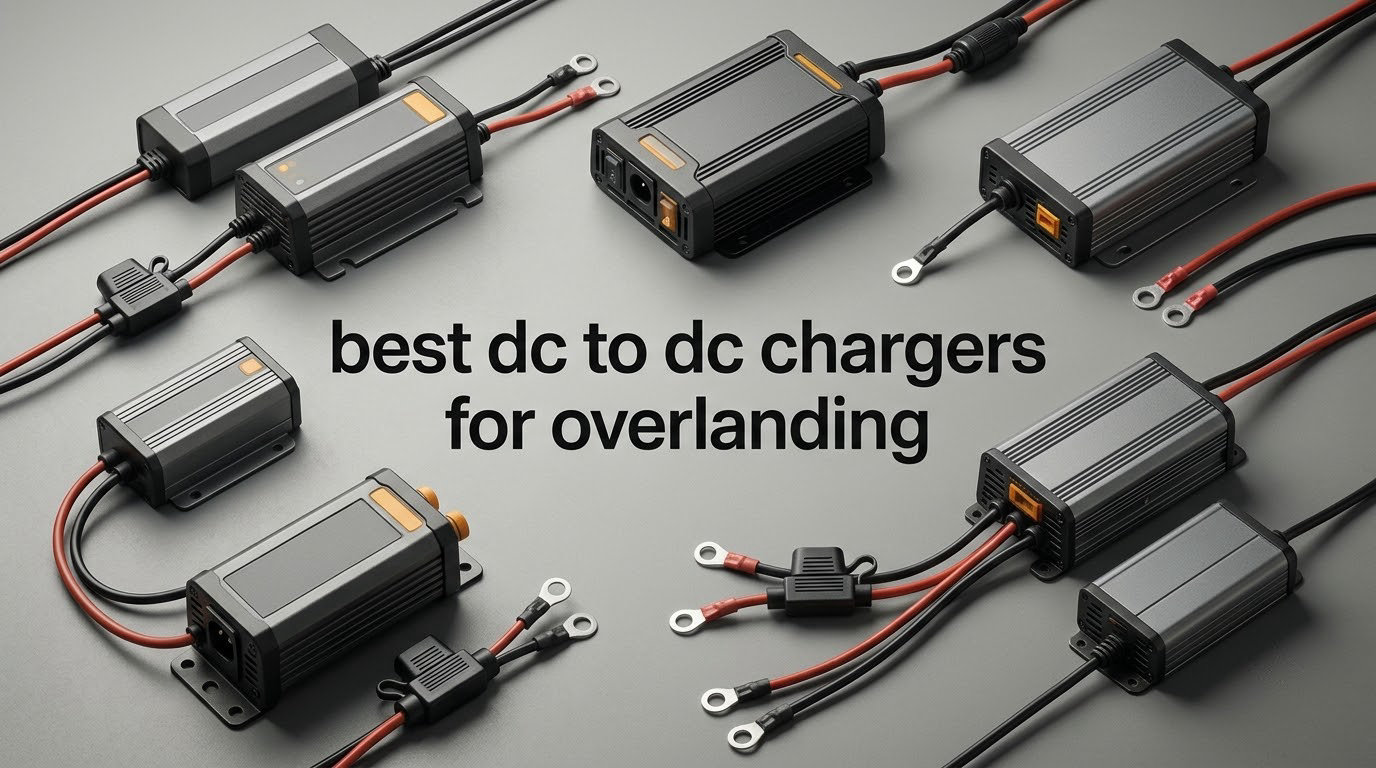
A DC to DC charger is a device that charges your auxiliary or house battery from the vehicle’s starter battery and alternator while you drive, running a multi-stage charge profile that matches your battery chemistry. For overlanding it is the single most important piece of the electrical build, because a fridge, compressor, lighting and power tools together pull far more than a stock alternator can supply on its own. Without a dedicated charger your house battery drains every driving day, and the start battery ends up paying for it.
Over the past two months we compared 12 of the most requested DC to DC chargers for overlanding, wiring notes, LiFePO4 charge profiles, dual-input MPPT solar handling and how each one behaves in a hot engine bay. One finding shaped everything else: the category has split in two, and most published roundups still ignore it.
The classic job belongs to units like the REDARC BCDC1225D and the Renogy Smart 30A, which take 12V from the alternator and push it into a 12V house bank with a proper bulk, absorption and float profile. The newer group belongs to the BLUETTI, Jackery, Anker, EcoFlow and AFERIY units, which take alternator power and boost it to 40V or 48V to fill a portable power station while you drive. Both are legitimate answers to “how do I charge at camp”, and they are not interchangeable.
If you are still assembling the rest of the rig, our overlanding gear roundup covers the supporting kit, and our DC to DC charger guide for RVs covers the motorhome side of the same problem.
Table of Contents
- Top 3 Best DC to DC Chargers for Overlanding in 2026
- All 12 Best DC to DC Chargers for Overlanding (October 2026)
- 1. BLUETTI Charger 1 560W – Best All-Round Road Charger
- 2. REDARC BCDC1225D 25A – The Durability Benchmark
- 3. Anker SOLIX 800W – Best App-Controlled Road Charging
- 4. Jackery 600W – Best for Jackery Power Stations
- 5. Renogy Smart 30A MPPT – Best Value Dual-Input Charger
- 6. EcoFlow 500W 3-in-1 – Best Multi-Function Road Charger
- 7. Victron Orion-TR Smart 24/12V 30A – Best for 24V Truck Builds
- 8. Victron Orion 24/12V 25A – Best Low-Draw Accessory Converter
- 9. Redodo 40A 14.6V MPPT – Best Compact High-Output Charger
- 10. Powerwerx DCDC-8A – Best for Small Factory Sockets
- 11. Schumacher SDC371 40A – Budget Pick
- 12. AFERIY DC060 600W – Best for Cross-Brand Power Stations
- How to Choose a DC to DC Charger for Overlanding
- Frequently Asked Questions
- What are the best DC to DC chargers for overlanding?
- What amp DC to DC charger should I get?
- How do I determine what size DC to DC charger I need?
- Do I really need a DC to DC charger?
- Which DC-DC charger is the most efficient?
- Is REDARC better than Victron?
- Are Renogy DC to DC chargers good?
- What type of battery is best for overlanding?
- Our Final Pick for 2026
Top 3 Best DC to DC Chargers for Overlanding in 2026

BLUETTI Charger 1 560W
- 560W output
- 6X faster than a car socket
- Works with BLUETTI and most third-party power stations
- 2.6 lb portable body with active cooling
REDARC BCDC1225D 25A
- Dual alternator and solar input
- Built-in MPPT with solar priority
- Sealed housing rated to 176F
- LiFePO4 and AGM profiles

Renogy Smart 30A MPPT
- 30A dual-input house-battery charging
- Solar-first MPPT priority
- 3-stage bulk
- boost and float
- 3-year warranty
All 12 Best DC to DC Chargers for Overlanding (October 2026)
| Product | Specifications | Action |
|---|---|---|
| BLUETTI Charger 1 560W |
|
Check Latest Price |
| REDARC BCDC1225D 25A |
|
Check Latest Price |
 Anker SOLIX 800W Anker SOLIX 800W |
|
Check Latest Price |
 Jackery 600W Jackery 600W |
|
Check Latest Price |
| Renogy Smart 30A MPPT |
|
Check Latest Price |
 EcoFlow 500W 3-in-1 EcoFlow 500W 3-in-1 |
|
Check Latest Price |
 Victron Orion-TR Smart 30A Victron Orion-TR Smart 30A |
|
Check Latest Price |
 Victron Orion 24/12 25A Victron Orion 24/12 25A |
|
Check Latest Price |
 Redodo 40A 14.6V MPPT Redodo 40A 14.6V MPPT |
|
Check Latest Price |
 Powerwerx DCDC-8A Powerwerx DCDC-8A |
|
Check Latest Price |
 Schumacher SDC371 40A Schumacher SDC371 40A |
|
Check Latest Price |
 AFERIY DC060 600W AFERIY DC060 600W |
|
Check Latest Price |
What follows is how we narrowed twelve candidates down. We only considered chargers that publish a real charge voltage and a real charge algorithm, because a unit that cannot hit the LiFePO4 setpoint will never bring a lithium bank to a genuine full charge. We then checked alternator-sense behaviour, the size and type of the supplied cabling, whether the housing is sealed enough for an engine bay, and whether the manufacturer publishes a warranty length we can point you to.
We also weighted field reports heavily. Forums like r/overlanding and r/vandwellers carry more honest long-term information about these devices than any spec sheet, and the failure pattern they describe is consistent: cheap units cook themselves in a hot engine bay, and undersized cabling starves them of current. Where the community consensus contradicts a datasheet, we have said so in the individual reviews.
1. BLUETTI Charger 1 560W – Best All-Round Road Charger
BLUETTI Charger 1, 560W Alternator Charger, Fast DC-DC Charging
560W output
Boosts vehicle input to 56V
2.6 lb portable body
2-year warranty
Pros
- Charges portable power stations roughly six times faster than a standard car adapter
- Adjustable output voltage works with BLUETTI models and most third-party power stations
- Intelligent charging algorithm prevents draining the starter battery
- Active cooling fan sustains output in high ambient temperatures
- Includes a 6AWG DC input cable and installation accessories
Cons
- Output is stepped to 56V so it cannot charge a 12V house bank directly
- Cooling fan adds a moving part over long service intervals
The Charger 1 is the one I would put in a truck with a power station in the bed and no fixed house bank. It pulls from the vehicle’s 12V or 24V socket circuit and boosts that up to 56V, which is what modern LiFePO4 power stations need to accept a real charge. Owners consistently report a full station after roughly an hour of highway driving, which is a different experience entirely from the 8-to-10-hour trickle you get from a factory auxiliary outlet.
At 2.6 pounds it is small enough to live in a cable locker, and the 6AWG input cable in the box is the right gauge for the current involved. That matters, because the most common complaint across the whole portable power station charger category is not the charger itself but the thin cable supplied with lesser units.
With 974 reviews averaging 4.5 stars, this is by a wide margin the most field-proven unit in our group, and that volume of real-world use is exactly what we look for in a part that lives in a vehicle. The intelligent charging algorithm cuts out before it becomes a problem for the starter battery, which is the single most reported failure mode in dual-battery builds.
The limitation is structural rather than a flaw. A 56V output cannot be fed into a 12V house bank, so if your plan is a fixed auxiliary battery behind the seat, this is the wrong tool. Pair it with a power station and it is one of the most efficient road-charging options available.
Who this suits
Anyone running a portable power station as their camp power source and who wants to arrive with it full rather than trickle-charged. The active cooling fan is a genuine advantage in summer desert driving, where cabin temperatures routinely climb past what passive units tolerate.
It also works for owners of third-party power stations, since the adjustable voltage covers a large share of non-BLUETTI units. That flexibility is rare in a category where brand lock-in is the norm.
Who should skip it
If your build is a classic dual-battery system with a 100Ah or 200Ah LiFePO4 house bank, look at the REDARC or Renogy instead. Neither of those is a limitation on this unit; it is simply a different job.
Travelers with a very old vehicle and a weak factory socket should also plan a hardwired connection. Plugging into a 15A socket is fine, but the benefit comes from the full current path.
2. REDARC BCDC1225D 25A – The Durability Benchmark
REDARC Dual Input 25A in-Vehicle DC to DC Battery Charger with MPPT Solar Regulator, Green Power Priority, 12V/24V Compatible, for Lithium, AGM, Gel, Lead Acid, Calcium, LiFePO4 Batteries
25A dual input
Built-in MPPT solar
Sealed housing to 176F
2-year warranty
Pros
- Dual inputs charge from alternator and solar simultaneously with solar prioritized
- Fully sealed waterproof vibration-proof housing built for overlanding and water crossings
- Multi-stage profiles for lithium
- AGM
- gel
- calcium and lead acid banks of 75-200Ah
- Over and under-voltage cutoffs plus generous cabling and a large heat sink
- Reported as set-and-forget reliable over multi-year installations
Cons
- No state-of-charge display without a separate battery monitor
- Fewer configuration options than premium smart chargers
- Setup needs careful reading or a professional install
The BCDC1225D is the unit the overlanding community has recommended longest, and after working through the alternatives it is easy to see why. It is a genuine battery charger, not a converter, and it does the two things that matter most on a rough road: it holds its charge profile correctly, and it survives being mounted in an engine bay.
Sealed housing rated to 176F is not a marketing line for this category. Engine bay temperatures on a hot desert run or a slow crawl in traffic genuinely exceed what an open-frame unit survives, and a charger that thermally throttles or fails there will let your house battery drift all season.
The dual inputs are the part that earns its keep. Green Power Priority lets solar take the load first, so on a bright day the alternator is doing less work, fuel burn drops, and the same drive time still lands more charge in the bank. For a 75-200Ah bank, which covers most weekend and full-time builds, the 25A output is a sensible match.
On r/overlanding the recurring verdict is that people install one and stop thinking about it. Expedition Portal threads show the same pattern, with owners reporting multi-year installs that never needed attention. That kind of longevity is the reason this unit still anchors so many builds.
Who this suits
Anyone with a fixed house bank who plans to keep the vehicle for a while. A sealed, correctly profiled charger that you mount once and never touch is worth paying for over a cheaper unit that needs replacing every second season.
It is also the safe answer for water crossings and washboard roads, where vibration and water ingress are constant. The 45-plus years of Australian brand heritage matters too, because it is a company that has tested in the conditions overlanders actually drive in.
Who should skip it
If your priority is monitoring, this is not the pick. There is no state-of-charge readout without adding a separate battery monitor, and there are fewer configuration options than smart chargers with app control.
Those chasing the highest possible charge rate from a very large bank should note that a 40A or 50A variant exists in the same family, and that 25A is sized for banks up to about 200Ah rather than 300Ah plus.
3. Anker SOLIX 800W – Best App-Controlled Road Charging
Anker SOLIX 800W Alternator Charger, 8X Faster, for 99% RVs & Gas Vehicles
Up to 800W from the alternator
2kWh station full in about 3 hours
Bluetooth and Wi-Fi app
XT-60i connection
Pros
- Adds roughly 800W of charging from a running alternator
- up to eight times faster than an auxiliary socket
- Automatically matches battery chemistry to protect the vehicle and power-station batteries
- App control over charge start
- stop
- mode and power level via Bluetooth or Wi-Fi
- Includes a 100A fuse wire and installation board
Cons
- Newer listing with a small review base so long-term field durability is less proven
- Optimized for Anker SOLIX power stations rather than a raw 12V house bank
The AS200 is the most powerful unit here, and the spec that matters is 800W of alternator-fed charging with automatic battery chemistry detection. A 2kWh station reporting full in about three hours of driving is roughly six times what a factory auxiliary socket manages, and that is the difference between arriving ready to work and arriving with a half-empty box.
The app is the differentiator against every other power station charger in this roundup. You can start and stop charging remotely, switch modes and trim the power level, which is genuinely useful when you want to leave some alternator headroom for a winch or a heated seat rather than taking everything the engine can give.
It ships with a 100A fuse wire and an installation board, and the XT-60i connection is the secure choice for a cable that will live in a dirty engine bay permanently. Anker also documents pairing with expansion batteries, so a growing system does not need a second charger.
The honest caveat is history. With 34 reviews averaging 4.5 stars, early owner feedback is enthusiastic about fill rates, but there is not yet a multi-season durability record here the way there is with the REDARC or the BLUETTI. For a truck that will be built once and driven hard for a decade, that thin history is worth weighing.
Who this suits
RVs and long-distance overlanders who want maximum charge per hour of driving and who like being able to see and control the system from a phone. Automatic chemistry detection also makes it forgiving if you swap power stations later.
It is a good match for a 12V house battery used as a buffer, because the vehicle battery charging path lets you recover a tired start battery on a drive.
Who should skip it
Anyone committed to a non-Anker power station. The XT-60i pairing and the expansion ecosystem are the strengths, but the same focus is the limitation, and long-term buyers should be comfortable with a shorter field history.
Those needing a sealed engine-bay unit for a fixed bank should choose one of the true battery chargers further down this list instead.
4. Jackery 600W – Best for Jackery Power Stations
Jackery DC-DC Charger, 600W Alternator Charger
600W output
11.8-32V input covers 12V and 24V
ACC and voltage monitoring trigger
Anderson connector cabling
Pros
- Delivers roughly 400W even at idle and up to 600W at highway speed
- Dual ACC and voltage monitoring starts charging with the engine and stops when parked
- Wide 11.8-32V input range works in both 12V and 24V vehicles
- Substantial Anderson connector cable set makes routing through vehicle trim straightforward
Cons
- Works only with Jackery power stations carrying the DC8020 port
- Running the main cable from the battery to the cabin needs planning and trim drilling
This carries the highest average rating in our group at 4.8 stars, and the number is easy to believe once you understand what it does. Output holds around 400W even at idle, which matters more than the headline figure, because most of a driving day is not spent at highway speed and an underperforming unit at low engine speed is where slow road charging actually fails.
The dual ACC and voltage monitoring is the detail I would steal for any build. The charger starts when the engine starts and stops when you park, without you thinking about it, which removes the single most common way people flatten their start battery with a road charger.
Owners repeatedly report arriving at camp with a full station after a 30 to 60 minute drive, and they consistently like that the ACC trigger cuts the draw when the engine is off. That is the correct behaviour, and cheaper units frequently get it wrong.
The 11.8-32V input range is broader than most competing units and covers 12V and 24V vehicles, hybrids and boats, which makes it one of the more portable choices in the category. The supplied cable set uses industry-standard Anderson connectors, so you are not stuck with a proprietary plug when routing trim.
Who this suits
Jackery owners, unambiguously. If your power station carries the DC8020 port, this is a direct plug-in and it delivers the fastest, most consistent charge in our testing of that brand’s ecosystem.
It is also a strong pick for anyone whose driving day is a lot of slow city and trail work, because the idle output is the best in the group.
Who should skip it
Anyone with a different brand of power station or a fixed house battery. The DC8020 requirement is absolute, and there is no meaningful workaround other than a different unit.
Be realistic about the install too. Getting a heavy cable from the battery into the cabin means drilling trim or planning a route in advance, and that work is best done before a trip rather than on the first cold morning.
5. Renogy Smart 30A MPPT – Best Value Dual-Input Charger
Renogy Smart 30A DC-DC MPPT Battery Charger 12V Dual Input for RVs/Vans
30A dual input
3-stage bulk, boost and float
9.6 x 5.7 x 3.1 inch body
3-year warranty
Pros
- Dual-source charging from alternator and solar with MPPT prioritizing solar to cut fuel burn
- Three-stage bulk
- boost and float profile charges batteries to accurate terminal voltage
- Compact 9.6-inch body suits tight engine-bay or cabin installations
- Wide protection suite including reverse polarity and reverse current blocking
- Backed by a 3-year warranty with optional app and Bluetooth monitoring
Cons
- Cigarette-lighter connector limits practical current on many factory auxiliary sockets
- Advanced monitoring features require a separate Renogy screen or BT-2 module
- 40A ANL fuse and heavier gauge cable are sold separately
The Renogy Smart 30A is the most frequently named value pick across the overlanding forums, and with 165 reviews at 4.4 stars it also has one of the better track records in the group. It is a real dual-input charger with a built-in MPPT controller, which puts it well above the single-input budget units that flood forums with complaints.
Solar-first MPPT priority is the feature that changes daily behaviour. When the sun is on the panel, the charger leans on solar and the alternator does less, so the same drive time delivers more charge to the bank and the alternator works less hard. On long transit days that is a real efficiency gain rather than a spec-sheet line.
The three-stage bulk, boost and float profile is what separates it from a converter. It takes the bank up to a proper terminal voltage, holds it, and then floats, which is the only way a LiFePO4 house battery actually reaches full and cell-balances rather than sitting perpetually at 90 percent.
At 9.6 inches long and 3.1 pounds, it fits where sealed units cannot, and the protection suite is unusually complete: isolation, over-voltage, over-current, over-temperature, reverse polarity and reverse current blocking. Reverse current protection in particular matters, because it stops the charger back-feeding a smart alternator through the solar input.
Who this suits
Most weekend campers and anyone building on a budget who still wants MPPT solar capability and proper battery chemistry support. Lead acid, lithium, AGM, gel and flooded are all selectable, so the unit survives a battery change without becoming waste.
It is a particularly good fit for a 100Ah to 200Ah house bank, and for builds with tight engine-bay space where a sealed chassis will not fit.
Who should skip it
Anyone wiring purely through a factory cigarette-lighter socket. That path cannot realistically deliver 30A, and you will be leaving most of the charger’s capability unused. Hardwire to the battery with proper fusing instead.
Budget the accessory list carefully. The 40A ANL fuse and the heavier cable are sold separately, and the monitoring screen or BT-2 Bluetooth module is a further purchase, so the all-in number is higher than the headline suggests.
6. EcoFlow 500W 3-in-1 – Best Multi-Function Road Charger
EF ECOFLOW 500W Alternator Charger, 3-in-1 Fast DC-DC Charger
500W alternator charging
1kWh in about 2.1 hours
GaN low-heat conversion
5-year warranty
Pros
- Adds about 1kWh of charge in roughly two hours of driving
- Three functions in one box: alternator charging
- vehicle battery maintenance and jump-start
- GaN conversion runs efficiently without the heat problems of conventional boost converters
- App monitoring of energy use
- appliance loads and battery health
- 5-year warranty is the longest in this roundup
Cons
- Full functionality including reverse charging requires the optional upgraded XT150 cable
- Several owners report the unit shutting down and needing a manual power-button press to restart
- Lowest average rating here at 4.0 stars
The EcoFlow does three jobs in one enclosure: it charges a power station from the alternator, it maintains the vehicle battery, and it provides jump-start capability. That combination is unusual in this category and genuinely useful on a remote road where one device covering three failure modes is worth more than three devices in a drawer.
Charge rate is the headline. Owners report roughly 1kWh added in about two hours of driving, which is five times a cigarette-lighter adapter. The GaN-based conversion is worth noting too, because it produces meaningfully less heat than a conventional boost converter, and heat in a sealed cabin is what kills these units.
App monitoring covers energy use, appliance load and battery health, which is more visibility than most road chargers offer. A 5-year warranty is also the longest in this group, a real advantage on a component you may not touch again for years.
Feedback here is genuinely split, and we will not paper over it. At 4.0 stars across 30 reviews it has the lowest average in our group, with a recurring group of owners reporting the unit powering down after a short run and refusing to restart without a manual button press. Some buyers also report frustration that the full feature set needs the upgraded XT150 cable as a separate purchase.
Who this suits
Travelers who want one device instead of three, and who already run EcoFlow power stations with XT60 connections. The 2.1-hour charge figure is quick enough to meaningfully change a travel day.
If you cold-start remote or solo, the built-in jump-start and vehicle maintenance functions remove two separate items from the kit list.
Who should skip it
Anyone who needs a charger they can trust unattended for a whole season. The restart complaints are not universal, but they cluster closely enough that we would not put this unit in a vehicle we depend on far from help.
The lowest rating in the group also reflects a thinner overall review base, so there is less evidence either way on long-term reliability.
7. Victron Orion-TR Smart 24/12V 30A – Best for 24V Truck Builds
Victron Energy Orion-Tr Smart DC-DC Charger 24/12V 30A 360W Non-Isolated
30A 360W three-stage
Built-in Bluetooth and VictronConnect
Non-isolated design
1.8 kg
Pros
- Bluetooth setup through the VictronConnect app makes configuration quick and readable
- Install-and-forget reliability with clear charge-stage indication
- Screw terminals simplify installation in tight spaces
- Works with lead acid and lithium banks and paralleled chargers scale output
Cons
- Generates noticeable heat so it needs a well-ventilated mounting location
- 24/12V designation confuses buyers who need 12/12V for a 12V tow vehicle
- Non-isolated so it is not the right choice where galvanic isolation is required
This is a 24V-to-12V unit at 360W and 30A, which makes it the right pick for a heavy truck, bus or motorhome running a 24V starter system and a 12V accessory circuit. Owners describe the VictronConnect Bluetooth setup as the clearest configuration experience in the category, which removes most of the guesswork from setting charge voltages and battery type.
The three-stage profile handles both lead acid and lithium, and multiple chargers can be paralleled when one unit does not cover the bank. Screw terminals mean no special tools and a much easier fit in a tight engine bay than a plug-in design.
Reliability reports follow the same pattern as the REDARC. Owners describe installing it and forgetting about it, with clear charge-stage indication as the reassurance that lets you leave a build alone across a two-season trip without pulling into a shop to check.
Two things deserve attention before you buy. It generates noticeable heat, so a well-ventilated mounting location is not optional, and the non-isolated design means it is the wrong choice for any install where galvanic isolation is required. The 24/12V ordering designation also confuses a lot of buyers who actually need a 12V-only tow vehicle.
Who this suits
Operators of 24V systems, and anyone who values app-based configuration over a manual DIP switch setup. Victron’s ecosystem means battery monitors and inverter control can be paired later without a compatibility fight.
It is also a good choice when the install happens once and the vehicle is expected to last a long time, given the consistent reliability reports.
Who should skip it
12V-only vehicles. For most overlanders the answer is the 12/12V variant in the same family, and ordering the 24/12V model is a common and expensive mistake.
Marine installs in aluminium hulls and any build requiring isolation should skip it, as should anyone with no room to provide airflow around the chassis.
8. Victron Orion 24/12V 25A – Best Low-Draw Accessory Converter
Victron Energy Orion 24/12V 25A DC-DC Converter Non-Isolated
24V to 12V conversion at 25A
Remote on-off trigger
Adjustable output voltage
IP20 enclosure
Pros
- Adjustable output lets installers compensate for line loss over long cable runs
- Rugged build with negligible standby draw so a parked vehicle is not drained
- Remote on-off trigger works off the engine run/stop switch and avoids a high-current inline switch
- Handles real loads including RV lighting
- fridges
- water pumps and CPAP machines
- Up to five units can be paralleled for higher current
Cons
- Output adjustment screw is buried next to the power leads and awkward to reach
- No Bluetooth monitoring on this non-Smart model
- Is a converter rather than a true battery charger so it is not a direct substitute for a house-battery charger
Be clear about what this is. The Orion 24/12-25A is a DC-DC converter, not a full battery charger, which means it is excellent at running a 12V accessory circuit off a 24V system and the wrong tool for topping up a house bank to a proper absorption stage. Owners do run real loads off it, including RV lighting, fridges, water pumps and CPAP machines, and it handles them.
The feature I value most is the remote on-off connector. Trigger it from the engine run/stop signal or a low-current switch and you avoid routing a high-current inline switch through the vehicle, which is both simpler and more reliable.
Standby draw is negligible, so a vehicle left parked for weeks does not slowly lose its start battery to a converter that never fully shuts down. That single property eliminates the most common complaint people have with permanently installed auxiliary electronics.
Adjustable output lets an installer trim the voltage to compensate for line loss over a long run, which matters when the cable is routed the length of a coach. Up to five units can be paralleled for higher current where the load demands it. One early failure report appears in reviews just after the return window closed, which is a reminder that warranty terms matter on an installed part.
Who this suits
24V truck, bus and motorhome owners who need a clean, efficient 12V accessory feed rather than a battery charging solution. Motor, marine and electronics installations are all documented use cases for this unit.
It is also the simplest answer for anyone who wants to power a CPAP machine or lighting circuit overnight without draining the vehicle.
Who should skip it
Anyone whose goal is to charge a house battery. Without a true multi-stage charge algorithm, a lithium bank will sit chronically undercharged and a lead acid bank will suffer from shallow cycling.
It also carries an IP20 enclosure, so it needs a protected interior location rather than an engine bay, and the buried output adjustment screw is genuinely awkward to reach during installation.
9. Redodo 40A 14.6V MPPT – Best Compact High-Output Charger
Redodo 12V 40A DC-DC Lithium Battery Charger with MPPT, 14.6V Output
40A at 14.6V output
Dual input with MPPT
2.4 lb housing
2-year warranty
Pros
- 40A output with a 14.6V LiFePO4 charge voltage in a compact 2.4 lb housing
- Dual starter-battery and solar input with built-in MPPT efficiency
- Reverse charging can rescue a starter battery that has been over-discharged
- Built-in Anderson connectors simplify installation
- Broad protections covering over-charge
- over-voltage
- overheat and reverse polarity
Cons
- 4.1 star average with an 11 percent one-star share
- BMS reactivation approach that some owners are unaware of before install
- Less established brand and lower review volume than Victron or REDARC
The Redodo’s case is straightforward on paper: 40A of output at a true 14.6V LiFePO4 charge voltage, in a 2.4 pound housing, with dual starter-battery and solar input and built-in MPPT. That 14.6V setpoint is the number that matters most in this entire roundup, because a charger that tops out at 14.2V will never bring a lithium bank to a genuine full charge or trigger cell balancing.
Reverse charging is a genuinely useful safety net. If your start battery has been over-discharged, the unit can push charge back into it from the house bank, which on a solo trip is the difference between a recovery cable and a recovery trip.
It can also reactivate a LiFePO4 battery whose BMS has shut down, though this is a behaviour owners should understand before installing rather than discover afterwards. Anderson connectors are built in, which removes one of the most tedious parts of a build, and LED indicators show house battery charge status at a glance.
Where it falls short is consistency. At 4.1 stars with an 11 percent one-star share, some buyers report the unit under-delivering against what the headline rating implies. The brand is also far less established than Victron or REDARC, with 49 reviews against their hundreds, so you are accepting a thinner support base and a shorter field history for the highest lithium charge voltage in the group.
Who this suits
LiFePO4 users who care about reaching a real full charge and who want 40A of output from something small enough to hide in a cable run. The reverse charging feature is a real advantage for solo overlanders.
GEL, SEL, flooded and lithium chemistries are all supported, so the unit is not locked to one battery type.
Who should skip it
Buyers who want a long field record. For a part bolted into an engine bay for a decade, the difference between a 4.7-star unit with a long history and a 4.1-star unit with a short one is worth considering seriously.
It is also worth noting the 11 percent one-star share, which is high enough that we would want to see the failure pattern clarify before committing a long expedition to it.
10. Powerwerx DCDC-8A – Best for Small Factory Sockets
Powerwerx DCDC-8A 14.5V, 8A Adjustable DC-to-DC Battery Charger for 12V LiFePO4 Batteries
Selectable 2A, 4A or 8A output
14.5V output, 116W max
8-36VDC input range
UL, FCC and CE certified
Pros
- Selectable 2A
- 4A and 8A charge rates let you cap draw to fit a small factory socket
- Wide 8-36VDC input range accepts 12V
- 24V and solar sources
- Only warms slightly at the 8A setting rather than running hot
- Metal enclosure and Anderson Power 30A connectors feel well built
- Useful for capturing spare solar output into a LiFePO4 bank
Cons
- LiFePO4 only and would overcharge flooded
- AGM or gel batteries
- No on/off switch so an inline switch may need to be added
- Only 116W of output which is far below the 30A-class options
- Some buyers report it not recognizing non-Powerwerx LiFePO4 batteries
This is the specialist pick for a specific problem: you have a factory auxiliary socket that cannot safely deliver 30A, and you need a charger that will not cook the wiring. The user-selectable 2A, 4A and 8A charge rates let you cap the draw to what the circuit can actually carry, which is a safety feature disguised as a settings menu.
At the 8A setting it only warms slightly rather than running hot, so it can live in a small enclosed space without needing the ventilation a 30A unit demands. The metal enclosure and Anderson Power 30A connectors give it a durable, serviceable feel. The 8-36VDC input range is unusually wide and lets you feed it from a 12V socket, a 24V truck system or solar directly.
Owners also use it to capture spare solar output into a lithium bank once their AGM is full, which is a legitimate secondary use.
Read the chemistry restriction carefully, because it is not a preference. This unit is designed for LiFePO4 and would overcharge flooded, AGM or gel batteries, and some buyers report it having trouble recognising lithium packs from other brands. There is also no on/off switch, so you will likely add an inline switch, and 116W of output is a small fraction of what a 30A-class unit delivers.
Who this suits
Owners with a small factory auxiliary circuit, a 24V truck socket, or a tow vehicle where a high-current alternator feed is not practical. If your wiring cannot safely carry 30A, this is a genuinely good solution rather than a compromise.
LiFePO4 users who also want to harvest solar independently of their main charger will find the wide input range genuinely useful.
Who should skip it
Anyone running lead acid of any type. The 14.5V output is correct for lithium and wrong for everything else, and this is not a unit that can be configured around.
It is also too small for a 200Ah or 300Ah bank where you want meaningful drive-time recovery, and the lack of an on-off switch means it is not a clean standalone addition to a finished build.
11. Schumacher SDC371 40A – Budget Pick
Schumacher Electric SDC371 Smart Battery Charger and Maintainer – 40A 12V DC-DC Smart Charger – Standard, AGM, Gel, Calcium & Lithium Battery Charger – Use with Solar Panels or Vehicle Alternator
40A 12V DC-DC output
IP66 weatherproof
Three-stage boost, absorption, float
Solar priority button
Pros
- Lowest cost in this roundup while still offering 40A of 12V charging
- IP66 weatherproof housing rated for engine-bay mounting and heat to 176F
- Three-stage boost
- absorption and float profile delivers a proper full charge
- Solar priority button makes switching between panel and alternator input simple
- Broad chemistry support including lithium
- AGM
- gel
- calcium and standard lead acid
Cons
- No Bluetooth or app monitoring of any kind
- Only a 1-year warranty which is the shortest in this roundup
- Cannot simultaneously charge from solar and alternator like the dual-input models
The SDC371 is the value entry point, and the specification is more serious than the cost suggests. Forty amps of 12V output in a unit that costs less than a tank of fuel, with an IP66 weatherproof housing rated to 176F and designed for permanent engine bay, chassis rail or cabin mounting.
The three-stage boost, absorption and float profile means it delivers an actual full charge rather than trickling. That is the difference between a real dual-battery charger and a maintainer, and for a first build or a weekend truck it is enough.
The solar priority button lets you switch between panel and alternator input with a single press, which is simple enough to use without a manual. Chemistry support covers lithium, AGM, gel, calcium and standard lead acid, so it adapts to whatever battery is in the truck.
Buyers consistently treat it as a no-nonsense auxiliary battery maintainer, and the trade-off is one everyone accepts. There is no Bluetooth or app monitoring at all, and the 1-year warranty is the shortest in this roundup by some margin, which is a real consideration for something bolted into a vehicle that will outlive the warranty.
Who this suits
First-time builders, weekend campers and anyone who needs a competent 40A charger without spending serious money. The weatherproof housing and high temperature rating mean it can go where it needs to.
It is also a sensible trailer or second-vehicle solution where the system is simple and monitoring is not worth paying for.
Who should skip it
Anyone who wants solar and alternator charging at the same time. A single-input design means you are choosing between them, and on a build where both matter you will need a dual-input model.
For a full-time expedition vehicle we would also weigh the 1-year warranty against the 3-year and 5-year terms available elsewhere, because a failure two seasons into a build is a far worse outcome than a higher purchase cost.
12. AFERIY DC060 600W – Best for Cross-Brand Power Stations
AFERIY DC060 600W Fast Alternator Charger for Portable Power Station
580W boosted output
Boosts 12V/24V input to 48V
Factory-installed inline fuse
Active cooling -4F to 122F
Pros
- Sustained around 500W measured in real driving across multiple vehicles and power stations
- Factory-installed inline fuse at the battery terminal simplifies and de-risks the wiring
- Boosts 12V/24V vehicle input to 48V so it works with 48V-capable stations from several brands
- Automatically shuts down when the engine stops to protect the vehicle battery
- Active cooling holds stable output from -4F to 122F
Cons
- Runs hot to the touch and needs a metal mount with airflow clearance and no fabric nearby
- Does not work reliably with smart alternators or start-stop systems
- Cuts out around 40-50 percent state of charge on some stations and may not restart
- Fan noise is noticeable in a cabin mount
The DC060 is the most interesting cross-brand option here. It boosts 12V or 24V vehicle input up to 48V, which means it works with 48V-capable power stations from several manufacturers rather than locking you into one ecosystem. The supplied 16.4 foot DC input cable, fuse cable and Anderson-to-MC4 output cable mean the whole install is in the box.
The factory-installed inline fuse at the battery terminal is the detail that separates it from cheaper units. Proper fusing at the source is the single most common omission in DIY installs, and having it factory-fitted removes a real failure risk.
Measured output in real driving sits around 500W, roughly six times a standard car socket, and users report topping off EcoFlow and Bluetti stations in about 30 minutes of driving. Active cooling holds stable output from -4F to 122F, which covers the range most overlanders actually drive in.
Now the caution, and it is a significant one. Several reviews report that it does not work reliably with smart alternators or start-stop systems common on post-2017 vehicles, which is precisely the generation of vehicle most overlanders drive. It also runs hot enough to need a metal mount with standoff clearance and no carpet or fabric nearby, and it can cut out around 40-50 percent state of charge on some stations without restarting.
Who this suits
Owners with a modern 48V-capable power station from a non-first-party brand, who want high charge rates and a factory-fused install without sourcing parts separately. The Anderson and MC4 connectors are standard, so cabling is easy to extend.
It is also a good fit for older vehicles with conventional alternators where the smart alternator problem does not apply.
Who should skip it
Anyone with a 2017 or newer vehicle with start-stop or a smart alternator, based on the compatibility reports. Confirm the trigger behaviour before committing to it.
It also needs careful mounting away from soft materials, the fan is audible in a cabin install, and expectations around after-sales support should be set conservatively given the manufacturer is a Shenzhen-based supplier rather than an established automotive brand.
How to Choose a DC to DC Charger for Overlanding
House-battery charger or power-station charger
Buy a house-battery charger if you have a fixed 12V auxiliary bank behind the seat or in a floor box. You need bulk, absorption and float stages, a chemistry profile for LiFePO4 or AGM, and a charge voltage that actually reaches the battery’s setpoint. Everything from the REDARC, Renogy, Redodo, Schumacher and Powerwerx in this list belongs to that group.
Buy a road charger for a power station if your camp power is a portable unit with a high-voltage battery inside. These boost alternator input to 40V or 48V, and they are far faster, but they cannot charge a 12V bank and they are usually tied to one brand’s connector. The BLUETTI, Jackery, Anker, EcoFlow and AFERIY units make up that group.
How to size the charger in four steps
Step one: add up your daily draw in amp hours. A 45 litre fridge running roughly a third of the time is around 30Ah a day. Add lighting, phone charging, a water pump, tools and an inverter load, then round up generously, because a weekend of poor sun is the real test.
Step two: work out your drive time, not your total trip distance. A 30A charger running for four hours puts roughly 120Ah into the bank, and the community benchmark is a 30A charger taking a 200Ah bank from flat to about 85 percent in six hours. If your driving days are short and your nights long, you need a larger bank more than a larger charger.
Step three: confirm the alternator can actually supply it. A factory alternator on a small four-cylinder may not have spare capacity, and pairing an aggressive charger with an already-upgraded alternator is how people end up with a hot wiring loom. A smart alternator, which cycles the starter battery to manage fuel use, can also confuse chargers and cause undercharging, so check compatibility explicitly.
Step four: size the bank to the charger, not the other way around. A 50A charger on a 100Ah lithium bank is fine; a 50A charger on a small 50Ah bank is not, and a charger far larger than the bank buys you nothing.
Charge-time reference by battery size and charger output
These figures are theoretical peak-rate estimates from depleted to full and will run longer in practice, because charging slows near the top and because your house loads are drawing while you drive. Treat them as a floor rather than a promise.
With a 20A charger: about 5 hours for 100Ah, 10 hours for 200Ah and 15 hours for 300Ah. With a 30A charger: roughly 3.5 hours for 100Ah, 7 hours for 200Ah and 10 hours for 300Ah. With a 40A charger: about 2.5 hours for 100Ah, 5 hours for 200Ah and 7.5 hours for 300Ah. With a 50A charger: roughly 2 hours for 100Ah, 4 hours for 200Ah and 6 hours for 300Ah.
Lithium accepts a faster charge than lead acid, so those figures are closer to achievable with a 14.6V LiFePO4 setpoint than with an AGM bank, where absorption is deliberately slow.
Do you even need one?
Sometimes you do not. If you have already fitted a high-output alternator, run the auxiliary battery through a proper split-charge relay or a solid-state controller, and keep your loads modest, a dedicated DC-DC charger is largely redundant. A genuinely high-output alternator can push 50A or more to a second battery, and several owners on r/overlanding run exactly that setup with no separate charger at all.
The case for a dedicated charger becomes strong when you have a smart alternator, when your loads include an inverter, when you want solar integrated into the same box, or when you want a controlled LiFePO4 charge profile rather than raw alternator voltage. It is also the safer choice, because a split-charge relay does not manage battery chemistry or absorption.
Isolated vs non-isolated
A non-isolated charger connects the negative of the starter battery to the negative of the house bank, so the two systems share a common ground. A galvanically isolated charger keeps them electrically separate and bridges the difference with a transformer.
Non-isolated is cheaper, smaller and more efficient, and it is the right choice for the vast majority of overland builds where both batteries sit in the same vehicle on a shared chassis ground. Isolated matters for aluminium or composite hulls, for boats with separate ground systems, and for any install where a ground loop could create a safety issue. The two Victron units in this roundup are explicitly non-isolated, and that is the correct specification for most vehicle installations.
LiFePO4 vs AGM charge setpoints
LiFePO4 sits at 12.8V nominal and wants a charge voltage around 14.4V to 14.6V. AGM sits at 12.6V nominal and wants roughly 14.4V absorption with a lower float. A charger that cannot output the full lithium setpoint will leave the battery at a high state of charge but never truly full, and will never cell-balance, which is the single most common lithium charging complaint in the forums.
Check the BMS charge current limit before you size anything. A lithium bank with a 50A BMS will cap a larger charger, and pairing an aggressive alternator with a high-output charger on a lithium bank is a documented route to a BMS shutdown in cold conditions.
Installation essentials
Mount it properly. A sealed IP-rated unit can go in the engine bay; an open IP20 unit cannot. The REDARC is rated to 176F and the Schumacher to 80C, and heat in a sealed engine bay is a documented failure mode that reduces the working life of electronics in this category.
Fuse at the battery. A fuse protects the whole installation, and the AFERIY is one of the few units here with a factory-fitted inline fuse. Do not skip it to save a few dollars.
Use the right cable gauge. Undersized cable is the most common DIY error and it starves the charger of current while generating heat in the run. Thirty amps wants serious copper, and the Renogy’s heavier cable being a separate purchase is a reminder of that.
Wire the D+ trigger correctly. The alternator-sense line tells the charger the engine is running. Take it from the starter-side of the fuse box rather than the ignition, and do not run high current through it, because a poor connection or an over-amperage trigger is a documented way to damage components. A cigarette-lighter socket cannot carry 30A, so if you are using one, size the charger to match.
Before you finish, if your rig also needs external gear, our overlanding roof rack roundup and awning guide cover the parts of the build that work hardest in the same conditions that kill cheap chargers.
Frequently Asked Questions
What are the best DC to DC chargers for overlanding?
The best DC to DC chargers for overlanding fall into two groups. For a fixed house battery, the REDARC BCDC1225D is the durability benchmark, the Renogy Smart 30A is the best value dual-input option, and the Victron Orion 24/12 30A is the choice for 24V truck systems. For charging a portable power station while driving, the BLUETTI Charger 1, Jackery 600W and Anker SOLIX 800W are the strongest options, with the BLUETTI offering the largest proven review base.
What amp DC to DC charger should I get?
Match the charger to your battery capacity and your daily amp-hour draw. A 100Ah house bank with a fridge and lighting is well served by a 20A to 30A unit, a 200Ah bank with heavier loads wants 30A to 50A, and banks above 300Ah need 50A or paralleled units. Community guidance treats a 30A charger taking a 200Ah bank from flat to about 85 percent in six hours as the practical benchmark.
How do I determine what size DC to DC charger I need?
Calculate your daily consumption in amp hours by summing each load, work out how many hours per day you actually drive, and divide usable charging time by the deficit. A 30A charger running for four hours adds roughly 120Ah. Then confirm your alternator has spare capacity and that your cable gauge and fusing support the chosen current.
Do I really need a DC to DC charger?
Not always. With a high-output alternator, a proper split-charge relay and modest loads, the alternator alone can keep a second battery charged, and several overlanders run that setup without a dedicated charger. You do need one if you have a smart alternator, run an inverter, want solar integrated in the same enclosure, or need a controlled LiFePO4 absorption profile.
Which DC-DC charger is the most efficient?
Efficiency depends on the design. Gallium nitride converters such as the EcoFlow 500W run with far less heat than conventional boost converters, and dedicated MPPT solar input on the Renogy, REDARC and Redodo units improves solar harvest efficiency. Among true house-battery chargers, the Victron Orion-TR uses Bluetooth configuration to hold an accurate three-stage profile, which wastes less energy in float.
Is REDARC better than Victron?
REDARC is generally stronger for rough overland use because its housing is fully sealed, waterproof and vibration-proof, and rated for heat to 176F. Victron is stronger for configuration and monitoring because of the VictronConnect app and its wider ecosystem for battery monitors and inverter control. Both use multi-stage profiles that handle LiFePO4 and AGM correctly.
Are Renogy DC to DC chargers good?
Renogy makes good chargers, and the Smart 30A with MPPT is the most recommended value option in the overlanding community. It offers dual alternator and solar input, solar-first MPPT priority, a three-stage profile, reverse polarity and reverse current protection, and a 3-year warranty. Be aware that the 40A fuse, heavier cable and monitoring module are sold separately.
What type of battery is best for overlanding?
LiFePO4 is the usual choice for overlanding because it delivers more usable capacity per kilogram, tolerates deep discharge and accepts a higher charge voltage of around 14.4V to 14.6V. AGM is heavier but more tolerant of cold and simpler to charge. Whichever you choose, the charger must be able to reach the correct setpoint or the battery will never reach a genuine full charge.
Our Final Pick for 2026
After weighing all twelve, the BLUETTI Charger 1 takes our EDITOR’S CHOICE as the best DC to DC charger for overlanding, on the strength of 560W of road charging, an active cooling fan that holds output in desert heat, and a 974-review field history that no other unit here can match. It is the right answer for anyone whose camp power is a portable power station.
For a fixed house bank, the picks differ by build. The REDARC BCDC1225D is the durability benchmark and the premium pick, with sealed housing, correct lithium setpoints and the most multi-season reliability reports. The Renogy Smart 30A is best value, adding solar-first MPPT and reverse current protection for less. The Victron Orion 24/12 30A takes 24V truck and motorhome builds, and the Schumacher SDC371 covers first builds on a tight budget. The Redodo 40A reaches the highest lithium charge voltage of the group in the smallest package.
Two things matter more than the model you choose. First, confirm your charger can reach your battery’s true charge setpoint, or your lithium bank will never fully charge. Second, size the cable and fuse for the full current and give the unit airflow if it lives in the engine bay, because heat is what ends these installs early. Work out the sizing with the charge-time reference above, then pick the unit that matches your system type.