
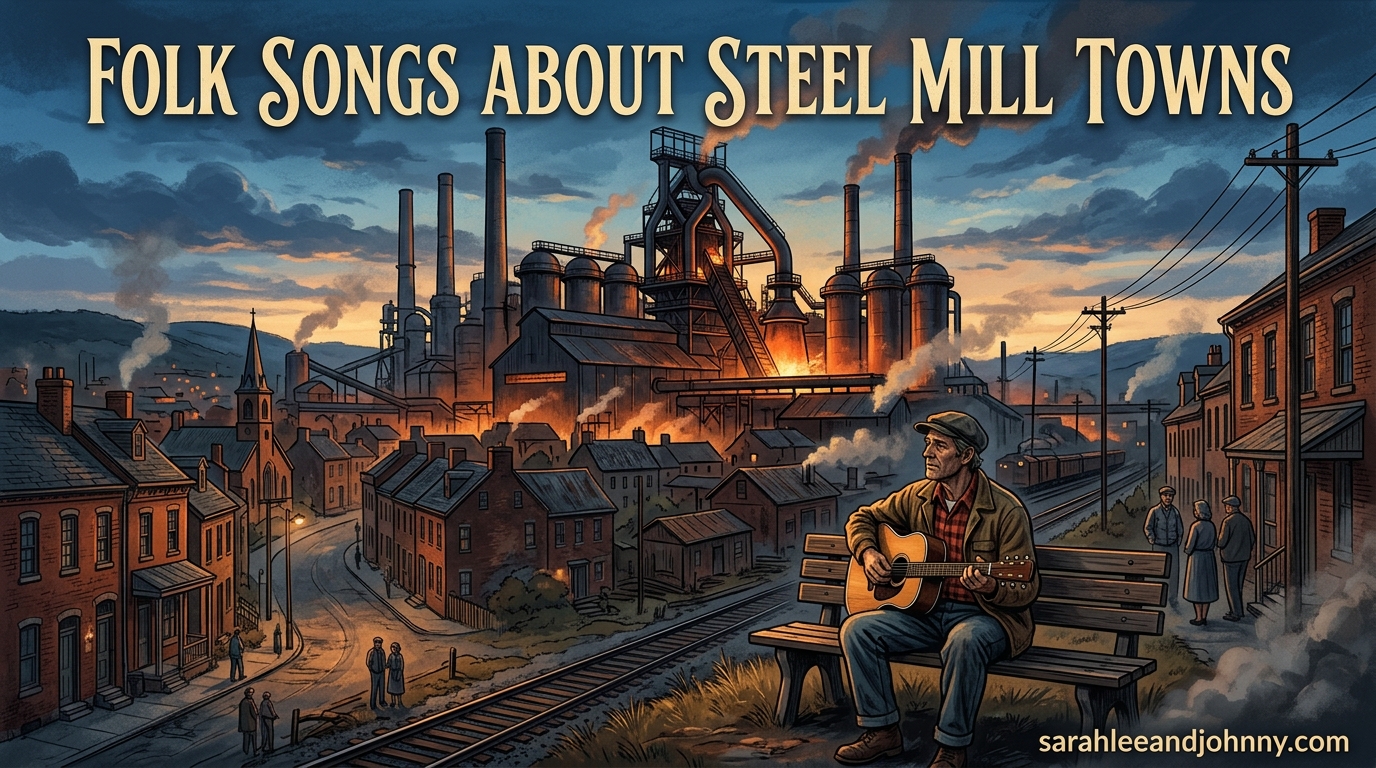
Steel mills built America. From the towering blast furnaces of Pittsburgh to the rolling mills along the Mahoning River in Youngstown, the steel industry shaped millions of lives — and those lives, in turn, shaped American music. Folk songs about steel mill towns capture the grit, heartbreak, solidarity, and stubborn hope of working-class communities that forged the backbone of industrial America. I have spent years collecting and studying these songs, and what strikes me most is how deeply personal they feel. Each one is a snapshot of real people dealing with real economic forces far beyond their control.
This guide covers the most important folk songs about steel mill towns, the artists who wrote and performed them, the regions that inspired them, and the recurring themes that tie them all together. Whether you are a folk music enthusiast, a labor history buff, or someone who grew up in a steel town and wants to hear your story told in song, you will find something meaningful here.
Table of Contents
- The History of Steel Mill Towns in American Folk Music
- Essential Folk Songs About Steel Mill Towns
- Regional Steel Towns and Their Musical Stories
- Key Artists Who Documented Steel Mill Town Life
- Common Themes in Folk Songs About Steel Mill Towns
- How to Discover More Folk Songs About Steel Mill Towns
- FAQs
- Conclusion
The History of Steel Mill Towns in American Folk Music
American folk music has always drawn from the lives of ordinary people. When the steel industry exploded in the late 1800s and early 1900s, entire communities sprang up around mills in Pennsylvania, Ohio, Indiana, and Alabama. Workers poured in from rural areas and from overseas — Eastern Europe, Italy, Mexico — bringing their musical traditions with them. Those traditions collided and combined with Appalachian folk, blues, and country to create something new.
Folk songs about steel mill towns emerged as a way for workers to make sense of their world. Songs were sung on picket lines, in union halls, at kitchen tables after long shifts, and at neighborhood taverns on Friday nights. They served as both entertainment and documentation, recording events that newspapers often ignored or distorted. The Homestead Strike of 1892, the Memorial Day Massacre of 1937, the slow shuttering of mills through the 1970s and 1980s — all of these found their way into song.
The folk tradition in steel country differs from, say, the coal mining songs of Appalachia or the railroad ballads of the West. Steel mill songs carry a specific industrial quality. They reference blast furnaces, scarfers, ingots, and rolling mills. They describe the particular sounds and rhythms of shift work. And they often focus on the relationship between workers and massive corporate entities like U.S. Steel and Jones & Laughlin.
What makes these songs endure is their emotional honesty. A song like “Youngstown” does not lecture you about economics. It puts you in the shoes of a man who gave his body to a mill, whose father and grandfather did the same, and who then watched the mill close and the town collapse around him. That kind of storytelling transcends any specific era.
Essential Folk Songs About Steel Mill Towns
These are the songs that define the genre. Some are well-known chart hits, while others are obscure gems buried in folk archives. Together, they paint a vivid picture of steel town life across more than a century of American history.
Youngstown — Bruce Springsteen
Released in 1995 on The Ghost of Tom Joad album, “Youngstown” is perhaps the most widely recognized song about a steel mill town. Springsteen wrote it after visiting Youngstown, Ohio, and speaking with former steelworkers. The song tells the story of a Vietnam veteran who returned home to work in the steel mills, following in his father’s and grandfather’s footsteps, only to see the industry collapse.
The lyrics reference Youngstown Sheet and Tube, the specific company that once employed thousands in the Mahoning Valley. Springsteen sings about “them big boys did what Hitler couldn’t do,” referring to how the shutdown of the steel mills accomplished what war could not — the destruction of Youngstown. It is a devastating line that captures the anger and betrayal felt by an entire generation of workers.
What makes “Youngstown” so powerful within the folk tradition is its narrative specificity. Springsteen does not write generically about deindustrialization. He writes about a particular place, with real history, and real consequences. The song ends by expanding beyond Youngstown to other devastated steel communities, making it both local and universal.
Mill Towns — The Del McCoury Band
Bluegrass has its own tradition of songs about mill towns, and “Mill Towns” by the Del McCoury Band stands as one of the finest examples. The song depicts the economic collapse of industrial communities and the painful exodus of young people who leave their hometowns because there is nothing left for them there.
The lyrics paint a picture of a town that was once alive with industry, where the mill was the center of everything — employment, identity, community. When the mill closes, the town does not just lose jobs. It loses its reason to exist. The survivor’s guilt theme runs through the song as well, directed at those who left and those who stayed behind.
Del McCoury’s high, lonesome vocal style is perfectly suited to this material. Bluegrass may seem like an unusual vehicle for industrial commentary, but the genre has deep roots in rural Appalachian communities that experienced the same kind of economic devastation. The acoustic arrangement gives the song an intimate, personal quality that amplifies its emotional impact.
Pittsburgh — Woody Guthrie
Woody Guthrie, the father of modern American folk music, wrote “Pittsburgh” as part of his vast catalog of songs about American workers and their struggles. Guthrie traveled extensively through steel country, and his songs about Pittsburgh capture the city at the height of its industrial power — and the human cost of that power.
Guthrie’s approach was direct and unflinching. He sang about soot-covered streets, about workers breathing black dust, about the contrast between the wealth generated by steel and the poverty of the people who actually made it. His songs about Pittsburgh connect the steel mill experience to a broader tradition of American labor protest music that stretches back to the 19th century.
Joe Glazer, the labor singer and historian, later recorded Guthrie’s “Pittsburgh” on his Smithsonian Folkways album Songs of Steel and Struggle: The Story of the Steelworkers. That album, which also includes songs about the Homestead Strike and the Memorial Day Massacre, remains one of the most comprehensive collections of steel-related folk music ever assembled.
Steel Mill Town — Aubory Bugg
Aubory Bugg’s “Steel Mill Town” brings the tradition into a more contemporary singer-songwriter space. The song opens with an intimate domestic scene — a house with bright blue shutters and a doghouse in the yard — before expanding into a meditation on growing up in the shadow of the mills.
What distinguishes Bugg’s approach is the sense of place. The song captures the specific texture of daily life in a steel mill town: the sounds of the mill in the background, the rhythm of shift changes, the way the whole community revolves around the industrial schedule. It is less about labor politics and more about what it feels like to be from one of these places.
The song resonated with listeners on forums like Reddit, where users searching for authentic steel town music frequently recommend it alongside more established names. Its appeal lies in its specificity and emotional honesty — two qualities that define the best folk songs about steel mill towns.
Workingman’s Blues — Merle Haggard
While not exclusively about steel mills, Merle Haggard’s “Workingman’s Blues” speaks directly to the experience of blue-collar industrial workers, including those in steel country. Haggard understood the pride and the pain of manual labor, and this song channels both with remarkable empathy.
The song captures the weariness of a man who has worked his whole life and has little to show for it. It is not angry — it is exhausted. That tone distinguishes it from protest songs and gives it a different kind of power. Forum discussions about folk songs about steel mill towns consistently recommend this track because it articulates what many steelworkers felt but could not always express.
Haggard’s influence on the broader tradition of working-class songs cannot be overstated. His Merle Haggard approach to storytelling — plainspoken, emotionally direct, unadorned — became a template that later artists like Springsteen and Steve Earle drew from heavily.
Miner’s Prayer — Dwight Yoakam
Dwight Yoakam’s “Miner’s Prayer” connects the steel mill town tradition to its close cousin: the mining song. In many steel communities, workers had family ties to coal mining, and the two industries shared cultural DNA. Yoakam’s song is a simple, heartfelt plea for protection and strength, delivered in a traditional country-folk arrangement.
The song works as a bridge between different strands of working-class American music. Steel workers, coal miners, factory hands — their experiences overlapped considerably, and the folk songs about their lives share common themes of danger, faith, community, and endurance. “Miner’s Prayer” captures the spiritual dimension of industrial work that is often present but rarely discussed in steel mill songs.
Regional Steel Towns and Their Musical Stories
Steel was not made in one place. Different regions developed their own industrial cultures, and those differences are reflected in the folk songs that came out of them. Understanding these regional variations adds depth to any exploration of folk songs about steel mill towns.
Pittsburgh and the Monongahela Valley
Pittsburgh was the undisputed steel capital of the world for nearly a century. The Monongahela Valley, stretching south from the city, was lined with mill towns — Homestead, Braddock, Duquesne, McKeesport, Clairton — each with its own identity. The 1892 Homestead Strike, one of the most significant labor conflicts in American history, produced songs and stories that are still referenced in folk music today.
Folk songs from the Pittsburgh region tend to emphasize labor organizing and union solidarity. This is the home of the United Steelworkers of America, and the union’s history is woven into the local folk tradition. Songs from this area often mention specific companies (Carnegie Steel, U.S. Steel) and specific events, giving them a documentary quality.
Youngstown, Ohio
Youngstown’s story is the one that most people associate with the decline of steel. Located in the Mahoning Valley, Youngstown was a thriving steel center until “Black Monday” in September 1977, when Youngstown Sheet and Tube announced it would close its Campbell Works. That single announcement began a cascade of closures that destroyed the local economy.
The songs about Youngstown — Springsteen’s being the most famous — focus on loss, betrayal, and the collapse of the social contract between workers and industry. There is a particular bitterness in these songs that distinguishes them from earlier Pittsburgh labor songs. The Pittsburgh songs are about fighting for rights. The Youngstown songs are about what happens after the fight is lost.
Birmingham, Alabama
Birmingham was the steel center of the South, and its folk music tradition reflects a different racial and cultural context than the northern mill towns. Songs from Birmingham’s steel district often intersect with the civil rights movement and the broader struggle of Black workers in the Jim Crow South. The city produced its own working-class music that deserves recognition alongside the better-known northern traditions.
Gary, Indiana
Gary was built by U.S. Steel in 1906 as a company town, and its entire identity was tied to the steel industry from the start. Folk songs from Gary tend to focus on the immigrant experience — Eastern European, Mexican, and Southern Black workers who came to the mills seeking opportunity. The musical traditions they brought merged into a distinctive regional sound that blended folk, blues, and early country.
Key Artists Who Documented Steel Mill Town Life
The artists behind these songs are as varied as the towns themselves. Some were professional musicians who spent years studying labor history. Others were working people who picked up a guitar and sang about what they knew.
Bruce Springsteen
Springsteen’s contribution to the steel mill town songbook goes beyond “Youngstown.” His broader catalog — “The Ghost of Tom Joad,” “The Rising,” “Death to My Hometown” — consistently returns to themes of industrial decline and working-class resilience. What sets Springsteen apart is his ability to combine folk storytelling traditions with rock instrumentation, bringing these stories to audiences who might never encounter traditional folk music.
His approach is literary. He researches his subjects, visits the places he writes about, and talks to the people who live there. The result is songs that feel authentic even when performed in arena shows. Springsteen essentially bridged the gap between the folk protest tradition and mainstream popular music.
Joe Glazer
Joe Glazer dedicated his career to labor music. His Smithsonian Folkways album Songs of Steel and Struggle is essential listening for anyone interested in folk songs about steel mill towns. The album collects songs spanning decades of steelworker history, from early union organizing songs to laments about plant closures.
Glazer was not just a performer. He was a historian and advocate who believed that songs could be tools for social change. His liner notes provide historical context for each track, making the album both a musical collection and an educational resource. He opened the album with Woody Guthrie’s “Pittsburgh” and included songs about the Memorial Day Massacre of 1937, when Chicago police killed ten steelworkers during a peaceful demonstration.
Woody Guthrie
Guthrie’s influence on the entire genre of folk songs about steel mill towns is immeasurable. He established the template: plain language, real places, real people, real injustice. His songs about industrial workers were part of his broader mission to document American life in all its complexity.
Guthrie traveled through Pennsylvania and Ohio during the 1940s, performing for union gatherings and picking up stories from steelworkers. His songs from this period complement his better-known Dust Bowl ballads, forming a more complete picture of American working-class experience.
Bluegrass and Country Contributors
The Del McCoury Band, Dwight Yoakam, Merle Haggard, and Johnny Paycheck all contributed to the broader tradition of songs about industrial and working-class life. Johnny Paycheck’s “Take This Job and Shove It” became an anthem for frustrated workers across all industries, including steel. These artists brought country and bluegrass sensibilities to themes that folk purists might have claimed exclusively as their own.
The crossover between folk, country, and bluegrass in steel town music is significant. In many steel communities, workers listened to all three genres interchangeably. The genre boundaries that music critics draw mattered less than the emotional truth of the songs themselves.
Common Themes in Folk Songs About Steel Mill Towns
Listen to enough of these songs and patterns emerge. The best folk songs about steel mill towns return to a handful of themes that define the steel town experience.
Labor Struggle and Union Organizing
From the Homestead Strike to the union drives of the 1930s, labor conflict is central to steel town folk music. Songs about picket lines, strikes, scabs, and solidarity gave workers a way to process and communicate their experiences. The union hall was often a musical space, where songs served both as morale boosters and organizing tools. The tradition of singing during strikes dates back to the earliest days of the labor movement.
Deindustrialization and Economic Collapse
The closure of steel mills across the Rust Belt in the 1970s and 1980s produced a wave of songs about loss. These songs mourn not just jobs but entire ways of life. They describe main streets with boarded-up storefronts, neighborhoods emptied by outmigration, and the psychological toll of watching your community unravel. This theme is what most people associate with steel mill town songs today, largely because of Springsteen’s influence.
Community Bonds and Shared Identity
Not all steel mill songs are about suffering. Many celebrate the tight-knit communities that grew up around the mills. Songs describe block parties, church picnics, ethnic festivals, and the deep bonds formed between people who work dangerous jobs together. This theme of community runs through bluegrass and country songs about mill towns in particular, where the focus is often on people rather than politics.
Generational Legacy
One of the most poignant themes in these songs is the handing down of work from one generation to the next. Fathers and sons (and eventually daughters) working the same mill, the same machine, the same shift. This generational continuity is both a source of pride and a source of tragedy when the mill closes and breaks the chain. Springsteen captures this powerfully in “Youngstown” when he sings about three generations of steelworkers in one family.
How to Discover More Folk Songs About Steel Mill Towns
If this article has sparked your curiosity, there are several ways to dig deeper into this rich musical tradition.
Smithsonian Folkways Collection
The Smithsonian Folkways label is a treasure trove of American labor music. Joe Glazer’s Songs of Steel and Struggle is the single best starting point. The label also carries recordings by other labor singers and folk collectors who documented steel town music. Many of these recordings are available for streaming on the Smithsonian Folkways website and through major streaming platforms.
YouTube and Streaming Platforms
YouTube hosts a surprising amount of steel-related folk music, from digitized vinyl rips of obscure albums to live performances by contemporary artists. Searching for combinations of terms like “steel mill folk song,” “Youngstown song,” and “labor union folk music” yields results. Spotify and Apple Music playlists dedicated to American labor songs or working-class folk music are also good discovery tools.
Modern Artists Carrying the Tradition
The tradition of writing songs about steel mill towns is not dead. Contemporary artists like Noah Kahan, who writes about hometown relationships and the pull of place, are part of a new generation engaging with these themes. While Kahan’s music is more personal than political, it shares the folk tradition of connecting individual experience to community and landscape.
Singer-songwriters in the Rust Belt continue to write about their hometowns, sometimes in direct conversation with the folk tradition established by Guthrie and Springsteen. Local music scenes in Pittsburgh, Cleveland, and Youngstown produce artists who grew up in the shadow of closed mills and channel that experience into their songwriting.
FAQs
What is the most famous folk song about a steel mill town?
Bruce Springsteen’s Youngstown (1995) is widely considered the most famous song about a steel mill town. Written for his album The Ghost of Tom Joad, it tells the story of a Vietnam veteran who returns to work in Youngstown, Ohio’s steel mills, only to watch the industry collapse. The song references real companies like Youngstown Sheet and Tube and expands to address the broader deindustrialization of American steel communities.
Why did Bruce Springsteen write the song Youngstown?
Springsteen wrote Youngstown after visiting Youngstown, Ohio, and speaking directly with former steelworkers about their experiences. He was struck by the devastation caused by the closure of the steel mills, particularly after Black Monday in September 1977 when Youngstown Sheet and Tube announced the shutdown of its Campbell Works. The song became part of his broader exploration of working-class American life on The Ghost of Tom Joad album.
What is the oldest folk song about steel workers?
Some of the earliest documented folk songs about steel workers date back to the labor conflicts of the late 1800s, particularly around the Homestead Strike of 1892 in Pennsylvania. Woody Guthrie later wrote songs about steel workers during the 1940s, including Pittsburgh, which became part of the standard repertoire of American labor folk music. Joe Glazer’s Smithsonian Folkways collection includes songs spanning from the earliest days of steel union organizing through the late 20th century.
Are there bluegrass songs about mill towns?
Yes, the Del McCoury Band recorded Mill Towns, one of the best-known bluegrass songs about the economic collapse of industrial communities. The song describes the exodus of young people from declining mill towns and the survivor’s guilt experienced by those who leave. Bluegrass and country music have deep connections to industrial working-class themes, particularly in Appalachia and the South where mill towns overlapped with traditional bluegrass communities.
What albums feature folk songs about steel mill towns?
The essential album is Joe Glazer’s Songs of Steel and Struggle: The Story of the Steelworkers, available through Smithsonian Folkways. Bruce Springsteen’s The Ghost of Tom Joad (1995) features Youngstown and other working-class narratives. The Del McCoury Band has recorded bluegrass songs about mill towns. For historical recordings, the Library of Congress American Folklife Center holds field recordings of industrial folk songs from steel communities.
Conclusion
Folk songs about steel mill towns are more than a musical genre. They are a living archive of American working-class history, told by the people who lived it. From Woody Guthrie’s plainspoken ballads about Pittsburgh to Springsteen’s haunting “Youngstown,” from Joe Glazer’s union anthems to the Del McCoury Band’s bluegrass laments, these songs preserve stories that might otherwise be forgotten.
What I find most remarkable about this tradition is its continued relevance. The themes these songs address — economic displacement, corporate indifference, community resilience, generational loss — are not relics of the past. They are live issues in 2026, as communities across America continue to grapple with the consequences of deindustrialization. The folk songs about steel mill towns that were written decades ago still speak to present realities, which is the truest mark of lasting art.
I encourage you to seek out the albums and artists mentioned in this guide. Listen to Joe Glazer’s Songs of Steel and Struggle. Spend time with Springsteen’s The Ghost of Tom Joad. Explore what modern artists from steel country are writing today. These songs deserve to be heard, shared, and remembered.