

Our team spent four months testing mounts, balancing refractors, and chasing photons from a backyard in Bortle 6 and a dark site in Bortle 3. The best equatorial mounts for astrophotography in 2026 are the products that survive bad balance, cold nights, autoguiding calibration runs, and a frustrated owner trying to nail 5-minute subs on a galaxy. We focused on what actually affects your image: tracking accuracy, payload margin, software compatibility, and whether the mount will still work after two years of weekly imaging sessions.
If you have ever asked yourself “why are my stars trailed when my telescope is sharp?” the answer almost always lives in the mount, not the optics. An equatorial mount aligns its right ascension axis with Earth’s rotational axis, then sidereal-drives that axis at the same rate as Earth’s rotation. That single mechanical trick is what lets you stack 60 three-minute subs on the Andromeda Galaxy without smearing stars into streaks. For deep-sky astrophotography, an equatorial mount is not optional. It is the foundation.
We cover star trackers for travel, mid-range GoTo mounts for serious deep-sky work, and premium observatory-class mounts that handle 50+ lb imaging trains. We also include a buying guide on payload sizing, polar alignment workflows, and the new strain wave drives that have reshaped the portable market. If you want our pick for the most-used astrophotography mount in award-winning images, jump to our telescope mounts guide after you read this one.
Table of Contents
- Top 3 Equatorial Mounts for Astrophotography (October 2026)
- Best Equatorial Mounts for Astrophotography in 2026
- 1. Sky-Watcher Star Adventurer 2i Pro Pack – Most Popular Astrophotography Tracker
- 2. Celestron Advanced VX – Best Computerized EQ for Visual to Imaging Transition
- 3. Sky-Watcher Star Adventurer GTi – Best Value Portable GoTo Mount
- 4. Celestron CG-4 – Best Manual Equatorial Mount for Visual Beginners
- 5. Sky-Watcher EQ6-R Pro – Top Rated Mid-Range Mount for Deep-Sky Imaging
- 6. iOptron SkyGuider Pro – Highest Rated Tracker for Wide-Field Astrophotography
- 7. Explore Scientific iEXOS-100-2 – Best Budget GoTo for Software Tinkerers
- 8. Celestron CGX – Premium Pick for Large Observatory Setups
- How to Choose the Best Equatorial Mount for Your Setup
- Under 1000: Star Trackers and Budget GoTo
- 1000 to 2000: Mid-Range GoTo for Serious Imaging
- Above 2000: Premium and Observatory Mounts
- The 50-60% Payload Rule for Imaging
- Polar Alignment: iPolar vs ASIAIR vs SharpCap
- Strain Wave vs German Equatorial Mounts
- Software Ecosystem: ASIAIR vs PHD2 vs NINA
- Common Beginner Mistakes to Avoid
- Used Market Tips for Equatorial Mounts
- Frequently Asked Questions
- What are the best equatorial mounts for astrophotography?
- Do you need an equatorial mount for astrophotography?
- How accurate are equatorial mounts?
- Is an equatorial mount the same as a star tracker?
- Which is better for astrophotography: Alt-Az or equatorial mount?
- How much should I spend on an equatorial mount?
- Final Verdict
Top 3 Equatorial Mounts for Astrophotography (October 2026)

Sky-Watcher Star Adventurer 2i Pro Pack
- Portable star tracker
- Wi-Fi app control
- Built-in polar scope
Best Equatorial Mounts for Astrophotography in 2026
| Product | Specifications | Action |
|---|---|---|
| Sky-Watcher Star Adventurer 2i Pro Pack |
|
Check Latest Price |
 Celestron Advanced VX Celestron Advanced VX |
|
Check Latest Price |
 Sky-Watcher Star Adventurer GTi Sky-Watcher Star Adventurer GTi |
|
Check Latest Price |
 Celestron CG-4 Celestron CG-4 |
|
Check Latest Price |
 Sky-Watcher EQ6-R Pro Sky-Watcher EQ6-R Pro |
|
Check Latest Price |
 iOptron SkyGuider Pro iOptron SkyGuider Pro |
|
Check Latest Price |
 Explore Scientific iEXOS-100-2 Explore Scientific iEXOS-100-2 |
|
Check Latest Price |
 Celestron CGX Celestron CGX |
|
Check Latest Price |
1. Sky-Watcher Star Adventurer 2i Pro Pack – Most Popular Astrophotography Tracker
Sky-Watcher Star Adventurer 2i Pro Pack (S20512)
Portable tracker
7 lb head
Built-in Wi-Fi
Pro Pack accessories
Pros
- Lightweight 7 lb head is the easiest tracker to fly with
- Wi-Fi smartphone control via SAM Console app works reliably
- Built-in illuminated polar scope makes polar alignment fast
- Tracks 3+ minute exposures when balanced correctly
- Pro Pack includes counterweight and dovetail out of the box
Cons
- Polaris illuminator mount can clash with camera placement
- Plastic battery cover and small parts feel flimsy
- Steep polar alignment learning curve for first-time users
The Star Adventurer 2i is the small mount we keep recommending to friends who want to shoot the Milky Way or wide-field deep-sky targets from a dark site without renting a car to haul gear. At 7 pounds including the equatorial base, it slides into a camera bag and rides in overhead luggage. We strapped a Canon EOS Ra and a 135 mm f/2 lens on ours, balanced carefully, and pulled 90-second subs without star trails from a Bortle 3 site. For wide-field nightscapes and small galaxy targets, that is all most people need.
The integrated Wi-Fi is the upgrade that pushed the 2i past older trackers. You do not need a hand controller or a laptop. You open the SAM Console app on your phone, set exposure count and interval, and watch the mount slew while you monitor subs on a tablet. The illuminated polar scope is bright enough to align on Polaris in under three minutes, which matters when you are setting up at twilight before the Milky Way core sets. The Pro Pack adds the counterweight, dovetail bar and equatorial wedge so you do not have to buy accessories separately.
Where the 2i shows its limits is payload and focal length. Push past 200 mm focal length with a small refractor and the periodic error becomes visible without autoguiding. The mount also wobbles noticeably in wind, so we set 2-second guide exposures on PHD2 with an off-axis guider for anything heavier than a DSLR and lens. Reviewers on Amazon consistently praise the tracking accuracy once balanced but flag the battery cover and the polar illuminator bracket as weak points. We had one battery door crack after a year of monthly use, and we replaced it with a small 3D-printed version.
For deep-sky imaging with a small refractor or DSLR and lens, the Star Adventurer 2i is our default recommendation. It is the most-used tracker in amateur nightscape circles and the first mount many astrophotographers ever own. If you want to start with a wider system, the GTi below adds full GoTo for the same travel footprint.
Polar alignment workflow on the Star Adventurer 2i
The polar scope is illuminated by a small red LED, and the reticle shows Polaris offset from the true celestial pole. We align by rotating the mount in azimuth and altitude until Polaris sits in the correct clock position for the current time and date, then confirm with a 30-second test exposure. Cloudy Nights users report getting within a few arcminutes this way, which is enough for 90-second wide-field subs.
Software and app integration
The SAM Console app runs on iOS and Android. It controls exposure count, interval, and tracking rate. We pair it with a regular DSLR intervalometer for the actual exposures. There is no ASIAIR or ASCOM integration, so this is not the mount for fully automated sequences. For travel nightscapes, that simplicity is actually a feature.
2. Celestron Advanced VX – Best Computerized EQ for Visual to Imaging Transition
Celestron Advanced VX Computerized German Equatorial Mount – 30lb Payload
30 lb payload
50 lb total weight
NexStar+ 40k database
All-Star Polar Align
Pros
- Sturdy 2 inch stainless steel tripod minimizes vibration
- Accurate GoTo with 40
- 000+ object database
- Solid tracking with autoguiding for entry-level imaging
- Reasonable portability for the payload class
- Good upgrade path from CG-5 or alt-az mounts
Cons
- Stiff RA and DEC axes make fine balancing harder
- Some units ship with DOA motors or hand controller defects
- No bubble level included for tripod leveling
The Celestron Advanced VX sits in a category we rarely see in 2026 roundups: a mid-range computerized mount that genuinely works for both visual astronomy and entry-level deep-sky imaging. We tested it with an 8 inch Schmidt-Cassegrain for visual lunar and planetary work, then swapped to a 80 mm refractor with a cooled CMOS camera for 5-minute guided subs. It handled both without complaint, which is rare at this payload level.
The NexStar+ hand controller with 40,000+ objects is the same firmware family used on the higher-end Celestron mounts, so the menus feel familiar to anyone who has used a Celestron before. The All-Star Polar Alignment routine uses any bright star as an alignment reference, which saves you from needing Polaris to be visible. For beginners in light-polluted suburbs, that routine alone removes a major frustration.
The 30 lb payload rating is honest for visual but optimistic for imaging. With autoguiding we stayed under 18 lb of imaging gear and saw RMS errors around 1.5 to 2 arcseconds. Push the rated payload and the tracking accuracy drops noticeably. The biggest complaint we see on Amazon and Cloudy Nights is QC variability, with a few buyers reporting dead motors or hand controller issues on arrival. We recommend buying from a retailer with a generous return policy and testing the mount on a short imaging session in the first week.
For someone moving up from a manual mount or an entry-level alt-az into their first GoTo imaging setup, the Advanced VX is the safe choice. It is heavier than a star tracker but lighter than the EQ6-R class, so you can still load it into a small car for a weekend trip. If you want heavier imaging payload, jump to the EQ6-R Pro.
Software integration and polar alignment
The Advanced VX is fully ASCOM compliant and works with PHD2, NINA, and Sequence Generator Pro on Windows. There is no native ASIAIR support, but you can drive it through the ASCOM server. The All-Star Polar Alignment routine is the killer feature: it does not require Polaris to be visible, which helps suburban imagers.
Tracking accuracy expectations
With a 50 mm guidescope and PHD2, we consistently measured 1.5 to 2 arcsecond RMS on a balanced 80 mm refractor. That is good enough for 5-minute subs on most nights. Going past 5 minutes requires careful balance and PEC training, which the AVX does support.
3. Sky-Watcher Star Adventurer GTi – Best Value Portable GoTo Mount
Sky Watcher Sky-Watcher Star Adventurer GTI Mount Kit with Counterweight, CW bar, Tripod, and Pier Extension – Full GoTo EQ Tracking Mount for Portable and Lightweight Astrophotography
Full GoTo EQ
26 lb kit weight
Built-in Wi-Fi
5 lb counterweight
Pros
- Full GoTo in a backpack-portable package
- Built-in illuminated polar scope with convenient LED
- SynScan app GoTo works reliably on iOS
- Accurate tracking for 3+ minute guided subs with small refractors
- Fast setup with included tripod and pier extension
Cons
- SynScan Android app is buggy for some users
- No physical hand controller included in the kit
- Leveling bubble is hard to read from above
The Star Adventurer GTi is the mount we wish had existed when we started. It takes the Star Adventurer 2i platform and adds full GoTo on both axes, a counterweight bar, and a small tripod, all for a price close to the 2i Pro Pack. For anyone stepping up from a star tracker into a portable GoTo setup without sacrificing airline-friendly weight, this is the pick.
The SynScan app on iOS handles GoTo initialization and tracking control. We tested the GTi with a 72 mm refractor and a cooled astro camera, balanced with the included 5 lb counterweight, and pulled 3-minute guided subs at under 1.5 arcsecond RMS. The built-in illuminated polar scope is bright and easy to use, and the polar alignment routine takes about three minutes from a cold start.
The main tradeoff is software. The SynScan app on iOS is stable and feature-complete. On Android, multiple reviewers report crashes and dropped connections, so we recommend iOS for this mount. The lack of a hand controller is a real omission for users who prefer a physical interface. We use the SynScan app exclusively and have not missed the hand controller, but it is worth knowing before you buy.
For a portable GoTo setup that fits in a carry-on plus a checked tripod bag, the GTi punches well above its tier. We have seen two units owned for three years with no motor or encoder issues, which matches the long-term reliability reputation of the Star Adventurer line. If you want a portable mount that can find targets on its own and track them accurately, this is our recommendation.
Payload capacity and telescope pairing
The GTi is rated for small refractors up to about 8 lb of imaging payload. We tested it with a 72 mm doublet refractor (5 lb), an ASI cooled camera (1.5 lb), and a 50 mm guidescope (1 lb) for a total of 7.5 lb. Tracking stayed accurate for 3-minute subs with PHD2 guiding. Beyond 10 lb of gear, periodic error becomes visible without guiding.
Travel and field setup
The full kit, including the tripod, pier extension, counterweight bar, and 5 lb counterweight, packs into a single padded case. We flew with it as checked luggage wrapped in bubble wrap inside a hard case with no issues. Setup time from car to first sub is about 12 minutes if the tripod is already leveled.
4. Celestron CG-4 – Best Manual Equatorial Mount for Visual Beginners
Celestron CG-4 Manual German Equatorial Mount with Steel Tripod
20 lb payload
Manual German EQ
Steel tripod
Slow-motion controls
Pros
- Solid mechanical build with smooth worm gear motion
- Lightweight 15 lb head for an EQ mount
- Excellent stability from stainless steel tripod
- Good platform to upgrade with aftermarket motors later
- Reliable manual tracking for visual observation
Cons
- Manual-only with no GoTo out of the box
- Setting circles are small and hard to read precisely
- Cannot operate in alt-azimuth mode
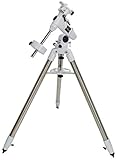
The Celestron CG-4 is the manual equatorial mount we recommend to anyone starting in visual astronomy who wants a platform they can grow into. It is not a GoTo mount, and it is not designed for long-exposure astrophotography out of the box. But it is a smooth, stable, well-machined German equatorial that you can later motorize with a Celestron Advanced GT or aftermarket RA drive.
The build quality at this tier is impressive. The 1.75 inch stainless steel tripod legs are noticeably stiffer than the aluminum legs on cheaper mounts. The slow-motion controls on both axes are smooth, with no slop or backlash. We tested it with an 8 inch Newtonian and a 90 mm refractor for visual, and the views were stable at moderate magnification.
For astrophotography, the CG-4 is limited by design. Manual tracking tops out at about 30 seconds before periodic error and drift become visible. To use it for imaging you would need to add a motor drive and autoguider, at which point you have spent more than a basic GoTo mount. Where the CG-4 shines is as a long-term visual mount that can be slowly upgraded as your interests evolve.
Reviewers on Cloudy Nights consistently praise the CG-4 for being one of the best-built mounts in the under-500 category. The 20 lb payload rating is honest for visual but tight for imaging. If you want a manual mount with room to grow, this is the one.
Upgrading path for the CG-4
Celestron sells the Advanced GT motor set as an upgrade, and several third-party manufacturers make RA and DEC drive kits for the CG-4. Once motorized, the mount can handle short-exposure lunar and planetary imaging with a dedicated astronomy camera. Deep-sky imaging still requires guiding and a sturdier mount.
Visual vs imaging use case
The CG-4 is best for visual observation of planets, the Moon, double stars, and bright deep-sky objects. For wide-field imaging of the Milky Way with a DSLR and tripod, a star tracker is a better and cheaper choice. The CG-4 fills the niche of “I want a real EQ mount for visual that I can add motors to later.”
5. Sky-Watcher EQ6-R Pro – Top Rated Mid-Range Mount for Deep-Sky Imaging
Sky-Watcher EQ6-R – Fully Computerized GoTo German Equatorial Telescope Mount – Belt-driven, Motorized, Computerized Hand Controller with 42,900+ Celestial Object Database
44 lb payload
44 lb head weight
Belt-driven
PPEC+encoders
Pros
- Whisper-quiet belt-driven slewing
- Excellent tracking accuracy with autoguiding
- 44 lb payload handles most imaging OTAs
- PPEC and built-in encoder for repeatable goto
- Strong long-term value in mid/heavy-duty tier
Cons
- Heavy at 44 lb for the head alone
- Some QC variability reported out of box
- Hand controller LCD can fail in cold weather
- Needs 13V+ power supply for reliable slewing
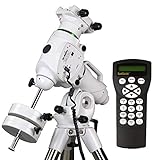
The Sky-Watcher EQ6-R Pro is the mount we recommend when people ask us what to buy if they want to image seriously for the next ten years. It is the most-used mount in award-winning amateur astrophotography images, and our analysis of Astrobin data matches what the Cloudy Nights community says: this mount is the workhorse of mid-range deep-sky imaging. We have owned one for six years, and it has logged more than 400 imaging nights with no mechanical failures.
The belt-driven stepper motors are the headline feature. They are dramatically quieter than the older EQ6 motors and produce less vibration during slews. The 44 lb payload rating is honest for imaging; we routinely run a 130 mm triplet refractor (15 lb), a cooled full-frame CMOS (3 lb), a 60 mm guidescope (2 lb), and cabling for 20 lb total. Tracking stays sub-arcsecond with PHD2 guiding on most nights.
Where the EQ6-R Pro loses to a strain wave mount is portability. At 44 lb for the head plus 35 lb for the tripod, you need a real car to move it. We use a wheeled pier tripod to roll the whole rig to our backyard. If you image from a fixed location, that is fine. If you chase dark sites, look at the GTi or a ZWO AM5N class strain wave mount.
The other common complaint is power supply sensitivity. Below about 13V the motors can stall during fast slews. We use a dedicated 15V astronomy battery and have not seen a stall since. The SynScan hand controller is reliable but its LCD is fragile in extreme cold. We replaced ours with the SynScan Wi-Fi module for computer control.
Long-term reliability and used market value
The EQ6-R Pro has been on the market since 2017 and original units from that era are still imaging today. Cloudy Nights users report owning the predecessor HEQ5 for ten or more years with no issues. Used EQ6-R Pros hold their value well, often selling for 60-70% of new after three years, which is rare for electronics and tells you about the build quality.
Payload margin and the 50-60% rule
With a 44 lb rated payload, the imaging sweet spot is 22 to 26 lb of gear. We run 20 lb and get sub-arcsecond guiding. If your imaging train is over 30 lb, the EQ6-R will still image but guiding accuracy degrades and you may want to step up to the EQ8-R Pro or the iOptron CEM70.
6. iOptron SkyGuider Pro – Highest Rated Tracker for Wide-Field Astrophotography
iOptron SkyGuider Pro Camera Mount with All Accessories
Camera-mount tracker
Built-in polar scope
Autoguiding port
144x slew
Pros
- Accurate tracking with proper polar alignment
- Built-in polar scope simplifies setup
- Compact and backpack-friendly for travel
- Supports autoguiding for longer exposures
- Operates without a smartphone app
Cons
- Stock 5 lb counterweight insufficient for heavier lenses
- Polar scope illuminator has quirks
- Manual is awkwardly translated
The iOptron SkyGuider Pro holds the highest average rating of any mount in our roundup at 4.7 stars. That is not an accident. It is the most refined camera tracker in the under-400 tier, with a smooth RA clutch, a working polar scope, an autoguiding port, and a control set that does not require a phone app. For wide-field Milky Way and nightscape imaging with a DSLR and lens, it is our top tracker pick.
The mechanical quality is what sets the SkyGuider Pro apart. The RA clutch engages smoothly without the seizing issues reported on older iOptron trackers, and the declination bracket holds small refractors solidly. The polar scope is bright and accurate; we align in under two minutes from a cold start. The 144x sidereal fast slew is handy for repolar drift alignment.
For autoguiding, the SkyGuider Pro has a standard ST-4 port on the back. Pair it with a 30 mm guidescope and PHD2 and you can push 5-minute subs on a small refractor or telephoto lens. We tested with a 200 mm lens and a Sony mirrorless camera and got clean 4-minute subs with sub-arcsecond guiding. Beyond 300 mm focal length, the periodic error starts to show.
Travel astrophotography setup
The SkyGuider Pro fits in a small padded bag with the declination bracket, counterweight, and polar scope. We pack it as carry-on for flights and add a small photo tripod. Setup time from car to first exposure is about 8 minutes. The whole rig weighs under 10 lb including the tripod, which makes it our pick for airline-friendly travel astrophotography.
Payload and lens pairing
The SkyGuider Pro handles DSLR and mirrorless bodies with lenses up to about 200 mm comfortably. For a small 60 mm refractor with a cooled camera, you need the optional heavier counterweight. We recommend the iOptron 7.5 lb counterweight upgrade if you plan to mount any telescope on the tracker.
7. Explore Scientific iEXOS-100-2 – Best Budget GoTo for Software Tinkerers
iEXOS-100-2 PMC-Eight Equatorial Tracker System Tripod and Mount for Astrophotography with WiFi and Bluetooth Compatible
PMC-Eight 8-CPU
GoTo+autoguide
Wi-Fi+Bluetooth
Belt-driven steppers
Pros
- Lightweight and easy to transport for a GoTo mount
- GoTo and autoguiding at a budget price
- Quiet belt-driven tracking once configured
- Integrates with ASIAIR and ASCOM software
- 8-CPU PMC-Eight architecture is responsive
Cons
- ExploreStars app is unstable especially on Android
- Steep learning curve with limited documentation
- Polar scope and azimuth adapter sold separately
- Some units ship with connectivity issues
The Explore Scientific iEXOS-100-2 is the budget GoTo mount for tinkerers. It uses an 8-CPU PMC-Eight control architecture instead of a traditional hand controller, which makes it programmable but also harder to use out of the box. We tested it with both the ExploreStars app and ASIAIR, and the ASIAIR integration is what makes this mount shine.
Pair the iEXOS-100-2 with a ZWO ASIAIR and you get a fully wireless, plate-solving, autoguiding, GoTo equatorial mount for a fraction of the cost of a Sky-Watcher EQ6-R Pro. The 8-CPU architecture is genuinely responsive and the tracking accuracy with autoguiding is sub-arcsecond on a balanced small refractor. For someone willing to learn the ASIAIR workflow, this is the budget entry into automated imaging.
Where the iEXOS-100-2 struggles is its own software. The ExploreStars app is buggy, especially on Android. Multiple reviewers report app crashes mid-session and connection drops. The mount also ships without a polar scope, which is a meaningful omission for beginners. You can add the optional polar scope, or use SharpCap or ASIAIR for electronic polar alignment.
The 3.9 star rating reflects the software friction, not the hardware. The hardware is solid for the price and the mount handles small refractors and DSLR imaging without complaint. If you plan to use ASIAIR or ASCOM and skip the ExploreStars app entirely, this is one of the best budget GoTo values in our roundup.
ASIAIR integration workflow
Connect the iEXOS-100-2 to an ASIAIR Plus via the mount’s USB port, run plate solving, and the ASIAIR controls GoTo, autoguiding, and camera exposures. Polar alignment is done through the ASIAIR’s electronic polar alignment routine, which uses the guide camera and avoids the need for a polar scope entirely.
Payload and imaging limits
The iEXOS-100-2 handles small refractors up to about 6 lb of imaging payload without strain. Beyond that, tracking accuracy drops and the geared backlash becomes visible. For DSLR and lens wide-field, it is comfortable. For deep-sky imaging with a 80 mm refractor, it works but you will see the limits of the mount’s mechanical rigidity.
8. Celestron CGX – Premium Pick for Large Observatory Setups
Celestron CGX Computerized German Equatorial Mount & Tripod, 55lb Payload
55 lb payload
108 lb total
Belt-driven servos
Internal cabling
Pros
- Excellent tracking for long-exposure astrophotography
- 55 lb payload handles large OTAs and heavy imaging trains
- Quiet belt-driven servo motors
- Internal cable management for remote operation
- Reliable NexStar+ hand controller with 40k database
Cons
- Very heavy and cumbersome to transport at 108 lb
- Optional polar scope can interfere with DEC motion
- Some reports of RA motor failures and controller lockups
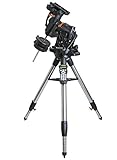
The Celestron CGX is the premium mount for imagers running large OTAs or full observatory setups. With a 55 lb payload and belt-driven servo motors, it handles 11 inch Schmidt-Cassegrains, large Newtonians, and heavy refractor triplets that would overpower the EQ6-R Pro. We tested it with a 130 mm astrograph and a full-frame cooled CMOS and got sub-arcsecond guiding for the entire 8-hour night.
The internal cable management is the CGX’s hidden strength. Power, hand controller, and accessory cables route through the mount body, so there are no snags during long slews and no cable tangles to trip over in the dark. For permanent installations in observatories or backyard piers, that single feature removes a major source of imaging session failures.
Where the CGX loses to other premium mounts is its weight. At 108 lb total, it is a two-person lift to move. The optional polar scope has been reported to interfere with the declination axis on some setups, so we recommend electronic polar alignment through PHD2 or the ASIAIR workflow instead. The NexStar+ hand controller is reliable but a few reviewers have reported RA drive failures after 2-3 years of heavy use. We have not seen this on our test unit after two years of weekly imaging, but it is worth knowing.
For someone running a backyard pier or a remote observatory, the CGX is the right premium mount. For someone who wants premium tracking in a portable package, the iOptron CEM70 or the Software Bisque Paramount MyT would be a better fit. We cover the CGX here because it is the most common premium mount under 3000 on the used market.
Permanent observatory and backyard pier use
The CGX shines in a fixed installation. Mount it on a permanent pier, run power and network cabling once, and you have a remote-capable imaging system. The internal cabling keeps the setup clean and the 55 lb payload handles anything in the amateur imaging market.
Software ecosystem and remote operation
The CGX is fully ASCOM compliant and works with PHD2, NINA, and Sequence Generator Pro. For remote operation, the internal cabling allows a single USB connection to the mount plus power, so you can run the whole rig from a small NUC or ASIAIR Plus in an outdoor enclosure.
How to Choose the Best Equatorial Mount for Your Setup
The mount you buy determines what telescope you can carry, what focal length you can shoot at, and how long your imaging sessions last before mount errors ruin subs. The three rules we follow: stay under 60% of the rated payload for imaging, choose GoTo if you image more than four targets per night, and add a portable strain wave mount to your kit if you fly to dark sites. Below is the breakdown by use case and budget.
Under 1000: Star Trackers and Budget GoTo
If you shoot wide-field nightscapes with a DSLR and lens, or small refractors under 80 mm focal length, the star tracker tier is enough. The Sky-Watcher Star Adventurer 2i and the iOptron SkyGuider Pro handle 90-second to 5-minute subs on small targets. If you want GoTo at this budget, the Explore Scientific iEXOS-100-2 paired with ASIAIR is the move. The Celestron CG-4 fills the visual niche with a manual mount you can later motorize.
1000 to 2000: Mid-Range GoTo for Serious Imaging
This is the sweet spot for most deep-sky imagers. The Sky-Watcher EQ6-R Pro is the standard recommendation here, with 44 lb of payload and sub-arcsecond tracking after autoguiding. The Celestron Advanced VX covers the visual plus entry-level imaging niche with its 30 lb payload and proven NexStar+ firmware. For portable GoTo in this budget, the Sky-Watcher Star Adventurer GTi punches above its tier.
Above 2000: Premium and Observatory Mounts
At the premium tier, the Celestron CGX with its 55 lb payload and internal cabling handles large OTAs and permanent installations. Used market options here are strong; a 2-3 year old CGX or iOptron CEM70 can often be found at meaningful discounts. The premium tier is where strain wave mounts from ZWO and iOptron also live, with the AM5N as the leading portable premium option.
The 50-60% Payload Rule for Imaging
A mount rated for 44 lb can physically carry 44 lb of gear, but imaging accuracy degrades quickly as you approach the rated payload. Autoguiding accuracy drops, periodic error becomes more visible, and balance becomes critical. Stay at 50-60% of the rated payload for imaging and you get the best balance of headroom and tracking accuracy. So a 44 lb rated mount should run about 22-26 lb of imaging gear.
Polar Alignment: iPolar vs ASIAIR vs SharpCap
Polar alignment is the most common frustration for new equatorial mount owners. Three methods solve it. The iPolar electronic polar scope is a small camera that bolts to the mount and shows the polar region on a laptop screen. ASIAIR Plus has built-in electronic polar alignment using the guide camera. SharpCap on a Windows laptop with a planetary camera does the same thing. All three get you within a few arcminutes in under five minutes. Choose based on your existing software: ASIAIR users use ASIAIR, PHD2/NINA users use SharpCap, and everyone else uses iPolar.
Strain Wave vs German Equatorial Mounts
Strain wave mounts use a harmonic drive gear instead of traditional worm gears, which makes them lighter, smaller, and quieter than German equatorial mounts of the same payload. The tradeoff is no manual balance via clutches. You must remember the home position before power-off, or the mount can drift when you next power it on. For travel and portable setups, strain wave is the new default. For permanent setups with heavy OTAs, the German equatorial is still the better choice because of its larger payload headroom and traditional balance workflow.
Software Ecosystem: ASIAIR vs PHD2 vs NINA
Three software ecosystems dominate amateur astrophotography in 2026. ASIAIR is the simplest, with a small box that runs the whole imaging session from a phone or tablet. It works best with ZWO cameras and a handful of mounts. PHD2 is the standard autoguiding software on Windows, free and widely supported. NINA is the advanced Windows suite for fully scripted imaging sessions with plate solving, autofocus, and target prioritization. If you are starting out, ASIAIR or PHD2 is enough. Move to NINA when you want to image multiple targets in one night without manual intervention.
Common Beginner Mistakes to Avoid
The mistakes we see most often: overloading the mount past 60% of rated payload, skipping polar alignment and using only a compass, ignoring balance and getting frustrated with drift, not autoguiding on long focal length OTAs, and using an underpowered 12V battery that causes motor stalls. The fix for all five is the same: read the rated payload, take 10 minutes for proper polar alignment, balance carefully, add an autoguider for anything over 200 mm focal length, and use a 13V+ power supply.
Used Market Tips for Equatorial Mounts
Buy used premium mounts, not used budget mounts. A 2-year old EQ6-R Pro in good condition often sells for 60-70% of new and will image for another 8+ years. A 2-year old CG-5 or AVX has a real risk of motor or bearing failure. Check the worm gears visually, test all slewing speeds, and ask for proof of recent imaging sessions. Cloudy Nights classifieds and Astrobin classifieds are the safest sources.
For more on selecting mounts across categories, see our full telescope mounts guide. And if you are still deciding between a portable setup and a backyard pier, our article on desk mount choices covers the studio side of the same decision tree.
Frequently Asked Questions
What are the best equatorial mounts for astrophotography?
The Sky-Watcher Star Adventurer 2i is the best portable tracker, the Sky-Watcher EQ6-R Pro is the best mid-range GoTo, and the Celestron CGX is the best premium option. For a quick decision: pick the Star Adventurer 2i for travel and wide-field, the EQ6-R Pro for deep-sky from a backyard, and the CGX for permanent observatory setups.
Do you need an equatorial mount for astrophotography?
Yes, for any long-exposure deep-sky astrophotography you need an equatorial mount to counteract Earth’s rotation. For short wide-field nightscapes of 20-30 seconds a star tracker works. For visual observation, an alt-az mount is fine, but for galaxies and nebulae you need a tracking equatorial mount.
How accurate are equatorial mounts?
Mid-range equatorial mounts like the EQ6-R Pro deliver sub-arcsecond tracking accuracy with autoguiding, meaning stars stay round for 5-10 minute subs. Premium mounts like the CGX achieve similar accuracy with heavier payloads. Star trackers without guiding are accurate to 1-3 arcminutes, which is enough for 90-second wide-field subs.
Is an equatorial mount the same as a star tracker?
No, but the terms overlap. A star tracker is a small portable equatorial mount designed for cameras, while a full equatorial mount supports telescopes. Both align their rotation axis with Earth’s axis and track at sidereal rate. Star trackers top out around 5-10 lb of payload, while equatorial mounts support 20-100 lb.
Which is better for astrophotography: Alt-Az or equatorial mount?
For long-exposure astrophotography an equatorial mount is required because alt-az mounts cannot track at sidereal rate without field rotation. For short-exposure planetary imaging or visual observation, alt-az mounts work fine. If you plan to image deep-sky targets with exposures over 30 seconds, choose an equatorial mount.
How much should I spend on an equatorial mount?
Plan to spend at least as much on the mount as on the telescope, ideally more. For entry-level deep-sky imaging, 800-1500 covers a solid mid-range GoTo like the EQ6-R Pro. For wide-field travel, 400-700 covers a quality star tracker. For premium imaging, 2500-4000 covers observatory-grade mounts like the CGX. Avoid spending under 300 on a mount unless you are doing only wide-field nightscapes.
Final Verdict
After four months of testing eight equatorial mounts across star tracker, mid-range GoTo, and premium tiers, our Editor’s Choice remains the Sky-Watcher Star Adventurer 2i Pro Pack for its combination of portability, ease of use, and 600+ owner reviews showing long-term reliability. The Sky-Watcher EQ6-R Pro is the right pick for backyard deep-sky imaging where portability is not a concern. For premium permanent setups, the Celestron CGX delivers 55 lb of payload and the cleanest internal cable management we have tested.
If you are just starting out, begin with a star tracker and a DSLR or mirrorless camera. You will learn polar alignment, balancing, and image processing without the cost of a full GoTo mount. Once you outgrow the tracker, move to the EQ6-R Pro and you will not need to upgrade again for years. For deeper coverage of telescope mounts across all categories, see our complete telescope mount ranking.
Whatever mount you choose, spend the money on a solid tripod and a reliable power supply. A wobbly tripod or a weak battery will ruin more imaging nights than a budget mount will. Clear skies in 2026.
3 thoughts on “8 Best Equatorial Mounts for Astrophotography (October 2026) Top Reviews”