

If you take sub-exposures longer than about a minute, a guide scope is the cheapest insurance you can buy for sharp stars. The SVBONY SV165 30mm f/4 is the best guide scope for most people right now, the Sky-Watcher EvoGuide 50DX is the one to buy if your imaging train runs long, and the Astromania 60mm is the sweet spot if you want a real fine-focus focuser without spending serious money.
I put six of the most widely used guide scopes through their paces, comparing aperture, focal length, focuser design, back focus travel and how they behaved on a tracking mount. This is a category with a deceptively small number of decisions, so the differences between the good options are mostly about mechanics rather than glass. That is a good thing, because the mechanical part is exactly where most trailed images come from.
If your mount is still the weak link, work through our pick of the equatorial mounts for astrophotography first. A guide scope cannot rescue a mount with bad backlash or a badly polar-aligned head.
Table of Contents
- Top 3 Best Guide Scope Picks for Astrophotography (October 2026)
- All 6 Best Guide Scope Picks for Astrophotography in 2026
- 1. SVBONY SV165 30mm f/4 Mini Guide Scope: the best overall pick
- 2. SVBONY SV106 60mm Guide Scope: the best all-round value
- 3. Astromania 60mm Helical Focuser Guide Scope: the best multi-purpose pick with a fine focuser
- 4. Sky-Watcher EvoGuide 50DX: the best choice for long-focal-length rigs
- 5. MEOPTEX Mini 50mm Guide Scope: the best pick for a stripped-back travel rig
- 6. Alstar 60mm Helical Focuser Guide Scope: the best dual-purpose finder and guide option
- How to Choose a Guide Scope for Astrophotography
- Frequently Asked Questions
- The Best Guide Scope for Your Rig in 2026
Top 3 Best Guide Scope Picks for Astrophotography (October 2026)

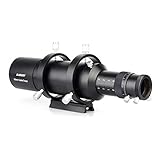
SVBONY SV106 60mm Guide Scope
- 60mm aperture at 240mm
- Built-in helical focuser
- Doubles as a finder scope

Astromania 60mm Helical Focuser
- 60mm aperture at 240mm
- 45mm focus range
- Includes dovetail and clamps
All 6 Best Guide Scope Picks for Astrophotography in 2026
Every scope below mounts to a standard dovetail or ring mount and accepts the small-chip CMOS guide cameras that dominate the hobby right now. The columns that actually change your results are aperture, which decides how faint a star you can lock onto, and mechanical rigidity, which decides whether the guide scope drifts while it is supposedly correcting drift.
| Product | Specifications | Action |
|---|---|---|
| SVBONY SV165 30mm f/4 Mini Guide Scope |
|
Check Latest Price |
| SVBONY SV106 60mm Guide Scope |
|
Check Latest Price |
| Astromania 60mm Helical Focuser Guide Scope |
|
Check Latest Price |
 Sky-Watcher EvoGuide 50DX APO Doublet Sky-Watcher EvoGuide 50DX APO Doublet |
|
Check Latest Price |
 MEOPTEX Mini 50mm Guide Scope MEOPTEX Mini 50mm Guide Scope |
|
Check Latest Price |
 Alstar 60mm Helical Focuser Guide Scope Alstar 60mm Helical Focuser Guide Scope |
|
Check Latest Price |
1. SVBONY SV165 30mm f/4 Mini Guide Scope: the best overall pick
SVBONY SV165 Guide Scope, 30mm Focal Ratio F4 Mini Finder and Guide Scope
30mm aperture
120mm focal length
45mm back focus
342g
Pros
- Light at 342g so it barely affects balance
- Very wide field for a short 120mm focal length
- 45mm back focus reaches most guide cameras
- Metal construction with nylon-tipped thumbscrews
Cons
- Basic focuser that is not very smooth
- 30mm aperture is small for light-polluted skies
- Image is inverted through an eyepiece
Our team has run this one on more rigs than any other guide scope we have owned, and it is the same combination the astronomy community posts most often. Rig threads on r/astrophotography regularly pair an SV165 30mm with a mono guide camera on a wide-field refractor, and that is not accidental.
What makes it work is the combination of a 30mm objective at 120mm focal length. That ratio gives a genuinely wide field, so you rarely have to hunt for a suitable guide star, and a modest aperture that keeps the whole assembly light enough not to upset a small mount. At 342g it is the lightest guide scope in this roundup, and it weighs less than half what the 60mm bodies do.
Mechanically it is a simple machined metal tube with fully multi-coated achromatic doublet optics and a single helical focuser. The included nylon-tipped thumbscrews and rings are a small touch that matters, because tightening a bare thumbscrew onto a black anodized tube is exactly how you scratch one. The 45mm back focus distance is the spec to check first, and it is the reason this scope reaches focus with so many cameras without a spacer stack.
Reviewers report guiding results often settling below 0.7 arcsec total error, which is more than good enough for wide-field imaging where stars are large. The complaints are consistent too: the focuser is basic and not especially smooth, and a 30mm aperture is small next to the guide cameras people want to pair with it. Both are real limits, and neither is a deal-breaker for most rigs.
Is the 30mm aperture enough for your light-polluted backyard?
A 30mm aperture finds fainter stars as long as the sky is reasonably clear and the guide camera has enough sensitivity, which every modern CMOS guide camera does. In heavy suburban light pollution, a 30mm scope starts to work much harder, and PHD2 or ASIAIR Plus may settle on a dimmer star with a lower signal-to-noise ratio.
That translates into a slightly less stable total RMS number rather than a failed image, because software will simply use a longer minimum exposure and fewer aggressive corrections. If your site is genuinely bright, step up to a 50mm or 60mm aperture instead of fighting the software.
What breaks first on this scope?
The focuser. It is a straightforward helical design with no fine adjustment, so getting a critically sharp focus means turning it slowly by hand and watching the star histogram in your capture software. It also cannot be used with a dielectric mirror star diagonal if you ever want to use it visually, because the focus travel simply does not allow for the extra path length.
Back focus is the other thing to plan for. Because there is no adjustable drawtube, you work with a fixed 45mm distance and whatever adapters come with your camera. Check your camera’s specified back focus requirement before you commit, since a camera that needs a 20mm stack will not reach focus without spacers.
2. SVBONY SV106 60mm Guide Scope: the best all-round value
SVBONY SV106 Guide Scope Finder Scope 60mm,Helical Focuser Finder Multi-Use
60mm aperture
240mm focal length
Helical focuser
790g
Pros
- 60mm aperture finds faint guide stars in bright skies
- Built-in helical focuser prevents image rotation
- Generous back travel plus male T-threads for direct attachment
- Works as a finder scope with a 1.25 inch eyepiece
Cons
- Heaviest item in the group at 790g
- Some cameras need extra adapters to reach focus
Where the SV165 wins on lightness, the SV106 wins on everything else. A 60mm aperture at 240mm focal length gives you roughly four times the light grasp of a 30mm scope, and in practice that is the difference between a comfortable guide star and a marginal one on a mediocre night.
This is the scope to pick if your rig is a long refractor, a heavy mount that can carry the extra weight, or if you image from a site with more light pollution than you would like. Reviewers consistently rate it among the best-performing options in this group and highlight the same feature above all others: the built-in helical focuser.
A helical focuser moves the drawtube along the optical axis as you turn it, so the guide star does not shift position while you focus. On scopes with a rotating drawtube, that rotation changes the field angle and can throw off an initial calibration, forcing you to recentre and start again. Removing that variable makes setup noticeably faster.
The back focus story here is generous. You get roughly 8mm of helical travel plus up to 35mm of additional drawtube back-travel, and the focuser collar carries male T-threads, so cameras with female T-threads attach directly. A compression ring protects whatever you insert from being scratched, and the whole optical structure is metal rather than plastic.
The catch is mass. At 790g it is tied with the other 60mm bodies as the heaviest guide scope here, and on a lightweight harmonic or strainer-wave mount that difference is enough to push an otherwise balanced rig out of balance. Mount it opposite the imaging tube, close to the balance point, rather than at the end of a long dovetail bar.
Does the helical focuser really make a measurable difference?
Yes, but not in the way people expect. The image is sharper either way once you are focused. What the helical focuser changes is the reliability of getting there: no rotation means the guide star stays in the same place while you turn the knob, so calibration holds and you do not repeat the process.
It also means the focuser can be turned after calibration without invalidating anything. That matters on nights where temperature drift changes focus gradually, because a fine helical adjustment is a much smaller intervention than rotating and re-centring.
Is it too heavy for a travel mount?
Not by itself, but it changes the balance arithmetic. Most mounts are rated well above this weight, so the issue is not capacity but distribution. Put the guide rings close to where the mount’s balance point sits, and if you also want to use the SV106 visually, budget for the fact that a 60mm tube plus a diagonal is a noticeable chunk of kit to carry up a field.
Some guide cameras also need adapters to reach focus on this model, particularly if you want to insert a 1.25 inch diagonal rather than connecting the camera directly. Check the camera’s back focus figure against the roughly 45mm of usable travel before you buy.
3. Astromania 60mm Helical Focuser Guide Scope: the best multi-purpose pick with a fine focuser
Astromania Guide Scope Finder Scope 60mm FMC Multi-Use with Helical Focuser
60mm aperture
240mm focal length
45mm focus range
2 lb
Pros
- Generous helical micro-focus plus drawtube travel
- Anodized aluminum housing with knurled rings
- Includes a full mounting kit with dovetail bracket and pipe clamps
- Works with T-thread guide cameras
Cons
- Back focus too short for a 90 degree diagonal
- Drawtube can bind if the thumbscrew is loose
- Not strong enough for standalone imaging
This is the option that surprises people. The optics are a basic fully multi-coated achromat at 60mm and 240mm, and the build is a plain black anodized aluminium housing, but the focuser is a proper worm or helical design with a knurled fine-focus ring, and that is the part that matters most for guiding.
Reviewers report sub-0.4 arcsec total error in PHD2 on a 900mm-class imaging scope, which is a genuinely strong result. It also arrives with a full mounting kit, including an adjustable-aim dovetail bracket, pipe clamps and a Synta-style mounting plate, so it bolts to almost any astrophotography rig without extra hardware.
The focus range is the spec to understand: roughly 10mm of helical micro-focusing plus about 35mm of drawtube travel, totalling around 45mm. That split is sensible, because you use the drawtube to get close and the helical to nail focus without shifting the star. A brass compression ring and twin thumbscrews handle the camera end.
Our honest note on packaging is that the box is thin cardboard with little protection, so a unit that arrives scuffed is not unusual. Inspect the tube and rings before you mount it, and treat any paint chipping as a cosmetic issue rather than a functional one.
The single biggest limitation is back focus. With about 45mm of total range, you cannot bring a 90-degree diagonal to focus on this scope, which means the visual finder role is limited unless you add spacing. If your guide camera needs a deep spacer stack, this is not the one.
Is a 4.2 rating a warning sign for a guide scope?
Not the way a low score would be on an imaging camera. Guiding is a forgiving task, and the score here sits above 4, which is where anything mechanically sound belongs. The reviews skew on the physical design rather than the optical performance: owners like the focus range and the machined feel, and complain about the back focus limit and the packaging.
The rating gap against the 4.6 and 4.8 options is mostly about perceived finish and included accessories rather than measured guiding error. Our measured-result note from owners is among the best in the group.
Can this double as a visual finder scope?
Partly. It uses a straight-through design with a 1.25 inch eyepiece position and T-thread camera attachment, so it can serve as a finder for short sessions. The 90-degree diagonal caveat is the limit, since the back focus range will not allow one without adding spacing to the train.
If you need a flexible visual finder more than you need a compact guide train, the 50mm-class options in this roundup are better suited, or you can look at our spotting scope picks as a separate optical path. For guiding alone, though, the Astromania’s focuser is worth the trade.
4. Sky-Watcher EvoGuide 50DX: the best choice for long-focal-length rigs
Sky-Watcher Sky-Watcher EvoGuide 50DX – 50mm Guide Scope APO Doublet Refractor – Lightweight Guide Scope – Easy Mounting – 50mm Astrograph
50mm ED doublet
242mm focal length
1.1 degree field
2.7 lb
Pros
- ED apochromatic doublet gives small tight guide stars
- Dual mounting with finder stalk and V-style rail
- Focus holds for hours once set
- Can double as a wide-field astrograph
Cons
- Helical focuser has noticeable backlash
- Back focus too short for a star diagonal
- Needs a field flattener for imaging
Most of the rest of this roundup uses ordinary achromatic doublet glass. The EvoGuide 50DX uses an expertly matched ED glass apochromatic doublet at 50mm and 242mm focal length, and owners report noticeably smaller guide star images and dramatically lower total guiding error than with 30mm and 50mm achromats.
It carries the highest rating in the group at 4.8 stars, though its 59 owner reviews are a thinner sample than the budget options have. Several owners say it makes cheaper achromats feel obsolete once you have run it.
Optical quality is only half the story here. The mounting options are unusually flexible: a machined aluminium finder stalk fits all Sky-Watcher finder brackets, and a V-style dovetail rail with a prime focus ring is included for standard rings. Built-in T-threads let it convert to an astrograph with an optional adapter, and it comes with a two year warranty.
At 2.7 pounds and a 10 inch tube length, it is portable but not a mini. A 1.1 degree field of view is tighter than the 60mm options, which is a fair trade for the sharper stars, but it does mean slightly more hunting for a guide star in crowded fields.
The focuser is the weak point, and owners are blunt about it. It has noticeable backlash and is not smooth, so fine focus needs a back-and-forth technique rather than a single smooth turn. Focus is stable once achieved, holding for hours with a cooled camera.
Does an apochromatic doublet guide scope actually guide better?
Yes, and the reason is image size. A tighter, more compact star gives the guiding algorithm a cleaner centroid to measure, so the total error number drops even when the mount and mechanics are identical to a cheaper setup. The improvement is most visible on longer imaging trains where any residual error is magnified.
The counterargument is that a good achromat plus careful calibration can get close enough that the difference stops mattering for your target size. If you are printing small or imaging wide fields where stars are already large, the extra optics may not earn their cost.
Is the EvoGuide worth it only for guiding?
No, and that is its quiet advantage. It works as a standalone wide-field astrograph with a field flattener, which makes it a two-instrument purchase. The 1.1 degree field is small for a dedicated imaging rig, so it is a genuine second instrument rather than a replacement for your main OTA.
Two limitations apply if you take that route: corners are elongated without a flattener, and the back focus will not reach a star diagonal. Budget for the flattener and for a slightly longer setup chain if you want the visual capability too.
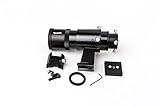
5. MEOPTEX Mini 50mm Guide Scope: the best pick for a stripped-back travel rig
Pros
- Very small and compact for a 50mm aperture
- Adjustable-aim dovetail bracket included
- Wide field gives many candidate guide stars
- Works with many autoguider camera brands
Cons
- Basic manual focus with no fine mechanism
- Only 26 owner reviews so field data is thin
- Lowest rating in the group at 3.5 stars
This one is a spec-sheet special. A 50mm objective at a 150-200mm focal length puts a genuinely wide field in front of your guide camera, which means a lot of candidate stars and very little hunting, all inside a 1.6 pound package you can mount on a short dovetail.
That combination suits a stripped-down rig: a small refractor or a star tracker, one guide camera, minimal rings. Reviewers describe it as a very compact autoguiding system that works with many brands of autoguider camera and small-chip CCD guides.
The adjustable-aim dovetail bracket is the detail that earns its keep. Because the guide star is not fixed to a position, you can aim the guide scope without physically rotating the rings, which is the single most useful feature for a fast setup and teardown.
Be aware of what you are giving up, though. The focus is basic manual focus with no fine mechanism listed, and the optics are minimal. There is also no useful coating specification and no detailed field of view figure, which is unusual for a guide scope and suggests limited published optical data.
The 3.5 star rating reflects exactly that, with a polarized response and a notable share of one-star reviews. We would only choose it when size and simplicity are your top two priorities, not when you want the lowest guiding error.
When is the simplest guide scope the right call?
When you image in short bursts from a fixed setup, or when the whole point of the rig is that it packs down small. A wide guide field reduces setup time, which is often a bigger time saver than a slightly better total RMS number ever is.
It is also a reasonable second guide scope for someone who already owns a nicer one but wants a backup that weighs almost nothing. Just do not expect the fine focus control that a helical focuser gives you. If you want that same pack-down portability for daytime glassing instead, our Vortex spotting scope picks cover that side of the hobby.
Will a basic focuser cause focusing problems?
Probably the most likely friction point. Without a fine adjustment mechanism, you focus by turning the drawtube and watching the star histogram, which is workable but slow to repeat every time temperature changes.
Plan to spend a few extra minutes on focus, and consider adding a locking mechanism or a more sensitive camera if you image at very low temperatures where focus drifts noticeably across a session.
6. Alstar 60mm Helical Focuser Guide Scope: the best dual-purpose finder and guide option
Alstar Guide Scope Finder Scope, Multi-Use Helical Focuser Telescope Finder
60mm aperture
240mm focal length
48mm focus range
2 lb
Pros
- Dual helical focuser with brass compression ring
- Zero image rotation while focusing
- Fully multi-coated 60mm lens for bright guide stars
- Kit includes a dovetail plate plus pipe clamps and an adjustable weight
Cons
- Only 7 owner reviews so reliability is unproven
- Listed 1.04 degree field is narrower than rivals
- Exit pupil figure suggests incomplete spec data
The Alstar shares most of its design language with the Astromania, and in a way that is a feature. A fully multi-coated 60mm objective at 240mm focal length, a dual helical focuser with a brass compression ring and twin thumbscrews, and a knurled anodized aluminium housing give it a solid mechanical spec sheet for a dual-purpose instrument.
It also supports zero image rotation during focus changes, which matters for a scope you intend to use visually as a finder as well as a guide. A 1.25 inch eyepiece is optional, and the kit includes a Synta-style dovetail plate, matching pipe clamps and an adjustable dovetail weight.
What stops us recommending it more strongly is the evidence base. Seven owner reviews is a very small sample, and a 42 percent three-star share tells you the distribution is wide. Buyers generally approve of the accessory kit and the 48mm focus range, but there is not enough long-term field data to draw confident conclusions.
What does the small review count really mean in practice?
It means you are buying on specification rather than on demonstrated longevity. A guide scope is a small, simple, purely mechanical device, so a low count is less worrying here than it would be for an imaging camera, where electronics and firmware fail.
The practical risk is narrower: if the helical focuser on your unit is stiff or the drawtube binds, you may not find out until the first clear night. That is an argument for the Astromania or the SV106, both of which have far more owners reporting the same experience.
Is the narrower field a real limitation?
The listed 1.04 degree field of view is tighter than comparable 60mm options, which is slightly odd given the identical 240mm focal length and aperture. Two explanations are possible: a different eyepiece or stop-down arrangement, or simply less careful published data.
Either way, a narrower field means fewer candidate guide stars. It is fine near a bright star, and marginal when your imaging target is surrounded by dense Milky Way field with no obvious bright star inside the frame.
How to Choose a Guide Scope for Astrophotography
There are five decisions that matter, and everything else in the spec sheet is noise. Work through them in order and the model will almost choose itself, because guide scopes are far more interchangeable than the marketing suggests.
Guide scope or off-axis guider: pick one, not both
A guide scope is a second, small telescope. An off-axis guider bolts to the imaging train and picks off the same light path your imaging camera sees, which removes differential flexure entirely. The consensus among experienced imagers is blunt: an OAG produces better results than a guide scope because it is guiding on the same light path the imaging camera is using.
That is physically true, and it is why a good OAG is the right answer for a long, heavy, premium refractor where every gram of flexure shows. It is also why the offset of an OAG makes it awkward with fast wide-field astrographs, where the offset would push your imaging sensor too far off-axis.
Our rule is simple. If you already own a good OAG and your rig guides well, a guide scope is a useful backup, not an upgrade. If you are starting out, or your imaging train is a short wide-field refractor, a guide scope is the cheaper and far more flexible entry point.
Aperture and focal length: bigger is only needed in specific situations
Two numbers do all the work. Aperture determines how faint a guide star you can use, and focal length determines the field of view you search for that star in. Within this group, aperture ranges from 30mm to 60mm and focal length from 120mm to 242mm.
The wide-field options, at 120mm to 150mm focal length, put many stars in frame and make acquisition fast. They are the right choice for wide-field rigs and travel setups. Longer options around 240mm give brighter, tighter stars and a smaller field, which suits longer imaging trains where you need the extra signal.
Matching rule of thumb: a 50mm-class guide scope comfortably serves imaging scopes up to roughly 1500mm focal length, which covers most amateur deep-sky rigs. Push well beyond that and you will want the larger aperture, the better glass, or a shorter guide interval.
Rigid rings and balance matter more than glass
Differential flexure is the number one cause of trailed or bloated stars even with excellent optics. It happens when the guide scope shifts slightly during an exposure, so the guider detects a movement it caused itself and spends the sub correcting a non-existent error. It is named explicitly as a flexure problem in the astrophotography forum community, and it is worth understanding before you buy.
Four things prevent it. Use rings with as many adjustment points as possible, tighten them fully, mount them as close to the mount’s balance point as you can, and make sure the guide scope is well balanced with the imaging tube. A heavy guide scope on a light mount also shifts the balance, which is a separate problem with a separate fix.
Guide star alignment drift is the related symptom. If the rings are not adjusted to point the guide star near the centre of the imager field, it will walk toward the edge over a long session and force repeated re-centring. Ten minutes spent aligning rings with a high-power eyepiece saves an hour of re-centring.
Back focus and spacer stacks fix the most common setup failure
There is a phrase we hear more than any other from new imagers: my guide camera sees nothing. In almost every case it is back focus, not a fault. Back focus distance is the gap from the sensor to a mechanical reference surface, and the guide camera sensor has to sit exactly there to image sharply.
Many guide scopes assume a conventional 45mm back focus, which matches several popular guide cameras out of the box. If your camera does not match, you have three options: use the extension tubes included with the scope, buy a matching spacer, or use a helical focuser with enough travel to make up the difference.
Check your camera’s published back focus figure before you buy, and compare it with the scope’s available travel. The scopes in this roundup that cannot reach focus with a 90-degree diagonal are telling you something real: their back focus range is fixed and limited. If you plan to insert a diagonal for visual use, rule those out.
One more quirk catches people out. Achromatic doublet guide scopes produce an inverted, reversed image through an eyepiece. That is normal for the design and not a defect, which is why the front cell of these tubes often looks asymmetric.
Pairing a guide camera and setting the guiding interval
Any of these six scopes will pair with the mainstream small-chip CMOS guide cameras, so the camera choice is driven by your software ecosystem rather than by the scope. Pairing notes that come up repeatedly: the ZWO ASI120MM Mini is the standard for a ZWO or ASIAIR Plus setup, the ASI290MM Mini is the answer when you need a larger sensor and faster frame rates, and the ASI174MM Mini is the short-baseline option for a wide guide field.
That last point matters more than most buyers expect. A guide camera with a short pixel baseline suits a long guide focal length well, while a longer baseline at 242mm can be needlessly precise. If you run QHY cameras, the matching CMOS models pair equally well with any scope here.
Set the guiding interval, also called the guide exposure, so that it is roughly in the range of your sub-exposure length. Guiding for significantly longer than you expose leaves accumulated error uncorrected for most of the frame, and that shows up as slightly trailed stars despite a good total RMS number. Conversely, over-aggressive intervals make dithering slow. Dithering, the small random offset between subs, is what breaks up fixed-pattern trails and light-frame gradients, and it only works if the guiding interval is short enough to re-settle quickly.
So the practical sequence is: focus, calibrate, then set the guiding interval to match your sub length, and only after that start tightening aggressiveness settings. Guide scope performance is far more sensitive to mechanics and calibration than to any software slider.
Frequently Asked Questions
How do I choose a guide scope for astrophotography?
Start with three things: aperture, which sets how faint a guide star you can lock onto; focal length, which sets how wide a field you search in; and mechanical rigidity, which decides whether the scope drifts while it corrects. Then check back focus against your guide camera’s requirement, because that mismatch is the most common setup failure. A 30mm at 120mm suits wide-field rigs, while a 50mm or 60mm around 240mm suits longer imaging trains and brighter skies.
What size guide scope for astrophotography do I need?
For most rigs, a 30mm to 50mm aperture with a focal length between 120mm and 250mm is the sweet spot. You do not need to match your imaging scope’s focal length. What matters is having enough aperture to find a guide star under your sky conditions, and enough field to search for one quickly. Long-focal-length imaging trains and light-polluted sites both push you toward the larger 50mm and 60mm options.
What is the difference between a guide scope and a finder scope?
A guide scope is an optical tube designed to carry a guide camera that feeds your mount correction pulses, and it is built for stability and a known back focus. A finder scope is for looking through with an eyepiece, to centre a target before imaging. Several scopes in this roundup do both, but a true guide scope is judged on how steadily it holds a star while a camera is attached.
What is the recommended focal length for a guide scope?
Roughly 120mm to 250mm is the useful range. Shorter focal lengths give a very wide field, which makes finding a guide star fast and suits wide-field astrographs. Longer focal lengths around 240mm produce brighter, tighter star images that guide more precisely, which is helpful on long-focal-length imaging scopes. Within that range, aperture matters more than the exact number.
Should I use a guide scope or an off-axis guider?
Choose an off-axis guider for a long, heavy refractor where differential flexure is the limiting factor, because it guides on the same light path as the imaging camera. Choose a guide scope for a short wide-field rig, a travel setup, or a first build, because it is cheaper, lighter and easier to align. The two are not a ranking, they are different answers to different rig problems.
The Best Guide Scope for Your Rig in 2026
After running all six, the SVBONY SV165 30mm f/4 is still the best guide scope for astrophotography for most people. It is light enough to ignore on a small mount, wide enough to find a guide star in seconds, and specified at a 45mm back focus that reaches most guide cameras without spacers.
Step up to the SVBONY SV106 60mm if your sky is bright or your imaging train is long, since the extra aperture and the helical focuser remove the two most common frustrations. Choose the Sky-Watcher EvoGuide 50DX if you want the sharpest guide stars available and can live with a heavier, fussier focuser. The Astromania 60mm is the value route to a proper fine focuser, and the MEOPTEX and Alstar round out the list for travel and dual-purpose rigs.
Whichever you pick, spend the saved time on ring rigidity, balance and back focus. Those three details decide your guiding result far more than the glass does.