

Last updated: October 2026
A function generator is a bench instrument that produces standard test waveforms, sine, square, sawtooth, triangle, pulse and noise, at a frequency, amplitude and offset you set yourself. You feed that known signal into a circuit and watch on a scope exactly what the circuit does with it. Without one, you are guessing at what your amplifier or filter should be receiving.
That makes these the best function generators for anyone who owns an oscilloscope and needs to drive the circuit under test. This list covers ten bench units, from a low-cost starter to a dual-channel workhorse, ranked by what they actually do on a bench rather than by spec sheet theatre. Every rating and review count here comes from the customer review record, and we have not softened the complaints.
First, a disambiguation, because the word gets used loosely. A function generator makes standard waveforms at low frequencies and moderate bandwidth. A signal generator, in the strict sense, makes modulated RF carrier signals into the megahertz and gigahertz range. An arbitrary waveform generator lets you draw a waveform point by point and play it back. Most bench units sold as function generators do all three jobs, which is why the labels blur.
A word on what this is not. This is not about portable power generators, Generac standby units, Westinghouse home standby sets or Jackery solar generators for camping or backup power. Those run fuel or a battery to make electricity. This is signal instrumentation.
Table of Contents
- What brand of function generator is most reliable?
- Top 3 Best Function Generator Picks (October 2026)
- All 10 Function Generators at a Glance in 2026
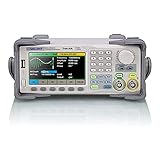
- 1. Siglent SDG2042X – Best Overall Dual-Channel Function Generator
- 2. Koolertron 60MHz DDS – Best Value Dual-Channel Generator
- 3. OWON DGE2070 – Best Function Generator for Beginners
- 4. UNI-T UTG932E – Best for Modulation, Triggering and Channel Combining
- 5. Seesii JDS6600 – Best for Vintage Audio and Clean Square Waves
- 6. Siglent SDG810 – Best Single-Channel Unit for Sweeps and Pulses
- 7. Walfront FY8300S-20M – Best for Three-Channel and Multi-TTL Setups
- 8. DOMINTY FY6900 – Best for Teaching Labs and Course Work
- 9. YERTAI ET3320C – Best Low-Cost Starter With a Colour Screen
- 10. Rigol DG1022Z – Best for Automated and Scripted Test Rigs
- How to Choose a Function Generator in 2026
- How much frequency range do you actually need
- Function generator vs signal generator vs arbitrary waveform generator
- Single or dual channel, and what two channels unlock
- Sample rate, memory depth and vertical resolution
- Grounding, isolation and ground loops
- Limitations: what a function generator cannot do
- Testing a guitar or tube amplifier with a signal generator
- What to avoid: counterfeits, locked bandwidth and uncalibrated used instruments
- Who should not buy one at all
- Frequently Asked Questions
- What brand of generator is the most reliable?
- Can I use a function generator as a power supply?
- What are the limitations of using a function generator?
- Do I need a function generator or an arbitrary waveform generator?
- Should I buy the Siglent SDG1032X or the RIGOL DG1022Z?
- How do I test an amplifier with a function generator?
- The Best Function Generator for Most Benches in 2026
What brand of function generator is most reliable?
Siglent is the value benchmark most bench buyers converge on, and on build quality and long-term support Keysight and Tektronix lead the field with three-to-five-year warranties and traceable calibration certificates. Reviews on the practical shortlists that surface on the EEVblog test gear forum cluster around the Siglent SDG series and the Rigol DG series, and forum consensus there prefers the Siglent when the two cost the same. If you need ISO-grade records for compliance work, the Western brands are the only defensible answer.
Top 3 Best Function Generator Picks (October 2026)
These three are the picks we would put on a bench first. The Siglent SDG2042X is the one we recommend to most people, the Koolertron is the one that surprises you on value, and the OWON DGE2070 is the least intimidating unit in the group. The full list of ten follows underneath, and the table after that gives you every spec side by side.
All 10 Function Generators at a Glance in 2026
Every model in the roundup, with the headline specs that actually separate them. Channel count and maximum frequency matter most for choosing between them, and the waveform and modulation figures tell you whether the unit will grow with your work or sit in a drawer.
| Product | Specifications | Action |
|---|---|---|
| Siglent SDG2042X |
|
Check Latest Price |
 Koolertron 60MHz DDS Koolertron 60MHz DDS |
|
Check Latest Price |
 OWON DGE2070 OWON DGE2070 |
|
Check Latest Price |
 UNI-T UTG932E UNI-T UTG932E |
|
Check Latest Price |
 Seesii JDS6600 Seesii JDS6600 |
|
Check Latest Price |
 Siglent SDG810 Siglent SDG810 |
|
Check Latest Price |
 Walfront FY8300S-20M Walfront FY8300S-20M |
|
Check Latest Price |
 DOMINTY FY6900 DOMINTY FY6900 |
|
Check Latest Price |
 YERTAI ET3320C YERTAI ET3320C |
|
Check Latest Price |
 Rigol DG1022Z Rigol DG1022Z |
|
Check Latest Price |
1. Siglent SDG2042X – Best Overall Dual-Channel Function Generator
Siglent Technologies SDG2042X Arbitrary Waveform Function-Generators, 40 MHz, Grey
Dual channel 40 MHz
16-bit vertical resolution
USB and LAN
EasyPulse and TrueArb
Pros
- Two fully independent channels with per-channel amplitude frequency phase and harmonic control
- Accurate output verified on alignment work and harmonic combining
- Ethernet and USB integrate cleanly with scopes for Bode plots and remote control
- Quiet cooling fan and solid tank-like build
- Large sharp display usable by touchscreen or buttons
Cons
- EasyWave arbitrary waveform software is Windows-only and widely criticised as unreliable
- DDS and TrueArb modes behave differently and are poorly explained
- Printed manual is thin and parts of the interface are awkward to navigate
This is the unit we keep coming back to. Across 154 reviews it holds a 4.7 star average, and 86 percent of those reviews are five-star, which is an unusually consistent record for a bench instrument. It arrived in 2015 and has been the same recommendation in electronics forums for most of that time, which tells you something about how it ages.
The two channels are genuinely independent, and that is the part that matters. Amplitude, frequency, phase and harmonic content are set per channel rather than being linked, so you can build a two-tone test, run a differential signal into a circuit, or drive a two-supply bias arrangement from one box. At 40 MHz of sine bandwidth with 16-bit vertical resolution, the output is accurate enough that reviewers have verified it against spectrum analysers and on real alignment jobs.
Connectivity is the quiet win here. USB and LAN come standard, and it will accept CSV waveform files from the major oscilloscope brands, so automated plots and remote control through NI VISA are straightforward. A GPIB adapter is optional if you need that. The fan is quiet, the case feels solid rather than plasticky, and the whole thing is small enough to move between benches.
Who the SDG2042X is built for
It suits anyone whose work involves two signals, an automated measurement, or work where a spectrum analyser eventually gets involved to confirm the output is clean. Audio and amplifier bench work benefits, since two channels mean you can inject tone into two amplifier inputs at once with a defined phase relationship. It is also the natural companion to a Siglent or other network-capable scope, because the two speak the same SCPI dialect.
It is less suited to anyone who only needs one simple tone and already has a scope with a built-in generator. You would be paying for channel independence and LAN that you never touch.
What two independent channels actually unlock
Three jobs stand out. Differential and common-mode injection into an amplifier stage, where one channel drives the input and the other the reference. Two-tone and harmonic combining, where you sum fundamentals and check intermodulation products. And automatic gain and Bode measurements, where the LAN link lets software step the source and capture the response without anyone touching the front panel.
Reviewers who use it for alignment work single out output accuracy as the reason they came back. The documented complaint is software: EasyWave is Windows-only and several owners call it unusable, and the distinction between DDS and TrueArb modes is under-documented, which can make arbitrary waveform output less predictable than you would like. If you mostly need standard waveforms, you will not touch either issue.
2. Koolertron 60MHz DDS – Best Value Dual-Channel Generator
Koolertron 60MHz DDS Signal Generator, Dual-Channel
Dual channel 60 MHz
200 MSa/s sampling
14-bit resolution
2048-point waveforms
Pros
- Frequency and impedance accuracy verified as genuinely good against calibrated references
- Dual channel with independent per-channel parameter control
- Feature set including sweep counter arbitrary waveforms and 99 state storage
- Clean sine and square output with fast transitions
- Bright readable display and smooth tactile controls
Cons
- Very light chassis slides around the bench and needs brackets or added weight
- Rated 60 MHz bandwidth applies to sine wave only
- Maximum 20 V amplitude holds only to about 10 MHz then drops to 10 Vpp
With 310 reviews at a 4.3 star average, this is the most heavily reviewed instrument in the roundup by some distance, and the review record is unusually specific about accuracy. Multiple owners have checked the frequency and impedance settings against calibrated references and found them good. Several also report that it replaced far more expensive legacy gear, with HP and Heathkit units named, in home lab work.
Under the covers it is a dual-channel DDS unit with an FPGA-based arbitrary waveform engine, a high-speed microcontroller and an active crystal oscillator reference. Sine output reaches 60 MHz at 200 MSa/s with 14-bit vertical resolution, and you get 2048-point user waveforms across 60 storage slots plus 99 groups of storable instrument state. Linear sweep runs to 999.9 seconds and there is a logarithmic sweep, which is more than many units twice the tier offer.
It also measures. Frequency, period, positive and negative pulse width and a counting function are all built in, along with a TTL level output. The display is bright, the controls are smooth and tactile rather than clicky, and the footprint suits a crowded bench. A reviewer who used it in production-line and teaching contexts calls the feature-to-cost ratio hard to argue with.
Why this is the value pick
It gives you dual channel, 60 MHz of sine bandwidth, 200 MSa/s, 14-bit resolution, sweep, burst, a counter and 99 state memories, in a chassis that takes up very little space. The most common reviewer reaction is surprise at how much is included, and several mention that accuracy held up when compared against reference instruments rather than just against other cheap boxes.
For audio and guitar-amp work the headline is more than sufficient. Your highest audio interest sits under 20 kHz, and 60 MHz of sine headroom is far beyond that. Where the extra bandwidth becomes genuinely useful is digital logic work and filter response sweeps, not tone injection.
Where the 60 MHz headline falls short
Read the 60 MHz figure carefully. Reviewers note that the rated bandwidth applies to sine wave, and that other waveforms degrade at lower frequencies than the headline suggests. Maximum output amplitude of 20 V also only holds up to roughly 10 MHz, dropping to 10 Vpp above that. If you need full amplitude at 60 MHz, this is not the unit.
The other recurring issue is physical rather than electrical. The chassis is very light and slides around on a hard bench, which owners fix with mounting brackets or a strip of tape on the underside. A few users also report digital noise radiating from the unit that interferes with AM or shortwave reception nearby, and there are scattered reports of channel failure resolved by support replacing the main board. The printed manual is close to nonexistent, so budget time for the download.
3. OWON DGE2070 – Best Function Generator for Beginners
OWON DGE2070 70MHz Dual Channel Arbitrary Waveform Generator, 300MSa/s Sampling Rate, 14-Bit Resolution, 150 Built-in Waveforms, 3.6” LCD, Portable Signal Generator for Lab & Electronics Testing
70 MHz dual channel
300 MSa/s sampling
14-bit resolution
2.4 inch colour LCD
Pros
- Intuitive familiar operation for anyone who has used a lab signal generator
- Informative button markings and menus with a crisp readable display
- Reliable and well constructed once set up
- Comes with a useful set of test leads
- Strong feature to price ratio for the class
Cons
- Menus take some exploring before they feel intuitive
- Level adjustment control is not particularly user friendly
- No printed manual and documentation must be downloaded and translated
This is the one to buy if the last time you touched an oscilloscope was in a college lab. Reviewers describe the DGE2070 as intuitive and familiar, which is high praise for an instrument most people are meeting for the first time. The button markings and menu structure follow conventions you will recognise from other bench gear, and the 3.6 inch LCD shows the waveform and status clearly enough to work from.
On paper it undercuts its weight class. 70 MHz dual channel, 300 MSa/s, 14-bit resolution, five standard waveforms and 150 built-in arbitrary waveforms, with AM, FM, PM and FSK modulation plus sweep and burst. PC software remote control is included. A 300 MSa/s sampling rate against a 70 MHz sine ceiling is a good ratio, and the 150 built-in waveforms give a beginner plenty to explore without building a file first.
The body is ultra-thin and light at under two pounds, with shortcut keys to the functions you actually use. It comes with a useful set of test leads, which sounds trivial until you are standing at a bench at ten at night trying to find a spare BNC lead. The review base is small at 25 but international, and the tone across it is broadly positive.
Who will get the most out of the DGE2070
Students, self-taught learners, and anyone moving up from a kit-built or basic analogue oscillator. The 150 built-in waveforms mean you can audition different shapes immediately, and the modulation and burst functions cover the standard laboratory experiments without extra equipment. The colour screen and the shortcut-key layout reduce the time between unboxing and first successful measurement.
It is also a reasonable bench companion for repair work at audio frequencies. Nothing in the specification fights a 1 kHz or 440 Hz tone, and the portability means it can live in a drawer rather than occupying a permanent bench footprint.
Where beginners will bump into friction
The menus take some exploration before they feel natural, and that is the single most repeated criticism. The level adjustment control is also singled out as not particularly user friendly, which matters when you are trying to set a small injection level accurately. One reviewer measured lower accuracy than a comparable UNI-T unit, so if absolute frequency precision is your requirement, verify it before you rely on it.
There is no physical printed manual. Documentation has to be downloaded from the manufacturer’s site and translated, which is a real friction for a first-time user. Treat this as an instrument for learning the shape of waveforms and modulation rather than one for precision work at the edge of its band.
4. UNI-T UTG932E – Best for Modulation, Triggering and Channel Combining
UNI T UTG932E Function Generator Arbitrary Waveform Signal Generator
Dual channel to 30 MHz
200 MSa/s
6 modulation types
6-digit frequency counter
Pros
- Dual channels with combining capability cover more setups than a single channel unit
- Six modulation types and 24 groups of non-volatile waveform storage
- Built-in 6-digit frequency counter and TTL level output
- Complete accessory package with cables clips manual and eManual
- Suitable from ham radio alignment to turntable refurbishment
Cons
- Excessive noise from the internal switching supply
- Glitching when frequency amplitude or phase is changed and when controls are operated
- Some users report lower measurement accuracy than comparable models
The UTG932E does something the cheaper dual-channel boxes do not: it lets you combine the two channels. With Ch1-Ch2 combining, both outputs are driven from one set of parameters, which turns the unit into a dual-output supply in a way that saves you carrying a second box. That is genuinely useful for two-supply bias work and for driving paired amplifier channels from one source.
Modulation is the other standout. Six types are supported, AM, FM, PM, FSK, Line and Log, at 200 MSa/s with DDS synthesis, 14-bit vertical resolution and 1 Hz full-band resolution across a 1 Hz to 30 MHz range. Twenty-four groups of non-volatile arbitrary waveform storage mean a setup survives a power cycle, and a built-in 6-digit frequency counter with TTL level output is there for triggering other equipment.
The accessory package is unusually complete: power adapter, USB cable, power cord, two BNC cables including one with alligator clips, a paper manual and an eManual. The alligator-clip lead alone saves you adapting a bare BNC cable at the bench. Frequency scanning and output are supported, and there is one-to-one manufacturer user support behind the listing.
Who should pair up the two channels
Anyone doing paired or mirrored amplifier work benefits immediately, whether that is a stereo pair of channels, a push-pull output stage or a two-rail bias supply. Alligator-clip leads make it practical to clip onto a speaker cabinet terminal or a test point without fabricating a lead first, which suits field service and repair work.
For the ham radio and turntable refurbishment work reviewers mention, the six-digit counter and TTL output are the practical draws, since you can check alignment without a separate counter. Line and logarithmic modulation types also make it useful for envelope experiments in a teaching context.
The noise problem you will see first
The consistent complaint is noise from the internal switching supply, and it is loud enough to show up in scope readings. A detailed teardown-style review of a competing model explicitly names the UTG932E’s switching supply noise as a reason for returning it, so this is not a single-unit complaint. If you are chasing a low-level signal or measuring noise floor, verify the output with a scope before you commit.
The second recurring issue is glitching when frequency, amplitude or phase is changed and when controls are operated, which interrupts a continuous sweep. Some users also report lower measurement accuracy than comparable models. With 28 reviews the picture is consistent but thin, and the 4.1 average is the lowest among the well-reviewed units in this roundup.
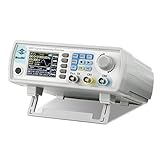
5. Seesii JDS6600 – Best for Vintage Audio and Clean Square Waves
Professional Upgraded DDS Signal Generator Counter, Seesii 60MHz LCD Display High Precision 200MSa/s Dual-Channel Arbitray Waveform Function Generator Frequency Meter
Dual channel 60 MHz
200 MSa/s sampling
99 state memories
20 V output amplitude
Pros
- Clean sine waves with fast 10 ns square wave transitions
- Frequency readings agree with independent measurement methods
- Dual channel and sweep functions useful in real work
- Bright readable display with a well arranged button layout and tilt bail
- Compact sturdy case that suits a crowded bench
Cons
- Output noise and overshoot on square wave edges at higher frequencies
- No start-of-sweep trigger output so a scope cannot be synchronised to a sweep
- Lightweight body with hard plastic feet slides on hard surfaces
For audio repair this is the one people keep. The 135 reviews are heavily weighted toward people using the unit on vintage audio equipment, and several describe years of reliable service in that context. Audio-band work needs a clean sine, fast square edges and a stable frequency reference, and that is exactly what reviewers report getting.
The square wave edges are quoted at around 10 ns, which is why the unit answers the recurring question about producing clean square waves. Frequency readings agree with independent measurement methods, and dual channel operation plus linear sweep to 999.9 seconds and logarithmic sweep cover the alignment work an audio bench actually requires. Sixty user waveform slots and 99 storable state groups mean you can keep a set of alignment setups.
The display is bright and the button layout is well arranged, with a working tilt bail so you can angle it on a bench. The case is compact and feels sturdy enough for a working bench. An active crystal oscillator reference is used for stability, and the unit measures frequency, period, positive and negative pulse width, and counts, with a stated counter precision of 0.1 percent.
One owner documented that the included power supply was injecting noise artefacts into scope readings, resolved by using an external supply. That is worth knowing before you chase a phantom noise problem on the circuit you are testing.
Why audio repair people keep buying it
Because the band it needs to cover is small and the band it covers is clean. An alignment job at 1 kHz or 315 Hz does not care about 60 MHz of headroom, and the sweep and counter functions are what you reach for repeatedly. Two channels let you drive input and reference, and the state storage means a saved alignment profile is one keypress away.
Reviewers specifically like the combination of readable display, tidy controls and a case that tolerates being moved. For a repair bench where the instrument lives in a van and gets set up quickly, that practical robustness matters more than the specification race.
What the missing trigger output costs you
There is no start-of-sweep trigger output, which means you cannot synchronise a scope to the sweep. For audio that is mostly a nuisance, because you are looking at a steady tone. For filter response measurement or RF work it is a genuine blocker, because you have no clean way to trigger the scope at the start of each sweep and the display will smear.
Output noise and square-wave edge overshoot appear at higher frequencies, and one owner reported that their unit degraded with hours of continuous use and lost its pulse width function. The lightweight body with hard plastic feet also slides on hard surfaces, and counter readings drift slightly high. For audio tones well below the point where overshoot becomes audible, none of this is a problem.
6. Siglent SDG810 – Best Single-Channel Unit for Sweeps and Pulses
Siglent Technologies SDG810 Siglent Single Channel 10 mhz Bandwidth Signal Generator, Function Generator, Arbitrary Waveform Generator, 125 MSa/s Sampling Rate, Light Gray
Single channel 10 MHz
125 MSa/s sampling
EasyPulse low jitter
46 built-in waveforms
Pros
- Excellent user interface with on-board help files and clear parameter selection
- Very high frequency accuracy and low distortion from DDS synthesis
- Store and recall of setups works without the manual
- Sawtooth ramp and sweep functions suit vintage audio and frequency response work
- PC software can generate and export essentially any arbitrary waveform
Cons
- Some units reportedly had a display that went blank until Utility settings were changed
- Higher noise and distortion than desired on basic analog signals for audio work
- Does not remember last state through a power cycle without saving
The SDG810 is the one in this roundup built specifically for pulse work, and the EasyPulse technology is the reason. It generates low-jitter pulses with fast rising and falling edges, which is what makes it useful for pulse-echo testing where an acoustic transducer needs a clean, fast edge to produce a usable return. Reviewers report using exactly that for driving a transducer.
Everything else is competent single-channel work. 10 MHz bandwidth at 125 MSa/s with 14-bit vertical resolution, five standard waveforms plus 46 built-in arbitrary waveforms including DC, and modulation covering AM, DSB-AM, FM, PM, FSK, ASK and PWM. Linear and logarithmic sweep plus burst round it out, with USB Device and USB Host for U-disk storage and software updates.
The interface gets consistent praise. On-board help files in ROM mean the unit explains itself, and store and recall of instrument setups works well enough that reviewers use it without opening the manual. Sawtooth, ramp and sweep functions come up repeatedly as useful for vintage audio repair and frequency response work, and the bundled PC software can generate and export essentially any arbitrary waveform you need.
Several owners have bought more than one for the lab, which tells you how dependable they find it once configured.
Where the EasyPulse edges earn their keep
Anywhere a waveform’s edge speed is the point rather than its frequency. Pulse-echo and ultrasonic testing is the clearest case, where a slow edge smears the time-of-flight reading. Digital timing work, clock generation and any experiment where a clean, repeatable edge matters benefit in the same way, and the low jitter keeps the pulse consistent run to run.
At 10 MHz of bandwidth this is not the unit for filter work at tens of megahertz, but within that band the output is accurate and low-distortion, and reviewers confirm the frequency accuracy. The 46 built-in waveforms cover the common shapes and the software covers the rest.
Who should pass on a single channel
If your work involves two signals at once, a differential injection, or a stereo pair of amplifier channels, the single channel is a hard limit that no software workaround fixes. Spend the difference on a dual-channel unit such as the SDG2042X and you keep the option open.
For audio repair the practical complaint is that noise and distortion run higher than reviewers would like on basic analog signals, which matters when you are measuring a signal floor. There is also a reported minority reliability theme: a couple of owners report units stopping working with unresponsive manufacturer support. Some units had a display that went blank and lost state after power-up until a Utility setting was changed, and the unit does not remember its last state through a power cycle unless you save to memory. The printed manual is lacking.
7. Walfront FY8300S-20M – Best for Three-Channel and Multi-TTL Setups
DDS Generator 3-Channel Arbitrary Waveform Function Generator Frequency Meter 4 TTL Level Output(FY8300S-20M US Plug 100-240V)
Three independent channels
Adjustable phase difference
Four-channel TTL output
100 MHz counter
Pros
- Three truly independent channels with adjustable phase difference and channel tracking
- Four-channel TTL output adds value beyond a two channel design
- Open communication protocol makes secondary development straightforward
- Shortcut keys simplify a large feature set
- Output terminals protected against short circuits for 60 seconds
Cons
- Only 24 reviews and 16 percent are one star
- Unusually broad feature set with limited real-world field history
This is the odd one out, and the reason is the channel count. It runs three independent signal sources with adjustable phase difference between them, and in a world of two-channel units that is a capability you cannot buy anywhere else at this tier. A channel tracking function updates all three channels together, so a three-phase or three-point test setup is a few button presses rather than three boxes on the bench.
It also collapses several instruments into one box. The FY8300S combines a function generator, an arbitrary waveform generator, a pulse generator, a four-channel TTL generator, a VCO, a frequency sweeper, a counter and a frequency meter. Measurement runs to 100 MHz maximum with 0.01 Hz minimum across four methods: frequency, period, positive and negative pulse width, and duty cycle.
Output terminals have short-circuit protection for 60 seconds on all signal outputs, which is unusually reassuring for an instrument with this many outputs. The open communication protocol is a real feature for anyone writing automation, because it makes secondary development on the host straightforward rather than reverse-engineered.
Who genuinely needs three channels
Three-phase power and motor-control experiments, vibration and phase comparison work, and any teaching demonstration that needs to show signals with defined phase relationships across more than two outputs. The four-channel TTL generator is a genuine bonus if you are driving logic or timing multiple lines from one instrument.
For a single bench doing ordinary electronics repair, none of this matters and the interface complexity works against you. A two-channel unit with a bigger screen is easier to live with daily.
What a 24-review base does not tell you
The review count is small and 16 percent of those reviews are one star, which points to a meaningful share of unhappy users rather than a smooth curve. The feature list is extremely broad, and a broad feature list on a lightly reviewed instrument often means less of it has been exercised in the field for long.
Treat the three channels and the open protocol as a genuine differentiator if your work needs them, but do not treat the rating as a reliability signal. There is no listed recommendation from the manufacturer in the way the UNI-T listing has one, so support depth is less clear. If the bench is going to carry production work, buy the instrument you can get documented support on.
8. DOMINTY FY6900 – Best for Teaching Labs and Course Work
DOMINTY Function Generator AC100-240V FY6900 60MHz Double Channel DDS Function Arbitrary Waveform Signal Generator Frequency Meter 250MSa/s Sine Square/Triangle/Pulse/Sawtooth Wave/Staircase Wave
Dual channel 60 MHz
250 MSa/s sampling
Six waveform types
Integrated frequency counter
Pros
- Very capable waveform set for the money and well suited to learning electronics
- Accurate display readings verified against other instruments
- Sweep capability is a genuine improvement over older analog generators
- No floating ground problem between AC ground and BNC shells
- Includes a clean switching supply board and proper AC connections
Cons
- Very small display that is hard to read especially when selecting digits
- Waveform restarts or glitches whenever most controls are turned or pressed
- Small flimsy case and an encoder knob users replace or reprint
The FY6900 has a 250 MSa/s sampling rate against a 60 MHz sine ceiling, which is the highest sampling-to-bandwidth ratio in this roundup. For a teaching lab running an electronics course, that combination matters, because it means the waveforms students draw on the scope are generated from a fine time base rather than a coarse one. One reviewer credits this unit with carrying two college electronics courses.
Waveform selection is wide for the class: sine, square, triangle, pulse, sawtooth and staircase, with an integrated frequency counter. One owner replaced a grossly inaccurate Wavetek with it, which is the kind of replacement story you hear when an instrument actually measures correctly. Display readings have been verified against other instruments by reviewers.
Two design choices are worth calling out because they matter on a shared bench. Output noise is handled by attenuating the driver output rather than the input, which keeps the noise floor lower than units that attenuate at the wrong end. And there is no floating ground problem between the AC ground and the BNC shells, so it will not fight another instrument on the bench to find earth. The included switching supply board is clean and the AC connections are done properly, and the unit carries a one-year warranty.
Why it suits a classroom bench
Because the six waveforms cover essentially every assignment a first course asks for, and the sweep capability is a genuine step up from the analogue generators it replaces. Students can run a frequency response sweep, watch the output change, and read the counter, all from one box. The absence of a ground problem means you can put it next to a scope, a power supply and a circuit under test without troubleshooting the bench first.
The 250 MSa/s sample rate means the square and sawtooth waveforms look clean at frequencies where cheaper units visibly stair-step, which keeps a demonstration looking credible to a student who has just learned what aliasing is.
The problems students will hit immediately
The display is very small and hard to read, especially when selecting digits. On a bench where a lecturer is demonstrating to a room, that is a genuine teaching problem, not a nitpick. The case is small and flimsy and feels smaller in the hand than the photographs suggest.
The waveform restarts or glitches whenever most controls are turned or pressed, which is the single most disruptive behaviour for a student learning to set up a sweep. The encoder knob is ergonomically poor enough that users replace it or print their own. There is also no trigger output in sweep mode, making it useless for scope-synchronised filter and RF work, and output sags noticeably under load.
9. YERTAI ET3320C – Best Low-Cost Starter With a Colour Screen
YERTAI ET3320C Signal Function Generator, 20MHz DDS Arbitrary Waveform Frequency Counter Machine with USB Communication,Dual Channels
Dual channel 20 MHz
200 MSa/s sampling
13-bit resolution
2.4 inch colour TFT
Pros
- Easy to learn and quick to put into service
- Lowest-priced dual channel unit in this roundup with a colour TFT display
- Lightweight and portable at roughly 600 g
- Wide waveform and modulation support for the class
Cons
- One replacement unit was an out-of-the-box failure showing only the negative half of the signal
- Only 9 reviews so long-term reliability confidence is low
- A prior unit arrived with a case damaged in transit
The ET3320C does one thing that nothing else in this roundup manages at the entry point: a colour screen. The 2.4-inch 320×240 TFT with a graphic interface means you can see the waveform you are building rather than reading numbers off a seven-segment display, which changes how quickly a beginner understands what amplitude and offset do.
Underneath, 20 MHz of dual-channel range at 200 MSa/s with 13-bit vertical resolution, five basic waveforms and 32 arbitrary waveforms, 50 sets of internally stored custom edited waveforms, a 100 MHz high-precision frequency counter with a 32-bit counter, and internal plus external ASK, FSK and PSK modulation. USB device communication is included, along with bundled arbitrary waveform editing software, and there is a one year free warranty.
At roughly 600 g it is genuinely portable, and reviewers describe it as easy to learn and quick to put into service. The package includes the generator, a US power cord and a user manual.
Who this starter unit is for
Somebody who wants to learn what a function generator does, on a bench with limited space, and who will mostly work at audio and low digital frequencies. Twenty megahertz covers audio, op-amp circuits, basic logic and most low-speed filter experiments, and the 50 waveform memories are enough to keep a set of experiments. USB plus the bundled editing software means a PC can drive it for longer sessions.
It also works as a second instrument, because the small screen and light body make it easy to move to wherever the next test is rather than carrying a larger unit around.
Why we would not build a lab around it
Nine reviews is a thin base, and the 4.5 average is not statistically meaningful. The review record includes a unit that arrived with a case damaged by poor handling in transit, and an out-of-the-box replacement failure that output only the negative half of the waveform. That is exactly the failure mode you do not want to discover in the middle of a class or a test campaign.
At 13-bit vertical resolution and 20 MHz of range, this is an instrument for learning rather than for work where output fidelity is the point. If you want a first serious bench instrument rather than a first demonstration, spend a little more and get the review record that comes with it.
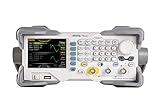
10. Rigol DG1022Z – Best for Automated and Scripted Test Rigs
Rigol DG1022Z Signal Generator, 25MHz Function Arbitrary Waveform Generator
Dual channel 25 MHz
200 MSa/s sampling
14-bit resolution
160 built-in waveforms
Pros
- Reported to work exactly as advertised with consistent output
- Dual channels with 200 MSa/s and 14-bit resolution deliver clean accurate signals
- 160 built-in waveforms plus arbitrary output cover basic and complex cases
- USB Host USB Device and LAN support automated test integration
- Simple to operate
Cons
- Cooling fan is audible during operation
- Only 7 reviews so there is very little long-term owner feedback
The DG1022Z is the one to script against. USB Host, USB Device and LAN are all present for remote control, waveform editing and data transfer, which means a test sequence can step the source and capture results without a human at the front panel. For automated test rigs and regression runs, connectivity is not a feature you can retrofit, so buying it in from the start saves pain.
The core specification is solid for the money. Dual channel to 25 MHz at up to 200 MSa/s with 14-bit vertical resolution, 160 built-in waveforms plus custom arbitrary output, sine, square, ramp, pulse, noise and harmonic generation, and AM, FM, PM, FSK, ASK and PWM modulation. Sweep, burst and harmonic generation are all present, and reviewers describe the output as clean and accurate.
It is also described as simple to operate, with short reviews reporting it works exactly as advertised with consistent output. The listed applications cover education, research and development, repair, embedded design and general electronics testing.
Who the DG1022Z is built for
Anyone writing test automation in Python, LabVIEW or LabWindows, where the SCPI command set over LAN or USB is the point rather than the touchscreen. The 160 built-in waveforms and the custom arbitrary output path give a script more to work with than a handful of standard shapes, and harmonic generation is unusual at this level.
It is also a solid second-unit choice for an education lab, where the interface is simple and the connectivity means instructors can drive demonstrations from a laptop across the room.
How to read a perfect rating on 7 reviews
A 5.0 average across 7 reviews is thin evidence, not a broad consensus, and a well-established bench instrument of this class would normally carry far more owner feedback. The comments are short and positive, and the one substantive note is that the cooling fan is audible during operation.
On the practical shortlists that appear in electronics forums, the Siglent SDG1032X and SDG2042X are named alongside this unit, with the Siglent preferred when the two are compared directly, and forum users have flagged RIGOL firmware updates as a source of introduced bugs. On our ranking it takes last place only because the evidence base is thin, not because the instrument underperforms. If your rig needs LAN scripting and the review count does not worry you, it is a legitimate choice.
How to Choose a Function Generator in 2026
Almost every confusion we see in forums comes from specs being compared without the task attached. Bandwidth, sample rate, memory depth and jitter all matter, but which one matters depends entirely on what you are driving. Start from the job, then read the spec sheet backwards.
How much frequency range do you actually need
Audio and guitar-amp work sits under 20 kHz, so any 20 MHz unit covers it with a thousandfold margin and the real difference becomes waveform quality and noise floor rather than bandwidth. General electronics, op-amp and filter work, and digital logic under 10 MHz needs 20 MHz to 40 MHz, which is where most of the affordable dual-channel units land. RF and high-speed serial work needs 100 MHz or more, and that is where the budget jumps sharply.
Read the bandwidth figure honestly. Reviewers of the Koolertron in this roundup point out that a 60 MHz headline applied to sine wave, with other waveforms degrading at lower frequencies, and that maximum amplitude also falls off well before the headline frequency. Maximum output frequency and usable flat bandwidth are not the same number, and the manual’s waveform table is where the real answer lives.
Function generator vs signal generator vs arbitrary waveform generator
The three names describe overlapping but distinct instruments, and buying the wrong one is a common and expensive mistake.
A function generator produces standard waveforms, sine, square, sawtooth, triangle, pulse and noise, at a frequency and amplitude you set. That covers most bench work and it is what most sellers mean when they list one.
A signal generator, strictly, produces modulated RF carrier signals into the megahertz and gigahertz range, with modulation, attenuation and often a calibrated output level for receiver testing. If your work is RF rather than baseband, you need one of these rather than a function generator with a large number on the box.
An arbitrary waveform generator lets you define a waveform point by point and play it back from deep memory. Every unit in this roundup with a sample rate in the hundreds of MSa/s and storage for dozens of waveforms is an AWG as well as a function generator. The distinction only matters if you need shapes you would otherwise have to describe with an equation, such as a captured transient or a physiologically-shaped stimulus.
For most people, the honest answer is that a modern bench unit does all three jobs, and the choice comes down to memory depth and how the arbitrary waveform editor behaves rather than the label on the front panel.
Single or dual channel, and what two channels unlock
Single channel is enough for a tone into one amplifier input, alignment work and most student experiments. It is also enough for pulse-echo testing, which is why the SDG810 in this roundup is single channel and still earns a place.
Dual channel buys you three specific things: differential and common-mode injection into a stage, two-tone and harmonic combining to check intermodulation, and a single box driving a two-rail bias supply or a stereo pair of channels. Add channel combining, as the UNI-T does, and you can drive both outputs from one parameter set. Three channels, as the Walfront offers, extends the same logic to three-point and three-phase work.
This is the decision most worth getting right, because it is the one you cannot add later. Everything else on the specification list can be worked around with a slower process or a different test method. Channel count cannot.
Sample rate, memory depth and vertical resolution
Sample rate determines how finely the digital synthesis represents your waveform in time. A useful rule is roughly ten samples across the fastest feature you care about, so a square wave at 10 MHz wants at least 100 MSa/s. A 300 MSa/s unit driving a 70 MHz sine has a healthy margin, and every unit in this roundup sits at or above 125 MSa/s, which is why square waves look usable across the board.
Vertical resolution is the quieter quality figure. 14-bit is the practical floor for audio and general electronics work, and 16-bit on the SDG2042X is a real step up for measuring low-level signals and harmonics. 13-bit, as on the ET3320C, will show at audio frequencies if you are chasing distortion.
Memory depth, quoted in points or millions of points, governs how long an arbitrary waveform you upload actually stays intact. A long captured transient needs depth in the millions; a synthetic shape built from a handful of points does not. Jitter matters where edge timing defines the measurement, which is exactly why the SDG810’s EasyPulse mode is the one to reach for on pulse-echo work.
Grounding, isolation and ground loops
This is the topic most skipped in roundups like this one, and it causes more ruined afternoons than any spec choice. Almost every bench function generator has its BNC shells and output ground tied to earth through the power supply. That single fact determines what you can and cannot connect it to.
Connect the generator to a circuit that is itself earth-referenced and everything is fine. Connect it across a floating circuit, or across a circuit with mains-connected parts, and you can create a ground loop or, worse, a current path that has nothing to do with your test. The symptom is a 50 Hz hum riding on your signal, or a reading that changes when you touch an earthed object.
The FY6900 in this roundup is specifically praised for having no floating ground problem between its AC ground and BNC shells, which is a meaningful practical advantage. If your work involves isolated, floating or mains-referenced circuits, an earth-referenced generator is a genuine limitation and you should look for a unit with isolated or floating outputs, or use a differential probe and a battery-powered circuit under test. Never defeat an earth ground by unplugging the safety earth, and never probe inside a mains-connected amplifier with a grounded generator.
Limitations: what a function generator cannot do
A function generator is a signal source, not a power supply, and the distinction is worth stating plainly because people try it anyway.
It cannot power a circuit. Output current is limited to tens of milliamps, and the 50 ohm output impedance is not a regulated supply.
Output amplitude droops when you terminate into a 50 ohm load, so the voltage you set is not the voltage you get.
Square wave rise time caps your usable bandwidth far below the sine wave headline.
There is no DC supply regulation, so output voltage moves with load changes.
Output protection is limited or absent on most units, and a dead short on a signal output is a real risk on the lower-cost models.
Continuous high-amplitude output runs into thermal limits that did not appear in short bursts.
If your oscilloscope already has a built-in generator, that is where you will find the same limitations. The dedicated bench unit wins on amplitude control, modulation, sweep, burst, channel count and stored setups, not on basic sine output.
Testing a guitar or tube amplifier with a signal generator
This is the workflow most relevant to our readers, and it is where a bench unit earns its keep in an audio shop.
First, do this on a load, not into a speaker. A 1 kHz sine at 0.1 Vrms is a safe starting injection level for most guitar preamp inputs. If the amp has a speaker selector, use the recording output path or a speaker load box.
Second, set the generator to a clean sine at 1 kHz, set the amplitude to 0.1 Vrms, and connect it to the amplifier input through a coupling capacitor if the input is capacitor-coupled. Then raise the amplifier gain until the output clips, and use your scope to find the clipping point. Watching the clip threshold tells you how much headroom the preamp has before it breaks up.
Third, for a solid-state amp that clips asymmetrically, repeat at 100 Hz and 10 kHz. If the clip point moves with frequency, the culprit is usually coupling capacitor value rather than the gain structure.
Fourth, for tube amp bias testing, set the generator to a 1 kHz sine, switch the channel pair to phase-opposed, and use a series coupling capacitor into each power tube cathode. Start near zero volts amplitude and increase slowly while monitoring the cathode current against the manufacturer’s specified idle current. If the current runs away, the tubes are gassy or the bias supply is unregulated, and the signal injection technique makes the fault visible instead of mysterious.
Fifth, always use a current-limited supply and never leave a tube amp on the bench unattended while injecting signal. Mains-referenced circuits and grounded generators are a bad combination, which is the grounding point above.
What to avoid: counterfeits, locked bandwidth and uncalibrated used instruments
Counterfeits and grey-market units are a real concern in this category, and the checks are straightforward if you know what to look for. Check that the listing carries a manufacturer warranty period rather than a return policy alone. Confirm the frequency and serial labelling matches the brand’s format, and that the accessories are the ones the manufacturer ships, not a generic BNC lead set. Buy from a seller with an established history on the model.
On bandwidth-locked units, the mechanism is usually a firmware feature installed at the factory that limits the output to a lower frequency until a licence option is enabled. The legitimate route is the manufacturer’s own option or a documented unlock from the brand. Community-modified firmware is a different matter, and it is not something we would build a lab dependency on, because firmware stability and future support become your problem.
For used and refurbished instruments, the decisive question is calibration. Ask for the calibration record with a date and a certificate. For compliance, medical, aviation or automotive work, a traceable calibration certificate is the deciding factor and a unit without one is not a saving. Check that the counter, the outputs and the display all behave, and that the BNC connectors are not worn, because loose connectors produce intermittent faults that are miserable to diagnose.
On forum trust signals specifically: a three-year warranty is the community baseline expectation, and long warranties plus traceable calibration are consistently the reasons people pay more for Keysight and Tektronix. Availability of software and drivers, including arbitrary waveform editors and IVI-C drivers, is a genuine purchase factor for anyone automating. A commenter on a DIY audio forum notes that cheap kit-based square wave oscillators exist and that they are inferior to a real bench generator, which is a fair summary of the kit-versus-instrument trade.
Who should not buy one at all
If your oscilloscope already has a built-in generator and your work is a steady sine into one input, a bench unit is an expensive way to buy the same thing. The build-in generator will not give you modulation, burst, stored setups, dual channels or a reliable frequency counter, but if you do not need those, you do not need a second instrument.
The other group that should wait is anyone whose work is RF. A function generator with a large bandwidth number is not a signal generator, and buying one for receiver or antenna work means buying the wrong instrument at a good price.
Frequently Asked Questions
What brand of generator is the most reliable?
Siglent is the value benchmark most bench buyers converge on, and on build quality, warranty length and long-term support Keysight and Tektronix lead, with three-to-five-year terms and traceable calibration certificates. Siglent leads on capability per pound at a given tier.
Can I use a function generator as a power supply?
No. Output current is limited to tens of milliamps, the output impedance is 50 ohm rather than a regulated supply, and the voltage is not designed to hold steady under load changes. Use a bench power supply for powering circuits and a function generator only for injecting signals.
What are the limitations of using a function generator?
Current limit of tens of milliamps, amplitude droop into 50 ohm loads, square wave rise time limiting usable bandwidth far below the sine headline, no DC supply regulation, limited output protection and thermal limits on continuous high-amplitude output. It is a signal source, never a supply.
Do I need a function generator or an arbitrary waveform generator?
You probably need one instrument that does both, because most modern bench units generate standard waveforms and play back uploaded arbitrary waveforms. A dedicated AWG only wins if you need complex user-loaded waveforms at high memory depth, such as captured transients or physiological stimuli.
Should I buy the Siglent SDG1032X or the RIGOL DG1022Z?
Forum consensus on electronics boards favours the Siglent SDG1032X when the two cost the same, with the Siglent seen as the more capable unit at that price point. The RIGOL DG1022Z competes on 160 built-in waveforms and strong USB and LAN connectivity for automated test work.
How do I test an amplifier with a function generator?
Set a 1 kHz sine at about 0.1 Vrms, feed it into the amplifier input through a coupling capacitor, and raise the amplifier gain until the output clips. Measure the clipping point on a scope, then repeat at 100 Hz and 10 kHz. Use a speaker load rather than a real speaker, and never leave a mains-referenced tube amp unattended.
The Best Function Generator for Most Benches in 2026
After working through ten units and reading several hundred owner reviews, the Siglent SDG2042X is the best function generator for the widest range of people. It is the only one here that pairs two genuinely independent channels with 40 MHz of sine bandwidth, 16-bit resolution, standard USB and LAN, and a 4.7 star average across 154 reviews. Its only real weakness is arbitrary waveform software, and that only matters if you are not generating standard waveforms.
If you want more capability per pound, the Siglent line is the benchmark the forums keep returning to, and the Koolertron in second place delivers dual channel, 60 MHz and 99 state memories with a 310-review record behind it. For pulse and edge work, the SDG810’s EasyPulse mode is the one to buy. For three channels and multi-TTL work, the Walfront is the only option in this roundup. For learning, the OWON DGE2070 is the least intimidating instrument here.
Whichever you choose, verify the output on a scope before you trust it, keep the grounding rules in mind, and remember that none of these instruments replaces a bench power supply. Use the buttons below to check the current specification and review record for the model that fits your bench.