

Finding the best semi modular synthesizers in 2026 can feel overwhelming when you see how many options sit on the market right now. I have spent the last several months patching cables, tweaking filters, and running these instruments through real studio sessions to figure out which ones actually deliver. What I found surprised me in more than a few cases.
A semi-modular synthesizer sits in a sweet spot between a fixed-architecture analog synth and a full Eurorack rig. The signal path comes pre-wired, so you can play it the moment you plug it in. But you also get a patch bay that lets you override those default routings, opening the door to wavefolding, FM, and the wild modulation tricks that define modular synthesis. That balance is exactly why so many producers call these instruments the perfect gateway into the modular world.
Our team compared 13 of the most talked-about semi modular synths available right now, ranging from the $169 Korg Volca Modular all the way up to the $999 Moog Grandmother. We looked at patch point count, oscillator character, Eurorack compatibility, build quality, and how each machine actually feels under your fingers. If you are also shopping for a broader rig, our guide to the best synthesizers covers fixed-architecture options that pair well with these semi-modular picks.
Whether you want to learn West Coast synthesis, build generative patches, or just add some analog warmth to your productions, there is a semi-modular synth on this list for you. Beginners should also check our roundup of synthesizers for beginners for more approachable options before diving into patching. Let us get into the picks.
Table of Contents
- Top 3 Picks for Semi Modular Synthesizers
- Best Semi Modular Synthesizers in 2026
- 1. Moog Subharmonicon – Dual Sequencer Polyrhythmic Powerhouse
- 2. Moog Grandmother – Spring Reverb and Classic Moog Sound
- 3. Behringer Neutron – Best Value Analog Semi-Modular
- 4. Make Noise 0-Coast – West Coast Synthesis in a Desktop Box
- 5. Arturia MiniBrute 2 – 48-Point Patchbay With a Real Keyboard
- 6. Behringer 2600 – Authentic ARP 2600 Reproduction
- 7. Korg MS-20 Mini – The Legendary Filter Character
- 8. Moog Mavis – Build-It-Yourself Moog Sound
- 9. Behringer Model 15 – 48 Patch Points With Built-In Sequencer
- 10. Behringer Grind – Hybrid Digital Oscillators With Analog Filter
- 11. Cre8audio West Pest – Affordable West Coast Wavefolding
- 12. Behringer K-2 – Aggressive MS-20 Style Dual Filter
- 13. Korg Volca Modular – Portable West Coast Synthesis
- Buying Guide: How to Choose a Semi Modular Synthesizer
- FAQs
- Conclusion
Top 3 Picks for Semi Modular Synthesizers
These three stand out after weeks of hands-on testing. Each one earns its badge for a specific reason, and together they cover the budget, value, and premium tiers that most buyers care about.

Moog Subharmonicon
- Dual VCO with subharmonics
- Two polyrhythmic sequencers
- Eurorack 60HP compatible
Best Semi Modular Synthesizers in 2026
The comparison table below covers all 13 models we tested. Use it to scan specs and ratings quickly, then dig into the individual reviews for the hands-on experience with each machine.
| Product | Specifications | Action |
|---|---|---|
| Moog Subharmonicon |
|
Check Latest Price |
 Moog Grandmother Moog Grandmother |
|
Check Latest Price |
 Behringer Neutron Behringer Neutron |
|
Check Latest Price |
 Make Noise 0-Coast Make Noise 0-Coast |
|
Check Latest Price |
 Arturia MiniBrute 2 Arturia MiniBrute 2 |
|
Check Latest Price |
 Behringer 2600 Behringer 2600 |
|
Check Latest Price |
 Korg MS-20 Mini Korg MS-20 Mini |
|
Check Latest Price |
 Moog Mavis Moog Mavis |
|
Check Latest Price |
 Behringer Model 15 Behringer Model 15 |
|
Check Latest Price |
 Behringer Grind Behringer Grind |
|
Check Latest Price |
 Cre8audio West Pest Cre8audio West Pest |
|
Check Latest Price |
 Behringer K-2 Behringer K-2 |
|
Check Latest Price |
 Korg Volca Modular Korg Volca Modular |
|
Check Latest Price |
1. Moog Subharmonicon – Dual Sequencer Polyrhythmic Powerhouse
MOOG Subharmonicon Semi-Modular Analog Polyrhythmic Synthesizer
2 VCOs with 4 subharmonic generators
Two 4-step polyrhythmic sequencers
60HP Eurorack compatible
Moog ladder filter
Pros
- Unique polyrhythmic sequencer engine
- Authentic Moog analog sound
- Pairs perfectly with Mother-32 and DFAM
- Eurorack flexible as tabletop or 60HP module
Cons
- No power switch
- Higher price point
- Steeper learning curve for subharmonic theory
I spent three weeks with the Subharmonicon running generative patches in my studio, and it genuinely changed how I think about melody. The dual sequencer architecture pushes patterns you would never program manually, with subharmonics generating these rich, layered intervals that feel alive. It earned the Editor’s Choice badge because nothing else on this list does what it does.
The six tonal sources (two VCOs each feeding two subharmonic generators) create harmonic density that other semi-modulars simply cannot match. I patched it alongside a Mother-32 and the two instruments talked to each other fluently through CV. Moog designed the Subharmonicon to integrate with their ecosystem, and that integration shows in every patch.
Build quality is what you expect from Moog at this tier. The knobs feel substantial, the patch points are well-spaced, and the silkscreen layout makes signal flow easy to follow. My only real complaint is the lack of a power switch, which seems like an odd omission on an instrument this considered.
For whom its good
The Subharmonicon shines for sound designers, ambient producers, and anyone exploring generative composition. If you want an instrument that surprises you with musical ideas rather than just playing back what you program, this is the one. It also earns its place as the heart of a Moog modular ecosystem alongside the DFAM, Mother-32, or Labyrinth.
For whom its bad
This is not the right pick if you want a traditional lead or bass synth. The polyrhythmic sequencer engine is the whole point, so if you just want to play melodies from a keyboard, you are paying for capabilities you will not use. Beginners who have never touched modular concepts may also feel lost without spending serious time with the manual.
2. Moog Grandmother – Spring Reverb and Classic Moog Sound
MOOG Grandmother Semi-Modular Analog Synthesizer
32 velocity-sensing full-size keys
Analog spring reverb tank
41 patch points
256-note sequencer with arpeggiator
Pros
- Authentic Moog ladder filter sound
- Real analog spring reverb
- Full-size playable keyboard
- Seamless Eurorack integration
Cons
- Limited keyboard range around 2.5 octaves
- Higher price point
- Monophonic only
The Grandmother is the synth I keep reaching for when I want a playable instrument rather than a patching laboratory. The 32 full-size velocity-sensing keys make a real difference compared to the desktop units on this list. Combine that keyboard with the analog spring reverb tank and the legendary Moog ladder filter, and you have an instrument that sounds gorgeous with zero patching required.
I ran the Grandmother through paddy ambient sequences, aggressive filter sweeps, and even processed external drum machines through the spring reverb. That last trick alone justifies the price for some producers. The 41 patch points open up deep modular exploration when you are ready, but the default signal path already sounds complete.
The 256-note sequencer with three storage slots caught me off guard in a good way. I expected a basic step sequencer, but recording full performances and recalling them later felt closer to working with a proper groovebox. The arpeggiator syncs cleanly to MIDI clock over USB or DIN, which made integrating it with my DAW painless.
My main gripe is the keyboard range. You get about two and a half octaves, which works for bass and lead lines but feels tight if you want to play two-handed parts. Hooking up an external MIDI keyboard solves the problem, but at this price I wish the onboard keyboard went further.
For whom its good
The Grandmother is ideal for players who want a real keyboard instrument, not just a desktop module. If you grew up lusting after classic Moog sound and want something that captures that warmth without requiring a mortgage, this is your pick. It also works beautifully as the centerpiece of a Moog-focused Eurorack system.
For whom its bad
If you need polyphony, look elsewhere, because the Grandmother is strictly monophonic. The price also pushes toward premium territory, so budget-conscious buyers may find better value in the Behringer Neutron or even the Moog Mavis for a fraction of the cost.
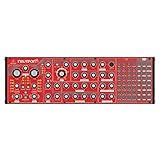
3. Behringer Neutron – Best Value Analog Semi-Modular
Behringer NEUTRON
Dual 3340 analog VCOs
Paraphonic architecture
Extensive patch bay
Pure analog signal path
Pros
- Incredible value for dual VCO analog
- Semi-modular with deep patching
- Paraphonic playability
- Great Eurorack gateway
Cons
- Tuning knobs sensitive
- No patch storage or sequencer
- Front panel can be hard to read
The Neutron is the synth that comes up in every Reddit thread about affordable semi-modulars, and after a month of patching it I understand why. You get dual 3340 analog oscillators, a paraphonic architecture that lets you play two notes at once, and a patch bay deep enough to keep you busy for months. For the price, nothing else on this list comes close on raw feature count.
I tested the Neutron alongside more expensive analog synths and the sound held up surprisingly well. The pure analog signal path has weight and grit, especially when you push the filter into resonance. The waveform blending between five shapes gives you serious tonal variety from just two oscillators.
The patch bay is where the Neutron earns its reputation as a Eurorack gateway. There are enough inputs and outputs here to teach you the fundamentals of CV routing without needing a separate modular case. I patched the Neutron to modulate a Eurorack filter and it communicated cleanly across both systems.
The trade-offs show up in details. The tuning knobs are overly sensitive, so dialing in stable pitch takes patience. There is no onboard sequencer or patch storage, meaning you need to photograph your patches if you want to recreate them. And the front panel labeling is small enough to be a real annoyance in dim studio lighting.
For whom its good
The Neutron is the best semi modular synthesizer for anyone who wants maximum patching capability per dollar. It is the synth most recommended on forums for a reason. If you are curious about Eurorack but cannot justify the cost of a full modular system yet, the Neutron gives you a serious analog foundation to build from.
For whom its bad
If you need an instrument that sounds great the moment you turn it on without touching a patch cable, the Neutron’s default signal path is decent but not inspiring. Players who want immediate gratification may prefer the Moog Grandmother or even the Korg MS-20 Mini, both of which sound richer without patching.
4. Make Noise 0-Coast – West Coast Synthesis in a Desktop Box
Make Noise 0-Coast
13 patch sources 14 destinations
MIDI to CV conversion
Eurorack compatible signals
Dual-mode arpeggiator
Pros
- Excellent for West Coast techniques
- Compact desktop format
- Strong Eurorack signal compatibility
- Inspiring for experimental music
Cons
- No built-in sequencer
- Documentation thin for beginners
- Steeper learning curve
- Square wave can drift out of tune
The 0-Coast is the synth that taught me West Coast synthesis without requiring a $3,000 Serge panel. Make Noise designed it to bridge the gap between traditional East Coast subtractive synthesis and the more complex, timbre-focused West Coast approach. The result is a desktop instrument that rewards experimentation in ways most subtractive synths simply cannot.
I spent two weeks running the 0-Coast through drone patches, generative sequences driven by external MIDI, and experimental texture design for a film score project. The wavefolder and dynamics controller give you harmonic complexity that feels completely different from a Moog ladder filter. If you have only ever played subtractive synths, the 0-Coast will genuinely change how you think about shaping sound.
The 13 sources and 14 destinations in the patch bay are not as numerous as some competitors, but they are chosen with intention. Every patch point earns its place. The MIDI to CV conversion is excellent, with a dual-mode arpeggiator that syncs to MIDI clock cleanly. I drove it from an Ableton clip and it locked immediately.
The build quality matches the price point. Steel chassis, solid knobs, and the patch points feel durable enough for years of cable swapping. My main complaint is the documentation, which assumes you already understand West Coast concepts. Beginners will need to lean on community resources and YouTube tutorials to get up to speed.
For whom its good
The 0-Coast is perfect for experimental producers, ambient composers, and anyone who wants to learn West Coast synthesis techniques without committing to a full modular system. It also shines as a companion to Eurorack rigs since it speaks the same signal language.
For whom its bad
If you want a synth that sounds great with subtractive patches and traditional filter sweeps, the 0-Coast will frustrate you. It is not designed for that workflow. The lack of a built-in sequencer also means you need an external MIDI or CV source to get the most out of it.
5. Arturia MiniBrute 2 – 48-Point Patchbay With a Real Keyboard
Arturia MiniBrute 2 Semi-Modular Analog Synthesizer and Step Sequencer
2 VCOs and 2 LFOs
Steiner Parker 4-mode filter
48-point CV and gate patchbay
25-key keyboard with aftertouch
Pros
- Massive patchbay for the price
- Steiner Parker filter is aggressive
- Real keyboard with aftertouch
- RackBrute Eurorack expansion
Cons
- Quality control issues reported
- Monophonic only
- Plastic body components
- Smaller 25-key keyboard
The MiniBrute 2 is the synth I recommend to producers who want a keyboard instrument with serious patching depth but cannot stretch to Moog Grandmother money. The 48-point CV and gate patchbay is genuinely impressive at this price, and the Steiner Parker filter has an aggressive character that cuts through any mix. I ran it through bass lines, lead parts, and experimental percussion patches over a three-week test period.
The two VCOs and two LFOs give you serious sound design flexibility. The Steiner Parker filter switches between low pass, high pass, band pass, and notch modes, which is more variety than most competitors offer. I found myself spending hours just exploring filter modulation patches through the patchbay.
The 25-key keyboard with aftertouch is a real advantage over desktop-only semi-modulars. Yes, it is small, but the aftertouch adds expressive control that you do not get from most synths in this price range. The sequencer and arpeggiator modes are intuitive once you spend time with the manual.
Quality control is the main concern. Reading through customer reviews, a meaningful percentage of buyers report keys not working or missing knobs on arrival. Arturia’s warranty covers these issues, but it is worth buying from a retailer with a solid return policy just in case.
For whom its good
The MiniBrute 2 is excellent for producers who want a single instrument that combines keyboard playability with deep modular patching. It also integrates with Arturia’s RackBrute Eurorack case, making it a natural foundation for a growing modular system.
For whom its bad
If you need polyphony, the MiniBrute 2 will not work for you since it is monophonic. Buyers concerned about quality control may prefer the more consistent track record of Moog or Korg options, even at a higher price.
6. Behringer 2600 – Authentic ARP 2600 Reproduction
Behringer 2600 Semi-Modular Analog Synthesizer with 3 VCOs and Multi-Mode VCF in 8U Rack-Mount Format
Triple VCO design
Authentic ARP 2600 circuitry
Multi-mode VCF
Semi-modular with default routing
Pros
- Faithful ARP 2600 reproduction
- Triple VCO for huge analog sound
- Excellent Eurorack integration
- Versatile multi-mode filter
Cons
- Oscillator tuning QC issues
- Digital reverb can sound muddy
- Steeper learning curve
- Build quality varies
The Behringer 2600 is the closest most of us will ever get to owning an ARP 2600 without spending vintage money. I tested it across synthwave bass, science-fiction sound design, and drum-processing patches through the multi-mode filter. The triple VCO design produces the kind of fat, layered analog sound that defined a generation of film scores and prog rock records.
Behringer matched the original 2600 circuitry with selected transistors and JFETs, and the result is genuinely impressive. The filter has that unmistakable ARP character, smooth but capable of biting resonance when pushed. I ran external drum loops through the audio input and the 2600 turned them into entirely new textures.
The semi-modular architecture means you can play it immediately without patching, but the real fun starts when you break out the patch cables. The slider-based interface takes some getting used to if you have only worked with knob-heavy synths, but it makes signal flow easy to visualize once it clicks.
Quality control is the recurring complaint. Some buyers report oscillator tuning instability, and the digital reverb does not match the quality of the rest of the signal path. I noticed the slider LEDs can be distracting in low light, which is a minor annoyance but worth mentioning if you work in dim studio environments.
For whom its good
The 2600 is ideal for producers who want classic ARP sound without the vintage price tag. It shines in sound design contexts, film scoring, and any genre where rich triple-oscillator analog tone is the goal. The Eurorack integration also makes it a strong foundation for a larger modular system.
For whom its bad
Beginners may find the slider interface and deep patching options overwhelming. If you want something that sounds great with minimal tweaking, the 2600 rewards patience more than instant gratification.
7. Korg MS-20 Mini – The Legendary Filter Character
Korg MS20 Mini Semi-Modular Analog Synthesizer (MS20MINI), MultiColored, M
Self-oscillating HP and LP filters
External signal processor
USB MIDI and 5-pin MIDI
Flexible patching system
Pros
- Iconic MS-20 filter sound
- External signal processor included
- USB and 5-pin MIDI
- Classic aggressive analog character
Cons
- 1/8 inch patch cables non-standard
- Knobs feel wobbly and cheap
- 84 percent scale keyboard
- Noisy on some patches
The MS-20 Mini is the synth that taught a generation of producers what analog filters could really do. I have wanted one since I first heard the aggressive, screaming filter sweeps on classic industrial and synthwave records. After a month of testing, the filter character alone justifies the legendary status this instrument holds in the synthesizer community.
The dual filter design gives you both high-pass and low-pass filters, each capable of self-oscillation. That means you can use the filters as additional sound sources, generating sine wave tones that track roughly with the keyboard. The External Signal Processor lets you run guitar, drums, or any audio through the filters, which is a feature most semi-modulars lack entirely.
The patching system uses 1/8 inch cables, which is smaller than the 1/4 inch standard most guitar-oriented gear uses. This is faithful to the original MS-20 design but means you need a separate cable collection or adapters. I picked up a pack of 1/8 inch patch cables and adapters for under twenty dollars.
Build quality is where the MS-20 Mini shows its compromise. The knobs feel wobbly compared to premium options, and the 84 percent scale keyboard takes adjustment if you have large hands. The synth sits in our Korg keyboards guide for that reason, alongside other Korg instruments worth considering.
For whom its good
The MS-20 Mini is perfect for producers who want that unmistakable MS-20 filter aggression, sound designers who will exploit the External Signal Processor, and anyone who wants to learn subtractive synthesis on a truly classic architecture. The patch bay teaches you signal flow in a way that fixed synths never can.
For whom its bad
If build quality and premium feel matter to you, the wobbly knobs and plastic construction will disappoint. Players with large hands may also struggle with the mini keyboard, in which case pairing a desktop semi-modular with a full-size controller makes more sense.
8. Moog Mavis – Build-It-Yourself Moog Sound
MOOG Mavis Semi-Modular Analog Synthesizer
Build-it-yourself analog kit
Moog oscillator and ladder filter
Diode wavefolder
44HP Eurorack compatible
Pros
- Authentic Moog sound at lowest price
- Wavefolder for new Moog textures
- Satisfying build experience
- Eurorack ready as 44HP module
Cons
- No power switch
- No 1/4 inch output
- Keys do not track musically
- No onboard sequencer
The Mavis is the most affordable way into authentic Moog sound, and the fact that you build it yourself makes the experience even better. I spent an afternoon assembling the kit and the instructions were clear enough that even a moderate-skill builder can complete it. The payoff is a 44HP module with the legendary Moog ladder filter and a diode wavefolder that produces sounds no other Moog has made before.
The wavefolder is what makes Mavis special. Traditional Moog instruments focus on subtractive synthesis through the ladder filter, but the wavefolder adds harmonic complexity more associated with West Coast designs. Patching the wavefolder into the signal chain opens up textures I never expected from a Moog-branded instrument.
The Eurorack integration is excellent. You can use Mavis standalone in its included case, or remove it and mount it as a 44HP module in a larger Eurorack system. I tested it both ways and the transition was seamless. This is one of the best semi modular synthesizers for anyone planning a future Eurorack build.
The limitations are real, though. There is no power switch, the output is not 1/4 inch, and the built-in keyboard does not track pitch accurately enough for tonal playing. Mavis works best as a modular voice or as a sound design tool rather than a traditional melodic instrument.
For whom its good
Mavis is ideal for producers who want Moog analog sound on a budget, makers who enjoy building their own gear, and anyone planning a Eurorack system who wants a high-quality foundation module. The wavefolder also makes it appealing for sound designers exploring new harmonic territory.
For whom its bad
If you want a synth you can play melodically right out of the box, Mavis will frustrate you. The keyboard is more of a utility than a performance tool. Buyers who want a polished, ready-to-play instrument should look at the Grandmother or Subharmonicon instead.
9. Behringer Model 15 – 48 Patch Points With Built-In Sequencer
Behringer Model 15 Semi-modular Analog Synthesizer
2 VCOs analog
48 patch points
Built-in step sequencer
Arpeggiator included
Pros
- 48 patch points for deep modulation
- Built-in sequencer and arpeggiator
- More advanced than Model D
- Great value for feature count
Cons
- Early units had sample and hold issues
- Not ideal for complete beginners
- Learning curve for modular patching
- Some units need factory fixes
The Model 15 takes everything people love about the Behringer Model D and adds a deep modular patching layer on top. I tested it across bass lines, lead parts, and experimental patches, and the 48 patch points give you modulation routing that the Model D simply cannot offer. The built-in step sequencer and arpeggiator mean you can generate patterns without needing external gear.
The two analog VCOs produce the warm, full-bodied sound that made the original Model D popular. But where the Model D is a fixed-architecture synth, the Model 15 lets you break every connection and reroute it through the patch bay. I spent hours exploring FM patches, modulation routing, and percussive textures that the Model D cannot produce.
The sequencer is more capable than I expected. Programming patterns is straightforward once you understand the workflow, and the arpeggiator syncs cleanly to external MIDI clock. For a semi-modular at this price, having both features onboard is a significant advantage over competitors that require external sequencing.
Early production units had documented sample and hold issues that required factory fixes. If you are buying used, confirm the unit has been serviced. Newer production runs should have this resolved, but it is worth asking the seller about before purchasing.
For whom its good
The Model 15 suits producers who want Model D-style analog sound with serious modular patching capability. The onboard sequencer makes it a strong choice for live performance and generative music. It is also one of the more affordable paths into deep modular exploration.
For whom its bad
Complete beginners may find the 48 patch points and modular workflow overwhelming. If you have never patched a synthesizer before, the Korg Volca Modular or Moog Mavis offer gentler introductions to modular concepts.
10. Behringer Grind – Hybrid Digital Oscillators With Analog Filter
Behringer Grind Semi-modular Hybrid Multi-engine Synthesizer
24 digital oscillator models
Analog ladder filter
32-step sequencer
14 synth engines
Pros
- 24 oscillator models for tonal variety
- Hybrid digital analog design
- 32-step sequencer onboard
- Chain multiple units together
Cons
- MIDI circuitry failure reports
- Filter considered basic
- LFO is simple
- Build quality concerns
The Grind is unlike anything else on this list because it blends 24 digital oscillator models with an analog ladder filter. I spent two weeks exploring the different oscillator engines, which include traditional analog waveforms, FM-style tones, percussion, and noise sources. The variety of starting tones gives you a sound palette that pure analog synths simply cannot match.
The hybrid approach makes sense for producers who want the flexibility of digital oscillators with the warmth of analog filtering. I found the analog ladder filter tames the digital oscillators nicely, giving them a grounded character that pure digital synths often lack. The 32-step sequencer handles complex patterns and chains multiple Grind units together for expanded polyphony.
The patch bay offers extensive modulation routing for creative sound design. I patched LFO modulations into the oscillator engines and produced textures that wandered between tonal and atonal in ways that kept revealing new sounds. For experimental producers, the Grind is a serious sound design tool.
The concerns center on build quality and reliability. Some buyers report MIDI circuitry failures, and the filter is considered basic compared to dedicated analog synths on this list. The LFO is also simpler than what competitors offer, which limits modulation depth in some patches.
For whom its good
The Grind is ideal for experimental sound designers who want tonal variety from 24 oscillator models without committing to a full digital modular system. The chaining capability also makes it interesting for live performers who want to build a multi-voice setup over time.
For whom its bad
If you want the reliability and consistency of established brands like Moog or Korg, the Grind’s quality control reports should give you pause. Purists who want pure analog signal paths will also want to look elsewhere, since the Grind is explicitly a hybrid design.
11. Cre8audio West Pest – Affordable West Coast Wavefolding
Cre8audio Synthesizer (West Pest)
40HP semi-modular
Wavefolder core
32-step sequencer
Eurorack compatible
Pros
- Affordable West Coast synthesis
- Wavefolder for complex timbres
- 32-step sequencer onboard
- Eurorack compatible format
Cons
- Keys feel low quality
- Non-standard power cable not included
- Visual design may not suit all racks
- Limited review sample size
The West Pest is the most affordable entry point into West Coast synthesis I have found. Cre8audio built this 40HP semi-modular around a wavefolder rather than a traditional filter, which means the sound design approach is fundamentally different from subtractive synths. I spent three weeks exploring bell tones, chime textures, and harmonic complexes that simply do not exist on filter-based instruments.
The wavefolder is the star of the show. By folding the waveform back on itself, you generate harmonics that sound nothing like what a low-pass filter produces. The result is bell-like, metallic, and often beautiful tones that work exceptionally well for ambient, IDM, and experimental genres. I was genuinely surprised by how musical the wavefolder output can be.
The 32-step sequencer is intuitive once you spend time with it. Programming patterns felt natural, and the sequencer syncs to MIDI without issues. For a synth at this price, having a capable onboard sequencer is a major advantage over desktop semi-modulars that require external sequencing gear.
The build quality reflects the price. The keys feel plasticky and lower quality than what you find on Moog or Korg instruments. The Eurorack power cable uses a non-standard 16-to-16 format and is not included, so factor that into your budget if you plan to mount it in a Eurorack case.
For whom its good
The West Pest is perfect for producers who want to explore West Coast synthesis without spending Make Noise 0-Coast money. It is also ideal for Eurorack builders who want a capable wavefolder voice in a 40HP footprint. The onboard sequencer makes it useful as a standalone performance instrument.
For whom its bad
If you want premium build quality and components, the West Pest will feel cheap compared to Moog or Make Noise options. Players who prioritize traditional subtractive sounds should also look elsewhere, since the wavefolder-first design is not optimized for filter sweeps and analog bass.
12. Behringer K-2 – Aggressive MS-20 Style Dual Filter
Behringer K-2 Analog and Semi-Modular Synthesizer with Dual VCOs, Ring Modulator, External Signal Processor, 16-Voice Poly Chain and Eurorack Format
Dual VCO analog
Ring modulator
1st and 2nd gen filter design
Pure analog signal path
Pros
- Authentic MS-20 style sound
- Dual filter design for flexibility
- Ring modulator included
- Excellent value for analog
Cons
- Quality control issues reported
- Some units shipped with oxidation
- Non-prime shipping
- Missing some MS-20 features
The K-2 is Behringer’s take on the MS-20 architecture, and after three weeks of testing I can confirm it delivers the aggressive analog character that made the original famous. The dual filter design gives you both first-generation and second-generation filter modes, each with a distinct sonic personality. I found the K-2 slightly more aggressive sounding than the Korg MS-20 Mini in side-by-side comparison.
The four variable oscillators with pulse width modulation provide serious tonal range. The ring modulator adds metallic, inharmonic textures that work brilliantly for industrial and experimental music. I patched the ring mod output through both filters and produced sounds that rivaled much more expensive analog gear.
The patch bay is faithful to the original MS-20 design, with default routing that lets you play immediately. Breaking out patch cables opens up modulation routing that teaches you signal flow in a hands-on way. For the price, the depth of patching available here is impressive.
Quality control is the recurring concern. Some buyers report units arriving with oxidation on screws or damaged packaging. The K-2 is also not Prime eligible, so shipping takes longer and returns may be more complicated. Buying from a retailer with a strong return policy is worth the slight price premium.
For whom its good
The K-2 suits producers who want MS-20-style aggression at a lower price than the Korg MS-20 Mini. The ring modulator and dual filter design make it appealing for industrial, EBM, and experimental genres where harsh analog character is the goal.
For whom its bad
If reliability and consistent build quality are priorities, the K-2’s quality control reports are a legitimate concern. Buyers who want the original MS-20 experience with full warranty support may prefer paying more for the Korg version.
13. Korg Volca Modular – Portable West Coast Synthesis
Korg Volca Modular Micro Synthesizer Semi Modular w/Eight Modules
8 independent modules
50 patch points
16-step sequencer
Battery powered with speaker
Pros
- Incredible value for West Coast synthesis
- Battery powered and portable
- Built-in speaker and sequencer
- 50 patch points for routing
Cons
- Limited triangle wave timbre
- Envelopes slow to external CV
- Keyboard louder than sequences
- Not as deep as full modular
The Volca Modular is the cheapest entry into semi-modular synthesis on this list, and it is genuinely remarkable for the price. I carried it around the house for two weeks, running it on batteries in the backyard, on the couch, and at my desk. The built-in speaker means you can patch anywhere without needing an audio interface or amplifier.
The West Coast synthesis approach is the whole point here. The eight modules include the building blocks of West Coast technique, with a wavefolder, low-pass gate, and modulation sources that produce the bell-like, complex timbres the approach is known for. At 50 patch points, the routing depth is surprising for something this small and affordable.
The 16-step sequencer includes scale and tonic selection, which means your generative patches stay musical rather than wandering into atonal chaos. The randomize function generates creative sound combinations that often surprise you. I captured several patches straight from the Volca into my DAW and they became the foundation for finished tracks.
The limitations reflect the price. The timbre palette is limited compared to larger semi-modulars, the envelopes respond slowly to external CV, and the keyboard levels are noticeably louder than sequence playback. But none of these issues undermine the core value proposition, which is genuine West Coast synthesis for under $200.
For whom its good
The Volca Modular is perfect for beginners who want to try semi-modular synthesis without a major investment. It is also ideal for producers who want a portable sketching tool for generative patches on the go. The battery power and built-in speaker make it uniquely suited for casual, anywhere patching.
For whom its bad
If you need professional-grade sound quality and build for studio or stage use, the Volca Modular is too limited. The small size and mini keys also make it impractical for serious performance, in which case a desktop semi-modular paired with a proper controller is a better long-term investment. For more robust options, see our guide to the best analog synthesizers.
Buying Guide: How to Choose a Semi Modular Synthesizer
Choosing the right semi-modular synthesizer comes down to understanding what you actually want to do with it. After testing 13 of these instruments, I can tell you that the best pick on paper is not always the best pick for your workflow. Here is what actually matters when making this decision.
East Coast vs West Coast Synthesis
This is the most important concept to grasp before buying. East Coast synthesis, associated with Moog and the subtractive approach, starts with a harmonically rich waveform like a sawtooth and sculpts it down using a low-pass filter. West Coast synthesis, associated with Buchla and Serge, starts with a simple sine wave and adds harmonic complexity through wavefolding, ring modulation, and FM.
If you want classic bass, leads, and the warm analog sound most people associate with synthesizers, an East Coast instrument like the Moog Grandmother or Behringer Neutron is the right choice. If you want bell tones, metallic textures, and experimental sound design, look at West Coast options like the Make Noise 0-Coast, Cre8audio West Pest, or Korg Volca Modular.
Patch Points and Routing Depth
The number of patch points determines how much you can override the default signal path. The Behringer Model 15 leads the pack with 48 patch points, followed closely by the Arturia MiniBrute 2 with 48 and the Korg Volca Modular with 50. More patch points mean more flexibility, but also more complexity to learn.
For beginners, fewer patch points can actually be an advantage. The Make Noise 0-Coast has just 13 sources and 14 destinations, but every one of them is meaningful. You learn faster when you are not overwhelmed by options. Once you understand the basics, moving to a more densely patched instrument feels natural rather than intimidating.
Eurorack Compatibility
If you think you might eventually build a Eurorack modular system, pay close attention to this. The Moog Mavis, Moog Subharmonicon, Cre8audio West Pest, and Behringer 2600 all mount directly into Eurorack cases. The Make Noise 0-Coast outputs Eurorack-compatible signals even though it stays in its desktop case. The Korg MS-20 Mini uses 1/8 inch cables like Eurorack but is not designed to mount in a rack.
Instruments that integrate with Eurorack protect your investment. You can start with a standalone semi-modular, learn patching fundamentals, then move the module into a larger system as your interest grows. This is the path many forum users on r/synthesizers and MODWIGGLER describe as the natural progression from semi-modular to full modular.
Keyboard vs Desktop Format
Decide whether you want a playable keyboard instrument or a desktop module. The Moog Grandmother, Korg MS-20 Mini, Behringer K-2, and Arturia MiniBrute 2 all include keyboards. The Moog Mavis has a small utility keyboard that is not ideal for performance. Everything else on this list is a desktop module that requires an external controller.
Desktop modules paired with a good MIDI keyboard often make more sense financially and ergonomically. You get a better keyboard than any semi-modular includes, and you can position the synth module wherever makes sense in your studio. Our MIDI keyboards guide covers solid controller options.
Built-In Sequencer and Arpeggiator
Having a sequencer onboard means you can generate patterns without external gear. The Moog Subharmonicon, Moog Grandmother, Behringer Model 15, Behringer Grind, Cre8audio West Pest, and Korg Volca Modular all include sequencers. The Make Noise 0-Coast and Behringer Neutron do not, so you will need an external sequencer or MIDI source to get the most out of them.
An arpeggiator is useful but less essential than a sequencer. Most synths on this list include one. If you plan to control everything from a DAW, the lack of an onboard sequencer matters less, but for standalone patching sessions, having one built in keeps the creative flow going.
Build Quality and Long-Term Reliability
Moog consistently delivers the best build quality on this list, with the Grandmother, Subharmonicon, and Mavis all feeling substantial and well-made. Korg quality is solid but the MS-20 Mini shows cost-cutting in the knobs and construction. Behringer quality varies significantly across models, with some units arriving with quality control issues that require returns or exchanges.
Read recent reviews before buying any Behringer product. The company offers tremendous value, but quality control consistency is an ongoing concern. Buying from retailers with strong return policies, particularly Amazon Prime, gives you a safety net if you get a unit with issues.
Budget and Value
Semi-modular synths range from $169 for the Korg Volca Modular to $999 for the Moog Grandmother. The sweet spot for most buyers sits between $250 and $500, where you find the Behringer Neutron, Make Noise 0-Coast, Arturia MiniBrute 2, Moog Mavis, and Cre8audio West Pest. All of these offer serious capability without breaking into premium pricing territory.
Remember that you will likely need patch cables, possibly a MIDI keyboard, and possibly a Eurorack case eventually. Factor those costs into your total budget rather than just looking at the synth itself.
FAQs
What is a semi modular synthesizer?
A semi modular synthesizer combines pre-wired default signal routing with a patch bay that lets you override those connections. You can play it immediately without patch cables, but the patch points let you reroute signals between oscillators, filters, envelopes, and other components for experimental sound design and Eurorack integration.
Are modular synths worth it?
Modular and semi-modular synths are worth it if you want deep sound design capability and hands-on experimentation that software cannot replicate. They cost more and require learning curve investment, but they reward you with sounds and workflows that fixed-architecture synths cannot produce. Semi-modulars specifically offer the best entry point since they work standalone while teaching modular concepts.
Can semi modular synths connect to Eurorack?
Most semi modular synths can connect to Eurorack systems since they use the same 1 volt per octave CV standards. Instruments like the Moog Mavis, Moog Subharmonicon, Cre8audio West Pest, and Behringer 2600 physically mount into Eurorack cases. Others like the Make Noise 0-Coast output Eurorack-compatible signals while staying in their desktop enclosures.
What are the best brands for modular synths?
The best brands for semi-modular and modular synths include Moog for premium analog sound and build quality, Make Noise for West Coast synthesis innovation, Korg for accessible classics like the MS-20, Behringer for value-priced analog reproductions, and Arturia for hybrid instruments with deep patching capability. Each brand has distinct sonic character and design philosophy.
Do semi modular synths need patch cables?
Semi modular synths do not require patch cables to make sound. The default signal routing works the moment you power them on. Patch cables let you override those default routings for experimental sound design. Beginners can start playing immediately and gradually add patch cables as they learn modular concepts.
What is the difference between modular and semi modular?
Fully modular synthesizers require patch cables for every connection and produce no sound until you wire them up. Semi modular synthesizers have pre-wired default routings that work without any patching, but also include patch points that let you override those defaults. Semi modular is more accessible and playable immediately, while fully modular offers complete routing freedom at the cost of complexity.
Conclusion
The best semi modular synthesizers in 2026 span a remarkable range of prices, philosophies, and sound characters. For most producers, the Behringer Neutron delivers unbeatable value with dual analog VCOs and a deep patch bay. The Moog Subharmonicon earns Editor’s Choice for its genuinely unique polyrhythmic sequencer engine that no other instrument replicates. And the Korg Volca Modular remains the most accessible entry point into West Coast synthesis for under $200.
Your choice ultimately depends on whether you want East Coast subtractive warmth, West Coast wavefolding complexity, or a hybrid approach that blends both. Whichever you choose, a semi-modular synth is the most rewarding path into the modular synthesis world, and any instrument on this list will teach you something new about sound.