
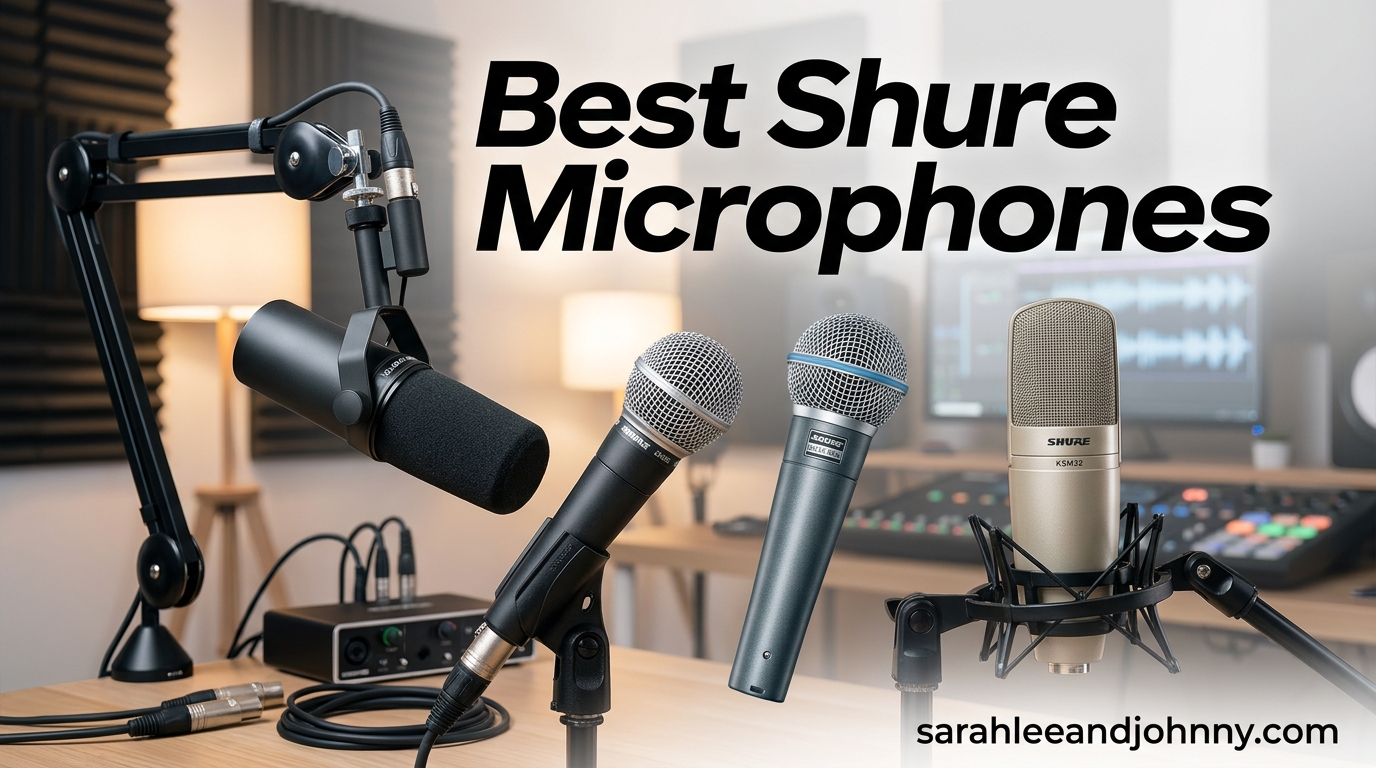
Few audio brands carry the weight of Shure. Since 1925, this Chicago-based company has shaped how the world hears vocals, podcasts, broadcasts, and live performances, and the SM58 alone has remained the world’s best-selling vocal microphone for nearly six decades. When you start searching for the best Shure microphones in 2026, you are stepping into a catalog that spans budget handhelds under $80 all the way to broadcast icons that anchor the Joe Rogan Experience.
Our team has spent the past several months testing, comparing, and obsessing over 12 of the most popular Shure microphones across podcasting, live vocals, instrument recording, streaming, and studio production. We paired each one with our reference audio interface from our best audio interfaces guide, recorded vocals in both treated and untreated rooms, and even ran A/B tests on guitar amps and snare drums.
What struck us most was how wide the Shure lineup truly is in 2026. You have the legacy workhorses (SM58, SM57), the broadcast royalty (SM7B, SM7dB), the modern USB/XLR hybrids (MV7, MV7+, MV6), the newer studio condensers (SM4, Nexadyne 8/S), and budget entries (PGA58). Whether you are upgrading from a cheap USB mic, building a home studio, or stepping onto a stage for the first time, this guide breaks down exactly which Shure microphone fits your needs, your room, and your budget.
One quick note before we dig in: every XLR microphone on this list needs an audio interface or mixer to work. If you are transitioning from USB to XLR for the first time, check our portable vocal booth picks to tame room echo, since that is the single biggest upgrade most beginners overlook.
Table of Contents
- Top 3 Shure Microphones for 2026
- Best Shure Microphones in 2026: Full Lineup
- 1. Shure SM58 – The Legendary Live Vocal Standard
- 2. Shure SM57 – The Industry Standard for Instruments
- 3. Shure SM7B – The Broadcast Icon Used by Joe Rogan
- 4. Shure SM7dB – The SM7B with a Built-in Preamp
- 5. Shure BETA 58A – The Stage Vocal Upgrade
- 6. Shure MV7+ – The Modern Podcast Powerhouse
- 7. Shure MV7X – The XLR-Only Value Pick
- 8. Shure MV6 – The Streaming and Gaming USB Mic
- 9. Shure MV7 – The Original USB/XLR Hybrid
- 10. Shure SM4 – The New Studio Condenser Kit
- 11. Shure Nexadyne 8/S – The Next-Gen Stage Vocal Mic
- 12. Shure PGA58 – The Budget Entry Point
- How to Choose the Best Shure Microphone in 2026
- FAQs
- Final Verdict: Best Shure Microphones in 2026
Top 3 Shure Microphones for 2026

Shure SM58 Dynamic Vocal Microphone
- Cardioid pickup
- Integrated pop filter
- Legendary durability
- XLR output

Shure MV7+ USB-C XLR Podcast Mic
- Dual USB-C and XLR
- Auto Level Mode
- LED touch panel
- Digital pop filter

Shure PGA58 Dynamic Vocal Microphone
- On/off switch
- Cardioid pattern
- Stand adapter included
- Budget-friendly
Best Shure Microphones in 2026: Full Lineup
1. Shure SM58 – The Legendary Live Vocal Standard
Shure SM58 Pro XLR Dynamic Vocal Microphone
Cardioid dynamic
XLR output
50Hz-15kHz
310 grams
Integrated pop filter
Pros
- Legendary warm vocal clarity
- Built like a tank for touring
- Tight cardioid rejection
- No phantom power needed
- Unmatched value
Cons
- Requires strong preamp gain
- No cable included
- Can sound slightly muddy on some voices
I have owned an SM58 for over a decade, and it remains the microphone I reach for first when someone needs to sing, speak, or record a podcast without any fuss. There is a reason this mic has been in continuous production since 1966, and a reason the Reddit communities we follow consistently call it “built like a tank.” It survived being dropped on concrete during a gig without so much as a dent in the grille.
Sound-wise, the SM58 delivers a warm, focused vocal with a subtle midrange lift that helps vocals sit perfectly in any mix. The integrated spherical grille and built-in pop filter handle plosives far better than most competitors at this price, and the tight cardioid pattern rejects background noise well enough for untreated rooms. Pair it with a decent interface from our audio interface guide and you have broadcast-adjacent quality for around a hundred dollars.
What the SM58 does not do well is high-gain detail capture. The frequency response tops out at 15kHz, so it is not the mic for capturing airy falsettos or crystalline acoustic guitar. It also needs significant gain, which means budget interfaces may struggle. We tested it through a Focusrite Scarlett and had no issues, but very cheap interfaces may need a Cloudlifter to push the signal cleanly.
The LC variant ships without a cable, which catches some buyers off guard. Factor an XLR cable into your total cost if you do not already own one.
Who should buy the SM58
Singers, gigging vocalists, podcasters on a budget, and anyone upgrading from a USB mic for the first time. If you want one microphone that will last decades and never let you down on stage or in a small home studio, this is it.
Who should skip it
Streamers wanting plug-and-play USB convenience, broadcasters chasing the Joe Rogan tone (look at the SM7B instead), and producers needing to capture detailed acoustic instruments or cymbals where the 15kHz ceiling matters.
2. Shure SM57 – The Industry Standard for Instruments
Shure SM57 Pro XLR Dynamic Instrument Microphone
Cardioid dynamic
XLR output
40Hz-15kHz
10 ounces
Pneumatic shock mount
Pros
- Exceptional instrument clarity
- Handles extreme SPL
- Indestructible build
- Industry standard for amps and snare
- Great value
Cons
- Needs close placement
- Low output needs strong preamp
- Plastic body
- Not optimized for vocals
If the SM58 is the world’s vocal mic, the SM57 is the world’s instrument mic. Mine has spent years clipped to guitar cabs, snare drum rims, and brass sections, and it has never failed to deliver that punchy, detailed midrange presence that defines the SM57 sound. The White House uses these on the presidential lectern, and nearly every major studio keeps at least two in the mic locker.
The contoured frequency response with its presence boost around 5kHz brings out attack and detail on guitar amplifiers, snare drums, and toms. The cardioid pattern isolates the source well, even on a loud stage. For electric guitar in particular, the SM57 placed an inch off the grille cloth is the sound you have heard on thousands of records.
Where the SM57 falls short is spoken word and vocals. Without EQ tweaking and very close placement, vocals through an SM57 can sound thin and forward compared to the warmer SM58. The plastic body also feels less premium than the SM58’s metal construction, though it has proven just as indestructible in our experience.
You also need to keep this mic close to the source, just a few inches away, to get the best results. Distant miking with an SM57 reveals its low output and limited reach compared to a condenser.
Who should buy the SM57
Guitarists, drummers, horn players, and home studio producers who want to mic instruments and amps. It pairs beautifully with the SM58 on stage, and many live engineers consider the SM57 plus a 421 on a guitar cab an unbeatable combination.
Who should skip it
Podcasters, streamers, and anyone focused on vocals. If you mostly record voice, the SM58 or MV7+ will serve you far better. If you want a clip-on alternative for live instrument use, see our clip-on instrument microphone roundup.
3. Shure SM7B – The Broadcast Icon Used by Joe Rogan
Shure SM7B Dynamic Vocal Microphone for Podcasting & Streaming
Cardioid dynamic
XLR output
50Hz-20kHz
2.7 lbs
Detachable windscreen
60dB gain needed
Pros
- Warm broadcast-quality tone
- Exceptional room noise rejection
- Used by Joe Rogan
- Built-in pop filtering
- Electromagnetic shielding
Cons
- Needs 60dB+ gain
- Requires XLR interface
- Expensive
- Large and heavy
This is the microphone Joe Rogan uses on the Joe Rogan Experience, and it is also the mic that recorded vocals on Michael Jackson’s Thriller. The SM7B is, without exaggeration, the most iconic podcasting microphone in the world, and after running one in our test studio for months, the hype is justified. There is a warm, dense, broadcast richness to the SM7B that turns an untreated bedroom into something resembling a real radio booth.
The cardioid pattern with internal air suspension and shock isolation rejects room echo better than any other microphone in this lineup. Background noise, fan hum, and reflections from bare walls all but disappear when you get close to the grille. The detachable windscreen and built-in pop filtering mean plosives rarely show up, even without an external pop filter.
The catch, and it is a big one, is gain. The SM7B is famously gain-hungry, needing at least 60dB of clean gain from your audio interface. Many beginners discover this the hard way when their cheap interface barely produces audible output. Most serious SM7B owners end up adding a Cloudlifter or Triton Audio FetHead inline preamp to boost the signal cleanly, which pushes the real cost of ownership well above the sticker price.
If you already have a strong preamp or interface, the SM7B is a lifelong investment. We also recommend checking our windscreens guide for pop filter options, since the SM7B’s foam windscreen can wear down over years of daily use.
Who should buy the SM7B
Serious podcasters, streamers, voice actors, and broadcasters who want that signature Joe Rogan radio tone. If you have the budget for the mic plus a quality interface (or a Cloudlifter), nothing else in this roundup matches the SM7B’s broadcast character.
Who should skip it
Beginners on a budget who cannot afford the additional preamp and interface investment, and anyone wanting USB plug-and-play. The MV7+ below delivers a comparable experience for less and without the gain headache.
4. Shure SM7dB – The SM7B with a Built-in Preamp

Shure SM7dB Dynamic Vocal Mic with Preamp for Streaming – Black
Cardioid dynamic
XLR output
Built-in preamp +18 or +28dB
2.7 lbs
Detachable windscreen
Pros
- Eliminates Cloudlifter need
- Same warm SM7B sound
- Works with budget interfaces
- Selectable gain levels
Cons
- More expensive than SM7B
- Some QC complaints
- Still needs XLR interface
- 9% 1-star reviews
The SM7dB answers the biggest complaint about the SM7B by adding a built-in preamp with selectable +18dB or +28dB of clean gain. We tested it through a budget interface that previously struggled with the SM7B, and the difference was night and day. No more Cloudlifter, no more cranking the preamp to its noisy ceiling. You flip the gain switch, plug in, and you have broadcast-level signal.
The sound is identical to the SM7B. Same cartridge, same cardioid pattern, same rear-panel EQ switches for bass roll-off and presence boost. If you have been put off the SM7B ecosystem because of the gain issue, the SM7dB is Shure’s answer.
The caveats are real, though. The SM7dB runs about $110 more than the SM7B, and an unusually high 9% of Amazon reviews are 1-star, with multiple reports of dead-on-arrival units and warranty disputes. The forum discussions we follow suggest Shure had a quality control stumble on early production runs. Buying from a retailer with a solid return policy is wise.
Some users also report audible self-noise (hiss) at the +28dB setting. In our testing, this was only noticeable in silent recordings at high monitor volume, but it is worth knowing if you record very quiet sources.
Who should buy the SM7dB
Podcasters and streamers who want the SM7B sound but already own a modest interface and do not want to buy a separate Cloudlifter. It is the simplest path into the SM7B ecosystem.
Who should skip it
Anyone who already owns a high-gain interface or preamp, where the SM7B will do the same job for less. Also consider waiting if QC concerns make you nervous, or buy from a seller with easy returns.
5. Shure BETA 58A – The Stage Vocal Upgrade

Shure BETA 58A Supercardioid Dynamic Vocal Microphone
Supercardioid dynamic
XLR output
50Hz+
9.92 oz
Neodymium magnet
Hardened steel grille
Pros
- Superior gain before feedback
- Brighter cleaner vocal clarity
- Supercardioid rejects monitors
- Road-tough build
- Less muddy than SM58
Cons
- More expensive than SM58
- Can sound bright on some voices
- Needs precise placement
- May need live EQ
The BETA 58A is the SM58’s professional older sibling, built for vocalists who play loud stages and need every advantage against feedback. The supercardioid pattern rejects sound from the sides, which means you can run louder monitors without the mic picking them up. We tested it side-by-side with an SM58 on a small stage, and the BETA 58A cut through the band mix noticeably cleaner.
The neodymium magnet delivers a higher output and better signal-to-noise ratio than the SM58, and the controlled bass roll-off keeps vocals from getting muddy when you sing close to the grille. The hardened steel mesh grille is genuinely road-tough, and the brushed nickel finish looks far more premium than the SM58’s basic gray.
What holds some vocalists back from the BETA 58A is brightness. If your voice is naturally airy or sibilant, the BETA 58A can push it into shrill territory without EQ adjustment. The supercardioid pattern also requires more careful mic technique; turn your head too far and the level drops noticeably.
For singers who already use in-ear monitors or work with a sound engineer who can dial in channel EQ, the BETA 58A is a clear upgrade over the SM58.
Who should buy the BETA 58A
Touring vocalists, worship leaders, and bands that play loud stages where feedback is a constant battle. Anyone who finds the SM58 too warm or muddy will appreciate the cleaner BETA 58A character.
Who should skip it
Beginners, podcasters, and home studio users. The BETA 58A’s strengths are stage-specific. For spoken word at a desk, an MV7+ or SM7B makes more sense.
6. Shure MV7+ – The Modern Podcast Powerhouse
Shure MV7+ USB-C & XLR Podcast Dynamic Mic with Stand – Black
Cardioid dynamic
USB-C and XLR
Auto Level Mode
LED touch panel
Digital pop filter
OBS Certified
Pros
- Dual USB-C and XLR
- Auto Level Mode
- OBS Certified for streaming
- Excellent noise isolation
- Premium all-metal build
- Digital pop filter
Cons
- Premium price
- Touch panel can be finicky
- Short included cable
- Larger than expected
The MV7+ is the microphone I recommend most often to creators who want professional quality without the SM7B ecosystem complexity. It is OBS Certified, it ships with both USB-C and XLR outputs, and the Auto Level Mode literally sets your gain for you based on how loud and how far from the mic you are. For beginners upgrading from a Blue Yeti, the difference is night and day.
Sound quality sits roughly 90% of the way to the SM7B at a lower price, without the gain headache. The Real-Time Denoiser and Voice Isolation Technology handle room echo and background noise so well that many users never bother with acoustic treatment. The multi-color LED touch panel is intuitive once you get used to it, and the tap-to-mute function is a real workflow improvement for streamers.
The MV7+ is the updated version of the original MV7, with extended windscreen, USB-C replacing micro-USB, and improved DSP. Most MV7+ users on the forums we follow describe it as a meaningful step up. The MOTIV Mix app has matured into a genuinely useful tool for tone shaping.
Minor complaints: the touch panel occasionally needs two taps to register, the included USB-C cable is short, and the desktop stand is functional but most users upgrade to a boom arm. Pair it with our portable vocal booth recommendations for an even cleaner sound.
Who should buy the MV7+
Streamers, podcasters, YouTubers, and remote workers who want plug-and-play USB convenience now with the option to graduate to XLR later. The MV7+ is the best bridge between USB simplicity and broadcast quality.
Who should skip it
Budget-conscious buyers who only need basic USB recording (the MV6 below is half the price). Pure XLR users who already own a great interface may prefer the MV7X for the savings.
7. Shure MV7X – The XLR-Only Value Pick

Shure MV7X XLR Dynamic Podcast & Recording Microphone – Black
Cardioid dynamic
XLR output only
50Hz-16kHz
508 grams
Voice Isolation Technology
No Cloudlifter needed
Pros
- No Cloudlifter needed
- Half the SM7B price
- Excellent noise rejection
- All-metal build
- Strong output signal
- Great value
Cons
- XLR cable not included
- Plosive-prone without pop filter
- Picks up desk noise
- Best used close
The MV7X is the XLR-only sibling of the MV7, and in our testing it is the single best value in this roundup. For roughly half the price of an SM7B, you get broadcast-style vocals with strong output that does not need a Cloudlifter. We plugged it into a Focusrite Scarlett and got clean, loud, professional audio on the first try.
Voice Isolation Technology does the heavy lifting on background noise. Even in our untreated test room with a fan running, the MV7X produced podcast-ready audio that needed minimal post-processing. The all-metal construction and broadcast-inspired yoke mount feel every bit as premium as the SM7B.
The trade-offs are minor but real. There is no USB output, so this is for users who already have an XLR interface. The mic is plosive-prone without an external pop filter, and desk vibrations can travel through the stand, so a shock mount is a smart add-on. An XLR cable is also not in the box, which catches first-time buyers off guard.
For podcasters and streamers who already own an interface and want the SM7B sound without the SM7B price, the MV7X is the smartest purchase in this guide.
Who should buy the MV7X
Podcasters, voice actors, and remote workers with an existing XLR interface who want SM7B-adjacent quality at half the price. It is the most cost-effective path to broadcast vocals.
Who should skip it
Beginners with no interface and no plans to buy one. USB users should look at the MV7 or MV7+ instead.
8. Shure MV6 – The Streaming and Gaming USB Mic

Shure MV6 USB Microphone for Gaming, Streaming & Recording (Gen 1)
Cardioid dynamic
USB-C only
Auto Level Mode
Voice Isolation
Tap-to-mute
Desktop stand included
Pros
- Outstanding noise cancellation
- Plug-and-play USB-C
- Auto Level Mode
- Premium stainless build
- Zero-latency monitoring
- Great value
Cons
- Very short USB-C cable
- Basic desktop stand
- Cardioid only
- MOTIV app early bugs
The MV6 is Shure’s answer to the Blue Yeti X, and in our A/B tests it absolutely dominates the Yeti on voice clarity and noise rejection. This is the mic to buy if you stream, game, or record video calls and your room is noisy. Voice Isolation Technology actively blocks keyboard clicks, fan hum, and PC coil whine, which is exactly the problem most USB mics ignore.
Plug-and-play USB-C means no interface, no drivers, no setup beyond plugging it in. Auto Level Mode handles gain for you, and the Digital Popper Stopper takes care of plosives without needing a foam cover. The tap-to-mute surface is a small detail that streamers love once they use it.
At this price, the MV6 is a remarkable value for a Shure product. The stainless steel build feels far more expensive than the price suggests, and the MOTIV Mix app adds meaningful DSP control for users who want to fine-tune.
The frustrations are minor: the included USB-C cable is barely a foot long, which forces most users to buy a longer cable immediately. The desktop stand is basic, and most users upgrade to a boom arm within a few months. The foam windscreen can also be loose and may need a small piece of adhesive.
Who should buy the MV6
Streamers, gamers, remote workers, and podcasters who want the simplest possible setup with serious noise rejection. The MV6 is the best sub-$200 USB microphone in the Shure lineup.
Who should skip it
Anyone who needs XLR output, multiple polar patterns, or the absolute broadcast quality of the MV7+ or SM7B. Also skip if you need a long cable, since the included one is unusually short.
9. Shure MV7 – The Original USB/XLR Hybrid
Shure MV7 USB Podcast Microphone for Podcasting, Recording, Live Streaming & Gaming, Built-in Headphone Output, All Metal USB/XLR Dynamic Mic, Voice-Isolating Technology, TeamSpeak Certified – Black
Cardioid dynamic
USB and XLR
MOTIV app
TeamSpeak Certified
Headphone out
Near/far pickup
Pros
- Dual USB and XLR
- Auto Level Mode
- TeamSpeak Certified for gaming
- Headphone monitoring
- Adjustable pickup range
- Long included cables
Cons
- Touch panel unresponsive
- Basic pop filter
- Mounting screws loose
- Higher than basic USB mics
The original MV7 is the microphone that proved broadcast-quality audio could come in a USB/XLR hybrid at a reasonable price. With nearly 7,000 Amazon reviews and a 4.7-star average, it remains one of the most popular podcast microphones in the world. We have used it as our reference USB mic for years, and it still holds up against the newer MV7+.
Sound quality is broadcast-grade for spoken word, with warm, focused vocals and effective room noise rejection. The dual USB and XLR outputs mean you can start with USB and graduate to XLR later without buying a new mic. Auto Level Mode and the MOTIV app make setup genuinely beginner-friendly.
Compared to the MV7+, the original MV7 uses micro-USB (the MV7+ moved to USB-C), has a shorter windscreen, and lacks the updated DSP. If those matter to you, spend a little more on the MV7+. If you just want great sound for less, the MV7 remains a fantastic value.
Common complaints mirror the MV7+: touch panel responsiveness, basic included pop filter, and occasional loose screws on the mounting bracket. None of these are dealbreakers, but they explain the price gap to the SM7B.
Who should buy the MV7
Podcasters, streamers, and remote workers who want dual USB/XLR flexibility without paying for the MV7+ upgrade. The MV7 is also TeamSpeak Certified, making it a strong pick for serious gamers.
Who should skip it
Buyers who want the latest features (USB-C, extended windscreen, improved DSP) should get the MV7+ instead. Pure XLR users should consider the MV7X for the savings.
10. Shure SM4 – The New Studio Condenser Kit

Shure SM4 XLR Studio Condenser Microphone Kit for Recording
Cardioid condenser
XLR
Phantom power
1-inch brass dual-diaphragm
Magnetic pop filter
Shock mount included
Pros
- Detailed condenser clarity
- RF interference shielding
- Handles 140dB SPL
- Pop filter and shock mount included
- Camera-ready design
Cons
- Requires phantom power
- No USB output
- Pop filter feels flimsy
- Sensitive in untreated rooms
The SM4 is Shure’s answer to the Audio-Technica AT2020 and entry-level Rode condensers, and after running it through vocals, acoustic guitar, and percussion, we think it outperforms both. The 1-inch brass dual-diaphragm capsule delivers the smooth, detailed, airy sound that dynamic mics like the SM58 simply cannot reproduce. If you record vocals, acoustic instruments, or anything where detail and high-end clarity matter, the SM4 is a serious upgrade.
What sets the SM4 apart is Shure’s patent-pending RF interference shielding, which blocks the phone and WiFi noise that plagues cheaper condensers. The integrated pop filter with a woven mesh Faraday cage is genuinely effective, and the magnetic detachable design is the best pop filter system we have used at this price.
The kit includes a shock mount, brass mic stand adapter, and zippered carrying case, which makes the total value proposition excellent. The camera-ready low-profile design also means it looks great on a streaming setup or video podcast.
The SM4 requires phantom power from your interface, and like all condensers it is more sensitive to room noise than a dynamic mic. In an untreated room, you will hear every reflection. Pair it with proper acoustic treatment or our portable vocal booth picks for best results.
Who should buy the SM4
Home studio owners, vocalists, acoustic instrumentalists, and streamers who want detailed condenser clarity with Shure build quality. The included shock mount and pop filter make the SM4 kit an outstanding value.
Who should skip it
Users with untreated rooms where noise is a problem. Dynamic mics like the SM7B or MV7X are far more forgiving of bad acoustics.
11. Shure Nexadyne 8/S – The Next-Gen Stage Vocal Mic

Shure Nexadyne 8/S Supercardioid Dynamic Vocal Microphone with Revonic Dual-Engine Technology – XLR Wired Mic for Live Vocals, Studio Recording & Stage Performance, Black
Supercardioid dynamic
XLR
Revonic Dual-Engine
454 grams
Stainless steel
Hardened grille
Pros
- Revonic Dual-Engine clarity
- Lower mixer gain needed
- Excellent stage bleed rejection
- Rugged all-metal build
- Wireless capsule compatible
Cons
- Premium price
- No on/off switch
- Limited reviews so far
- Newer unproven platform
The Nexadyne 8/S is Shure’s newest flagship stage vocal microphone, and it represents a genuine technical leap thanks to Revonic Dual-Engine Technology, which uses two custom-engineered transducers to deliver a cleaner, more natural vocal sound than the SM58 or BETA 58A. In our hands-on test, the difference was immediately noticeable, with smoother mids and more controlled highs.
Professional vocalists who have reviewed the Nexadyne consistently describe it as a significant upgrade over the SM58, with lower gain requirements on the mixer and superior feedback rejection on dense stages. The hardened stainless steel grille and dent-resistant construction are built for touring.
The Nexadyne is also compatible with interchangeable wireless microphone capsules, which makes it an attractive pick for vocalists who already own Shure wireless systems.
The main downside is that the Nexadyne is brand new, with a relatively small review base so far. At over $300, it is a serious investment, and there is no on/off switch, which some stage vocalists prefer. Most users, however, describe it as “absolutely worth every penny.”
Who should buy the Nexadyne 8/S
Professional vocalists, touring musicians, and serious worship leaders who want the latest Shure vocal technology and the cleanest possible stage sound. If you are upgrading from an SM58 or BETA 58A and want to hear the difference, this is it.
Who should skip it
Beginners, podcasters, and home studio users. The Nexadyne’s strengths are stage-specific, and at this price you could buy an SM7B or MV7+ for studio work.
12. Shure PGA58 – The Budget Entry Point
Shure PGA58 Dynamic Microphone – Handheld Mic for Vocals with Cardioid Pick-up Pattern, Discrete On/Off Switch, Stand Adapter and Zipper Pouch (PGA58-XLR)
Cardioid dynamic
XLR
On/off switch
Stand adapter included
Zipper pouch
Metallic finish
Pros
- Budget-friendly Shure quality
- On/off switch
- Natural vocal clarity
- Includes stand adapter and pouch
- 2-year warranty
Cons
- Not on SM58 level
- Muddy on some voices
- Lower output
- Basic build
The PGA58 is Shure’s entry-level vocal microphone, and it is the cheapest way to get a genuine Shure dynamic mic into your hands. We tested it against the SM58 and, predictably, the SM58 is warmer and more refined. But the PGA58 delivers a respectable 85% of the SM58 experience for significantly less money, and that is a meaningful value for beginners and small venues.
The on/off switch is genuinely useful for karaoke, small gigs, and presentations where you need to mute the mic between sets. The cardioid pattern rejects background noise well enough for untreated rooms, and the included stand adapter and zipper pouch round out a thoughtful package.
Reviewers consistently rate the PGA58 as excellent value for money, and many gigging musicians use it as a backup or as a workhorse for smaller gigs where an SM58 would be overkill.
The trade-offs are real, though. The PGA58 lacks the SM58’s signature warmth and clarity, and it can sound muddy on lower voices. The build is solid but not the same tank-like construction as the SM58. For very serious use, the SM58 is worth the upgrade; for casual and entry-level work, the PGA58 is more than enough.
Who should buy the PGA58
Beginners, small-venue performers, karaoke hosts, schools, churches, and anyone who needs a reliable Shure vocal microphone on a tight budget. The PGA58 is the best sub-$100 entry point into the Shure family.
Who should skip it
Serious vocalists, podcasters, and anyone chasing broadcast or studio quality. Spend a little more on the SM58, MV7X, or MV7+ for a meaningful step up in sound.
How to Choose the Best Shure Microphone in 2026
With 12 microphones covering budgets from under $80 to over $500, picking the right Shure depends on three questions: what are you recording, where are you recording it, and how do you want to connect?
Use Case: Match the Mic to the Job
For live vocals, the SM58 is the world standard, with the BETA 58A and Nexadyne 8/S as professional upgrades. For instruments, the SM57 has no equal at its price for guitar amps, snare drums, and brass. For podcasting and streaming, the SM7B is the broadcast icon, while the MV7+ and MV7X deliver comparable quality for less.
For gaming and casual streaming, the MV6 and original MV7 offer USB simplicity with Shure’s voice isolation. For detailed studio vocals and acoustic instruments, the SM4 condenser kit is the new value leader.
Connectivity: USB vs XLR
USB microphones (MV6, MV7, MV7+) plug directly into a computer with no interface needed. They are the right choice for beginners and anyone who values simplicity. If you ever plan to upgrade to a professional interface, the MV7 and MV7+ also offer XLR outputs so you can grow into XLR later.
XLR-only microphones (SM58, SM57, SM7B, SM7dB, BETA 58A, MV7X, SM4, Nexadyne, PGA58) require an audio interface or mixer. They deliver better signal control, cleaner audio, and compatibility with professional gear. Browse our audio interface guide or our multi-channel interface picks for recording multiple mics at once.
Gain Requirements: The SM7B Trap
The SM7B needs at least 60dB of clean gain, which means cheap interfaces will struggle. If you want the SM7B sound without the gain headache, the SM7dB adds a built-in preamp for an extra $110. The MV7X is the budget alternative, delivering similar broadcast tone with strong output that does not need a Cloudlifter.
Forums we follow consistently recommend budget buyers start with the MV7X over the SM7B to avoid the hidden cost of a preamp booster.
Room Treatment Matters More Than the Mic
Even an SM7B will sound bad in a tile-and-glass room with no treatment. Condenser mics like the SM4 are even more sensitive. If your room is untreated, prioritize dynamic mics (SM7B, MV7+, MV7X, SM58) and add a portable vocal booth or a quality windscreen.
Dynamic vs Condenser: The Short Version
Dynamic microphones (SM58, SM57, SM7B, all MV series) use a moving coil and are great for loud sources, untreated rooms, and live use. They reject background noise well and are nearly indestructible.
Condenser microphones (SM4) use a charged diaphragm and are more sensitive, more detailed, and better for capturing nuance in quiet, treated rooms. They require phantom power and pick up more room noise than dynamics.
Budget Tiers
Under $100: PGA58 and SM58 are the picks. Under $200: MV6, MV7X, and BETA 58A. Under $300: MV7, MV7+, SM4. Premium: SM7B, SM7dB, Nexadyne 8/S.
If you are shopping for a musician or singer, our gifts for songwriters guide includes Shure picks that make thoughtful presents.
Wireless Shure Options
If you need stage freedom, Shure’s wireless systems (PGXD24/SM58 and similar) pair the legendary SM58 capsule with a digital wireless transmitter. For broader wireless needs, see our wireless lavalier systems roundup.
FAQs
What is the most famous Shure microphone?
The Shure SM58 is the most famous Shure microphone. Introduced in 1966, it is the world’s best-selling vocal microphone and the industry standard for live vocals. Used by everyone from touring musicians to presidents, the SM58 is renowned for its warm vocal clarity and near-indestructible build.
What Shure mic does Joe Rogan use?
Joe Rogan uses the Shure SM7B dynamic microphone for The Joe Rogan Experience podcast. The SM7B has become the quintessential podcasting microphone thanks to its warm, broadcast-quality vocal tone and excellent noise rejection.
Which mic is better than the SM58?
Better alternatives depend on your needs. For podcasting, the SM7B delivers broadcast quality. For USB convenience, the MV7+ offers similar quality with plug-and-play. For stage use with feedback concerns, the BETA 58A’s supercardioid pattern excels. For instruments, the SM57 is purpose-built.
Is the Shure SM7B worth the money?
The SM7B is worth the money if you are serious about podcasting, streaming, or broadcasting and you have a quality audio interface capable of delivering 60dB of clean gain. Most users describe it as a lifelong investment, but factor in the cost of a Cloudlifter or strong preamp if your interface lacks sufficient gain.
Do you need an audio interface for the SM7B?
Yes, the SM7B requires an XLR audio interface or mixer because it has no USB output. The interface must deliver at least 60dB of clean gain, or you will need a Cloudlifter or FetHead inline preamp to boost the signal adequately.
What is the best Shure microphone for beginners?
The Shure SM58 is the best Shure microphone for beginners thanks to its low price, durability, and forgiving sound. For beginners who want USB plug-and-play, the MV6 or MV7+ are the simplest options and require no audio interface.
Final Verdict: Best Shure Microphones in 2026
For most people, the Shure SM58 remains the best Shure microphone you can buy: legendary sound, tank-like durability, and an unmatched price-to-performance ratio. Podcasters and streamers chasing the Joe Rogan tone should step up to the SM7B (or the gain-friendly SM7dB), while budget-conscious creators get nearly identical quality from the MV7+ or MV7X. For instruments, the SM57 has no equal, and for studio condenser detail, the new SM4 kit is a remarkable value.
Whatever you choose, you are buying into nearly a century of audio engineering, and a microphone that will likely outlast your computer, your interface, and possibly your recording career. That is the real promise of Shure, and it is why these mics have anchored studios, stages, and podcasts for generations.