
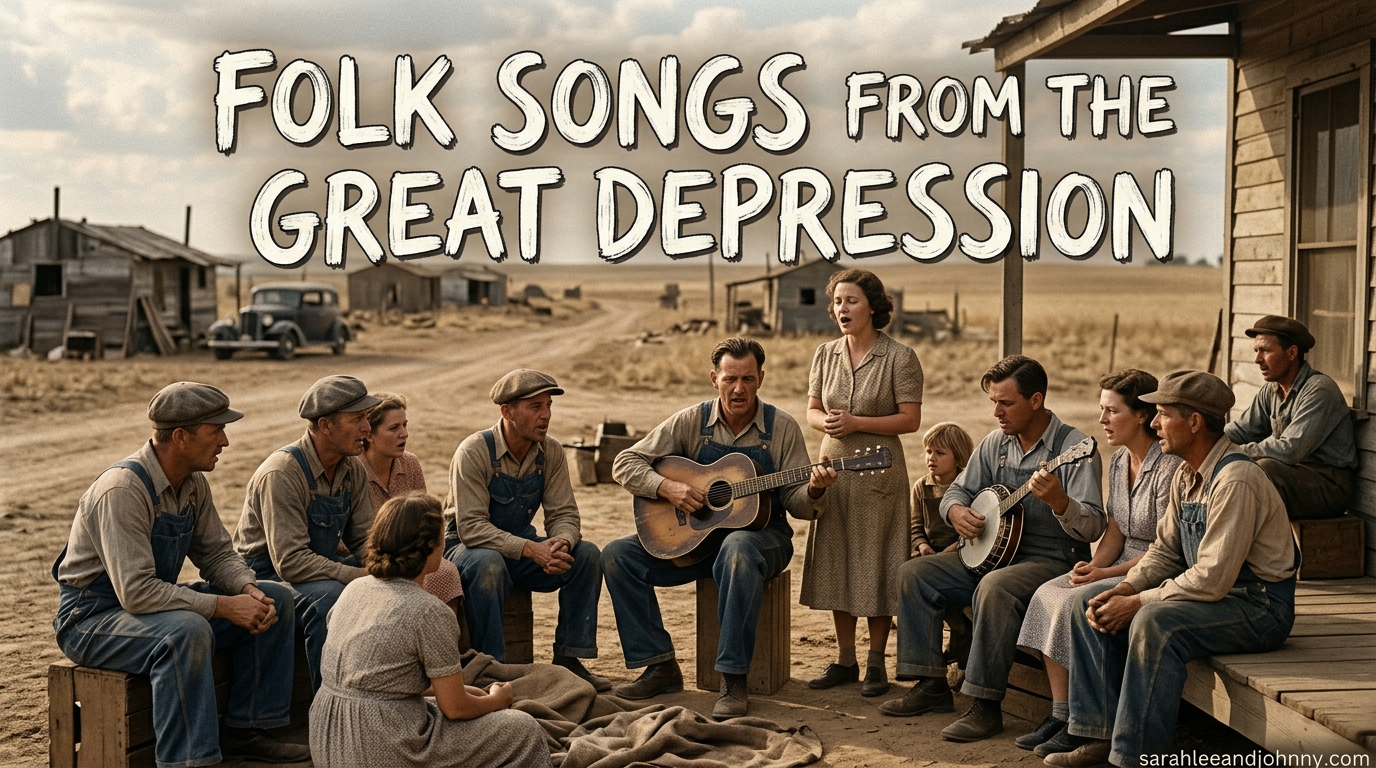
When the stock market crashed in 1929, millions of Americans lost everything. Jobs vanished. Homes were foreclosed. Farms turned to dust. But through all of that devastation, people picked up guitars, banjos, and whatever instruments they could find, and they sang. Those folk songs from the Great Depression carry a weight that feels startlingly familiar in 2026 — income inequality, housing crises, and the feeling that the system is stacked against ordinary people.
I have spent years studying and performing American folk music, and the more I listen to these Depression-era songs, the more I realize they are not museum pieces. They are living documents. Woody Guthrie, Lead Belly, Pete Seeger, and countless unnamed musicians captured something timeless about economic struggle, displacement, and the stubborn hope that keeps people going. Their words could have been written yesterday.
This article walks through the most powerful folk songs from the Great Depression that still apply today, explains why they remain relevant, and shows you exactly where to start listening if you want to hear them for yourself.
Table of Contents
- What Made Folk Songs from the Great Depression So Powerful
- Folk Songs from the Great Depression That Still Apply Today
- 1. “This Land Is Your Land” — Woody Guthrie (1940)
- 2. “Brother, Can You Spare a Dime?” — Jay Gorney and Yip Harburg (1932)
- 3. “So Long, It’s Been Good to Know You” — Woody Guthrie (1940)
- 4. “Hard Travelin'” — Woody Guthrie (1946)
- 5. “Pastures of Plenty” — Woody Guthrie (1941)
- 6. “Do Re Mi” — Woody Guthrie (1937)
- 7. “Ain’t Goin’ Down to the Well No More” — Lead Belly (various recordings)
- Woody Guthrie: The Dust Bowl Troubadour
- Lead Belly: The 12-String Guitar Legend
- Pete Seeger and the Folk Revival Connection
- Why Depression-Era Folk Songs Still Matter in 2026
- How to Start Listening to Depression-Era Folk Music
- FAQs
- The Enduring Power of Folk Songs from the Great Depression
What Made Folk Songs from the Great Depression So Powerful
Depression-era folk music was not entertainment in the way we think of it today. It was survival. When 15 million Americans were unemployed and countless families lost their homes, music became one of the few ways people could process what was happening to them.
The songs came from direct experience. Woody Guthrie watched the Dust Bowl swallow farmland across Oklahoma, Texas, and Kansas. Migrant workers — often called “Okies” as a derogatory term for those fleeing the Dust Bowl — packed everything they owned into broken-down cars and headed west to California, only to find more poverty and exploitation waiting. Guthrie and others turned those experiences into songs because nobody else was telling the story.
Acoustic instruments were cheap and portable. A guitar, a banjo, or a fiddle cost far less than a piano, and you could carry it from town to town, from migrant camp to migrant camp. The Federal Music Project, a New Deal program, also employed thousands of musicians during this era, helping to document and preserve folk traditions that might otherwise have been lost.
What made these songs so effective was their honesty. They did not sugarcoat poverty. They did not pretend everything was fine. A song like “Brother, Can You Spare a Dime?” asked a direct, uncomfortable question about a nation that had promised prosperity and delivered breadlines instead. That kind of blunt social commentary is exactly why these songs still resonate nearly a century later.
Folk Songs from the Great Depression That Still Apply Today
Here are the Depression-era folk songs that carry the most direct relevance to the challenges people face in 2026. Each one speaks to a specific modern parallel — from wealth inequality to housing instability to the migrant experience.
1. “This Land Is Your Land” — Woody Guthrie (1940)
Most people know this song as a cheerful patriotic tune sung in elementary schools. The full version is something else entirely. Guthrie wrote it as a direct response to Irving Berlin’s “God Bless America,” which he found complacent and out of touch with the reality of widespread poverty and displacement.
The lesser-known verses tell a different story. One describes a private property sign and a questioning of who truly owns the land. Another depicts people lined up at a relief office, hungry and desperate. In 2026, as debates rage over housing rights, land ownership, wealth concentration, and who gets to live where, Guthrie’s questions hit with uncomfortable precision.
This is arguably the most famous of all folk songs from the Great Depression, and its relevance has never faded because the fundamental tension it describes — between the idea that this land belongs to everyone and the reality that it does not — remains unresolved.
2. “Brother, Can You Spare a Dime?” — Jay Gorney and Yip Harburg (1932)
Technically a popular song rather than a traditional folk ballad, this track became an anthem of the Depression and was later absorbed into the folk canon. It tells the story of a man who built railroads, fought in World War I, and did everything he was supposed to do — only to stand in a breadline asking for spare change.
The anger and betrayal in that narrative maps directly onto the experience of millions today. People who worked hard, followed the rules, played by the book, and still found themselves underwater on a mortgage, drowning in medical debt, or laid off during a pandemic. The song asks: what happens to the social contract when the people who built the country are left with nothing?
That question has not lost its urgency. Every time a factory closes, a pension gets cut, or a tech company lays off thousands of workers while executives pocket bonuses, “Brother, Can You Spare a Dime?” is there, waiting.
3. “So Long, It’s Been Good to Know You” — Woody Guthrie (1940)
Guthrie wrote this after witnessing “Black Sunday” — April 14, 1935 — when one of the worst dust storms in American history rolled across the Great Plains, blocking out the sun and forcing families to abandon their homes. The song has a darkly humorous tone, with Guthrie describing a dust storm so thick that people could not see their hands in front of their faces.
Climate displacement in 2026 gives this song a new and chilling relevance. Wildfires in the West, hurricanes in the South, and rising sea levels forcing coastal communities to relocate — the experience of watching your home become uninhabitable is no longer confined to history books. Guthrie captured the strange mix of grief and dark humor that comes with losing everything to forces beyond your control.
4. “Hard Travelin'” — Woody Guthrie (1946)
“I’ve been havin’ some hard travelin’, I thought you knowed.” With that opening line, Guthrie speaks for every person who has ever hit the road out of necessity rather than choice. The song describes a life of riding freight trains, sleeping in missions, and picking crops for poverty wages.
The modern gig economy has created its own version of hard traveling. Workers driving for rideshare apps, picking up delivery gigs, and moving from one short-term contract to another know what it means to hustle constantly just to stay afloat. The specifics have changed — an app instead of a freight train, a rented room instead of a mission — but the underlying reality of itinerant, precarious labor is strikingly similar.
5. “Pastures of Plenty” — Woody Guthrie (1941)
This song was written for a documentary about the Bonneville Dam project, but its subject is the migrant farmworker. Guthrie sings about the people who pick the fruit, tend the fields, and feed the nation — yet go hungry themselves. He describes a green and fertile California built on the backs of workers who are denied its bounty.
The agricultural labor system has not changed as much as most people would like to believe. Migrant workers in 2026 still face exploitation, poor housing, and systemic exclusion from the prosperity their labor creates. “Pastures of Plenty” could serve as a soundtrack for every news story about farmworker conditions, meatpacking plant outbreaks, or immigration policy debates.
6. “Do Re Mi” — Woody Guthrie (1937)
If you do not have money, California does not want you. That is the blunt message of “Do Re Mi,” one of Guthrie’s most direct songs about the California migration. He warns Dust Bowl refugees that the golden state is not the promised land they have heard about — you need money to survive there, and if you arrive without it, you will be worse off than before.
This song could be about any number of modern economic traps. The high cost of living in desirable cities. The way low-wage workers are priced out of the very communities they serve. The false promise that moving somewhere new will solve problems rooted in systemic inequality. Guthrie saw through it all, and his warning still applies.
7. “Ain’t Goin’ Down to the Well No More” — Lead Belly (various recordings)
Lead Belly recorded several versions of this song about refusing to accept unjust conditions. It is a song of quiet defiance, a declaration that there are limits to what a person will endure. Lead Belly’s version draws on older folk traditions but updates them with his own experience of the Depression-era South and the prison system.
In 2026, workers across industries are reaching similar breaking points. Strikes, union organizing efforts, and mass resignations reflect the same basic human impulse: the refusal to keep accepting conditions that are unjust. Lead Belly’s song captures that moment of drawing a line, and it sounds as fresh now as it did in the 1930s.
Woody Guthrie: The Dust Bowl Troubadour
Woody Guthrie was born in 1912 in Okemah, Oklahoma, a small town that sat right in the path of the Dust Bowl. By the time the droughts and dust storms of the 1930s devastated the region, Guthrie was already a young man watching his community collapse around him. He did what came naturally: he wrote songs about it.
Guthrie’s significance goes far beyond any single song. He created a template for what protest folk music could be — direct, plainspoken, and unafraid to name the people and systems responsible for suffering. His guitar famously bore the label “This Machine Kills Fascists,” a statement of purpose that connected his music to a broader political vision.
During the late 1930s and early 1940s, Guthrie traveled extensively, playing for migrant workers, union meetings, and anyone who would listen. His Dust Bowl ballads — songs like “So Long, It’s Been Good to Know You,” “Do Re Mi,” and “Tom Joad” (inspired by John Steinbeck’s “The Grapes of Wrath”) — were written for and about the people he met on the road. They were not abstract political statements. They were dispatches from the front lines of American poverty.
Guthrie’s influence on every generation of folk and protest music that followed is impossible to overstate. Bob Dylan, Bruce Springsteen, Billy Bragg, and countless others have cited him as a primary inspiration. His willingness to write about uncomfortable truths — economic inequality, political corruption, the failures of the American Dream — set a standard that still defines what protest music can accomplish.
His legacy is also preserved through the Woody Guthrie Foundation and the Smithsonian Institution, which maintain archives of his writings, recordings, and artwork. The fact that his songs are still covered, quoted, and referenced in political movements nearly 80 years after his most productive period tells you everything about their enduring power.
Lead Belly: The 12-String Guitar Legend
Huddie William Ledbetter, known as Lead Belly, was one of the most important American folk musicians of the 20th century, though his story is far less widely known than it should be. Born in 1888 in Louisiana, Lead Belly spent time in prison, worked as a laborer, and eventually became one of the most recorded folk artists of his era.
Lead Belly’s instrument of choice was the 12-string guitar, and his driving, rhythmic style became one of the defining sounds of American folk music. He drew from a deep well of musical traditions — work songs, field hollers, spirituals, ballads, and blues — and synthesized them into something entirely his own.
His songs covered an enormous range of subjects, from children’s play-party songs to searing indictments of racial injustice. “Bourgeois Blues” directly attacked the racism he experienced in Washington, D.C. “Rock Island Line” became a standard covered by artists across genres. “Goodnight, Irene” became a massive pop hit after his death.
Lead Belly’s relevance to the modern conversation about economic and racial justice is clear. He was a Black man from the rural South who experienced every form of systemic oppression the 1930s had to offer, and he channeled that experience into music that was by turns joyful, angry, mournful, and defiant. Modern artists from Nathaniel Rateliff to Rhiannon Giddens have drawn directly on his legacy, proving that his music still speaks to contemporary struggles.
His field recordings, preserved by the Library of Congress and Folkways Records, remain some of the most important documents of American musical culture. If you want to understand where folk music comes from — not the polished coffeehouse version, but the raw, real thing — Lead Belly is essential listening.
Pete Seeger and the Folk Revival Connection
If Woody Guthrie and Lead Belly created the foundation of Depression-era folk music, Pete Seeger was the bridge that carried it into the future. Born in 1919, Seeger met Guthrie in 1940 and the two formed the Almanac Singers, a group that performed at union halls, strikes, and political rallies throughout the early 1940s.
Seeger understood something that many musicians do not: a song is only powerful if people sing it together. He made community singing the centerpiece of his performances, encouraging audiences to join in rather than simply listen. This was not a gimmick. It was a philosophical commitment to the idea that folk music belongs to the folk — to ordinary people raising their voices together.
During the 1950s and 1960s, Seeger became one of the central figures of the folk revival. He helped found the Newport Folk Festival, mentored young artists like Bob Dylan and Joan Baez, and kept Depression-era songs in the repertoire at a time when they might otherwise have faded into obscurity.
Seeger’s activism extended far beyond music. He participated in the civil rights movement, the anti-Vietnam War movement, and the environmental movement. He adapted old folk songs for new causes, showing that the musical traditions of the 1930s could be flexible enough to address whatever injustices arose in later decades.
His approach — using simple, singable songs as tools for organizing and consciousness-raising — has influenced generations of activists. The tradition of singing at protests, marches, and rallies that we see in 2026 traces directly back to the model Seeger built on the foundation of Depression-era folk music.
Why Depression-Era Folk Songs Still Matter in 2026
The parallels between the 1930s and today are not subtle. The wealth gap in 2026 is wider than it has been since the Gilded Age. Housing costs have pushed millions of workers to the brink. Gig economy jobs offer flexibility without security, echoing the itinerant labor that Guthrie sang about. Climate change is displacing communities in ways that recall the Dust Bowl migration.
But the connection goes deeper than economics. These songs matter because they give people language for experiences that are hard to articulate. When Woody Guthrie sings about being broke and hungry in a country overflowing with wealth, he names something that millions of people feel but struggle to express. When Lead Belly refuses to go back to an unjust situation, he gives voice to a universal human impulse toward dignity and self-respect.
There is also a growing movement of younger listeners discovering this music. Gen Z and millennial audiences, raised on streaming platforms and social media, are finding Depression-era folk through Spotify playlists, YouTube channels, and TikTok videos. The rawness and authenticity of these recordings stands in sharp contrast to the polished production values of contemporary pop, and many young listeners find that honesty refreshing.
Modern artists are keeping the tradition alive as well. Bruce Springsteen’s “The Ghost of Tom Joad” album drew directly on Guthrie’s legacy. Nathaniel Rateliff’s soulful folk-rock echoes Lead Belly’s emotional intensity. Rhiannon Giddens has made a career of connecting historical folk traditions to contemporary conversations about race and justice. These artists prove that the musical vocabulary created during the Depression is still the right tool for describing the world in 2026.
The forum discussions I have followed on Reddit and elsewhere confirm this. Users consistently say they feel more connected to historical folk songs than to much of contemporary music, precisely because these older songs deal with real, tangible struggles rather than abstract sentiments. People are hungry for art that acknowledges hardship without being defeated by it, and that is exactly what Depression-era folk music provides.
How to Start Listening to Depression-Era Folk Music
If this article has convinced you to explore this music, you are in luck. Many of the most important Depression-era folk recordings are widely available, often for free, thanks to their preservation by public institutions.
The single best starting point is the Smithsonian Folkways catalog. Folkways Records, founded by Moses Asch in 1948, recorded and released hundreds of albums by Woody Guthrie, Lead Belly, Pete Seeger, and dozens of other folk artists. When the Smithsonian Institution acquired Folkways in 1987, they committed to keeping every single album in print permanently. You can stream many of these recordings through the Smithsonian Folkways website and major streaming platforms.
For Woody Guthrie specifically, start with “Dust Bowl Ballads” — his 1940 album that collects his most famous songs about the Dust Bowl migration. It is available on every streaming service and remains one of the most important albums in American music history.
For Lead Belly, the “Lead Belly Legacy” series on Smithsonian Folkways offers a comprehensive introduction. His recordings of “Goodnight, Irene,” “Rock Island Line,” and “The Bourgeois Blues” are essential listening.
The Library of Congress also holds extensive field recordings from the 1930s and 1940s, many of which are available online through the American Memory project. These are raw, unpolished recordings made in migrant camps, prison farms, and rural communities. They sound like what they are: people singing because singing is what they had.
If you prefer a curated introduction, search for “Great Depression folk music” playlists on Spotify or YouTube. The folk music community on Reddit, particularly r/folk and r/AskHistorians, is also an excellent resource for recommendations and discussion. Users there are generous with their knowledge and happy to help newcomers find their way into the genre.
FAQs
What was the most popular music during the Great Depression?
During the Great Depression, popular music included big band swing, jazz, and Broadway show tunes, but folk music held special significance because it directly addressed the economic hardship people were experiencing. Artists like Woody Guthrie and Lead Belly created songs that documented the realities of poverty, migration, and unemployment, while commercial popular music often provided escapist entertainment. Both coexisted, but the folk tradition is what has endured most powerfully as a historical document of the era.
What are the top five folk songs from the Depression era?
The five most significant Depression-era folk songs are: 1) ‘This Land Is Your Land’ by Woody Guthrie — a critique of inequality disguised as a patriotic anthem; 2) ‘Brother, Can You Spare a Dime?’ by Jay Gorney and Yip Harburg — a lament for the broken social contract; 3) ‘So Long, It’s Been Good to Know You’ by Woody Guthrie — a darkly humorous take on Dust Bowl displacement; 4) ‘Pastures of Plenty’ by Woody Guthrie — about migrant farmworkers feeding a nation that denies them its bounty; 5) ‘Hard Travelin” by Woody Guthrie — describing the life of itinerant laborers. Each remains relevant because the economic and social issues they describe have not been fully resolved.
Who was the main folk singer during the Great Depression?
Woody Guthrie is widely considered the most important folk singer of the Great Depression era. Born in Oklahoma in 1912, he witnessed the Dust Bowl firsthand and wrote hundreds of songs documenting the experiences of migrant workers, the unemployed, and the rural poor. He was not the only significant figure — Lead Belly and Pete Seeger were also central to the era’s folk music — but Guthrie’s output, influence, and cultural impact make him the defining voice of Depression-era American folk music.
What was the protest folk song in the 1960s?
The 1960s folk revival produced many protest songs, with Bob Dylan’s ‘Blowin’ in the Wind’ and ‘The Times They Are a-Changin” among the most famous. Pete Seeger also adapted Depression-era songs for the civil rights movement, most notably turning ‘We Shall Overcome’ into a movement anthem. The 1960s protest folk tradition was built directly on the foundation laid by Depression-era artists like Woody Guthrie, whose songs provided the template for using music as a tool for social and political commentary.
Is folk music still relevant today?
Yes, folk music remains deeply relevant today. The economic anxieties, political polarization, and social justice movements of the 2020s have sparked renewed interest in folk traditions. Artists like Rhiannon Giddens, Nathaniel Rateliff, and Jason Isbell carry forward the songwriting ethos established by Depression-era musicians. Streaming platforms have also made historical folk recordings more accessible than ever, introducing new generations to songs that speak directly to contemporary struggles with inequality, displacement, and workers’ rights.
Why are traditional folk songs relevant today?
Traditional folk songs remain relevant because the human experiences they describe — economic hardship, injustice, displacement, community, and resilience — are universal and ongoing. The specific circumstances change, but the underlying emotions and struggles are remarkably consistent across generations. Depression-era folk songs, for example, describe income inequality, housing insecurity, and exploitative labor practices that are still major issues today. These songs also provide a sense of historical continuity, showing that previous generations faced similar challenges and found ways to endure and resist.
The Enduring Power of Folk Songs from the Great Depression
Folk songs from the Great Depression endure because they tell the truth. Woody Guthrie did not write press releases. Lead Belly did not craft corporate messaging. Pete Seeger did not worry about market testing. They wrote and sang about what they saw, what they lived, and what they believed, and that honesty has kept their music alive for nearly a century.
The seven songs I have covered here — from “This Land Is Your Land” to “Ain’t Goin’ Down to the Well No More” — are not historical curiosities. They are mirrors. When you listen to them, you hear the same struggles that fill the news in 2026: workers fighting for fair wages, families displaced by forces beyond their control, communities grappling with inequality that feels structural and permanent.
What these songs offer beyond documentation is hope. Not the shallow, everything-will-be-fine kind, but the stubborn, hard-won kind that comes from people who have been through the worst and decided to keep singing anyway. That is the real legacy of Depression-era folk music, and it is why these songs will continue to apply as long as there are people willing to listen.
If you have never sat down with a Woody Guthrie album or a Lead Belly recording, there has never been a better time. The music is waiting, and it has plenty left to say.