
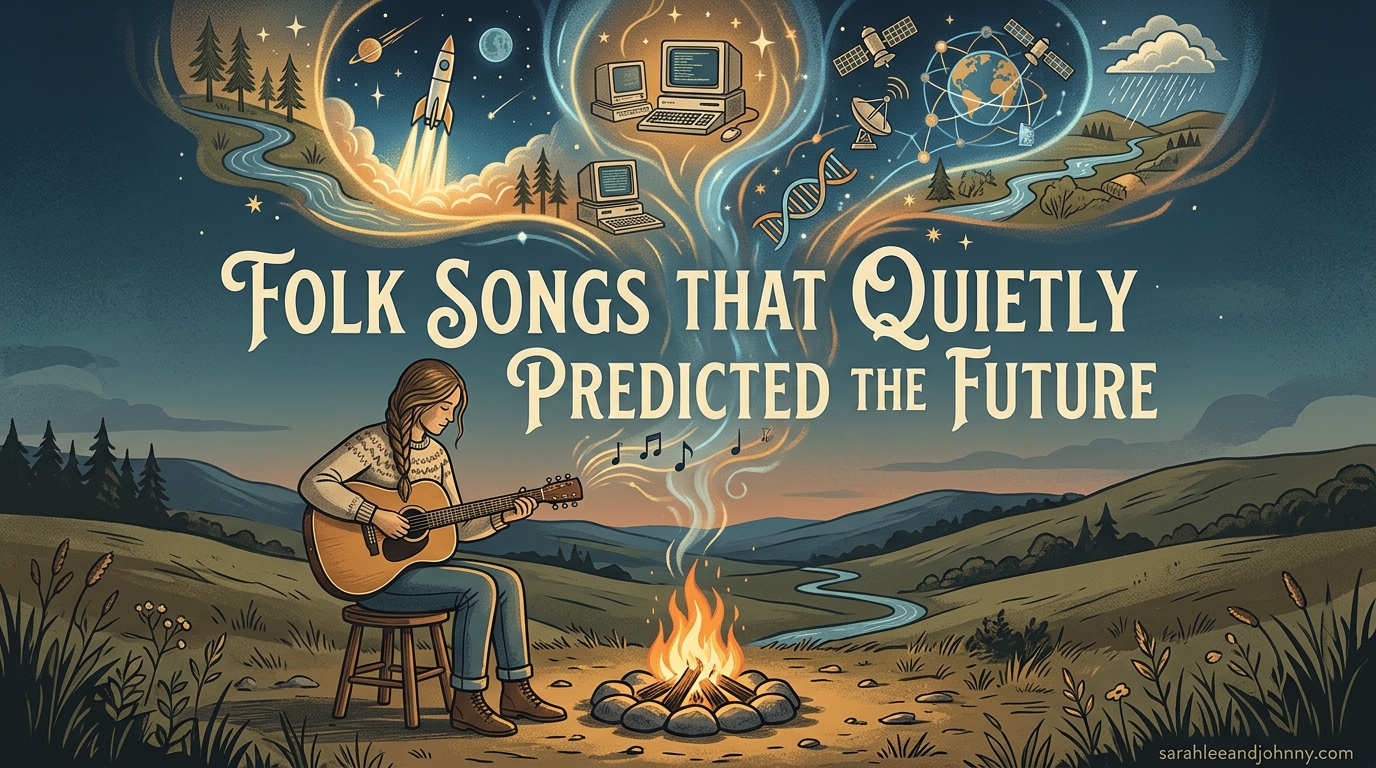
Some songs age like wine. Others age like time capsules with a working crystal ball inside. Folk songs that quietly predicted the future did not arrive with flashing neon signs or theatrical declarations. Instead, they showed up in minor keys, on cracked acoustic guitars, at union halls and coffee shops, carrying warnings that most people did not fully hear until decades later. From Bob Dylan’s visions of environmental collapse to Woody Guthrie’s raw dispatches about immigrant lives that America preferred to ignore, these tracks documented patterns the rest of the world had not yet recognized. This guide explores the most striking examples of prophetic folk music and explains why the folk tradition, more than any other genre, seems to produce songs that echo forward into events their writers could not possibly have known about.
Table of Contents
- Bob Dylan’s “A Hard Rain’s a-Gonna Fall” (1962) – The Nuclear Shadow
- Bob Dylan’s “License to Kill” (1983) – Climate Change Before It Had a Name
- Woody Guthrie’s “Deportee (Plane Wreck at Los Gatos)” (1948) – Immigration and Invisible Lives
- Woody Guthrie’s “This Land Is Your Land” (1940) – The Protest Song Disguised as Patriotism
- Joni Mitchell’s “Big Yellow Taxi” (1970) – Environmentalism’s Catchiest Warning
- Pete Seeger’s Quiet Warnings – Folk Music’s Conscience
- Why Folk Songs That Quietly Predicted the Future Hold Such Power
- FAQs
- The Future Is Still Being Written in Verse
Bob Dylan’s “A Hard Rain’s a-Gonna Fall” (1962) – The Nuclear Shadow
Bob Dylan wrote “A Hard Rain’s a-Gonna Fall” during the Cuban Missile Crisis in October 1962. The world held its breath for thirteen days while Kennedy and Khrushchev stared each other down over nuclear warheads in Cuba. Dylan, just 21 years old, channeled that collective dread into a song that reads like a series of feverish visions. He later said he wrote the long verses in a basement, feeling like the world might end before he could finish singing them.
The lyrics describe a world of ecological ruin, social collapse, and spiritual desolation. “I saw a newborn baby with wild wolves all around it” captures the vulnerability of innocence surrounded by predatory forces. “I saw guns and sharp swords in the hands of young children” anticipated the militarization that would consume the rest of the century and beyond. These images were specific enough to feel like prophecy but general enough to apply to nearly every crisis that followed.
What makes this song remarkable is not just that Dylan sensed the danger of nuclear annihilation. Plenty of people did that. The song’s true prophetic quality lies in its structure. Each verse piles images upon images, a technique borrowed from the Scottish folk ballad “Lord Randall,” creating a cumulative portrait of a world spiraling out of control. Sixty years later, the song still sounds current. Substitute “hard rain” for any number of modern existential threats and the lyrics fit just as snugly.
Dylan never claimed to be a prophet. In his memoir Chronicles: Volume One, he described songwriting as listening to signals and translating them. “A Hard Rain’s a-Gonna Fall” may simply be the work of a young man paying closer attention than anyone else in the room.
Bob Dylan’s “License to Kill” (1983) – Climate Change Before It Had a Name
In 1983, climate change was not yet part of everyday conversation. Scientists like James Hansen were beginning to sound alarms, but the general public had barely registered the threat. Enter Dylan, writing on his album Infidels a song that now sounds like it was composed last Tuesday.
“Man has invented his doom,” Dylan sings in “License to Kill,” tracking a civilization so intoxicated by its own technological power that it cannot see the cliff ahead. “Now he looks at the sky and he looks at the sea / And he looks at his children and he starts to see.” Those lines capture the exact emotional arc of environmental awareness. First indifference, then the slow recognition that we are destroying the world our children will inherit.
The song also touches on the arrogance of dominion. “He asks the question, ‘Is it too late?'” Dylan understood that the question itself was part of the problem. Asking whether it is too late implies that someone, somewhere, has the answer. But in folk tradition, the warning is the point, not the solution. Dylan was not offering policy recommendations. He was holding up a mirror and letting the reflection do its work.
Woody Guthrie’s “Deportee (Plane Wreck at Los Gatos)” (1948) – Immigration and Invisible Lives
On January 28, 1948, a plane carrying 32 passengers, including 28 Mexican migrant workers being deported from California, crashed near Los Gatos Canyon. Newspapers covered the tragedy but identified the American crew members by name while listing the deported workers simply as “deportees.” No names. No identities. No grief.
Woody Guthrie read the coverage and was furious. He wrote “Deportee (Plane Wreck at Los Gatos)” as a response, giving names and dignity to people the press had erased. “Goodbye to my Juan, goodbye Rosalita,” he sings, inventing names for the unnamed dead. “You won’t have a name when you ride the big airplane.” The song is a quiet, devastating indictment of a country that relies on immigrant labor while refusing to acknowledge immigrant humanity.
Seventy-eight years later, immigration remains one of the most contentious issues in American politics. Debates about border walls, deportation raids, and the status of undocumented workers dominate headlines. Guthrie’s song did not predict a specific event so much as it diagnosed a permanent condition. America’s relationship with immigrant labor has always been built on exploitation and erasure. Guthrie heard that truth in 1948 and wrote it down in a melody so gentle it barely sounds like a protest song at all.
That is what makes folk songs that quietly predicted the future so powerful. They do not shout. They do not need to. They simply tell the truth, and the truth has a long shelf life.
Woody Guthrie’s “This Land Is Your Land” (1940) – The Protest Song Disguised as Patriotism
Most Americans know “This Land Is Your Land” as a cheerful elementary school anthem. It gets sung at Fourth of July celebrations, school assemblies, and patriotic events. But Guthrie wrote it as a direct rebuke to Irving Berlin’s “God Bless America,” a song he found saccharine and dismissive of the millions of Americans struggling through the Great Depression.
The original manuscript included verses that almost never get sung today. “In the shadow of the steeple I saw my people / By the relief office I seen my people / As they stood hungry, I stood there wondering / If this land was made for you and me.” Another verse describes a private property sign that the narrator ignores, suggesting that the land belongs to everyone, not just those who can afford to buy it.
Guthrie was predicting, perhaps unintentionally, a battle that would define American politics for generations. Who does this country belong to? Who gets to benefit from its resources? Who is included in the phrase “you and me”? Every debate about wealth inequality, land rights, indigenous sovereignty, and the social safety net circles back to the questions Guthrie embedded in a song that first graders now sing without understanding its radical roots.
Joni Mitchell’s “Big Yellow Taxi” (1970) – Environmentalism’s Catchiest Warning
“They paved paradise and put up a parking lot.” Seven words into “Big Yellow Taxi” and Joni Mitchell had already written one of the most quoted environmental statements in music history. The song was inspired by a trip Mitchell took to Hawaii, where she looked out her hotel window and saw a beautiful landscape being devoured by development. That juxtaposition, paradise and asphalt side by side, became the song’s central image.
“Big Yellow Taxi” addresses environmental destruction, corporate greed, and the human tendency to destroy what we love and then grieve what we lost. “Don’t it always seem to go that you don’t know what you’ve got till it’s gone.” That line became a cultural idiom, repeated so often that people forget it came from a folk song written by a 26-year-old Canadian woman watching Hawaii disappear.
The song predicted the central tension of environmental politics. Developers pave first and ask questions later. Communities mourn what they failed to protect. The pattern repeats in every city, every forest, every coastline where economic growth collides with ecological survival. Mitchell saw the pattern early and wrote it into a melody so catchy that people sing along without realizing they are participating in an elegy.
Pete Seeger’s Quiet Warnings – Folk Music’s Conscience
If Bob Dylan was folk music’s visionary and Woody Guthrie was its conscience, Pete Seeger was its encyclopedia. Seeger spent decades collecting, performing, and preserving folk songs, but he also wrote and popularized tracks that carried their own prophetic weight.
“Where Have All the Flowers Gone,” adapted from a Cossack folk song and a passage in Mikhail Sholokhov’s novel And Quiet Flows the Don, traces a devastatingly simple cycle. Flowers are picked by young girls. Young girls are married to young men. Young men become soldiers. Soldiers die in graveyards. Graveyards grow flowers. The cycle begins again.
Seeger wrote the additional verses in 1955, during the Cold War, but the song’s power lies in its timelessness. Every generation sends its young to war. Every generation buries them. Every generation wonders why. The song predicted nothing specific and everything general. It describes the permanent machinery of militarism with the patient repetition of a folk ballad, trusting the listener to draw the obvious conclusion.
Seeger also championed environmental causes through music long before it was fashionable. His work cleaning up the Hudson River and performing at environmental rallies throughout the 1970s and 1980s demonstrated his belief that folk music was not just entertainment but a tool for cultural repair. His songs did not predict the future so much as they insisted on a better one.
Why Folk Songs That Quietly Predicted the Future Hold Such Power
There is a reason folk music produces more prophetic songs than almost any other genre. It has nothing to do with mysticism and everything to do with method. Folk songwriters work close to the ground. They listen to people. They attend union meetings, sit in living rooms, walk picket lines, and ride freight trains. Their raw material is the lived experience of communities, not the abstract theories of intellectuals.
This proximity to ordinary life gives folk songwriters an early warning system. Woody Guthrie saw how migrant workers were treated because he rode the rails with them. Bob Dylan sensed nuclear dread because he sat in Greenwich Village coffee shops with people who had fled fascism in Europe. Joni Mitchell watched paradise being paved because she looked out a hotel window and paid attention. These artists were not predicting the future. They were describing the present so accurately that the future had no choice but to confirm what they already saw.
The folk tradition also values simplicity. A pop song can hide behind production. A rock song can overwhelm with volume. But a folk song stands or falls on its words and its melody. There is nowhere to hide. This forces folk songwriters to be economical, direct, and honest. When you strip away the noise, what remains is a clear picture of reality. And a clear picture of reality tends to age well.
Oral tradition plays a role too. Folk songs are designed to be passed from person to person, generation to generation. They carry cultural memory the way a river carries sediment. Each performance adds a new layer of meaning while preserving the original deposit. This is why a song written in 1948 about deported migrant workers can still stop you in your tracks in 2026. The medium is built for longevity.
The songwriter in folk tradition functions as both journalist and historian, recording events as they happen while framing them in a context that reveals their deeper significance. Pete Seeger once said that folk music is “the music of the people who have no other music.” That statement captures the genre’s essential quality. Folk songs emerge from communities that do not have think tanks, lobbyists, or media empires to amplify their concerns. The song itself is the broadcast. And sometimes, the broadcast reaches far into the future.
FAQs
What are songs that talk about the future?
Songs that talk about the future span every genre, but folk music has a unique track record. Bob Dylan’s “A Hard Rain’s a-Gonna Fall” (1962), Joni Mitchell’s “Big Yellow Taxi” (1970), and Woody Guthrie’s “Deportee” (1948) all described conditions that became more relevant decades after they were written. These songs do not predict specific events so much as they identify patterns that continue unfolding over time.
What is the greatest folk song of all time?
Ask ten people and you will get ten answers, but “This Land Is Your Land” by Woody Guthrie consistently ranks at or near the top of every list. Written in 1940 as a response to “God Bless America,” it has been covered by hundreds of artists and remains a staple of American musical culture. Its combination of simple melody, powerful message, and hidden radical verses makes it arguably the most important folk song ever written.
What is the future of folk music?
Folk music continues to evolve in 2026 through artists who carry the tradition forward while addressing contemporary concerns. Artists like Brandi Carlile, Jason Isbell, and Rhiannon Giddens blend traditional folk techniques with modern production and current social commentary. The genre’s future lies in the same place it has always been: in the hands of songwriters who pay close attention to the world around them and have the courage to tell the truth about what they see.
How do folk songs represent culture?
Folk songs represent culture by capturing the concerns, values, and daily experiences of communities in real time. Unlike commercial music written for mass consumption, folk songs emerge from specific places and specific people. They document working conditions, social injustices, environmental changes, and political struggles from the perspective of those directly affected. This makes them both historical records and cultural barometers that reveal what a community was thinking and feeling at a particular moment in time.
The Future Is Still Being Written in Verse
Folk songs that quietly predicted the future were never really about prophecy. They were about attention. Guthrie paid attention to deported workers the press would not name. Dylan paid attention to nuclear dread the politicians tried to normalize. Mitchell paid attention to paradise being paved while everyone else looked the other way. Seeger paid attention to the cycles of war that each generation swore would be the last.
The folk tradition continues today. Somewhere right now, a songwriter with an acoustic guitar and a notebook is documenting a pattern the rest of us have not yet recognized. In twenty or thirty or fifty years, someone will hear that song and say it predicted the future. It did not. It described the present. The future just took a while to catch up.
And that may be the most important lesson these songs offer. You do not need to be a prophet to see what is coming. You just need to look around and tell the truth about what you see. Folk music has been doing exactly that for centuries. The evidence suggests it will keep doing it for centuries more.