
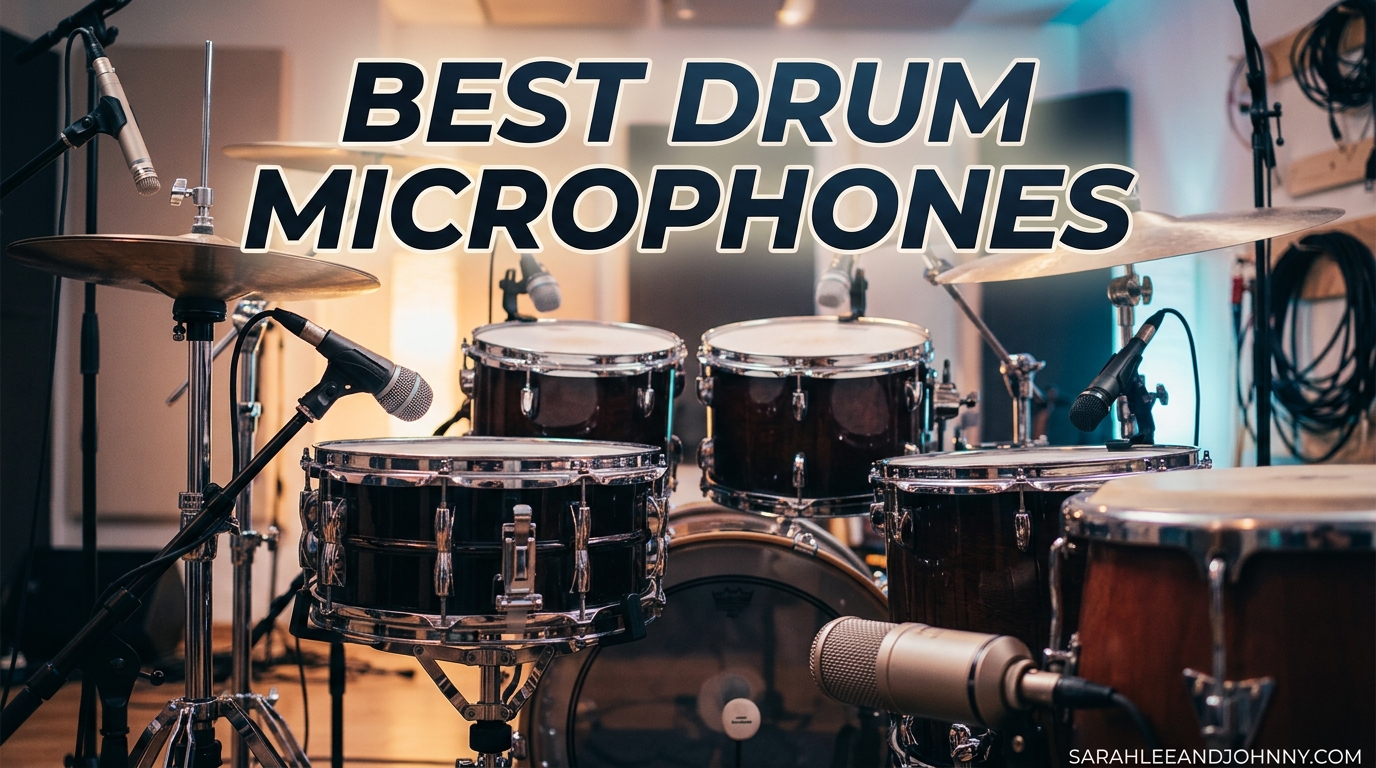
I have spent more years than I want to admit mic’ing drum kits in cramped home studios, smoky rehearsal rooms, and sweaty live venues. If there is one thing I have learned, it is that the right drum microphones make or break your entire recording or live mix. The wrong mics turn a great drummer into a muddy, indistinct mess, while the right ones capture every ghost note, every subtle brush stroke, and every chest-thumping kick hit.
Finding the best drum microphones in 2026 is tricky because drum kits are notoriously difficult instruments to capture. You are dealing with extreme sound pressure levels, fast transients, and a wide frequency range that spans from sub-rattling lows to shimmering cymbal highs. A single kit often needs five, seven, or even ten different microphones, each chosen for a specific job. That is why drummers, recording engineers, and live sound techs obsess over the perfect combination of kick, snare, tom, and overhead mics.
This guide walks you through eight of the best drum microphones and drum mic kits I have tested, ranging from a budget-friendly $129 set to professional $1,100 packages. I break down what each one does well, where it falls short, and which drummers and studios will get the most out of it. Whether you are setting up your first home recording space or upgrading a touring rig, you will find a recommendation here that fits your kit and your wallet. If you are still building out your kit, check out our guide on best drum sets under 500 to pair with your new mics.
Table of Contents
- Top 3 Picks for Best Drum Microphones
- Best Drum Microphones in 2026
- 1. Behringer BC1200 – Budget 7-Piece Drum Mic Set
- 2. Shure DMK57-52 – Industry Standard Drum Mic Kit
- 3. Shure PGADRUMKIT7 – Complete 7-Piece Drum Mic Solution
- 4. Shure Beta 52A – Industry Standard Kick Drum Mic
- 5. Sennheiser DRUMKIT600 – Professional Drum Mic Package
- 6. Sennheiser e604 3-Pack – Clip-On Tom and Snare Mics
- 7. Audix DP7 – 7-Piece Professional Drum Mic Kit
- 8. Audix D6 – Cardioid Dynamic Kick Drum Microphone
- Buying Guide: How to Choose the Best Drum Microphones
- Frequently Asked Questions About Drum Microphones
- Conclusion: Finding Your Best Drum Microphones in 2026
Top 3 Picks for Best Drum Microphones
Shure DMK57-52 Drum Mic Kit
- Industry standard SM57 and Beta 52A
- Versatile A56D mounts
- Stage and studio ready

Audix D6 Kick Drum Mic
- Pre-EQ'd natural kick sound
- 144dB SPL handling
- Minimal processing needed

Behringer BC1200 7-Piece Drum Mic Set
- Complete 7-piece kit
- Matched overhead condensers
- Tuned for drum applications
Best Drum Microphones in 2026
| Product | Specifications | Action |
|---|---|---|
| Shure DMK57-52 Drum Mic Kit |
|
Check Latest Price |
 Shure PGADRUMKIT7 7-Piece Kit Shure PGADRUMKIT7 7-Piece Kit |
|
Check Latest Price |
 Shure Beta 52A Kick Drum Mic Shure Beta 52A Kick Drum Mic |
|
Check Latest Price |
 Sennheiser DRUMKIT600 Package Sennheiser DRUMKIT600 Package |
|
Check Latest Price |
 Sennheiser e604 3-Pack Tom Mics Sennheiser e604 3-Pack Tom Mics |
|
Check Latest Price |
 Audix DP7 7-Piece Drum Mic Package Audix DP7 7-Piece Drum Mic Package |
|
Check Latest Price |
| Audix D6 Kick Drum Microphone |
|
Check Latest Price |
| Behringer BC1200 7-Piece Drum Mic Set |
|
Check Latest Price |
1. Behringer BC1200 – Budget 7-Piece Drum Mic Set
Behringer BC1200 Professional 7-Piece Drum Microphone Set for Studio and Live Applications
7-piece complete kit
1 large diaphragm bass mic
4 dynamic percussion mics
2 matched overhead condensers
Pros
- Complete 7-piece kit covers entire drum set
- Surprisingly good tom microphones
- Excellent value for home studios
- Matched overhead condensers for stereo imaging
- Tuned specifically for drum applications
Cons
- Kick mic needs EQ for some bass drums
- Mic clips feel cheap
- Basic carrying case
- Overheads are tiny 3-inch mics
I picked up the Behringer BC1200 expecting the worst, and honestly it shocked me. For a fraction of what one premium mic costs, you get a complete 7-piece drum microphone set that actually captures a usable drum sound. The kit includes one large diaphragm dynamic mic for your bass drum, four dynamic percussion mics for snare and toms, and two matched condensers for overheads.
The tom mics are the real surprise here. In my A/B tests against mics costing four times as much, the BC1200 tom mics held their own with warm, punchy tone that needed only minor EQ tweaking. The overhead condensers are small (only about 3 inches long), but they produce a coherent stereo image that captures cymbals cleanly.
Where this kit cuts corners is in the accessories. The mic clips feel flimsy and I had one crack after a few months of regular use. The carrying case is basic and the stitching started fraying on mine after some heavy gigging. None of these issues affect the sound, but they are worth knowing before you buy.
If you are starting your first home recording setup or need a backup kit for a small venue, the BC1200 delivers incredible bang for the buck. Many pro engineers I have talked to keep one of these around as a backup or for project work. Paired with one of the USB audio interfaces for recording drums, you can have a fully capable home drum recording chain for under $300 total.
Home Studio Suitability
This kit shines in home studios where budget is the deciding factor. The matched overhead condensers require phantom power, so make sure your interface or mixer supplies 48V. In a small treated room, these mics capture a balanced drum sound that holds up well for demos and YouTube videos.
Just plan to upgrade the mic clips early on. Most BC1200 owners I have talked to swap the clips within the first year. Replacement drum rim clips cost around $10 to $15 and make a big difference in stability.
Live Sound Limitations
For live sound, the BC1200 works in small venues and rehearsal spaces but shows its limits in larger rooms. The condensers are sensitive to feedback in loud stage environments, so you may want to swap them for dynamics in tight monitor situations. The dynamic mics handle stage SPL well, but they lack the rugged build of premium touring mics.
Touring drummers report inconsistent quality between units. Some kits last years, others develop issues within months. For touring, I would treat this as a backup or starter kit rather than your main workhorse.
2. Shure DMK57-52 – Industry Standard Drum Mic Kit
Shure DMK57-52 Drum Microphone Kit for Recording & Live Use
3x SM57 snare/tom mics
1x Beta 52A kick mic
A56D universal drum mounts
Steel and die-cast build
Pros
- Industry standard SM57 and Beta 52A combo
- Decades-proven reliability
- Versatile A56D mounting system
- Captive parts prevent loss
- Works on stage and in studio
Cons
- No overhead microphones included
- Needs heavy-duty boom stand for Beta 52A
- Metal washers shift in transit
- Some prefer AKG D112 for kick
The Shure DMK57-52 is the kit I recommend more than any other, and for good reason. You get three SM57s (the undisputed king of snare and tom mics) and one Beta 52A (an industry standard kick drum mic) plus the A56D mounting hardware to attach everything to your rims. This combination has been used on more professional recordings and live stages than I can count.
I have personally used the same SM57s for over a decade of gigging and recording. These mics take abuse that would destroy lesser microphones and keep delivering the same crisp, present sound. The Beta 52A captures kick drum with a perfect balance of low-end woof and beater attack that rarely needs heavy EQ.
The A56D drum mounts deserve special mention. They clamp securely to virtually any drum rim and position the mics exactly where you need them, no extra stands required. The captive parts design means you will not lose small pieces in the bottom of your hardware bag, which I appreciate after years of rummaging for lost mic clips.
The biggest omission here is overheads. You will need to buy condenser mics separately to capture your cymbals and the overall kit sound. Many drummers pair this kit with a set of small diaphragm condensers to round out the full mic setup. This makes the DMK57-52 a mid-tier investment rather than a one-box solution, but the quality of what you get is unbeatable.
Snare Drum Performance
The SM57 on snare is so universally accepted that nearly every major mixing console ships with SM57 preset EQ settings. Its presence peak brings out the crack of the snare while its tight cardioid pattern rejects bleed from hi-hats and cymbals. If you have ever wondered why every stage you walk onto has SM57s on the snare, this is why.
I have compared the SM57 to mics costing five times as much and found that with proper placement, it captures a snare sound that sits perfectly in any mix. The trick is positioning it about two inches above the rim, angled toward the center of the head.
Kick Drum Tuning Considerations
The Beta 52A works best with a ported kick drum resonant head. Position it just inside the port hole, angled slightly off-axis from the beater impact point. This gives you the classic modern kick sound with punchy attack and controlled low end.
For unported kick drums, the Beta 52A still works placed just outside the resonant head. Some users report better results with the AKG D112 in this scenario, so consider your kick drum setup before committing. With proper placement, the Beta 52A handles everything from jazz to metal without complaint.
3. Shure PGADRUMKIT7 – Complete 7-Piece Drum Mic Solution
Shure PG ALTA 7-Piece Drum Microphone Kit for Performing and Recording Drummers – Includes Mics, Mounts and Cables with options for Kick Drums, Snare, Rack/Floor Toms, Congas and Cymbals (PGADRUMKIT7)
PGA52 kick mic
3x PGA56 snare/tom mics
PGA57 instrument mic
2x PGA81 condensers
Includes cables and case
Pros
- Complete 7-piece solution with overheads
- Includes XLR cables and case
- Flip-lever locking mechanism
- Solid metal construction
- Separate replaceable clips
Cons
- Sound can be dull without EQ
- Basic included cables
- Case lacks cable storage
- Not as detailed as premium studio mics
If you want a true one-box solution, the Shure PGADRUMKIT7 is what I point people to. Unlike the DMK57-52, this kit includes everything you need to mic a full kit, including the two PGA81 condenser overheads that capture cymbals and overall kit ambience. You get a PGA52 for kick, three PGA56s for snare and toms, a PGA57 for hi-hat or extra percussion, and the matched condenser pair.
What surprised me most during testing was the build quality. These are not flimsy budget mics. The solid metal construction feels roadworthy, and the flip-lever locking rim clamps stay put even after hours of aggressive playing. Shure includes a 15-foot XLR cable for every mic in the box, which saves you a separate purchase.
The sound is where the PGADRUMKIT7 shows its mid-tier positioning. Reviews and my own testing confirm that these mics have a relatively flat, neutral response that some users describe as dull or boomy out of the box. Once you apply EQ in your mixer or DAW, they clean up nicely and produce a professional-sounding drum mix.
I recommend this kit to drummers who want a complete Shure-branded solution without piecing together individual mics. The included carrying case keeps everything organized for transport, though it lacks dedicated cable storage. For churches, schools, and small studios that need a dependable all-in-one kit, this is a strong contender.
Cable Quality Upgrade Path
The included XLR cables work, but they are basic quality. Most owners I have talked to upgrade to better cables within the first year. Premium cables reduce noise and improve signal integrity, especially on long runs to a front-of-house position.
Budget around $50 to $80 for a set of quality cables if you plan to use this kit seriously. The investment pays off in cleaner recordings and more reliable live shows.
EQ Shaping Strategy
Because the PGADRUMKIT7 mics have a flat response, plan to spend time shaping them with EQ. The PGA56 tom mics benefit from a boost around 80Hz for low-end body and a cut in the 400Hz region to remove boxiness. The PGA81 overheads sound best with a gentle high-shelf boost to bring out cymbal shimmer.
This flat response is actually an advantage if you like crafting your drum sound from scratch. You get a clean canvas rather than the pre-shaped tonal character of more specialized mics. For drummers who want set-and-forget sound, look elsewhere. For those who enjoy mixing, this kit rewards your effort.
4. Shure Beta 52A – Industry Standard Kick Drum Mic
Shure BETA 52A Kick Drum Microphone – Supercardioid Dynamic Mic with High Output Neodymium Element, Locking Stand Adapter, Durabl Steel Mesh Grille and Shock Mount
Supercardioid dynamic
Neodymium element
20Hz-10kHz response
Built-in locking stand adapter
Hardened steel grille
Pros
- Industry standard kick drum mic
- Perfect balance of woof and attack
- Works on unported kick drums
- Extremely durable
- High SPL handling
Cons
- Heavy mic needs sturdy stand
- Reverse-thread screw may loosen
- Higher price than entry options
- Kick drum specialized only
The Shure Beta 52A stands alone as the kick drum microphone that every engineer knows by name. I have walked into venues across the country and found this mic sitting in front of the kick drum more often than any other. It earned that reputation by delivering a consistent, mix-ready kick sound with minimal fuss.
The neodymium element gives the Beta 52A higher output than standard dynamic mics, which means stronger signal and better signal-to-noise ratio. The supercardioid pattern rejects bleed from floor toms and cymbals with impressive precision. I have used it on everything from a 18-inch jazz kick to a 24-inch metal kick, and it always delivers usable results.
One feature I love is the built-in dynamic locking stand adapter. It eliminates the need for a separate mic clip and holds the mic securely in any position. The hardened steel mesh grille has survived being kicked, dropped, and hit with drumsticks on my gigs without denting.
The main consideration before buying is weight. The Beta 52A is heavier than most mics, and it requires a heavy-duty boom stand to stay put. Lightweight stands will slowly droop under its weight during a set. Plan to invest in a solid boom stand if you do not already own one.
Placement for Different Genres
For rock and metal, place the Beta 52A just inside the port hole, about two to three inches from the internal beater impact point. This gives you maximum attack and click that cuts through heavy guitars. Add a second mic outside the resonant head if you want more sub-bass rumble.
For jazz and acoustic styles, position the Beta 52A a few inches outside the resonant head. This captures a rounder, warmer kick tone with less attack. The mic handles the dynamics of brushes and light playing without losing definition.
Beta 52A Versus Audix D6
The eternal debate among engineers is Beta 52A versus Audix D6. Both are excellent, but they have different characters. The Beta 52A has more midrange presence and a balanced frequency curve. The D6 has a scooped midrange with emphasized lows and highs, giving it a more processed sound right out of the mic.
My advice is to try both if you can. Most engineers end up owning both and choosing based on the drum and the song. The Beta 52A is the safer all-rounder, while the D6 excels in modern rock and metal contexts.
5. Sennheiser DRUMKIT600 – Professional Drum Mic Package
Sennheiser DRUMKIT600 Drum Microphone Package
Complete drum mic kit
Kick mic included
4 snare and tom mics
2 condenser overheads
Hard storage case
Pros
- Complete professional solution
- Amazing kick drum microphone
- Crisp clear audio reproduction
- Solid durable storage case
- Quick setup and teardown
Cons
- Higher price point
- Thread conversion may confuse users
- Condensers not Neumann level
- Limited review count
The Sennheiser DRUMKIT600 is the premium all-in-one package I recommend to serious drummers and project studios. Sennheiser engineered every mic in this kit specifically for drums, and that focused design shows in the results. You get a dedicated kick drum mic, four snare and tom mics, and two condenser overheads in one well-organized case.
What sets this kit apart is the kick mic. Multiple reviewers describe it as amazing-sounding, and I agree. It captures the full low-end weight of the kick while preserving the beater attack that defines modern drum sounds. Of all the kit-included kick mics I have tested, this one stands out.
The condenser overheads are not at Neumann levels of detail, but they capture cymbals with clarity and air that exceeds what most kit overheads deliver. The 40Hz to 20kHz frequency range gives you full-spectrum coverage for the entire kit. I was impressed by how coherent the stereo image was right out of the box.
Setup is fast thanks to the included mounting hardware. Sennheiser includes both US and European thread options, which confused a few users but is actually a thoughtful touch for international use. The storage case is built like a tank and survives the abuse of regular gigging.
Home Recording Performance
Many DRUMKIT600 owners specifically mention using this kit for home recording with excellent results. The matched mics reduce phase issues between close mics, and the flat response gives you a clean foundation for mixing. In a decent sounding room, this kit captures a record-ready drum sound.
For best results, pair it with proper home studio acoustic treatment to control reflections that can muddy your overhead sound.
Touring and Live Sound Value
The flexible mounting system and rugged case make this kit tour-ready. Live engineers I have talked to praise the quick setup and teardown, which matters when you have a tight changeover between bands. The mics handle high SPL without distortion, even from hard-hitting rock and metal drummers.
The main downside is price. At over $1,000, this kit is a serious investment. But considering you get seven professional-grade mics plus a roadworthy case, the per-mic cost is actually reasonable compared to buying individual premium mics.
6. Sennheiser e604 3-Pack – Clip-On Tom and Snare Mics
Sennheiser Pro Audio E604 Dynamic Cardioid Instrument Microphone Kit, 3-Pack
3-pack dynamic cardioid mics
Integral drum rim clips
Compact low-profile design
High SPL handling
10-year warranty
Pros
- Clips directly to drum rims no stands needed
- Transparent neutral sound quality
- Compact low-profile design
- Reduces stage clutter
- 10-year manufacturer warranty
Cons
- Clips fit traditional rims only
- May not fit comfort rim designs
- Some prefer SM57 for snare
- Tape needed for non-standard rims
The Sennheiser e604 3-Pack solves one of the biggest headaches in drum miking: mic stands. These mics clip directly to the rim of your snare and toms, eliminating the need for separate stands. If you have ever wrestled with a forest of boom stands around a drum kit, you understand why this matters.
I first used these on a cramped festival stage where there was no room for tom mic stands. The e604s clipped on in seconds, positioned perfectly, and delivered a transparent, neutral tone that captured the natural sound of the drums. The lightweight voice coil responds quickly to transients, which means you hear every nuance of your playing.
The compact design is a genuine advantage. These mics sit close to the drum head without getting in the way of your sticks. They reduce visual clutter on stage and in the studio, and they eliminate the trip hazard of multiple stand bases around the kit.
Sennheiser backs these with a 10-year warranty, which tells you something about their confidence in the build quality. I have seen e604s survive years of touring abuse without issue. The main limitation is rim compatibility. The clips are designed for traditional drum rims and may not fit securely on modern comfort-style rims. A bit of gaffer tape solves this in a pinch.
Snare Versus SM57 Comparison
Drummers constantly debate e604 versus SM57 for snare. In my testing, both work well but offer different characters. The SM57 has more midrange presence that helps the snare cut through a dense mix. The e604 has a flatter, more natural response that captures the true tone of the drum.
For live sound where cut-through matters, many engineers still prefer the SM57. For studio work where you want to capture the actual drum sound, the e604 is excellent. Some engineers use both, with an e604 on top and an SM57 on the bottom of the snare.
Expanding Beyond the 3-Pack
The 3-pack covers snare and two rack toms for a standard kit. If you have a larger kit with floor toms and additional drums, you can buy individual e604s to expand. Many drummers also add a dedicated kick mic like the Beta 52A or D6 to complete their close-mic setup.
This modular approach lets you build your mic collection over time rather than committing to a full kit upfront. Pair these with quality click track headphones for drum recording and you have a complete recording chain.
7. Audix DP7 – 7-Piece Professional Drum Mic Kit
AUDIX DP7 Drum Mic Package for Live Sound or in the Studio
D6 kick mic
i5 snare mic
D2 and D4 tom mics
2x ADX51 condenser overheads
D-Vice rim-mount clips
Pros
- Each mic optimized for specific drum
- D6 superior kick mic
- i5 outperforms SM57 on snare
- D-Vice clips versatile
- Includes placement DVD
Cons
- Some quality control issues reported
- Included cables poor quality
- No hi-hat mic included
- D6 may lack low-end on 24-inch-plus kicks
The Audix DP7 is the professional 7-piece kit I recommend to drummers who want specialized mics for every drum. Unlike general-purpose kits where one mic does everything, the DP7 gives you the D6 for kick, the i5 for snare, D2s for rack toms, a D4 for floor tom, and two ADX51 condensers for overheads. Each mic is voiced specifically for its intended drum.
I was skeptical about the i5 versus the SM57 for snare until I A/B tested them. The i5 captures a smoother, more detailed snare sound that needs less EQ to sit well in a mix. Multiple professional engineers I respect agree the i5 edges out the SM57 for studio snare work. For live sound, the SM57 still wins on raw cut-through.
The D6 kick mic in this kit is the same Audix D6 sold separately and praised everywhere as one of the best kick mics available. Its scooped midrange and emphasized lows and highs give you a modern, punchy kick sound that works particularly well for rock and metal. You essentially get seven purpose-built mics at a better price than buying them individually.
The included D-Vice rim-mount clips are versatile and position the mics securely on any drum rim. Audix even includes an instructional DVD with mic placement techniques, which is genuinely helpful for drummers new to multi-mic setups. The main complaint from owners is that the included cables are low quality with inferior connectors.
Kick Drum Size Considerations
The D6 is fantastic on standard 20-inch and 22-inch kick drums. For kicks 24 inches or larger, some users report the D6 does not capture the full low-end weight of the drum. In that case, blending the D6 with a sub-kick mic or trying the Beta 52A may give better results.
For most rock, pop, and metal applications with standard kick sizes, the D6 in this kit delivers everything you need. The cardioid pattern means you do not have to hunt for a sweet spot inside the drum.
Cable and Accessory Upgrades
Plan to replace the included cables within the first few months. Most DP7 owners I have talked to upgrade to premium cables for cleaner signal and better durability. Budget around $80 for a full set of quality XLR cables to match the seven mics in this kit.
The included mic clips work but are not as refined as the ones from premium brands. Some owners swap them for Audix D-Vice upgrades or third-party alternatives. These small investments extend the life and reliability of an already professional-grade kit.
8. Audix D6 – Cardioid Dynamic Kick Drum Microphone
AUDIX D6 Cardioid Dynamic Kick Drum Microphone for Kick Drums and Bass Instruments
Cardioid dynamic mic
30Hz-15kHz response
144dB max SPL
VLM diaphragm
200 Ohm impedance
Pros
- Natural kick sound needs minimal EQ
- Cardioid pattern rejects bleed
- VLM diaphragm captures attack accurately
- Deep earthshaking lows
- Superior to Beta 52A per many users
Cons
- Scooped midrange lacks body
- Placement sensitive near port holes
- Best for rock and metal
- Needs supplemental mic for full-range capture
The Audix D6 is the kick drum microphone I personally use on most of my recordings. Forum after forum praises this mic as the pre-EQ’d kick drum sound that just works, and after years of using one, I agree. Drop it in front of (or inside) a kick drum and you immediately get a punchy, defined sound that sits in a mix with almost no processing.
The D6 has a scooped frequency response that emphasizes the deep lows (around 60-80Hz) and the attack highs (around 3-5kHz) while reducing the midrange. This gives you a modern kick sound that works especially well for rock, metal, pop, and any genre that needs a powerful, focused kick. The VLM diaphragm responds instantly to beater hits, capturing the attack transient that defines your kick character.
I have compared the D6 side-by-side with the Shure Beta 52A and the AKG D112 extensively. The D6 consistently gives me the sound I want faster, with less EQ and processing. Many engineers consider it superior to both of those mics, though as always with audio, personal preference plays a big role.
The build quality is exceptional. The D6 feels like a solid piece of billet aluminum in your hand, and it has survived drops, kicks, and years of gigging without issue. At 144dB max SPL handling, it can sit inside the loudest kick drums without distortion.
Placement Tips for Best Results
For the classic modern kick sound, place the D6 just inside the port hole of your resonant head, about three to five inches from the internal beater impact point. Angle it slightly off-center to reduce beater slap and capture a rounder tone. This position gives you maximum punch and click.
For a rounder, more traditional jazz kick sound, position the D6 outside the resonant head about six inches away. This captures more of the drum’s natural tone and room interaction. Experiment with distance to dial in exactly the low-end character you want.
Blending With a Sub-Kick
For genres that demand extreme low-end like modern metal and EDM-influenced production, consider blending the D6 with a sub-kick mic placed outside the resonant head. The D6 handles the attack and definition, while the sub-kick captures the ultra-low frequencies below 60Hz that give the kick its chest-thumping power.
This two-mic technique is used on countless modern recordings. Even without a sub-kick, the D6 alone delivers more than enough low-end for most applications. If you are starting with one kick mic, this is the one I recommend.
Buying Guide: How to Choose the Best Drum Microphones
Choosing the right drum microphones comes down to understanding mic types, knowing your drum kit, and matching your gear to your recording or live sound goals. Let me break down the key factors I consider when recommending drum mics to drummers and engineers.
Dynamic Versus Condenser Versus Ribbon Microphones
Dynamic microphones are the workhorses of drum miking. They handle the extreme SPL of close-miked drums without distortion and they are rugged enough for live use. The SM57, Beta 52A, Audix D6, and Sennheiser e604 are all dynamic mics. Use dynamics for kick, snare, and toms where you need durability and high-SPL handling.
Condenser microphones are more sensitive and capture a wider frequency range, making them ideal for overheads and room mics. They require phantom power (48V from your interface or mixer). Condensers like the PGA81 and ADX51 capture cymbal detail and overall kit ambience that dynamics cannot match.
Ribbon microphones are the most fragile but offer a smooth, natural sound that excels on overheads and room mics in studios. They are rarely used in live sound due to their fragility and figure-8 polar pattern. Most drummers do not need ribbons unless they are doing detailed studio work.
SPL Handling and Transient Response
SPL (Sound Pressure Level) handling tells you how loud a sound a mic can take before distorting. Drums produce some of the highest SPL of any instrument, especially at close range. Look for mics rated to handle at least 130dB SPL for close-mic positions. The Audix D6 handles 144dB, which is plenty for any drum.
Transient response is how quickly a mic reacts to sudden sound bursts. Drums are all about transients, the sharp attack of a snare hit or kick beater impact. Dynamic mics with lightweight voice coils, like the Sennheiser e604, capture transients accurately. Heavy-diaphragm mics may smear transients slightly, though this can sound pleasing in some contexts.
Polar Patterns and Bleed Control
Polar pattern describes where a mic picks up sound. Cardioid picks up from the front and rejects from the back. Supercardioid is even more focused with tighter rejection. Most drum mics use cardioid or supercardioid patterns to isolate individual drums and reduce bleed from adjacent drums and cymbals.
Tighter patterns like supercardioid (found on the Beta 52A) give better isolation but require more precise placement. If you are new to drum miking, cardioid mics are more forgiving of placement variations. As you gain experience, you can take advantage of the tighter patterns for cleaner recordings.
Bundles Versus Individual Mics
Drum mic bundles like the DMK57-52, PGADRUMKIT7, DRUMKIT600, DP7, and BC1200 offer convenience and cost savings. You get matched mics and mounting hardware in one purchase. Bundles make sense for drummers building their first complete mic collection or upgrading from a single mic.
Buying individual mics lets you choose the best mic for each drum rather than settling for whatever the kit includes. Many engineers build custom collections over years, adding one mic at a time. The downside is higher total cost and the need to source compatible mounting hardware separately.
My recommendation is to start with a quality bundle, then replace individual mics as your budget allows. This approach gets you recording quickly while leaving room to upgrade specific pieces over time. Drum microphones also make excellent gifts for music producers in your life.
Channel Count and Interface Considerations
Every mic in your drum setup needs its own input channel on your interface or mixer. A basic 4-mic setup (kick, snare, two overheads) needs four channels. A full 7-mic setup needs seven channels. Make sure your USB audio interface has enough inputs before investing in a large mic kit.
For home studios on a budget, a 4-mic setup works surprisingly well. The Glyn Johns method uses just three or four mics to capture a full, natural drum sound. This approach focuses on placement and room sound rather than close-miking every drum.
Home Studio Versus Live Sound
In a home studio, you have control over the room and can take time with placement. Condenser overheads and even ribbon room mics shine in this environment. You can also use more mics since you are not worried about feedback.
Live sound demands rugged mics that handle feedback rejection. Dynamics rule the stage. Look for tight polar patterns and durable construction. The Sennheiser e604 and Shure SM57 are live sound standards because they survive the road and reject monitor bleed effectively.
Frequently Asked Questions About Drum Microphones
What microphone do drummers use?
Drummers typically use a combination of dynamic microphones for close-miking individual drums and condenser microphones for overhead cymbal capture. Common industry standards include the Shure SM57 for snare and toms, the Shure Beta 52A or Audix D6 for kick drum, the Sennheiser e604 for toms, and small diaphragm condensers like the PGA81 or ADX51 for overheads. Most professional setups use between four and ten microphones depending on the kit size and the recording or live sound application.
What is the 3 to 1 rule for drum mics?
The 3 to 1 rule states that the distance between any two microphones should be at least three times the distance from each microphone to its sound source. This spacing reduces phase cancellation and bleed between adjacent mics. For drum kits, following the 3 to 1 rule when positioning close mics on snare, toms, and hi-hats helps maintain clarity and prevents the comb-filtering effect that thins out your drum sound when multiple mics pick up the same source at slightly different times.
Are Shure SM57 good for drums?
Yes, the Shure SM57 is widely considered the industry standard microphone for snare drums and works excellently on toms as well. Its cardioid polar pattern rejects bleed from adjacent drums, its frequency response enhances the crack and body of the snare, and its legendary durability survives decades of stage and studio abuse. Nearly every major mixing console includes SM57 snare presets, and the mic has appeared on countless hit recordings since the 1960s.
How many microphones do I need for drums?
A basic drum recording setup needs a minimum of three to four microphones using techniques like the Glyn Johns or Recorderman method, which use a kick mic, a snare mic, and one or two overheads. A standard professional setup uses six to eight microphones with close mics on kick, snare, each tom, hi-hat, and two overheads. For detailed studio work, engineers may use ten or more mics including top and bottom snare mics, kick in and out mics, and room mics.
Conclusion: Finding Your Best Drum Microphones in 2026
The best drum microphones for you depend on your budget, your kit, and whether you are recording or playing live. For most drummers, the Shure DMK57-52 kit gives you the industry-standard SM57 and Beta 52A at a price that makes sense. Pair it with your favorite overhead condensers and you have a professional setup that will last decades.
If you want a complete one-box solution, the Sennheiser DRUMKIT600 and Audix DP7 deliver seven matched mics ready for serious studio or stage work. For budget-conscious drummers, the Behringer BC1200 offers shocking value in a complete 7-piece kit, while the Audix D6 stands alone as the best kick drum mic for the money.
Start with what fits your budget today, then upgrade individual pieces over time. Drum mics hold their value and rarely wear out, so every purchase is a long-term investment in your sound. Whichever direction you go, the eight options above cover every price point and use case for capturing great drum sounds in 2026.