
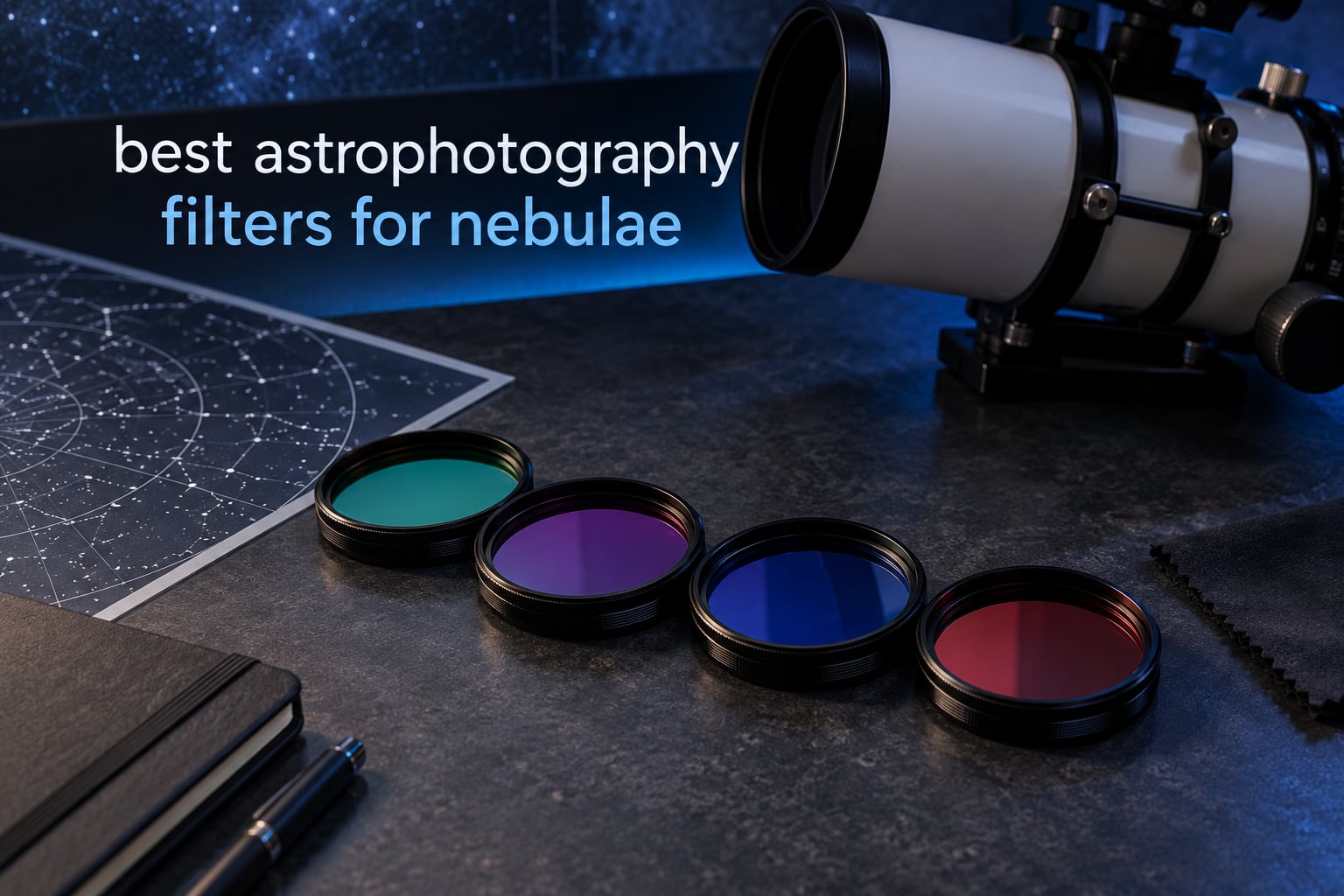
If you shoot with a one-shot colour camera, the best astrophotography filters for nebulae are H-alpha/OIII dual-band filters, and if you shoot mono, a matched 3nm SHO set. Everything else on the market is either a broader version of that idea or a visual filter that gets recommended in the wrong context.
We put nine filters through their paces to separate the ones that earn a place in an imaging train from the ones that only look good through an eyepiece. The list runs from a 2-inch 7nm dual-band built for colour CMOS cameras down to two 1.25-inch UHC filters whose main value is at the eyepiece and on the guide scope.
One clarification matters more than any product on this page. A UHC or O-III filter sold in 1.25 inches is mostly a visual observing accessory, and it is regularly confused with a photographic narrowband filter. Cloudy Nights regulars put it plainly: for nebulae you want a filter that passes O-III alone, or O-III with H-Beta, and that is a different product from a broadband UHC.
The nebula filters below are the ones we would actually put on a camera in 2026, ordered by how much they change your final image rather than by specification sheet.
Table of Contents
- Top 3 Best Astrophotography Filters for Nebulae (October 2026)
- Best Astrophotography Filters for Nebulae In 2026
- 1. SVBONY SV220 7nm Dual-Band Filter: the Best All-Round Nebula Filter Here
- 2. Optolong L-Extreme 7nm: Best-Rated Filter in the Group for Colour Nebulae
- 3. Optolong L-Enhance: Best Nebula Filter for Fast Telescopes
- 4. Optolong L-Pro: Best Filter for Star Colour and Reflection Nebulae
- 5. Astromania 2 Inch O-III: Best Single-Line Filter for Planetary Nebulae
- 6. SVBONY SV240: Best Single Filter Covering Both Nebulae and Galaxies
- 7. SVBONY 1.25 Inch UHC: Best Budget Filter for Visual Work and Guiding
- 8. Celestron 1.25 Inch Oxygen III: Best Option with Warranty Support Behind It
- 9. Astromania 1.25 Inch UHC: Best Budget Nebula Filter for Suburban Observing
- Buying Guide: How to Pick a Nebula Filter
- Frequently Asked Questions
- Final Verdict: Nebula Filters in 2026
Top 3 Best Astrophotography Filters for Nebulae (October 2026)

SVBONY SV220 7nm Dual-Band
- 7nm H-Alpha and O-III bands
- Over 94% peak transmission
- 2 inch M48 thread

Optolong L-Extreme 7nm
- Dual 7nm H-Alpha and O-III
- Made for one-shot colour cameras
- Works under moonlight

Optolong L-Enhance
- Dual narrowband H-Alpha and H-Beta/O-III
- Tolerates f/2 focal ratios
- 2 inch M48 thread
Best Astrophotography Filters for Nebulae In 2026
| Product | Specifications | Action |
|---|---|---|
| SVBONY SV220 7nm Dual-Band Nebula Filter |
|
Check Latest Price |
| Optolong L-Extreme 7nm Dual Narrowband |
|
Check Latest Price |
| Optolong L-Enhance Dual Narrowband |
|
Check Latest Price |
 Optolong L-Pro Light Pollution Filter Optolong L-Pro Light Pollution Filter |
|
Check Latest Price |
 Astromania 2 Inch O-III Narrowband Astromania 2 Inch O-III Narrowband |
|
Check Latest Price |
 SVBONY SV240 Multi-Narrowband SVBONY SV240 Multi-Narrowband |
|
Check Latest Price |
 SVBONY 1.25 Inch UHC Filter SVBONY 1.25 Inch UHC Filter |
|
Check Latest Price |
 Celestron 1.25 Inch Oxygen III Filter Celestron 1.25 Inch Oxygen III Filter |
|
Check Latest Price |
 Astromania 1.25 Inch UHC Filter Astromania 1.25 Inch UHC Filter |
|
Check Latest Price |
1. SVBONY SV220 7nm Dual-Band Filter: the Best All-Round Nebula Filter Here
SVBONY SV220 Telescope Filter, 2″ 7nm Dual-Band Nebula Filter for Deep Sky
7nm H-Alpha 656.3nm and O-III 500.7nm
Over 94% peak transmission
2 inch M48 thread
Anodized aluminium frame
Pros
- Over 94% transmission keeps sub-exposure times reasonable for a dual-band filter
- Effectively suppresses skyglow from city skies and moonlight
- Reduces post-processing effort on one-shot colour cameras
- Anodized aluminium frame with waterproof optical glass
Cons
- Imaging only with no visual use
- Needs optics slower than f/4 or the band shift costs you signal
- 7nm passband still lengthens exposures versus no filter
The SV220 is the filter we reach for first when someone asks for one purchase that handles emission nebulae from a bright backyard. It passes hydrogen-alpha at 656.3nm and oxygen-III at 500.7nm through a 7nm window each, and the stated peak transmission above 94% is why it does not feel punishing to expose.
In practice that combination means skyglow from streetlights and a bright Moon is mostly rejected while the two lines nebulae emit strongly in still land. Reviewers shooting from urban skies report less gradient correction work afterwards, which is where dual-band filters earn their cost back.
The framing is worth being clear about. It is listed for colour CMOS, CCD and digital cameras, and the manufacturer states it cannot be used on smart telescopes or on optical systems faster than f/4, because a fast beam shifts the band off the emission line.
At 30g in an anodized aluminium frame with an M48x0.75 thread, it pairs cleanly with off-the-shelf 2-inch filter wheels and drawtubes. Just budget for the extra sub time a 7nm filter demands compared with no filter at all.
Where the SV220 earns its place
Owners shooting emission nebulae from city and suburban skies get the biggest win, because the two-pass design needs no filter changes between channels and no channel combination in processing. If you use a stock DSLR or a cooled OSC and want a single-lens answer to light pollution, this is it.
It also handles a bright Moon without losing the target, which matters for anyone who cannot wait for a new Moon to start a project.
Where the SV220 will disappoint
Fast Newtonians and RASA-class instruments are out. The stated f/4 floor is not a guideline, it is the point at which band shift starts eating your hydrogen-alpha signal, and IceInspace users chasing similar behaviour on f/2 rigs report narrow bands dropping out almost entirely.
It is also not a visual filter. If you wanted one filter for the eyepiece and the camera, this is the wrong tool and the wrong size.
2. Optolong L-Extreme 7nm: Best-Rated Filter in the Group for Colour Nebulae
Optolong L-Extreme 7nm Dual Narrowband Filter (H-Alpha and O-III) (2″)
Dual 7nm H-Alpha and O-III
Optimised for one-shot colour cameras
2 inch thread
Imaging only
Pros
- Highest rated filter in this group at 4.9 with almost all five-star reviews
- Colour emission nebulae without combining multiple filters
- Handles bright light pollution and moonlight
- Made specifically for one-shot colour cameras
Cons
- 7nm band needs optics slower than roughly f/4
- Longer integration times than broadband dual-band filters
- Imaging only with no visual use
The L-Extreme carries the highest average rating in this roundup at 4.9, with a review base where 95% of buyers gave five stars and nobody reported one or two stars. It is the same 7nm H-alpha plus O-III concept as the SV220, aimed squarely at colour cameras.
What owners keep coming back to is simplicity. Because it passes both nebula lines in a single exposure, a one-shot colour user never has to build a colour-composite from separate H-alpha and O-III frames, which is the step that puts most beginners off narrowband imaging entirely.
The optical caveat repeats across those reviews. A 7nm band shifts blue on fast systems, so the filter suits moderate aperture refractors and f/5 to f/8 Newtonians rather than wide-field rigs running faster than f/4.
Its stated maximum shutter speed of 30 seconds is a digital-camera guideline for correct exposure calibration, and the 2-inch thread suits standard drawtubes and filter wheels. If your rig is slow enough, this is the pick we would hand to a colour imager who wants a clean result with minimal processing.
Reasons to choose the L-Extreme
Suburban and moonlit sessions with a one-shot colour camera are where it shines, and reviewers describe emission nebulae coming out in colour from skies that would otherwise show nothing but gradient. No filter combination is needed, so a single clear night still produces usable data.
It is also a safe second pair of hands if you already own something similar and want a matching 2-inch filter that shares the same thread.
Reasons to look elsewhere
The review count is the smallest in our group at 52, so you are trusting a thin data set compared with the hundreds behind the 1.25-inch UHC filters below. The optical restriction on fast telescopes is identical to the SV220, and that is a hard limit rather than a preference.
If your optical train is faster than f/4, neither this filter nor the SV220 is the right instrument. Look at the broader Optolong options further down this list.
3. Optolong L-Enhance: Best Nebula Filter for Fast Telescopes
Optolong 2″ L-Enhance Dual Narrowband Light Pollution Filter (H-Alpha and H-Beta/O-III)
Dual narrowband H-Alpha and H-Beta/O-III
Handles f/2 ratios
2 inch M48x0.75
Plastic cell
Pros
- Bandpass wide enough for fast optics such as an f/2 refractor
- Reviewers image NGC 7000 from Bortle 8-9 backyards
- Works with unmodified DSLRs and cooled OSC cameras
- Better star control than a broadband UHC filter
Cons
- Blocks a lot of light so sub times lengthen
- Priced higher than the entry dual-band options
- Can leave blue halos with achromatic refractors
The L-Enhance solves the exact problem that pushes people off dual-band filters. Its bandpass is described as wide enough to tolerate fast ratios such as f/2 refractors and RASA-style telescopes, where a 7nm filter loses most of its hydrogen-alpha signal to band shift.
That wider window also means more light overall, so sub-exposure times stay manageable. Several owners use it for Bahtinov mask focusing on a stock DSLR, which would be impossible with a narrow filter that transmits almost nothing in white light.
Its H-Beta/O-III band is worth flagging because it is not a pure O-III line. On a mono or OSC camera that extra H-Beta sensitivity changes the colour balance toward a cooler result than a strict oxygen-III filter would give, and it helps pull detail out of targets like M27 and the Veil.
The cell is plastic rather than machined aluminium, which is the visible difference from Optolong’s higher-end filters. The 2-inch M48x0.75 thread is standard, and it is built for DSLR, colour CMOS and CCD cameras rather than eyepieces.
Who this filter suits
Fast optical systems are the whole case for it. If you shoot with an f/2 telescope and a dual-band filter, this is the one most likely to still deliver signal at the emission line.
It also suits OSC shooters who want more contrast than a broadband filter gives but have not yet committed to a mono camera and filter wheel.
Who should skip it
Galaxies with strong broadband or reflection components are the wrong target, and reviewers make the same point on AstroBin forum threads where people warn that light pollution filters cut natural yellow light out of galaxies. Reviewers also flag blue halos around stars with achromatic refractors.
It blocks a lot of light, so compared with the L-Pro further down this list your sub times grow even though the contrast improves. And several reviewers name the cost as the main drawback.
4. Optolong L-Pro: Best Filter for Star Colour and Reflection Nebulae
Optolong 2″ L-Pro Light Pollution Filter
Multi-bandpass light pollution filter
About 90% transmission at nebula lines
Sharp roll-off at pollutant lines
CNC aluminium cell
Pros
- Sharp roll-off cuts skyglow while keeping nebula signal
- Higher transmission means shorter integrations than narrow dual-band
- Black anodised CNC cell suppresses internal reflections
- Works on fast wide-field optics and colour CMOS
Cons
- Strong green cast on one-shot colour images
- Not a visual filter
- Bright stars still bloom because there is no narrowband star suppression
The L-Pro takes a different approach to the same problem. Instead of two narrow windows, it uses a multi-bandpass design with a sharp roll-off at light pollutant emission lines and roughly 90% transmission at the major nebula lines.
That wider approach keeps star colours, which narrow dual-band filters throw away, and it tolerates fast focal ratios where narrow options band shift. Reviewers pair it with an OSC camera and report that the green cast needs colour correction in processing, and some pair it with a UV/IR cut alongside.
For anyone who wants a dark sky background without losing the palette, this is the balanced option in Optolong’s line, sitting between the broad and very narrow ends of the range. The CNC machined cell in black anodised aerospace grade aluminium is there to kill internal reflections, which show up as veiling glare otherwise.
At 2 inches with a 48mm M48 thread, it drops into the same drawtube as the dual-band filters above. The wide bandpass also means integration times stay shorter, which is a real saving on an OSC camera in a Bortle 7 to 9 sky.
Where the L-Pro is the right call
Targets with reflection components are the answer. Galaxies, star clusters and reflection nebulae such as the Pleiades all lose their natural colour under a dual-band filter, and this one keeps enough broadband signal to render them properly.
Fast optics are the other case. Several users pair it with wide-field refractors where the broader transmission means no band shift to fight.
Where the L-Pro falls short
It is not a narrowband filter, so bright stars still bloom and the sky background will never be as black as it goes with a true dual-band. If your priority is maximum contrast on an emission nebula from a bright site, a dual-band filter beats it.
The green cast on colour images is real and reviewers mention it consistently, and it is imaging only rather than a visual filter.
5. Astromania 2 Inch O-III: Best Single-Line Filter for Planetary Nebulae
Astromania O-III Filter 2 Inch Telescope Filter Narrowband Nebula Filters
Passes 496-501nm oxygen lines at about 95%
Blocks the rest of the visible spectrum
2 inch thread
Individually inspected and inscribed
Pros
- Strong contrast on the Veil and Dumbbell planetary nebulae
- About 95% transmission through both oxygen lines
- Each filter is individually inspected and laser-inscribed
- Reported as good value against premium narrowband equivalents
Cons
- Does nothing for hydrogen-dominant targets like M42
- Cuts roughly a stop of light so exposure time doubles
- Passes near-infrared light so mono rigs may need an IR-cut filter
When you want one line isolated rather than two, this is the filter in our group built to do it. It passes the doubly-ionised oxygen lines between 496nm and 501nm at approximately 95% and blocks virtually everything else in the visible spectrum.
Experienced observers describe the Veil Nebula in particular as transformed through it, and the Dumbbell and Cat’s Eye come up repeatedly in reviews. Each unit is individually inspected and inscribed with the measured transmittance of the two oxygen lines, which is unusual care for a filter at this end of the market.
For imaging, users like the clean thread and supplied case, and it sits happily in a filter wheel. The catch is that a strictly oxygen-III line makes a strongly green image on a colour camera, and it cuts about a stop of light, so you are looking at roughly twice the exposure time.
Technical reviewers also note that it passes notable near-infrared light, which on a mono camera means an IR-cut filter is still needed. At 14.2g in a 2-inch glass cell with a standard 48mm thread, it fits standard 2-inch accessories.
Targets this filter serves best
Planetary nebulae and supernova remnants are the natural fits because oxygen-III emission dominates them. M27, the Dumbbell, the Ring and the Veil all respond strongly, and the high transmission keeps those faint objects reachable.
It also works as a visual filter in 2-inch form, which the dual-band imaging filters on this list cannot do at all.
Where it is the wrong choice
Hydrogen-dominant targets such as M42 and reflection nebulae get almost nothing from an oxygen-III line, so this filter simply blocks the signal you came for. One reviewer also documented serious star halo artefacts on a mono camera that made the filter unusable in a narrowband workflow.
If you shoot one-shot colour and want a finished image rather than a narrowband channel, doubling your exposure for a green frame is rarely the best use of a clear night.
6. SVBONY SV240: Best Single Filter Covering Both Nebulae and Galaxies
SVBONY SV240 Telescope Filter, 2″ Multi-Narrowband Galaxy Nebula Filter
H-Alpha O-III and H-Beta in one filter
Over 90% peak transmission
OD4 or greater cut-off
300-1100nm working range
Pros
- Covers three bands so no filter set is needed
- Reviewers report a contrast boost from Bortle 7-9 backyards
- Rated for Bortle 1 through Bortle 8 skies
- Near-infrared rejection targets urban light pollution
Cons
- Halos around stars on fast refractors
- One reviewer returned it over uncorrectable halos
- Multi-band design makes planets look dark and discoloured
The SV240 is the one-filter answer for people who cannot commit to a single filter type. It passes hydrogen-alpha, oxygen-III and H-beta in a single optical window with peak transmission above 90% and a cut-off depth of OD4 or better across a 300-1100nm working range.
Owners imaging from Bortle 7 and 8 sites report good contrast and colour without visible artefacts, and the near-infrared cut is aimed squarely at urban light pollution. Several describe it as the cheapest way to cover nebulae and galaxy targets in one-shot colour setups.
The most important warning in the reviews is about which optical tube you use. It suits reflectors far better than refractors: one user documented halos on a refractor that could not be corrected and sent the filter back, and the manufacturer flags the near-infrared halo risk itself.
Because it blocks yellow-orange as part of the multi-band design, planets render very dark and take on an unnatural colour. The rating of 4.3 across 39 reviews reflects that split between people who got the right optical tube and people who did not.
Where the SV240 makes sense
One filter covering nebulae and galaxies is genuinely useful for an OSC owner who does not want to buy a set. It also has the broadest rating claim of the group, specified for Bortle 1 through Bortle 8 skies.
Reviewers note it produces fewer star halos than some competing multi-band filters when paired with a reflector, which is where its contrast boost shows up most.
Where it is risky
Fast refractors are the problem case, and the halo reports are specific enough that we would not put it on one without checking. The 39-review base is also the thinnest here, so the reports come from a small group of owners rather than a wide sample.
It also blocks the yellow-orange light that makes planets look familiar, and the manufacturer itself rates it for Bortle 1 to 8, which is a narrower promise than the claims made for true dual-band filters.
7. SVBONY 1.25 Inch UHC: Best Budget Filter for Visual Work and Guiding
SVBONY Telescope Filter, 1.25″ UHC Filter Improve Contrast for Telescope
UHC light pollution filter
1.25 inch thread at 31.75mm
Optical glass in aluminium frame
40g
Pros
- Darkens the background and boosts contrast on emission nebulae
- Reviewers cite performance close to an Optolong UHC
- Does not cut infrared so it works as a guiding filter
- Solid threading reported across reviews
Cons
- Broad 50nm passband gives less contrast than narrowband filters
- Least effective against modern white LED street lighting
- Visual contrast gain is subtle at the eyepiece
This is the most-reviewed filter in our group by a wide margin, at 611 reviews and a 4.6 average, and the owner reports consistently describe a clear jump in contrast on the Veil, Orion, M27 and the Pleiades from suburban skies.
What it actually is, is a UHC filter that selectively reduces transmission of wavelengths produced by artificial light, in a 1.25-inch aluminium frame with optical glass and multi-coating. The 31.75mm thread drops straight onto standard eyepieces, and at 40g it adds nothing noticeable to the eyepiece train.
The detail that makes it more useful than a pure visual accessory is that it does not cut infrared response. That means it can sit in a filter wheel or in front of a guide scope without starving the guider’s camera of signal, which reviewers repeatedly point out.
Several owners use their UHC filters in a filter wheel for imaging, though it is worth being honest about what that gets you. A broad 50nm passband gives far less contrast than a dual-band or narrowband filter on an emission nebula.
Where it is worth buying
As a visual filter it does what a UHC is supposed to do, and Stargazers Lounge advice about spending on a decent one rather than a cheap clone applies here. Reviewers who compared it against an Optolong UHC found the performance close.
As a guiding filter it is one of the few filters here you can put in front of a guide scope without blocking the wavelengths the guiding camera relies on, and it comes with a one-year accessory warranty.
Where it is not enough
It is weakest against modern white LED street lighting, where sodium and mercury sources used to give this kind of filter an advantage. Several reviewers describe the visual gain as modest and some find it disappointing for broadband targets.
For imaging emission nebulae from a bright site, a dual-band filter on a colour camera will produce a much darker background than this one can.
8. Celestron 1.25 Inch Oxygen III: Best Option with Warranty Support Behind It
Celestron Oxygen III Narrowband Telescope Specialized Filter – 1.25″
Isolates 496nm and 501nm oxygen lines
Blocks the rest of the visible spectrum
StarBright XLT coating
1.25 inch thread
Pros
- Backed by a two-year limited warranty and US support
- Owners used it to find the Owl and Crab nebulae
- Dims background stars so faint nebulae stand out
- Reduces glare from a bright Moon
Cons
- Needs roughly an 8 inch aperture to deliver its potential
- Dims background stars heavily so centre targets first
- Supplied plastic packaging does not protect the filter
The Celestron Oxygen III is the pick here if support and warranty matter to you. It isolates the same two doubly-ionised oxygen lines at 496nm and 501nm as the Astromania above, blocks the remainder of the visible spectrum, and carries a two-year limited warranty with US-based support.
Owners report using it to find the Owl, Crab, Monkey Head and Cassiopeia nebulae that were invisible without it, and to see visible improvement in detail on the Veil and M42. It also cuts glare from a bright Moon, which reviewers mention as a bonus.
Aperture is the limiting factor here, and reviewers are unusually clear about it. The most enthusiastic accounts come from people running 8-inch-plus scopes, while several state plainly that smaller apertures gain little. If your telescope is a short-tube refractor, this filter will not transform much.
It also dims background stars substantially, so you need to centre a target before threading the filter in. A few buyers report performance close to an equivalent Baader filter, and one bought it expecting a general light pollution filter and found it disappointing for broadband targets.
When this is the right filter
Owners with larger apertures and a preference for a supported, warrantied product will get a satisfying visual result on oxygen-emitting targets. The StarBright XLT coating and the simple 31.75mm thread mean it fits any 1.25-inch focuser or eyepiece.
It is also the practical choice if you want to see a nebula before committing night hours to imaging it.
When it is the wrong filter
Aperture, mostly. Under about 8 inches the contrast gain is modest, and it is a visual filter rather than a narrowband imaging filter, so it will not sit in a mono imaging train and produce a clean narrowband channel.
The supplied plastic display packaging is the most common complaint, offering no real protection in the field, so buy a proper filter case alongside it.
9. Astromania 1.25 Inch UHC: Best Budget Nebula Filter for Suburban Observing
Astromania Telescope Filter 1.25 Inch UHC Filter Improve Contrast Nebula
1.25 inch UHC nebula filter
Blocks wavelengths from artificial lighting
Anti-reflection multi-coating
8.53g
Pros
- Contrast boost enough to reveal previously invisible nebulosity
- Optical glass with an aluminium frame that feels well made
- Fits a wide range of eyepieces and 1.25 inch focusers
- Comes with a protective clear case
Cons
- Broadband passband gives less contrast than narrowband filters
- Modest effect in brightly light-polluted suburban skies
Astromania’s UHC filter is the simplest option here and the one most people end up buying first. Reviewers use it on Orion, the Lagoon and the Swan nebulae from suburban and city skies and report the appearance of nebulosity they could not see before threading it in.
It is a 1.25-inch broadband UHC and light pollution reduction filter with premium anti-reflection multi-coating on optical glass, in an aluminium frame with a standard 31.75mm thread. At 8.53g it is light enough to leave in an eyepiece cap without thinking about it.
Compatibility is straightforward, since it works with refractors, reflectors and catadioptric telescopes that have 1.25-inch focusers. A protective clear case is included, which is more than several competing packages manage.
The 4.4 average across 156 reviews reflects a wider spread than the SVBONY UHC above, with more one and two-star reports. Those tend to describe a modest improvement rather than a disappointing filter, and a few mention only a small effect in bright suburban skies.
Why it makes the budget slot
For visual work from a suburban backyard, it does the job without the extra cost of a dual-band filter you cannot use through an eyepiece. Contrast is raised enough to reveal targets that were previously invisible, which is the whole point at this end of the market.
It also suits anyone building a kit slowly who wants one more item for the eyepiece case rather than a filter for a camera they have not bought yet.
Where it falls short
As an imaging filter it is modest. The broadband passband gives far less contrast on an emission nebula than any dual-band option above, and in bright suburban skies the effect is smaller still.
If your goal is a finished image of a nebula rather than seeing one, save your effort for a 2-inch dual-band filter built for colour CMOS cameras and put this one in the eyepiece instead.
Buying Guide: How to Pick a Nebula Filter
Start with your camera, not the filter catalogue. A one-shot colour camera needs one filter that passes everything you want in a single exposure, while a monochrome camera can afford a matched set and a filter wheel. Buying a dual-band filter for a mono setup wastes half of it.
If you are still choosing hardware, a tracking mount that actually tracks will bank you integration hours before any filter does. We covered camera options in our beginner astrophotography camera guide, and mount selection in our equatorial mount roundup.
3nm vs 7nm vs a broad bandpass
Narrower filters reject more light pollution and give darker skies, but they need slower optics. A 3nm band is the standard for mono narrowband work on f/4 to f/8 systems, 7nm is the sweet spot for colour CMOS cameras, and anything broader gives up sky background control in exchange for keeping star colours and working on fast telescopes.
The practical rule from forum consensus is straightforward: run anything faster than f/4 and a 7nm filter will band shift, so choose a wider filter such as the L-Enhance instead. At f/5 and slower, 7nm works well and 3nm becomes reasonable.
Filter size and vignetting
Size follows your sensor and focal ratio. A 1.25-inch thread suits eyepieces and small sensors, 2-inch covers most astro cameras, and unmounted 36mm or 50mm glass is the choice for large formats and fast optics.
At f/2 and faster, a small filter clips the corners of a wide field and vignettes badly, so check that your filter is wide enough for your sensor and beam. Undersized filters are the single most common sizing mistake people make.
One-shot colour or monochrome camera
Colour cameras want one dual-band filter, no filter wheel and no channel combination. Monochrome cameras want separate 3nm hydrogen-alpha, oxygen-III and sulfur-II filters, plus the discipline to blend them into SHO or keep HaRGB.
That trade is also a budget trade, and it is why we covered the whole gear chain, from guide scopes for astrophotography to tripods rated for heavy mounts, before adding optics to the train.
Which filter for which nebula type
Emission nebulae such as Orion, the California and the Veil respond to dual-band hydrogen-alpha and oxygen-III. Planetary nebulae want the oxygen-III line on its own. Reflection nebulae, galaxies and star clusters need broadband signal, and light pollution filters cut exactly the yellow-orange light that gives those targets their colour.
Our separate guide to light pollution filters for city astrophotography covers the broadband end of this in more detail.
Visual UHC and OIII filters vs photographic filters
A 1.25-inch UHC filter in an eyepiece thread is built to be looked through. A photographic narrowband filter is built to be measured, with a specified bandpass, a 2-inch M48 thread and a cell that fits a filter wheel. They cost similar amounts and do completely different jobs, which is where most beginner confusion starts.
Do filters beat more integration time?
Sometimes, and not always. A dual-band filter can cut the hours needed on a bright sky by a large margin because it rejects light you do not want, which makes it one of the highest-leverage purchases in an urban imaging setup.
On a genuinely dark site the maths works the other way: a filter adds sky brightness, costs you photons and adds time. If your tracking is already good, extra clear nights will improve an image faster than another filter will.
Frequently Asked Questions
What filter to use for nebula?
For a one-shot colour camera, use a hydrogen-alpha and oxygen-III dual-band filter in 2 inches. It passes both nebula emission lines in one exposure and blocks most skyglow, so emission nebulae are reachable from a suburban or city sky. For a monochrome camera, use separate 3nm hydrogen-alpha, oxygen-III and sulfur-II filters and blend them into an SHO or HaRGB image.
What are the best astrophotography filters for nebulae?
The best astrophotography filters for nebulae depend on your camera and focal ratio. Our top pick is a 7nm dual-band filter for one-shot colour cameras on optics slower than f/4. Fast telescopes need a wider dual-band filter, galaxies and reflection nebulae need a broadband light pollution filter, and mono imagers need a matched 3nm narrowband set.
What filter is best for imaging galaxies?
For galaxies, use a broadband light pollution filter rather than a dual-band or narrowband filter. Dual-band filters discard the yellow-orange light that carries much of a galaxy’s colour, so reflection nebulae and galaxies can come out flatter than an unfiltered image. A multi-bandpass filter with a sharp roll-off at pollutant lines keeps star colour while controlling gradients.
Is a 3nm filter better than a 7nm filter?
A 3nm filter gives a darker sky background and finer contrast than 7nm, but it transmits far less light and shifts badly on fast optics. It is the standard for monochrome narrowband work at f/4 and slower. On a one-shot colour camera, 7nm is usually the better compromise because the extra transmission shortens integration times.
What filter is best for viewing the moon?
No nebula filter helps with lunar viewing, because the Moon is broadband reflected sunlight rather than emission-line light. For visual lunar work use a neutral density filter or a colour filter matched to the telescope aperture. Narrowband filters like UHC and OIII are for emission nebulae, and putting one on the Moon simply dims and tints it.
Final Verdict: Nebula Filters in 2026
For most people shooting emission nebulae from a backyard in 2026, the SVBONY SV220 is the one filter that changes the outcome, because 94% transmission across the hydrogen-alpha and oxygen-III bands keeps your sub times workable while killing skyglow. On a colour camera under a bright Moon it does the job on its own, with no filter wheel and no channel combination.
Own a fast telescope? Pick the wider Optolong L-Enhance instead of any 7nm filter, and shoot mono? Look for a matched 3nm set rather than anything on this page. Want colour in galaxies and reflection nebulae? The L-Pro keeps it. The two 1.25-inch UHC filters here belong in an eyepiece, not on a camera.